
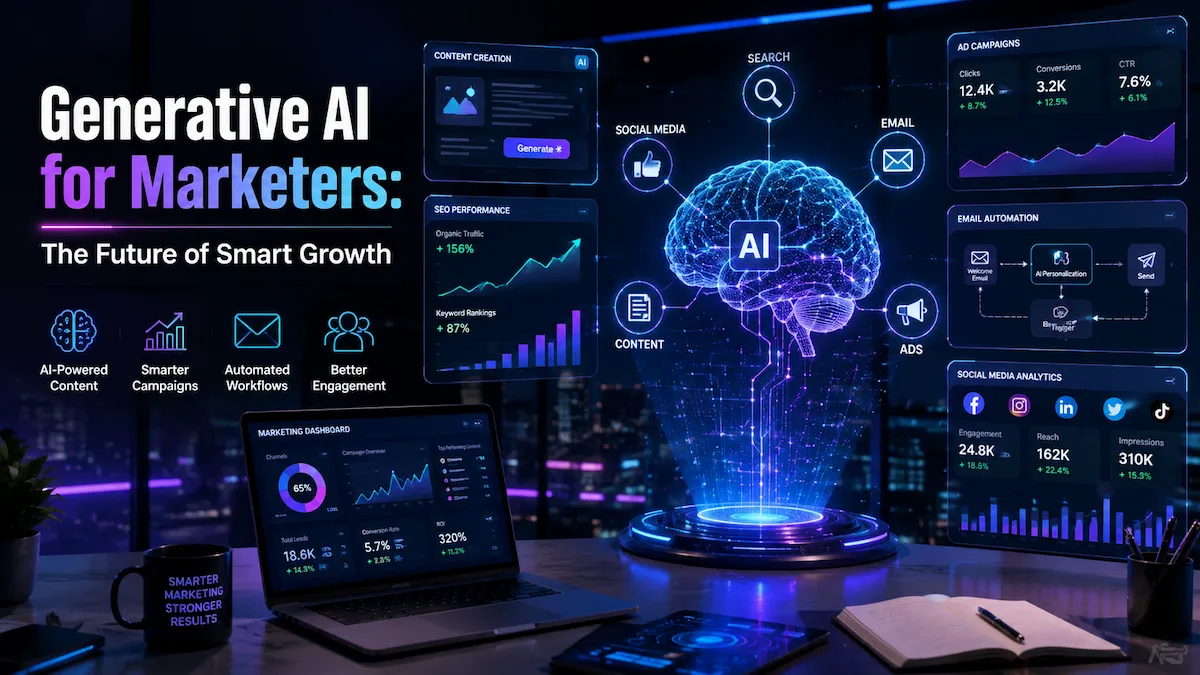
Quick Definition: Generative AI for marketers refers to AI systems—powered by large language models, image generators, and multimodal models—that create original text, images, video, and structured data from natural language instructions. Unlike rule-based automation, generative AI produces net-new content that adapts to context, audience, and brand requirements in real time.
If you’ve been waiting for generative AI to mature before committing to it, that window has already closed. The marketers pulling ahead right now aren’t the ones with the biggest budgets — they’re the ones who figured out how to build AI into their daily workflows without losing their brand identity or editorial standards in the process.
According to McKinsey’s State of AI research, marketing and sales saw the largest jump in generative AI adoption from 2023 to 2024—more than doubling in a single year. And HubSpot’s 2025 State of AI report found that 91% of marketing leaders say their teams are now using AI to assist in their jobs, while 67% believe AI will significantly transform how marketing gets done in 2025.
This guide is not a surface-level overview. It’s a practical system for digital marketers, content leads, SaaS growth teams, and agency strategists who want real answers—which use cases work, which tools are worth the subscription, how to measure ROI, and what mistakes to avoid before they cost you time and credibility.
What Is Generative AI for Marketers?
Generative AI is a category of artificial intelligence that produces original content—copy, images, video, code, and data—from natural language instructions called prompts. Unlike predictive analytics, which forecasts outcomes from existing data, generative AI creates something new from scratch.
Generative AI for marketers is rapidly becoming a core technology for content creation, campaign optimization, customer engagement, and scalable digital marketing operations.
For marketing teams, this matters because the bottleneck is almost never strategy. It’s execution. Writing enough emails. Testing enough ad variations. Producing enough blog content. Localizing enough landing pages. Generative AI attacks exactly that problem.
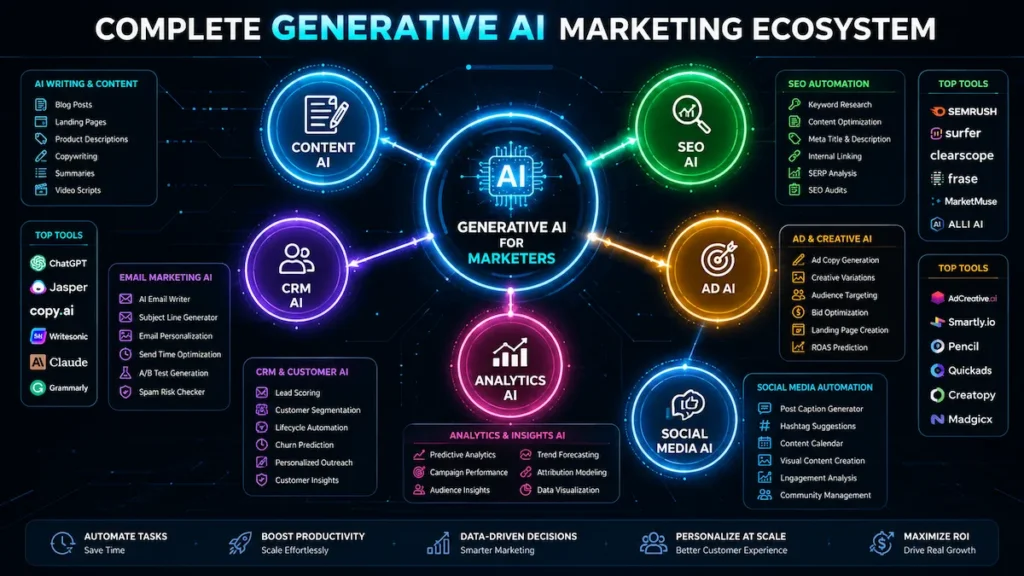
The technology at the core — large language models like GPT-4o, Claude, and Gemini — has been trained on enormous text datasets and can generate contextually accurate, stylistically consistent content across virtually any format a marketing team produces. It can also generate images (Midjourney, Adobe Firefly), video scripts, audio outlines, and structured data outputs—making it genuinely multimodal in a marketing context.
What generative AI can create for marketers:
- Long-form blog posts and SEO pillar content
- Email sequences and subject line variations
- Ad copy across search, social, and display channels
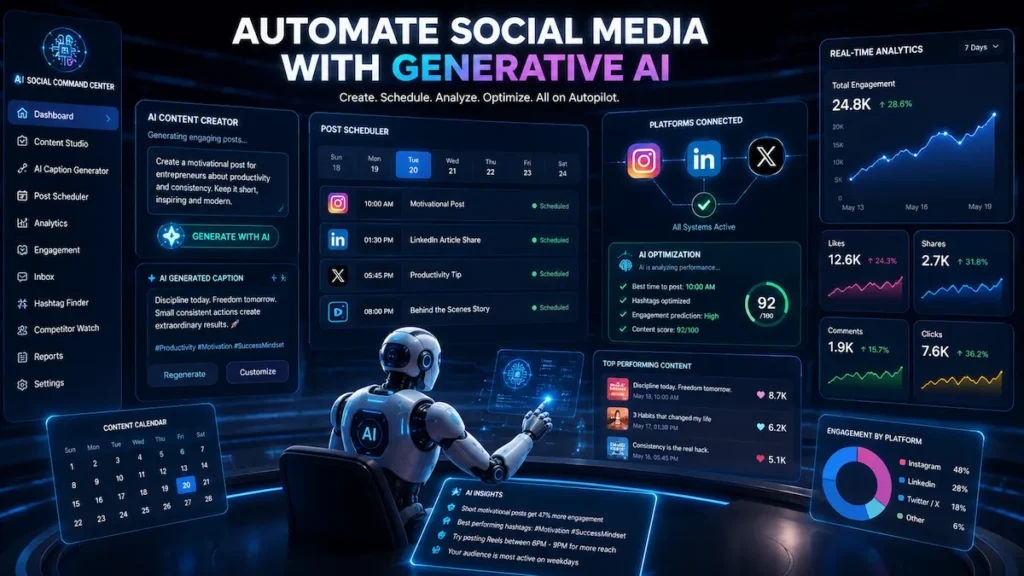
- Social media captions and content calendars
- Product descriptions at scale
- Video scripts and podcast outlines
- Meta titles, descriptions, and schema markup
- Customer-facing chatbot and FAQ responses
- Internal briefs, SOPs, and campaign planning documents
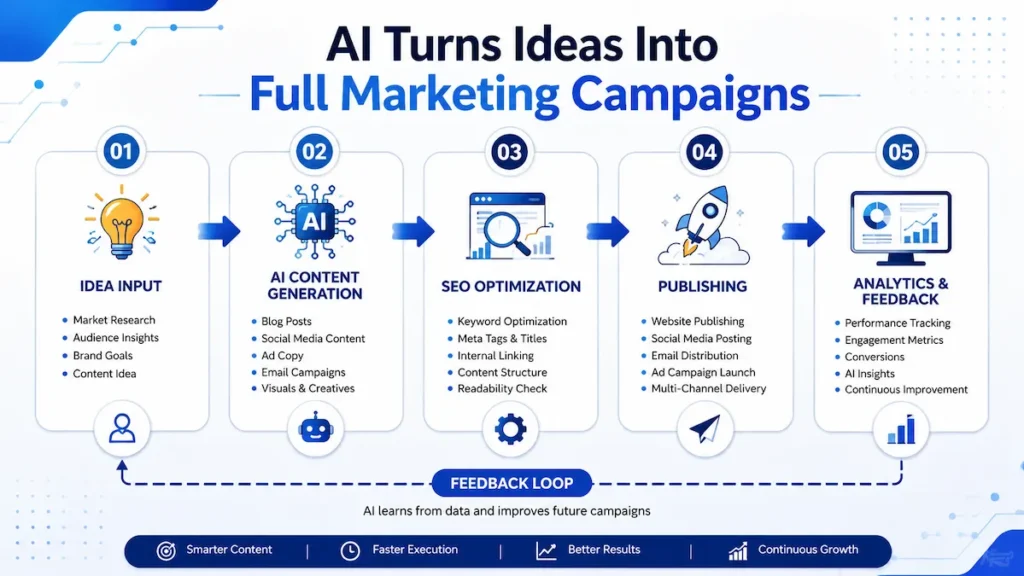
How Generative AI for Marketers Works
Understanding how generative AI for marketers works is essential for building efficient workflows that improve productivity without sacrificing quality or brand consistency.
At a practical level, you give the model a prompt — a written instruction — and it returns a generated output based on its training and any additional context you provide. The quality of the output is almost entirely a function of the quality of the input. This is why prompt engineering has become a core skill for marketing teams, not just a technical curiosity.
Here’s the workflow that produces consistently strong results:
Step 1 — Define the goal clearly What format are you creating? Who is the audience? What action should the content drive? What’s the word count and tone?
Step 2 — Build a context-rich prompt Include your brand voice descriptors, the target keyword, format requirements, audience details, and ideally one or two examples of existing content you’ve approved. Blank prompts produce generic outputs.
Step 3—Treat the first output as a working draft. Rarely should raw AI output be published without editing. If it reads like AI wrote it, it probably needs another round of prompting and human refinement.
Step 4 — Iterate with follow-up prompts Skilled AI users treat it as a dialogue—refine the tone, restructure an argument, make the opening stronger, and add a specific example. Chaining prompts on complex deliverables produces dramatically better results than a single prompt attempt.
Step 5 — Edit for brand voice, accuracy, and originality Verify every statistic. Add specific examples that only your team or your clients could provide. Inject the original insight that AI cannot fabricate on its own. This is the human layer that determines whether your content performs or disappears.
Pro Tip: The best marketing teams treat generative AI as a first-draft engine, not a finished content factory. Human editors remain essential—not just for quality, but for the EEAT signals (experience, expertise, authority, and trust) that Google’s ranking systems are specifically designed to reward.
The AI Marketing Acceleration Framework™
Most marketing teams adopt generative AI reactively — one tool here, one use case there — and end up with inconsistent results and no clear system. The teams seeing compounding gains follow a structured approach.
This framework provides a structured approach to implementing generative AI for marketers across content, advertising, analytics, and campaign management.
Here’s the framework that produces consistent results across content, performance, and growth marketing:
AUDIT → ALIGN → AUTOMATE → AUGMENT → ANALYZE
1. Audit map every content type your team produces. Identify the three most time-consuming tasks that involve writing, ideation, or repetitive formatting. These are your starting points, not your entire roadmap.
2. Align Before using any AI tool, build your brand context document — tone of voice, audience personas, approved messaging, key differentiators, and writing examples. This gets embedded into every prompt your team uses.
3. Automate Identify the tasks where AI can handle first-draft creation reliably: blog drafts, email sequences, social repurposing, ad copy variations, and product descriptions. Build repeatable prompt templates for each.
4. Augment Use AI to amplify strategic work — competitive analysis, content briefing, keyword research synthesis, audience segmentation ideas, and campaign angle development. AI here is a thinking partner, not a content factory.
5. Analyze and measure what the AI-assisted content is actually doing—traffic, engagement, conversions, and time saved. Quarterly reporting against pre-AI baselines is the only way to know whether your investment is compounding.
This framework works regardless of team size. A solo content marketer can apply it as effectively as an agency running 50 client accounts.
The Numbers Behind the Shift
The growing adoption of generative AI for marketers is supported by substantial productivity, efficiency, and revenue-focused research from leading organizations.
The case for adopting generative AI in marketing isn’t theoretical. The data tells a clear story:
- McKinsey estimates generative AI could unlock $0.8 trillion to $1.2 trillion in incremental productivity across sales and marketing functions on top of gains already achieved from traditional AI.
- According to McKinsey’s 2025 research, 71% of organizations now regularly use generative AI in at least one business function — up from 65% in early 2024.
- HubSpot’s research shows content creation is the top AI use case for marketers (35%), followed by data analysis (30%) and workflow automation (20%).
- A Gartner survey found that early adopters of generative AI report an average 22.6% productivity improvement and 15.2% cost reduction.
- HubSpot’s 2026 State of Marketing Report found that 61% of marketers believe AI represents marketing’s biggest disruption in 20 years.
These aren’t projections from 2022. They’re outcomes being measured by real marketing teams right now.
12 High-Impact Use Cases of Generative AI for Marketers
These practical examples demonstrate how generative AI for marketers can improve execution speed, content quality, and campaign performance.
1. Long-Form Blog Content and SEO Articles
One of the most popular applications of generative AI for marketers is creating SEO-focused content at scale.
Use AI to generate comprehensive first drafts based on a target keyword, content brief, and audience profile. The model handles structure, semantic coverage, and internal linking suggestions—your team adds original research, expert quotes, and strategic depth.
Real-world example: A B2B SaaS content team we reviewed was spending roughly four hours producing a single 1,500-word blog post — from brief to published draft. After implementing a structured AI workflow (prompt template → AI draft → editor review → fact-check → publish), that timeline dropped to under 90 minutes per post. The team reallocated the saved time to original research and expert interviews, which improved content quality and backlink acquisition simultaneously.
2. Email Sequences and Drip Campaigns
Generative AI for marketers helps teams develop personalized email campaigns much faster than traditional workflows.
Input your audience segment, buyer stage, desired action, and any behavioral triggers. AI generates full email sequences — subject lines, preview text, body copy, and CTAs — in a fraction of the time manual writing requires. A/B variant creation that used to take days now takes an afternoon.
3. Ad Copy Generation and Variation Testing
Performance teams increasingly use generative AI for marketers to produce and test large volumes of advertising variations.
Generate dozens of headline and description variants for Google Search, Meta, LinkedIn, and display campaigns. Use AI to brainstorm angle variations simultaneously—pain-focused, outcome-focused, social proof-driven, and curiosity-gap—then run structured tests across audience segments before scaling spend.
Real-world example: A performance marketing agency managing mid-market e-commerce accounts used AI to generate 40 ad copy variants across three audience segments in a single session. Previously, the copywriter produced 8–10 variants per campaign. The expanded test volume improved click-through rates by identifying winning angles 60% faster than the previous manual process.
4. Social Media Repurposing at Scale
Social content repurposing is one of the highest-return use cases of generative AI for marketers.
A single well-researched blog post or research report contains enough material to generate 10–15 unique social posts across LinkedIn, Instagram, X, and short-form video scripts. AI handles the reformatting — your brand voice guidelines keep it consistent. This is one of the highest-leverage use cases for content-heavy marketing teams.
If you’re wondering how AI is reshaping the role of social media managers, the answer isn’t replacement—it’s significant workflow transformation. Managers who adapt gain capacity; those who don’t lose competitive ground.
5. Landing Page Copy and Conversion Assets
Input your offer, target audience, competitive positioning, and primary objections. AI generates a full landing page structure — headline, subheadline, feature-benefit sections, social proof framing, FAQ copy, and CTA — ready for editorial review and design. Useful for rapid iteration during campaign testing phases.
6. Product Descriptions at Scale
For e-commerce teams or SaaS product marketers managing large catalogs, AI can generate consistent, on-brand product descriptions by the hundreds — a task that previously required months of copywriter time. Feed it your product specs, positioning framework, and tone guide, and the output requires minimal editing.
7. SEO Content and Topical Authority Building
Producing enough content to build topical authority around a keyword cluster takes time that most teams don’t have. AI can generate well-structured drafts for supporting cluster articles, FAQ sections, and schema-ready content faster than any human team working unassisted. Pair this with a clear topical authority strategy, and the compounding effect on organic traffic is significant. For an honest look at how AI is affecting SEO jobs and workflows, the shift is more nuanced than most headlines suggest.
8. Personalized Outreach and ABM Campaigns
Personalized account-based marketing has become more scalable through generative AI for marketers.
Sales-led marketing teams use AI to personalize cold emails, LinkedIn messages, and outreach sequences at scale—pulling in company-specific context and pain points to create messages that don’t read like mail merge output. For ABM campaigns where personalization is the entire point, AI makes one-to-one messaging economically viable at a 1,000-account scale.
9. AI-Assisted Advertising Strategies
Generative AI for marketers supports campaign planning by generating audience insights and creative concepts.
Performance marketers running paid campaigns use generative AI not just to write copy but to generate campaign strategy frameworks, audience hypothesis documents, and creative briefs. For a deeper look at how AI is changing advertising strategy, the shift from manual creative development to AI-assisted iteration is redefining what a performance team can produce.
10. Email Marketing Workflows
AI is transforming email marketing beyond subject line testing. Full campaign sequences, behavioral trigger emails, re-engagement flows, and post-purchase journeys can all be drafted at AI speed and refined by human editors. The question most email marketers should be asking isn’t whether to use AI—it’s how to structure the workflow so quality doesn’t drop as volume scales. The broader conversation about AI’s impact on email marketing roles is worth understanding before you build your team structure around it.
11. Content Repurposing and Multi-Format Expansion
Content expansion remains one of the most cost-effective applications of generative AI for marketers.
Take a 45-minute webinar transcript and turn it into a blog post, three LinkedIn articles, an email sequence, a YouTube script, and a downloadable guide — all in a single AI-assisted workflow. This type of multi-format expansion used to require a content team of five. AI-enabled teams of two can now execute the same output volume.
12. Competitive Analysis and Positioning Work
Use AI to analyze competitor messaging by pasting in competitor landing pages, ad copy, or blog content, then ask it to identify patterns, surface positioning gaps, and generate differentiated angles for your own brand. Combine it with your team’s market knowledge, and the output quality jumps significantly.
Generative AI vs. Traditional Marketing Automation
This distinction matters for how you plan your stack and set team expectations. Comparing generative AI for marketers with traditional automation reveals how modern AI tools complement existing marketing technology stacks.
| Dimension | Traditional Marketing Automation | Generative AI |
|---|---|---|
| What it does | Executes pre-defined rules and sequences | Creates original content from prompts |
| Flexibility | Rule-based; limited to what was programmed | Adaptive; responds to context dynamically |
| Content output | Selects from pre-written templates | Generates net-new content on demand |
| Personalization | Segment-level (defined personas) | Individual-level (contextual generation) |
| Setup requirement | Workflow design and trigger logic | Prompt engineering and editorial review |
| Best for | Nurture sequences, triggered campaigns, CRM workflows | First drafts, copy variation, creative ideation |
| Human oversight needed | Low (once configured) | High (quality control essential) |
| Examples | HubSpot Workflows, Marketo, Klaviyo | ChatGPT, Claude, Jasper, Copy.ai |
The most effective marketing stacks in 2025 use both—automation handles the sequencing and delivery logic, and generative AI handles the content creation and variation. They’re complementary, not competing.
Best Generative AI Tools for Marketers
Choosing the right platform is critical because different generative AI for marketers’ tools excel in different marketing functions. Not every AI tool is built for every marketing use case. Here’s an honest assessment:
| Tool | Best For | Strengths | Limitations |
|---|---|---|---|
| ChatGPT / GPT-4o | General content, strategy, research | Highly flexible, wide use case coverage | Generic output without strong context in prompt |
| Claude (Anthropic) | Long-form content, nuanced brand voice | Excellent for tone, complex reasoning, long documents | Fewer native marketing workflow integrations |
| Jasper AI | Marketing-specific content at scale | Marketing templates, brand voice training, team collaboration | Expensive at scale, output still needs editing |
| Copy.ai | Short-form copy, emails, social posts | Fast iteration, workflow builder | Less capable for complex or long-form content |
| HubSpot Breeze AI | CRM-native marketing content | Seamless CRM context, native workflow integration | Limited to HubSpot ecosystem |
| Adobe Firefly | AI image generation for marketing | Commercially licensed, brand-safe visuals | Not a text generation tool |
| Surfer SEO / Semrush AI | SEO-assisted content optimization | Content scoring, keyword density guidance | Narrower scope; not a full content creation solution |
| Canva AI | Social graphics and presentations | Easy for non-designers, good brand kit integration | Limited advanced customization |
Expert Note: Platform lock-in is a real risk. Start by identifying which part of your content process is the biggest bottleneck, then choose the tool that solves that specific problem. Trying to consolidate your entire marketing stack into a single AI platform from day one almost always produces underwhelming results.
Understanding the broader benefits of AI across digital marketing channels helps put individual tool decisions in the right strategic context.
Real Examples of Generative AI in Marketing
These examples illustrate how generative AI for marketers is producing measurable business results across multiple industries.
SaaS Marketing Team — Content at Scale A Series B SaaS company with a three-person content team used AI to expand from 4 blog posts per month to 14,140 while keeping the same headcount. Each post follows a human-AI-human workflow: a strategist writes the brief and keyword brief (human), AI generates a first draft (AI), and a senior editor refines, fact-checks, and adds original insight (human). Organic traffic grew 43% over six months. The editorial quality actually improved because writers spent less time on structure and more time on depth.
E-commerce Brand — Ad Copy Testing A direct-to-consumer apparel brand used AI to generate 50 Facebook and Instagram ad copy variants across five audience segments in two days — a task that previously took three weeks with a freelance copywriter. The increased variant volume reduced their cost-per-acquisition by 28% over 60 days by identifying high-performing angles faster.
B2B Agency — Client Content Delivery A marketing agency serving mid-market B2B clients used AI to create first drafts for client blog content, cutting per-post production time from 5 hours to 1.5 hours. The time savings allowed them to add two new content clients without hiring. Net margin on content services improved by 31%.
Startup Marketing — Doing More With Less An early-stage startup with a single marketing hire used AI to build and maintain a full content engine — weekly blog posts, a monthly email newsletter, LinkedIn content, and paid ad copy — that would previously have required a team of three. The founder described it as “the equivalent of hiring a full content department for the cost of two SaaS subscriptions.”
Measuring ROI from Generative AI in Marketing
Tracking ROI is essential for proving that generative AI for marketers contributes directly to business growth.
One of the most underserved questions in generative AI coverage is this one: how do you actually know if it’s working? Here’s a practical measurement framework:
| KPI | Before AI Adoption | After AI Adoption (Target) | How to Measure |
|---|---|---|---|
| Blog posts published/month | Baseline | +50–150% | CMS publishing data |
| Time-to-publish (avg. per post) | Baseline hours | -40–70% | Time tracking tool |
| Email sequences created/month | Baseline | +80–200% | Email platform data |
| Ad copy variants per campaign | Baseline | +200–400% | Campaign manager |
| Cost per content asset | Baseline | -30–60% | Budget + output ratio |
| Team hours on content creation | Baseline | -30–50% | Time tracking tool |
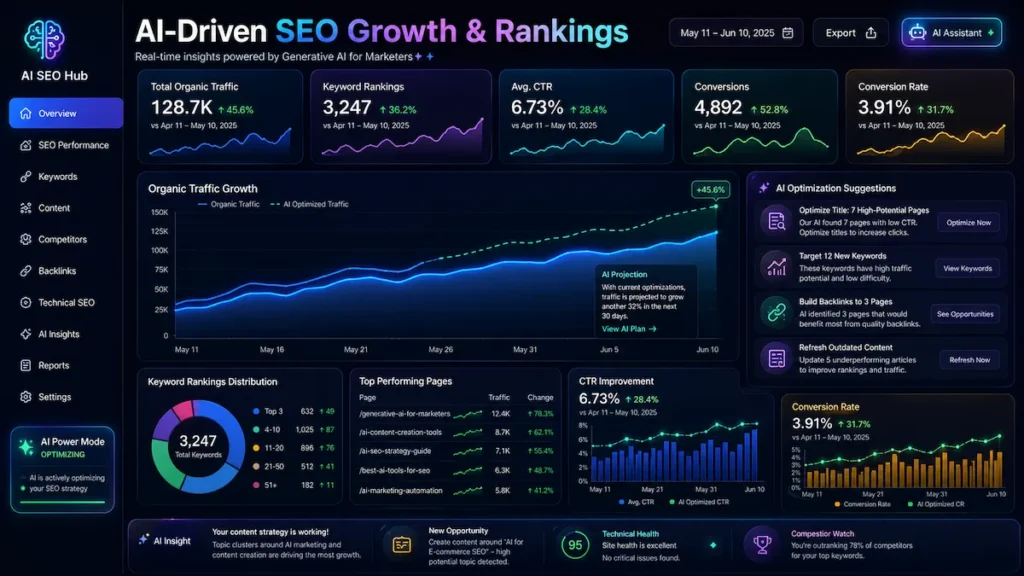
| Organic traffic (6-month) | Baseline | +20–60% | Google Analytics |
| Conversion rate (email/landing) | Baseline | The measure varies | CRM / Analytics |
How to use this table: Run a 4-week AI pilot on a single content type. Record baseline metrics before you start. Measure the same metrics at the end of the pilot. The delta is your ROI data—use it to make the business case for broader adoption before scaling.
Less than one in five organizations currently track KPIs for their generative AI initiatives, according to McKinsey’s 2025 research. That’s why so many teams feel uncertain about whether AI is working — not because it isn’t, but because they haven’t defined what “working” looks like. Define your KPIs before you launch, not after.
How to Implement Generative AI for Marketers: Step-by-Step
Organizations that follow a structured implementation process typically achieve better outcomes from generative AI for marketers’ initiatives.
Phase 1 — Audit Your Workflow (Week 1–2) Map every content type your team produces monthly. Flag the three that consume the most time relative to strategic value. Start there.
Phase 2 — Build Your Brand Context Document (Week 2–3) Assemble a reusable context block: tone of voice descriptors, key audience profiles, approved messaging pillars, words to use and avoid, and 3–5 examples of your best existing content. This gets embedded at the top of every important prompt your team sends.
Phase 3 — Build a Prompt Library (Week 3–4) Create a shared repository of tested, approved prompts organized by content type — blog draft prompt, email subject line prompt, ad copy prompt, social repurposing prompt, and so on. Treat this library as a living document that improves with team use.
Phase 4 — Run a Structured Pilot (Week 4–6) Test AI on one content type only. Measure: output quality, editing time required, team satisfaction, and the downstream performance of that content. Adjust your prompts based on results before expanding.
Phase 5 — Define Editorial Standards and Governance (Before Scaling) Establish clear team guidelines: What percentage of AI output can be published without editorial review? Who is responsible for quality sign-off? What content categories require human-only writing (legal content, sensitive topics, thought leadership under an executive’s name)? Document this before volume scales.
Phase 6 — Measure, Report, and Iterate (Quarterly) Track your pre-defined KPIs monthly. Review the framework quarterly. The teams seeing compounding results are the ones that treat AI adoption as an ongoing optimization process, not a one-time implementation.
Common Mistakes Marketers Make with Generative AI
Understanding these common mistakes can help organizations maximize the value of generative AI for marketers while avoiding costly errors.
Publishing raw AI output without editing. The quality gap between edited and unedited AI content is significant. Raw output frequently contains generic phrasing, structural padding, and occasionally hallucinated statistics. Always edit.
Using AI without brand context. A blank prompt into an AI model produces generic content. Every prompt needs your brand voice guide, audience context, content goal, and ideally approved examples.
Over-relying on AI for strategy. AI is excellent at execution and ideation support. It is not a replacement for market insight, competitive intelligence from primary research, or the strategic judgment your clients and leadership are paying for.
Neglecting prompt iteration. The first output is rarely the best output. Treat prompting as an iterative dialogue—refine, redirect, add constraints, and build on each response before moving to the next stage.
Skipping governance before scaling. The most common mistake. Teams that scale AI volume without editorial standards damage brand consistency and, over time, EEAT signals. Build the quality gate before you build the volume.
Challenges and Risks of Generative AI in Marketing
Hallucinations and factual inaccuracy. LLMs generate plausible-sounding content — which sometimes means generating plausible-sounding falsehoods. Every statistic, citation, or specific claim produced by AI must be independently verified before publication.
Brand voice drift. Without embedded context and editorial oversight, AI output gradually drifts from your established brand personality. This is especially damaging at scale when dozens of pieces are being produced per month.
EEAT and content quality risks. Google’s Search Quality Evaluator Guidelines prioritize experience, expertise, authoritativeness, and trust. Mass-produced AI content with no original insight, no real-world examples, and no human expertise embedded in it performs poorly against these standards—not because it was AI-generated but because it’s low quality.
Data privacy and IP considerations. Review the data handling policy of every AI tool your team uses. Many tools use input data to improve their models by default. Proprietary research, unreleased campaign strategies, and customer PII should not be entered into AI tools without a clear data processing agreement in place.
Competitive saturation. As every marketing team adopts generative AI, the baseline quality bar for AI-assisted content rises. Differentiation increasingly comes from the human layer — unique original insight, proprietary data, expert perspective, and genuine audience understanding.
Across digital marketing, this trend is reshaping job functions at every level. Whether you’re looking at PPC management, content writing, or the broader question of digital marketing as a career path, the answer is consistently the same: humans who use AI well outcompete both humans who don’t use AI and AI used without strong human judgment.
Expert Strategies for Marketing Teams Using Generative AI
These expert recommendations can help teams unlock the full potential of generative AI for marketers while maintaining quality standards.
Strategy 1: Build a Context Document for Every Major Prompt Before generating any piece of content, assemble a context block: brand voice guide, target persona, competitive positioning, content goal, and approved messaging. Paste this as the opening of every prompt. The quality improvement is consistent and immediate.
Strategy 2: Use AI for Infinite Variation in Paid Media Generate 30+ headline variants per campaign, then run structured tests across audience segments before scaling spend. The faster you identify winning angles, the lower your cost-per-acquisition. This is where performance marketers see the most immediate, measurable gains.
Strategy 3: Train AI on Your Best Work Feed 3–5 examples of your best-performing content into every prompt with the instruction to write in a similar style. On enterprise platforms, use brand voice training features to encode this systematically. The output quality when AI has strong examples is significantly better than when it operates from generic training data alone.
Strategy 4: Use the Human-AI-Human Workflow A human defines the strategy and provides context → AI generates the first draft → a human editor refines, fact-checks, and adds original insight. This is the structure that preserves quality while capturing efficiency gains. Don’t shortcut either human step.
Strategy 5: Build AI Into Your Brief Process Content briefs are high-value but time-consuming. Use AI to generate first-draft briefs from a keyword, audience definition, and content goal, then have a strategist refine and approve. A process that used to take 45–60 minutes per brief now takes 15–20—with no quality drop when the strategist adds their judgment.
The Future of Generative AI for Marketers
Agentic AI workflows. AI agents that can autonomously plan, execute, and iterate on marketing tasks — not just generate a piece of content but run a full campaign workflow — are already in early deployment. Expect this to become standard infrastructure in major marketing platforms by 2026.
Multimodal content generation. The gap between text, image, audio, and video generation is narrowing rapidly. Marketing teams will generate complete creative assets—video ads, podcast episodes, and interactive content—from a single prompt-driven workflow.
Individual-level personalization. True one-to-one marketing personalization is now technically achievable. AI can generate unique email content, landing page variants, and product recommendations for individual customers in real time—not segments.
AI-native platform consolidation. Tools like HubSpot, Salesforce, and Adobe are embedding generative AI deeply into their core platforms. The standalone AI writing tool category will consolidate. AI becomes infrastructure.
Regulatory and disclosure requirements. Expect formal guidelines around AI content disclosure, particularly in regulated industries and paid advertising contexts. Building transparent AI content practices now—disclosures, editorial policies, and documentation—is a competitive advantage as compliance becomes mandatory.
FAQs: Generative AI for Marketers
The following questions address some of the most common concerns about implementing generative AI for marketers effectively.
Q1: Is AI-generated content penalized by Google?
Google evaluates content quality, not production method. According to Google’s guidance on AI content, content that demonstrates genuine EEAT signals—original insight, expertise, and trustworthy sourcing—is not penalized for being AI-assisted. Mass-produced, unedited AI content with no original value typically performs poorly for the same reason low-quality human-written content does: it fails to meet user needs.
Q2: What’s the difference between generative AI and marketing automation?
Traditional marketing automation executes predefined rules and sequences—if X behavior, trigger Y email. Generative AI creates original content from context. The two are increasingly converging: platforms like HubSpot and Salesforce now combine both in the same workflow.
Q3: How do I maintain brand voice consistency when using AI at scale?
Build a detailed brand voice guide and embed it into every prompt. Include tone descriptors, words to use and avoid, sentence structure preferences, and 3–5 examples of approved content. On enterprise platforms, use brand voice training to encode this systematically.
Q4: What’s the best AI tool for a marketing team just getting started?
ChatGPT (GPT-4o) is the most versatile entry point—flexible, capable, and low-barrier to start with. Once you’ve identified your primary use case, evaluate specialized tools like Jasper or HubSpot Breeze AI for more structured marketing workflows.
Q5: How do I measure ROI from generative AI in marketing?
Use the KPI framework in this article. Measure content production velocity, time-to-publish, team hours reallocated from production to strategy, and downstream content performance. Compare against tool subscription costs. Run a 4-week pilot with clear baseline data before drawing conclusions.
Q6: Can AI replace marketing copywriters?
Not in a meaningful sense, but it fundamentally changes what copywriters spend their time on. Writers who adapt to AI-assisted workflows become significantly more productive. The demand is increasingly for writers who can prompt effectively, edit AI output with expert judgment, and add the original insight and experience that AI cannot generate.
Q7: What types of content should NOT be AI-generated without strong human oversight?
Legal and compliance-sensitive content, thought leadership published under a named executive, content requiring original primary research, sensitive or crisis communications, and any content in highly regulated industries (healthcare, finance, and legal) should have rigorous human review regardless of whether AI was used in drafting.
Q8: How long does it take to see results from implementing generative AI?
Efficiency gains are typically visible within 4–6 weeks of a structured pilot. Content performance improvements—organic traffic growth and improved lead generation—take 3–6 months to materialize in organic channels and should be tracked against pre-AI baselines.
Q9: What is prompt engineering, and does my marketing team need to learn it?
Prompt engineering is the practice of crafting precise, context-rich instructions to get better AI outputs. Yes, your team needs this skill. Even a basic understanding of how to structure prompts with brand context, audience detail, and format requirements dramatically improves output quality. It is the highest-leverage skill investment for any AI-enabled marketing team right now.
Q10: How do data privacy concerns affect marketing teams using AI tools?
Review each tool’s data usage policy carefully before use. Many tools use input data to train their models by default. Use API access or enterprise agreements with formal data processing agreements (DPAs) for any sensitive inputs. Avoid entering customer PII, unreleased strategy documents, or proprietary research into consumer-tier AI tools.
Conclusion
Generative AI for marketers isn’t a future possibility — it’s a current operational reality that is widening the gap between teams that have built it into their workflows and those still running evaluations.
The pattern among teams seeing real results is consistent: they started with a specific workflow problem, implemented AI as a structured tool rather than a shortcut, maintained editorial standards at every step, and measured outcomes against clear baselines. The AI Marketing Acceleration Framework — Audit, Align, Automate, Augment, Analyze — gives any marketing team a repeatable path to those same results.
The technology keeps improving. The prompt library you build today becomes more powerful with every model upgrade. The workflows you establish now compound over time.
The question isn’t whether generative AI belongs in your marketing strategy in 2025. It’s how quickly you build the systems to use it well—before the competitive gap becomes permanent.