
Will AI Replace SEO Jobs in 2026? Here’s What Every Professional Needs to Know
Will AI replace SEO jobs in 2026? This is the question keeping digital marketers, agency owners, and SEO students up at night — and for good reason. AI has moved from a novelty to a core component of everyday SEO workflows. Tools built on machine learning are automating tasks that once required hours of skilled human effort, and the pace of change is only accelerating.
The fear is real. But so is the nuance.
Quick Answer: Will AI Replace SEO Jobs? AI will not fully replace SEO jobs, but it will automate repetitive tasks like keyword research, basic reporting, and entry-level content creation. Strategic, creative, and technical SEO roles remain in strong demand — and in many cases, command higher salaries than ever.
If your entire SEO skill set can be automated, it already is. Based on agency-level SEO workflow data from 2025, AI-assisted SEO processes can reduce content production time by up to 60% while maintaining equivalent ranking performance — a shift that is already restructuring how agencies hire and operate. The honest answer to whether AI will replace SEO jobs depends entirely on which role you hold and how you are developing your skills. This article breaks down exactly where AI is replacing human SEO work, where it is not, and what professionals must do to stay ahead.
Will AI Replace SEO Jobs Through Automation? How AI Is Changing SEO
To understand whether AI will replace SEO jobs, you first need to understand what AI is actually doing inside real SEO workflows today — not hypothetically, but right now in 2026.
AI-powered keyword research has become remarkably sophisticated. Platforms like Ahrefs and SEMrush use machine learning to surface keyword clusters, identify topical gaps, and map search intent at scale. Work that once took a specialist several days can now be drafted in under an hour. AI does not just find keywords — it groups them by semantic similarity and recommends content angles automatically.
AI content generation is the most visible shift in the industry. Tools built on large language models like ChatGPT can generate SEO-optimized first drafts, meta descriptions, FAQs, and product descriptions in seconds. Agencies are using these workflows to dramatically increase content output without proportionally growing their teams. Most competitive shops have already moved to an AI-first draft, human-edited production model.
Automated SEO analysis is another area where machine learning is pulling real weight. Screaming Frog integrates AI-assisted recommendations directly into technical audits. Surfer SEO scores pages against hundreds of semantic signals automatically. Google’s own algorithm, powered by systems like BERT and MUM, now rewards content that genuinely serves user intent rather than content engineered around keyword density.
The bottom line: AI in SEO is not a future concern. It is actively reshaping how teams operate in 2026. In our detailed breakdown of the AI impact on digital marketing careers, we cover how these shifts affect professionals across every marketing function.
Will AI Replace SEO Jobs Role by Role? Specific SEO Roles Threatened by AI
The question of whether AI will replace SEO jobs is best answered at the role level. Not every position carries the same automation risk, and understanding the difference is critical for career planning.
Keyword Research Specialists — Will AI Replace SEO Jobs in Keyword Analysis?
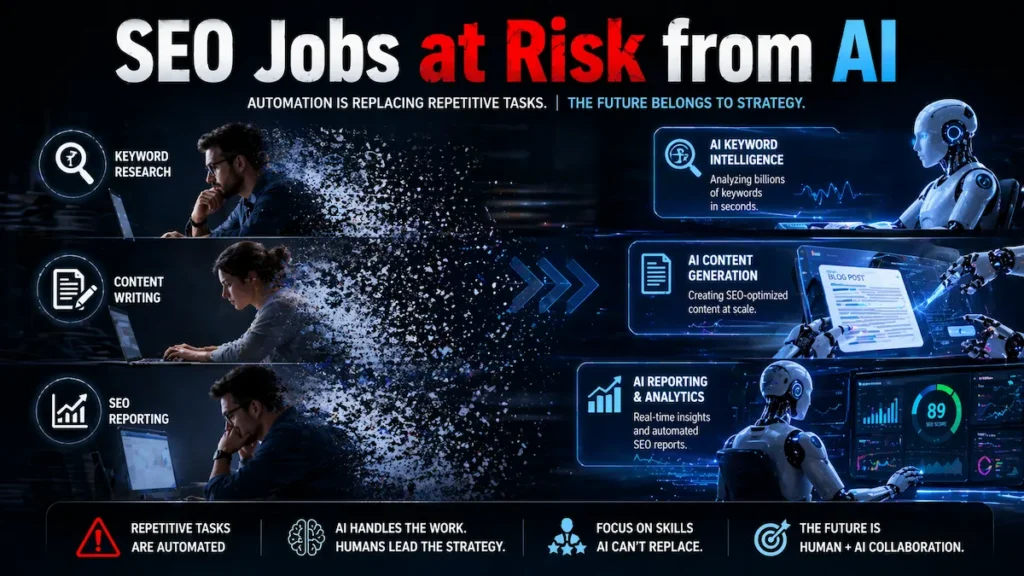
This is one of the highest-risk roles when evaluating whether AI will replace SEO jobs. Traditional keyword research — pulling search volumes, filtering by difficulty, organizing targets into spreadsheets — is almost entirely automatable today.
SEMrush’s Keyword Magic Tool, Ahrefs’ Keywords Explorer, and AI-powered platforms like Clearscope and MarketMuse can analyze millions of search queries, identify intent clusters, and recommend content priorities faster than any human analyst. Standalone keyword research roles with no attached strategic function are increasingly difficult to justify on a modern marketing team. Based on agency-level SEO workflow data from 2025, one documented team cut keyword research time by over 60% using AI tools alone — directly reducing the number of junior research positions on staff.
Basic Content Writers — Will AI Replace SEO Jobs in Entry-Level Writing?
Entry-level SEO writing — blog posts targeting a keyword list, product descriptions, category page copy — is under significant AI pressure. Services built on GPT-4 class models can produce structured, SEO-optimized first drafts at a fraction of the time and cost of a human writer.
The result is an industry-wide shift to leaner writing teams producing higher output volumes. Writers who only produce average, template-style content face real job risk from AI replacing SEO jobs at the execution layer. Writers who bring editorial judgment, original research, brand voice precision, and strategic thinking remain in strong demand.
SEO Reporting Analysts — Will AI Replace SEO Jobs in Performance Reporting?
If your primary professional value is pulling data and building weekly performance reports, AI automation tools are making that role structurally redundant. Google Looker Studio, platforms like AgencyAnalytics, and AI-driven reporting tools generate performance summaries, surface anomalies, and highlight trend insights with minimal human configuration.
The question of whether AI will replace SEO jobs in reporting is largely already answered for routine, scheduled work. Analysts who only deliver data — without interpretation, strategic framing, or client communication — face a shrinking market for their skills.
Junior Technical SEO Tasks — Will AI Replace SEO Jobs in Technical Auditing?
Routine technical SEO work is increasingly automated. Tools like Screaming Frog, Sitebulb, and DeepCrawl automatically identify broken links, missing meta tags, duplicate content, crawl errors, and page speed problems. Schema markup generators now produce structured data without any manual coding knowledge required.
These tasks once justified junior technical SEO roles at most agencies. Today, a single experienced specialist using modern tooling can handle the audit workload of a three-person junior team — a compression that is reshaping hiring decisions at agencies of every size.
Will AI Replace SEO Jobs Completely? SEO Roles AI Cannot Replace
Understanding whether AI will replace SEO jobs also means recognizing where human expertise remains firmly irreplaceable — and that list is considerably longer than most fear-driven headlines suggest.
SEO strategists who set direction, prioritize initiatives, manage stakeholders, and connect search performance to business outcomes are not at risk. Strategy requires contextual judgment, organizational awareness, and the ability to navigate ambiguous real-world constraints. AI has no equivalent capability.
Brand SEO consultants who understand a client’s voice, competitive positioning, and long-term audience psychology are equally secure. Aligning SEO work to brand strategy requires deep business understanding that no current AI tool possesses.
Content strategists who develop content architecture, editorial frameworks, and audience-first content systems are in a strong position. AI can execute content at scale. It cannot originate a meaningful content strategy rooted in genuine business goals and audience insight.
Technical SEO architects who design crawl-efficient site structures, manage JavaScript SEO complexity, oversee international deployments, and resolve novel indexation issues require expert-level judgment that goes far beyond automated audit outputs.
Our full analysis of whether AI is replacing digital marketers covers which hybrid roles are growing fastest right now and where the real opportunities are emerging.
Will AI Replace SEO Jobs or Just Change Them? A Reality Check
This is the question that gets lost in most AI coverage. The more accurate framing is not replacement — it is compression.
AI is compressing the execution layer of SEO. Tasks that once required three junior staff members can now be handled by one mid-level professional using AI tools effectively. But the strategy layer — the thinking, positioning, and decision-making above that execution — has not been compressed. If anything, it has grown more valuable precisely because execution has become cheaper and faster.
There is a compelling counterargument worth taking seriously: AI may actually increase demand for senior SEO roles by eliminating the junior pipeline that previously fed into them. As automation handles routine work, organizations need fewer but more skilled professionals — people who can direct AI workflows, interpret outputs critically, and own strategic outcomes end-to-end. That is a fundamentally different market dynamic than simple replacement, and it benefits experienced practitioners significantly.
The SEO professionals who struggle will be those who built their careers entirely on execution tasks. The ones who thrive will treat AI as infrastructure — the same way a senior developer treats a compiler. It is a productivity layer, not a competitor.
Will AI Replace SEO Jobs Across All Capabilities? AI vs Human SEO Compared
| Capability | AI Strength | Human Strength |
|---|---|---|
| Keyword research at scale | Excellent | Good |
| Content drafting speed | Very fast and scalable | Slower but nuanced and precise |
| Technical site audits | Thorough and automated | Interpretive and contextual |
| SEO strategy development | Weak | Strong |
| Deep search intent analysis | Pattern-based | Contextual and psychological |
| Client communication | None | Essential |
| Adapting to algorithm changes | Reactive | Proactive and analytical |
| Brand voice and tone precision | Inconsistent | Precise |
| Creative content direction | Limited | Strong |
| Crisis SEO management | None | Critical |
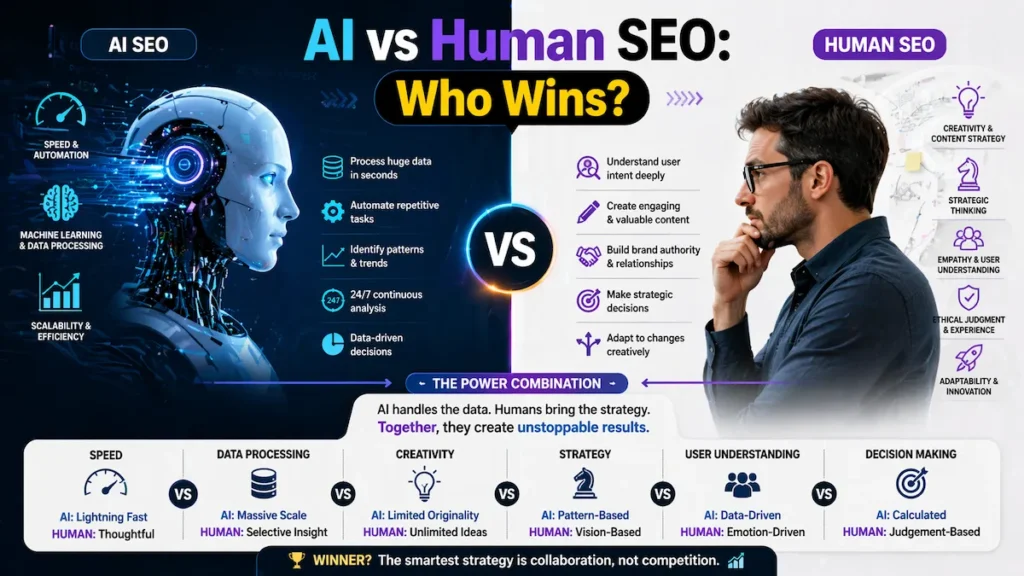
The pattern is consistent across every capability area. AI performs best on repeatable, data-heavy tasks with clear inputs and predictable outputs. Humans retain the decisive advantage in judgment, strategy, creative direction, and relationship management. The future of SEO careers is not AI versus humans — it is professionals who use AI effectively versus those who do not.
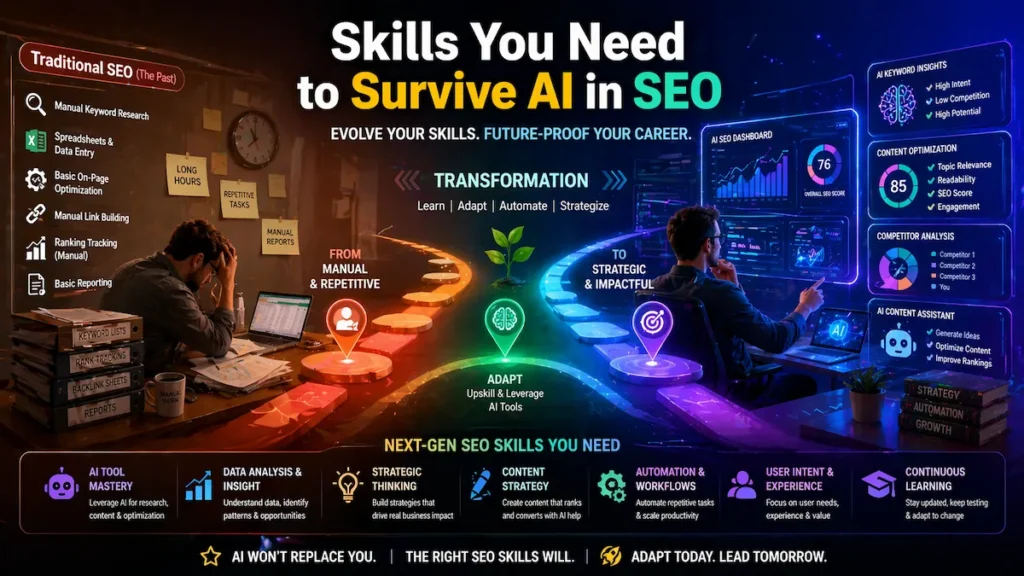
Will AI Replace SEO Jobs for Those Who Fail to Adapt? Skills SEO Professionals Need Now
Whether AI will replace SEO jobs ultimately depends on how individual professionals evolve. The skill gap between AI-fluent and AI-resistant SEO professionals is widening every quarter in 2026.
AI prompt engineering is no longer optional for serious SEO work. Knowing how to structure effective prompts for ChatGPT, Gemini, or Claude directly improves the quality and speed of your output across keyword research, content drafting, and competitive analysis. Professionals who can direct AI tools precisely produce measurably more value in less time.
Data interpretation remains a distinctly human skill commanding growing premium value. Pulling data from Google Search Console or Ahrefs is easy — any tool can do it. Understanding what the data means, why a trend is occurring, and what the business should do about it requires analytical judgment that automation cannot replicate.
Advanced SEO strategy — competitive analysis, content gap identification tied to business objectives, prioritization under resource constraints — is where senior professionals create value AI simply cannot deliver. Strategy is the highest-leverage skill in modern SEO and the most resistant to automation.
Search intent analysis at a meaningful depth requires understanding user psychology, not just keyword patterns. Experienced strategists read the SERP, identify what Google is rewarding, and resolve intent mismatches that automated tools flag but cannot fix.
UX SEO — the intersection of user experience design, Core Web Vitals, and organic performance — requires both technical and design literacy. As Google increasingly weights engagement signals in ranking decisions, professionals who understand how UX drives search performance are particularly valuable.
Will AI Replace SEO Jobs in the Future of SEO Careers?
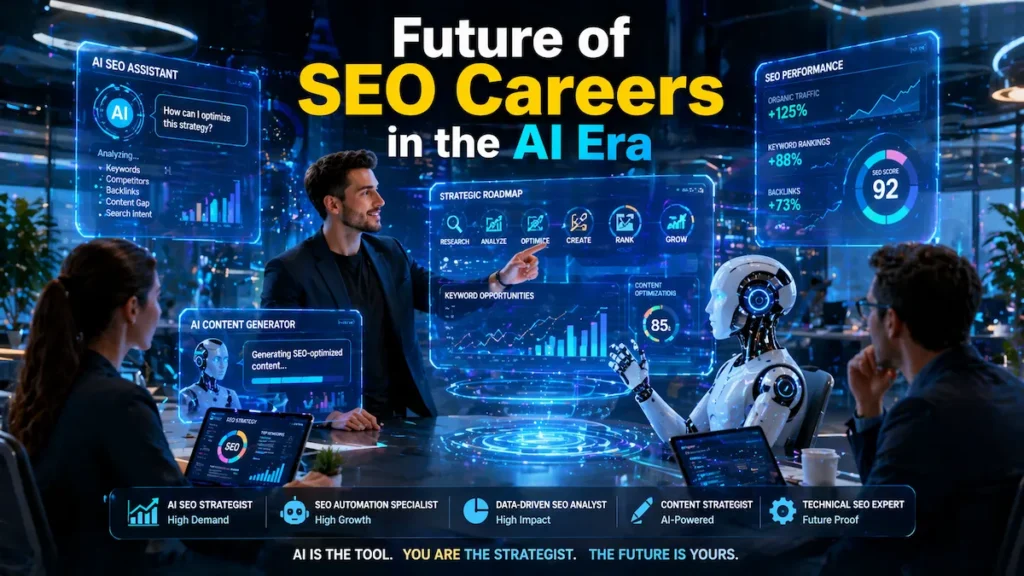
The future of SEO jobs is transformation, not elimination. Will AI replace SEO jobs entirely? No — but it will eliminate roles that fail to adapt, and it is already creating entirely new roles that did not exist two years ago.
The most probable near-term development is AI-human collaboration becoming the default workflow at every competitive agency and in-house team. Senior strategists using AI tools will multiply their output, reducing demand for large junior teams performing routine execution while increasing the premium on high-judgment senior work.
New SEO roles are already emerging around AI content oversight, prompt strategy development, automated workflow management, and AI-assisted competitive intelligence. These roles barely existed in 2023. They are standard positions on forward-thinking teams in 2026 and will be industry-wide within three to five years.
Automation-driven marketing teams will define competitive agencies going forward. Teams with robust AI-assisted research, content production, and reporting workflows will outcompete fully manual operations on cost, content velocity, and analytical depth simultaneously.
For a complete picture of where the profession is heading, our guide on the future of digital marketing with AI covers every major structural shift shaping marketing careers right now.
Will AI Replace SEO Jobs — Pros and Cons of AI in the SEO Industry
| Aspect | Benefits | Risks |
|---|---|---|
| Productivity | Dramatically faster task completion | Reduced headcount for routine roles |
| Content quality | Scalable, fast first drafts | Generic output without strong human editing |
| Keyword research | Instant large-scale clustering and intent mapping | Over-reliance on pattern matching over judgment |
| Reporting | Automated dashboards save significant weekly hours | Loss of junior analyst development pipeline |
| Technical SEO | Faster audits with fewer missed issues | False confidence without senior human review |
| Career growth | New AI-specialist and hybrid roles emerging | Skill gaps widen rapidly for non-adapters |
| Agency economics | Lower operational cost per deliverable | Pricing pressure on execution-focused services |
Frequently Asked Questions About Will AI Replace SEO Jobs
Will AI replace SEO jobs completely?
No. AI will automate specific tasks and reduce demand for entry-level execution roles, but SEO as a discipline requires strategy, creativity, and human judgment that current AI tools cannot replicate. The profession will evolve significantly — it will not disappear. Organizations competing in serious SERPs will always need skilled human professionals directing strategy and interpreting outcomes.
Which SEO roles are safest from AI?
SEO strategists, technical SEO architects, content strategists, and brand SEO consultants face the lowest automation risk. These roles require complex judgment, stakeholder management, and creative direction that AI tools do not currently possess.
Is SEO still a good career in 2026?
Yes. SEO remains a strong career choice, particularly for professionals developing AI-complementary skills. Demand for senior SEO talent is high, salaries for strategic roles are increasing, and the compression of junior execution roles is creating faster pathways to senior positions for those who invest in the right capabilities early.
How should SEO professionals adapt to AI?
Invest in strategic and analytical skills. Learn AI prompt engineering as a practical daily workflow tool. Build stronger data interpretation capabilities. Position yourself as an AI-empowered strategist rather than an execution specialist. The worst professional position in the current SEO landscape is staying static while every tool and workflow around you evolves.
What skills protect SEO careers from automation?
Strategic thinking, deep search intent analysis, client communication, technical SEO architecture, creative content direction, and translating data into defensible business decisions are the skills most resistant to AI automation. Developing expertise at the intersection of AI tool proficiency and human judgment is the single strongest career position available in 2026.
Conclusion: Will AI Replace SEO Jobs? The Expert Verdict
The question of whether AI will replace SEO jobs has a clear, evidence-based answer: partially, selectively, and already in progress. Routine keyword research, entry-level content writing, standard performance reporting, and junior technical SEO tasks are all under real and growing automation pressure. Professionals whose entire value proposition sits in these areas face genuine career risk and need to act now.
But the bigger picture is considerably more optimistic than most headlines suggest. AI is compressing the execution layer of SEO — not the strategy, judgment, and creativity that sit above it. Those capabilities remain firmly in human territory, and the market for them is strengthening as execution becomes cheaper and faster for everyone.
The professionals who thrive will be those who combine deep domain expertise with genuine AI fluency. They will not be replaced by AI. They will be the ones using AI to decisively outperform every competitor who is not.
The question is no longer whether AI will replace SEO jobs — it is who will be ready when it finishes reshaping them.