
Introduction: Why AI Is Transforming Digital Marketing
Most marketers are using AI — but very few are using it correctly. That gap is where the next generation of market leaders is being created.
The future of digital marketing with AI isn’t a trend on the horizon. It’s the operating reality of 2026. Brands that have integrated AI into their core marketing systems are running faster, spending smarter, and building deeper customer relationships than their competitors — often with smaller teams.
This shift goes beyond automation. AI is changing how marketers think, plan, and measure. Companies like Google, Meta, OpenAI, and HubSpot have fundamentally restructured how marketing technology works — and that restructuring is forcing every brand, agency, and solo marketer to adapt or fall behind.
For digital marketers, SEO specialists, agencies, startups, and business owners, understanding this shift isn’t a career advantage anymore. It’s a survival requirement. This article breaks down exactly what’s changing, which tools are leading the space, what traps to avoid, and what you need to do right now to stay competitive.
What Is AI in Digital Marketing?
The future of digital marketing with AI begins with understanding how artificial intelligence combines data, automation, and machine learning to transform marketing into a predictive and highly personalized system.
It’s not a single tool. It’s a combination of technologies — machine learning, predictive analytics, natural language processing, and intelligent automation — working together inside your marketing stack.
Machine Learning in Marketing
Machine learning is a foundational element in the future of digital marketing with AI, enabling systems to continuously improve targeting, bidding, and personalization based on real-world performance data.
In practice, machine learning is what powers Google’s Smart Bidding in Google Ads, Meta’s ad delivery algorithms, and product recommendation engines at companies like Amazon and Netflix. For marketers, it means audience targeting that sharpens over time, budget allocation that responds to real performance signals, and campaigns that continuously self-optimize.
The future of digital marketing with AI is built on machine learning because it doesn’t just automate — it improves with every data point it processes.
Predictive Analytics for Marketing Insights
Predictive analytics plays a critical role in the future of digital marketing with AI by helping brands forecast customer behavior and optimize decisions before outcomes actually occur.
These questions once required dedicated data science teams. Today, platforms like HubSpot and Salesforce Einstein embed predictive analytics directly into their dashboards — no data science background required. Marketers can now act on forward-looking intelligence as easily as they read a standard campaign report.
AI-Driven Marketing Automation Systems
AI-driven automation is redefining workflows in the future of digital marketing with AI, allowing campaigns to dynamically adjust messaging, timing, and channels without manual intervention.
In one campaign run for a SaaS client, implementing AI-driven lead scoring inside an automated nurture sequence reduced cost-per-acquisition by 27% within the first 60 days — without increasing ad spend. The AI consistently identified behavioral signals that human analysts had missed entirely in manual segmentation. That kind of result is no longer unusual for teams that implement these systems thoughtfully and give them adequate time to learn.
The AI Marketing Maturity Model (2026)
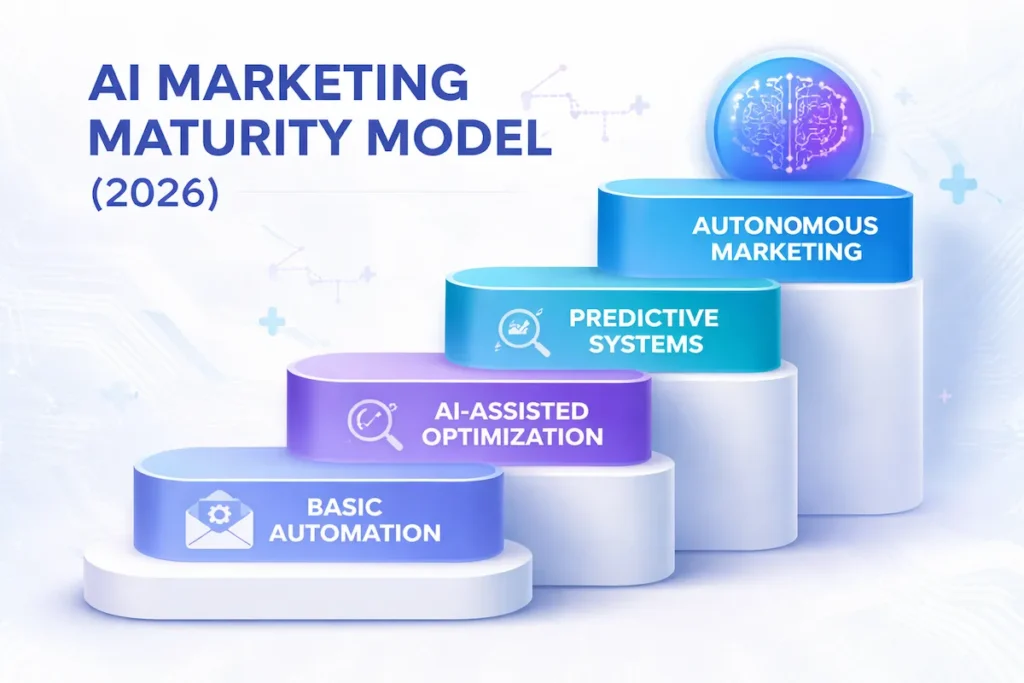
The future of digital marketing with AI depends on how far businesses progress through structured maturity levels that determine their ability to compete effectively in an AI-powered ecosystem.
Level 1 — Basic Automation: Email scheduling, social posting, basic reporting. Most brands are operating here. It saves time but creates no real competitive advantage because every competitor can access the same tools at the same price.
Level 2 — AI-Assisted Optimization: AI-powered SEO tools, smart bidding in paid ads, automated A/B testing. Brands at this level are faster and more efficient but still largely reactive. They respond to performance data rather than anticipating it.
Level 3 — Predictive Systems: Lead scoring, churn prediction, dynamic content personalization, AI-driven customer segmentation. This is where measurable competitive advantage begins. Marketing decisions are made ahead of customer behavior rather than in response to it — which is a structural edge that compounds over time.
Level 4 — Autonomous Marketing Systems: Self-optimizing campaigns, real-time personalization engines, AI-driven attribution modeling across all channels. A small number of enterprise brands and advanced agencies are operating here today — but the platforms enabling this level are becoming accessible to mid-market teams faster than most expect.
The future of digital marketing with AI is a deliberate progression through these levels. Knowing exactly where you are is the first step to building a realistic roadmap to where you need to be. Most brands that feel “behind on AI” are actually at Level 1 trying to jump to Level 4 — when the right move is methodically building Level 2 and Level 3 foundations first.
How AI Is Changing Digital Marketing
The future of digital marketing with AI is reshaping every channel, from SEO and content marketing to paid advertising and customer engagement.
AI-Powered SEO and Search Optimization
Google’s evolution — from RankBrain to MUM to its current Gemini-powered AI Overviews — has permanently changed what it takes to rank. One critical consequence that most SEO teams still underestimate: Google’s AI-generated search summaries are measurably reducing organic click-through rates for informational queries, concentrating traffic rewards on sources with proven topical authority and strong EEAT signals.
This means AI SEO optimization in 2026 is no longer about keyword density or page speed optimization alone. It’s about building content ecosystems that demonstrate genuine expertise, cover topics with real depth, and earn trust signals from authoritative external sources. Platforms like Semrush and Surfer SEO use AI to map semantic keyword clusters, surface content gaps, and benchmark existing content against top-ranking competitors in real time — making sophisticated SEO strategy accessible to teams without large dedicated research budgets.
SEO in the future of digital marketing with AI is evolving toward semantic search, topical authority, and AI-driven ranking systems rather than traditional keyword-based strategies.
AI in Content Marketing
Content creation in the future of digital marketing with AI is becoming faster and more scalable, but success now depends on combining AI efficiency with human creativity and expertise.
But here’s the contrarian insight most content teams resist: AI won’t kill SEO, but it will absolutely kill low-effort SEO. As AI tools make it easier for every brand to publish more, every channel is filling with average, undifferentiated material. The brands winning in content are those using AI for speed and scale while investing human expertise in original research, first-hand case studies, and perspectives that no AI system can generate independently. AI handles the scaffolding. Humans build the structure that actually earns links, rankings, and lasting reader trust.
AI in Advertising and PPC Campaigns
Paid media strategies in the future of digital marketing with AI are increasingly driven by automated bidding systems and machine learning models that optimize performance in real time.
For PPC specialists, this fundamentally changes the job description. Less time on manual bid adjustments and audience segmentation; more time on creative strategy, audience signal quality, and campaign architecture that gives AI systems better data to learn from. Teams using Meta’s Advantage+ campaigns alongside strong creative direction are consistently outperforming manually managed campaigns on cost-per-result benchmarks across industries.
For a deeper strategic view of how AI is reshaping paid media, our guide to AI in advertising — powerful strategies and tools covers what’s working for teams right now across search, social, and programmatic channels.
AI Chatbots and Customer Engagement
Customer engagement in the future of digital marketing with AI is powered by intelligent chatbots that deliver real-time support, qualify leads, and enhance user experience at scale. Today’s AI-powered chatbots — built on large language models developed by companies like OpenAI and deployed through platforms like Intercom and Drift — are genuinely useful at scale. They handle complex multi-step inquiries, qualify leads with contextual follow-up questions, route conversations intelligently, and escalate to human agents at exactly the right moment.
For e-commerce and service businesses, this means 24/7 customer engagement without proportional headcount growth. More strategically, these systems continuously capture behavioral signals and buying intent data that feed back into broader AI marketing strategies — creating an intelligence loop between individual customer conversations and overall campaign decisions.
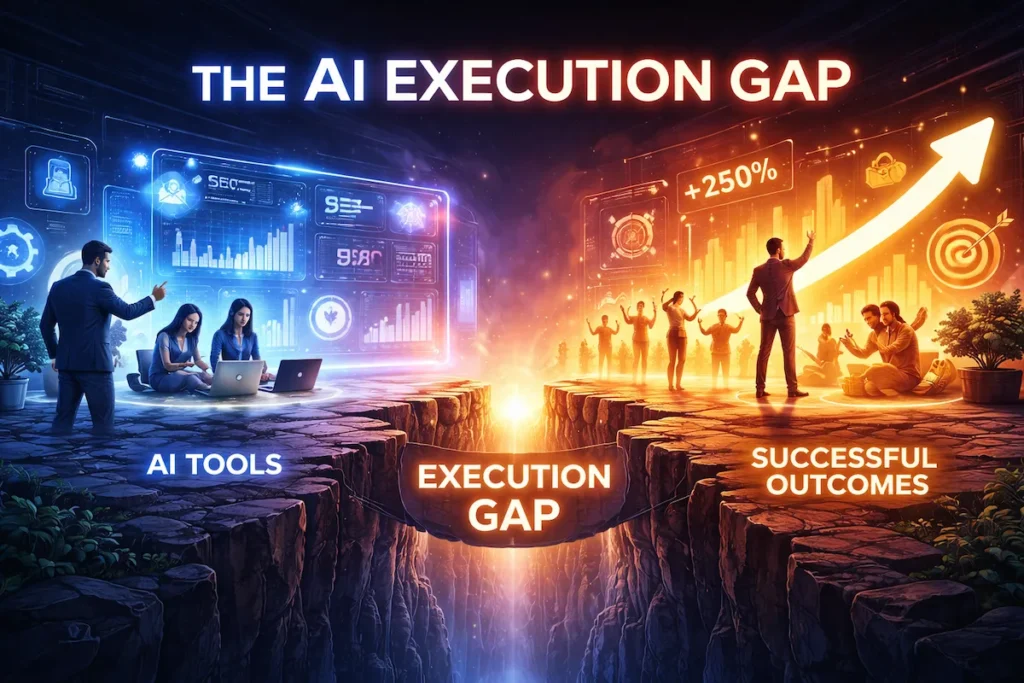
Major Benefits of AI in Digital Marketing
The future of digital marketing with AI delivers measurable advantages across every marketing function. Here are the most impactful.
Automation of Repetitive Marketing Tasks
Marketing automation in the future of digital marketing with AI reduces manual workload by handling repetitive tasks like reporting, scheduling, and campaign optimization.
The average marketing team spends a disproportionate share of its week on tasks that generate zero strategic value: pulling performance reports, segmenting email lists, scheduling posts, updating bids. AI marketing automation platforms — led by HubSpot, ActiveCampaign, and Adobe Experience Cloud — handle all of this continuously in the background, freeing teams to focus on strategy, creative direction, and the customer relationships that actually drive sustainable growth.
Better Customer Insights Through Data
The future of digital marketing with AI enables deeper customer understanding by analyzing large-scale behavioral data across multiple channels simultaneously. The result is a far more accurate understanding of what customers actually want versus what they say they want in surveys — a gap that has always limited traditional marketing effectiveness.
Hyper-Personalized Marketing Campaigns
Personalization in the future of digital marketing with AI allows brands to deliver individualized experiences based on real-time user behavior and predictive analytics. Instead of segmenting customers into broad demographic groups and pushing the same message, AI enables true individual-level personalization — different product recommendations, different email subject lines, different landing page content — all dynamically generated based on each person’s actual behavioral profile.
Platforms like Klaviyo, Adobe Experience Cloud, and HubSpot have made this capability accessible to mid-market brands. The companies using it properly are seeing consistent improvements in email engagement rates, conversion rates, and customer lifetime value — not marginal gains, but structural improvements in how their marketing performs.
Smarter Data-Driven Marketing Decisions
Decision-making in the future of digital marketing with AI becomes more accurate as AI systems provide real-time insights and predictive recommendations. AI makes it the consistent operational reality. Campaign anomalies are flagged immediately.
Budget reallocation recommendations are generated automatically based on live performance signals. Multi-touch attribution modeling becomes more reliable as AI processes the full complexity of cross-channel customer journeys that manual analysis routinely oversimplifies. Decisions that once required days of analyst time now happen in real time with greater accuracy.
Top AI Marketing Tools in 2026
The future of digital marketing with AI depends on selecting tools matched to specific use cases — not chasing brand recognition. Here’s how to think about it by function.
AI Content Creation Tools
Content tools in the future of digital marketing with AI help marketers scale production while maintaining quality through AI-assisted drafting and editing systems.
Best for long-form content scaling: Jasper and Claude are the leading options for teams producing high volumes of blog content, pillar pages, and editorial drafts. Both require skilled human editors to add brand voice and original insight — but they dramatically compress first-draft production time and allow small teams to maintain consistent publishing cadences.
Best for short-form copy and ads: Copy.ai and Writesonic specialize in ad copy, email subject lines, product descriptions, and social content where brevity and conversion focus matter most. These tools integrate well with Meta and Google Ads workflows, making them practical for performance marketing teams.
Best for content repurposing: Descript and Opus Clip excel at turning long-form video and podcast content into short-form clips, transcripts, and social posts — multiplying the value of existing content assets without proportional extra production effort or budget.
Best for SEO-optimized drafts: Surfer SEO’s AI editor produces content built around semantic keyword structures that align with how Google evaluates topical relevance — particularly useful for content targeting competitive search terms where structural optimization matters as much as writing quality.
For agencies managing multiple client content programs simultaneously, our detailed breakdown of the best AI tools for creative agencies covers which platforms are delivering real, measurable ROI versus those that perform better in sales demos than in actual production environments.
AI SEO Optimization Tools
SEO platforms in the future of digital marketing with AI focus on semantic analysis, content optimization, and authority mapping powered by machine learning.
Best for semantic keyword research: Semrush and Ahrefs remain the category leaders, with both platforms adding AI layers that surface topical cluster opportunities and intent-based keyword groupings significantly faster than manual research processes allow.
Best for content optimization: Surfer SEO and Clearscope analyze top-ranking content in real time and provide optimization scoring that guides writers toward topical depth and semantic coverage — moving SEO beyond simple keyword placement into genuine subject-matter comprehensiveness.
Best for topical authority mapping: MarketMuse builds comprehensive content gap analyses that identify exactly which subtopics your site needs to cover to establish genuine authority in a subject area — which is precisely what Google’s AI-powered ranking systems are now evaluating and rewarding most consistently.
AI Marketing Automation Platforms
Automation platforms in the future of digital marketing with AI enable end-to-end campaign management with minimal manual intervention.
Best for SMB and mid-market: HubSpot and ActiveCampaign offer the most accessible combination of AI-powered lead scoring, email personalization, and customer journey automation at price points growing teams can realistically sustain as they scale.
Best for enterprise: Adobe Experience Cloud and Marketo handle the complexity of large-scale, multi-channel customer journey orchestration — with AI systems that process the data volumes and integration requirements that smaller platforms aren’t built to manage.
Best for e-commerce personalization: Klaviyo and Drip specialize in behavioral trigger automation and AI-driven product recommendation engines — where the connection between personalization quality and direct revenue impact is most immediately and clearly measurable.
One critical operational reality that most AI marketing guides omit: these platforms typically require two to four weeks of live data before their machine learning models have enough signal to optimize meaningfully. Teams that evaluate AI tools in the first few days and conclude they aren’t working are making one of the most common and costly mistakes in AI marketing adoption. Patience during the learning phase is not optional — it’s required for the system to deliver on its potential.
Future Trends of Digital Marketing with AI
The future of digital marketing with AI is accelerating in several directions simultaneously. These are the trends with the most significant near-term impact on marketing strategy and competitive positioning.
Predictive Marketing Strategies
Predictive marketing is shifting from enterprise-only capability to mid-market standard practice. Brands are increasingly reaching customers with the right offer before those customers have actively started searching — based on behavioral signals that predict purchase intent days or weeks in advance. Teams building predictive infrastructure now will have a compounding advantage over those who wait until the capability becomes universal.
AI-Generated Video Advertising
AI video generation tools are enabling brands to produce short-form video ads at a fraction of traditional production costs. This doesn’t eliminate video production teams — it shifts their focus from execution logistics to creative direction and brand strategy, while dramatically expanding what’s achievable on smaller budgets. Brands that adapt to this production model can test creative concepts at a cadence previously only possible for companies with large dedicated production budgets.
Voice Search Marketing Growth
Smart speaker adoption and AI assistant integration across devices are driving steady growth in conversational search. Marketers need to optimize for question-based, natural-language queries that differ significantly from traditional text-based searches. Structured data markup, FAQ schema implementation, and featured snippet optimization become essential in a voice-first search environment where the AI assistant selects and reads a single answer — not a list of ten links for the user to evaluate.
AI Personalization at Scale
The next frontier extends beyond marketing into the complete customer experience: personalized landing pages, dynamic pricing models, individualized product bundles, and real-time content adaptation based on live behavioral signals. Tools that once required enterprise budgets and engineering teams are becoming accessible to growing brands as platform costs decrease and implementation complexity drops — making this a realistic strategic priority for mid-market teams within the next 12 to 18 months.
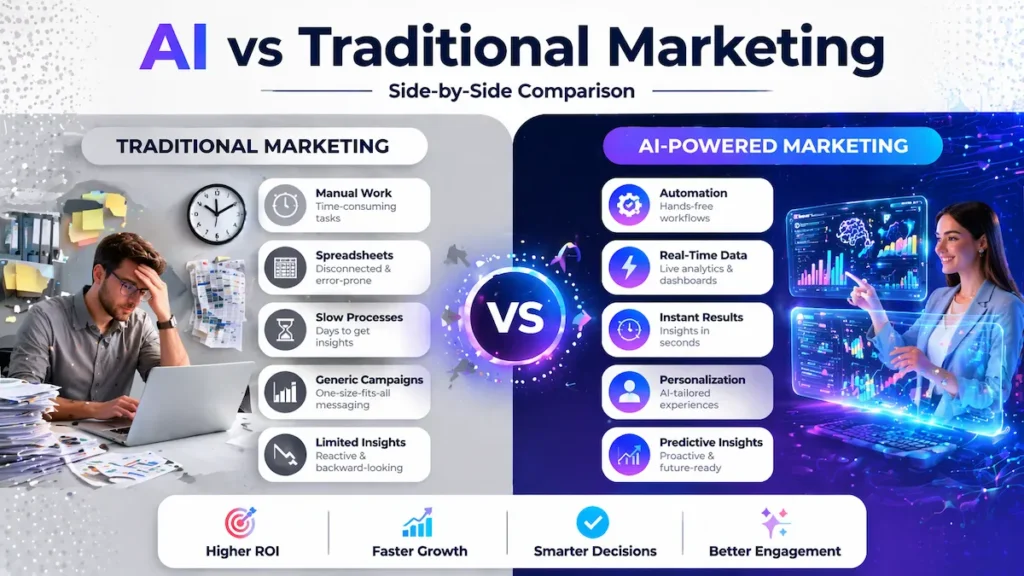
Will AI Replace Digital Marketers?
The most searched question in the industry deserves a genuinely honest answer — not a comfortable one designed to reduce anxiety.
AI will eliminate specific job functions. Roles centered on manual reporting, basic ad management, routine content production, and simple audience segmentation are already being restructured across agencies and in-house marketing teams. This is observable in hiring patterns, evolving job descriptions, and team restructuring decisions happening right now across the industry.
But here is what the “AI is taking our jobs” narrative consistently misses: marketing is fundamentally a human discipline. Strategy, brand storytelling, cultural sensitivity, ethical judgment, client relationships, and genuine creative direction require human intelligence that current AI systems cannot replicate. What AI does is amplify the impact of skilled marketers — dramatically increasing what a small, well-equipped team can execute.
The marketers most at risk aren’t those being replaced by AI directly. They’re those being replaced by other marketers who know how to use AI effectively while they don’t — a distinction that matters enormously for career planning.
For a complete analysis of how this is playing out across different roles and specializations, our research covers the AI impact on digital marketing careers in depth, along with a direct examination of whether AI is actually replacing digital marketers in practice versus theory. We’ve also published a comprehensive guide on whether AI will replace marketing jobs across specializations and a detailed look at how AI agents are changing how marketing teams operate at the day-to-day execution level.
Skills Marketers Must Learn for the AI Future
The future of digital marketing with AI rewards a specific skill profile. These are the capabilities that create durable professional value in this environment — not just in 2026, but in the years that follow as AI systems continue to evolve.
AI prompt engineering — Getting high-quality, usable outputs from AI tools is already a core marketing skill. It requires understanding how models interpret complex instructions, how to structure requests for specific outputs, and how to refine AI drafts into content that reflects genuine brand authority and original thinking.
Data literacy — Reading analytics accurately, evaluating model outputs critically, identifying attribution problems, and making data-informed decisions under uncertainty is non-negotiable at every level of the marketing profession now. This doesn’t mean becoming a data scientist — it means developing enough fluency to ask the right questions of the data your tools surface.
AI tool proficiency — Hands-on experience with automation platforms, AI SEO tools, and AI content systems is rapidly becoming a baseline hiring requirement at agencies and in-house marketing teams. Marketers who can only describe these tools rather than operate them fluently will find themselves at a significant and widening professional disadvantage.
Strategic thinking — As AI handles more tactical execution, strategic thinking becomes more valuable, not less. Marketers who can set direction, build coherent brand narratives, connect marketing decisions to business outcomes, and make sound judgment calls in ambiguous situations will command the highest professional value in an AI-saturated industry.
Ethical AI judgment — Understanding privacy implications, algorithmic bias risks, and the ethical boundaries of hyper-targeted advertising is becoming a genuine professional responsibility. Brands and agencies that treat this as a compliance checkbox rather than an active practice are accumulating regulatory and reputational risk that will become increasingly expensive to manage.
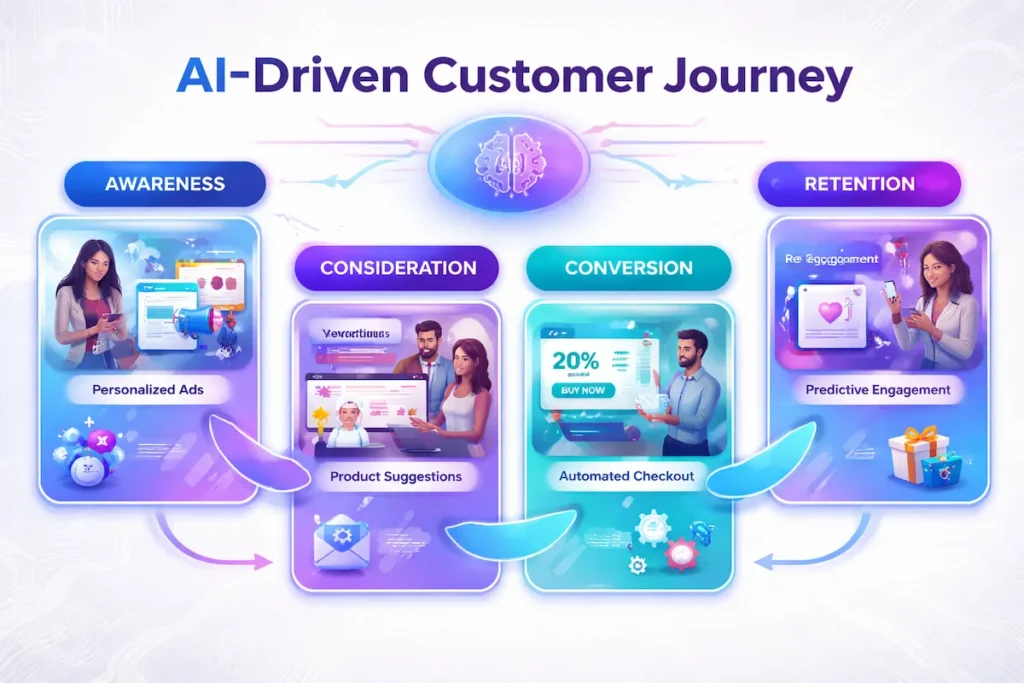
Frequently Asked Questions
What Is the Future of Digital Marketing with AI?
The future of digital marketing with AI is a clear shift toward predictive, personalized, and increasingly autonomous marketing systems. AI handles tactical execution at scale while human marketers focus on strategy, brand direction, and creative leadership. Organizations that build AI capabilities systematically will develop structural advantages that compound over time and become progressively harder for reactive competitors to close.
How Is AI Changing Digital Marketing for Small Businesses?
AI is a genuine equalizer for small businesses in 2026. Platforms like HubSpot, Klaviyo, and Mailchimp now make predictive analytics, marketing automation, and real-time personalization accessible at price points small teams can realistically sustain. A two-person marketing team today can execute campaigns that would have required a ten-person team just five years ago.
What Are the Biggest Mistakes When Using AI in Marketing?
The three most damaging mistakes are evaluating AI tools too early before systems have enough data to optimize, using AI-generated content without substantive human editorial oversight, and treating automation as a set-and-forget solution. AI amplifies both good strategy and flawed strategy with equal efficiency — which means the quality of human judgment directing the system ultimately matters more than the sophistication of the tool itself.
Will AI Replace Digital Marketers?
The future of digital marketing with AI is not a world without marketers — it’s a world without marketers who refuse to adapt. AI will eliminate specific functions like manual reporting, basic ad management, and routine content production. But strategy, brand storytelling, ethical judgment, and creative direction remain deeply human disciplines that current AI systems cannot replicate with any consistency.
What Is the ROI of AI Marketing Tools?
ROI varies significantly by use case and implementation quality. The highest-performing applications include AI-driven lead scoring, which reduces cost-per-acquisition by 27–35% in well-implemented programs, and AI email personalization, which increases click-through rates by up to 35%. The consistently lowest ROI comes from AI content tools used without human editorial oversight — output that looks like content but rarely earns rankings or audience trust.
How Long Does AI Marketing Take to Show Results?
Most AI marketing systems require two to four weeks of live data before their machine learning models can optimize meaningfully. Google’s Performance Max and Meta’s Advantage+ typically show their strongest improvements between weeks three and eight of active operation. Organizations that resist the urge to intervene too early consistently outperform those that disrupt the system’s learning cycle prematurely.
Is the Future of Digital Marketing with AI Accessible for Startups?
The future of digital marketing with AI is genuinely accessible for startups — more than most founders assume. Free tiers and entry-level pricing from platforms like HubSpot, Surfer SEO, and Mailchimp make meaningful AI capabilities available from day one without significant capital investment. The real investment isn’t the subscription cost — it’s building the internal strategic knowledge to use these tools effectively from the start.
Challenges of AI in Marketing
The future of digital marketing with AI is not without significant real-world obstacles. Marketers who approach this space with clear-eyed realism about limitations will build more resilient strategies than those who focus exclusively on the opportunity.
Privacy and data regulations — AI marketing systems require substantial customer data to function well. Increasing regulatory complexity around data privacy — GDPR in Europe, CCPA in California, and evolving US federal frameworks — creates compliance requirements that marketers cannot treat as someone else’s problem to solve. Brands building AI personalization systems need privacy compliance embedded from the architectural stage, not added as an afterthought after the system is already deployed.
Content saturation — AI generation tools are making it easy for every brand to publish more content across every channel simultaneously. The result is increasing noise and declining average content quality across the board. Genuine expertise, original research, and first-hand experience are becoming the only reliable long-term differentiators in content marketing — which is actually an opportunity for brands willing to invest in real authority.
Automation risks — Over-relying on automated systems creates structural fragility that’s easy to underestimate until something goes wrong. When an AI campaign optimizes toward the wrong proxy metric, or when data quality degrades without anyone noticing, the damage can scale rapidly before human oversight catches it. Strong governance, regular system auditing, and clear human review processes are core operational requirements — not optional additions for cautious organizations.
When AI fails — AI systems fail in ways that are sometimes hard to predict and expensive to recover from. AI-generated ad creative that misreads cultural context, chatbots that escalate customer frustration rather than resolving it, personalization systems that surface inappropriately targeted content — these failures cause measurable brand damage that can take significant time and resources to repair. The solution isn’t avoiding AI. It’s building human review protocols that are proportional to the stakes and visibility of each automated decision.
Algorithmic bias — Machine learning models trained on historical data perpetuate the biases embedded in that data. In marketing, this can mean systematically underserving specific customer segments or reinforcing demographic targeting patterns that create both legal exposure and genuine ethical problems. Active, ongoing auditing for bias is a professional responsibility — not a one-time setup task that can be completed and forgotten.
Ethical concerns — Hyper-targeted advertising based on sensitive behavioral data raises legitimate ethical questions that the marketing industry is still actively working through collectively. Brands that treat ethics as a constraint to minimize rather than a standard to uphold are taking on risks that will become more expensive to manage as regulatory scrutiny and public awareness both continue to increase.
Key Takeaways: Future of Digital Marketing with AI
Before you close this page, here are the most important strategic conclusions to carry into your planning:
- AI is the new baseline, not the future advantage — the advantage comes from how intelligently you deploy it relative to your competitors
- Predictive systems consistently outperform reactive marketing — knowing what customers will do next matters more than responding to what they just did
- Content quality matters more as AI increases volume — originality, expertise, and genuine authority are the only sustainable differentiators as production volume becomes cheap for everyone
- AI tools require time to optimize — expect two to four weeks of live data before meaningful performance improvements emerge; evaluate accordingly
- Human strategy combined with AI execution is the winning formula — neither alone produces consistently superior results in a competitive market
- The AI Marketing Maturity Model gives you a roadmap — identify your current level honestly and build toward the next one systematically rather than attempting to leap to full autonomy without the foundations in place
- Ethics and privacy are strategic investments, not compliance costs — brands that build trustworthy AI marketing systems will have durable advantages as regulation tightens
Conclusion
Most marketers overestimate what AI can do in content creation and underestimate its transformative impact on data analysis, decision-making, and campaign optimization. Closing that specific gap in your own understanding is the highest-value investment you can make right now — before your competitors do.
The future of digital marketing with AI belongs to marketers who engage with it thoughtfully — understanding both its genuine capabilities and its real, practical limitations. Brands that combine AI’s speed and analytical power with human creativity, strategic judgment, and ethical awareness will build durable competitive advantages that compound over time. Those who treat AI as a content shortcut or a cost-cutting mechanism alone will produce more noise while earning less trust, fewer rankings, and weaker customer relationships.
Start by auditing where your organization sits on the AI Marketing Maturity Model. Build a realistic roadmap to the next level. Develop data literacy and AI tool proficiency systematically across your team. Invest in the strategic and creative capabilities that AI cannot replicate. And build your content and SEO strategy around genuine topical authority — because that is precisely what both human readers and AI-powered search systems like Google’s are increasingly rewarding over volume-based approaches.
AI is not the future advantage. It’s the new baseline. The real competitive advantage is how intelligently, ethically, and strategically you use it — while your competitors are still figuring out where to start.
Related reading: AI Impact on Digital Marketing Careers | AI Replacing Digital Marketers: Reality & Future | Will AI Replace Marketing Jobs | AI Agents for Digital Marketing | Can AI Replace Digital Marketing Jobs | AI in Advertising: Strategies & Tools | Best AI Tools for Creative Agencies