
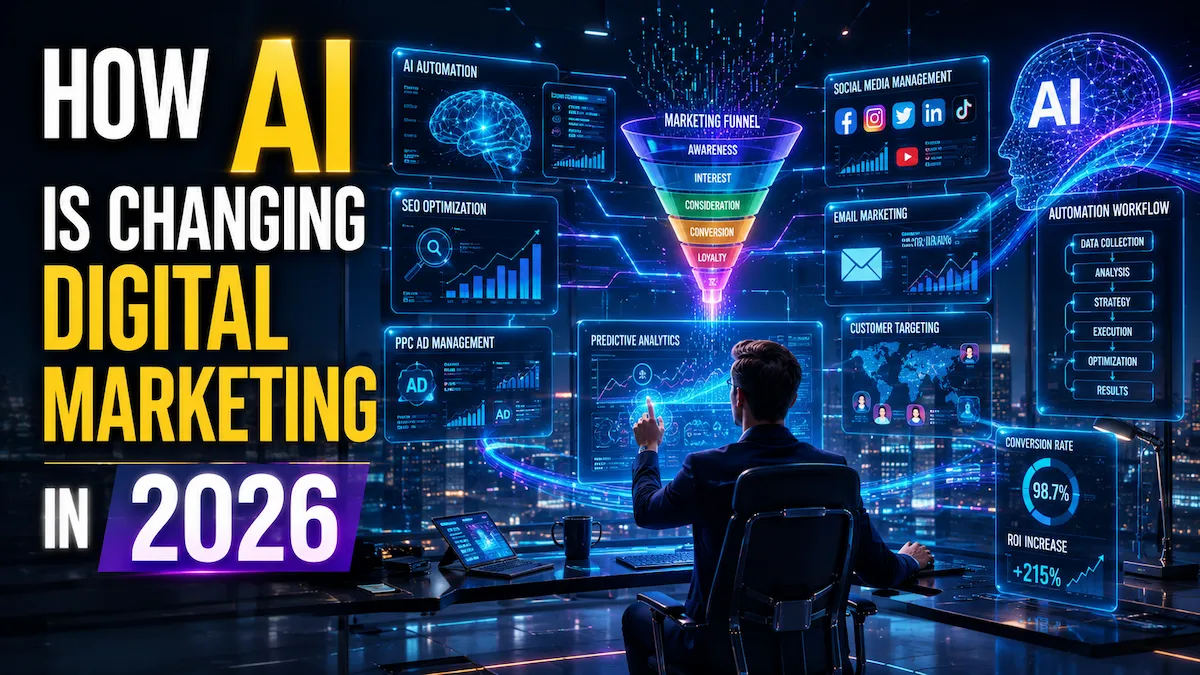
How AI is changing digital marketing is no longer a future prediction—it’s already redefining how brands attract, convert, and retain customers at scale.
According to McKinsey & Company’s personalization research, AI-assisted marketing teams already outperform traditional workflows across personalization, campaign efficiency, and content velocity—delivering 5–15% revenue lifts and 10–30% improvements in marketing spend efficiency for brands that implement it correctly. In 2026, the competitive gap is no longer theoretical. It’s operational, it’s widening every quarter, and most businesses aren’t moving fast enough to close it.
The brands quietly outperforming their competitors right now aren’t spending more. They’re operating at a fundamentally different leverage point — using AI systems that analyze, predict, personalize, and optimize faster than any human team could manually manage.
“Data without AI is just expensive storage.”
This guide covers every major marketing channel, introduces four original frameworks for understanding AI’s structural impact, and gives you an honest picture of the risks most coverage skips entirely.
1. AI Marketing Statistics: 2026 Benchmarks
How AI is changing digital marketing becomes obvious when performance benchmarks consistently outperform traditional marketing workflows.
Before diving into channels, ground the strategy in what the data actually shows.
| Application | Benchmark | Source |
|---|---|---|
| AI personalization revenue lift | 5–15% revenue improvement | McKinsey & Company |
| AI personalization spend efficiency | 10–30% improvement | McKinsey & Company |
| Smart Bidding CPA improvement | 15–30% lower cost-per-acquisition | Google Ads platform data |
| Email send-time optimization | 10–20% open rate improvement | Klaviyo platform data |
| AI product recommendations | 10–30% average order value lift | McKinsey & Company |
| AI content production speed | 3–5x faster output | HubSpot State of Marketing |
| Predictive segmentation engagement | 20–40% engagement improvement | Industry benchmarks |
| AI conversion rate optimization | 15–25% landing page CR lift | CXL Institute research |
| Churn prediction intervention | 20–35% churn reduction | Industry benchmarks |
Critical caveat: These are consistent ranges across implementations with sufficient data, proper configuration, and human strategic oversight. AI amplifies quality inputs. It does not compensate for weak strategy, unclear positioning, or poor creative direction.
2. What Is AI in Digital Marketing?
Understanding how AI is changing digital marketing starts with understanding how machine learning and predictive systems influence modern campaigns.
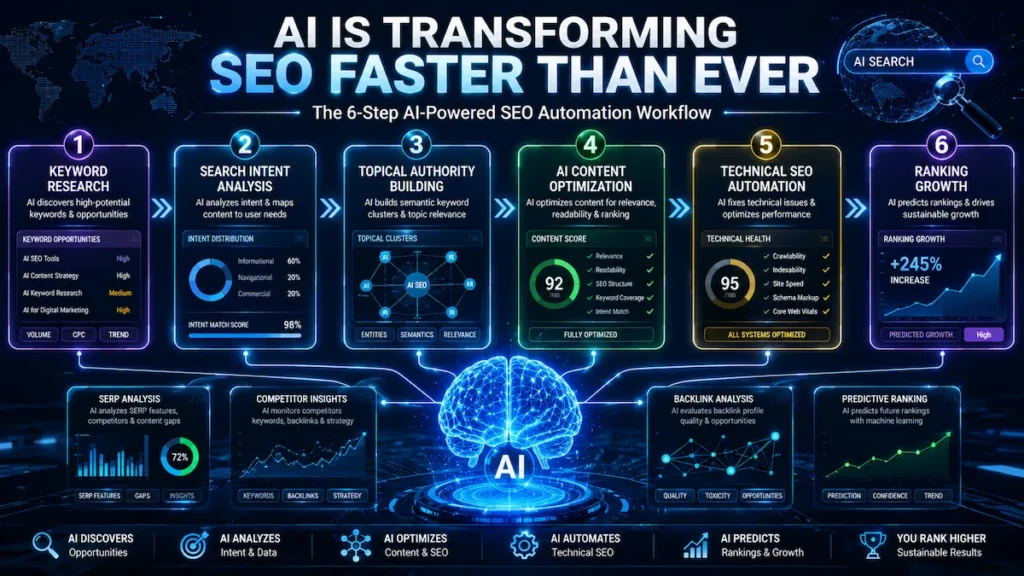
In operational terms, AI in digital marketing refers to machine learning models, natural language processing systems, computer vision, and predictive algorithms that automate decisions, surface insights, and personalize experiences at a scale no human team can replicate.
Machine learning: the feedback loop that compounds
How AI is changing digital marketing can be seen in machine learning systems that improve performance continuously through data.
Machine learning models learn from data and continuously improve their outputs. Google’s Smart Bidding processes millions of contextual signals per auction—device, location, query semantics, and conversion history—and adjusts bids in real time. A recommendation engine trained on 10,000 purchase sequences learns something useful. At 10 million sequences, it becomes nearly impossible to compete against manually.
This is the defining characteristic of AI marketing systems: the data advantage compounds. Every behavioral signal collected today feeds tomorrow’s model. Every week of delayed investment is a week of compounding foregone.
Predictive analytics: from reactive to proactive
Predictive analytics shows how AI is changing digital marketing from reactive campaigns to proactive decision-making.
Predictive analytics uses behavioral and historical data to forecast outcomes—which leads will convert, which customers are approaching churn, which content will rank, and which offers will convert for which segments. HubSpot surfaces predictive lead scores natively. Klaviyo estimates customer lifetime value at the account level and optimizes send timing accordingly. What required a dedicated data science team two years ago is now embedded in mid-market martech stacks.
Personalization: far beyond first-name tokens
Personalization technology demonstrates how AI is changing digital marketing through real-time customer experiences.
Modern AI personalization engines analyze behavioral data, purchase history, session activity, and demographic signals to dynamically adjust content, product recommendations, pricing, and messaging across websites, email, ads, and apps simultaneously. McKinsey’s research identifies this cross-channel personalization capability as the primary driver of the revenue lifts cited above.
3. The AI Marketing Maturity Curve
The AI Marketing Maturity Curve explains how AI is changing digital marketing at different levels of organizational adoption. The AI Marketing Maturity Curve maps four stages of operational progression:
▸ Stage 1 — Tool Adoption Isolated AI tools with no cross-channel data sharing. ChatGPT for content drafts, smart bidding in Google Ads, and basic email automation. No strategic integration between systems. Most SMBs currently sit here.
▸ Stage 2 — Channel Integration AI embedded per channel — AI-assisted SEO, AI-optimized PPC, behavioral email segmentation. Performance improves channel by channel, but systems remain siloed with no shared customer intelligence. Most mid-market brands sit between Stage 1 and Stage 2.
▸ Stage 3 — Cross-Channel Orchestration ← Where competitive separation begins AI systems sharing signals across channels — unified customer profiles, cross-channel attribution, predictive journey mapping. The Predictive Personalization Loop activates at this stage. Leading growth brands are here.
▸ Stage 4 — AI-Native Operations Marketing strategy designed around AI capability from the start. Autonomous optimization loops, real-time personalization engines, AI agents handling execution. Very few organizations have reached Stage 4, but it defines the competitive ceiling for the next five years.
Key takeaway: The strategic question isn’t whether to use AI tools. It’s about which stage you’re at and how quickly you can reach Stage 3—where cross-channel intelligence creates a compounding data advantage your competitors cannot easily replicate.
4. What Smart Brands Do Differently
The article’s title makes a specific promise. Here’s what delivering on it actually looks like in practice.
Smart brands understand how AI is changing digital marketing before their competitors fully recognize the shift.
They treat AI as infrastructure, not a feature. Smart brands don’t evaluate AI tools individually. They evaluate whether each tool contributes data, signals, or optimization capability to their broader marketing infrastructure. Every tool that doesn’t connect to anything else is a stage 1 dead end.
They build first-party data infrastructure before they need it. The Predictive Personalization Loop only works with quality behavioral data. Smart brands started building first-party data collection, CRM hygiene, and unified customer profiles before privacy regulations and cookie deprecation forced the issue. They’re now running AI systems on data that competitors don’t have access to.
They understand that data compounds. A behavioral dataset six months old is more valuable than one three months old. A system with 18 months of conversion data makes substantially better predictions than one with six months. Smart brands recognize this compounding dynamic and prioritize data infrastructure investment over short-term tool purchases.
They let AI handle execution and invest humans in strategy. The execution-to-strategy shift is real. Smart brands have restructured their marketing teams to spend less time on bid management, scheduling, and reporting and more time on positioning, creative direction, and strategic interpretation. They use AI to scale what humans design — not to replace the design.
They refuse to compete on volume of content. The AI Content Commoditization Effect is actively eroding the value of generic AI output. Smart brands use AI to produce better-targeted, more expert content faster — not simply more content. They invest in original research, proprietary frameworks, and authentic brand voice as strategic differentiators.
They govern their AI systems actively. Smart brands build guardrails into every automated system—bidding caps, creative review cycles, content editorial standards, and privacy compliance audits. They know that automation without governance is how accounts spiral and brand credibility erodes.
“Execution without differentiation isn’t a strategy; it’s just activity.”
5. How AI Is Transforming Content Marketing
Content workflows clearly show how AI is changing digital marketing through speed, scalability, and optimization.
AI writing: removing throughput ceilings
AI content generation tools have changed the economics of production. What took a writer a full day can now be produced as a high-quality first draft in under an hour, with a human editor refining voice, adding proprietary insights, and verifying accuracy. The practical application isn’t replacing writers—it’s eliminating the blank-page problem and freeing senior writers for high-value strategic work.
The question of whether AI will replace content writers depends on which parts of the workflow are being automated versus augmented. Writers who shift toward strategy, editorial direction, and original research become more valuable. Those whose primary value is mechanical production face genuine displacement pressure.
AI content optimization: topical depth, not keyword density
Tools like Semrush’s ContentShake, Clearscope, and Surfer SEO use NLP models to analyze top-ranking content and surface semantic optimization opportunities—entities, related topics, and coverage gaps that improve relevance signals without keyword stuffing.
What changed: Google increasingly evaluates topical depth and entity relationships rather than isolated keyword frequency. The ranking bar moved from “Does this mention the keyword?” to “Does this comprehensively own the topic?”
Programmatic content at catalog scale
E-commerce brands with large catalogs use programmatic AI to auto-generate product description pages and category landing pages—capturing long-tail organic traffic across thousands of SKUs. The brands doing this well use AI for structural scaffolding and human editors for pages serving high-intent, high-conversion traffic.
6. How AI Is Changing SEO
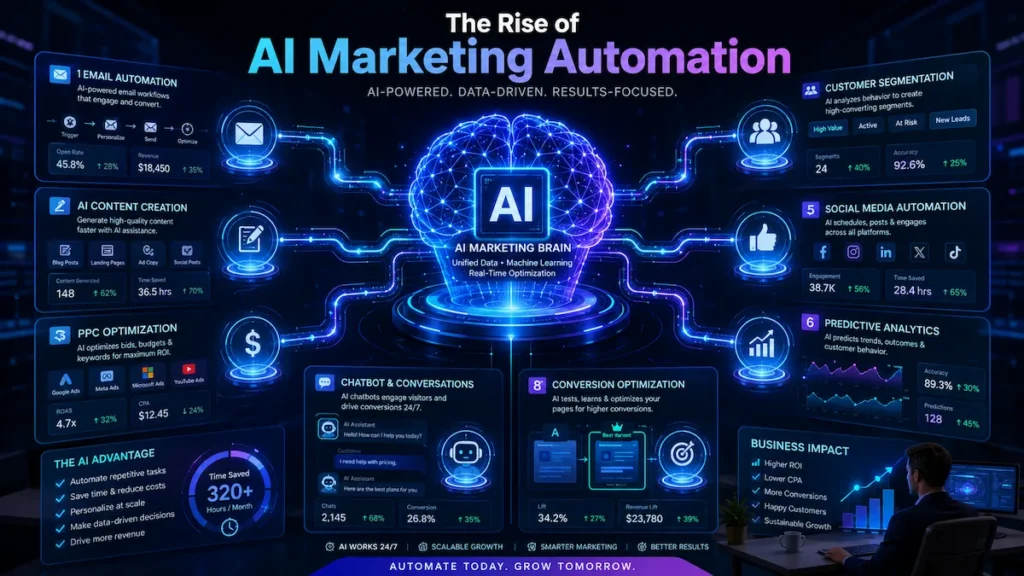
Search engine optimization is one of the clearest examples of how AI is changing digital marketing structurally.
From keyword targeting to topical authority
Topical authority strategies show how AI is changing digital marketing from isolated keywords to semantic ecosystems.
AI-powered keyword research tools embedded in Ahrefs and Semrush now analyze intent patterns, semantic relationships, and topical gaps rather than just volume and competition metrics. The goal has shifted from targeting individual keywords to building topical authority across entire subject domains.
Understanding whether AI is reshaping traditional SEO roles requires distinguishing between execution tasks AI handles well — keyword clustering, technical auditing, SERP pattern analysis — and the strategic interpretation that remains durably human.
Semantic SEO and entity relationships
Semantic SEO highlights how AI is changing digital marketing through entity-based search understanding. Cover a topic comprehensively enough with the right related entities, co-occurring terms, and contextually relevant subtopics, and your content becomes the authoritative reference for that subject domain. AI optimization tools now assist with this systematically.
AI technical SEO, and internal linking
Technical automation demonstrates how AI is changing digital marketing at an enterprise SEO scale. Enterprise platforms like Botify use machine learning to prioritize fixes by estimated traffic impact rather than treating all issues equally. Internal linking — one of the most consistently underexploited SEO levers — can now be systematically managed through AI tools that audit content libraries, map topical relationships, and recommend link insertions that strengthen semantic structure. At scale, this is genuinely impossible to manage manually.
7. AI in PPC Advertising
Paid media performance reveals how AI is changing digital marketing faster than almost any other channel. Manual campaign management is no longer viable at a meaningful scale.
Smart bidding: from execution to strategy
Google’s Smart Bidding processes hundreds of contextual signals simultaneously per auction—device, location, time, audience membership, query semantics, and historical conversion probability. Human campaign managers cannot process this volume of variables in real time. According to Google’s own platform data, advertisers using Smart Bidding report 15–30% CPA improvements over manual bidding. The role has shifted from bid management to strategy definition, constraint-setting, and performance diagnosis.
Understanding what AI means for PPC managers specifically is more nuanced than either “AI replaces everything” or “nothing changes”—the required skills have shifted substantially, but strategic oversight is more valuable than it’s ever been.
Reality check: Smart bidding campaigns left without performance guardrails can exhaust budgets rapidly on low-quality traffic. Most failed AI ad implementations are configuration and oversight problems — not technology problems.
Predictive targeting and automated creative optimization
Meta’s Advantage+ and Google’s Smart Campaigns identify high-conversion audience segments invisible from surface-level audience analysis. Responsive Search Ads and Performance Max test headline and description combinations automatically, learning which creative elements drive performance per segment and allocating budget dynamically.
For a deeper look at how AI is reshaping advertising strategy beyond bidding mechanics, this analysis of AI-powered advertising strategies and tools covers the implementation layer in detail.
8. AI Email Marketing Automation
Email automation is one of the strongest examples of how AI is changing digital marketing operationally.
Behavioral segmentation and send-time optimization
Behavioral segmentation proves how AI is changing digital marketing with adaptive customer engagement. Modern AI email platforms like Klaviyo and Mailchimp create dynamic segments that update continuously based on behavioral signals—purchase history, browse patterns, engagement frequency, and category affinity—without manual list management. Klaviyo’s own platform data shows consistent 10–20% open rate improvements from send-time optimization alone, without changing a word of copy.
The question of whether AI is replacing email marketing roles is being actively debated by practitioners. Automation handles execution, but strategic email thinking—lifecycle design, segmentation logic, and offer strategy—is becoming more valuable as execution gets commoditized.
Adaptive workflows and AI personalization
Adaptive workflows reveal how AI is changing digital marketing through personalized communication paths. AI workflow systems move beyond fixed trigger points to adaptive branching—the sequence a subscriber follows changes based on real-time engagement signals rather than following a predetermined path regardless of behavior. Dynamic content blocks change product recommendations, imagery, offers, and messaging based on individual behavioral profiles—producing a different email per recipient from one campaign structure.
Tools like Persado analyze historical subject line performance to predict which copy approaches and emotional triggers generate the highest open rates per audience segment—removing the guesswork from one of email marketing’s highest-leverage variables.
9. How AI Is Changing Social Media Marketing
Social platforms increasingly reflect how AI is changing digital marketing through predictive engagement systems.
AI engagement analysis processes comment sentiment, shares context, and audience reaction patterns to surface qualitative insights that raw engagement numbers don’t capture. Understanding why content resonates is as valuable as knowing that it does.
AI-powered social listening platforms monitor brand mentions, competitive conversations, and consumer sentiment signals at a volume impossible to track manually—surfacing actionable intelligence for reputation management before issues escalate.
The question of whether AI is displacing social media managers follows the same pattern as every other channel: automation handles scheduling, monitoring, and reporting. Creative strategy, community relationships, and platform intuition remain durably human.
10. AI Analytics and the Predictive Personalization Loop
Advanced analytics explain how AI is changing digital marketing from reporting into predictive intelligence.
From descriptive to predictive intelligence
The shift from descriptive analytics (what happened) to predictive analytics (what will happen) is one of the most operationally significant changes AI is driving. Knowing a customer segment has a high probability of churning in the next 30 days enables preemptive intervention — not retroactive re-engagement campaigns that cost more and convert less.
According to Google’s documentation on data-driven attribution in GA4, DDA models consistently outperform last-click attribution in predicting actual conversion causality — giving media buyers a substantially more accurate picture of what spend is genuinely generating returns.
The Predictive Personalization Loop
▸ The Predictive Personalization Loop
Behavioral data → feeds AI models → AI generates personalized experiences → personalized experiences produce richer behavioral signals → richer signals improve AI model accuracy → loop repeats and compounds
This self-reinforcing cycle is the most powerful structural advantage AI creates in marketing. Unlike a campaign result, which is finite, the Loop compounds. Brands that build this infrastructure early accumulate a data moat that competitors cannot easily replicate regardless of budget. Every week of delayed investment is a week of compounding foregone.
Mini case example: A B2B SaaS company implemented cross-channel behavioral tracking feeding a unified customer data platform. Within six months, AI-driven personalization lifted free-to-paid conversion by 22% — not through new messaging, but by surfacing the right content to the right users at the right moments in their journey. The Predictive Personalization Loop was already compounding.
11. AI in Ecommerce and Customer Experience
E-commerce innovation highlights how AI is changing digital marketing through personalized shopping experiences.
Product recommendations: among the highest-ROI AI applications
Product recommendation engines using collaborative filtering and deep learning consistently lift average order value by 10–30% and improve repeat purchase frequency, according to McKinsey research. Amazon’s recommendation engine is the canonical example, with McKinsey attributing a significant portion of Amazon’s total revenue to AI-driven product discovery.
Mini case example: An e-commerce apparel brand replaced manually curated “you might also like” modules with AI-driven recommendations on product detail pages. Average order value increased 18% in the first quarter, with the AI surfacing product combinations the merchandising team hadn’t thought to pair manually.
Full-experience personalization
AI enables dynamic personalization across the entire shopping experience—homepage merchandising, category page ordering, search result ranking, promotional offers, and checkout incentives—based on individual user profiles. According to CXL Institute research, brands implementing this systematically report 15–25% conversion rate improvements.
Conversational commerce
Modern AI chat systems handle complex product queries, personalized recommendations, and order status inquiries with a quality that meaningfully reduces support load while improving conversion at the consideration stage. The best implementations treat AI as a knowledgeable first-line resource—and route edge cases to human agents rather than pretending the AI handles everything.
12. Real Benefits vs Real Risks
Understanding how AI is changing digital marketing also requires understanding the risks alongside the benefits.
| Benefit | Performance Range | Source |
|---|---|---|
| Smart Bidding CPA reduction | 15–30% | Google platform data |
| Email send-time optimization | 10–20% open rate lift | Klaviyo platform data |
| AI product recommendations | 10–30% AOV lift | McKinsey & Company |
| Content production speed | 3–5x output increase | HubSpot State of Marketing |
| Predictive segmentation | 20–40% engagement lift | Industry benchmarks |
| AI conversion optimization | 15–25% CR lift | CXL Institute |
| Churn prediction | 20–35% churn reduction | Industry benchmarks |
Now the risks—which most AI marketing coverage underplays:
AI Content Saturation. Every niche is being flooded with mediocre AI output. Google’s systems are increasingly capable of distinguishing genuine expertise from synthetic summarization. The differentiation value of original research, proprietary frameworks, and authentic brand perspective has increased proportionally.
Misinformation risk. Large language models confidently produce inaccurate information. Without expert human review, AI-generated content can include factual errors and fabricated statistics—creating brand credibility and legal exposure that regulated industries especially cannot afford to ignore.
Over-automation. Automating too much, too fast, creates brittle systems where errors compound quietly. Smart bidding without guardrails exhausts budgets. Automated email sequences without behavioral intelligence damage subscriber relationships. Most failed AI implementations are workflow and governance problems — not technology problems.
Privacy and regulatory complexity. AI personalization systems require data at scale. GDPR, CCPA, and emerging global regulations create compliance complexity. With third-party cookies deprecated, brands building on borrowed data now face urgency. First-party data infrastructure isn’t optional — it’s foundational.
Algorithmic bias. AI systems learn from historical data and can perpetuate historical biases in targeting and audience exclusion. Mathematical optimization is not inherently neutral. Active auditing is required, not assumed.
13. The Contrarian Take: AI Is Making Generic Marketing More Worthless, Not Less
The AI Content Commoditization Effect explains how AI is changing digital marketing by reducing the value of generic content.
The AI Content Commoditization Effect works like this: as AI lowers the cost of producing acceptable content, it simultaneously raises the bar for what distinguishes genuinely valuable content. Every brand now accesses the same underlying models. Every agency can spin up an AI content operation in weeks. When everyone’s content is generated from identical systems, differentiation erodes — and it erodes fast.
The brands winning with AI in 2026 aren’t producing the most content. They’re using AI to produce better-targeted, more deeply expert content faster — while competitors drown in mediocre AI output that doesn’t rank, doesn’t convert, and doesn’t build trust.
Key takeaway: Google increasingly distinguishes genuine expertise from synthetic summarization. Original research, proprietary frameworks, and authentic brand voice have become more differentiated—precisely because AI has made generic content abundant and cheap.
14. Will AI Replace Digital Marketers?
The debate around jobs is central to discussions about how AI is changing digital marketing today.
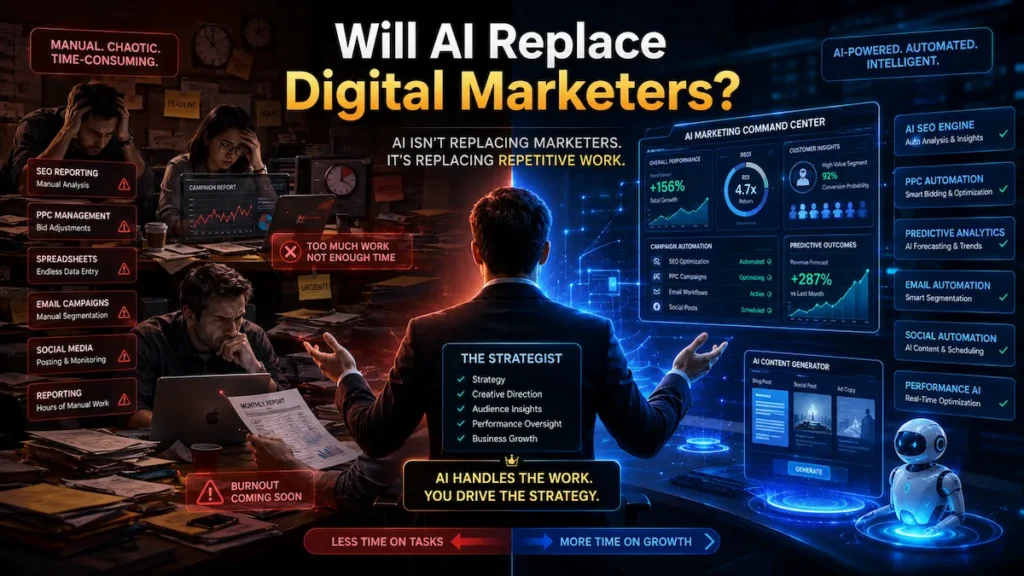
Vulnerable to automation: basic content production at scale, manual bid management, routine report generation, simple A/B test execution, and social scheduling. These are high-volume, rule-based tasks where AI consistently outperforms manual execution on speed and cost.
Durably valuable: strategic thinking, cultural intelligence, creative direction, stakeholder relationship management, ethical judgment, and the ability to synthesize ambiguous signals into coherent brand positioning.
▸ The Execution-to-Strategy Shift
AI is changing the ratio of execution to strategy in marketing roles — not eliminating those roles, but fundamentally changing what they require. The marketer who understands how to direct, evaluate, and improve AI system outputs is measurably more valuable than one who either ignores the tools or defers to them uncritically.
The career impact looks different across disciplines. Whether AI replaces content writers, SEO professionals, PPC managers, or social media managers, each deserves individual examination—the nuances matter significantly. For a broader view of digital marketing as a career path in the AI era, the picture is more complex than either side of the debate acknowledges.
15. 90-Day AI Marketing Adoption Roadmap
This roadmap provides a practical framework for implementing how AI is changing digital marketing inside organizations.
Weeks 1–2: Audit your execution layer List every marketing task your team performs weekly. Categorize each as high-volume and rule-based (AI candidate) or strategic and interpretive (human-led). Most teams discover that 40–60% of their time goes to work AI handles better. Identify your top three AI-ready workflows—these become your implementation priorities.
Weeks 3–4: Audit your data. AI performs in proportion to data quality. Audit your conversion tracking setup, behavioral data collection, and CRM hygiene. Identify the gaps between the data you’re currently collecting and the data your AI tools need to optimize effectively. This step determines your ceiling — and most organizations discover their ceiling is lower than they assumed.
Month 2: Implement AI in your highest-ROI channel first Choose the channel with the most data, the highest execution overhead, and the clearest performance metric. For most brands, this is PPC (enable Smart Bidding with proper conversion tracking) or email (enable send-time optimization and behavioral segmentation). Let the system run for four to six weeks before evaluating performance. Resist the urge to evaluate too early — AI systems improve as they accumulate data.
Month 3: Connect reporting and build toward Stage 3 Move from channel-level reporting to cross-channel attribution. Implement GA4 data-driven attribution if not already in place. Build unified performance dashboards that surface cross-channel signals rather than siloed channel metrics. This infrastructure is what enables Stage 3 orchestration on the AI Marketing Maturity Curve.
Ongoing: Start the Predictive Personalization Loop Every behavioral data point you collect now feeds the AI models you’ll run in 12 months. The Loop compounds, which means starting the data infrastructure today creates an advantage that grows automatically over time. Most brands that are ahead in 2027 started their first-party data strategy in 2025 or 2026.
16. Future of AI in Digital Marketing
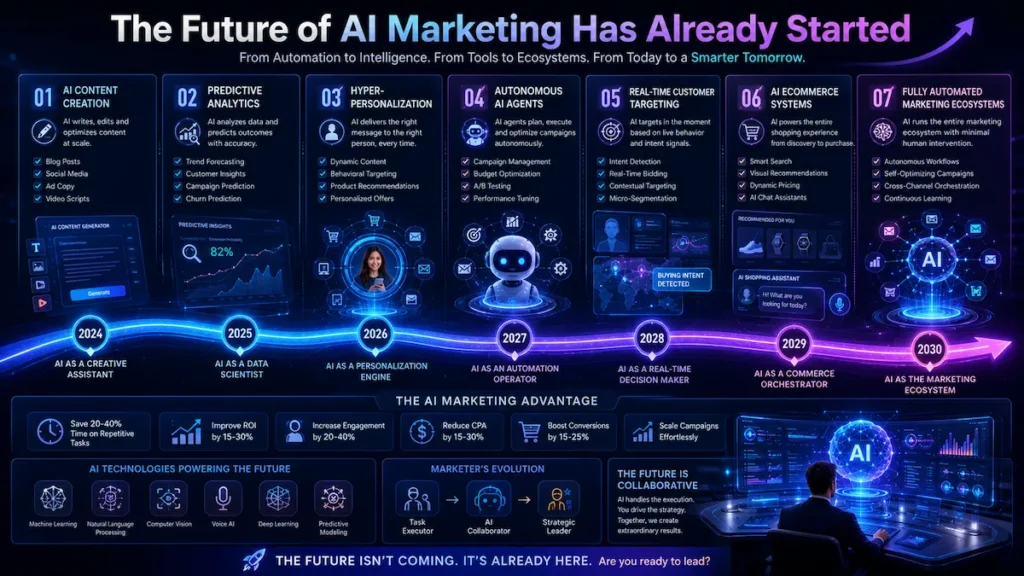
The future roadmap illustrates how AI is changing digital marketing into autonomous intelligent ecosystems.
Autonomous AI marketing agents are the next evolution—systems that research keywords, brief content, publish, monitor rankings, and adjust strategy based on performance data, with human oversight at the strategic level only. Early enterprise deployments are already underway. Within three to five years, this will be the competitive baseline for sophisticated marketing operations.
Multimodal AI systems will seamlessly operate across text, image, video, voice, and data simultaneously—creating cohesive multi-format campaign assets without the siloed channel strategies that currently create execution gaps and inconsistent customer experiences.
Voice search and conversational AI. As AI voice interfaces mature, optimizing for natural language queries becomes a critical SEO and content strategy consideration. According to HubSpot’s research on voice search, conversational query optimization remains one of the most underinvested areas in most content strategies—representing a significant near-term opportunity for brands willing to build for it now.
The predictive personalization loop at enterprise scale. The end state is a fully dynamic customer experience where pricing, content, product display, messaging, and offer structure adapt in real time based on the individual’s current behavioral context—not just their historical profile. Some enterprise e-commerce players are already deploying early versions of this. The brands building the data infrastructure today are positioning themselves for an advantage that will be genuinely difficult to replicate from a standing start.
17. Expert Final Thoughts
The frameworks in this guide explain how AI is changing digital marketing strategically, not just tactically.
The AI marketing maturity curve defines where you are. Reaching Stage 3 cross-channel orchestration is the threshold where real competitive separation begins and the loop activates.
The Predictive Personalization Loop defines your data advantage over time. It starts as a small edge and becomes a structural moat—which means every month you delay is a month of compounding you miss.
The AI Content Commoditization Effect explains why generic AI content fails. As production costs collapse, genuine expertise, original frameworks, and authentic brand voice rise in value. AI amplifies good strategy. It does not substitute for it.
The Execution-to-Strategy Shift explains what your team needs to become. The marketers who thrive are those who treat AI as infrastructure — directing it, governing it, and applying human judgment precisely where it genuinely matters.
For implementation: identify your current maturity stage, audit your data infrastructure, automate the execution layer in your highest-data channel first, and start the Predictive Personalization Loop now rather than when it feels urgent.
“Execution without differentiation isn’t a strategy; it’s just activity.”
AI is changing digital marketing faster than most businesses realize. The competitive gap is already measurable. The question now isn’t whether to engage—it’s how strategically you build the organizational capability to use these systems well.
18. Frequently Asked Questions
These FAQs answer the most common questions about how AI is changing digital marketing in 2026 and beyond.
How is AI changing digital marketing in 2026?
How AI is changing digital marketing in 2026 can be seen through automation, predictive analytics, personalization, and real-time campaign optimization across every major channel.
What AI marketing tools are best for beginners?
To understand how AI is changing digital marketing, beginners should start with tools like Google Smart Bidding, ChatGPT, Semrush, GA4, and Klaviyo.
How can small businesses use AI in digital marketing?
Small businesses can benefit from how AI is changing digital marketing by automating email campaigns, ad optimization, and customer segmentation without large teams.
Is AI-generated content bad for SEO?
How AI is changing digital marketing does not mean AI content automatically hurts SEO. High-quality AI-assisted content with real expertise can still rank well.
Can AI improve Google Ads performance?
Yes, how AI is changing digital marketing is especially visible in Google Ads through Smart Bidding, predictive targeting, and automated optimization.
Will AI replace digital marketers?
How AI is changing digital marketing is shifting marketers toward strategy and creativity while repetitive execution becomes automated.
What is the AI Marketing Maturity Curve?
The AI Marketing Maturity Curve explains how AI is changing digital marketing from basic tool adoption to fully AI-driven operations.
What is the Predictive Personalization Loop?
A self-reinforcing cycle where behavioral data feeds AI models → AI models generate personalized experiences → personalized experiences generate richer behavioral signals → richer signals improve AI model accuracy → the loop repeats and compounds. Brands building this infrastructure early accumulate a data moat that competitors cannot easily replicate regardless of budget.
What is the AI Content Commoditization Effect?
As AI lowers the cost of producing acceptable content, it simultaneously raises the bar for what distinguishes genuinely valuable content. When every brand and agency can generate acceptable content instantly from the same underlying models, differentiation must come from original research, proprietary frameworks, authentic brand perspective, and genuine subject matter expertise—not production speed.
What are the biggest risks of AI in digital marketing?
The AI content commoditization effect, misinformation from unreviewed AI outputs, over-automation creating brittle systems without governance, privacy and regulatory compliance complexity, algorithmic bias in targeting, and loss of authentic brand voice are all challenges. Most failed AI implementations are workflow and oversight problems — not technology problems.
How much does AI marketing automation cost?
AI marketing automation is now embedded across price points. Google’s Smart Bidding costs nothing beyond standard Google Ads spend. Klaviyo and Mailchimp’s AI features are included in standard subscriptions. Semrush and Ahrefs AI tools are included in core plans. Dedicated AI optimization and enterprise personalization platforms scale from several hundred to several thousand dollars monthly depending on data volume and complexity.
What is the 90-Day AI Marketing Adoption Roadmap?
The roadmap outlines practical steps for implementing how AI is changing digital marketing through automation, data infrastructure, and cross-channel optimization.