
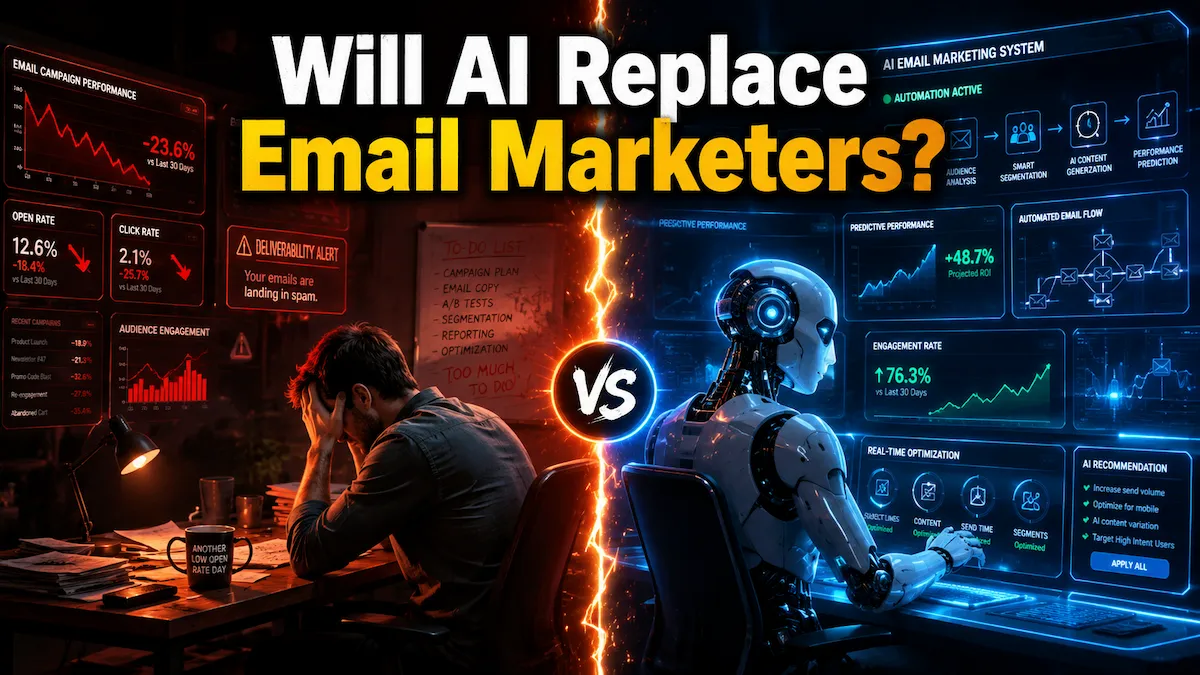
Here’s something most marketing thought leaders won’t say out loud.
Some email marketers are already being replaced by AI. Not in some distant, speculative future. Right now, in 2026, companies are cutting entry-level email roles, consolidating campaign management under marketing automation platforms, and running full drip sequences without a single human writing a word.
And yet, some email marketers are earning more than ever.
The insight most AI coverage misses: AI commoditizes competence. It creates opportunity for genuine excellence. The more AI-generated email floods the inbox, the more valuable an authentic human voice becomes.
The real question isn’t whether AI is disrupting email marketing—it obviously is. The question is which email marketers are at risk, which skills are becoming more valuable, and what separates the professionals who will thrive from those who won’t see it coming until it’s too late.
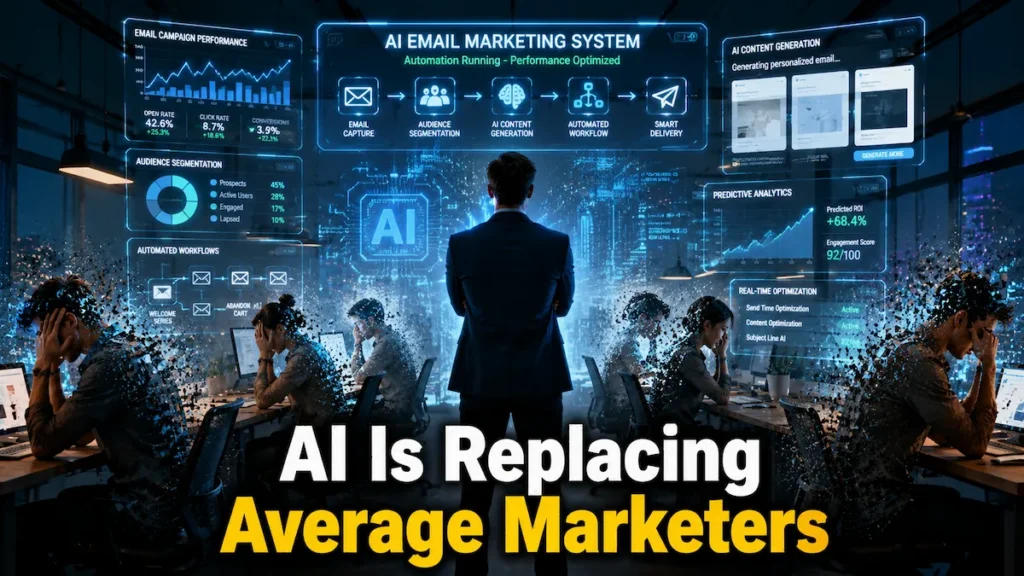
What “AI Replacing Email Marketers” Actually Means
Understanding how AI replacing email marketers actually works starts with recognizing that automation is targeting repetitive execution tasks rather than eliminating strategic marketing expertise.
AI replacing email marketers refers to the growing automation of repetitive tasks—segmentation, campaign scheduling, basic copywriting, analytics, and optimization—through AI-powered marketing platforms. Strategic creativity, customer psychology, and brand trust still rely heavily on human marketers and are not yet replicable by AI.
AI is replacing parts of the role, not the profession. Understanding that distinction is what separates marketers who are panicking from the ones who are building.
Why This Became a Massive Industry Fear
Fear around AI replacing email marketers accelerated when businesses realized AI tools could automate campaign execution, segmentation, and basic email copywriting at scale.
The fear accelerated the moment ChatGPT produced passable marketing copy in three seconds. Then HubSpot launched AI-assisted content tools. Then Klaviyo integrated predictive analytics that could automatically determine the best send time, product recommendation, and subject line—without a human making a single creative decision.
Suddenly, tasks junior email marketers spent entire weeks doing could be automated in minutes: writing welcome sequences, A/B testing subject lines, segmenting subscriber lists, and pulling campaign performance reports.
The same disruption is playing out across every corner of digital marketing. If you’ve been following what’s happening with AI replacing PPC managers or the real impact of AI on social media management roles, the underlying pattern is strikingly familiar. The same conclusion emerges in analyses of AI replacing content writers and AI disrupting SEO jobs: execution-heavy roles compress first, while strategic roles strengthen.
Email Marketing Isn’t Dying—The Data Says the Opposite
Despite concerns about AI replacing email marketers, email marketing itself continues to deliver some of the highest ROI in digital marketing.
Before examining what AI means for email marketing careers, it’s worth establishing what it doesn’t mean: the death of the channel itself.
According to Litmus’s 2024 State of Email report, email marketing averages a 36:1 ROI—consistently outperforming nearly every other digital channel. Rising paid acquisition costs across Google and Meta are pushing brands back toward owned channels like email, while first-party data importance surges as third-party cookies disappear.
HubSpot’s marketing research reinforces this: segmented and personalized emails show open rate lifts of up to 14% and click-through improvements of up to 100% compared to non-segmented campaigns. Brands aren’t abandoning email. They’re demanding better email — and AI is raising the bar for what “better” requires from the humans running these campaigns.
How AI Is Replacing Email Marketers Right Now
The reality of AI replacing email marketers is already visible through automation platforms that now manage workflows, analytics, and personalization with minimal human input.
Automation: The First and Fastest Wave
The first major wave of AI replacing email marketers is happening through automation systems that handle repetitive campaign management tasks.
Platforms like Klaviyo and HubSpot now generate entire behavioral flow sequences from customer data inputs, with AI suggesting branch logic, timing intervals, and content variations automatically. The automation doesn’t just send emails—it learns from engagement data and adjusts dynamically. Marketers whose primary contribution was building and maintaining automation architecture are seeing their workload compress sharply.
Predictive Personalization: Scale No Human Can Match
Predictive personalization tools are accelerating AI replacing email marketers by allowing brands to deliver large-scale targeting without expanding human teams.
Klaviyo’s predictive analytics can forecast customer lifetime value, churn probability, and next purchase date in real time. A human marketer managing this level of personalization across 50,000 subscribers would need dozens of hours weekly just to keep segments current. AI handles it continuously, without fatigue, without billing hours.
Campaign Management: The Compression of the Operational Loop
AI replacing email marketers becomes most obvious when campaign management workflows that once required hours of labor are now completed in minutes.
Jasper and ChatGPT generate email copy from a brief in minutes. HubSpot’s AI features populate content blocks using live CRM data. AI-generated analytics summaries convert raw performance data into strategic insights without a human analyst touching a spreadsheet.
If your role is primarily execution-focused without meaningful strategic ownership, that work is being automated faster than most people are comfortable admitting.
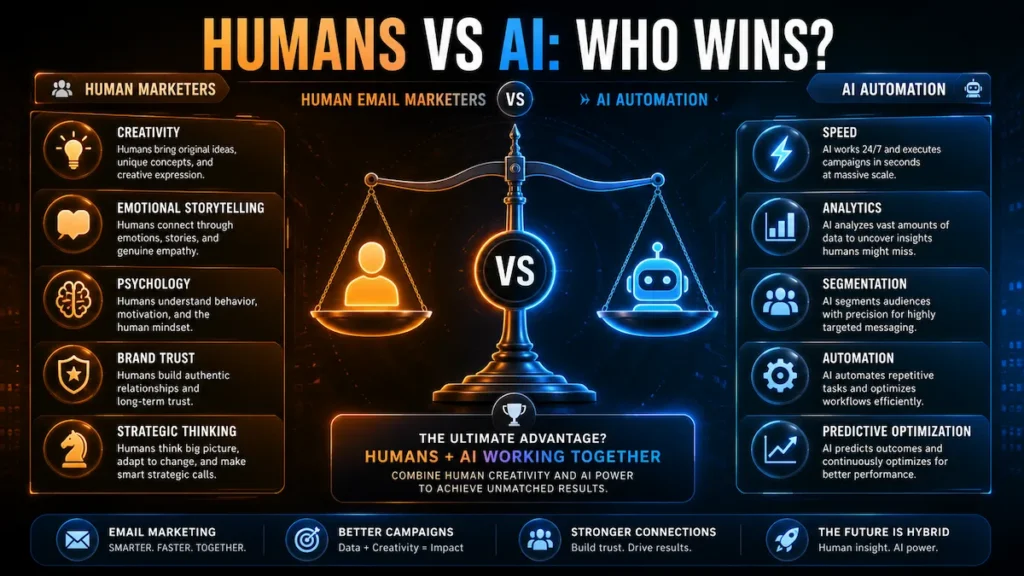
AI vs. Human Email Marketers — Strategic Comparison
The debate around AI replacing email marketers becomes clearer when comparing AI’s operational efficiency against the human strengths of creativity, trust-building, and emotional storytelling.
| Capability | AI | Human Marketer |
|---|---|---|
| Scale and speed | Exceptional | Limited |
| Data analysis and pattern recognition | Superior | Slower, more error-prone |
| A/B testing and automation | Continuous and automated | Manual and periodic |
| Basic email copywriting | Fast and competent | Slower but more nuanced |
| Emotional storytelling | Weak | Strong when skilled |
| Brand voice development | Mimics; cannot create | Builds authentically over time |
| Customer psychology | Pattern-based | Intuitive and contextual |
| Strategic creative decisions | Cannot own | Core human advantage |
| Building subscriber trust | Cannot generate | Compounding human investment |
| Deliverability management | Rules-based | Nuanced and relationship-driven |
What AI Cannot Replace
Even as AI replacing email marketers reshapes the industry, emotional intelligence and authentic brand communication remain deeply human advantages.
Emotional storytelling. Campaigns that genuinely move people come from deep understanding of a brand’s voice and authentic knowledge of a customer’s emotional reality. AI generates technically competent copy. It consistently struggles with resonance—the gap between an email that earns a polite click and one that generates a reply saying, “This is exactly how I feel” still requires human empathy.
Customer psychology. AI can tell you email X converted better than email Y. What it cannot do is understand why the message landed, then use that understanding to create campaigns that tap into emerging emotional territory before the data reflects it. This is the same strategic edge discussed in the analysis of AI replacing copywriters—creative judgment holds its ground across every discipline where it’s genuinely applied.
Brand trust. AI can mimic an established voice. It cannot build one from scratch. Once subscribers sense they’re reading machine-generated filler, trust erodes fast—and rarely comes back fully. Trust is the mechanism that makes everything else in email marketing work.
What Patterns Are Emerging Across AI-Assisted Campaigns
One of the most important lessons from AI replacing email marketers is that fully automated campaigns often struggle to maintain authentic engagement over time.
Some email teams have reported consistent counterintuitive patterns when shifting to AI-managed programs, and these observations align with broader deliverability and engagement data:
Open rates up. Reply rates down. AI-optimized subject lines consistently outperform human-written ones on open rates—while the same campaigns show meaningfully lower reply rates. AI-optimized hooks attract attention without building genuine conversation.
Automated nurture sequences increase unsubscribe fatigue. Brands running fully AI-managed nurture flows without human editorial review tend to see unsubscribe rates climb after 60 to 90 days. Technically optimized. Emotionally monotonous.
Hybrid campaigns outperform both pure approaches. The highest-performing programs use AI for segmentation, timing, and structure—and human writers for the core message, story, and CTA framing.
A Real-World Example
In one DTC brand analysis, a mid-sized Shopify store reduced email production time by 70% after switching to AI-generated drafts inside Klaviyo. Initial results were strong—open rates improved, campaign output tripled, and the team reclaimed hours weekly.
Six months later, reply rates had dropped by nearly half. Inbox placement slipped from 93% to 76%. Unsubscribe rates were quietly climbing. The diagnosis: technically optimized emails that no longer felt human. The fix was a human editor reviewing every AI draft to restore voice, emotional texture, and conversational tone. Within 90 days, inbox placement recovered and reply rates returned, while production speed remained 50% faster than pre-AI workflows.
The Hidden Knowledge Erosion Problem
One overlooked consequence of AI replacing email marketers is the gradual loss of hands-on learning that once helped junior marketers develop strategic instincts. There’s a deeper implication almost no one is discussing.
As AI removes repetitive operational work, it also removes the environment where most marketers developed their strategic instincts in the first place. Writing hundreds of promotional emails teaches you what resonates. Managing A/B tests manually teaches you to think in hypotheses. Building flows by hand teaches you how customer journeys actually behave.
When AI handles all of that by default, future marketers may enter senior roles without the foundational pattern recognition that repetitive tasks quietly built over years. That’s not just a career risk for individuals. It’s a structural knowledge problem for the entire industry—and almost no one is preparing for it.
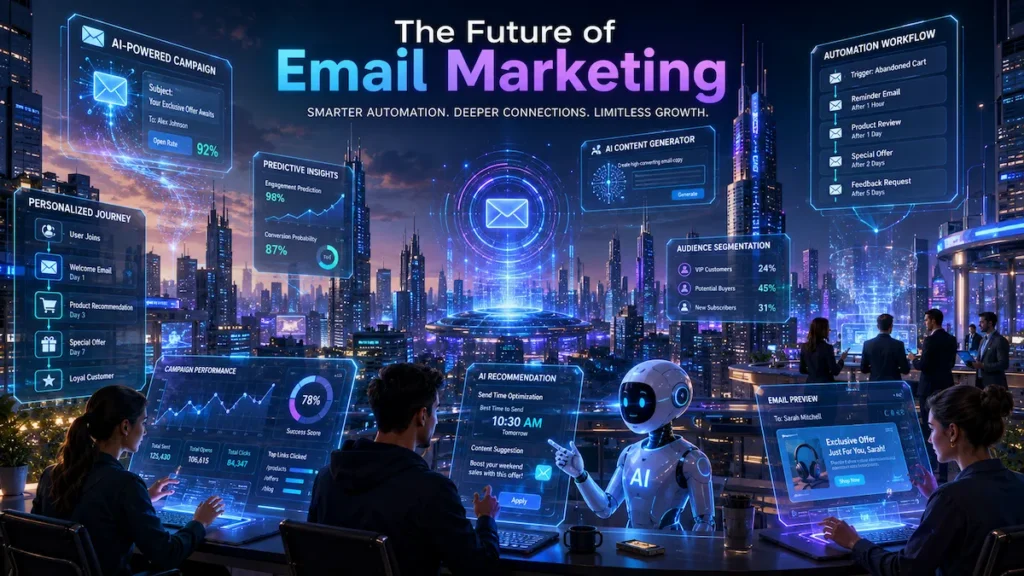
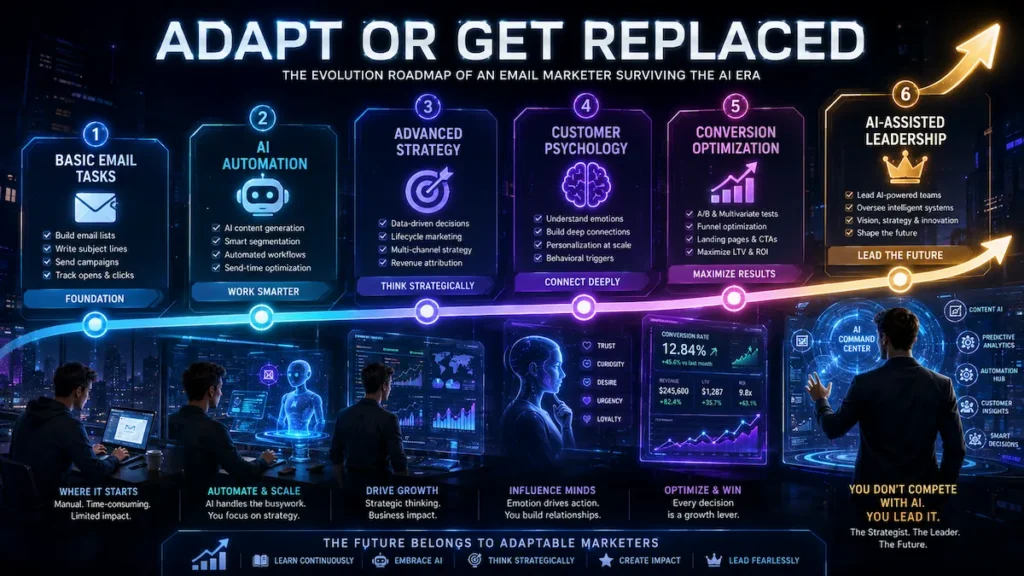
The 3-Layer Email Marketing Survival Framework
The smartest response to AI replacing email marketers is understanding which layers of email marketing are automating fastest and which still depend on human expertise.
Layer 1—Automation (AI Dominates)
Layer 1 of AI replacing email marketers focuses heavily on repetitive operational tasks that automation systems now handle efficiently.
Campaign scheduling and sends, segmentation updates, A/B test execution, deliverability monitoring, basic copy production, and analytics reporting. If your role lives primarily in Layer 1, the disruption is already here.
Layer 2—Optimization (AI Assists, Humans Direct)
Interpreting campaign performance data, identifying behavioral targeting patterns, adjusting lifecycle flows, and refining messaging angles. AI generates the data. Human judgment decides what to do with it.
Layer 3—Strategic Influence (Humans Still Dominate)
Customer lifecycle marketing strategy, brand voice development, customer journey engineering, cross-channel integration, and creative direction. This is where the most resilient email marketing careers are anchored—and where the urgency to build is not a future consideration. It’s a present one.
Which Jobs Are Most at Risk?
The biggest impact of AI replacing email marketers is currently being felt in execution-heavy roles built around repetitive operational work.
Execution-heavy roles face the most immediate disruption:
- Email coordinators—setting up sends, pulling reports, managing content calendars
- Junior email copywriters—promotional templates and basic nurture sequences without strategic input
- Campaign operations managers—high-volume, low-complexity programs without meaningful creative differentiation
- Manual segmentation analysts—list hygiene, audience pulls, and performance summaries that AI tools now automate
This connects directly to the wider question of whether digital marketing is still a viable career in the AI era—and the answer hinges entirely on this distinction between operators and strategists.
Hard truth: The marketers most vulnerable to AI are usually the ones whose work was already operationally replaceable before AI existed. AI didn’t create the vulnerability. It made it visible and accelerated the timeline dramatically.
The Deliverability Problem AI Cannot Solve
A major weakness in AI replacing email marketers is that AI-generated campaigns still struggle to maintain long-term deliverability and authentic engagement signals. This is the section most AI-and-email articles skip entirely.
As AI-generated email volume increases, inbox providers—particularly Gmail and Outlook—are applying increasingly sophisticated filtering logic. Google’s 2024 sender guidelines significantly increased enforcement around engagement signals, authentication, and sender reputation. Deliverability specialists at firms like Validity and GlockApps have noted that programs showing sustained engagement decline face compounding inbox friction—regardless of technical compliance.
What’s emerging in practice: reply rate suppression from AI-optimized copy engineered for clicks rather than genuine conversation is a real inbox placement risk. According to Mailchimp’s email marketing benchmarks, engagement metrics vary significantly by sector, and programs showing sustained decline signal to inbox providers that subscriber interest is fading.
Some email teams have reported inbox placement dropping significantly over six to twelve months of fully AI-managed sending — without policy violations or list quality issues. The only material change was a shift to fully AI-generated content. Deliverability is earned through authentic communication and genuine engagement signals, both of which remain distinctly human advantages.
Skills Email Marketers Need to Survive AI
The professionals surviving AI replacing email marketers are the ones developing strategic, analytical, and customer-focused skills beyond simple execution.
Conversion optimization strategy. Understanding the full conversion pathway—offering sequencing, pricing psychology, urgency mechanics, and lifecycle stage messaging—and architecting strategies that drive measurable business outcomes. Not writing better subject lines. Designing systems that compound revenue over time.
Customer journey engineering. Mapping and continuously improving the full customer lifecycle, including where email intersects with SMS, paid retargeting, loyalty programs, and customer support. Marketers who own this holistically become effectively irreplaceable.
AI-assisted workflow mastery. Becoming genuinely fluent in AI tools as a strategic amplifier. The marketers directing ChatGPT, Klaviyo AI, HubSpot AI, and Jasper as workflow accelerators are producing dramatically better output in dramatically less time—which is exactly what a sustainable digital marketing career in the AI era now demands.
Deliverability management. Understanding sender reputation, engagement-based inbox placement, and the relationship between content quality and deliverability health. As AI-generated email volume surges, this is becoming one of the most valuable—and rarest—skills in the industry.
Why AI May Actually Increase Demand for Skilled Email Marketers
AI may actually increase demand for elite email marketers—because mediocre automation is creating more inbox noise than ever before.
When every brand runs AI-managed sequences, AI-generated copy, and algorithm-optimized send schedules, the inbox becomes uniformly competent. Every email looks polished. None of them feel human. Subscriber attention concentrates almost entirely on the brands that break through with something genuinely real.
This dynamic is already visible in how AI is reshaping advertising strategy across channels. The winning brands aren’t the ones who automated the most — they’re the ones who automated intelligently and kept human creativity at the center of the work audiences actually experience.
“AI commoditizes competence. It creates opportunity for genuine excellence.”
That’s not optimism. It’s the actual competitive landscape of 2026.
Myth vs. Reality
| Myth | Reality |
|---|---|
| AI will eliminate all email marketing jobs within five years | AI eliminates some roles — primarily operational ones. Strategic, creative, and senior analytical roles remain in demand for marketers who adapt. |
| AI email automation performs as well as human-run campaigns | In transactional contexts, AI performs comparably. In campaigns requiring resonance and strategic nuance, human oversight wins on long-term metrics. |
| Email marketing is dying because of AI | Email ROI remains among the highest in all of digital marketing. The channel is growing. AI is elevating the bar, not eliminating the profession. |
| AI will reduce demand for email marketing expertise | AI will reduce demand for email operators. It will increase demand for email strategists who can direct AI intelligently. |
Frequently Asked Questions
Is AI replacing email marketers entirely?
AI replacing email marketers entirely is not what’s happening—and the distinction matters. AI is automating repetitive, execution-heavy tasks like scheduling, segmentation, and basic copywriting, while strategic roles focused on customer psychology, brand voice, and lifecycle marketing remain firmly human territory.
Which email marketing jobs are most at risk from AI?
Roles built around operational execution—email coordinators, junior copywriters, campaign ops managers, and manual segmentation analysts—face the steepest disruption. These positions are being compressed or eliminated as AI platforms handle the same output faster and at lower cost.
Can AI write email copy as well as a human?
For transactional emails and promotional templates, AI-generated copy performs comparably on surface metrics like open rates. But for campaigns that require emotional resonance, nuanced brand voice, or genuine persuasion, human-written or human-directed copy consistently outperforms on the metrics that actually drive revenue.
What is the biggest misconception about AI replacing email marketers?
The biggest misconception around AI replacing email marketers is that it threatens the profession as a whole. In reality, it threatens the operational layer of the role—not the strategic one. Marketers who own customer journey engineering, conversion strategy, and brand trust are seeing demand for their skills increase, not decrease.
Does AI hurt email deliverability?
It can—especially at volume and without human editorial oversight. Programs running fully AI-generated content have reported inbox placement declining over time, as engagement signals weaken and inbox providers respond to sustained drops in reply rates and subscriber interaction.
What skills make an email marketer future-proof in the AI era?
The skills that compound in value are conversion optimization strategy, customer journey engineering, deliverability expertise, and genuine AI workflow fluency. These are all areas where human judgment directs the outcome—not areas where AI can operate independently.
How concerned should email marketers be about AI right now?
The concern is most warranted for marketers whose roles are primarily operational. For those actively building toward Layer 3 strategic work—and treating AI as a productivity multiplier rather than a competitor—the current shift creates more opportunity than risk. AI replacing email marketers who never moved beyond execution is real. AI replacing strategic thinkers is not.
Final Verdict
AI is replacing some email marketers, and it will replace more. But it isn’t replacing email marketing — and it isn’t replacing skilled, strategic professionals who understand what they genuinely bring to the table that a machine cannot replicate.
The marketers who are winning have already decided what AI is: the most powerful productivity multiplier their careers have ever seen—and they’re using it to do the strategic work they never had the bandwidth for before.
Ironically, AI may eliminate mediocre email marketing entirely, while making exceptional email marketing more profitable than it has ever been.
The future of email marketing does not belong to the marketers who resist AI. It belongs to the marketers who become more human while everyone else becomes automated.
Serious about future-proofing your email marketing career? Audit which parts of your current workflow belong in Layer 1—and deliberately redirect your energy toward the Layer 3 strategic decisions that AI genuinely cannot make. That reallocation is where competitive distance gets built and where careers get secured for the decade ahead.