
By a Digital Marketing Strategist | Updated 2026
In 2026, AI can write captions, schedule posts, analyze campaigns, and generate performance reports faster than entire marketing teams could just a few years ago. Platforms that once required a full-time specialist are now partially automated with a few clicks.
So it’s no surprise that one question keeps coming up in every agency, marketing team, and freelance community across the country:
Will AI replace social media managers?
The anxiety is real. But here’s the thing—the answer isn’t what most people expect.
Will AI Replace Social Media Managers? Understanding the Reality
This question isn’t just trending on Google.
It’s a live conversation happening in marketing departments, LinkedIn threads, and university career centers nationwide. And honestly, the concern makes sense.
AI tools like ChatGPT, Jasper, and Hootsuite’s AI features can now write captions, suggest hashtags, schedule posts, and generate performance reports in seconds. That’s work that used to take hours.
When business owners see that kind of efficiency, the natural follow-up question is: “Do we even need a human for this?”
The reality is more nuanced.
AI is exceptional at handling repetitive, data-driven tasks. But social media management—done well—is far more than scheduling posts and writing captions.
According to the U.S. Bureau of Labor Statistics, marketing management roles are projected to grow 6% through 2032, even as automation expands across industries.
That growth signal tells you something important: businesses still need human marketing leadership.
Why Businesses Are Rapidly Adopting AI Tools in Social Media Marketing
Companies aren’t adopting AI tools because they want to fire their marketing teams.
They’re adopting them because the pressure to produce more content—faster, at lower cost—has never been greater.
A brand running active accounts across Instagram, TikTok, LinkedIn, Facebook, and X needs a constant stream of content. In real client workflows, the brands seeing the best results aren’t replacing their managers with AI. They’re equipping their managers with AI.
The result? Higher output without sacrificing quality or strategy.
Marketing automation platforms like Buffer, Sprout Social, and Later have integrated AI features that handle scheduling, caption drafts, and audience analysis. A mid-sized U.S.-based eCommerce brand that implemented AI scheduling tools reported reducing content production time by approximately 40%—and after human optimization of that AI output, saw an 18% increase in post engagement over 90 days.
That’s the model winning right now: AI does the heavy lifting, humans direct the outcome.
Why the “Will AI Replace Social Media Managers” Question Keeps Growing
The fear around AI replacing marketing jobs is amplified by broader conversations about automation across every industry.
When people see AI writing articles, generating images, and holding customer service conversations, it’s natural to wonder where it stops.
This question connects directly to a larger pattern playing out across the profession.
If you’re seriously evaluating your career risk, your next step should be understanding whether AI is replacing content writers—because that’s where the same shift is already happening faster. And when you look at AI’s broader impact on digital marketing careers, the same conclusion keeps emerging: AI is transforming roles, not eliminating them wholesale.
Understanding that distinction is what separates professionals who adapt from those who fall behind.
What Social Media Managers Actually Do—And Why AI Won’t Replace Them
Here’s the part most people miss.
A social media manager isn’t just someone who posts on Instagram three times a week. The role is deeply strategic, highly relational, and requires a level of human judgment that no AI tool currently replicates.
Most people severely underestimate what this job actually involves—and that’s exactly why the “AI will replace social media managers” argument keeps falling apart under scrutiny.
Strategic Content Planning and Brand Voice Management
Great social media management starts with understanding a brand’s voice—its personality, values, and the specific way it communicates with its audience.
That brand voice has to stay consistent across every post, story, comment, and campaign.
AI can mimic tone. It can write in a “casual” or “professional” style. But it doesn’t understand why a brand speaks the way it does—or how that voice needs to evolve as the company grows and its audience changes.
In agency environments managing multiple brands simultaneously, this brand voice stewardship is arguably the most valuable thing a social media manager delivers.
And it’s inherently human work.
Content planning also involves reading cultural moments, tracking trending topics, understanding audience psychology, and positioning against competitors. These aren’t tasks you can fully automate. They require creative judgment and business intuition built through real experience.
Audience Engagement and Community Building
Building an engaged online community is one of the most valuable things a brand can do on social media.
And it’s almost entirely dependent on authentic human connection.
Replying to comments, managing DMs, handling complaints with empathy, and nurturing a loyal follower base all require emotional intelligence. When managing multiple brand accounts, the difference between a generic AI-generated response and a thoughtful human reply is immediately visible to followers—and it affects brand perception in measurable ways.
A Sprout Social research report found that 64% of consumers want brands to connect with them on social media.
“Connection” is something AI cannot manufacture authentically. Humans feel it. Algorithms don’t.
Analytics, Campaign Strategy, and Performance Optimization
Social media managers are also data analysts.
They track performance metrics, identify what’s working, and adjust campaigns accordingly. This involves more than reading a dashboard—it requires understanding why numbers are moving and what to do about it.
A human manager looks at a post that underperformed and asks: “Was it the caption? The timing? The creative? Did something in the news shift our audience’s attention?”
That kind of contextual, strategic thinking is what separates a great social media manager from a scheduling bot.
How AI Is Transforming Social Media Management—And Will It Replace Social Media Managers Entirely?
AI is genuinely powerful, and its impact on marketing workflows is significant.
Understanding how AI tools are being used today is essential for any marketing professional who wants to stay relevant. This fits into a broader industry shift—and if you want the full picture, the future of digital marketing with AI is worth understanding in depth before making any career decisions.
AI Content Creation Tools Changing Marketing Workflows
Tools like ChatGPT, Jasper, and Copy.ai can draft captions, generate post ideas, write ad copy, and suggest content angles in seconds.
For a social media manager juggling multiple clients or accounts, this kind of support dramatically increases output capacity.
The key word is support.
According to a HubSpot State of Marketing report, marketers using AI tools report saving an average of 2.5 hours per day on content tasks. But the best results consistently come when humans edit, refine, and add strategic context to AI output.
In one agency scenario, a social media manager using AI tools reduced content production time by half while simultaneously increasing campaign testing frequency—something that directly improved ROI across every account they managed. The AI didn’t replace the strategy. It created more space for it.
Raw AI-generated content often lacks nuance, cultural awareness, and brand-specific personality. Without a skilled human in the loop, it shows.
AI Automation for Scheduling and Campaign Management
Scheduling automation has existed for years—but AI has made it significantly smarter.
Platforms like Hootsuite and Sprout Social now use AI to recommend optimal posting times based on audience behavior, suggest content mixes, and automate A/B testing for campaigns.
This frees up meaningful time for social media managers to focus on higher-level strategy. Exactly the kind of work AI can’t do independently.
How Far Can AI Analytics Actually Go in Social Media Marketing?
Predictive analytics tools can now identify audience trends, forecast content performance, and segment audiences with impressive accuracy.
For brands running paid social campaigns, this data is invaluable.
AI doesn’t just report what happened—it can now suggest what to do next. That capability is transforming how marketers approach campaign strategy, even if it doesn’t replace the human who has to make the final call and take accountability for results.
Tasks AI Can—and Will—Replace (Will AI Replace Social Media Managers in These Areas?)
Let’s be direct about what AI handles well.
Acknowledging AI’s strengths isn’t defeatism—it’s smart professional awareness.
Caption Writing and Hashtag Suggestions
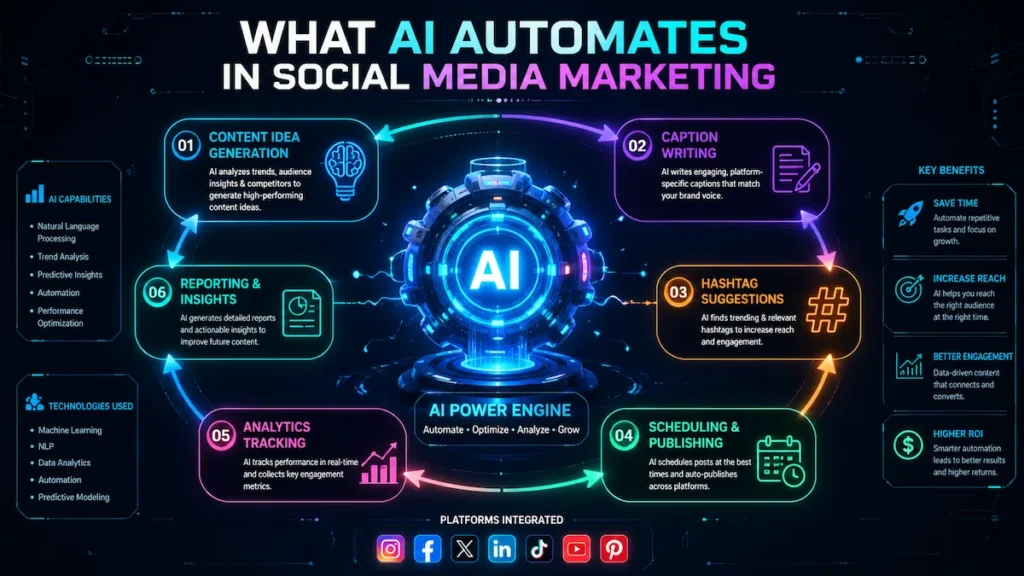
AI content generation tools produce solid first drafts of social captions and suggest relevant hashtags quickly.
For high-volume content needs, this is genuinely useful. A skilled manager reviews, edits, and approves—rather than writing from scratch every time.
This task is largely automated. Professionals who treat caption writing as their core value proposition are already feeling the squeeze.
Automated Posting and Scheduling
Smart scheduling tools determine the best times to post based on audience data, reducing guesswork and improving organic reach.
This has been automated for years. AI has just made it more accurate.
It’s no longer a differentiating skill for social media managers — it’s table stakes.
Automated Reporting and Data Insights
AI-powered dashboards compile performance data, generate weekly reports, and highlight key metrics without manual data entry.
This saves hours of administrative work and redirects manager time toward analysis and action rather than data collection.
The reporting function, once a billable skill, is rapidly becoming a commodity.
Here’s the reality:
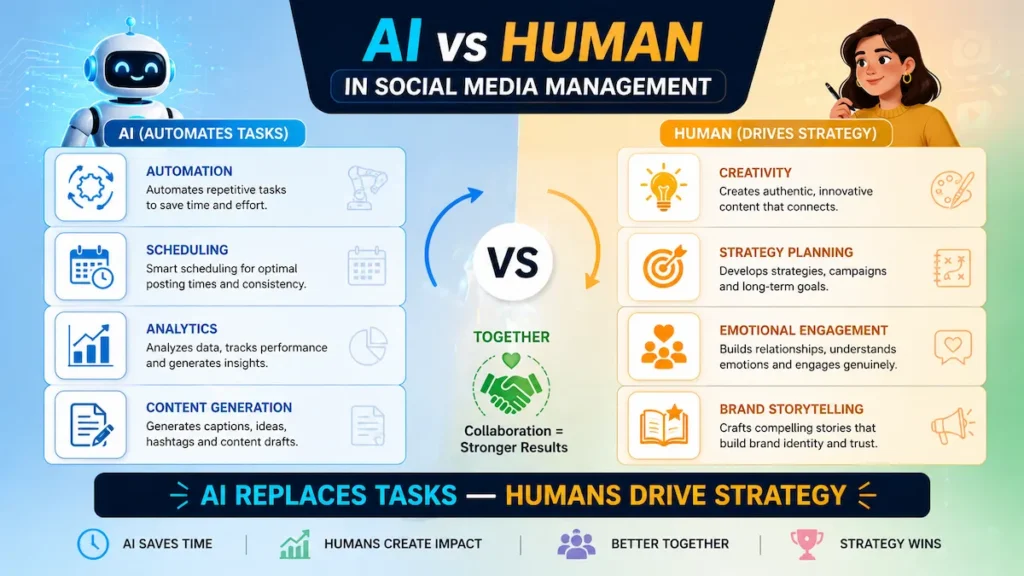
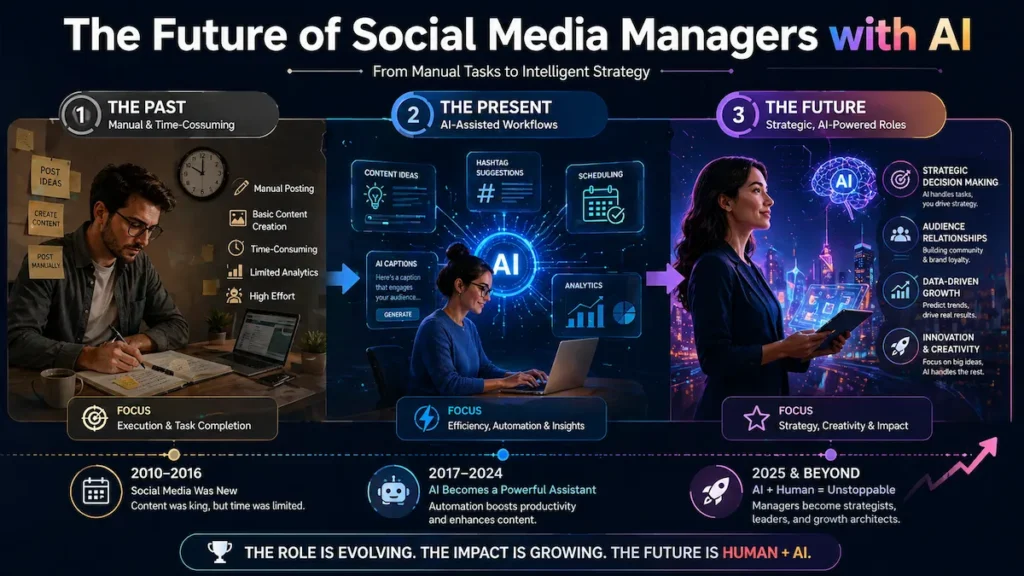
AI replaces tasks. Humans drive strategy.
This is the line that defines the future of social media marketing.
That’s the distinction every social media professional needs to internalize—and build their entire career positioning around.
Tasks AI Cannot Replace—The Real Answer to “Will AI Replace Social Media Managers”
This is where the replacement argument collapses entirely.
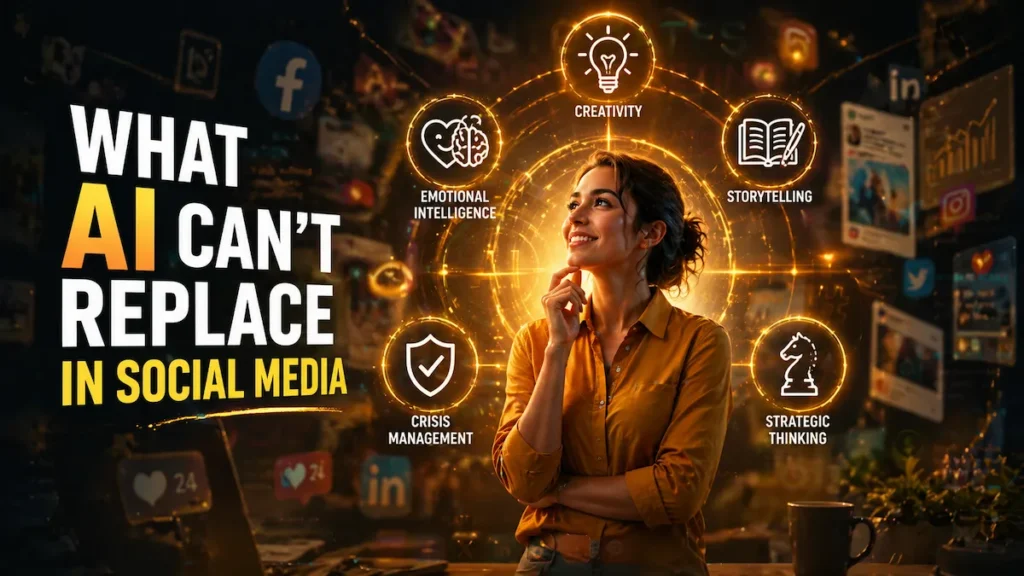
There are fundamental dimensions of this job that require human intelligence, creativity, and judgment that no current AI can reliably replicate.
Creative Brand Storytelling
Stories that genuinely connect come from humans who understand human experience.
The best brand content taps into emotion, culture, shared values, and timely moments in ways that feel real — because they are real. AI generates content that reads well. It consistently struggles to generate content that resonates at the level great brand storytelling requires.
This is precisely why the debate around AI vs. human creativity in marketing remains wide open—and why human creative judgment still commands a premium in every serious marketing organization.
Crisis Management and Brand Reputation
When a brand faces backlash, a PR crisis, or a sensitive cultural moment, a social media manager has to make rapid, high-stakes decisions.
What do we post? What do we delete? Do we respond or stay quiet? How do we rebuild trust with an audience that feels betrayed?
These decisions require judgment, empathy, and a deep understanding of the brand’s values and its relationship with its audience. Getting it wrong can cost a company millions in lost trust and revenue.
AI is nowhere near equipped to handle this responsibly.
Handing a brand crisis to an algorithm isn’t efficiency. It’s a liability.
Emotional Intelligence in Community Engagement
Community management is relationship work.
It requires reading emotional subtext in comments, knowing when to engage and when to de-escalate, and making individual customers feel genuinely seen and valued.
That’s not something you can automate with a prompt. It’s something you have to feel and respond to in real time—and audiences notice the difference immediately.
The Future of Social Media Managers—Will AI Replace Social Media Managers or Elevate the Role?
The digital marketing future doesn’t look like a world without social media managers.
It looks like a world where social media managers are more capable, more strategic, and more valuable because of AI—not despite it.
Why AI Will Become a Marketing Assistant, Not a Replacement for Social Media Managers
Think about how AI works in other high-skill professions.
Lawyers use AI-powered legal research tools. Architects use generative design software. Surgeons use robotic assistance. In every case, the tool made the professional more capable—it didn’t make the professional obsolete.
AI in social media marketing works the same way.
It handles the repetitive and the data-heavy so human professionals can spend more time on strategy, creativity, and the relationship-building that actually drives brand loyalty and business growth.
If you’re still asking whether AI can truly replace digital marketers, the consistent pattern across every marketing discipline is the same: augmentation, not replacement.
Skills Social Media Managers Must Develop to Stay Relevant
The marketers who will thrive are the ones who treat AI fluency as a core professional skill.
That means learning how to prompt AI tools effectively, how to evaluate and edit AI-generated content, and how to use automation platforms strategically to multiply their own output.
Beyond AI literacy, the skills that will always matter—creative thinking, strategic planning, emotional intelligence, and brand judgment—become more valuable as AI handles the mechanical work.
According to the World Economic Forum’s Future of Jobs Report, critical thinking, creativity, and complex problem-solving are among the skills least susceptible to automation. Those are, not coincidentally, the exact skills great social media managers already use every day.
If you want to future-proof your marketing career, your next step should be exploring where digital marketing careers are heading with AI in 2026—because the opportunity for prepared professionals has never been bigger.
Here’s the contrarian insight most people miss:
The real risk isn’t that AI replaces social media managers.
It’s that average social media managers who don’t use AI will be replaced by those who do.
That’s the actual threat—and the actual opportunity.
Pros and Cons of AI in Social Media Marketing
Pros:
- Faster content creation and ideation at scale
- Automation efficiency that significantly reduces repetitive workloads
- Better analytics, predictive insights, and smarter campaign targeting
Cons:
- Creativity limitations—AI output frequently lacks originality, cultural nuance, and authentic personality
- Over-automation risks—brands managed primarily by AI begin to feel robotic and disconnected
- Loss of authentic brand voice when AI-generated content isn’t carefully managed and humanized
Frequently Asked Questions About Whether AI Will Replace Social Media Managers
Will AI replace social media managers completely?
No, AI will not completely replace social media managers. While AI effectively automates repetitive tasks like scheduling, caption drafting, and basic reporting, the strategic, creative, and relational dimensions of the role require human expertise that current AI cannot replicate. The profession is evolving—not disappearing.
Is social media management still a good career in 2026?
Yes, and it’s stronger for professionals who adapt. Demand for skilled social media strategists continues to grow, and those who combine human creativity with AI tool proficiency are among the most sought-after candidates in today’s marketing job market.
What marketing skills are future-proof against AI?
Brand strategy, creative storytelling, crisis management, emotional intelligence, community relationship building, and AI tool management are all highly future-proof skills. These are the areas where human judgment adds irreplaceable value—and where AI consistently falls short.
How can marketers work effectively with AI tools?
Start by identifying the repetitive, time-consuming tasks in your workflow—caption drafts, scheduling, data reporting—and use AI tools to handle those. Redirect the time you save toward strategy, campaign development, community engagement, and the creative work where your human insight creates real competitive advantage.
AI works best as a starting point, not a final product.
Will AI replace social media managers in smaller businesses first?
No, AI will not fully replace social media managers in small businesses either. While AI tools can handle scheduling, captions, and basic analytics, small businesses still rely heavily on human creativity, brand understanding, and real-time decision-making. In fact, the question of will AI replace social media managers is often misunderstood—AI reduces workload but doesn’t replace the strategic role humans play.
Why are people asking will AI replace social media managers in 2026 specifically?
The concern has grown in 2026 because AI tools have become more advanced and widely accessible. Platforms now automate tasks that once required dedicated staff, making the question will AI replace social media managers more common across marketing teams. However, the reality is that AI is improving efficiency, not removing the need for human-led strategy and emotional intelligence.
How should beginners respond to the idea of will AI replace social media managers?
Beginners should see AI as an opportunity rather than a threat. The question will AI replace social media managers often creates unnecessary fear, but the real shift is toward hybrid roles where humans use AI to work faster and smarter. Those who learn how to combine creativity with AI tools will actually become more valuable in the job market.
Conclusion—Will AI Replace Social Media Managers or Build a More Powerful Version of the Role?
So, will AI replace social media managers?
The evidence points clearly in one direction: no. But it will absolutely transform what the role looks like, what skills matter most, and where human professionals need to focus their energy.
The marketers who treat this moment as a threat will fall behind. The ones who treat it as an opportunity will build careers that are more efficient, more strategic, and more impactful than anything that was possible before AI entered the picture.
AI handles the volume. Humans provide the vision.
That’s not a competition—it’s a partnership. And the future of social media marketing belongs to professionals who know how to make both work together.
If you’re a social media manager reading this: learn the tools, sharpen your strategy, and lean hard into what makes you irreplaceable. Your creativity, judgment, emotional intelligence, and human connection are the things AI will never fully replicate.
In a world flooded with automated content, those qualities are becoming more valuable—not less.
The marketers who understand this shift early won’t just survive it—they’ll lead it.