
What Is the AI Impact on Digital Marketing Careers?
The AI impact on digital marketing careers is no longer a future forecast.
It is happening right now — in real job descriptions, real campaign workflows, and real marketing budgets across every industry.
Artificial intelligence has moved from a buzzword into the operational backbone of how brands attract, engage, and convert customers. Search engine optimization, paid media, email automation, content strategy, analytics — every layer of digital marketing is being rebuilt around machine learning, generative AI, and predictive systems.
Here is the direct answer most marketers searching this topic actually need:
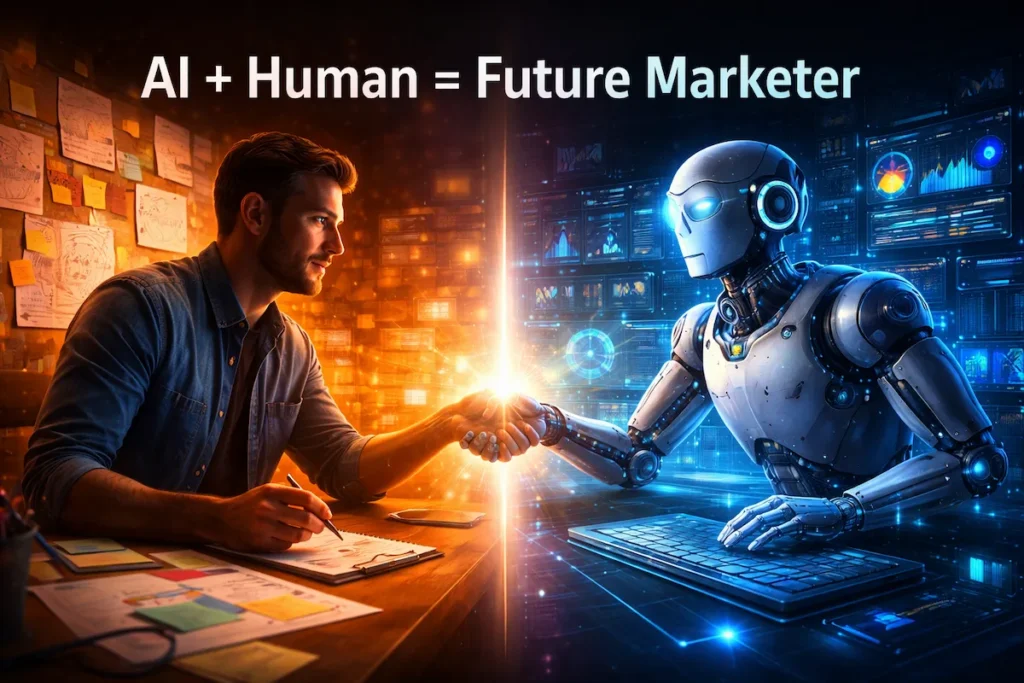
What is the AI impact on digital marketing careers? AI is restructuring marketing roles rather than eliminating the profession. It is automating execution-heavy tasks, compressing some entry-level positions, and simultaneously creating entirely new strategic and technical roles. Marketers who adapt will thrive. Those who do not face real displacement pressure. The shift is already well underway.
According to the World Economic Forum (Future of Jobs Report 2025), job disruption will affect 22% of all roles by 2030 — with 170 million new positions projected to be created even as 92 million are displaced, resulting in a net gain of 78 million jobs globally.
McKinsey reports that revenue increases from AI are most consistently observed in marketing and sales — making it one of the functions where AI is generating the clearest, most measurable business impact right now.
The question is not whether AI will change your marketing career. It already has. The question is whether you are ahead of that change or reacting to it too late. The AI impact on digital marketing careers is already reshaping how marketing teams operate across industries.
How AI Is Reshaping Marketing Roles by Discipline
The AI impact on digital marketing careers can be clearly seen in how every marketing discipline is being restructured.
Content Marketing: From Production to Editorial Direction
The core definition of the AI impact on digital marketing careers shows a shift from manual execution to AI-assisted strategy and automation. Content marketing is the most visibly disrupted area of digital marketing.
Generative AI tools — including ChatGPT, Claude, Gemini, and platforms like Jasper — can draft blog posts, product descriptions, and social copy in seconds. This has fundamentally changed what content marketers are hired to do.
The AI impact on digital marketing careers in content marketing is shifting professionals from production-heavy work to strategic content direction. Having worked on content strategy for brands navigating this transition, the pattern I see repeatedly is this:
Marketers who struggle are treating AI as a ghostwriter. Marketers who are thriving are using it as a research assistant and first-draft accelerator — while bringing their own editorial judgment, domain expertise, and lived experience to the final product.
That human layer is exactly what Google’s Helpful Content System and E-E-A-T guidelines reward. It is also what no AI tool can fabricate at scale.
Key takeaway: The content marketer’s role has shifted from production to curation, editorial direction, and quality control. If you are still being measured purely by word count output, your role has already changed — whether your employer has acknowledged it or not.
For a deeper look at whether this means AI is displacing the content profession entirely, see our full analysis of AI replacing digital marketers: separating reality from hype.
SEO: Adapting to AI Overviews and Semantic Search
The AI impact on digital marketing careers in SEO is driving a move toward semantic search, AI Overviews, and authority-based optimization.
Search engine optimization has been transformed at every level — from keyword research to technical audits to content structure. A key insight into the AI impact on digital marketing careers is that roles are evolving rather than disappearing completely.
Google’s AI Overviews now appear above traditional organic results for a significant share of informational queries, pulling synthesized answers directly from the web. This is reducing click-through rates for content that used to dominate page one, particularly for broad informational searches.
According to the World Economic Forum (Future of Jobs Report 2025), AI and big data top the list of fastest-growing skills through 2030. SEO professionals are directly downstream of both.
In real campaigns I have seen work, the response that is consistently producing results involves three strategic adjustments:
- Shifting toward bottom-of-funnel content that AI Overviews rarely displace
- Implementing structured data and schema markup so content is cited within AI-generated answers rather than simply bypassed
- Building topical authority clusters that signal comprehensive expertise to both traditional rankings and AI-powered search systems
Technical SEO tasks — crawl analysis, redirect mapping, log file analysis — are now largely AI-assisted. Strategic decisions about information architecture, topical prioritization, and competitive positioning still require experienced human judgment.
Key takeaway: SEO is shifting from keyword targeting to knowledge architecture. The SEOs who understand how to position content for AI-mediated search will define the discipline over the next three years.
Paid Media and PPC: The Strategy-First Shift
The AI impact on digital marketing careers in paid media is reducing manual optimization tasks while increasing strategic oversight responsibilities. Paid advertising has been transformed more completely by AI than almost any other marketing discipline.
Google’s Performance Max and Meta’s Advantage+ suite have absorbed large portions of what PPC analysts once did manually — audience targeting, bid optimization, creative testing, and budget allocation are now handled by machine learning systems that process more signals per millisecond than any analyst could in a week.
Will AI replace PPC analysts? Not entirely — but it has already replaced the most manual parts of the role. What remains is strategic oversight: setting the right campaign objectives, recognizing when automated systems are optimizing toward a proxy metric rather than a real business outcome, and providing the creative inputs that machine learning cannot generate on its own.
PPC specialists who understand how to feed AI systems correctly — with high-quality creative assets, accurate conversion data, and well-structured campaign architecture — are consistently outperforming those still focused on manual bid management.
For a broader look at how AI agents are reshaping paid and organic marketing workflows end-to-end, see our guide on AI agents for digital marketing.
Key takeaway: PPC has become a strategy-first discipline. Creative direction and campaign architecture are now the primary value a paid media specialist delivers.
Email and Marketing Automation: Expanding Capability
Email and automation are areas where AI is expanding what marketers can accomplish — without necessarily eliminating roles. The AI impact on digital marketing careers in email marketing is expanding personalization and automation while changing the role of marketers.
Predictive send-time optimization, AI-generated subject line testing, behavioral segmentation, and dynamic content personalization are now standard in platforms like HubSpot, Klaviyo, ActiveCampaign, and Salesforce Marketing Cloud.
McKinsey reports that contact-center automation and AI-assisted content support for marketing strategy are among the most widely adopted AI use cases across business functions in 2025 — and email automation sits at the intersection of both.
Key takeaway: The most valuable automation specialists today are those who can design the logic behind AI-personalized journeys — not just execute the technical setup. Behavioral trigger strategy and lifecycle architecture are skills AI amplifies but cannot replace.
Analytics: Interpretation Has Become the Premium Skill
Marketing analytics has always required a blend of technical skill and business judgment. AI now handles large portions of the technical side — data cleaning, pattern detection, anomaly identification, and predictive modeling — faster than any human team. The AI impact on digital marketing careers in analytics is increasing demand for interpretation, storytelling, and decision-making skills.
This creates a clear premium on interpretation over generation.
According to the World Economic Forum (Future of Jobs Report 2025), analytical thinking remains the most sought-after core skill among employers — with seven in ten companies citing it as essential in 2025.
Generating a dashboard is trivially easy with AI. Understanding why a metric changed, what it implies for strategy, and how to communicate it to a non-technical leadership team remains genuinely difficult — and genuinely valuable.
Key takeaway: Data fluency without analytical storytelling is becoming a commodity. The combination of technical literacy and business communication is where the real compensation premium lives.
Jobs at Risk vs. Jobs Being Created: The Honest Picture
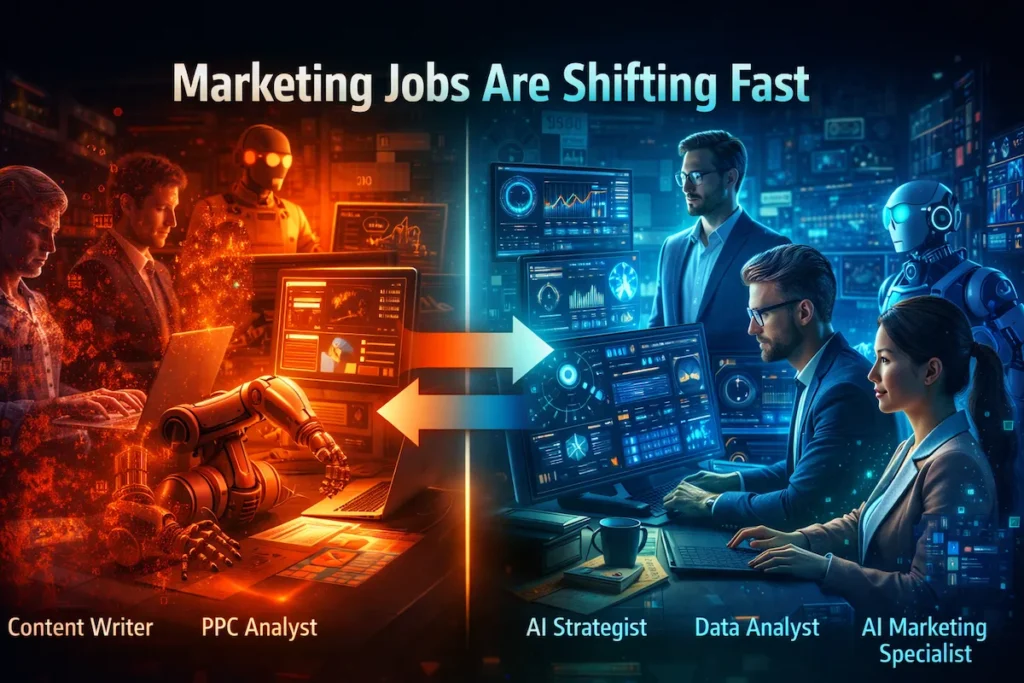
The AI impact on digital marketing careers is creating a clear divide between roles that are being automated and roles that are emerging.
Which Marketing Roles Face the Highest Displacement Pressure
The AI impact on digital marketing careers shows that repetitive and entry-level execution roles are under the highest automation pressure.
The AI impact on marketing careers is not evenly distributed. Disruption is most concentrated in roles where work is repetitive, output-volume-focused, or heavily templated — not roles that require strategic judgment or creative direction.
| Role Under Pressure | Why AI Is Displacing It |
|---|---|
| Junior content writers (templated output) | Generative AI matches speed at lower cost |
| Entry-level PPC analysts (manual bidding) | Automated bidding absorbs core tasks |
| Ad production (resizing, creative variants) | Adobe Firefly, Canva AI, platform-native tools |
| Social media schedulers | AI-powered scheduling and caption generation |
| Basic data entry and reporting roles | Auto-generated dashboards and AI summaries |
Let’s be direct about something important:
AI is not replacing marketers. It is replacing average marketers — specifically, those whose professional value is anchored in high-volume task execution rather than strategic thinking, creative direction, or domain expertise.
That distinction matters enormously for how you should plan your career over the next two to three years.
For a comprehensive breakdown of which roles face the most structural risk, read our detailed analysis of whether AI can replace digital marketing jobs.
Which Marketing Roles Are Growing Because of AI
At the same time, AI is generating new roles that did not exist at scale five years ago. These positions command significant compensation premiums precisely because the skills required are rare. The AI impact on digital marketing careers is also creating new roles focused on AI strategy, automation systems, and predictive marketing.
| Emerging AI-Driven Role | Core Function |
|---|---|
| AI Content Strategist | Builds human + AI content systems at scale |
| Prompt Engineer (Marketing) | Crafts AI inputs for brand-consistent output |
| Marketing AI Ops Specialist | Manages and monitors AI tool integrations |
| AI-Augmented SEO Specialist | Focuses on E-E-A-T and AI search optimization |
| Conversational Marketing Manager | Designs AI chatbot and LLM-powered journeys |
| Predictive Analytics Marketing Manager | Uses AI forecasting to drive campaign strategy |
These roles share a common thread: they require professionals who understand both the marketing discipline and the AI systems operating within it. That combination is genuinely scarce — and therefore genuinely valuable.
For context on how AI is reshaping advertising specifically — including creative automation and AI-generated ad formats — see our breakdown of AI in advertising: powerful strategies and tools.
The AI Career Adaptation Framework
The AI impact on digital marketing careers requires a structured skill-building approach to stay relevant in evolving roles.
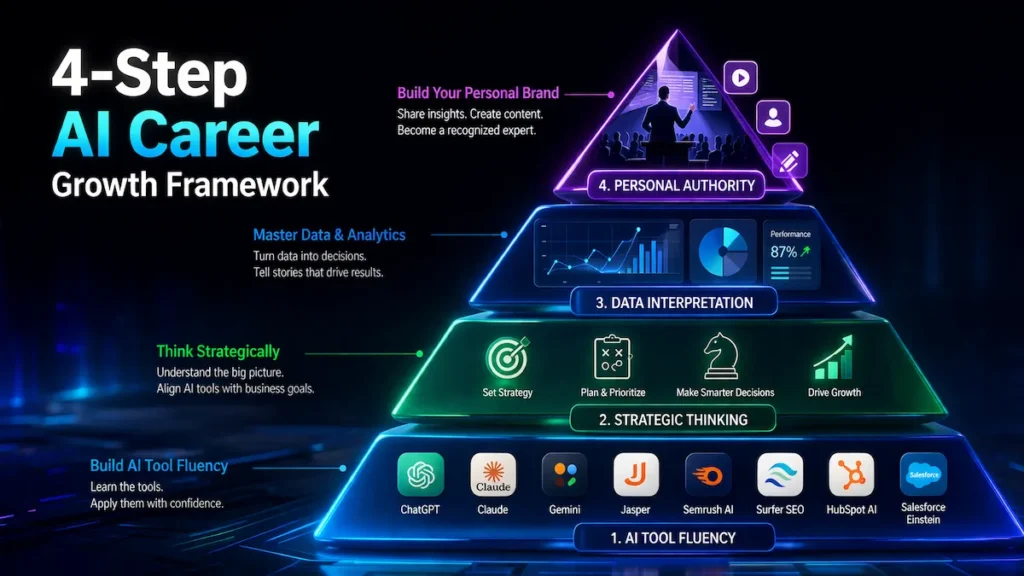
Most career advice about AI is either too abstract or too tool-specific. What actually works is a layered approach — building capabilities in a deliberate sequence rather than scrambling to learn every tool at once.
Here is the framework I have seen produce the clearest results in practice:
Layer 1 — AI Tool Fluency Know which AI tools exist in your discipline, how to use them effectively, and what their outputs actually look like in production. This is the foundation. Without it, everything above is theoretical. The AI impact on digital marketing careers begins with mastering AI tools relevant to your specific marketing discipline.
Start here: Learn one AI tool per marketing channel. Do not try to master everything simultaneously.
Layer 2 — Strategic Thinking Understand how AI tools fit into broader campaign strategy. Know when to use them, when to override their output, and how to set objectives that automated systems can optimize toward effectively. The AI impact on digital marketing careers becomes clearer when marketers learn how to guide AI tools toward business goals.
Milestone: You can explain to a non-technical stakeholder why an AI system made a specific recommendation — and whether to act on it.
Layer 3 — Data Interpretation Move beyond reading AI-generated reports to questioning them. Develop the ability to identify when an AI system is optimizing toward the wrong metric, drawing false correlations, or missing important context. The AI impact on digital marketing careers grows stronger as professionals shift from reading data to interpreting AI-driven insights.
Milestone: You catch a meaningful insight that an automated dashboard missed — and you know why it was missed.
Layer 4 — Personal Authority Build a visible, verifiable track record of expertise. Publish under your own name. Develop original research. Become known for a specific point of view in your discipline. The AI impact on digital marketing careers rewards marketers who build visible expertise and original thought leadership.
Milestone: Your name — not just your employer’s — carries professional weight in your area of specialization.
This framework is not sequential in a rigid sense. But most marketers who are thriving in an AI-augmented environment have moved through these layers more or less in this order.
For a deep look at the specific tools driving this transformation, see our guide on AI tools for creative agencies and marketing teams.
The Skills That Define Career Success in 2026
The AI impact on digital marketing careers is reshaping which skills are valuable and which are becoming outdated.
What Actually Matters Now
According to the World Economic Forum (Future of Jobs Report 2025), 39% of workers’ existing skill sets will be transformed or become outdated between 2025 and 2030. For marketing professionals, that transformation is concentrated in a specific skill set.
Skills becoming less valuable: Manual execution of tasks AI now handles faster — standard bid management, templated copywriting, basic data pulls, routine social scheduling. The AI impact on digital marketing careers shows that repetitive execution skills are becoming less valuable in modern marketing roles.
Skills becoming more valuable:
Prompt engineering — The difference between a marketer who gets mediocre AI output and one who consistently produces usable first drafts comes down almost entirely to prompt quality. This is learnable, teachable, and being underprioritized by most marketing organizations right now.
Strategic AI tool selection — Knowing which tool to use for which task — and critically, when not to use AI — is an emerging form of marketing judgment that separates good operators from great ones.
Data interpretation and storytelling — McKinsey reports that AI’s impact on marketing is most measurably felt in content support for marketing strategy and in analytics functions. Marketers who translate AI output into real business strategy are commanding the highest professional leverage.
Original research and first-hand expertise — AI cannot conduct original interviews, run proprietary surveys, or reflect genuine lived experience. Marketers who build a track record of producing unique data and authentic expert perspective create content that AI tools cannot replicate — and that Google actively prioritizes under its E-E-A-T framework.
Human storytelling and brand voice — The content performing best in an AI-saturated environment carries distinctive perspective, genuine narrative, and verifiable expertise. Developing and protecting a recognizable voice — your organization’s or your own — is one of the highest-leverage career investments a marketer can make right now.
How to Future-Proof Your Marketing Career Against AI
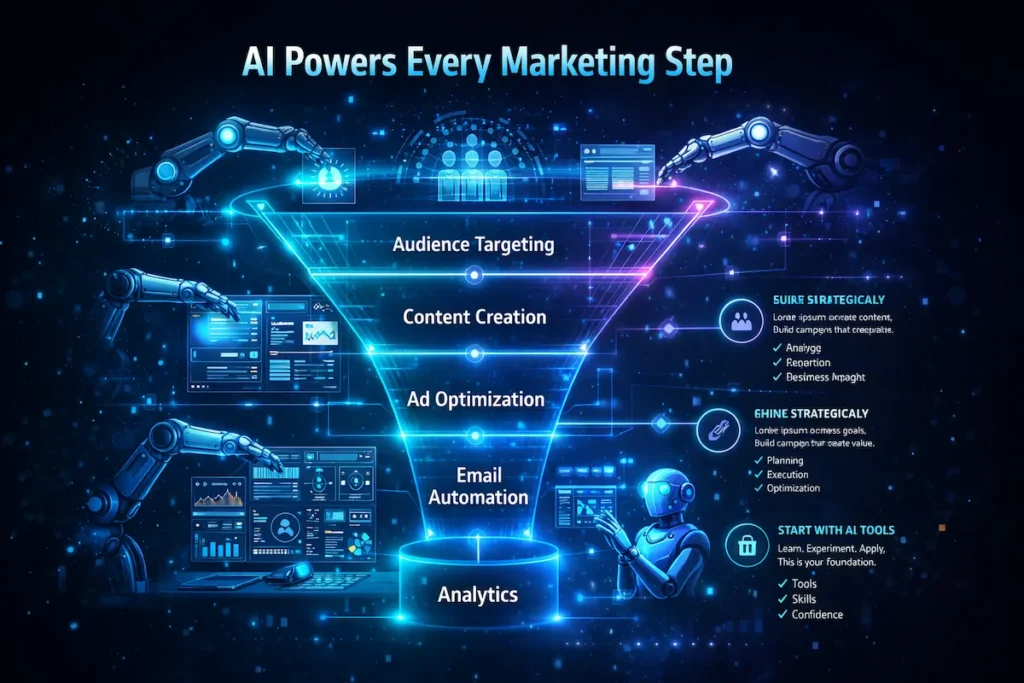
The AI impact on digital marketing careers makes future-proofing essential through continuous learning and strategic adaptation.
Practical Strategies That Are Working Right Now
The AI impact on digital marketing careers rewards marketers who adopt AI tools before they become industry standards. Here is the honest truth that most career advice in this space avoids stating directly:
The real risk is not AI. It is marketers who refuse to develop strategic judgment and data fluency while AI rapidly absorbs the execution layer beneath them.
Based on what is working across real marketing organizations in 2025 and 2026, here are the approaches worth prioritizing:
Adopt AI tools before they are mandated. Marketers who experiment proactively build genuine fluency. Those who wait until their employer requires it are perpetually behind. Start with the AI tools most relevant to your discipline and use them consistently — not occasionally.
Build a T-shaped AI skill profile. Broad familiarity with AI across marketing disciplines, combined with deep expertise in one specific area, creates a profile that is both versatile and specialized. This combination is commanding significant compensation premiums in the current market. The AI impact on digital marketing careers favors professionals who combine broad AI awareness with deep marketing expertise.
Connect your work to business outcomes — every time. AI produces outputs efficiently. What organizations will continue to value is marketers who connect their work to revenue growth, pipeline quality, customer retention, and market share. Reframe every project you own around the business outcome it serves, not the deliverable it produces.
Make your expertise visible. E-E-A-T rewards demonstrated authority. Publishing under your own name, contributing to industry publications, and maintaining an active professional presence creates credentials that AI cannot manufacture — and that protect your career from commoditization over time.
Stay rigorously current. Coursera’s data in the WEF Future of Jobs Report 2025 shows that generative AI training saw over 3.2 million enrollments in 2024 alone — an average of six enrollments per minute, up from two per minute in 2023. The learning curve is steep and accelerating. Structured courses, professional communities, and hands-on experimentation are not optional for career longevity.
For a focused breakdown of the question most marketers are privately asking right now, see our analysis of will AI replace marketing jobs — the full 2025 and 2026 guide.
The 2026 Outlook: Where the AI Impact on Marketing Careers Is Heading
The AI impact on digital marketing careers will continue to deepen as AI becomes fully integrated into marketing systems worldwide.
Long-Term Signals Worth Paying Attention To
McKinsey’s State of AI (2025) reports that 88% of organizations now use AI in at least one business function — and 72% report using generative AI, up from just 33% one year prior. Marketing is one of the primary deployment zones.
That adoption rate has direct consequences for headcount structures, role definitions, and compensation across the industry. The most credible forecasts point toward a genuine bifurcation in the marketing job market over the next three to five years.
Marketers whose value will increase: Those who develop strategic judgment, AI fluency, original expertise, and the ability to interpret data through the lens of business outcomes. This cohort will have leverage that previously required full departments to achieve.
Marketers who will face sustained pressure: Those whose value proposition remains anchored in high-volume execution — content production, manual campaign management, templated reporting — without building the higher-order skills that AI amplifies rather than replaces.
According to McKinsey’s 2025 State of AI research, more than 70% of companies expect to reskill at least 11% of their workforce in the next three years specifically in response to AI integration. Proactive upskilling is already a strategic corporate priority — not a distant concern.
The good news is this: the AI impact on digital marketing careers is ultimately an expansion of what the profession can accomplish. Marketing is not disappearing. It is evolving into something more strategic, more data-informed, and more technology-integrated than at any point in its history. The marketers who embrace that evolution will define what the profession looks like a decade from now.
Frequently Asked Questions
The AI impact on digital marketing careers raises important questions about job security, skills, and future opportunities.
Will AI replace digital marketing jobs entirely?
No. AI is automating specific tasks and displacing some entry-level roles, but marketing as a discipline requires strategic judgment, creative direction, and relationship-driven skills that current AI systems cannot replicate. The AI impact on digital marketing careers is structural transformation — not elimination.
Which marketing skills are most resistant to AI displacement?
Strategic thinking, prompt engineering, original research and first-hand expertise, data storytelling, human brand voice development, and relationship-driven skills are the most durable. These are the capabilities AI amplifies rather than replaces.
How quickly is AI changing digital marketing careers?
The change is already in progress and accelerating. Platform-level integrations — Google’s Performance Max, Meta’s Advantage+, AI Overviews in search — have already restructured significant portions of marketing work. The pace will continue to increase through 2026 and beyond.
What AI tools should digital marketers prioritize learning in 2026?
For content: ChatGPT and Claude. For SEO: Semrush AI and Surfer SEO. For automation and analytics: HubSpot AI and Salesforce Einstein. For paid media: Google Performance Max and Meta Advantage+. Building literacy across these categories reflects the real breadth of AI’s impact on how marketing work gets done.
Is digital marketing still a good career path in the age of AI?
Yes — provided you build AI fluency alongside marketing fundamentals from the start. Entry-level marketers who treat AI as a core professional skill, not an optional add-on, will be significantly better positioned than those who treat it as a threat to avoid.
Conclusion: Your Next Move
The AI impact on digital marketing careers is the most significant professional disruption this industry has seen since digital advertising itself emerged. It is creating real pressure on certain roles while simultaneously opening new opportunities for marketers who invest in the right capabilities.
The professionals who will lead the next decade understand AI as a powerful tool with specific limitations — and they deliberately build the human capabilities that give AI output its meaning: strategy, editorial judgment, creative direction, and genuine domain expertise.
Here is where to go next based on your role:
- If you are in SEO: Start with our guide on AI replacing digital marketers to understand the full strategic picture, then move to our breakdown of AI agents for digital marketing for workflow-level tactics.
- If you are in paid media or advertising: Begin with our analysis of AI in advertising: strategies and tools.
- If you are managing a team or agency: See our breakdown of the best AI tools for creative agencies for a practical evaluation framework.
- If you are assessing your job security: Read our direct assessment of can AI replace digital marketing jobs — it gives you an honest answer without the hype.
Bookmark this guide and use it as your AI career roadmap. The marketers who act on this framework now will not be asking whether AI is a threat in two years. They will be the ones others are asking for advice.
Authoritative Sources
- Future of Jobs Report 2025 — World Economic Forum
- The State of AI 2025: Agents, Innovation, and Transformation — McKinsey & Company
- Coursera × WEF Generative AI Enrollment Data — Coursera Blog
- Google Search Central — E-E-A-T and Helpful Content Guidelines — Google
- How AI Is Redefining Jobs and the Future of Work — MarketingProfs