
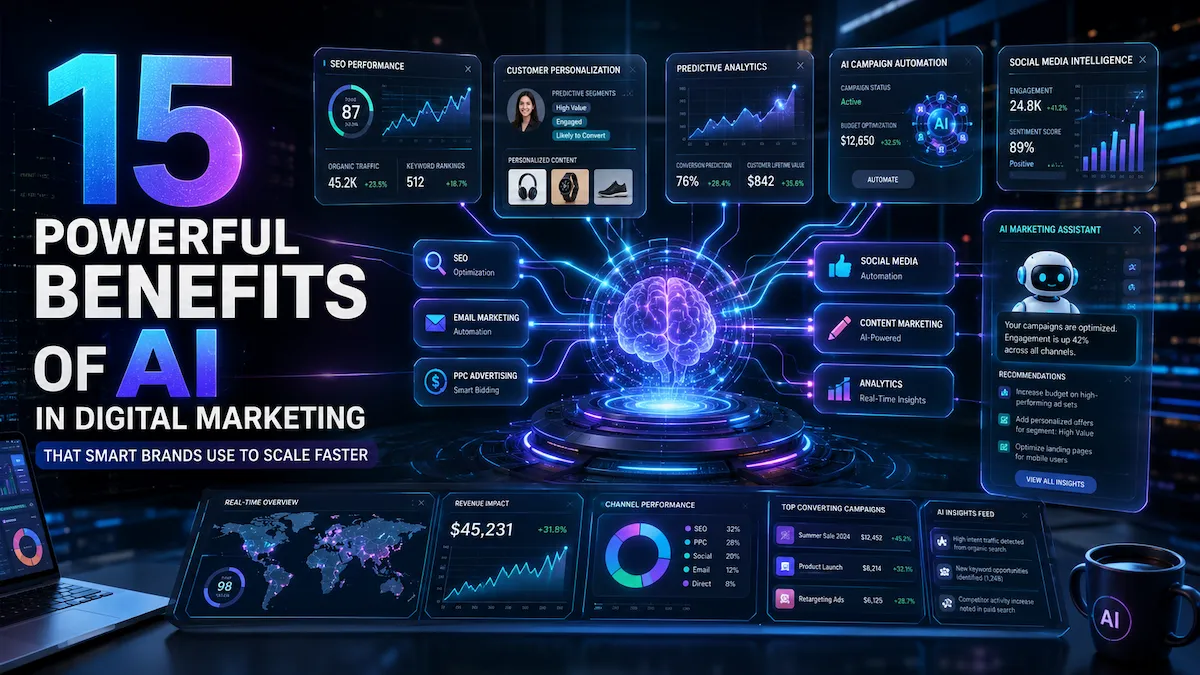
Quick Answer — Featured Snippet: The top benefits of AI in digital marketing include smarter customer personalization, faster content creation, AI-powered SEO, predictive analytics, automated advertising, AI chatbots, improved conversion rates, semantic SEO automation, real-time SERP monitoring, and autonomous campaign optimization. Together, these capabilities help businesses reduce costs, improve targeting accuracy, and scale marketing operations faster than any traditional method allows.
The benefits of AI in digital marketing are transforming how brands scale content production, personalize customer experiences, automate campaigns, and improve marketing performance in 2026.
What Is AI in Digital Marketing?
Understanding the benefits of AI in digital marketing starts with learning how artificial intelligence automates, personalizes, and optimizes modern marketing workflows.
Artificial intelligence in digital marketing refers to the use of machine learning models, natural language processing, predictive algorithms, and automation systems to plan, execute, optimize, and personalize marketing activities at scale.
That covers a broad range — from AI-powered content generation and intelligent chatbots to predictive lead scoring and autonomous ad campaign management.
The scale of adoption tells the story clearly. According to Salesforce’s State of Marketing report, 84% of marketers now use AI in some form across campaign execution and analytics — up dramatically from just 29% five years ago. That isn’t gradual adoption. That’s an industry-wide shift.
How AI Is Transforming Modern Marketing
One of the biggest benefits of AI in digital marketing is the ability to compress the gap between data analysis, decision-making, and campaign execution.
The most meaningful shift AI brings isn’t that it replaces human thinking. It’s that it compresses the feedback loop between data, decision, and action to near-zero.
Traditionally, a marketing team might spend a week analyzing campaign data, drawing insights, building creative assets, testing variations, and re-optimizing. An AI system handles much of that continuously in the background while your team stays focused on strategy and creative direction.
The benefits of AI in digital marketing show up most clearly when organizations stop treating it as a tech add-on and start building entire workflows around AI capabilities. For a broader look at where AI fits into 2026 marketing strategy, this complete guide to AI in digital marketing covers the strategic foundation in depth.
Why Businesses Are Rapidly Adopting AI Marketing
The growing benefits of AI in digital marketing are pushing businesses to adopt AI tools faster to improve scalability, efficiency, and competitive advantage.
Cost efficiency is one driver. Scalability is another. But the deeper force is competitive necessity. When competitors use AI for audience segmentation, ad optimization, and content personalization, staying manual creates a structural disadvantage that compounds every quarter.
McKinsey’s research on AI in business finds that companies integrating AI into core marketing operations report revenue uplifts of 3–15% and sales ROI improvements of 10–20% compared to peers using traditional approaches. That data is hard to ignore.
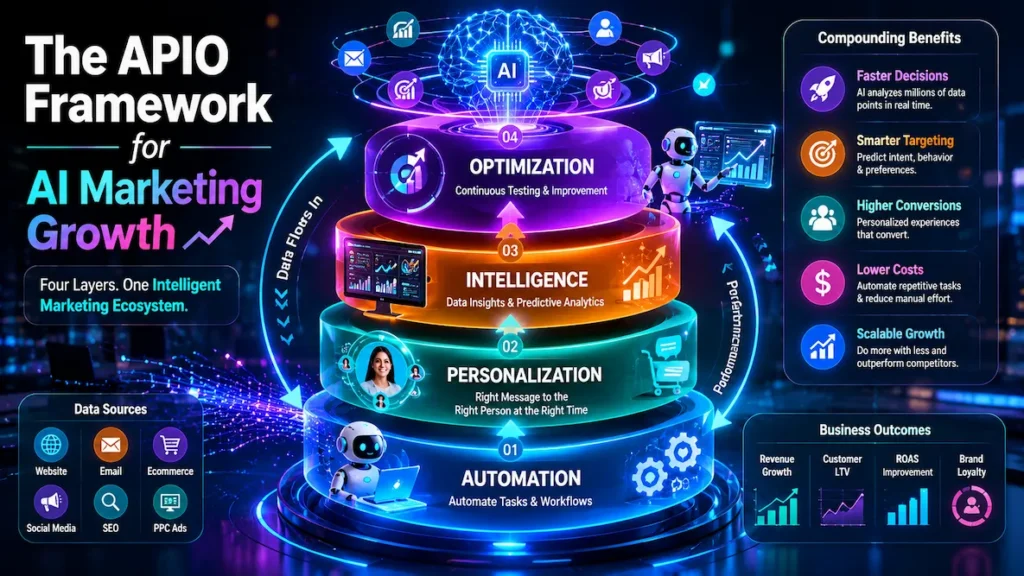
The APIO Framework: How Elite Brands Structure AI in Marketing
The benefits of AI in digital marketing become more powerful when businesses implement AI through structured frameworks like APIO.
The most effective approach we see across audits of high-performing marketing teams is what we call the APIO Framework: four layers that work together to produce compounding results.
[Visual Opportunity — APIO Framework Diagram] A four-layer pyramid or closed loop: Automation (base) → Personalization → Intelligence → Optimization (top), with arrows showing each layer feeding the next in a continuous cycle. Brand color palette. Clean, minimal design.
Layer 1 — Automation: Remove manual execution from high-volume, repeatable tasks. Content drafting, reporting, bid management, email sequencing, and internal linking.
Layer 2 — Personalization: Use behavioral data to deliver the right message to the right person at the right moment. Dynamic content, segmented email flows, adaptive ad creative.
Layer 3 — Intelligence: Turn data into decisions through AI analytics, predictive modeling, intent analysis, and customer behavior forecasting.
Layer 4 — Optimization: Close the feedback loop. AI continuously tests, learns, and improves performance across every layer above it.
Key Insight: Teams that implement only Layer 1 get efficiency gains. Teams that implement all four layers get compounding competitive advantage. Most businesses are stuck at Layer 1 or 2. The biggest gains—and the clearest benefits of AI in digital marketing—live at Layers 3 and 4.
15 Benefits of AI in Digital Marketing
The core benefits of AI in digital marketing include automation, personalization, predictive analytics, smarter SEO, and improved conversion optimization.
Quick Reference — All 15 Benefits
- Improved customer personalization at scale
- Faster AI-powered content creation
- Better SEO optimization through semantic analysis
- Smarter advertising campaigns with improved ROAS
- Advanced data analytics and business intelligence
- AI-powered email marketing that adapts by behavior
- AI chatbots for 24/7 engagement and lead qualification
- Increased conversion rates through behavioral targeting
- Workflow automation that multiplies team output
- Predictive customer behavior analysis and LTV forecasting
- AI-powered lead generation and intelligent scoring
- Semantic SEO automation and topic cluster management
- Real-time SERP monitoring and content intelligence
- AI-driven social media optimization and planning
- Autonomous campaign budget allocation and bidding
Benefit 1: Improved Customer Personalization
Bottom line: AI delivers 1:1 personalization at scale — something no manual process can replicate.
AI systems analyze behavioral signals—browsing history, purchase patterns, email engagement, and content interactions—and dynamically serve personalized messaging, product recommendations, and experiences in real time.
In audits we’ve run on eCommerce brands using AI personalization properly, conversion rates on personalized recommendation modules consistently outperform static product grids. For SaaS brands, adaptive onboarding flows reduce early churn by surfacing the right features at exactly the right stage of activation.
The data backs this up: according to McKinsey’s personalization research, brands that get personalization right generate 40% more revenue from those activities than average players.
Benefit 2: Faster AI-Powered Content Creation
AI writing tools compress the time required to produce first drafts, generate outlines, write metadata, and create A/B test variations.
In content operations we’ve reviewed, teams using AI-assisted drafting workflows reduce first-draft production time by 50–70%—without sacrificing final output quality when a strong editorial layer stays in place.
AI adds the most value on drafts, ideation, repurposing, and SEO metadata. Human editors need to own brand voice, original research, and strategic insight.
Google’s Search Quality Evaluator Guidelines place significant weight on demonstrated expertise and trustworthiness—signals that come from humans, not volume alone. This is something marketers exploring whether AI will replace content writers need to understand clearly before restructuring their content operations.
Benefit 3: Better SEO Optimization
One of the strongest benefits of AI in digital marketing is improving SEO through semantic optimization, keyword clustering, and search intent analysis.
Bottom line: Keyword density thinking is outdated. Topical completeness is the current standard — and AI is the fastest way to achieve it at scale.
AI SEO tools analyze top-ranking content, identify semantic keyword gaps, suggest internal linking opportunities, and score content for topical relevance before publication.
One issue we see repeatedly on large content sites is fragmented keyword targeting—dozens of pages competing against each other for similar queries, diluting authority instead of concentrating it. AI keyword clustering solves this directly. What used to take a strategist two full days now takes two to three hours, with better accuracy.
For those exploring whether AI is replacing SEO professionals entirely, the honest answer is AI handles the volume work while experienced strategists own architecture and judgment calls.
Benefit 4: Smarter Advertising Campaigns
Manual ad management at scale is a losing game. Too many variables — audiences, placements, creative combinations, bids, times of day — for human optimization to keep pace with in real time.
AI advertising systems, including Google’s Performance Max and Meta’s Advantage+ campaigns, use real-time data to allocate budget, adjust bids, rotate creative, and retarget based on predicted conversion probability.
Expert Insight: “AI is compressing execution timelines across paid media, but strategic differentiation still comes from humans—the audience architecture, the creative brief, and the offer positioning. Those decisions are still yours to make.”
For a detailed breakdown of how AI in advertising is reshaping paid strategy with specific tools and implementation frameworks, that’s worth reading alongside this article.
Benefit 5: Advanced Data Analytics
Most marketing teams have more data than they can act on. The problem isn’t access to information — it’s turning information into decisions fast enough to matter.
AI analytics platforms surface anomalies, identify trends, flag performance drops, and correlate variables across datasets that would take human analysts weeks to review. According to Gartner’s marketing analytics research, organizations using AI-powered analytics are 2.2x more likely to outperform peers on key marketing KPIs, including conversion rate and customer retention.
Google Analytics 4 already uses machine learning to generate predictive audiences and identify high-value customer segments automatically — without a data science team to configure it.
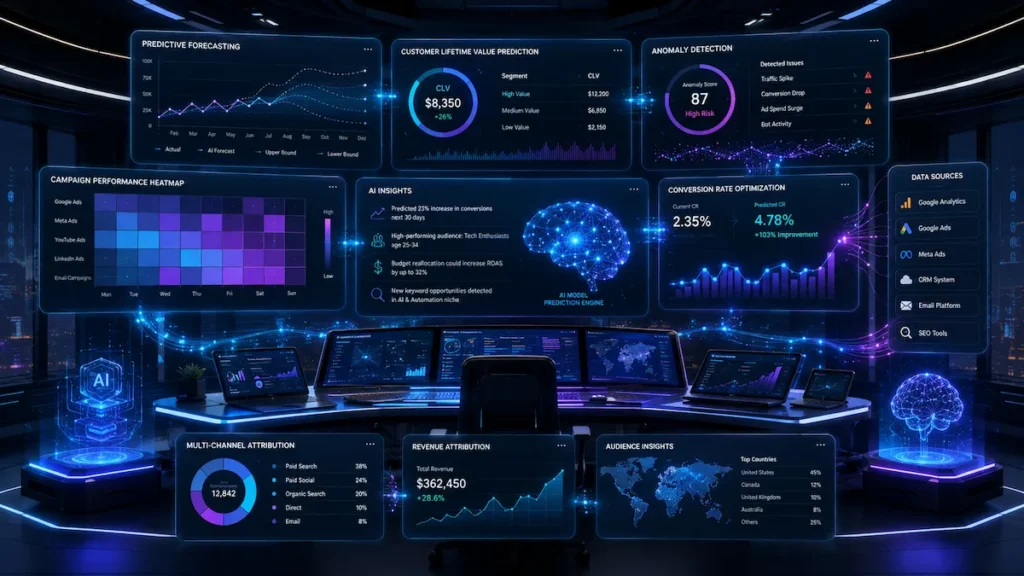
[Visual Opportunity — AI Analytics Dashboard Mockup] A simplified UI showing anomaly detection alerts, predictive audience segments, LTV forecast curves, and a channel performance heatmap—all labeled as AI-generated outputs with real-time timestamps. Clean, data-dense design.
Benefit 6: AI-Powered Email Marketing
The benefits of AI in digital marketing also improve email marketing performance through personalization and automated behavioral segmentation.
Email remains one of the highest-ROI digital marketing channels — and AI has made it significantly more effective. AI applies across subject line optimization, send-time personalization, behavioral segmentation, and dynamic content blocks.
According to HubSpot’s State of Marketing research, personalized email campaigns generate 26% higher open rates and significantly better click-through rates than broadcast approaches across nearly every industry vertical.
For a specific look at whether AI is replacing email marketers or reshaping the role, the short answer is tactical execution is automating rapidly, while strategy and creative judgment remain human.
Benefit 7: AI Chatbots and Customer Engagement
Modern AI chatbots—powered by large language models—handle complex queries, maintain context across conversations, and integrate with CRM systems to personalize responses based on customer history.
Teams often underestimate this benefit: a qualified opportunity that gets instant, contextually relevant responses at 11pm converts at a meaningfully higher rate than one that waits until the next business day. For marketing teams, this means 24/7 lead qualification, instant product inquiry responses, and measurable reduction in support volume reaching human agents.
Benefit 8: Increased Conversion Rates
Higher conversions are among the most profitable benefits of AI in digital marketing thanks to predictive targeting and dynamic personalization. AI improves conversion rates through:
- Behavioral targeting — serving the right message to the right visitor at the right moment
- Predictive lead scoring — surfacing highest-probability opportunities for sales follow-up
- Dynamic personalization — adapting page content, CTAs, and offers in real time
- Real-time testing — running multivariate experiments continuously rather than sequentially
- Automated segmentation — grouping users by behavior, not just demographics
In client campaigns where AI personalization was layered onto existing landing pages—without changing page design—we’ve seen measurable conversion lift within 60–90 days, driven purely by serving more contextually relevant messaging to segmented visitor groups.
Benefit 9: Workflow Automation and Efficiency
Beyond marketing-facing benefits, AI drives significant efficiency in the operational layer. Automated reporting, AI-assisted campaign briefing, content repurposing pipelines, and asset tagging all reduce administrative overhead that consumes team time without producing direct output.
In one agency workflow we reviewed, implementing AI-assisted reporting and campaign briefing reduced internal overhead by roughly 60%—freeing strategists to spend more time on client strategy and less on compiling data into slides.
Benefit 10: Predictive Customer Behavior Analysis
Predictive analytics shifts marketing from reactive to proactive. Instead of analyzing what customers did last month, predictive models forecast what they’re likely to do next—who’s about to churn, who’s ready to upgrade, and which product they’ll purchase next.
Expert Insight: “The real value of predictive AI in marketing isn’t that it gives you better data. It’s that it gives you better data before you need to make the decision—not after. That timing shift is where the ROI actually lives.”
The longer a model trains on your customer data, the more accurate the predictions become — and the more proactively your marketing moves before behavior occurs rather than after.
Benefit 11: AI-Powered Lead Generation and Scoring
The benefits of AI in digital marketing extend to lead generation through automated scoring and intelligent prospect identification.
AI lead generation tools identify website visitors using firmographic data, score inbound leads based on behavioral signals, and trigger personalized outreach sequences automatically.
Combined with Salesforce’s AI-powered CRM capabilities, AI-driven lead generation creates a prospecting system that surfaces high-intent opportunities before human sales teams would otherwise identify them—reducing pipeline lag and improving close rates on inbound traffic.
Benefit 12: Semantic SEO Automation and Topic Clustering
What it means: Semantic SEO automation optimizes content for meaning, context, and topic relationships — not keyword repetition — using AI to identify related entities, language variations, and contextual patterns at scale.
AI tools automate identifying related entities, natural language variations, and contextual patterns that strengthen a page’s topical relevance at the cluster level. Topic clustering is the architectural strategy that makes content authority scalable: a pillar page covers a broad topic comprehensively while cluster pages cover subtopics in depth, all interlinked to concentrate authority.
Key Insight: Semantic SEO automation isn’t just about finding related keywords. It’s about building a content architecture that tells Google, “This site owns this topic.” That distinction is what drives durable rankings rather than traffic spikes.
Benefit 13: Real-Time SERP Monitoring and Content Intelligence
Real-time SEO intelligence is one of the advanced benefits of AI in digital marketing that helps brands respond quickly to ranking changes.
AI SERP monitoring tools track ranking patterns continuously, flag featured snippet shifts, surface new People Also Ask entries, and identify competitor content movements—feeding intelligence directly into editorial prioritization in near real time.
For teams managing large content libraries, this shifts content strategy from calendar-driven to signal-driven: you update content when SERP signals demand it, not on an arbitrary six-month review cycle.
Benefit 14: AI-Driven Social Media Optimization
AI handles content scheduling optimization, performance pattern analysis, audience sentiment monitoring, hashtag effectiveness, and optimal posting time recommendations—removing the guesswork from social media execution.
AI’s role in social media management is shifting execution work to automation while pushing human value toward strategy, brand voice, community building, and cultural judgment—the parts of social that drive genuine audience connection and can’t be replicated algorithmically.
Benefit 15: Autonomous Campaign Budget Allocation
Smarter budget allocation is one of the most cost-saving benefits of AI in digital marketing for multi-channel advertising campaigns.
AI-powered budget allocation systems monitor campaign performance in real time and shift spend automatically toward the channels, audiences, and creatives producing the best results—without waiting for a weekly optimization call.
For brands running multi-channel campaigns, this means budget is always working at maximum efficiency, with underperforming spend redirected before it accumulates into a significant waste problem. This is part of the broader shift around whether AI will replace PPC managers — the execution layer is automating fast, while strategic governance, audience architecture, and offer positioning remain distinctly human responsibilities.
Mini Case Study: AI Personalization in eCommerce
The Challenge: A mid-size outdoor gear brand had strong traffic but inconsistent conversion rates. Product recommendations were static — same items shown to every visitor regardless of browsing history or purchase intent.
The AI Implementation:
- Dynamic homepage product carousels personalized by browsing behavior
- Triggered email sequences based on cart abandonment and category engagement
- Ad creative that adapted based on which product types a visitor had engaged with
The Outcome: Higher average order value, improved repeat purchase rate, and a customer experience that felt contextually relevant—driven entirely by AI personalization layered onto existing infrastructure without a full platform rebuild.
What This Means: You don’t need to rebuild your stack to start capturing personalization benefits. AI personalization tools integrate with most existing eCommerce platforms and begin producing measurable results within the first few weeks of proper configuration.
How AI Improves SEO and Organic Search Rankings
The benefits of AI in digital marketing are particularly measurable in SEO. Better research, semantic content optimization, and smarter technical analysis give AI-equipped teams a compounding advantage that widens over time.
AI Keyword Research, Clustering, and Intent Analysis
Keyword clustering demonstrates the practical benefits of AI in digital marketing by improving content structure and search intent alignment.
Understanding why someone searches matters more than knowing what they searched. AI search intent tools categorize queries by intent type—informational, navigational, commercial, and transactional—and align content architecture to match what Google’s algorithms are trying to serve.
Aligning to intent doesn’t just improve rankings. It reduces bounce rate, increases dwell time, and builds engagement signals that feed back into Google’s ranking systems over time.
AI-Powered Content Optimization and Semantic SEO
Tools like Clearscope, Surfer SEO, and MarketMuse analyze top-ranking pages for any keyword and identify the semantic topics, entities, and structural patterns they share—then score your content against those benchmarks.
This targets comprehensive topical coverage — exactly what Google’s Helpful Content system and semantic search algorithms reward. Keyword density thinking is outdated. Topical completeness is the current standard.
AI Internal Linking and SERP Monitoring
Automated internal linking highlights the scalability-focused benefits of AI in digital marketing for large content websites.
Internal linking is critical for both SEO and user experience — and almost universally neglected at scale. AI tools crawl a site’s entire content catalog, identify contextual linking opportunities, and suggest or automate internal link placement without requiring manual editorial review of every page.
AI SERP monitoring tools track ranking shifts continuously, flag featured snippet changes, surface new People Also Ask entries, and identify competitor content movements in near real time.
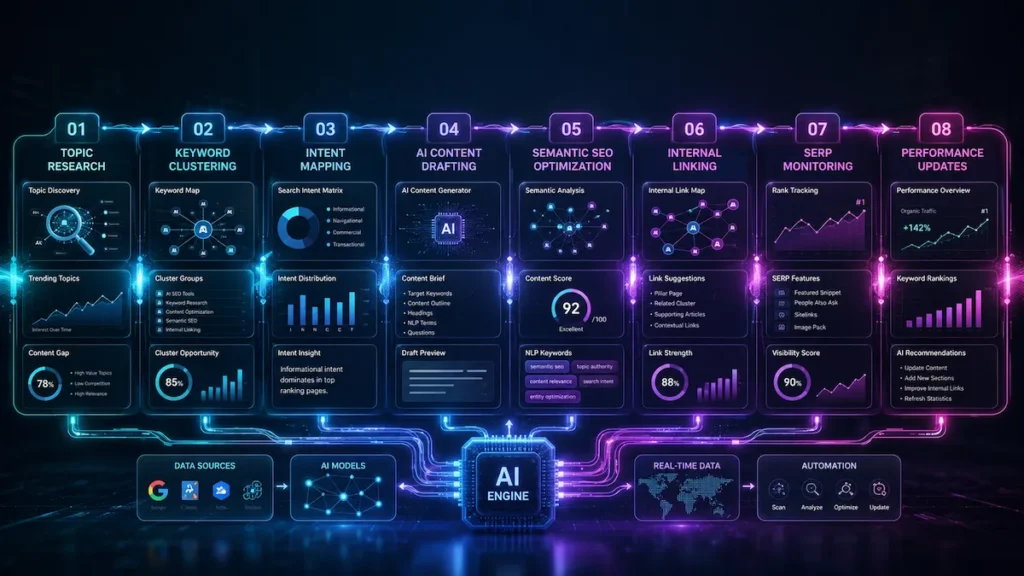
[Visual Opportunity — AI SEO Workflow Diagram] A horizontal flow with labeled stages: Topic Research → Keyword Clustering → Intent Mapping → Content Brief → AI Draft → Semantic Optimization → Internal Link Placement → SERP Monitoring → Update Trigger. Each stage includes the AI tool category responsible. Clean, linear design with directional arrows.
How AI Improves Content Marketing Strategy
The content-related benefits of AI in digital marketing help brands produce, optimize, and scale high-quality content faster.
The 7-Step AI Content Workflow
(HowTo schema eligible—mark each step with HowTo step markup)
A mature AI content workflow doesn’t begin at the draft. It begins upstream—with AI-assisted topic research—and continues downstream through optimization and performance monitoring post-publication.
Step 1: AI identifies topic opportunities based on search demand, competition gaps, and semantic relationships in your niche.
Step 2: The strategist prioritizes and briefs based on business goals, topical cluster architecture, and audience intent.
Step 3: AI generates an outline and first draft based on a detailed creative brief that includes audience, angle, and competitive context.
Step 4: Human editor refines—adding original insight, brand voice, expert perspective, and editorial judgment.
Step 5: AI checks semantic optimization against benchmark content and surfaces specific gaps to address.
Step 6: The human approves and publishes with the author schema, publication date, and EEAT signals properly marked up.
Step 7: AI monitors performance and flags when content needs refreshing based on ranking changes or engagement signals.
Every step has a human checkpoint. AI handles volume. Humans handle judgment.
For example, an article on whether digital marketing remains a strong career in the AI era functions as a natural cluster piece around this pillar—each article reinforcing the topical authority of the others through strategic interlinking.
The Contrarian Truth About AI Content Volume
Expert Insight: “More AI content isn’t better AI content. The brands winning in organic search right now are the ones treating AI as a research and drafting infrastructure—not a publishing volume machine. The editorial standards that made great content great haven’t changed. Only the tools have.”
Here’s what most “benefits of AI” articles won’t say: overproducing AI-assisted content without strong editorial standards is one of the fastest ways to damage organic performance right now.
The brands winning with AI content aren’t publishing more—they’re publishing smarter. First-party data matters more here than most teams realize. The more proprietary inputs you feed into AI systems — your customer behavior, your campaign outcomes, your audience segments — the more differentiated the output becomes. Generic prompts produce generic content. Proprietary inputs produce proprietary insights that competitors can’t replicate.
Real-World Applications of AI in Digital Marketing
Real-world case studies show how the benefits of AI in digital marketing improve personalization, automation, and campaign performance.
Automated Advertising and PPC Optimization
A DTC brand running campaigns across Google, Meta, and programmatic channels uses AI to manage bid adjustments, creative rotation, and audience expansion automatically. The system runs continuous multivariate tests, allocating budget toward what performs and pulling from what doesn’t.
What previously required a full-time paid media manager plus weekly agency calls now runs largely autonomously — with human oversight focused on strategic direction rather than daily execution.
AI Email Automation
The email automation benefits of AI in digital marketing help businesses improve engagement and reduce manual segmentation work.
A B2B SaaS company uses AI to build behavioral email sequences that adapt based on how individual subscribers engage. Someone who reads every product email but ignores case studies gets a different sequence than someone who clicks case studies but skips feature announcements. The AI updates each contact’s pathway continuously—without requiring manual segmentation updates.
AI Analytics and Lead Generation
A digital marketing agency built a centralized AI analytics dashboard aggregating performance data across all client accounts. It surfaces anomalies automatically and generates plain-language performance summaries — cutting reporting time from roughly 12 hours per week to under 3 hours.
Combined with Salesforce’s AI-powered CRM capabilities, AI-driven lead generation creates a prospecting system that surfaces high-intent opportunities before human sales teams would otherwise identify them—reducing pipeline lag and improving inbound close rates.
Challenges and Risks of AI in Digital Marketing
Understanding the risks alongside the benefits of AI in digital marketing helps businesses build safer and more effective AI workflows.
Overdependence on Automation
When AI systems manage campaigns or content without adequate human oversight, errors compound quietly until they become significant problems. AI optimization can confidently go in the wrong direction if the underlying data is flawed or the model lacks sufficient history to make reliable predictions.
Human checkpoints in AI workflows aren’t bureaucratic overhead—they’re the mechanism that catches directional errors before they scale into expensive problems.
Data Privacy and Ethical Concerns
AI personalization depends on behavioral, demographic, and purchase data—creating meaningful compliance obligations under GDPR, CCPA, and expanding US state privacy frameworks. According to the International Association of Privacy Professionals, US state privacy laws are expanding rapidly, creating a compliance patchwork that marketers using AI personalization must navigate carefully.
AI systems can also inherit and amplify biases in training data—producing advertising that inadvertently discriminates in targeting. These aren’t hypothetical risks; they’ve produced real regulatory and reputational consequences for major brands.
Human Creativity Limitations
Despite the many benefits of AI in digital marketing, human creativity and strategic thinking still remain essential.
AI is excellent at pattern recognition, optimization, and execution within defined parameters. It is not good at conceptual originality, cultural nuance, emotional intelligence, or brand judgment. The campaigns that create genuine cultural moments still require human creative vision at their core.
AI amplifies creative execution. It doesn’t replace creative thinking. That distinction becomes more important as AI capabilities expand, not less.
AI Misinformation Risks
AI content tools can confidently produce inaccurate information. In regulated industries or legally sensitive contexts, every piece of AI-assisted content needs expert review and fact-checking before it reaches an audience.
Future Trends of AI in Digital Marketing
The future benefits of AI in digital marketing will center around predictive personalization, automation, and autonomous decision-making.
Hyper-personalized marketing moves beyond behavioral targeting to contextual and predictive personalization — understanding not just what someone bought, but when they’re most receptive, in what format, and at what stage of the customer journey.
Predictive AI systems will become standard infrastructure for data-mature organizations—forecasting customer lifetime value, churn probability, and campaign performance before spending budget fundamentally changes how resources get allocated.
Voice search optimization is growing in strategic importance as AI assistants become embedded across search, mobile, and home devices. Conversational queries require different content optimization approaches than typed queries.
AI video generation is maturing rapidly. The ability to generate, personalize, and localize video content at scale will change the economics of video marketing for brands currently treating it as a high-cost channel.
Autonomous marketing platforms represent the longer-term trajectory—systems that make marketing decisions within defined parameters, with human oversight rather than human execution.
According to Gartner’s AI in marketing forecasts, by 2026, 80% of creative assets for digital advertising will be produced with the help of generative AI tools — a figure that underscores how deeply AI is embedding itself into the operational fabric of marketing rather than sitting alongside it.
Traditional Marketing vs AI-Assisted Marketing
| Area | Traditional Marketing | AI-Assisted Marketing |
|---|---|---|
| Audience Segmentation | Manual, demographic-based | Predictive, behavioral-based in real time |
| Campaign Optimization | Weekly or monthly review cycles | Continuous, autonomous real-time adjustment |
| Content Production | Fully manual — slow, resource-heavy | AI-assisted drafting — 50–70% faster |
| Reporting | Manual compilation — 8–12 hrs/week | Automated dashboards — under 3 hrs/week |
| Personalization | Broad audience messaging | 1:1 dynamic personalization at scale |
| SEO Research | Manual keyword analysis — days | AI clustering and intent mapping — hours |
| Email Marketing | Batch-and-blast segmentation | Behavioral sequences that adapt per subscriber |
| Ad Bidding | Manual bid adjustments | Autonomous real-time budget allocation |
| Lead Scoring | Gut instinct or basic rules | Predictive scoring from behavioral signals |
| Analytics | Reactive — review past performance | Proactive—surface anomalies and forecast trends |
What This Means: The gap between traditional and AI-assisted marketing operations isn’t just a productivity gap. It’s a strategic intelligence gap. AI-equipped teams aren’t just working faster — they’re making better decisions, faster, with more accurate data. That advantage compounds over time.
Pros and Cons of AI in Digital Marketing
| Factor | Pros | Cons |
|---|---|---|
| Speed | Cuts research, content, and reporting time by 50–70% | Can outpace human oversight if checkpoints are missing |
| Personalization | Enables true 1:1 personalization at scale | Requires strong first-party data and governance |
| Cost Efficiency | Reduces labor costs for high-volume repeatable tasks | Platform and implementation costs can be significant |
| SEO Performance | Improves semantic coverage, clustering, content scoring | AI content without editorial oversight hurts rankings |
| Advertising | Real-time optimization improves ROAS meaningfully | Black-box optimization makes performance diagnosis hard |
| Content Creation | Compresses production timelines by 50–70% | Requires strong human editorial layer to maintain quality |
| Analytics | Surfaces patterns and anomalies faster than manual review | Only as reliable as the data quality feeding the model |
| Customer Service | 24/7 availability and consistent quality at scale | Complex or sensitive queries still require humans |
| Data Privacy | Enables consent-based personalization at scale | Expanding compliance requirements demand serious governance |
| Creativity | Amplifies creative execution and testing velocity | Cannot replace original human creative vision |
Key Takeaways
(Speakable Schema eligible—mark this section for voice search extraction.)
- AI improves marketing scalability by automating high-volume, repeatable tasks across content, reporting, email, and advertising—multiplying team output without proportional headcount growth.
- Personalization delivers the highest ROI — brands that get AI-driven personalization right generate up to 40% more revenue from those activities than average performers.
- Topical completeness matters more than keyword density — AI SEO tools enable semantic optimization that aligns with how Google’s algorithms actually evaluate content quality in 2026.
- Predictive analytics enables proactive marketing — AI forecasts customer behavior, churn risk, and campaign performance before you spend budget, not after.
- AI amplifies strategy rather than replacing marketers—the teams winning with AI are those using it to go deeper on strategy, not just faster on execution.
- First-party data is the multiplier — the more proprietary inputs you feed AI systems, the more differentiated and defensible your outputs become.
- Human oversight remains non-negotiable — AI without editorial, ethical, and strategic oversight produces errors at scale. The APIO Framework works only when humans govern each layer.
Frequently Asked Questions
Is AI replacing digital marketers?
No. The benefits of AI in digital marketing come from improving marketer productivity and strategic efficiency rather than replacing human marketers entirely.
How does AI improve SEO?
The SEO-focused benefits of AI in digital marketing include semantic optimization, keyword clustering, automated internal linking, and predictive SERP analysis.
What are the biggest benefits of AI in digital marketing?
The biggest benefits of AI in digital marketing include personalization at scale, smarter advertising optimization, predictive analytics, workflow automation, and faster content production.
Can small businesses use AI marketing tools?
Yes — and the barrier to entry is lower than most small business owners realize. Tools like HubSpot’s AI features, Google’s smart bidding systems, AI-powered email platforms, and accessible content tools are priced and designed for non-enterprise users. The ROI case for small businesses comes down to leverage on limited bandwidth: one person doing the research, content, and reporting work of two or three people.
Which AI marketing tools are most effective?
Effectiveness depends on use case, but consistently high-performing categories include: Semrush and Surfer SEO for AI-assisted SEO and content optimization; HubSpot and Salesforce for AI-powered CRM and marketing automation; Google Performance Max and Meta Advantage+ for AI-optimized advertising; and Klaviyo or ActiveCampaign for AI-powered email automation.
Is AI content good for SEO?
Yes — when combined with human oversight, the SEO-related benefits of AI in digital marketing help create semantically optimized and highly relevant content that performs well in search engines.
How does AI improve conversions?
AI improves conversions through behavioral targeting, predictive lead scoring, dynamic website personalization, real-time multivariate testing, and automated segmentation — all working simultaneously. In client campaigns where AI personalization was layered onto existing pages without design changes, measurable conversion lift appeared within 60–90 days driven purely by serving more contextually relevant messaging.
Conclusion
The benefits of AI in digital marketing aren’t theoretical — they’re producing measurable advantages right now for teams that have moved past the hype and built AI into how they actually operate.
But be clear-eyed about what AI delivers. It multiplies capability within well-designed systems. It compresses timelines for research, creation, optimization, and analysis. It makes personalization and automation accessible at scales that previously required enterprise-level resources.
What it doesn’t do is think strategically, create original cultural meaning, build genuine brand trust, or make judgment calls requiring ethical reasoning and contextual awareness. Those remain distinctly human—and they’re becoming more valuable precisely because they can’t be automated.
The teams seeing the biggest gains aren’t the ones automating the most. They’re the ones who are thoughtful about what to automate, who protect the human judgment that makes their marketing distinctive, and who use AI to go deeper on strategy rather than just faster on execution.
The APIO Framework — Automation, Personalization, Intelligence, Optimization — isn’t about replacing your marketing team. It’s about building a system where your team’s strategic thinking gets amplified at every layer. That’s the version of AI in digital marketing worth investing in.
The capability gap between AI-equipped teams and manual operations is widening every quarter. The question isn’t whether AI belongs in your marketing stack. It’s whether you’re building the strategic competency to use it well.