
Written by Irfan Ullah | Digital marketing strategist focused on AI-powered workflows, SEO strategy, and content systems for technology brands. 10+ years helping businesses adapt to platform shifts.
The rapid evolution of artificial intelligence is changing how marketers work, making digital marketing skills for the AI era essential for professionals who want to stay competitive in 2026. These skills combine AI tools, strategic thinking, analytics, creativity, and human expertise to help marketers build smarter campaigns and achieve better results.
In the past two years, tools like ChatGPT, Google Gemini, and HubSpot’s AI suite have quietly rewritten how campaigns are built, how content gets created, and how decisions get made. What once took a team of five can now be handled by one person who understands the right digital marketing skills for the AI era.
This guide covers the 15 skills that matter most right now, the AI tools behind each one, the human abilities machines still cannot replace, the most common mistakes marketers make, and a practical roadmap to get started.
Whether you are a working professional, a freelancer, a business owner, or someone entering marketing for the first time, this is the resource worth bookmarking.
Quick Summary: The 5 Most Important Skills to Learn First
- AI Prompt Engineering
- SEO and Search Intent Optimization
- Data Analytics and Performance Tracking
- Marketing Automation Management
- Brand Storytelling and Human Creativity
What Are Digital Marketing Skills for the AI Era?
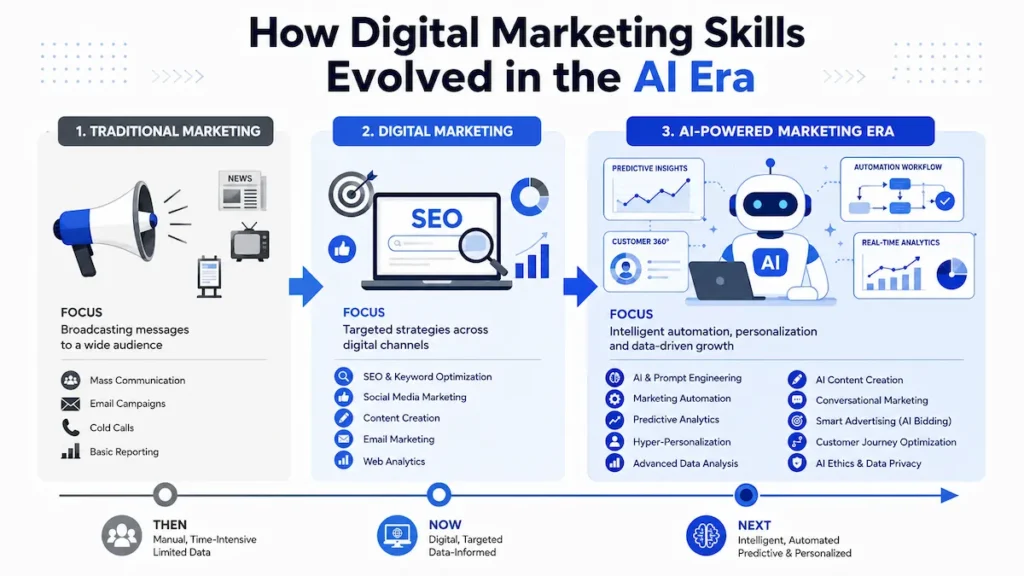
Digital marketing skills for the AI era are the combination of technical, creative, and strategic abilities that let a marketer work alongside AI tools—not just use them, but direct them, evaluate their output, and apply human judgment where machines fall short.
These are different from traditional marketing skills in one important way: they assume AI is already part of your daily workflow. Knowing how to write is no longer enough. You need to know how to brief an AI, edit its output, verify its accuracy, and add the originality that tools like ChatGPT cannot produce on their own.
Understanding AI-Driven Marketing
Understanding AI-driven marketing is a core part of Digital Marketing Skills for the AI Era because marketers must know how artificial intelligence influences customer targeting, personalization, automation, and campaign optimization.
For marketers, this means less time on repetitive tasks and more pressure to demonstrate strategic value. The AI marketing skills that matter are the ones that help you provide that value consistently.
Why These Skills Matter More Than Ever
The importance of Digital Marketing Skills for the AI Era continues to grow because businesses need marketers who can use AI efficiently while applying human creativity, strategy, and critical thinking.
Research from organizations studying the future of work consistently shows that AI will automate many repetitive marketing tasks while increasing demand for marketers who can manage AI systems, interpret AI-generated data, and create authentic, human-centered content. The marketers who thrive will not be the ones who avoid AI. They will be the ones who direct it most effectively.
If you are thinking about where digital marketing careers are heading in 2026, the answer is clear: the career path still exists—it just runs through a different set of skills than it did five years ago.
Why Traditional Marketing Skills Are No Longer Enough
Traditional marketing knowledge remains valuable, but digital marketing skills for the AI era add a new layer of expertise that helps professionals adapt to AI-powered platforms, automated workflows, and changing consumer behavior.
How Automation Is Reshaping Marketing Jobs
As automation transforms marketing roles, digital marketing skills for the AI era allow professionals to move beyond repetitive tasks and focus on strategy, optimization, and managing intelligent marketing systems.
Marketing automation used to mean scheduling emails. Today it means AI systems that analyze customer behavior, trigger personalized messages at the right moment, score leads automatically, and report on performance without manual input. Tools like HubSpot, ActiveCampaign, and Salesforce have made this accessible to businesses of every size.
This shifts the job description fundamentally. You are no longer just the person doing the task. You are the person designing, managing, and improving the system that does it. That requires a different, higher-order skill set.
The Rise of AI-Powered Marketing Platforms
The growth of AI-powered platforms makes digital marketing skills for the AI era necessary for marketers who want to understand how algorithms influence advertising, content distribution, and customer engagement.
Google’s Performance Max campaigns, Meta’s Advantage+ system, and TikTok’s Smart Performance Campaigns all use AI to make real-time decisions about who sees your ads, what creative to show, and when. LinkedIn’s Campaign Manager offers predictive audience suggestions. YouTube’s auto-optimization adjusts video ad delivery automatically.
Understanding the logic behind these platforms — what signals they use, how they optimize, and when human override is needed — is one of the most underrated AI marketing skills available. Marketers who skip this understanding are flying blind in their own campaigns.
Top 15 Digital Marketing Skills for AI Era Every Professional Should Master
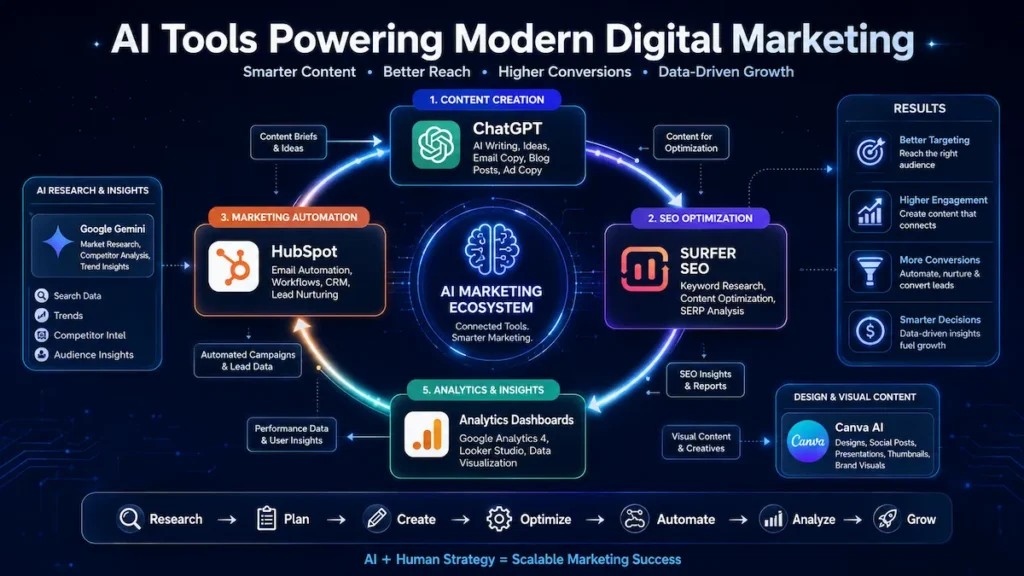
Developing digital marketing skills for the AI era requires mastering a combination of technical abilities, AI knowledge, analytical thinking, and creative marketing skills that drive business growth.
1. AI Prompt Engineering
AI prompt engineering is one of the most important digital marketing skills for the AI era because marketers must learn how to guide AI tools with clear instructions to generate accurate and useful outputs.
Prompt engineering is the skill of writing clear, specific instructions that get genuinely useful output from AI tools. Vague prompts produce generic results. Well-structured prompts produce outputs you can actually publish, send, or present.
In real marketing workflows, AI is most useful during the research and first-draft stages. The strongest results come when a marketer reviews AI output, adds customer insights from real conversations, and refines the final message with their own voice and brand knowledge. The AI accelerates the process; the marketer controls the quality.
Practical workflow: Give the AI a role, a context, a task, and a format. Example: “You are a B2B email marketing expert writing to SaaS founders who just started a free trial. Write a 5-email onboarding sequence. Each email is under 150 words, with one clear CTA at the end.” That level of specificity consistently produces better first drafts than a one-line request. The generative AI guide for marketers in 2026 covers how this approach extends to ad copy, landing pages, and full campaign briefs.
2. AI Content Strategy and Content Creation
AI content strategy has become a critical part of digital marketing skills for the AI era, allowing marketers to use artificial intelligence for faster production while maintaining originality, quality, and brand consistency.
AI can generate content. Deciding what to create, for whom, and why is still a human job. Content strategy means mapping your audience’s journey, identifying content gaps, building topic clusters, and creating a publishing cadence that builds authority over time.
The marketers who win use AI to produce content faster while applying human judgment to direct the strategy. They are editors and architects, not just writers. AI-generated output still requires human review because accuracy, brand alignment, and originality vary significantly depending on how well the AI was briefed.
3. SEO and Search Intent Optimization
SEO remains a foundation of digital marketing skills for the AI era because marketers must understand search intent, AI-driven search changes, and how to create content that provides real value.
SEO in the AI era is not about keyword stuffing or chasing shortcuts. Google’s search systems increasingly rely on machine learning models to understand content quality, relevance, and user intent—which means generic, surface-level content gets filtered out faster than ever. According to Google’s Search Quality Evaluator Guidelines, E-E-A-T (Experience, Expertise, Authoritativeness, and Trustworthiness) is central to how quality is assessed.
Understanding search intent — the actual reason behind a query — is more valuable than keyword volume alone. Tools like Surfer SEO help analyze top-ranking pages and optimize for semantic relevance, but a human still needs to understand why those signals matter and what the reader actually wants.
Many marketers are asking whether AI is replacing SEO jobs in 2026. The honest answer: SEO roles are evolving significantly, but the skill of understanding search intent and earning topical authority is more valuable now, not less.
4. Data Analytics and Performance Tracking
AI generates mountains of data. Being able to read, interpret, and act on that data is among the highest-value AI marketing skills available. You do not need to be a data scientist. You do need to understand Google Analytics 4, track the right KPIs, identify trends, and translate numbers into decisions.
A marketer who can say “our click-through rate dropped 18% this month because landing page load time increased after the site migration, and here is the fix” is significantly more valuable than one who just forwards a report without context.
5. Marketing Automation Management
This goes well beyond scheduling social posts. Marketing automation management means building workflows in platforms like HubSpot, designing lead nurture sequences, segmenting audiences, and using behavioral triggers to send the right message at the right moment.
A well-built automation system runs around the clock, qualifies leads, and moves prospects through the funnel while your team focuses on strategy. Building and managing that system is a standalone career skill worth developing deliberately.
6. AI-Powered Email Marketing
Email remains one of the highest-ROI channels in digital marketing — and AI has made it more powerful. AI tools now assist with subject line optimization, send-time prediction, personalized content blocks, and A/B testing at scale.
The skill is not just activating these features. It is knowing when to automate and when to add a personal, human touch that automation cannot replicate. An AI can write a promotional email. It cannot replace a founder writing a genuine update to their community. The question of whether AI is replacing email marketers is one many professionals are asking—the answer depends almost entirely on whether those marketers are willing to evolve their skill sets.
7. Conversion Rate Optimization (CRO)
Getting traffic to a page is half the job. Converting that traffic into leads or customers is where CRO comes in. This means A/B testing, analyzing user behavior with tools like Hotjar or Microsoft Clarity, improving landing page copy, simplifying forms, and removing friction at every step of the buying process.
AI-powered CRO tools can now run multivariate tests automatically and serve winning variations in real time. But identifying what to test and understanding why users behave the way they do still requires human empathy and experience.
8. AI in Advertising and Paid Media
AI has fundamentally changed paid advertising. Smart bidding, dynamic creative optimization, and predictive audience targeting are now table stakes. Marketers who understand how AI is reshaping advertising strategies and tools are better equipped to manage budget efficiently and improve ROAS across Google, Meta, and programmatic channels.
The key skill here is learning to work with AI ad systems rather than against them—setting the right inputs, creative parameters, and audience signals, then letting the algorithm do its job while you monitor for anomalies.
9. Video Marketing and Short-Form Content
TikTok, YouTube Shorts, and Instagram Reels dominate content consumption right now. Video earns more engagement, reach, and retention than any other format. AI tools can generate scripts, create auto-captions, suggest editing cuts, and produce synthetic B-roll.
The skill that AI cannot replicate here is storytelling instinct—understanding pacing, knowing what makes someone stop scrolling, and crafting a hook that lands in the first three seconds. That remains a human judgment call.
10. Customer Personalization Strategies
Modern consumers expect brands to understand them. AI enables hyper-personalization at scale—product recommendations, personalized landing pages, and dynamic email content—but someone has to design the personalization logic and define what “relevant” actually means for a given customer segment.
Marketers who understand customer psychology, segmentation strategy, and the ethical limits of personalization will always be in demand. AI gives you the capability; strategy gives it meaning.
11. Social Media Strategy and Community Management
Social platforms are no longer just distribution channels. They are community hubs, search engines, and customer service desks. AI can generate social content, suggest posting times, and analyze engagement patterns — but it cannot build relationships or respond to nuanced community moments with genuine authenticity. The production side is increasingly automated; the relationship side remains entirely human. That distinction is at the center of the ongoing conversation about whether AI will replace social media managers in 2026.
12. Brand Storytelling and Human Creativity
This is the skill AI cannot replicate at any meaningful depth. Brand storytelling is the ability to craft a narrative that makes people feel something real—connected to a product, aligned with a mission, or loyal to a brand. It requires cultural awareness, emotional intelligence, and creativity rooted in lived human experience.
AI can generate stories. It cannot have them. As AI-generated content floods every channel, the premium on distinctly human, specific, and emotionally resonant content increases. Investing in storytelling is investing in something that compounds in value over time.
13. Marketing Analytics and Attribution Modeling
Understanding which channels, campaigns, and touchpoints drive actual revenue — not just traffic — is a critical AI marketing skill. Multi-touch attribution, customer lifetime value modeling, and cohort analysis are all areas where AI tools accelerate the work, but a marketer still needs to ask the right questions and interpret the answers correctly.
14. AI Ethics and Responsible Marketing
As AI becomes central to how campaigns target audiences and personalize messages, the ethical dimensions of those decisions matter more. Data privacy regulations, bias in algorithmic targeting, and transparency with customers about how their data is used are all areas a competent marketer needs to understand in 2026.
15. Adaptability and Continuous Learning
This is not a soft skill filler. It is the most practical skill on this list. The AI tools available in 2026 will look different from those in 2028. Marketers who build a habit of testing new tools, reading what is changing, and adjusting their workflows regularly will stay competitive regardless of what gets automated next.
Best AI Tools Supporting These Skills
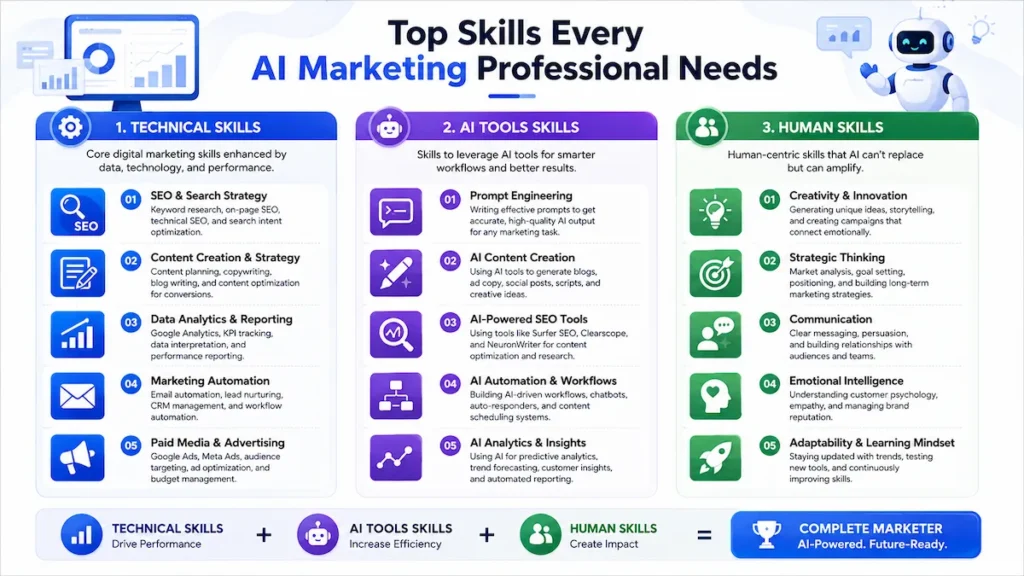
The right AI tools help professionals apply digital marketing skills for the AI era by improving productivity, automation, research, content creation, and performance analysis.
ChatGPT for Marketers
ChatGPT handles content drafts, email sequences, ad copy, persona research, competitor analysis, and campaign ideation. Modern AI models can support complex, multi-step marketing workflows when they receive clear context and well-defined instructions—which is exactly why prompt engineering matters. Limitation: AI-generated output still requires human review for accuracy, tone, and brand alignment—the output reflects your prompt quality, not independent expertise.
Best for: First drafts, idea generation, repurposing existing content, FAQ drafts.
Google Gemini for Research
Google Gemini supports modern digital marketing skills for the AI era by helping marketers analyze information, discover trends, and improve research processes.
Gemini integrates with Google Search, Google Docs, and Google Analytics — uniquely powerful for marketers in the Google ecosystem. Its real-time web access gives it an advantage over static models for research tasks. Limitation: Like all AI research tools, it requires fact-checking before any claim is used in published content.
Best for: Competitive research, trend analysis, content briefs, keyword ideation.
Surfer SEO for Content Optimization
Surfer SEO analyzes top-ranking pages for any keyword and tells you the right word count, semantic terms, internal linking opportunities, and NLP score needed to compete. Limitation: It optimizes for current SERP patterns — it cannot substitute for a genuine understanding of your audience’s actual needs.
Best for: On-page SEO, content scoring, content brief generation.
HubSpot for Automation
HubSpot helps marketers apply digital marketing skills for the AI era through AI-powered automation, CRM management, and customer journey optimization.
HubSpot covers marketing automation, CRM, and AI-powered lead management. Features include email send-time optimization, predictive lead scoring, content generation, and behavioral workflow triggers. Marketing automation can improve lead management and conversion processes significantly — but only when workflows and customer data are properly maintained from the start. Limitation: HubSpot’s AI features are most effective when your CRM data is clean and consistently structured.
Best for: Lead nurturing, email automation, CRM management, sales-marketing alignment.
Canva AI for Visual Content
Canva’s AI features — Magic Design, Magic Write, and AI image generation — allow marketers without design backgrounds to produce professional-quality visuals. Limitation: AI-generated visual templates are widely used, which means brand differentiation requires custom creative direction on top of the AI output.
Best for: Social media graphics, presentation decks, branded templates.
Human Skills That Become More Valuable in the AI Era
While AI tools are powerful, digital marketing skills for the AI era also depend on human abilities like creativity, leadership, empathy, and strategic decision-making.
The marketers most at risk are not those who lack technical skills. They are the ones who have not invested in distinctly human abilities that AI cannot replicate. These skills appreciate in value as automation increases.
Strategic Thinking — AI executes. Humans decide what to execute. Understanding a business’s competitive position and building a marketing plan that moves it forward requires judgment, business acumen, and the ability to navigate ambiguity. No AI model does this reliably.
Creativity — Not the kind that generates another generic listicle. Real creativity — unexpected connections, genuine originality, ideas that feel surprising — is rooted in human experience. As AI-generated content becomes ubiquitous, the premium on content that feels distinctly human increases sharply.
Emotional Intelligence — Marketing is fundamentally about understanding people. What do they fear? What stops them from buying? Emotional intelligence informs better messaging, stronger relationships, and more effective campaigns. AI can simulate empathy. It does not have it.
Leadership and Decision-Making — As AI systems handle more execution, the demand for marketers who can lead teams, evaluate AI outputs critically, and make high-stakes judgment calls under uncertainty will grow. Someone needs to be in the room saying, “This is technically accurate but wrong for our audience.” Whether AI strengthens or threatens a given marketing role depends almost entirely on how much of that role requires this kind of judgment — a question explored in depth in the analysis of whether AI will replace content writers in 2026.
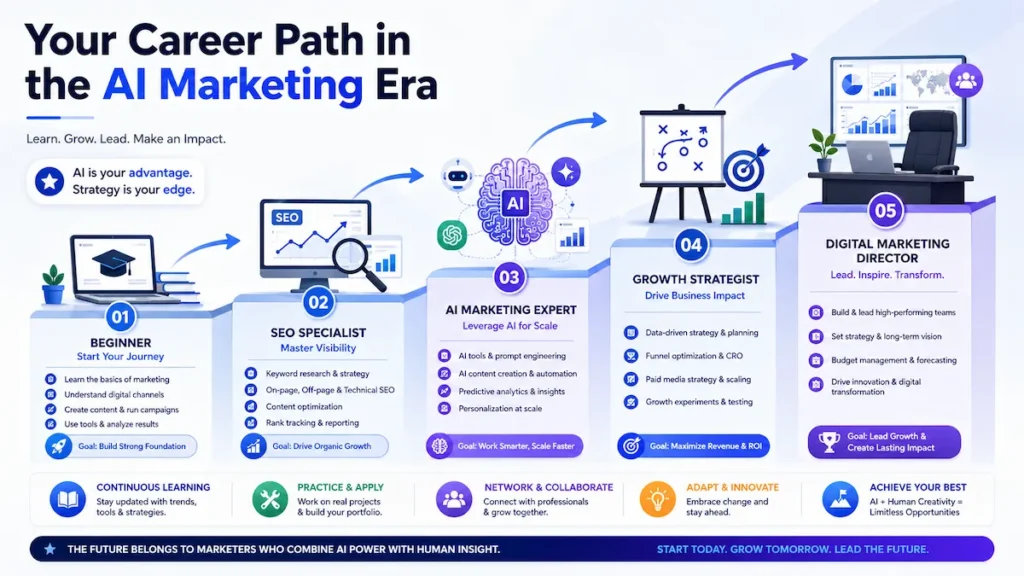
How to Learn Digital Marketing Skills for AI Era
Learning digital marketing skills for the AI era requires consistent practice, experimentation with AI tools, real-world projects, and continuous improvement.
Free Learning Resources
- Google Digital Garage — Free courses on digital marketing fundamentals, analytics, and AI basics
- HubSpot Academy — Free certifications in inbound marketing, email, and content strategy
- Meta Blueprint — Free training on Facebook and Instagram advertising, including AI-powered ad tools
- Google Skillshop — Free certifications for Google Ads, Analytics, and Google Marketing Platform
- Coursera (audit mode) — Top university courses on machine learning and marketing strategy available for free
Certifications Worth Considering
- Google Analytics Certification — Free, widely recognized, demonstrates real data literacy
- HubSpot Content Marketing Certification — Practical, regularly updated, respected by B2B employers
- Meta Certified Digital Marketing Associate — Useful for paid social roles and agency freelancers
- Semrush SEO Fundamentals Certificate — Good for demonstrating current SEO knowledge
- AI for Everyone by Andrew Ng, Deep Learning. AI — The best non-technical introduction to AI concepts for marketers
Warning: Avoid expensive “AI marketing bootcamps” that promise transformation in 30 days. The field moves too fast for static curricula to stay current. Ongoing learning matters more than any single credential.
Building Real-World Experience
- Run your own projects. Start a blog, test a $50 ad campaign, and build a landing page. Document results honestly.
- Offer free work to a local business or nonprofit. Two genuine case studies with measurable results outweigh ten certificates.
- Experiment with AI tools publicly on LinkedIn. Documenting what you tested, what worked, and what did not builds credibility while you build skills.
- Join active communities. Reddit’s r/marketing, HubSpot’s community, and Semrush’s Academy all provide real feedback loops.
Building a future-proof digital marketing career in 2026 means combining these hands-on habits with a clear skill prioritization strategy — starting with the highest-leverage skills and expanding from there.
Common Mistakes Marketers Make When Building These Skills
Avoiding common mistakes is important when developing digital marketing skills for the AI era, especially over-relying on AI without applying human judgment.
Over-Reliance on AI
The biggest mistake is treating AI as a replacement for thinking. Marketers who delegate strategy, content direction, keyword decisions, and audience analysis entirely to AI produce generic work that neither search engines nor real people find valuable. AI is a force multiplier. It amplifies good thinking. It also amplifies shallow thinking.
Ignoring SEO Fundamentals
Some marketers assume that because AI can write content, SEO no longer matters. That is incorrect. Google still evaluates technical performance, crawlability, structured data, and E-E-A-T signals. Chasing AI content shortcuts while ignoring fundamentals leads to content that ranks nowhere and earns nothing.
Publishing AI Content Without Human Editing
AI-generated content is often plausible enough to pass a quick read, but it leans toward the generic, the safe, and the forgettable. It also introduces factual errors without flagging them. Every piece of AI-generated content needs a human editor who verifies facts, adds specific real-world examples, aligns the content to actual brand voice, and removes anything that reads like it was written by a machine trying to sound human.
Future Trends Shaping AI Marketing Skills
Future marketing trends show that digital marketing skills for the AI era will become even more important as AI agents, predictive analytics, and automation reshape the industry.
AI Agents — Autonomous systems completing multi-step marketing tasks without human instruction. Early versions already run ad campaigns, monitor brand mentions, and generate reports. Marketers who learn to configure and oversee AI agents will effectively be managing digital teams.
Predictive Marketing — Using historical data and machine learning to forecast customer behavior before it happens. Industry research, including analysis from McKinsey on AI-powered growth strategies, points to predictive analytics as one of the highest-leverage applications of AI in marketing. The skill is knowing how to act on predictions, not just generate them.
Hyper-Personalization—Beyond “Hi, [First Name]” emails. Serving different homepages, product recommendations, and ads to each individual based on real-time behavior. AI makes it technically possible. Human strategy makes it feel relevant rather than intrusive.
Voice and Conversational Search — As AI interfaces like ChatGPT and Perplexity become mainstream, queries are growing longer, more conversational, and more intent-specific. Marketers who understand how to structure content for conversational search will capture traffic that traditional keyword-focused SEO misses entirely.
Mini Case Study: How One Small Business Applied These Skills
This case study demonstrates how applying digital marketing skills for the AI era can help small businesses improve efficiency, content production, and marketing performance.
Here is a realistic example of what applying AI marketing skills looks like in practice—not a Fortune 500 team, but a small business with limited time and budget.
Background: A two-person e-commerce brand selling handmade home goods.
Before AI marketing skills:
- 20+ hours per week writing product descriptions, emails, and social posts manually
- Email campaigns sent roughly once a month, whenever time allowed
- No structured way to track which content drove actual purchases
- SEO done by instinct with no keyword research process
After six months of building and applying these skills:
- Structured ChatGPT prompts cut content writing time by about 60%, freeing 12 hours weekly for strategy and customer engagement
- A simple HubSpot post-purchase automation sequence (three emails) increased repeat purchase rate within 90 days
- Google Analytics 4 setup revealed that blog content drove 40% of organic traffic but almost no sales—they shifted focus to product comparison content that actually converted
- Surfer SEO optimization moved three category pages from page 3 to page 1 within four months
The lesson: None of this required a large budget or technical background. It required learning the right skills, applying them consistently, and using AI to support thinking—not replace it.
Pros and Cons of AI Marketing Skills
Understanding the advantages and challenges of digital marketing skills for the AI era helps professionals make smarter decisions about adopting AI-driven marketing strategies.
| Advantages | Challenges |
|---|---|
| Dramatically increases productivity and campaign output | Steep learning curve for non-technical marketers |
| Enables meaningful personalization at scale | Risk of over-automation and loss of authentic brand voice |
| Faster, cheaper data-driven decision-making | AI tools regularly produce inaccurate or generic content |
| Opens new career roles and income opportunities | Requires constant upskilling as tools evolve |
| Levels the playing field for small businesses | Creates dependency on third-party AI platforms |
| Reduces time on repetitive, low-value tasks | May reduce some entry-level job opportunities |
| Stronger ROI measurement and attribution capability | Privacy and ethical risks around data use |
| Competitive advantage for early adopters | Can widen the skills gap inside marketing teams |
Frequently Asked Questions
These frequently asked questions explain how digital marketing skills for the AI era are changing careers, marketing strategies, and business growth opportunities.
Q: Is AI replacing digital marketers?
Not in the near term — and not in the roles that matter most. AI automates specific, repetitive tasks (data entry, basic ad management, first-draft content), but strategy, creativity, emotional intelligence, and relationship-building remain human domains. Marketers who build the right AI marketing skills will see their value increase, not decrease.
Q: What skills do marketers need in the AI era?
The most important are AI prompt engineering, SEO and search intent optimization, data analytics, marketing automation management, conversion rate optimization, and brand storytelling. Equally important are human skills — strategic thinking, creativity, and emotional intelligence — that AI currently cannot replicate.
Q: How does AI affect digital marketing?
AI is changing how content is created, how ads are targeted, how leads are scored, and how customer journeys are personalized. Marketers now direct AI systems rather than executing manual tasks, which shifts the required skill set significantly at every career level.
Q: Which AI tools should marketers learn first?
Start with ChatGPT or Google Gemini for content and research. Add Surfer SEO for content optimization, HubSpot for automation, and Google Analytics 4 for performance tracking. Master one tool deeply before moving to the next.
Q: Do I need a technical background?
No. Most AI marketing tools are built for non-technical users. You need curiosity, willingness to experiment, and enough analytical thinking to evaluate whether the AI’s output is actually useful and accurate.
Q: How long does it take to build these skills?
A focused learner can develop foundational AI marketing skills in 3–6 months. Building the applied expertise that translates into career advancement takes 12–18 months of hands-on practice. Learning by doing consistently beats watching tutorials passively.
Q: Will AI make SEO obsolete?
No. SEO is evolving, not disappearing. As Google’s AI Overviews and tools like Perplexity become more central to how people find information, topical authority, E-E-A-T signals, and structured content matter more, not less. The tactics change; earning trust and providing real value stay constant.
Q: What is the difference between AI marketing skills and traditional marketing skills?
Traditional skills cover copywriting, basic SEO, social media posting, and email marketing. AI marketing skills add the ability to use AI tools effectively, interpret AI-generated data, manage automated systems, and apply human judgment to AI outputs. In 2026, you genuinely need both layers.
Q: Are certifications worth getting?
Selectively, yes. Certifications from Google, HubSpot, Meta, and Semrush carry real weight with employers and clients. Generic “AI marketing” certificates from unknown providers generally do not. Free credentials from established platforms tend to be more credible than paid ones from obscure sources.
Q: Can small businesses compete using AI marketing skills?
Yes—and this is one of AI’s most democratizing effects. A single marketer who understands AI tools can now produce content, run campaigns, and analyze data at a quality level that previously required a full team. The advantage is available to anyone willing to build the skills.
Q: What human skills become more valuable as AI grows?
Strategic thinking, genuine creativity, emotional intelligence, leadership, and ethical judgment all increase in value as AI handles more execution. When everyone has access to the same tools, the differentiator becomes the quality of human judgment applied on top of them.
Q: How do I stay current with AI marketing changes?
Follow Search Engine Journal, Marketing Week, and the official blogs of Google, HubSpot, and OpenAI. Join active marketing communities on LinkedIn and Reddit. Set aside 2–3 hours weekly to test new tools and read about what is changing. Consistency compounds over time.
Conclusion
The future belongs to marketers who develop strong digital marketing skills for the AI era and learn how to combine artificial intelligence with creativity, strategy, and human insight. Building these skills today creates better opportunities in the AI-driven marketing landscape of tomorrow.
The digital marketing skills for the AI era are not a replacement for what you already know. They are the next layer — the layer that separates marketers who remain relevant from those who get left behind.
The marketers building these skills now are not doing it because it is trendy. They are doing it because the evidence is clear: AI is accelerating the pace of marketing, and the professionals who direct that acceleration have more leverage, more value, and more opportunity than those who stand apart from it.
Start with one skill. Go deep before going wide. Apply it to something real, even something small. The gap between marketers who have embraced AI and those who have not is widening every month — and 2026 is still early enough to be firmly on the right side of it.
Your next step: Pick one skill from this list and spend 30 minutes today making a start. Not this week. Today.