
Last Updated: June 2026
Salary Methodology: Ranges compiled from the U.S. Bureau of Labor Statistics, Glassdoor, LinkedIn Salary Insights, and publicly posted US job listings as of early 2026. Figures vary by geography, seniority, company size, and industry.
AI-proof marketing jobs are becoming one of the most important career topics for marketers in 2026.
As AI continues to automate content creation, reporting, and campaign execution, professionals are now searching for AI-proof marketing jobs that offer long-term stability and growth.
Understanding which AI-proof marketing jobs remain resilient can help you make smarter career decisions before automation reshapes the industry further.
AI wrote the draft, generated the ads, analyzed performance, and scheduled distribution — all before most marketers finished their first coffee. That reality creates a difficult question: if AI handles more marketing execution every year, where does that leave marketing careers?
The answer is not avoiding AI. It is moving toward work that becomes more valuable because AI exists. In this guide, you will find the 11 marketing careers most resilient to automation in 2026—with salary benchmarks, AI resistance scores, a career roadmap, and a practical framework for building long-term security into your marketing career.
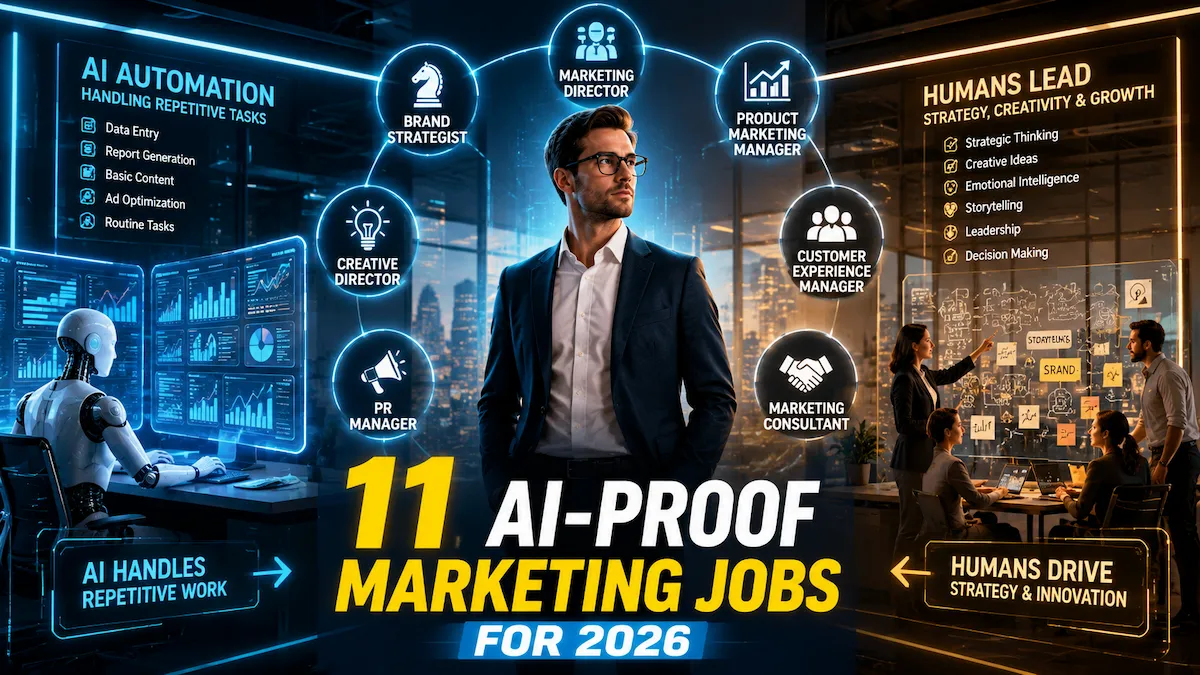
Quick Answer: The most AI-resilient marketing jobs are brand strategist, marketing director, product marketing manager, creative director, PR manager, customer experience manager, and marketing consultant. They remain durable because they rely on strategic decision-making, leadership, emotional intelligence, and human relationships — capabilities that are difficult to standardize or automate.
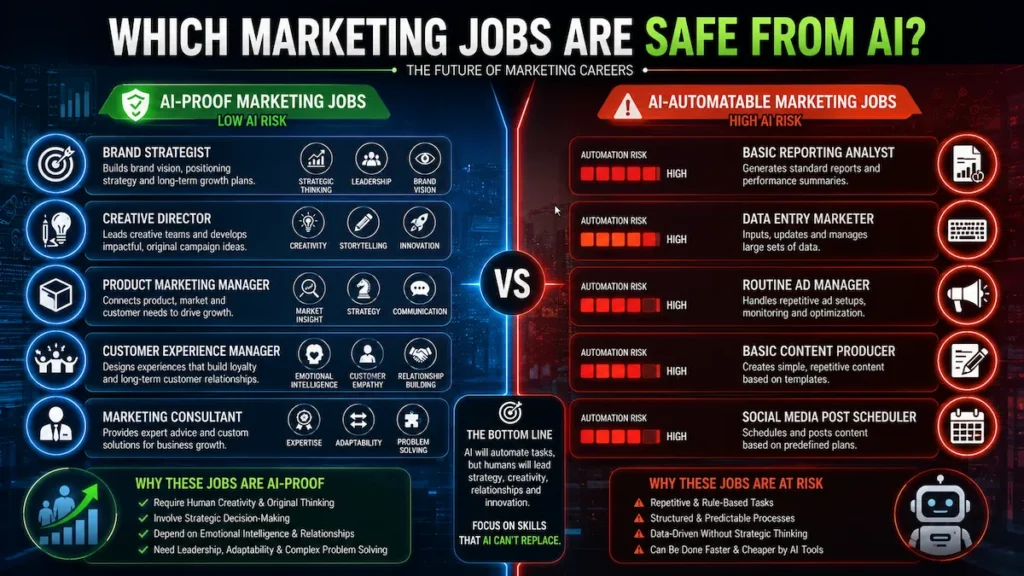
Comparison: AI-Resilient vs. High-Automation-Risk Roles
This comparison shows how AI-proof marketing jobs differ from execution-heavy roles increasingly exposed to automation.
| Role | Automation Risk | Human Skill Demand | US Salary Range | Future Demand | Career Stability |
|---|---|---|---|---|---|
| Brand Strategist | Very Low | Very High | $85K–$220K+ | High | Very Stable |
| Marketing Director | Very Low | Very High | $110K–$200K+ | Very High | Very Stable |
| Product Marketing Manager | Low | High | $95K–$175K | Very High | Very Stable |
| Creative Director | Low | Very High | $110K–$200K+ | High | Very Stable |
| PR Manager | Low | Very High | $70K–$200K+ | Strong | Very Stable |
| Consumer Psychology Specialist | Low | Very High | $80K–$145K | Growing | Stable |
| Customer Experience Manager | Low | High | $75K–$140K | High | Stable |
| Partnership Marketing Manager | Very Low | High | $80K–$150K | High | Stable |
| Community Manager | Very Low | Very High | $55K–$120K+ | High | Stable |
| Marketing Consultant | Very Low | Very High | $90K–$200K+ | Strong | Very Stable |
| Personal Branding Strategist | Low | Very High | $65K–$130K+ | Very High | Stable |
| Junior Content Writer (generic) | Very High | Low | $40K–$60K | Declining | Unstable |
| Social Media Scheduler | Very High | Very Low | $35K–$55K | Declining | Unstable |
| Standard Reporting Analyst | High | Low | $45K–$70K | Declining | Unstable |
| Basic PPC Campaign Manager | High | Medium | $50K–$75K | Declining | Unstable |
What Makes These Roles Durable Against Automation
Understanding the traits behind AI-proof marketing jobs makes it easier to invest in skills that remain valuable long-term.
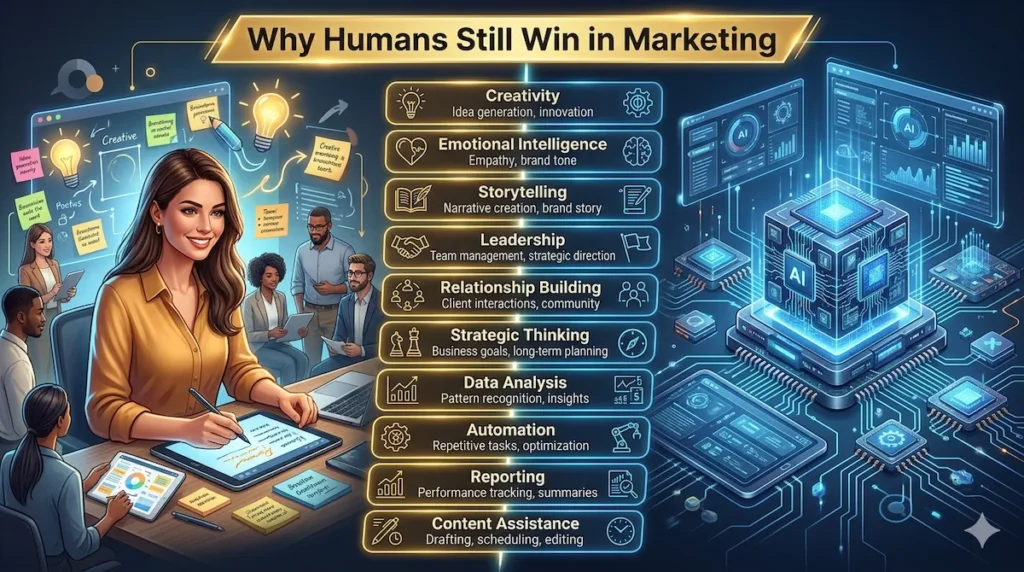
Not all marketing work is equally exposed to automation. The roles holding their value share a consistent profile: they depend on capabilities that AI cannot reliably replicate at a professional level.
Human creativity is the first pillar. AI can recombine and optimize at scale. What it cannot do is originate with authentic meaning. The best brand strategists and creative directors draw on cultural intuition and lateral thinking that comes from actually being human. Defining why a brand exists and how it should make people feel still requires a person.
Strategic judgment is the second. Strategy is the call you make after the data is interpreted—which market to enter, when to walk away, and how to align competing stakeholders around one narrative. AI can model scenarios; it cannot own the accountability that comes with the decision.
Emotional intelligence is the third. Understanding what makes people trust a brand, navigating client relationships, building community — these require genuine human presence that no current AI can enter meaningfully.
Leadership is the fourth. As AI absorbs execution-layer tasks, the demand for people who can set direction, build teams, and align organizations around a coherent strategy goes up — not down.
Top 11 AI-Proof Marketing Jobs in 2026
These AI-proof marketing jobs combine strategic value, human insight, and long-term career durability.
1. Brand Strategist
Brand strategy remains one of the strongest examples of AI-proof marketing jobs because differentiation still depends on human judgment.
Brand strategists define an organization’s identity, positioning, and long-term narrative—answering the foundational questions that no AI can answer authentically from the inside.
Why it is lower automation risk: Brand strategy requires cultural intuition, original thinking, and the ability to synthesize qualitative insight into a compelling point of view. AI can analyze what existing brands do; it cannot generate genuinely original positioning rooted in a specific company’s authentic story.
Core Responsibilities: Competitive positioning, brand architecture, messaging frameworks, consumer insight synthesis, and brand equity measurement.
Required Skills: Consumer research, competitive analysis, storytelling, positioning frameworks, cross-functional leadership.
US Salary: $85,000 – $220,000+ | Growth Path: Brand Manager → Senior Strategist → VP Brand → Chief Brand Officer | Future Demand: High
2. Marketing Director
Marketing director consistently ranks among the highest-paying AI-proof marketing jobs in modern organizations.
Why it is lower automation risk: Leadership cannot be automated. Judgment, accountability, and the ability to build teams through ambiguity are irreducibly human. A mid-size SaaS company recently reduced campaign operations headcount by 35% using AI tools while expanding its product marketing team, because positioning and alignment became more strategic, not less.
US Salary: $110,000 – $200,000+ | Growth Path: Marketing Manager → Director → VP Marketing → CMO | Future Demand: Very High
3. Product Marketing Manager
Product Marketing Manager is one of the fastest-growing AI-proof marketing jobs in SaaS and technology companies.
Why it is lower automation risk: PMMs must synthesize qualitative research, deeply understand customer psychology, and build alignment across teams with conflicting priorities. The contextual judgment and relationship skills this requires are not automatable.
Required Skills: Customer research, positioning, competitive intelligence, sales enablement, cross-functional communication.
US Salary: $95,000 – $175,000 | Future Demand: Very High, particularly in SaaS and enterprise tech.
4. Consumer Psychology Specialist
Consumer psychology specialist stands out among AI-proof marketing jobs because it focuses on understanding human behavior.
Why it is lower automation risk: Understanding human behavior—cultural context, emotional triggers, and cognitive biases in specific audiences—requires genuinely human interpretive depth. According to the American Psychological Association, cognitive and emotional decision-making involves factors that statistical modeling alone cannot capture. AI identifies behavioral correlations; it cannot explain the mechanisms driving them.
US Salary: $80,000 – $145,000 | Future Demand: Growing rapidly as brands compete on emotional resonance.
5. Customer Experience Manager
A customer experience manager is one of the AI-proof marketing jobs that helps brands compete through customer loyalty and trust.
Why it is lower automation risk: Creating experiences that feel genuinely human requires judgment at every design level. AI can personalize individual touchpoints, but the strategic architecture of a great CX remains a human endeavor. As AI-generated interactions become ubiquitous, brands delivering authentically human experiences will differentiate on CX as a primary competitive advantage.
US Salary: $75,000 – $140,000 | Growth Path: CX Analyst → CX Manager → Director → Chief Experience Officer
6. Creative Director
Creative directors lead the creative vision for brands and campaigns—setting direction, guiding teams, and ensuring every asset serves the strategic brief.
Why it is lower automation risk: While AI generates assets quickly, the judgment to determine what is genuinely good—culturally relevant, emotionally resonant, and strategically aligned—belongs to humans. That editorial judgment, combined with team leadership, is not automatable. Paradoxically, AI-generated content is increasing demand for creative directors who can maintain brand quality at scale.
US Salary: $110,000 – $200,000+ | Growth Path: Art Director / Senior Copywriter → ACD → Creative Director → CCO
7. Public Relations Manager
PR managers protect and advance brand reputation through earned media, stakeholder communications, and crisis management.
Why it has lower automation risk: PR is built on human relationships, trust, and the ability to read complex social and political dynamics in real time. Crisis communications requires judgment, empathy, and accountability that no AI can own. The Public Relations Society of America (PRSA) identifies relationship management and ethical judgment as the irreplaceable core competencies of the profession.
US Salary: $70,000 – $200,000+ (VP/Director level) | Future Demand: Strong
8. Partnership Marketing Manager
Partnership marketing manager is among the AI-proof marketing jobs that rely heavily on trust and collaboration.
Why it is lower automation risk: Partnership development is deeply relationship-intensive. Building trust, navigating competing interests, and negotiating terms requires interpersonal intelligence that is difficult to standardize or replicate programmatically.
US Salary: $80,000 – $150,000 | Future Demand: High, particularly as partnerships become a capital-efficient growth lever for mid-market companies.
9. Community Manager
Community managers build, grow, and nurture communities around a brand, product, or shared interest—serving as the human face of a brand’s most engaged audience relationships.
Why it is lower automation risk: Community is fundamentally about human connection. Real relationships, trust, and belonging cannot be automated. For a detailed look at how AI is affecting social media management, the data shows scheduling and analytics are automating; genuine relationship-building is not.
US Salary: $55,000 – $120,000+ | Future Demand: High — community is increasingly recognized as a high-ROI retention and growth channel.
10. Marketing Consultant
Marketing consultants help organizations solve complex challenges—positioning, brand strategy, and channel selection—as independent advisors or agency partners.
Why it is lower automation risk: Consulting is fundamentally relational. It requires understanding a specific client’s unique context, building trust through interpersonal skill, and applying judgment honed through diverse real-world experience. AI is actually increasing demand for consultants who can help organizations navigate AI adoption without costly mistakes.
US Salary: $90,000 – $200,000+ | Growth Path: Senior Specialist → Consultant → Fractional CMO / Agency Founder
11. Personal Branding Strategist
A personal branding strategist is one of the emerging AI-proof marketing jobs benefiting from demand for authentic expertise.
Why it is lower automation risk: Personal brands are, by definition, personal. They require deep understanding of a specific individual’s story, voice, and goals. While AI assists with content production, the strategy behind a credible personal brand — and the authentic human presence that makes it work — cannot be automated. For a broader view of what a future-proof digital marketing career looks like, this is an increasingly strong path.
US Salary: $65,000 – $130,000+ | Future Demand: Very High — as AI floods channels with generic content, authentic human voices become premium assets.
AI Resistance Score Breakdown
This AI Resistance Score helps identify which AI-proof marketing jobs offer the greatest long-term career stability.
Scoring criteria: Strategic Complexity (25) + Human Interaction (25) + Creativity (20) + Leadership (20) + Low Automation Exposure (10)
| Role | Strategic | Human Interaction | Creativity | Leadership | Low Automation | Score /100 |
|---|---|---|---|---|---|---|
| Marketing Director | 25 | 23 | 18 | 20 | 9 | 95 |
| Marketing Consultant | 25 | 23 | 17 | 20 | 9 | 94 |
| Brand Strategist | 25 | 20 | 22 | 18 | 9 | 94 |
| PR Manager | 22 | 25 | 18 | 18 | 9 | 92 |
| Creative Director | 20 | 18 | 22 | 20 | 9 | 89 |
| Product Marketing Manager | 24 | 20 | 17 | 18 | 8 | 87 |
| Partnership Marketing Manager | 20 | 23 | 14 | 16 | 8 | 81 |
| Customer Experience Manager | 20 | 22 | 15 | 16 | 8 | 81 |
| Consumer Psychology Specialist | 22 | 18 | 15 | 14 | 9 | 78 |
| Community Manager | 15 | 25 | 15 | 14 | 9 | 78 |
| Personal Branding Strategist | 18 | 20 | 20 | 12 | 8 | 78 |
Roles with Highest Automation Exposure
Understanding vulnerable roles makes it easier to transition toward AI-proof marketing jobs with stronger future demand.
Being honest about vulnerability is as important as identifying opportunity.
Basic Content Production: Junior writers producing generic blog posts and templated social copy are directly in the path of automation. Writers who develop a genuine specialty, distinctive voice, or subject-matter depth remain valuable—undifferentiated writing does not. The full picture on AI and content writers in 2026 covers this bifurcation in detail.
Standard Reporting Roles: Analysts who primarily pull dashboards are increasingly replaceable by AI-powered analytics platforms. Analysts focused on strategic interpretation and business recommendations remain relevant.
Email Execution Roles: Sequence building, list management, and basic A/B testing are being absorbed by AI platforms rapidly. The complete analysis of AI and email marketers in 2026 shows that email strategy and segmentation intelligence remain human-led—but execution is automating fast.
Basic PPC Management: Entry-level paid media managers running fixed-parameter campaigns are losing ground to platforms like Google’s Performance Max and Meta’s Advantage+. The detailed look at whether AI replaces SEO and search marketing roles applies equally here—strategic direction and cross-channel interpretation remain human work; execution-only positions are the most exposed.
The Human Leverage Formula
The Human Leverage Formula explains why AI-proof marketing jobs continue gaining value as automation expands.
The marketers building the most durable careers in 2026 are not simply avoiding automation-prone tasks. They are actively maximizing human leverage—the combination of skills that compound in value as AI takes over execution.
Career Stability = Decision Quality + Relationship Strength + Creative Judgment + AI Fluency
Each variable compounds the others. Strong creative judgment without AI fluency means being outpaced by someone who pairs both. AI fluency without relationship strength means lacking the senior opportunities that matter. All four together create a career profile that is genuinely durable against automation at every level.
The guide to digital marketing skills for the AI era covers exactly where to invest development time to build each variable. For the tools side specifically, the generative AI guide for marketers in 2026 is the practical companion.
Skills With the Strongest Long-Term Value
Developing these capabilities is essential for securing high-paying AI-proof marketing jobs in the years ahead.
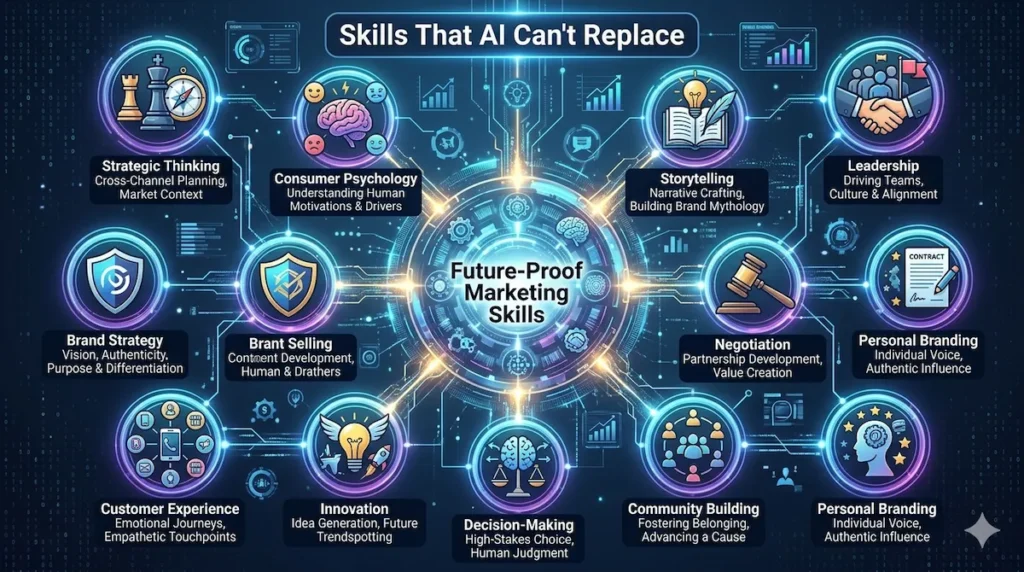
Strategic thinking remains the single most durable marketing skill. AI executes. Humans decide what to execute and why. The ability to see beyond immediate tactics to market dynamics, competitive positioning, and long-term brand building is something AI tools augment but cannot replace.
Consumer psychology—understanding why people buy, what drives trust, and how to frame choices—is foundational for any marketer who wants to remain relevant. The Journal of Consumer Psychology remains a strong resource for practitioners building genuine expertise here.
Storytelling at the strategic level — translating complex ideas into narratives that move people — is irreplaceable. Brand stories, executive communications, and product narratives require human resonance that AI cannot match authentically.
Leadership and influence grow more valuable as AI handles more execution. Managing people, influencing without authority, and motivating teams through ambiguity are not optional for anyone targeting senior roles.
AI collaboration is the counterintuitive entry: knowing how to direct, evaluate, and integrate AI tools effectively is becoming a baseline competency. Prompt engineering, AI output quality assessment, and workflow integration are now expected at mid-level and senior marketing roles.
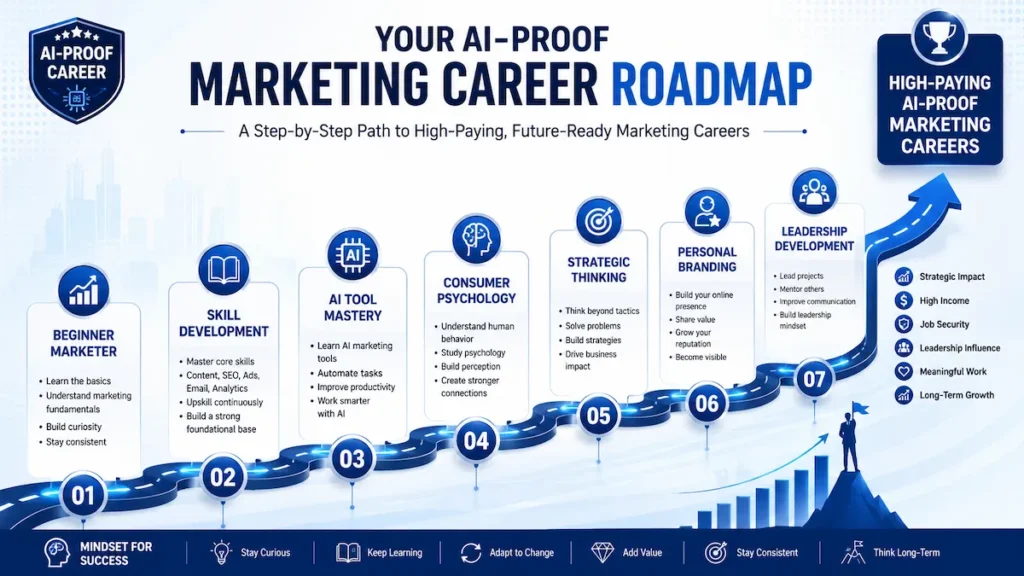
Career Roadmap
This roadmap shows how professionals can progress into AI-proof marketing jobs through deliberate skill development.
Beginner Level (0–2 Years)
- Choose a specialization with inherent human-skill requirements: brand, community, PR, or product marketing
- Build foundational skills in writing, research, and data interpretation—not just tool operation
- Learn one or two AI marketing tools deeply rather than collecting surface-level familiarity with many
- Develop a portfolio demonstrating strategic judgment, not just execution output
Key Milestone: A junior role in a brand, PR, product marketing, or community function with genuine strategic exposure.
Intermediate Level (2–5 Years)
- Develop a genuine specialty — consumer psychology, brand strategy, partnerships, or CX
- Build professional visibility through publishing, speaking, or industry writing
- Take cross-functional projects to develop business acumen beyond the marketing function
- Begin managing clients or internal projects to build early leadership experience
Key Milestone: Manager or senior specialist role with budget and/or direct report responsibility.
Advanced Level (5+ Years)
- Position yourself as a strategic leader, not just a senior practitioner
- Build thought leadership visibility within your industry vertical
- Develop executive-level communication and board-level presentation skills
- Explore consulting, advising, or fractional CMO work to diversify expertise and income
Key Milestone: VP, Director, or C-suite appointment — or a profitable independent consulting practice.
For the full context of what this progression looks like in the current AI environment, the complete guide to building a digital marketing career with AI is a strong companion resource.
Future Trends
Emerging technologies will reshape marketing, but demand for AI-proof marketing jobs is expected to remain strong.
Generative AI as Table Stakes: According to McKinsey’s research on AI in marketing, companies integrating generative AI into marketing workflows are seeing significant gains in content production speed and campaign iteration. Marketers who can direct, evaluate, and edit these tools have a decisive edge. Those who ignore them will work harder for diminishing returns.
Autonomous AI Agents: AI agents capable of planning and executing multi-step marketing tasks—research, reporting, scheduling, and optimization—are in early deployment at leading organizations. The implication is clear: the value of execution is falling while the value of supervision, strategic judgment, and direction is rising sharply.
Human-AI Collaboration as Core Competency: The most successful marketing organizations over the next five years will develop frameworks where AI handles scale, speed, and data processing — and humans provide strategic direction, creative judgment, and quality oversight. Marketers who operate effectively in this model will be in extraordinary demand.
The Evolving CMO: The chief marketing officer role is transforming significantly. Modern CMOs must be comfortable with AI tools and data infrastructure while remaining genuine brand and creative leaders. The career paths leading to the CMO seat are already shifting in response.
Common Mistakes That Accelerate Career Vulnerability
Avoiding these mistakes can help professionals move toward more secure AI-proof marketing jobs.
Waiting too long to specialize. Generalist marketers without a clear specialty are the most exposed to automation. Deep expertise in a human-intensive domain is the core career moat.
Ignoring AI tools entirely. Refusing to engage with AI does not make you more valuable — it makes you less competitive. The goal is to be a skilled human who can direct and evaluate AI output, not to compete with it directly.
Confusing execution with strategy. Scheduling posts, formatting reports, and writing templated copy are exactly what AI automates first. Invest heavily in developing strategic judgment.
Neglecting personal brand. In an AI economy, visibility and reputation matter more than ever. Marketers who invest in publishing, speaking, and networking create demand for themselves that is not subject to automation.
Staying in a high-exposure role too long. If your role is primarily composed of tasks AI is already doing competently, transition now — not when the position is eliminated. Career pivots require lead time.
Underinvesting in leadership development. Many mid-level marketers focus all development energy on technical skills while neglecting communication and leadership capabilities. In an AI era, leadership is the ultimate differentiator.
Prioritizing tool certifications over strategic insight. A collection of platform certifications is not a career strategy. Employers need people who think strategically — not just people who can operate tools.
Failing to build genuine industry expertise. A marketer with deep domain knowledge in healthcare, fintech, SaaS, or CPG is far more durable than a generalist. Industry knowledge compounds over time and is extremely difficult for AI to replicate.
FAQs
These frequently asked questions address the most common concerns about AI-proof marketing jobs and career stability.
What are the most AI-resilient marketing jobs in 2026?
Brand Strategist, Marketing Director, Product Marketing Manager, Creative Director, PR Manager, and Marketing Consultant consistently rank highest based on their human-skill intensity, leadership requirements, and relationship dependence. The AI Resistance Score table above provides a detailed breakdown by criteria.
Will AI replace marketing jobs entirely?
AI will not eliminate marketing as a profession, but it is fundamentally reshaping which roles exist and what they require. Execution-heavy roles are at significant risk. Roles dependent on strategy, creativity, leadership, and human connection are growing in value. The profession is bifurcating — not disappearing.
Is content marketing dead because of AI?
Strategic content creation remains an important component of many AI-proof marketing jobs.
What marketing skills are most valuable in 2026?
Strategic thinking, consumer psychology, storytelling, leadership, and AI collaboration skills are the most durable capabilities right now. Add deep industry expertise and genuine relationship-building ability, and you have a career profile well-positioned regardless of how AI tools evolve.
Can AI replace a CMO?
Not in any meaningful near-term timeframe. The CMO role requires executive judgment, cross-functional leadership, and ultimate accountability for business outcomes. AI supports CMOs significantly—automating analytics, generating creative variations—but it cannot own the role’s accountability.
How do I transition from a high-exposure role to a more resilient one?
Moving into AI-proof marketing jobs often starts with identifying transferable skills and building strategic expertise.
How much do human-intensive marketing roles pay?
Compensation is strong and trending upward. Marketing Directors earn $110,000–$200,000+. Product marketing managers earn $95,000–$175,000. Brand strategists earn $85,000–$220,000+ at senior levels. As demand grows and supply of truly strategic talent remains limited, these benchmarks are expected to continue rising.
How important is it to learn AI tools as a marketer?
Extremely important. AI fluency is increasingly a baseline expectation at mid-level and senior roles. The goal is to be fluent enough to direct AI tools effectively, evaluate outputs critically, and integrate them intelligently into workflows—not to become a technical specialist.
Conclusion
The marketing professionals who will thrive over the next decade are not the ones pretending AI does not exist, and they are not the ones surrendering their judgment to it either. They are the ones who understand exactly what AI can and cannot do — and who have positioned their expertise deliberately on the human side of that line.
Four key takeaways:
- AI is automating execution-layer marketing tasks at an accelerating pace—content production, reporting, and basic campaign management face the most pressure
- The 11 roles in this guide are positioned for sustained demand because they require strategy, creativity, emotional intelligence, and leadership that AI cannot reliably replicate
- The Human Leverage Formula—Decision Quality + Relationship Strength + Creative Judgment + AI Fluency—is the career framework that matters most right now
- A clear progression exists from beginner to advanced, and the transition is achievable for most marketers willing to invest intentionally
Your immediate next steps:
- Audit your current role for automation exposure this week
- Choose one role from this guide that aligns with your background and interests
- Identify two to three skills to build over the next six months using the Human Leverage Formula as your guide
- Start building professional visibility through publishing and targeted networking
- Connect with professionals already in your target role to understand what the path actually looks like
The AI era is not a threat to skilled, strategic, human-intensive marketers. It is an accelerant. The demand for people who think clearly, lead effectively, and connect genuinely — while intelligently directing AI tools — has never been higher. Start building that profile today.
Salary data sourced from the U.S. Bureau of Labor Statistics, Glassdoor, and LinkedIn Salary Insights. Figures represent US-based compensation and vary by geography, company size, seniority, and industry. AI resistance scores are editorial assessments based on publicly available research on automation risk in marketing roles.