
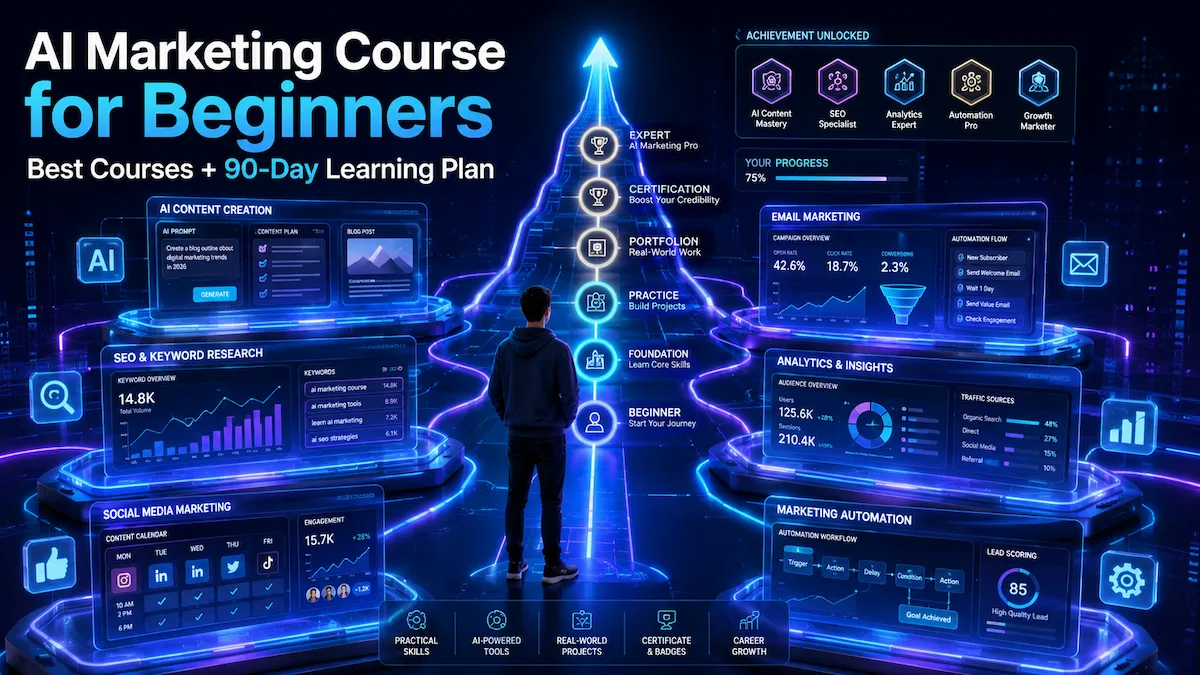
You searched for an AI marketing course for beginners because you already sense what the data confirms: AI is not replacing marketers—it is replacing marketers who refuse to learn it.
AI literacy increasingly appears in marketing job requirements, especially for content, analytics, and automation workflows. Yet most beginner AI marketing courses either drown you in jargon or sell certifications that carry no real market weight.
This guide gives you a structured path from beginner to practical AI marketing capability—covering the best courses, the tools that matter, and a 90-day plan you can start this week.
If you only have 90 seconds: Start with HubSpot AI for Marketing (free) → practice with ChatGPT daily → build one real portfolio project → earn one recognized certification. That sequence alone puts you ahead of most beginners entering the market right now.
🔗 Before diving in, see how this connects to building a future-proof digital marketing career in 2026 — the bigger picture helps you prioritize what to learn first.
Why Trust This Guide
This guide was built by reviewing beginner AI marketing curricula across seven major platforms, comparing practical assignments and real-world learning outcomes, and prioritizing beginner accessibility and portfolio value over marketing claims. Course assessments are updated for the 2026 tool landscape. Rankings reflect a weighted scoring methodology explained before the course reviews below.
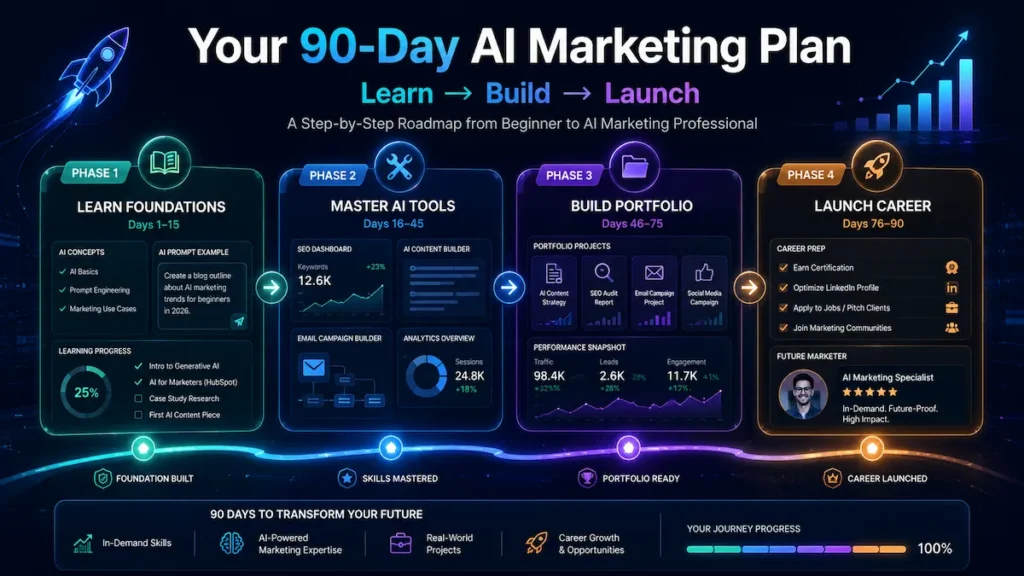
Quick Comparison: Best AI Marketing Courses for Beginners
| Course | Best For | Cost | Time | Outcome |
|---|---|---|---|---|
| HubSpot AI for Marketers | Absolute beginners | Free | 3–5 hrs | Practical skills + cert |
| Google Digital Marketing (Coursera) | Career switchers | ~$39/mo | 6 months | Employer-recognized cert |
| LinkedIn Learning AI Path | Working professionals | $39.99/mo | 15–20 hrs | LinkedIn-visible credential |
| Semrush Academy | SEO-focused beginners | Free | 4–6 hrs | Tool proficiency + certification |
| Coursera — AI for Everyone | Concept clarification | Free to audit | 6 hrs | AI literacy foundation |
| Marketing AI Institute | Intermediate marketers | $97–$497+ | Self-paced | Deep specialization |
| Udemy AI Marketing Masterclass | Budget learners | $15–$20 | 10–20 hrs | Broad overview |
Recommended Starter Stack: What to Actually Use First
Before investing heavily, pair your AI marketing course for beginners with a simple tool stack that builds hands-on experience from day one.
Decision paralysis from too many tool options is one of the most common reasons beginners stall before they start. This stack removes that friction.
Free tier — start here:
- AI Assistant: ChatGPT (OpenAI) — content creation, ideation, prompt practice
- Analytics: Google Analytics 4 — performance tracking and AI-generated insights
- Content Workflow: HubSpot free CRM — email automation and campaign management
One paid addition (choose based on your goal):
- Career focus: Google Digital Marketing Certificate on Coursera
- SEO focus: Semrush Academy (start with the free cert, upgrade when ready)
- Visibility focus: LinkedIn Learning (included with LinkedIn Premium trial)
Start with the free tier for the first 30 days. Add one paid course or tool only after you have logged real hours with the free stack. Buying tools before building habits is the most common and most expensive beginner mistake.
Which AI Marketing Course Should You Choose?
This section helps you match the best AI marketing course for beginners to your current experience level and long-term career direction.
| You Are | Start Here | Why |
|---|---|---|
| Student (no experience) | HubSpot AI for Marketers | Free, structured, beginner-friendly |
| Freelancer | Semrush Academy + ChatGPT practice | Directly billable SEO and content skills |
| Career Switcher | Google Digital Marketing Certificate (Coursera) | Employer-recognized across 150+ companies |
| Small Business Owner | HubSpot + ChatGPT daily practice | Low cost, immediate operational application |
| Working Marketer | LinkedIn Learning AI Path | The credential appears on your LinkedIn profile instantly |
Best Course by Goal
| Goal | Recommendation |
|---|---|
| Fastest start with no budget | HubSpot AI for Marketers (free) |
| Career switch with employer recognition | Google Digital Marketing Certificate |
| SEO and content specialization | Semrush Academy (free) |
| AI concept clarity before tools | AI for Everyone — Andrew Ng |
| Portfolio-first learning | HubSpot + ChatGPT daily practice |
Pick the row that matches you and start this week — not next month.
Why Learning AI Marketing in 2026 Is No Longer Optional
A structured AI marketing course for beginners helps shorten the learning curve and turn AI concepts into practical marketing skills.
The demand shift is no longer gradual. According to LinkedIn’s 2024 Workplace Learning Report, AI literacy now ranks among the top five skills employers are actively recruiting for across industries — not just tech. Marketing job listings mentioning AI tool proficiency have grown significantly year-over-year across content, automation, and analytics roles.
For beginners, this creates a practical window: the bar for “AI-competent marketer” is still accessible enough that 90 days of focused, consistent learning can meaningfully differentiate you from candidates with years of experience who have not upskilled.
AI Is Redefining Marketing Roles—Not Eliminating Them
The World Economic Forum’s Future of Jobs 2025 report projects that AI will generate new marketing roles centered on AI strategy, prompt management, data storytelling, and human-AI collaboration—while automating certain repetitive execution tasks. The marketers who advance will be those who direct AI tools effectively, not those who compete with them.
If you are wondering whether content or SEO roles are structurally at risk, the fuller picture is covered in our analysis of whether AI will replace content writers and what skill adjustments that trend actually requires.
The Freelance and Small Business Advantage
For freelancers and small business owners, AI marketing tools compress what previously required agency-level budgets. A solo operator using ChatGPT for content ideation, Canva AI for design, and Google Analytics 4 for performance tracking can now deliver outputs that previously required a team of four or five — a direct revenue opportunity for those who develop these skills now.
⚡ Quick Answer: AI literacy increasingly appears in marketing job requirements across content, analytics, and automation roles. Beginners who build hands-on AI skills in 2026 gain a practical advantage that compounds over time as the broader workforce skill gap remains wide.
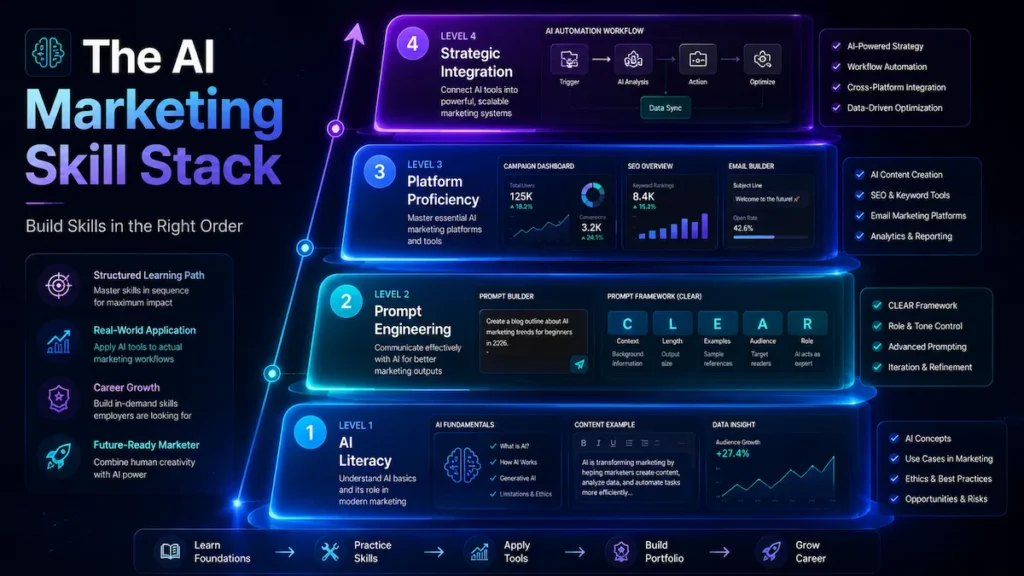
90-Day AI Marketing Learning Roadmap for Beginners
Following this roadmap alongside an AI marketing course for beginners creates a practical path from learning to real implementation.
Work through these phases in sequence—skipping ahead creates gaps that show up in real work and client conversations.
Phase 1 (Days 1–15): Build Your AI Marketing Foundation
The first stage of an AI marketing course for beginners should focus on understanding AI concepts before relying on tools.
Your first goal is concept clarity. Before opening any tool, understand what AI can and cannot do in a marketing context.
- Complete Google’s free Introduction to Generative AI (Google Cloud Skills Boost — 1 hour)
- Complete HubSpot’s free AI for Marketing certification track (3–5 hours)
- Read one AI marketing case study daily from HubSpot Blog or MarTech Alliance
- Write your first AI-generated content piece using ChatGPT—a structured 500-word blog intro on a topic you know well
- Set up Google Analytics 4 on a test site (a free WordPress.com blog works if you do not have one)
Phase 2 (Days 16–45): Core AI Marketing Tool Mastery
Most successful learners treat their AI marketing course for beginners as a hands-on workshop rather than passive video consumption.
Work through tool categories in weekly blocks—one category at a time—rather than all five simultaneously:
Week 3 — Content Creation + Prompt Engineering
- Tools: ChatGPT (OpenAI), Jasper, or Copy.ai
- Task: Write a 10-article content plan for a niche topic using AI. Save the best three as portfolio pieces.
- Skill focus: The CLEAR Prompt Formula — Context, Length, Examples, Audience, Role
Week 4 — SEO + Analytics
- Tools: Semrush AI assistant or Surfer SEO; Google Analytics 4 with AI Insights
- Task: Run an AI-assisted SEO audit on a real website (with permission). Build a simple GA4 dashboard.
- Skill focus: How AI surfaces keyword gaps and performance patterns that manual review misses
Week 5 — Email + Social
- Tools: HubSpot AI email tools or Klaviyo AI; Buffer AI, or Hootsuite OwlyWriter
- Task: Build a 5-email welcome sequence using AI subject line testing. Create a 30-day social content calendar.
- Skill focus: AI personalization tokens and how automation decisions affect campaign performance
Week 6 — Portfolio Sprint
- Compile your best output from Weeks 3–5 into three to four documented portfolio pieces
- Each piece should include a one-paragraph note: what AI produced, what you manually refined, and why
For the full breakdown of which skills to prioritize and in what sequence, the guide on learning AI marketing skills online in 2026 maps the exact progression most beginner resources underestimate.
Phase 3 (Days 46–75): Build a Visible AI Marketing Portfolio
A high-quality AI marketing course for beginners becomes more valuable when every lesson produces documented portfolio assets.
The four most practically valuable portfolio assets for beginner AI marketers:
- AI Content Project: A 10-article content plan with three published pieces on Medium or Substack
- AI SEO Audit: A documented Semrush audit with AI-assisted recommendations versus your manual corrections noted
- AI Email Campaign: A 5-email welcome sequence built in HubSpot’s free CRM with subject line test results
- AI Social Campaign: A 30-day Instagram content calendar with first-month engagement metrics attached
Phase 4 (Days 76–90): Credential, Apply, and Iterate
Completing an AI marketing course for beginners should lead directly into certifications, portfolio visibility, and real applications.
- Earn one employer-recognized certification: Google Digital Marketing Certificate, HubSpot Marketing Hub, or Meta Blueprint AI Ads
- Update your LinkedIn profile—add “AI Marketing” as a skill, list specific tools, and reference your portfolio projects by name
- Apply to 3–5 entry-level roles per week, or pitch 2–3 freelance clients with a specific, narrow service offering backed by portfolio samples
- Join AI marketing communities: Marketing AI Institute’s Slack group, r/ChatGPT for marketers, and LinkedIn groups for AI marketing professionals
💡 Expert Tip: Every course hour should produce a real artifact—a content piece, a campaign draft, or an analytics report. The portfolio gap is the single largest differentiator between beginners who move forward and those who stall.
⚡ Quick Answer: The 90-day roadmap moves through four phases: foundation (Days 1–15), weekly tool mastery blocks (Days 16–45), portfolio building (Days 46–75), and credentialing with applications (Days 76–90). Consistent output throughout each phase is what converts learning into practical capability.
Before You Enroll: How to Spot a Course Worth Avoiding
Not every AI marketing course for beginners delivers practical outcomes, so evaluating quality signals matters before enrolling.
Avoid a course if it:
- Promises guaranteed income or specific monthly earnings figures
- Has no visible update date or was last updated before 2024
- Contains no practical projects — only lecture videos or prompt templates
- Teaches only prompt engineering with no broader marketing workflow context
- Lists no verifiable instructor credentials outside the platform itself
- Has reviews that describe content as “informative” without mentioning practical outcomes
This filter eliminates the majority of low-quality options without requiring you to evaluate content you cannot yet assess.
The 7 Best AI Marketing Courses for Beginners in 2026
Choosing the right AI marketing course for beginners depends on your goals, available time, and whether you prioritize certifications, portfolio work, or practical tool experience.
How We Ranked These Courses
| Criterion | Weight |
|---|---|
| Beginner Friendliness | 30% |
| Practical Projects | 25% |
| Tool Coverage | 20% |
| Cost Efficiency | 15% |
| Credential Value | 10% |
1. HubSpot Academy — AI for Marketers Certification
Cost: Free | Duration: 3–5 hours | Weighted Score: 9.3/10
The strongest free entry point for beginners. Covers AI in email marketing, CRM automation, content creation, and campaign optimization — within a tool ecosystem used by 228,000+ businesses globally. According to HubSpot’s State of Marketing 2024 report, AI adoption in content and email workflows grew by over 50% among marketing teams in the past year alone, making this curriculum directly relevant to current job requirements.
- Best for: Students and beginners targeting content or email marketing roles
- Standout: Free, self-paced, builds directly usable tool skills
- Limitation: Focused on HubSpot’s ecosystem; lighter on SEO and paid advertising AI
2. Google Digital Marketing & E-commerce Certificate (Coursera)
Cost: ~$39/month (financial aid available) | Duration: 6 months at 10 hrs/week | Weighted Score: 9.1/10
The best structured option for career switchers. Integrates Google Analytics 4, Google Ads, and Google’s AI campaign tools into a single credential. Google reports this certificate is recognized by 150+ US employers, including Deloitte, Walmart, and Verizon—making it one of the most employer-validated beginner credentials currently available.
- Best for: Career switchers with no prior marketing experience
- Standout: Employer-recognized at scale; AI tools embedded in real campaign workflows
- Limitation: AI-specific content is growing but lighter than dedicated AI marketing programs
3. LinkedIn Learning — Become an AI-Powered Marketer Path
Cost: $39.99/month (included with LinkedIn Premium) | Duration: 15–20 hours | Weighted Score: 8.8/10
Completion adds a verifiable certificate directly to your LinkedIn profile—immediately visible to recruiters actively searching the platform. Covers AI content strategy, AI analytics, and AI-assisted campaign management. LinkedIn’s own data indicates that profiles with verified skills certificates receive significantly more recruiter outreach than those without.
- Best for: Working marketers who want visible credentials fast
- Standout: LinkedIn profile integration; passive recruiter visibility post-completion
- Limitation: Primarily video-based; less hands-on project work than bootcamp alternatives
4. Semrush Academy — AI Content Marketing Course
Cost: Free | Duration: 4–6 hours | Weighted Score: 8.7/10
Free, SEO-forward AI education with direct integration to one of the industry’s most widely used SEO platforms—used by over 95,000 paying customers globally, according to Semrush’s published company data. Ideal for beginners targeting content strategist or SEO specialist roles who want simultaneous tool familiarity and conceptual grounding.
- Best for: Beginners targeting SEO, content marketing, or digital agency work
- Standout: Free certification from an enterprise-grade platform
- Limitation: Focused on content and SEO; limited coverage of email, paid, or social AI
5. Coursera — AI for Everyone (Andrew Ng, DeepLearning.AI)
Cost: Free to audit, ~$49 for certificate | Duration: 6 hours | Weighted Score: 8.5/10
The most recommended AI literacy foundation course for non-technical beginners globally, developed by Andrew Ng—co-founder of Google Brain and former chief scientist at Baidu. Not marketing-specific, but builds the conceptual clarity that prevents beginners from over-trusting or under-using AI tools in practice. Pair with HubSpot for a complete beginner stack.
- Best for: Beginners who feel intimidated by AI concepts and want clarity before tool training
- Standout: Globally respected; no technical background required; free to audit
- Limitation: Must be paired with a marketing-specific course to be directly job-relevant
6. Marketing AI Institute — AI Academy
Cost: $97–$497+ per course | Duration: Self-paced | Weighted Score: 8.3/10
Founded by Paul Roetzer, one of the most cited practitioners in the AI marketing space, the Marketing AI Institute offers courses built exclusively around AI’s impact on marketing workflows rather than general AI theory. Best suited after completing beginner-level content.
- Best for: Practitioners ready to move beyond beginner content
- Standout: Marketing-only focus; practitioner-built curriculum
- Limitation: Higher price point; less employer name recognition than Google or HubSpot
7. Udemy — The Complete AI Marketing Masterclass
Cost: $15–$20 on sale | Duration: 10–20 hours | Weighted Score: 7.9/10
The most affordable structured option for broad coverage. Quality varies by instructor — filter by courses with 1,000+ reviews and a 4.5+ star rating. Frequent 80–90% discount sales make this a low-risk entry point for budget-conscious learners.
- Best for: Budget-conscious beginners who want broad topic coverage at minimal cost
- Standout: Extremely affordable with frequent discounting
- Limitation: No standardized curriculum; quality is entirely instructor-dependent
⚡ Quick Answer: The 7 best AI marketing courses for beginners in 2026 are HubSpot (free, best starter), Google/Coursera (best for career switchers), LinkedIn Learning (best for visibility), Semrush Academy (best for SEO), AI for Everyone by Andrew Ng (best for concept clarity), Marketing AI Institute (best for depth), and Udemy (best for budget learners). Choose based on your current situation, not the most impressive-sounding name.
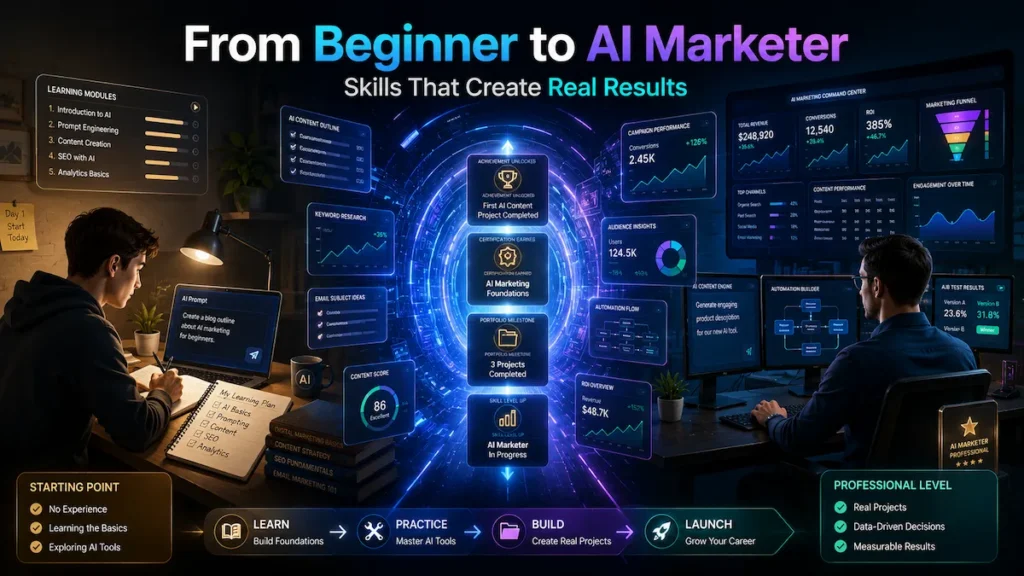
The AI Marketing Skill Stack Ladder
A strong AI marketing course for beginners should build skills sequentially rather than introducing advanced tools too early.
The AI Marketing Skill Stack Ladder (AMSSL) organizes competencies in the sequence they need to be built—by dependency, not by popularity.
Level 1 — AI Literacy (Week 1–2)
- What large language models (LLMs) like GPT-4 actually are and where they fail
- The difference between generative AI (creates content) and predictive AI (analyzes patterns)
- How AI hallucination and factual errors create measurable campaign risks
- Ethical considerations: disclosure requirements, copyright boundaries, brand voice protection
Level 2 — Prompt Engineering for Marketers (Week 3–4)
The quality of your AI marketing output is almost entirely determined by the quality of your input prompt.
- The CLEAR Prompt Formula: Context, Length, Examples, Audience, Role
- Negative prompting: specifying what the AI should not write is often as important as what it should
- Chain prompting: breaking complex tasks into sequential prompts for higher-quality outputs
- Persona injection: conditioning AI tools to write consistently in your brand’s voice
Level 3 — Platform Proficiency (Month 2)
Complete at least one real marketing task per tool — not just tutorials. Real tasks produce portfolio pieces; tutorials produce forgotten knowledge.
Level 4 — Strategic AI Integration (Month 3)
Connect tools into repeatable, documented workflows:
- AI-assisted content production pipeline: ideation → drafting → editing → publishing → SEO optimization
- Lead nurturing automation with AI email personalization
- A brand prompt library: a tested set of prompts that reliably produce on-brand output at scale
The integration layer at Level 4 is what separates marketers who use AI tactically from those who build digital marketing skills that hold their value across the AI era.
7 Mistakes Beginners Make When Learning AI Marketing
Avoiding these mistakes ensures your AI marketing course for beginners translates into practical capability instead of unused certifications.
Mistake 1: Chasing tools instead of skills. AI marketing tools change every three to six months. Learn the skill category and treat the specific tool as interchangeable.
Mistake 2: Publishing AI content without human editing. Factual errors, brand inconsistencies, and generic phrasing are common in unedited AI output. The editorial role remains irreplaceable — human judgment still determines whether AI output is accurate, on-brand, and worth publishing.
Mistake 3: Ignoring prompt engineering. Invest at least two weeks in prompt engineering practice before expanding to other tools. The leverage at this stage is disproportionately high relative to the time invested.
Mistake 4: Collecting certifications without building portfolio pieces. Three real portfolio pieces demonstrate more practical capability than five certificates in most hiring and client conversations.
Mistake 5: Skipping the analytics layer. Many beginners focus on creative and content AI tools while ignoring analytics. Understanding how AI is reshaping SEO measurement and reporting gives useful context on why the analytics layer matters beyond content creation alone.
Mistake 6: Using AI to bypass creative thinking. AI is a force multiplier for creative marketers — not a substitute for strategic thinking. Use AI to execute ideas efficiently, not to generate strategy from nothing.
Mistake 7: Learning in isolation. AI marketing evolves too quickly for solo self-study to keep pace. Follow practitioners on LinkedIn, engage with Marketing AI Institute’s community, and subscribe to newsletters like TLDR Marketing. Community-based learning compounds faster than structured course content alone.
⚠️ Industry Warning: Low-quality AI marketing courses are increasingly sold with inflated ratings. Before purchasing, verify the instructor has demonstrable real-world marketing experience, the curriculum was updated within the past 12 months, and reviewers cite practical outcomes—not just that the content was “informative.”
AI Marketing Career Opportunities for Beginners
Completing an AI marketing course for beginners can support entry into roles that increasingly expect AI-assisted workflows.
Entry-Level Roles That Value AI Marketing Skills
| Job Title | Typical Compensation | AI Tools Required | Best Learning Path |
|---|---|---|---|
| AI Content Writer / Specialist | Entry-level range (varies by location and experience) | ChatGPT, Jasper, Surfer SEO | HubSpot + Semrush Certs |
| Marketing Automation Specialist | Entry-level range (varies by location and experience) | HubSpot, Mailchimp AI, Klaviyo | HubSpot Cert + 90-day roadmap |
| SEO Specialist (AI Tools) | Entry-level range (varies by location and experience) | Semrush, Surfer, NeuralText | Semrush Academy + Google Cert |
| Social Media Manager (AI) | Entry-level range (varies by location and experience) | Buffer AI, Canva AI, Hootsuite | LinkedIn Learning Path |
| Digital Marketing Analyst | Mid entry-level range (varies by location and experience) | Google Analytics 4, Looker Studio | Google Cert + Portfolio |
| Freelance AI Marketing Consultant | Hourly/project-based (varies by scope and market) | All of the above | Full 90-Day Roadmap |
Research current compensation ranges on LinkedIn Salary, Glassdoor, or the Bureau of Labor Statistics for your specific market before anchoring to any figures.
The Freelance Opportunity
For freelancers and small business owners, the AI marketing skills gap creates a direct, accessible revenue window. Small businesses increasingly need AI-assisted content, SEO, and email marketing but cannot afford agency retainers—creating demand for affordable, skilled freelance practitioners.
Understanding whether a digital marketing career remains viable with AI in 2026 gives useful context on demand trajectory before committing to a specialization. And for those considering email as a specialization, the guide on AI and email marketing in 2026 covers what that role now requires at the entry level.
⚡ Quick Answer: Entry-level AI marketing roles beginners can realistically target include AI Content Writer, Marketing Automation Specialist, SEO Specialist, Social Media Manager, Digital Marketing Analyst, and freelance consulting. Portfolio work is the primary differentiator at the entry level—not certifications alone.
When an AI Marketing Course May NOT Be Right for You
Before enrolling in an AI marketing course for beginners, confirm that your goals, available time, and foundational marketing knowledge align.
If you have no marketing fundamentals. AI marketing courses work best when you already understand what marketing is trying to accomplish—awareness, consideration, conversion, and retention. Start with the Google Digital Marketing Certificate as a foundation first.
If you are expecting a passive income shortcut. AI marketing skills follow the same compound learning curve as any professional skill. Consistent practice and real work are not optional steps.
If your industry has heavy compliance requirements. Healthcare, legal, financial services, and pharmaceutical marketing operate under strict content regulations. Verify that any course you choose specifically addresses compliance for your industry.
If you cannot commit 5–10 hours per week consistently. Sporadic learning does not produce retained, applicable skill sets. Adjust your timeline before starting rather than abandoning the roadmap midway.
Your First 7 Days: Action Checklist
These actions help transform an AI marketing course for beginners into consistent execution and measurable progress.
Before the FAQs, before the conclusion—here is the only list that matters right now:
- ☐ Create a ChatGPT account (free tier is sufficient to start)
- ☐ Complete HubSpot AI for Marketing — Lesson 1 (under 1 hour)
- ☐ Install Google Analytics 4 on a test site or existing property
- ☐ Write and save your first AI-generated content piece using a structured prompt
- ☐ Save that piece as Portfolio Item #1 with a one-paragraph process note attached
- ☐ Bookmark the Introduction to Generative AI for Day 2
- ☐ Join one AI marketing community: Marketing AI Institute Slack or r/ChatGPT for marketers
Seven actions. Seven days. That is enough to confirm whether this learning path is right for you before committing further time or money.
Frequently Asked Questions
The answers below address the most common concerns people have before starting an AI marketing course for beginners.
Which AI marketing course is best for complete beginners?
HubSpot Academy’s AI for Marketers certification is the strongest starting point — free, self-paced, and focused on tools used in real entry-level marketing roles. Pair it with Google’s free Introduction to Generative AI for a complete conceptual and practical foundation in under 10 hours total.
Can I learn AI marketing in 90 days?
Yes — with consistent effort. Most beginners reach practical AI marketing competency in 60–90 days with 5–10 hours of weekly practice. The timeline shortens with prior marketing experience and lengthens if portfolio-building is skipped. The roadmap in this guide is designed to be realistic, not aspirational.
Is AI marketing worth learning in 2026?
Yes. According to LinkedIn’s 2024 Workplace Learning Report, AI literacy ranks among the top five in-demand skills across industries. The skill gap in the broader marketing workforce remains wide, which means early learners still have a meaningful practical advantage — one that will narrow as adoption accelerates.
Do employers care about AI certifications?
Employer-recognized certifications from Google, HubSpot, Meta, and LinkedIn carry real signal value — particularly when paired with portfolio work. A certification alone is rarely sufficient. Three to five documented portfolio pieces alongside one employer-recognized certification are materially stronger than either alone.
What AI tools should I learn first?
Start with five: ChatGPT for content creation and ideation, Google Analytics 4 for performance tracking, HubSpot’s free CRM for email automation, Canva AI for visual content, and Semrush or Ubersuggest for AI-assisted SEO. These five appear most consistently across entry-level AI marketing role requirements.
Can I freelance with beginner AI marketing skills?
Yes — with honest positioning. Beginners who offer one or two specific services and price appropriately for their experience level can find entry-level freelance work within their first 90 days of focused learning. Niche down first; expand scope as your portfolio grows.
How do I choose the right AI marketing course for beginners?
The best AI marketing course for beginners depends on your current experience, budget, and learning goal. If you want a free starting point, begin with HubSpot’s beginner certification and practice with real tools. If your goal is career transition, a structured program with portfolio projects and employer recognition may provide more value.
What should I do after completing an AI marketing course for beginners?
After finishing an AI marketing course for beginners, focus on applying what you learned through real projects. Create sample campaigns, build a small portfolio, document your process, and practice using AI tools consistently. Practical output is usually more valuable than collecting multiple certificates.
Is a free AI marketing course for beginners enough to get started?
Yes, a free AI marketing course for beginners can be enough to build foundational skills and understand how AI supports content, analytics, automation, and campaign workflows. Many beginners benefit more from completing one free course and creating portfolio projects than purchasing several paid programs too early.
The Bottom Line: Start This Week
The fastest way to benefit from an AI marketing course for beginners is to complete lessons, publish work, and build momentum immediately.
- This week: Complete HubSpot’s free AI for Marketers certification (3–5 hours) and Google’s Introduction to Generative AI (1 hour)
- This month: Work through Phase 1 and Phase 2 of the 90-day roadmap — one tool category per week, one real task per category
- In 60 days: Have three portfolio pieces documented and ready to share
- In 90 days: Apply for entry-level roles or pitch your first freelance client with a specific, narrow service offering backed by real work samples
The AI marketing course for beginners that actually works is the one you finish, apply, and build from — not the most expensive or most impressive-sounding one. The difference between beginners who build practical AI marketing capability and those who do not is almost never the course they chose. It is the output they produced while taking it.
For the skills that remain valuable regardless of how AI tools evolve, the complete guide to generative AI for marketers in 2026 is the logical next read from here.