
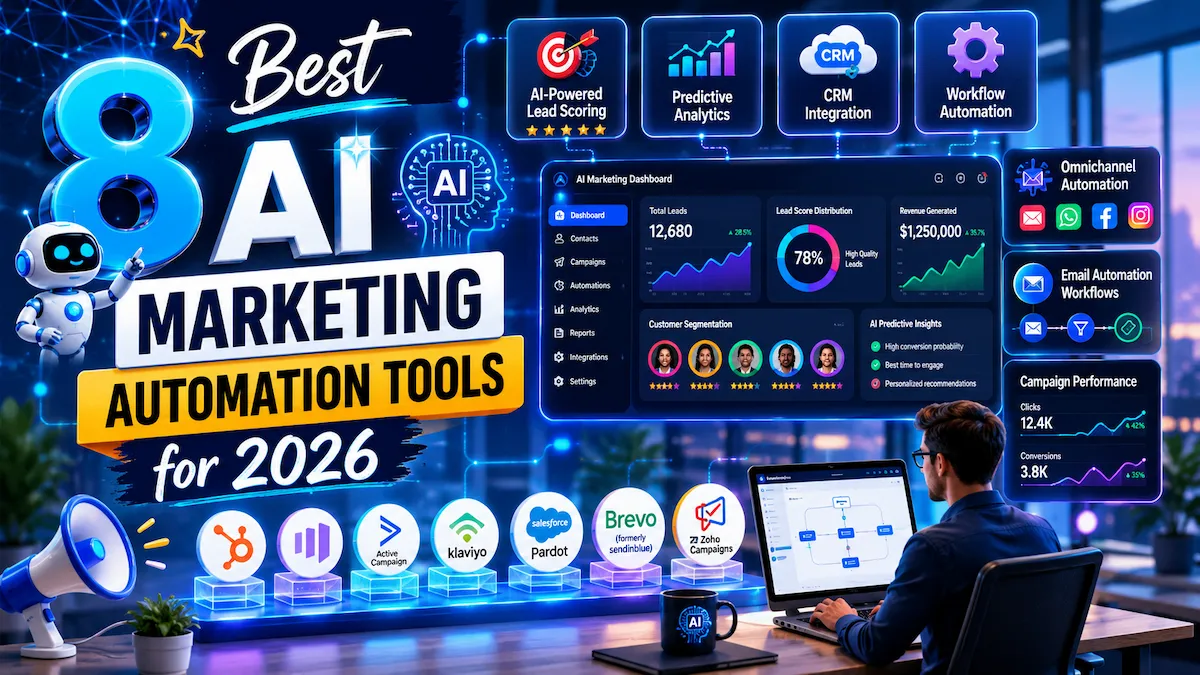
If your marketing still runs on manual workflows, spreadsheets, and batch email blasts, you are already behind. In 2026, the fastest-growing businesses—from lean SaaS startups to high-volume e-commerce brands—run on AI marketing automation tools that plan, segment, personalize, and optimize in real time without a human touching every step.
These tools are not a trend. They are now core marketing infrastructure. According to Salesforce’s State of Marketing Report, 84% of marketers now use AI in some capacity, and adoption is accelerating fastest in automation, segmentation, and personalization. Meanwhile, McKinsey research estimates that AI-driven personalization alone can lift marketing ROI by 10–30% depending on the sector and implementation maturity.
The question is no longer whether to use AI marketing automation. The question is which platform fits your business—and how to implement it without wasting budget on the wrong tool.
This guide gives you a straight, expert-level breakdown: what these tools do, how they work, which ones perform, what they cost, and which one fits your business model. No hype. No filler. Just a decision-grade resource for marketing managers, SaaS founders, e-commerce operators, and agency leaders.
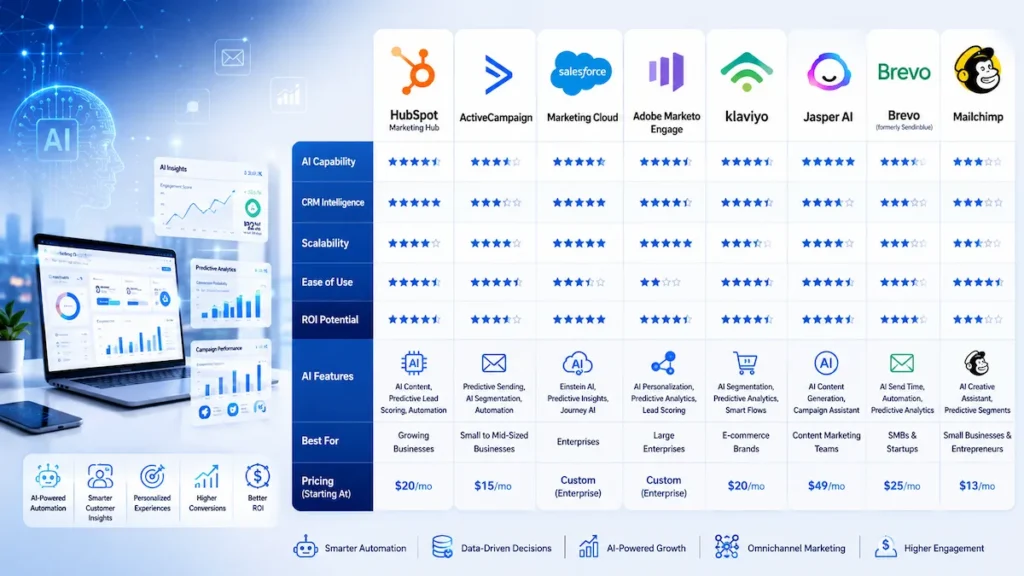
Quick Comparison: Best AI Marketing Automation Tools (2026)
| Tool | Best For | Starting Price | AI Score |
|---|---|---|---|
| HubSpot | B2B SaaS, Mid-Market | $18/mo | 9.5/10 |
| ActiveCampaign | Agencies, SMBs | $15/mo | 9.0/10 |
| Klaviyo | Ecommerce | $20/mo | 9.4/10 |
| Salesforce MC | Enterprise | ~$1,250/mo | 9.6/10 |
| Marketo | Enterprise B2B | ~$1,000/mo | 8.8/10 |
| Brevo | Startups, SMBs | $25/mo | 7.8/10 |
| Jasper AI | Content Teams | $39/mo | 8.5/10 |
| Mailchimp | Solopreneurs | $13/mo | 7.2/10 |
What Are AI Marketing Automation Tools?
AI marketing automation tools are software platforms that use machine learning, predictive analytics, and behavioral data to automate, personalize, and optimize marketing operations across channels—without requiring manual execution at each step.
They go beyond traditional automation by adding intelligence. Instead of triggering an email when someone signs up, an AI-powered system analyzes purchase history, browsing behavior, lifecycle stage, and predicted intent—then decides what message to send, through which channel, at what time.
This shift is already reshaping entire marketing roles. Understanding how AI is changing digital marketing careers is critical context before choosing and implementing any automation platform.
How AI Marketing Automation Tools Actually Work
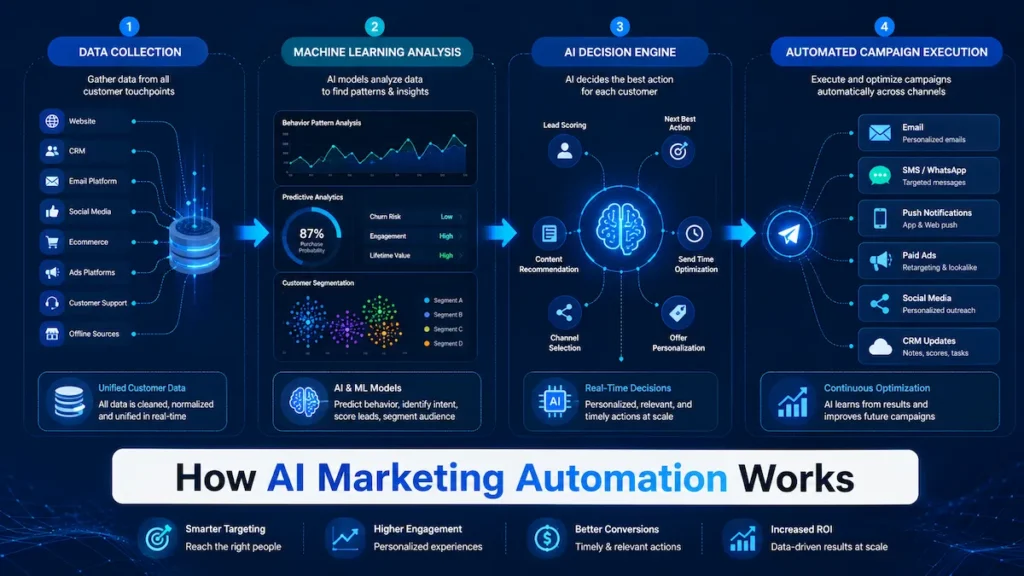
The underlying architecture of a modern AI marketing platform involves three core engines:
Data ingestion layer: The tool collects behavioral signals from your website, CRM, email platform, ad accounts, and transactional systems. This is the raw fuel for all AI decisions.
Machine learning models: Trained on your data and industry patterns, these models power lead scoring, customer segmentation, churn prediction, send-time optimization, and content personalization.
Workflow execution engine: Once the AI makes a decision—this lead is sales-ready, this customer is likely to churn, this segment responds to discount offers—the automation layer executes: send email, update CRM field, trigger retargeting ad, assign to rep.
The key distinction is feedback loops. AI systems continuously retrain based on outcomes—open rates, conversions, and revenue—making each campaign smarter than the last. Traditional automation does not do this.
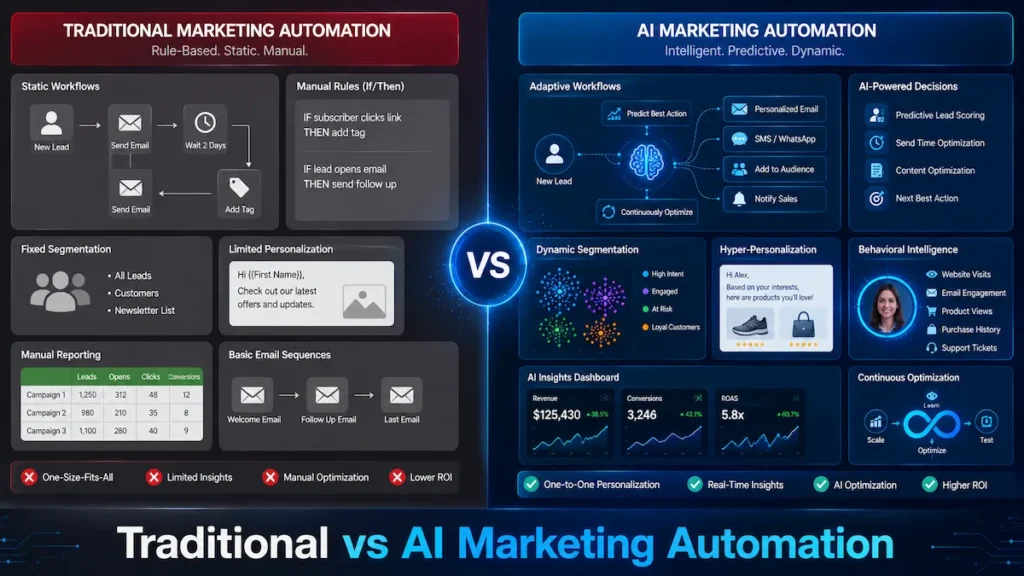
Traditional Automation vs AI Marketing Automation Tools
| Dimension | Traditional Automation | AI Marketing Automation |
|---|---|---|
| Triggering logic | Rule-based (if/then) | Predictive + behavioral signals |
| Segmentation | Static lists | Dynamic, ML-driven segments |
| Personalization | Merge tags (name, company) | Content, timing, channel, offer |
| Optimization | Manual A/B testing | Continuous self-optimization |
| Lead scoring | Point-based manual rules | Predictive scoring models |
| Learning | None — static rules | Continuous model retraining |
| Scale | Degrades with complexity | Improves with more data |
Why AI Marketing Automation Tools Matter in 2026
The marketing environment has compressed the window between intent and decision. Buyers research faster, compare more options, and expect relevance at every touchpoint. Manual marketing teams simply cannot operate at the speed or scale the market demands.
The business case is backed by numbers. Gartner projects that by 2027, AI will influence over 80% of all customer interactions across digital marketing channels. Businesses using predictive lead scoring report conversion rate improvements of 20–40% versus rule-based scoring systems. Email campaigns using AI-driven send-time optimization consistently outperform static schedules by 15–25% on open rates alone.
Impact on ROI and Conversion
One of the biggest advantages of AI marketing automation tools is their ability to improve ROI and conversion rates through predictive decision-making.
The ROI case is not theoretical. Businesses that deploy AI marketing automation tools with proper data hygiene and clear workflows see results in weeks, not quarters — particularly in email, CRM, and paid acquisition.
- Lead conversion rates increase when scoring models identify high-fit prospects earlier in the funnel, enabling sales to prioritize correctly.
- Email revenue per send improves when send-time optimization and predictive content selection replace generic broadcast campaigns.
- Customer acquisition cost decreases as behavioral targeting reduces wasted ad spend on low-intent audiences.
- Customer lifetime value rises when AI-driven retention workflows identify churn signals early and trigger re-engagement at the right moment.
If you are exploring the broader impact of AI across advertising channels, the strategies and tools shaping AI in advertising provide additional context on where automation connects with paid media.
Role in Customer Journey Optimization
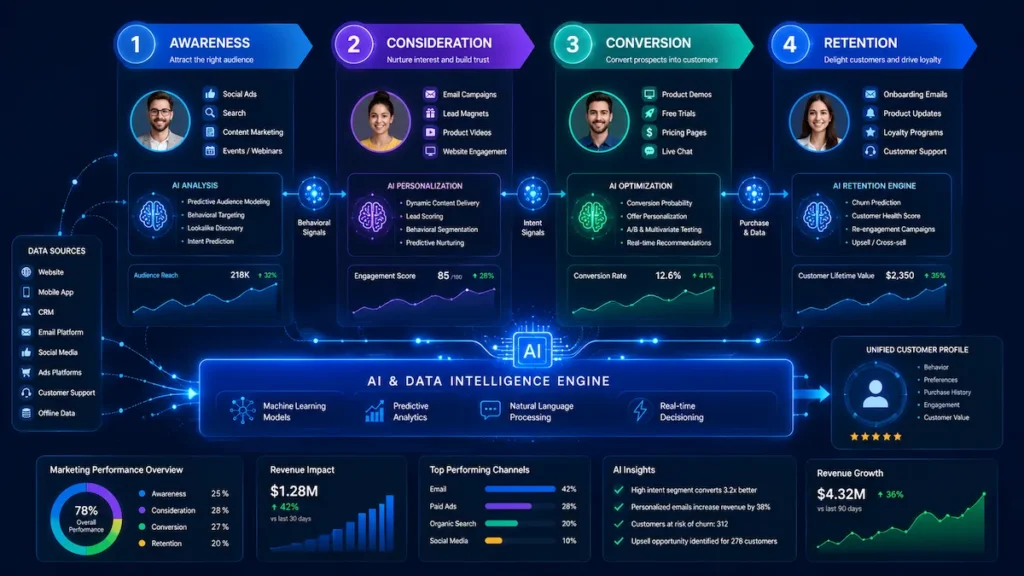
Modern AI marketing automation tools optimize every stage of the customer journey, from awareness to long-term retention.
Every stage of the customer journey — awareness, consideration, conversion, retention — now has a corresponding AI-powered function in these platforms:
- Awareness: Predictive audience modeling surfaces your brand to users who match your best-customer profile before they search.
- Consideration: AI lead nurturing sequences adapt messaging based on which content assets each prospect has engaged with.
- Conversion: Intent scoring flags when a lead is ready for a sales conversation, routing them to the right rep at the right time.
- Retention: Churn prediction models trigger loyalty campaigns, personalized offers, or success team outreach before a customer decides to leave.
The result is a customer journey that feels personalized and timely—because the AI is making hundreds of micro-decisions invisibly across the funnel. For a wider view on how AI reshapes marketing operations, the 15 benefits of AI in digital marketing cover the full strategic picture.
Real-World Use Cases of AI Marketing Automation Tools
Ecommerce Funnel Automation Example
This example demonstrates how AI marketing automation tools help e-commerce brands automate customer acquisition and retention workflows. A mid-market e-commerce brand selling skincare products uses Klaviyo with AI-powered segmentation and predictive send-time features:
- Abandoned cart sequences trigger within 60 minutes, personalized by product category, price point, and whether the shopper is new or returning.
- Post-purchase flows recommend complementary products based on purchase history, with AI-determined send timing for each individual contact.
- Predictive replenishment emails trigger when a customer is statistically likely to need a product refill — before they seek alternatives.
- Winback campaigns deploy when churn likelihood exceeds a threshold, with discount depth calibrated by customer lifetime value.
The result: a fully automated revenue engine that runs 24/7, adapts to individual behavior, and improves conversion with every campaign cycle.
SaaS Lead Nurturing Example
Many SaaS companies rely on AI marketing automation tools to automate lead nurturing and accelerate pipeline growth. A B2B SaaS company offering project management software uses HubSpot’s AI tools for CRM automation and lead scoring:
- Inbound leads from content downloads are automatically scored based on company size, industry, job title, and behavioral signals (pages visited, time on pricing page, return visits).
- High-scoring leads receive an accelerated nurture sequence with case studies and demo invitations. Low-scoring leads enter a longer educational sequence.
- The AI monitors engagement signals and dynamically re-routes leads between sequences when behavior changes — a cold lead who returns to the pricing page three times gets escalated immediately.
- Sales reps receive daily AI-generated priority lists with conversation starters based on each lead’s specific behavior.
This system replaced a manual SDR qualification process, reducing cost-per-qualified-lead while increasing pipeline velocity.
Agency Multi-Client Automation Example
Agencies use AI marketing automation tools to manage multiple client campaigns efficiently while maintaining personalization at scale.
A digital marketing agency managing 30+ clients uses ActiveCampaign as its core AI marketing automation platform:
- The agency applies consistent AI workflow templates across all client accounts, reducing build time by over 60%.
- AI-generated performance insights surface anomalies—a sudden drop in open rates, a spike in unsubscribes—and alert account managers before clients notice.
- Omnichannel marketing automation connects email, SMS, and CRM tasks in unified workflows, eliminating disconnected tools.
- Reporting is automated and client-ready, with AI-summarized performance narratives generated weekly.
For agencies navigating how AI tools change team structures, understanding whether AI will replace social media managers and whether AI will replace content writers is directly relevant to how you staff and position your services.
Best AI Marketing Automation Tools: Expert Breakdown
1. HubSpot Marketing Hub
Overview: HubSpot is the dominant all-in-one CRM and marketing automation platform for SMBs and mid-market companies. Its AI capabilities are embedded across the entire platform — not bolted on as a separate module.
Key AI Features:
- Predictive lead scoring with behavioral and firmographic signals
- AI content assistant for email, landing pages, and ads
- Smart send-time optimization
- Automated customer journey mapping
- ChatSpot AI for CRM querying and task automation
Pros:
- Full-stack CRM + marketing automation in one platform
- Excellent onboarding and support infrastructure
- Deep integration ecosystem (1,000+ native integrations)
Cons:
- Pricing scales steeply as contact list grows
- Advanced AI features locked behind Professional/Enterprise tiers
- Can be overkill for very small teams
Pricing: Free tier available. Starter from $18/month. Professional from $800/month. Enterprise from $3,600/month.
Best Use Case: SaaS companies and B2B businesses that need unified CRM + marketing automation with strong sales alignment.
Expert Verdict: HubSpot is the safest bet for growing B2B businesses that want a single platform to manage the full revenue cycle. The AI features are genuinely useful—not cosmetic—but budget realistically for the professional tier.
2. ActiveCampaign
Overview: ActiveCampaign is a customer experience automation platform with one of the strongest native AI stacks in its price range. It excels at complex, multi-step automation workflows with deep behavioral triggering.
Key AI Features:
- Predictive content—AI selects optimal email content block per recipient
- Predictive sending—send-time optimization at individual contact level
- Win Probability scoring in the CRM pipeline
- AI-generated automation suggestions based on contact behavior
Pros:
- Most powerful automation builder in the mid-market segment
- Excellent deliverability track record
- Strong CRM integration without requiring enterprise budget
Cons:
- UI has a learning curve for new users
- The reporting dashboard is less polished than HubSpot’s.
- Native ad integration less robust than competitors
Pricing: Starter from $15/month. Plus from $49/month. Professional from $79/month. Enterprise pricing available.
Best Use Case: Agencies, e-commerce brands, and businesses that need sophisticated automation logic at mid-market price points.
Expert Verdict: ActiveCampaign delivers more automation power per dollar than any other platform in this comparison. For teams serious about AI-driven personalization and workflow complexity, it outperforms tools costing significantly more.
3. Salesforce Marketing Cloud
Overview: Salesforce Marketing Cloud (SFMC) is the enterprise-grade standard for AI marketing automation. Built for large organizations with complex data environments, it integrates natively with the Salesforce CRM ecosystem through the Einstein AI layer.
Key AI Features:
- Einstein AI for predictive engagement scoring
- Journey Builder for cross-channel customer journey automation
- Einstein Content Selection — AI picks imagery and copy variants
- Interaction Studio for real-time behavioral personalization
Pros:
- Best-in-class AI for enterprises with large contact databases
- Native Salesforce CRM integration is unmatched
- Omnichannel coverage: email, SMS, push, social, ads
Cons:
- High total cost of ownership, including implementation
- Requires dedicated SFMC administrators
- Implementation timelines measured in months, not days
Pricing: Entry packages typically start around $1,250/month with significant implementation costs.
Best Use Case: Enterprise businesses with complex, multi-brand operations and an existing Salesforce CRM investment.
Expert Verdict: SFMC is built for enterprises that need industrial-scale AI marketing automation and have the team and budget to support it. For everyone else, the complexity and cost create more friction than value.
4. Adobe Market o Engage
Overview: Marketo Engage (part of Adobe Experience Cloud) is a B2B marketing automation platform purpose-built for demand generation, account-based marketing (ABM), and complex B2B funnels.
Key AI Features:
- Predictive audiences using Adobe Sensei AI
- AI-powered lead scoring models
- Content AI for email and landing page personalization
- Account profiling and ABM intelligence
Pros:
- Purpose-built for enterprise B2B marketing workflows
- Strong ABM capabilities with named-account targeting
- Deep Adobe Experience Cloud integration (Analytics, Target, AEM)
Cons:
- High cost and implementation complexity
- UI feels dated compared to newer competitors
- Steep learning curve for non-technical marketers
Pricing: Typically starts around $1,000–$3,000/month depending on database size and features.
Best Use Case: Enterprise B2B companies running account-based marketing programs with high-value deal cycles.
Expert Verdict: Marketo is a serious tool for serious B2B demand gen operations. If you are not doing ABM at scale or do not already use Adobe Experience Cloud, it is hard to justify the cost and complexity.
5. Klaviyo
Overview: Klaviyo is the dominant AI marketing automation platform for e-commerce, with native integrations for Shopify, WooCommerce, BigCommerce, and Magento.
Key AI Features:
- Predictive analytics: expected date of next purchase, predicted lifetime value, churn risk
- AI-generated product recommendations
- Smart Send Time optimization
- AI-powered segment builder using predictive attributes
Pros:
- Best-in-class e-commerce data model
- Predictive analytics built into the free/starter tier
- Excellent pre-built automation flows for e-commerce use cases
Cons:
- Primarily an email + SMS platform — not a full marketing suite
- Pricing escalates quickly for large contact lists
- Less useful for B2B or non-ecommerce businesses
Pricing: Free up to 250 contacts. Email plans from $20/month. Email + SMS plans scale by contact count.
Best Use Case: Ecommerce brands on Shopify or similar platforms that want AI-powered lifecycle marketing without enterprise complexity.
Expert Verdict: For e-commerce, Klaviyo is the default recommendation. Its predictive analytics and e-commerce-native data model put it in a different category from generic email tools. The free tier alone delivers more AI capability than many paid competitors.
6. Jasper AI
Overview: Jasper is an AI content marketing automation platform built for marketing teams that need to produce high-quality content at scale — ads, emails, social, landing pages, and blog content — with brand consistency.
Key AI Features:
- Brand Voice: AI trained on your specific tone, style, and messaging guidelines
- Campaign creation: full content suites from a single brief
- AI image generation integrated with content workflows
- Collaboration tools for marketing team content pipelines
Pros:
- Significantly reduces content production time and cost
- Brand Voice feature produces consistent, on-brand output
- Strong for agencies managing multi-brand content
Cons:
- Content still requires human editing for accuracy and depth
- Not a full marketing automation platform — no CRM or email sending
- Quality varies by content type—long-form requires more editing
Pricing: Creator plan from $39/month. Pro plan from $59/month. Business plans available.
Best Use Case: Content-heavy marketing teams and agencies scaling production without proportionally scaling headcount.
Expert Verdict: Jasper solves a specific, painful problem: producing enough quality content to fuel a full marketing operation. Use it alongside a platform like HubSpot or ActiveCampaign, not instead of one.
7. Brevo (formerly Sendinblue)
Overview: Brevo is an all-in-one marketing platform offering email, SMS, WhatsApp, chat, and CRM automation — with an accessible price point that makes it particularly relevant for SMBs and international businesses.
Key AI Features:
- Send-time optimization using machine learning
- AI-powered subject line scoring
- Predictive segmentation based on engagement patterns
- Automated campaign optimization suggestions
Pros:
- Most cost-effective platform in this comparison for small teams
- Strong multichannel automation (email + SMS + WhatsApp)
- Simple, clean UI with short implementation time
Cons:
- AI features less sophisticated than HubSpot or ActiveCampaign
- CRM capabilities are basic compared to full CRM platforms
- Limited advanced reporting and attribution tools
Pricing: Free plan available. Starter from $25/month. Business from $65/month. Enterprise pricing available.
Best Use Case: Small businesses, early-stage startups, and international companies that need multi-channel automation at an accessible price point.
Expert Verdict: Brevo is the best value entry point into AI-assisted marketing automation for teams with limited budgets. It does not compete on depth, but it outperforms both HubSpot and ActiveCampaign on cost-efficiency for simpler use cases.
8. Mailchimp
Overview: Mailchimp has evolved from a basic email tool into an AI-assisted marketing platform with audience management, automation, and analytics. It remains the most widely adopted email tool globally, particularly among very small businesses.
Key AI Features:
- Predicted demographics for audience segmentation
- Send-time optimization
- AI content optimizer for subject lines and body copy
- Smart recommendations for campaign improvement
Pros:
- Massive ecosystem of templates, integrations, and learning resources
- Low barrier to entry with a functional free tier
- Good enough for straightforward email marketing programs
Cons:
- AI capabilities are surface-level compared to dedicated AI-first platforms
- Automation builder significantly less powerful than ActiveCampaign or HubSpot
- Pricing has become less competitive as features have expanded
Pricing: Free up to 500 contacts. Essentials from $13/month. Standard from $20/month. Premium from $350/month.
Best Use Case: Very small businesses and solopreneurs who need simple email automation and are not ready for a more powerful platform.
Expert Verdict: Mailchimp is a starting point, not an endpoint. Treat it as a temporary tool until the operation justifies ActiveCampaign or HubSpot. One area where this is most visible: AI is already replacing core email marketing functions that Mailchimp handles manually—platforms built for AI execution have a structural advantage.
AI Marketing Automation Tools Comparison Framework
| Tool | ROI Potential | AI Depth | Ease of Use | CRM Intelligence | Scalability | Cost Efficiency |
|---|---|---|---|---|---|---|
| HubSpot | ★★★★★ | ★★★★☆ | ★★★★☆ | ★★★★★ | ★★★★★ | ★★★☆☆ |
| ActiveCampaign | ★★★★★ | ★★★★☆ | ★★★☆☆ | ★★★★☆ | ★★★★☆ | ★★★★★ |
| Salesforce MC | ★★★★★ | ★★★★★ | ★★☆☆☆ | ★★★★★ | ★★★★★ | ★★☆☆☆ |
| Marketo | ★★★★☆ | ★★★★☆ | ★★☆☆☆ | ★★★★☆ | ★★★★★ | ★★☆☆☆ |
| Klaviyo | ★★★★★ | ★★★★★ | ★★★★☆ | ★★★☆☆ | ★★★★☆ | ★★★★☆ |
| Jasper AI | ★★★★☆ | ★★★★☆ | ★★★★★ | ★☆☆☆☆ | ★★★★☆ | ★★★★☆ |
| Brevo | ★★★☆☆ | ★★★☆☆ | ★★★★★ | ★★★☆☆ | ★★★☆☆ | ★★★★★ |
| Mailchimp | ★★★☆☆ | ★★☆☆☆ | ★★★★★ | ★★☆☆☆ | ★★★☆☆ | ★★★★☆ |
AI Marketing Automation Tools Pricing Guide
This AI marketing automation tool’s pricing guide helps businesses compare entry-level, mid-tier, and enterprise costs before choosing a platform.
One of the most frequently searched topics in this category is cost. Here is a clean pricing overview across all tiers:
| Platform | Free Tier | Entry Price | Mid-Tier | Enterprise |
|---|---|---|---|---|
| HubSpot | Yes | $18/mo | $800/mo | $3,600+/mo |
| ActiveCampaign | No | $15/mo | $79/mo | Custom |
| Klaviyo | Yes (250 contacts) | $20/mo | ~$150/mo | Custom |
| Salesforce MC | No | ~$1,250/mo | Custom | Custom |
| Marketo | No | ~$1,000/mo | ~$2,000/mo | Custom |
| Brevo | Yes | $25/mo | $65/mo | Custom |
| Jasper AI | No | $39/mo | $59/mo | Custom |
| Mailchimp | Yes (500 contacts) | $13/mo | $20/mo | $350/mo |
Key insight: The entry-level price is rarely where businesses operate long-term. HubSpot at $18/month delivers a fraction of its AI capability — the meaningful features begin at $800/month. Always evaluate mid-tier pricing against your anticipated contact volume and feature requirements, not the headline number.
How to Choose AI Marketing Automation Tools
Choosing the right AI marketing automation tools requires balancing business goals, automation needs, CRM requirements, and budget constraints.
1. Define your primary use case first. Are you nurturing B2B leads, automating e-commerce lifecycle campaigns, managing multi-client workflows, or scaling content production? The answer eliminates most tools immediately. Klaviyo is built for e-commerce. Marketo is built for enterprise B2B. Using either outside their intended model creates avoidable friction.
2. Assess your CRM requirements. If you already run on Salesforce, Marketing Cloud is the path of least resistance. If you are building CRM from scratch, HubSpot gives you CRM + marketing in one system. If CRM is secondary to automation complexity, ActiveCampaign outperforms both on workflows per dollar.
3. Match AI maturity to team capability. Advanced AI features—predictive scoring, autonomous campaign optimization, and behavioral personalization—only deliver value if your team can set them up correctly and your data is clean enough to train on. Start simpler than you think you need, then scale up as operational maturity grows.
4. Calculate true cost at scale. Run the pricing for your current contact volume, then for 2x and 5x that volume. Some platforms (Klaviyo, HubSpot) scale steeply. Others (ActiveCampaign) remain cost-efficient across a wider range. The platform that is cheapest today may not be cheapest at the scale you are building toward.
5. Evaluate integration depth with your existing stack. A marketing automation platform that does not integrate cleanly with your e-commerce platform, CRM, ad accounts, and analytics tools creates data silos that undermine every AI decision the system makes. Integration quality is not optional infrastructure — it is the foundation everything else depends on.
AI Marketing Automation Tools for Different Business Types
Small Businesses
For smaller teams, AI marketing automation tools provide affordable ways to automate repetitive marketing tasks and improve efficiency.
Small businesses need tools that are fast to set up, affordable at low contact volumes, and do not require a dedicated marketing ops team. The priority is automation of repetitive tasks—welcome sequences, abandoned cart recovery, and follow-up emails—with enough AI to improve over time.
Recommended: Brevo for budget-first operations. ActiveCampaign Starter for teams ready to invest in automation depth. Mailchimp is only for those truly just starting out with no complex workflow needs.
E-commerce Brands
E-commerce companies benefit from AI marketing automation tools that support predictive analytics, customer segmentation, and lifecycle marketing.
E-commerce businesses have a specific data model—products, orders, cart events, and purchase history—that generic marketing tools do not natively understand. The platform needs deep e-commerce integration to power predictive replenishment, post-purchase flows, browse abandonment, and LTV-based segmentation.
Recommended: Klaviyo is the clear choice. Its predictive analytics, e-commerce data model, and pre-built flows are purpose-built for this use case. ActiveCampaign is a strong second if CRM is also a priority.
SaaS Companies
SaaS businesses need tools that connect marketing to the full customer lifecycle — from first-touch lead to activation, expansion, and retention. The CRM must be tightly integrated with product usage data to power behavioral triggers and predictive churn alerts. Understanding how AI is transforming PPC management and AI’s impact on SEO roles is also relevant context for SaaS marketing teams building integrated automation strategies across paid and organic channels.
Recommended: HubSpot for most SaaS companies under $50M ARR. Salesforce Marketing Cloud for enterprise SaaS with an existing Salesforce investment.
Agencies
Agencies use AI marketing automation tools to standardize workflows, improve reporting, and scale client management operations.
Agencies need tools that support multi-client management, sub-account structures, and consistent automation templates deployable across clients without rebuilding from scratch. The platform’s AI must surface performance anomalies proactively—there is no time to monitor 30 dashboards manually.
Recommended: ActiveCampaign for its sub-account structure and automation builder flexibility. HubSpot for agencies with a certified partner relationship. Jasper AI as a content production layer across all client accounts.
Common Mistakes Businesses Make With AI Marketing Automation Tools
1. Over-automation Automating too many touchpoints without strategic prioritization creates noise, not engagement. Start with your highest ROI workflows—abandoned cart, lead nurture, and onboarding—and expand from there. Complexity is the enemy of execution.
2. Poor Segmentation AI-powered personalization is only as effective as your segmentation logic. If your customer segments are too broad — “all leads” or “all customers” — the AI cannot do meaningful work. Invest in defining behavioral and attribute-based segments before building workflows.
3. Weak Data Hygiene AI models trained on dirty data produce unreliable outputs. Before deploying predictive scoring or personalization, audit your CRM data: remove duplicates, standardize fields, fill gaps in contact records. Machine learning marketing depends entirely on data quality.
4. Wrong Tool Selection The most common mistake is selecting a tool based on brand recognition rather than use-case fit. A SaaS company buying Klaviyo or an e-commerce brand implementing Marketo will spend months configuring a platform never designed for their business model.
5. Ignoring Attribution Models AI marketing automation generates multi-touch attribution data that most businesses never use. If you cannot measure which automation touchpoints contributed to revenue, you cannot optimize them. Set up attribution before campaigns go live — not after.
6. Set-and-Forget Mentality Automation is not a one-time project. Workflows need quarterly audits to catch logic errors, update outdated sequences, and adjust for changes in customer behavior. Treat automation as a living system, not a completed task.
Future of AI Marketing Automation Tools
The next generation of AI marketing automation is not an incremental upgrade — it is a structural shift in how marketing operations work. These are the developments that will define this space through 2027 and beyond.
AI Agents Replacing Workflow Builders The most significant near-term shift is the move from pre-built automation sequences to autonomous AI agents. Rather than configuring a 12-step email workflow, you brief an AI agent on a campaign objective — “generate 50 qualified demos in Q3 from mid-market SaaS companies” — and the agent determines the audience, writes the content, sets the schedule, monitors performance, and reallocates budget dynamically. Platforms including HubSpot, Salesforce, and ActiveCampaign are all actively building agent-layer capabilities into their core products.
Fully Autonomous Marketing Systems Several platforms are already building toward systems where AI manages the full campaign lifecycle: goal setting, strategy selection, creative production, distribution, optimization, and reporting—with humans in an oversight role rather than an execution role. This is not a 2030 concept. Early versions are operational today for specific use cases like paid media and email optimization. Within 18–24 months, autonomous campaign management will be a standard feature tier, not a premium add-on.
First-Party Data as the AI Advantage With third-party cookies eliminated across major browsers, first-party data — what your own platform knows about your customers — becomes the competitive differentiator. The businesses with the cleanest, richest first-party data sets will run significantly better AI models than competitors relying on data aggregators. This makes data strategy inseparable from AI marketing automation strategy.
Generative AI Campaign Production The content bottleneck in marketing has historically been a limiting constraint on how many campaigns a team can run simultaneously. Generative AI removes that constraint. Platforms are now integrating generative AI directly into campaign builders — write one brief, generate 20 creative variants, test all of them simultaneously, and let the AI allocate budget toward winners in real time. The impact on content writers and content-focused roles is already significant, and the pace is accelerating.
Predictive Revenue Forecasting The next capability shift moves AI platforms from campaign optimization to revenue forecasting. Rather than reporting what happened last month, they will produce reliable 90-day revenue projections segmented by channel, campaign type, customer cohort, and product line—enabling proactive budget allocation decisions before results materialize. Early versions of this exist today in HubSpot and Salesforce. By 2026–2027, it will be a standard planning tool.
Multimodal AI in Marketing Campaigns The AI layer in marketing platforms is expanding beyond text into image, video, voice, and interactive content generation. Campaigns that previously required creative agencies to produce will be generated, tested, and optimized within the marketing platform itself. This does not eliminate creative strategy—it eliminates the production bottleneck that slows strategy execution.
Cookieless Behavioral Targeting As cookie-based tracking sunsets, AI marketing automation platforms are developing contextual targeting, cohort-based analysis, and on-site behavioral modeling as replacements. Platforms that have built strong first-party identity resolution—Klaviyo, HubSpot, and Salesforce—are structurally advantaged in a cookieless environment versus newer platforms without established data infrastructure.
The directional conclusion is clear: the gap between businesses using AI marketing automation tools and those that are not will widen significantly over the next 24 months. The technology is moving faster than most marketing teams are adapting, and early implementation advantage compounds over time as AI models improve with more data.
EEAT Trust Summary Table
This AI marketing automation tools trust summary compares reliability, adoption, risks, and ideal use cases across the leading platforms.
| Tool | Industry Adoption | Risk Factors | Reliability | Ideal Use Case Fit |
|---|---|---|---|---|
| HubSpot | Very High | Cost scaling | Very High | B2B SaaS, Mid-Market |
| ActiveCampaign | High | UI complexity | Very High | Agencies, SMB, Ecommerce |
| Salesforce MC | Very High | Implementation cost | Very High | Enterprise |
| Marketo | High (Enterprise) | Cost, complexity | High | Enterprise B2B |
| Klaviyo | Very High | Limited to email/SMS | Very High | Ecommerce |
| Jasper AI | High | Output quality variance | High | Content Teams, Agencies |
| Brevo | Medium-High | Limited AI depth | High | SMB, Startups |
| Mailchimp | Very High | Limited scalability | High | Very Small Business |
Frequently Asked Questions
These frequently asked questions address the most common concerns businesses have when evaluating AI marketing automation tools.
What are AI marketing automation tools?
AI marketing automation tools are software platforms that use machine learning and predictive analytics to automate and personalize marketing tasks — including email campaigns, lead scoring, customer segmentation, CRM workflows, and campaign optimization — without requiring manual execution at every step.
Which AI marketing automation tool is best overall?
HubSpot is the best all-around platform for most B2B businesses combining CRM, marketing, and sales automation. Klaviyo leads for e-commerce. ActiveCampaign offers the best automation power at mid-market price points. The right answer depends on your business model, budget, and team size.
Are AI marketing automation tools worth the investment?
Yes—for businesses with consistent lead or customer volume, the ROI from automated lead nurturing, personalized campaigns, and predictive churn management typically exceeds platform cost significantly. The risk is not in investing too much; it is in underinvesting in setup, data quality, and workflow design.
How much do AI marketing automation tools cost?
Costs vary significantly: Brevo and Mailchimp start under $30/month. ActiveCampaign and Klaviyo from $15–$49/month at entry level. HubSpot Professional from $800/month. Salesforce Marketing Cloud and Marketo cost $1,000–$3,600+/month. Enterprise tools typically involve additional implementation and consulting fees.
What is the best AI marketing automation tool for small businesses?
Brevo offers the best combination of features, multichannel capability, and price for small businesses. ActiveCampaign is the strongest choice if automation depth is a priority and the team can manage a short learning curve. Both offer free trials to validate fit before committing.
Can AI fully automate marketing?
Not entirely—and the best systems are not designed to. AI marketing automation handles execution, optimization, and personalization at scale. Strategic decisions, brand positioning, creative direction, and relationship management still require human judgment. The goal is to automate high-volume, data-driven tasks so human attention focuses on strategy and creative work.
Final Expert Verdict
Selecting the right AI marketing automation tools ultimately depends on your business model, growth stage, budget, and operational complexity.
| If You Are… | Recommended Tool | Why |
|---|---|---|
| An e-commerce brand on Shopify/WooCommerce | Klaviyo | Native e-commerce data model + best predictive analytics in segment |
| A B2B SaaS startup under 50 employees | HubSpot Starter or Professional | CRM + marketing automation in one platform, strong support |
| A digital marketing agency (10–50 clients) | ActiveCampaign | Best automation builder + sub-account structure + cost efficiency |
| An enterprise with Salesforce CRM | Salesforce Marketing Cloud | Native integration eliminates data sync complexity |
| An enterprise B2B doing ABM | Adobe Marketo Engage | Purpose-built for account-based marketing at scale |
| A content-heavy team or agency | Jasper AI + any core platform | Solves the content velocity problem without replacing automation logic |
| A small business just getting started | Brevo | Low cost, low complexity, enough to start building automation habits |
The most expensive mistake in this category is over-complicating the decision. Start with the tool that fits your current scale and business model — not the one you might need in three years. You can migrate up. You cannot get back the months spent over-configuring a platform that was wrong from the start.
Whichever tool you select, implement it with clean data, clear workflow logic, and realistic expectations. The AI does the heavy lifting. Your job is to give it the right foundation to work from.