
Most marketing teams are not losing to bigger budgets. They are losing to smarter workflows.
While one team manually writes five blog posts a month, another uses AI tools to research, draft, optimize, and publish twenty — with tighter targeting and faster iteration. The gap is not talent. It is tooling and the strategy behind it.
This guide covers 27 tested AI tools with honest benchmarks, a proprietary maturity framework, stack recommendations by business type, and the workflows where AI should never be trusted.
Jump To
- Quick Reference: Best Tool by Use Case
- AI Marketing Maturity Model
- 4-Layer AI Marketing Stack
- 27 AI Tools — Full Breakdown
- Best Tools by Category
- Stack by Business Type
- TOFU → MOFU → BOFU Mapping
- Where AI Should NOT Be Used
- Hidden Cost of Stack Complexity
- Why AI Marketing Strategies Fail
- FAQ
Quick Reference: Best AI Tool by Use Case
| Use Case | Best Tool | Why |
|---|---|---|
| SEO content optimization | Surfer SEO | Real-time NLP scoring against SERP competitors |
| Long-form strategy + briefs | Claude | Best reasoning depth for complex editorial tasks |
| Brand content at volume | Jasper | Brand voice training reduces editing overhead |
| Budget all-rounder | ChatGPT | The free tier handles ideation, drafts, repurposing |
| E-commerce email automation | Klaviyo | Predictive segmentation and churn prevention |
| Cold outbound email | Instantly AI | Deliverability infrastructure + AI personalization |
| Paid ad creative testing | AdCreative.ai | 100+ creative variants without a design team |
| Cross-channel bid management | Google PMax | AI bidding system reduces CPA by 20–40% |
| Competitor + keyword research | Semrush AI | An all-in-one platform eliminates context switching |
| Social scheduling + captions | Buffer / Hootsuite | AI posting suggestions across platforms |
| Visual content | Canva AI / Midjourney | Ad graphics and campaign imagery at speed |
| Video marketing | Synthesia / Descript | AI avatars and podcast-to-video repurposing |
| Workflow automation | Make.com / Zapier AI | Connects your entire tool stack |
What AI Tools for Digital Marketing Actually Are
AI tools for digital marketing are software applications that use machine learning, NLP, or generative AI to execute or enhance marketing tasks—from content creation and research to ad optimization, email personalization, and campaign analytics.
The useful framing is not “what is it” but “what bottleneck does it solve.” These tools are valuable when removing friction from repeatable, high-volume tasks. They become liabilities when applied to tasks requiring original strategic judgment or authentic human engagement.
How professionals use them:
- Pre-production—keyword clustering, gap analysis, brief generation using Semrush AI and Claude
- Production—AI-generated first drafts with a mandatory human edit pass (where brand voice and expertise actually enter the content)
- Campaign management—AI bid tools adjusting spend in real time; email platforms personalizing at the individual subscriber level
If you are wondering whether AI is replacing email marketers entirely, the honest answer is it is replacing specific execution tasks—not the strategic function.
What the benchmarks show:
- AI-assisted workflows produce content 3–5× faster with equivalent SEO performance when the editorial layer is maintained
- Agency case study: Using Surfer SEO + Claude cut content production from 14 hours to 5 hours per article without losing ranking quality—by eliminating manual competitive analysis and not skipping editorial review
- AI email optimization delivers 15–28% improvement in open rates versus static campaigns
- AI creative tools compress time-to-winning ad variant by 40–60%
- Google PMax AI bidding system reduces CPA by 20–40% when fed strong first-party data
- E-commerce case study: Klaviyo’s predictive model flagging at-risk customers 60 days early reduced churn by 18% over 90 days—zero additional head count
Where AI tools fail: No strategy behind them (volume becomes noise), unedited output published at scale, and measuring publishing cadence instead of downstream revenue. Google’s quality rater guidelines explicitly reward firsthand experience—something unedited AI output structurally cannot provide.
The AI Marketing Maturity Model
Most teams buy Level 3–4 tools while operating at Level 1 readiness. The result is expensive underutilization with no measurable ROI.
| Level | Stage | What It Means | Best-Fit Tools |
|---|---|---|---|
| 1 | AI-Assisted Production | Individual tasks sped up, with no workflow integration | ChatGPT free, Claude free, Canva AI |
| 2 | AI Workflow Integration | AI embedded in repeatable workflows with defined standards | Jasper, Surfer SEO, Mailchimp AI |
| 3 | AI-Driven Optimization | AI informs strategy decisions, not just execution | Semrush AI, Klaviyo, AdCreative.ai, Google PMax |
| 4 | Predictive AI Orchestration | AI surfaces opportunities proactively—churn flags, keyword gaps, | HubSpot AI Enterprise, Salesforce MC AI |
| 5 | Autonomous Marketing Systems | End-to-end workflows with minimal human execution input | Custom LLM deployments, AI agent frameworks |
The rule: Execute your current level well before jumping two levels. The failure pattern is almost always mismatched tool sophistication and operational readiness.
The 4-Layer AI Marketing Stack
Effective AI marketing programs are built on four sequential layers. Skipping a layer breaks everything above it.
| Layer | Function | Tools | Success Signal |
|---|---|---|---|
| 1 — Production | Generate creative content and copy at scale | Jasper, Claude, ChatGPT, AdCreative.ai, Writesonic | Production time drops 50%+ without quality loss |
| 2 — Optimization | Align output with search intent and conversion goals | Surfer SEO, Semrush AI, Frase, Google PMax | Content ranks in 90 days; CPA hit within 3 cycles |
| 3 — Personalization | Right message, right segment, right moment | Klaviyo, Instantly AI, HubSpot CRM, Reply.io | Email open rates and CVR improve within 60 days |
| 4 — Automation | Connect layers 1–3 into self-optimizing workflows | Make.com, Zapier AI, HubSpot Pro, Notion AI | Manual execution hours documented and reinvested |
Most common failure: Heavy investment in Layer 1, Layer 2 skipped entirely, zero organic traffic, confusion about why.
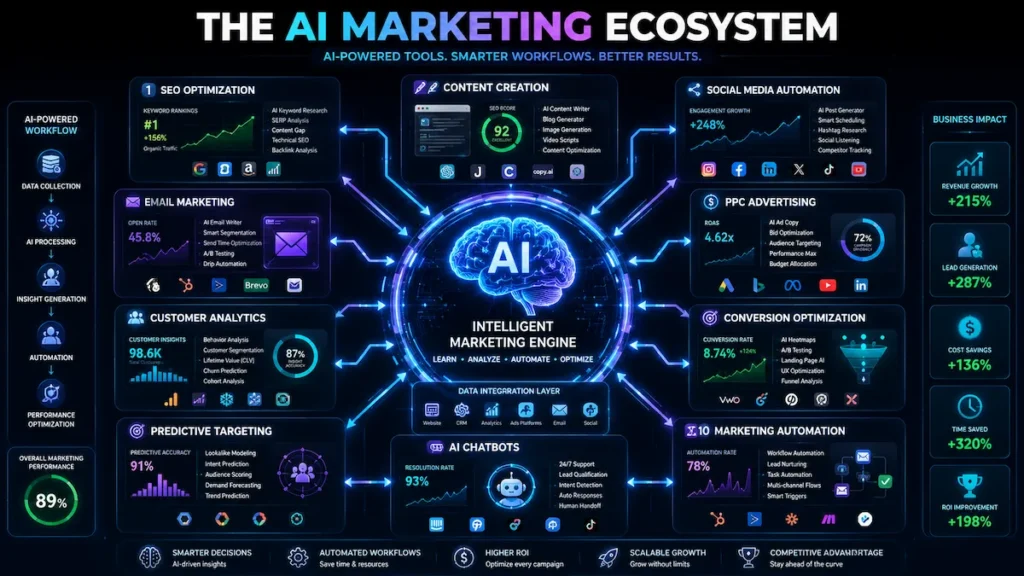
27 AI Tools for Digital Marketing—Full Breakdown
Tier 1: Core Stack Tools (Deep Coverage)
1. Surfer SEO’s NLP Content Scoring Engine scores articles against top SERP competitors in real time, surfacing entity gaps and structural weaknesses before you publish. Makes Google’s NLP evaluation criteria visible instead of guessable. The question of whether AI is replacing SEO jobs is worth reading—tools automate the data layer, but cluster architecture still requires human judgment. Limitation: No backlink data. Produces mechanically over-optimized results when applied to brand or editorial content.
2. Semrush AI Content Optimization Platform It combines keyword research, content scoring, and competitive benchmarking in one environment—eliminating the context switching that fragments strategic thinking across multiple tools. Limitation: AI writing output is weaker than dedicated content tools. Hard to justify outside the existing Semrush ecosystem.
3. Jasper’s Brand Voice Training System Trained brand profiles produce on-tone content at scale, significantly reducing editing burden for teams with established style guidelines. How AI is reshaping content writing roles covers what is genuinely automating versus what still demands human craft. Limitation: Output quality is capped by input brief quality. Not suited for research-heavy or technical content.
4. Claude’s Long-Context Reasoning Engine Best for complex strategy: competitive analysis, detailed outlines, synthesizing multiple research sources, building frameworks. Produces more nuanced output on complex briefs than general-purpose tools. Limitation: No native SEO integration, no live SERP data. Always pair with a dedicated SEO tool for search-specific workflows.
5. ChatGPT’s Generative Language Model Best for rapid ideation, outline generation, content repurposing, and quick research via browsing. Rewards sophisticated prompting; returns generic output for weak briefs. Limitation: Not reliable for high-stakes factual content. Always verify claims independently.
6. Klaviyo’s Predictive Customer Behavior Model Segments customers by purchase likelihood, churn risk, and predicted LTV — triggering personalized flows before the behavior manifests. Knowing churn risk 60 days early enables preemptive retention campaigns manual segmentation cannot deliver. Limitation: Performs optimally above 10,000 contacts. Not suited for long-cycle B2B sales.
7. AdCreative.ai’s Performance Creative Engine generates hundreds of creative variants for Facebook and Google display, compressing time-to-winning-creative by 40–60% without a dedicated design team. For the full landscape of AI strategies reshaping advertising, that deep-dive covers programmatic and AI-native platforms beyond creative generation. Limitation: Volume over brand precision. Output requires refinement for established visual standards.
8. Google Performance Max AI Bidding System Allocates budget across search, display, YouTube, Gmail, and Maps based on real-time conversion signal strength. Reduces CPA by 20–40% at scale when fed first-party data and creative diversity. The debate about whether AI will fully replace PPC managers has a nuanced answer—bid management is automating rapidly; campaign strategy is not. Limitation: Opacity makes drop diagnosis difficult. Never run as your sole campaign type — parallel search campaigns maintain keyword-level visibility.
Tier 2: Essential Supporting Tools
| # | Tool | Category | Best For | Starting Price |
|---|---|---|---|---|
| 9 | Canva AI | Visual Content | Ad graphics, social images, presentations — no designer needed | Free / $15/mo |
| 10 | Midjourney | Image Generation | Campaign imagery and visual concepts at speed | $10/mo |
| 11 | Instantly AI | Cold Email | Outbound sequencing with deliverability infrastructure built in | $37/mo |
| 12 | HubSpot AI | CRM + Automation | Full-funnel marketing and sales automation at scale | $800/mo |
| 13 | Hootsuite AI | Social Media | Scheduling, social listening, AI captions across platforms | $99/mo |
| 14 | Buffer AI | Social Media | Simple scheduling with AI post suggestions for lean teams | $6/mo |
| 15 | Perplexity Pro | Research | Real-time market intelligence and competitive research | $20/mo |
| 16 | Grammarly AI | Editing | Brand-consistent editing, tone adjustment, and clarity at scale | Free / $12/mo |
| 17 | Phrase | SEO Content | AI content briefs and SERP-based optimization guidance | $15/mo |
| 18 | Copy.ai | Content | Fast copy generation for ads, emails, and landing pages | Free / $49/mo |
| 19 | Writesonic | Content | Long-form AI writing with built-in SEO optimization | $16/mo |
| 20 | Notion AI | Workflow | Content planning, meeting notes, internal documentation | $10/mo |
| 21 | Make.com | Automation | No-code workflow automation connecting your entire stack | Free / $9/mo |
| 22 | Zapier AI | Automation | Cross-app automation with AI-powered workflow logic | Free / $20/mo |
| 23 | Synthesia | Video | AI avatar videos for product demos and training content | $22/mo |
| 24 | Descript | Video/Podcast | Edit video by editing text and repurpose audio into written content | Free / $24/mo |
| 25 | Reply.io | Sales Outreach | AI-powered multichannel sales sequences with intent signals | $60/mo |
| 26 | Apollo AI | Lead Gen | AI prospecting, lead scoring, and outbound sequence automation | Free / $49/mo |
| 27 | Mailchimp AI | AI subject line suggestions and send-time optimization for SMBs | Free / $13/mo |
Best AI Tools by Category
Best AI SEO Tools
- Surfer SEO—real-time NLP content scoring
- Semrush AI—an all-in-one research and optimization platform
- Frase—SERP-based brief generation and content optimization
Best AI Content Writing Tools
- Claude—complex strategy, long-form, research synthesis
- Jasper—brand voice consistency at high production volume
- ChatGPT—ideation, repurposing, rapid drafting
- Writesonic—long-form writing with built-in SEO layer
Best AI Email Marketing Tools
- Klaviyo—predictive segmentation and churn prevention (e-commerce)
- Instant AI—cold outbound at scale with deliverability infrastructure
- Mailchimp AI—send-time optimization for SMBs on a budget
Best AI Social Media Tools
- Hootsuite AI—enterprise scheduling + social listening
- Buffer AI—simple AI post suggestions for lean teams
Best AI Paid Advertising Tools
- Google Performance Max—cross-channel AI bid management
- AdCreative.ai—performance creative generation at volume
Best AI Automation Tools
- Make.com—visual no-code workflow automation
- Zapier AI—AI-powered cross-app automation
- HubSpot AI—full CRM and marketing automation suite
Best AI Tool Stack by Business Type
| Business Type | Content | SEO | Paid | Est. Monthly Cost | |
|---|---|---|---|---|---|
| Solo Creator | Claude/ChatGPT free | Search Console | Mailchimp free | Canva AI free | $0–$40 |
| Small Business | Jasper Starter | Surfer SEO | Klaviyo Starter | AdCreative.ai | $150–$350 |
| E-commerce | Jasper + Claude | Semrush AI | Klaviyo predictive | Google PMax + AdCreative | $400–$800 |
| Agency | Jasper Teams | Semrush and Surfer | Instantly + Klaviyo | AdCreative + PMax | $800–$2,000 |
| Enterprise | Custom LLM | Semrush Enterprise | Salesforce MC AI | Full Google/Meta AI | $3,000–$10,000+ |
At solo and small business levels, the real constraint is strategic clarity—not tooling. At the agency level, integration architecture matters as much as the tools themselves. At Enterprise, the investment is data infrastructure, not subscriptions.
TOFU → MOFU → BOFU: Matching AI Tools to the Buyer Journey
Deploying AI tools uniformly across the funnel without adjusting for intent is one of the most expensive mistakes in AI marketing.
| Funnel Stage | Goal | Best AI Tools | Content Types |
|---|---|---|---|
| TOFU — Awareness | Reach people with a problem but no defined solution | Claude, ChatGPT, Semrush AI, Buffer/Hootsuite | How-to guides, explainers, comparison articles |
| MOFU — Consideration | Guide prospects comparing solutions | Jasper, Klaviyo segmentation, AdCreative.ai | Buyer guides, tool comparisons, ROI calculators |
| BOFU — Decision | Convert high-intent prospects | Instantly AI, Klaviyo flows, Google PMax | Demos, pricing comparisons, implementation guides |
Where AI Should NOT Be Used in Marketing
Most AI marketing content only covers what these tools can do. This section matters more.
Brand storytelling and founder-led content. The most powerful brand narratives come from genuine human experience. AI can structure and polish — but the raw material must be human. A brand voice built on AI-generated personality is fragile; a voice built on real perspective compounds.
Crisis communication. Responses to public controversy must be immediate, authentic, and demonstrably human. AI-drafted responses that read as templated accelerate reputational damage rather than contain it.
Emotional campaigns. Campaigns built around cultural moments or community identity require the kind of emotional intelligence that AI approximates but does not possess. The difference between resonance and tone-deafness often comes down to a human editor’s instinct.
Relationship-driven B2B sales. AI can research and draft outreach, but the conversations that move high-value deals forward are human. Automating relationship touchpoints in enterprise sales is signal degradation, not efficiency.
Regulated industries. In financial services, healthcare, legal, and pharmaceutical marketing, AI is not a reliable compliance reviewer. Expert human review is non-negotiable regardless of how content was produced.
The pattern: wherever authenticity, emotional precision, legal accuracy, or genuine relationships are the primary value—AI is a risk, not an accelerator.
The Hidden Cost of AI Tool Stack Complexity
Most AI marketing content focuses on what tool stacks enable. The more useful question is what they silently cost.
Integration overhead. In a six-tool stack, maintaining broken connections, expired tokens, and data discrepancies can consume 5–10 hours monthly — rarely included in ROI calculations.
Subscription creep. Stacks grow faster than they are audited. A tool superseded by a feature you already pay for keeps billing because no one compared the overlap. Quarterly usage audits are non-negotiable.
Prompt inconsistency. Without a shared prompt library, one team member’s AI output is excellent and another’s is unusable. The tool’s effective performance is limited by its weakest user.
Data silos. Klaviyo knows email behavior. Surfer knows content rankings. Analytics knows what converts. Without data flowing between them, each AI is optimizing a partial picture.
The rule before adding any tool: ask, “What does this replace?” before “What does this add?” The most effective AI stacks are not the largest — they are the most integrated.
Why Most AI Marketing Strategies Fail
No funnel strategy. High organic traffic with no conversion path solves the wrong problem entirely.
No intent mapping. Every piece of AI-assisted content needs explicit intent classification before the brief is written. Informational content against commercial keywords fails regardless of quality. Semrush’s intent classification research is a practical starting framework.
Weak SEO architecture. AI tools can write. They cannot independently build a topical authority model. That requires a human to map keyword clusters, plan internal linking, and ensure the site signals topical depth—not just individual articles.
Over-automation without oversight. Teams that hand campaign management entirely to AI tools consistently underperform teams that maintain human strategic direction while leveraging AI execution speed.
According to McKinsey’s research on AI adoption in marketing, companies with clear human oversight structures outperform those pursuing full automation by a significant margin on revenue impact.
Conclusion
AI tools for digital marketing are not a shortcut. They are a force multiplier—and force multipliers require a direction to amplify.
The teams extracting real ROI in 2026 share three things: a clear strategy before they open any tool, a rigorous human editing layer over AI output, and measurement against business outcomes rather than production metrics.
Use the AI Marketing Maturity Model to assess where you actually sit. Use the 4-Layer AI Marketing Stack to build upward from that level—not two levels above it. Start with your highest-volume, most repeatable task. Measure what moves downstream revenue. Redirect reclaimed hours toward the strategic work AI cannot do.
That is how AI tools for digital marketing build durable competitive advantages—through deliberate deployment in service of a strategy that was already worth executing.
The broader question of whether digital marketing remains a viable career in this AI-driven environment has a clear answer: it survives, but the required skill set is shifting decisively toward strategy, direction, and AI oversight.
FAQ
What are the best AI tools for digital marketing in 2026?
It depends on the channel. For SEO: Surfer SEO and Semrush AI. For content: Jasper and Claude. For paid ads: AdCreative.ai and Google Performance Max. For email: Klaviyo for e-commerce, Instantly AI for cold outbound. Most professional teams run a multi-tool stack across categories.
Can AI tools hurt SEO rankings?
Yes — when unedited, low-quality AI content is published at scale. Google’s helpful content systems target thin, repetitive content regardless of production method. AI-assisted content that is editorially reviewed and demonstrably more useful than existing results does not get penalized. The risk is the process, not the tool.
How many AI marketing tools do you actually need?
Three to five, covering content production, SEO optimization, and either email or paid ads. Beyond this, integration overhead typically exceeds performance return. Depth of use in fewer tools consistently outperforms breadth across many.
Are AI marketing tools worth it for small businesses?
Yes, when chosen strategically. Spending $150–$300/month that eliminates 10–15 hours of manual production weekly generates real ROI. Start with free tiers, find your actual bottleneck, and invest in the specific tool that eliminates it.
Can AI replace digital marketers?
No. AI automates execution — drafting, scheduling, bid management, reporting — but cannot replace strategic thinking, brand judgment, or authentic audience relationships. The marketer’s role shifts toward direction and oversight. It does not disappear.
Is AI-generated content safe for Google rankings?
Yes, when editorially reviewed and genuinely useful. The human editing layer — verifying facts, injecting original expertise, ensuring the content adds something beyond existing results — is what makes AI-assisted content competitive in quality SERPs.