
Reviewed by enterprise SEO strategists and AI workflow consultants with hands-on experience across SaaS, e-commerce, and B2B content operations. Grounded in research from McKinsey, Gartner, Salesforce, Adobe, and Google Search documentation. Last updated: 2026.
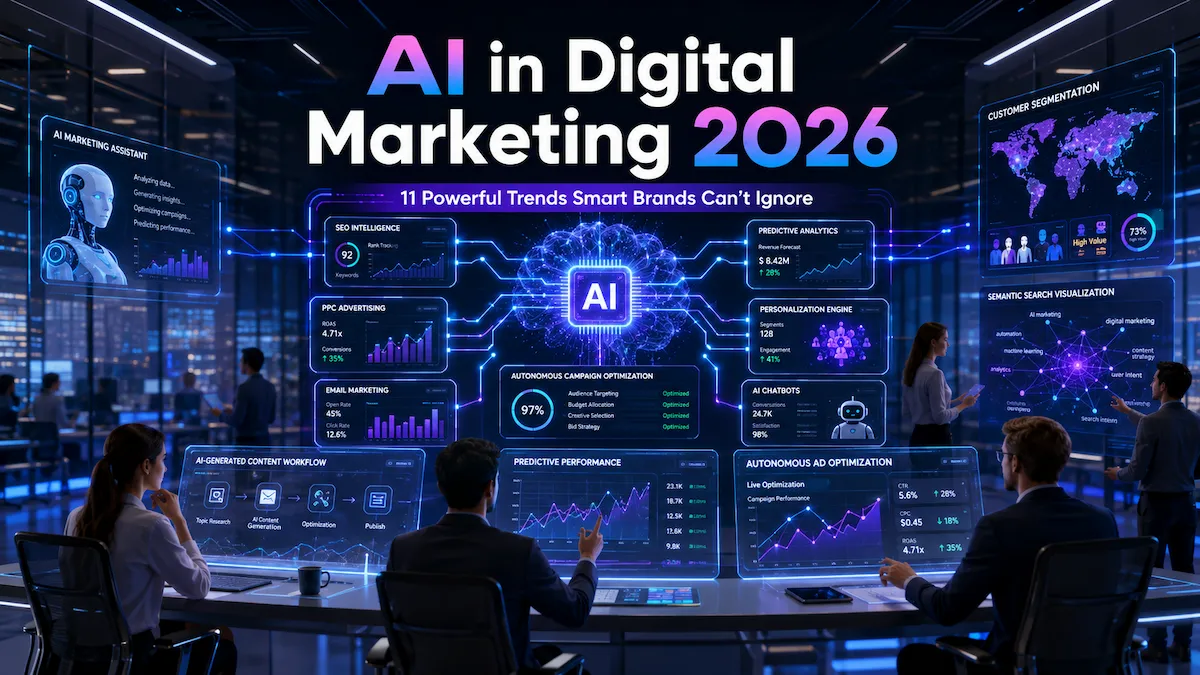
AI in digital marketing 2026 is fundamentally transforming how brands approach SEO, advertising, customer engagement, and data-driven growth strategies. If you’re still thinking of AI as a nice-to-have add-on, 2026 is your wake-up call.
AI in digital marketing 2026 isn’t just about writing blog posts faster or auto-scheduling social media. It’s a full structural shift in how brands connect with customers, rank on Google, run ads, and measure results. The marketing teams that adapt now will outpace competitors who are still figuring out whether to “try AI.”
This guide breaks down what’s actually happening, which tools are dominating, and what you need to do to stay competitive—without the hype.
Key Takeaways
- AI in digital marketing 2026 is shifting from automation to autonomous execution—systems that test, decide, and optimize without human approval at every step.
- Human strategic oversight is more valuable, not less—the marketer’s role is moving from execution to judgment, quality control, and goal-setting.
- Semantic SEO and topical authority now outperform isolated keyword optimization — Google rewards depth and expertise, not keyword density.
- AI personalization and predictive analytics are reshaping customer acquisition — real-time behavioral data is replacing demographic assumptions.
- Brands that automate without editorial systems risk losing rankings and trust — AI content at scale requires human review infrastructure.
- The real competitive moat isn’t AI tools — it’s proprietary data and strategic judgment layered on top of commodity AI systems.
AI Marketing Stats 2026
| Stat | Source |
|---|---|
| Generative AI could add $4.4 trillion annually to the global economy—marketing and sales among the highest-impact functions | McKinsey |
| High-performing marketing teams are 2.1x more likely to use AI than underperformers | Salesforce State of Marketing |
| 80%+ of enterprise marketing organizations will use AI-assisted decision-making by 2026, up from 30% in 2023 | Gartner |
| 66% of consumers expect companies to understand their unique needs | Adobe Digital Trends |
| Teams with structured AI workflows report 60–80% reduction in content production time | Industry benchmarks |
| One e-commerce brand reduced CPA by 31% using Meta Advantage+ with AI-optimized creative rotation over 90 days | Practitioner case example |
What Is AI in Digital Marketing in 2026?
AI in digital marketing 2026 is no longer limited to automation tools — it now powers complete marketing ecosystems capable of optimizing campaigns autonomously.
What is AI-powered marketing? AI-powered marketing is the use of machine learning, large language models (LLMs), predictive analytics, and intelligent automation to plan, create, distribute, optimize, and measure marketing activity across every channel—faster and more accurately than human teams can do manually.
In 2024, AI was mostly a productivity tool. In 2026, it’s becoming the operating system of marketing itself.
“AI is no longer a marketing tool. It’s becoming the marketing operating system.”
The shift is structural, not incremental. In 2024, most AI tools were point solutions—ChatGPT for copy, Midjourney for images, and Surfer SEO for optimization. By 2026, the move is toward integrated AI systems where content, SEO, ads, analytics, and customer data are connected under one intelligence layer. Your content strategy informs your ad targeting, which informs your email segmentation, which feeds back into content planning. AI makes that loop tighter and faster than any human team could manage manually.
What is autonomous marketing? Autonomous marketing uses AI systems to analyze data, optimize campaigns, and make real-time marketing decisions with minimal human intervention—continuously, across every channel, without waiting for approval at each step.
The strategic risk most teams underestimate: autonomous systems can optimize toward the wrong goal just as efficiently as the right one. Without clearly defined business outcomes — not just campaign metrics — AI will gladly improve click-through rates while conversion rates quietly collapse. Human oversight is the control layer that keeps the whole system honest.
The 4-Layer AI Marketing Stack in 2026
The most effective marketing organizations in 2026 aren’t using AI randomly across isolated tools. They’re building structured systems with four distinct layers:
Layer 1 — AI Data Layer: The foundation. First-party customer data, behavioral signals, CRM records, and campaign metrics — all unified. AI cannot make smart decisions without clean, connected data. This is where most businesses should start and where most skip ahead.
Layer 2 — AI Decision Layer: Where machine learning models operate—predicting customer intent, scoring leads, identifying which content to produce, and determining which segments to prioritize.
Layer 3—AI Execution Layer: Where AI acts on those decisions—generating content drafts, launching ad variations, sending personalized emails, and adjusting bids in real time. This layer runs at machine speed.
Layer 4—Human Strategic Oversight Layer: Where experienced marketers operate in 2026—not in execution, but in goal-setting, quality control, creative direction, and strategic judgment.
The most common failure pattern: businesses invest heavily in Layer 3 while neglecting Layer 1 and skipping Layer 4 entirely. The result: fast content with no strategic direction, or optimized campaigns pointing toward the wrong outcome.
What Most Companies Get Wrong About AI Marketing
Many businesses adopting AI in digital marketing 2026 fail because they prioritize automation speed over strategic clarity and data quality.
“Fast execution of a weak strategy is still a weak strategy.”
These mistakes are widespread—and show up quietly in analytics before they show up loudly in quarterly reviews.
1. They automate before fixing their data quality. AI is only as smart as the data it learns from. Deploying AI on top of messy, siloed data produces fast answers to the wrong questions.
2. They scale content before building editorial systems. Publishing volume goes up. Quality control doesn’t. The result is a backlog of AI-written content that sounds generic, fails to rank, and quietly damages brand credibility.
3. They optimize for traffic instead of conversion quality. AI excels at maximizing whatever metric you give it. If that metric is traffic instead of qualified pipeline, you’ve built an efficient system generating the wrong results at scale.
4. They mistake AI speed for strategic advantage. Fast execution of a weak strategy is still a weak strategy. The businesses gaining ground are thinking more clearly about what they’re optimizing for—then using AI to execute it well.
5. They treat AI adoption as a one-time implementation. AI tools and best practices evolve monthly. Teams that built a workflow in early 2024 and haven’t revisited it are running on outdated approaches against competitors who’ve iterated continuously.
Why AI in Digital Marketing 2026 Is Growing So Fast
The explosive growth of AI in digital marketing 2026 is driven by rising personalization demands, predictive analytics, and scalable AI content systems.
Rising personalization demand. Adobe research found 66% of consumers expect companies to understand their unique needs — a standard impossible to meet at scale without AI. Personalization engines now adjust messaging, recommendations, and pricing dynamically in real time per individual, not per segment.
AI-generated content scaling. Teams using generative AI—GPT-4o, Claude AI, and Gemini—are scaling AI content marketing without scaling headcount. The brands are winning treat AI as a first draft engine, not a publish button. Here’s what most teams miss: AI-generated content scales faster than editorial review capacity. You can produce 500 articles a month—but if your editing team can review only 80, you’re bottlenecked at a different point in the workflow. Real-world example: A B2B SaaS content team cut production time from 18 hours to 6 hours per article — but only after two months of building editorial review standards that maintained quality at that speed. The AI gave them scale. The editorial system gave them rankings.
Predictive analytics. Gartner predicts 80%+ of enterprise marketing organizations will use AI-assisted decision-making by 2026 — up from 30% in 2023. AI models forecast which segments will convert, when, and what message will move them. Marketers ignoring predictive data are flying blind while competitors aren’t.
Ad optimization at machine speed. TikTok Ads and Meta Ads have leaned heavily into AI-powered ad campaign optimization. An e-commerce brand using Meta Advantage+ reduced CPA by 31% over 90 days — without increasing ad spend. The only change: switching from manual ad sets to AI-optimized delivery.
11 Powerful AI Marketing Trends in 2026
The most important developments in AI in digital marketing 2026 revolve around automation, semantic search, AI-driven personalization, and predictive customer intelligence.
1. AI-Powered SEO Automation
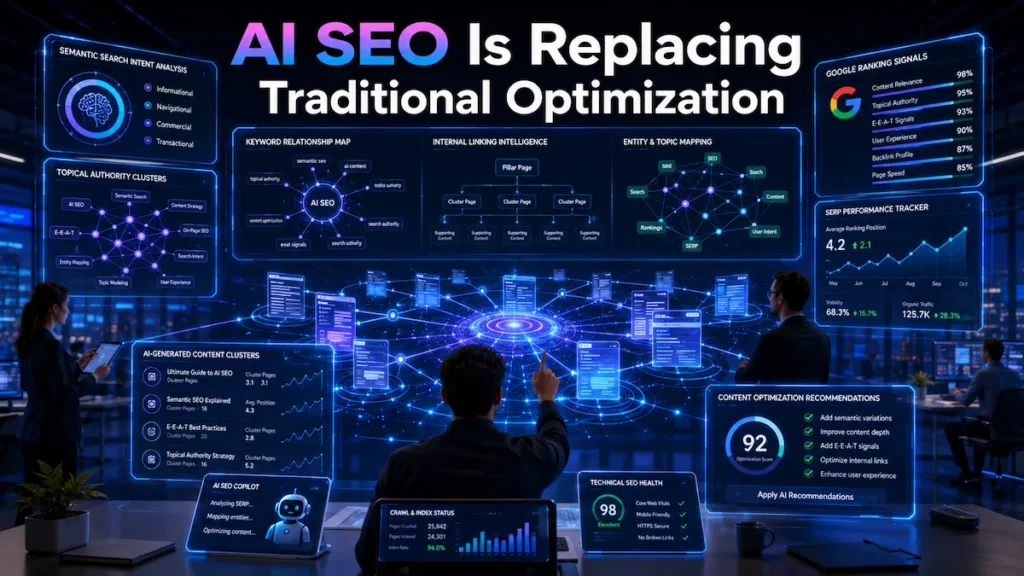
What is AI SEO? AI SEO uses machine learning and NLP to automate keyword research, content optimization, topical authority mapping, and search intent analysis—at a scale manual SEO cannot match.
AI SEO automation now handles keyword clustering, content gap analysis, internal linking, and on-page semantic optimization. The smarter teams go further — building AI-generated topical authority clusters that dominate entire niches. Real-world example: A SaaS team implemented AI-driven topical authority mapping. Organic traffic to the cluster increased 67% within four months — because Google recognized the interconnected depth of coverage, not just individual page quality.
2. Predictive Customer Analytics
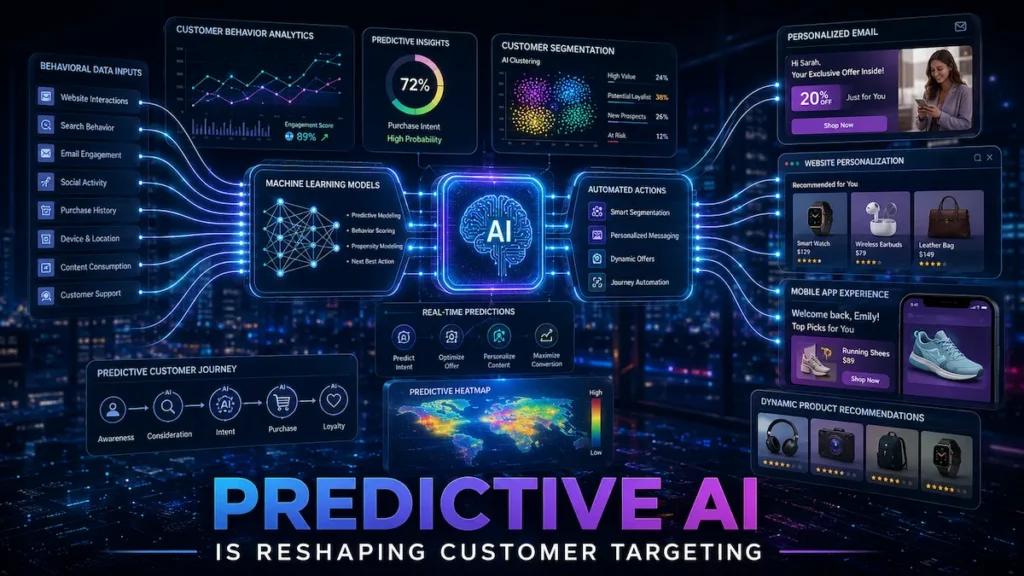
What is predictive marketing analytics? Predictive marketing analytics uses AI models trained on customer behavior to forecast purchase likelihood, churn risk, and optimal engagement timing—before the customer signals intent.
Predictive analytics has become one of the most valuable applications of AI in digital marketing 2026 for identifying high-converting customer segments.
Platforms like HubSpot AI and Salesforce Einstein score leads by conversion likelihood, forecast churn, and identify upsell opportunities. Real-world example: An enterprise SaaS company found that prospects who visited the pricing page twice within 72 hours had a 4.3x higher close rate. Routing those leads to immediate outreach increased pipeline conversion by 28% — with no changes to the sales process.
3. Hyper-Personalized Email Campaigns
Generic email blasts are dead. AI email personalization now optimizes subject lines, body copy, product recommendations, and send times per individual — not per segment. A D2C brand using AI-personalized sequences saw a 22% increase in repeat purchase rate within 60 days, driven by dynamic recommendations based on individual browsing history, not segment averages.
4. AI Video Marketing
The rise of AI in digital marketing 2026 has dramatically reduced video production barriers through generative media and AI voice technologies.
AI has removed most production barriers. Teams now script, storyboard, generate voiceovers, create B-roll via generative video models, and produce localized versions without separate production crews. Real-world example: A global SaaS company produced product demos in seven languages in 11 days — a project that previously required 6–8 weeks and 74% more budget — using AI voice cloning and generative video localization.
5. Voice Search Optimization
What is voice search optimization? Voice search optimization structures content to answer conversational queries directly and concisely—targeting featured snippets and AI overviews that voice assistants read aloud in response to spoken searches.
Building for voice means concise answers at section tops, conversational phrasing that mirrors how people speak rather than type, FAQ formatting that extracts cleanly into audio responses, and featured snippet targeting as a primary SEO goal.
6. Autonomous PPC Campaigns
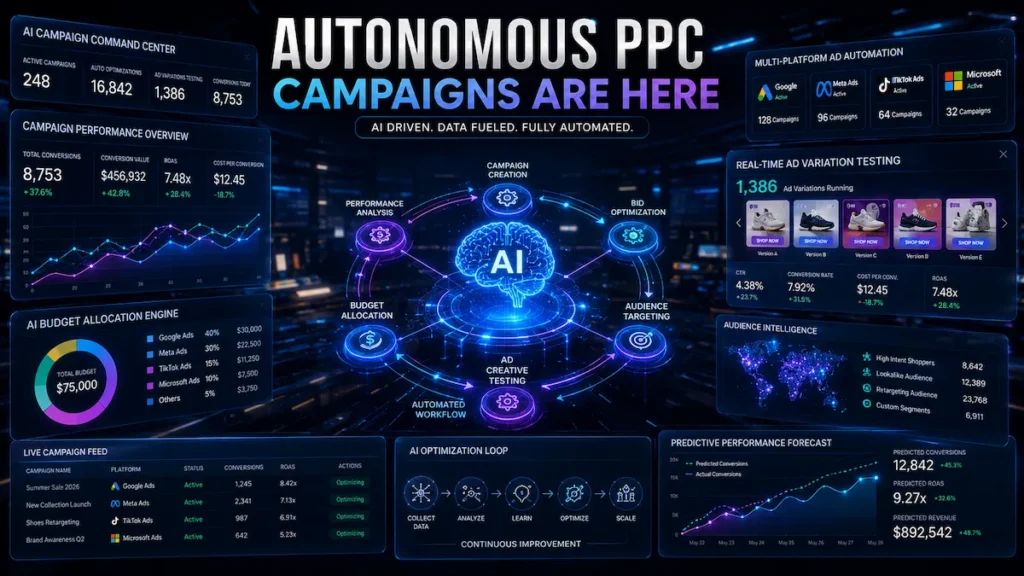
What is AI PPC automation? AI PPC automation uses machine learning to handle campaign bidding, creative selection, audience targeting, and budget allocation in real time — continuously improving performance against defined business outcomes.
Performance Max on Google and Advantage+ on Meta handle creative selection, targeting, bids, and placements simultaneously. Skilled PPC managers aren’t obsolete — but their role has shifted decisively toward strategy, goal-setting, and quality control rather than daily manual management.
7. AI Chatbots & Conversational Marketing
What is conversational AI marketing? Conversational AI marketing uses LLM-powered chatbots to engage prospects in real-time dialogue—qualifying leads, answering product questions, resolving support issues, and guiding users toward conversion, 24/7 without human agents.
Critical operational insight: chatbot performance degrades when the underlying knowledge base isn’t maintained. AI running on outdated product information becomes a liability, not an asset. Real-world example: A B2B software company deployed a chatbot on its pricing page. Within 30 days it handled 61% of inbound demo requests without human intervention—converting 18% higher than the previous form-based flow because it answered objections in real time rather than asking prospects to wait.
8. Real-Time Customer Segmentation
What is real-time AI segmentation? Real-time AI segmentation dynamically adjusts which segment a customer belongs to as their behavior changes — serving different messaging based on live signals rather than static historical data.
A customer who just viewed a pricing page gets different messaging than one who downloaded a guide three weeks ago. A lead who visits the pricing page twice in 48 hours triggers accelerated sales outreach automatically. This precision reduces ad spend waste and makes every touchpoint feel relevant—compounding into better engagement scores and lower acquisition costs over time.
9. AI Influencer Discovery
What is AI influencer discovery? AI influencer discovery uses machine learning to scan millions of social accounts simultaneously — analyzing audience authenticity, engagement quality, and predicted campaign ROI — to match brands with creators whose actual audience aligns with their customer base.
AI in digital marketing 2026 helps brands identify high-performing influencers through audience authenticity analysis and predictive ROI modeling. Traditional influencer research involved hours of manual work and often yielded mediocre results. AI platforms deliver audience authenticity analysis at scale, predicted ROI before any commitment, and creator-audience alignment scoring well beyond surface demographics.
10. Generative AI Content Engines
What is generative AI content marketing? Generative AI content marketing uses large language models to produce original marketing content—articles, ad copy, email sequences, scripts—at scale, with human strategists directing output and editors ensuring quality, accuracy, and brand alignment.
Generative systems are becoming foundational to AI in digital marketing 2026 by accelerating content research, drafting, and optimization workflows.
The Human + AI Content Maturity Model—benchmark where your team sits:
| Level | What AI Handles | What Humans Handle |
|---|---|---|
| Level 1 — AI-Assisted Drafting | First drafts | Heavy editing, fact-checking, strategy |
| Level 2 — AI Workflow Integration | Research, structure, drafts | Insight, brand voice, fact-checking |
| Level 3 — AI-Driven Optimization | SEO, metadata, internal linking, drafts | Strategy, voice, quality gates |
| Level 4 — Autonomous Content Systems | Full pipelines | Defined quality gate review only |
Most agencies are at Level 2. The fastest-scaling teams are at Level 3. Level 4 requires significant quality control infrastructure — teams that have attempted it without that foundation have uniformly regretted it.
11. AI Conversion Rate Optimization
What is AI CRO? AI CRO uses machine learning to analyze user behavior — scroll depth, click patterns, form abandonment — and automatically suggest and test site changes that improve conversion rates at scale.
AI CRO diagnoses why users aren’t converting, not just where they drop off. Real-world example: A SaaS company used AI-driven CRO on its free trial page. The AI identified abandonment at the email field wasn’t reluctance—it was a paragraph of marketing copy placed above the form that diluted intent. Moving the form above that copy increased trial signups by 34% with no other changes.
Best AI Marketing Tools Dominating 2026
The leading platforms shaping AI in digital marketing 2026 include tools for content generation, semantic SEO, automation, analytics, and AI workflow orchestration.
ChatGPT — The most versatile tool in most marketers’ stacks. Real power comes from advanced prompting and API integration into AI workflow automation systems, not standalone use.
Jasper AI — Purpose-built for marketing teams. Maintains brand voice and scales content production. Works best when strong editorial review is built into the process, not bolted on afterward.
HubSpot AI — Deeply integrated AI across CRM, email, social, and content tools. Drafts emails, generates content briefs, scores leads, and surfaces contact insights in real-time context. One of the most cohesive full-funnel AI platforms available.
Surfer SEO — Sits at the intersection of AI content optimization and technical SEO. Its NLP analysis identifies the semantic patterns and entity coverage that Google’s ranking systems reward. Essential infrastructure for teams serious about topical authority.
Copy.ai excels at high-volume structured content: product descriptions, ad variants, social captions, and email sequences. Its workflow features build repeatable AI content pipelines without proportional headcount growth.
Midjourney—Removes visual content production as a bottleneck. Reduces dependency on expensive photo shoots for ad creative, editorial imagery, and social content at scale.
Claude AI — Developed by Anthropic. Increasingly used by enterprise teams for longer-form content and multi-source editorial synthesis where context window depth and sustained coherence matter.
How AI Is Transforming SEO in 2026
SEO strategies built around AI in digital marketing 2026 now prioritize semantic relevance, topical authority, and search intent alignment over isolated keyword targeting.
Semantic Search Is Now the Default
AI in digital marketing 2026 is closely tied to semantic search systems that evaluate expertise, contextual relevance, and topical depth.
Google’s ranking systems have moved decisively toward semantic understanding. It’s no longer about keyword presence—it’s about demonstrating genuine expertise and covering topics in sufficient depth. Google’s own documentation emphasizes people-first content as the core ranking signal — a standard that shallow AI content consistently fails to meet, regardless of how well it’s technically formatted.
Search Intent and Topical Authority
A page targeting the right keyword but satisfying the wrong intent won’t rank in 2026. AI-powered intent analysis helps teams identify whether Google rewards informational, commercial, navigational, or transactional content for any given query before writing begins.
What is topical authority mapping? Topical authority mapping uses AI to identify content gaps, cluster related topics, and build interconnected content systems—signaling deep expertise to Google across hundreds of semantically related queries simultaneously.
This structural approach consistently outperforms single-page optimization. Our overview of how AI is changing digital marketing in 2026 covers why content architecture now matters more than isolated page-level tactics.
EEAT Challenges and the Human + AI Hybrid
One of the biggest challenges in AI in digital marketing 2026 is balancing AI-generated efficiency with authentic human expertise and editorial oversight.
AI alone cannot demonstrate genuine experience. It can describe what experience looks like. It can’t provide it. Brands publishing pure AI content without editorial judgment see rankings stall — not because Google detects “AI writing,” but because AI content underperforms on EEAT signals: original insight, practical specificity, balanced analysis, and demonstrated operational knowledge.
“In a world where everyone has access to the same AI tools, competitive advantage comes from human judgment layered on top of them.”
The most effective SEO operations in 2026 are hybrid — AI running analysis and first-draft optimization in the background, while skilled strategists add original insight, maintain editorial standards, and ensure nothing reaches publication without human review.
Benefits and Risks of AI Marketing
The benefits are real and measurable:
- Faster campaigns — research, brief, draft, launch in days, not weeks
- Better targeting—behavioral signals that human analysts cannot process at real-time scale
- Lower costs — less human time per piece, lower CPA, fewer wasted impressions
- Better ROI — targeting + creative + timing improvements that compound over time
- 24/7 automation — campaigns optimize overnight, chatbots work weekends, emails trigger on behavior
But the downsides are equally real.
Generic content saturation. The same tools available to you are available to every competitor. When everyone uses similar prompts and models, content converges. > “Differentiation is now a function of what your team knows, not what your tools can generate.”
AI misinformation. Generative models hallucinate — confidently producing incorrect statements, invented statistics, and misattributed quotes. Any AI content published without human fact-checking is a liability.
Over-automation risks. Autonomous systems optimize toward the goal they’re given. If that goal is poorly defined, they’ll hit it perfectly while missing the actual business outcome. Human oversight isn’t a bottleneck — it’s the safeguard that prevents efficient systems from efficiently doing the wrong things.
Google spam concerns. Google’s spam policies explicitly target scaled, low-quality content produced to manipulate rankings. Publishing AI output without meaningful human contribution isn’t just a quality risk — it’s a manual action risk.
Will AI Replace Digital Marketers?
The evolution of AI in digital marketing 2026 is reshaping marketing roles by automating repetitive execution tasks while increasing demand for strategic thinking.
Straight answer: some roles, yes. Most roles, no — but they’ll change significantly.
Roles AI will replace: repetitive, execution-level work — basic first-draft copywriting, manual A/B test setup, standard report generation, routine social media scheduling, simple ad creative variations. If your primary value is executing a defined, rule-based process, AI can do it faster and cheaper. This is the present reality for many entry-level roles, not a future risk.
For a full career outlook across disciplines, our guide on whether digital marketing careers remain viable with AI in 2026 addresses the complete picture.
Skills marketers must build:
- Strategic judgment — knowing which goals to optimize for, not just how to optimize
- Creative direction — guiding AI toward original ideas rather than average outputs
- Quality evaluation — recognizing when AI output is wrong, mediocre, or off-brand
- Systems thinking — building workflows where AI and humans each do what they do best
- Stakeholder communication — translating AI capabilities into business value
Learning to prompt AI is table stakes. Evaluating AI output strategically — and knowing when to override it — is the real differentiator. Marketers who define goals, make judgment calls, and translate business objectives into marketing systems are more valuable than ever. The divide between those people and repetitive workers is widening fast.
How to Use AI in Digital Marketing Successfully
Brands succeeding with AI in digital marketing 2026 are building scalable workflows that combine AI execution with strong human editorial review systems.
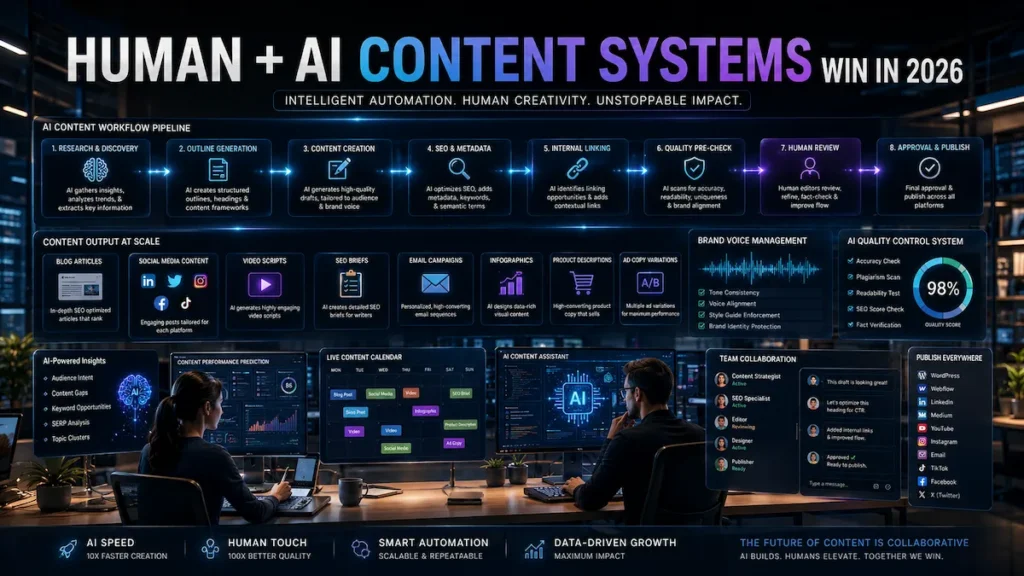
Build AI workflows, not just AI tools. The real leverage comes from repeatable systems—AI content pipelines, reporting frameworks, and campaign templates—where AI handles the heavy lifting and humans handle the judgment. A single well-built workflow replaces dozens of disconnected tool interactions every week.
Human editing is non-negotiable. AI drafts need substantive editing—not light proofreading. Add original insight. Remove generic phrasing. Fact-check every claim. Align tone with brand standards. Teams that skip this publish content that reads like AI wrote it. And increasingly, both Google and readers can tell.
Protect your brand voice. AI tools trained on generic internet data cannot replicate your brand voice by default. Build detailed style guides and use them to evaluate AI output before publication. Some enterprise teams fine-tune models on their own content archives — a worthwhile investment where voice is a genuine differentiator.
Follow the AI SEO workflow that actually works:
Research intent → Map topical clusters → Identify content gaps → Produce semantically rich content → Optimize with AI tools → Add EEAT signals through editorial review → Publish → Measure and iterate
Shortcuts anywhere in this chain produce mediocre results. The full process compounds.
Future of AI in Digital Marketing Beyond 2026
The future of AI in digital marketing 2026 points toward increasingly autonomous systems capable of managing campaigns, analytics, and optimization independently.
AI Agents and Autonomous Systems
What are AI agents in marketing? AI agents are autonomous AI systems that plan multi-step tasks, take action across tools and platforms, and self-correct based on results—without requiring human instruction at each step.
OpenAI has identified agentic systems as one of its highest-priority development directions. In marketing, early versions are already autonomously researching competitors, adjusting campaigns, generating reports, and surfacing strategic recommendations. Most are still in supervised deployment, but that boundary is shifting rapidly.
Fully autonomous AI advertising systems — where AI sets strategy, creates creative, and optimizes toward business outcomes — are becoming viable for sophisticated organizations. The brands getting ahead are defining outcome metrics with unusual precision, because autonomous systems optimize exactly toward whatever you measure. Vague goals produce vague results at machine speed.
Predictive Commerce and Synthetic Audiences
Predictive commerce is beginning to surface the right product to the right person at the moment they’re most likely to buy—before they’ve even searched. For e-commerce brands, this is compressing the consideration-to-purchase cycle in ways traditional funnel thinking doesn’t account for.
AI-native search interfaces are also generating synthetic audiences — simulated user segments built from behavioral models — that brands can use to test messaging before running against real humans. This changes market research timelines from weeks to hours. Knowing the current limits of that accuracy is becoming a meaningful strategic competency.
Two Contrarian Predictions Worth Taking Seriously
Prediction 1 — The Commodity Collapse: By 2027, access to AI tools will no longer be a competitive advantage. The tools will be a commodity. The real differentiators will be proprietary first-party data, organizational learning velocity, and the quality of human strategic judgment layered on top of commodity systems. Companies investing in data infrastructure and strategic talent now are building the moats that matter — not the ones stockpiling tool subscriptions.
Prediction 2 — The Brand Voice Crisis: Brands that fully automate their marketing in the next 18 months will face a brand voice crisis by 2027. Generic AI output at scale without editorial oversight creates compounding sameness that erodes brand identity — hard to measure quarterly, but very visible annually. The brands that maintained human creative leadership through the automation wave will be far better positioned than those that didn’t.
Frequently Asked Questions
What is AI in digital marketing in 2026?
AI in digital marketing 2026 refers to the use of machine learning, generative AI, predictive analytics, and intelligent automation to improve SEO, content marketing, advertising, and customer engagement across digital channels.
What is AI-powered marketing?
AI-powered marketing uses machine learning and automation to improve targeting, personalization, content creation, and campaign optimization in real time — at a speed and scale no human team can match manually.
Which AI tools are best for digital marketing in 2026?
The most popular tools used in AI in digital marketing 2026 include ChatGPT, Claude AI, Jasper AI, HubSpot AI, Surfer SEO, Copy.ai, and Midjourney for automation and content optimization.
Will AI replace digital marketers?
AI in digital marketing 2026 is automating repetitive marketing tasks, but strategic thinking, creativity, and human oversight remain essential for long-term success.
How is AI changing SEO in 2026?
AI in digital marketing 2026 is transforming SEO through semantic search optimization, topical authority mapping, predictive analytics, and automated content workflows.
What is generative AI marketing?
Generative AI marketing uses large language models—like GPT-4o, Claude AI, or Gemini—to produce original marketing content at scale. Done well, with strong editorial oversight, it dramatically increases both output volume and quality simultaneously.
What are the biggest risks of AI in marketing?
One of the biggest risks associated with AI in digital marketing 2026 is over-automation without proper human review, which can lead to misinformation, poor-quality content, and weakened brand trust.
How do I use AI for content marketing without losing quality?
Use AI for research, outlining, and first drafts. Invest in substantive human editorial review. Maintain a detailed brand voice guide. Fact-check all AI-generated claims. Prioritize information gain over volume — fewer, better pieces consistently outperform high-volume generic content in 2026 search environments.
What is autonomous marketing?
Autonomous marketing uses AI systems to analyze data, optimize campaigns, and make real-time decisions with minimal human intervention—continuously, across every channel, without waiting for approval at each step.
Conclusion
The companies that win with AI in digital marketing 2026 won’t be the ones using the most tools. They’ll be the ones building the best systems — combining clean first-party data, smart AI decision-making, fast AI execution, and disciplined human strategic oversight into a compounding competitive advantage.
Use the 4-Layer AI Marketing Stack as your framework. Don’t rush to Layer 3 without building Layer 1 first. Don’t skip Layer 4 because it feels slow — it’s what makes everything else sustainable.
Avoid the mistakes most companies are quietly making:
- Automating before fixing data quality
- Scaling content before building editorial systems
- Optimizing for traffic instead of conversion quality
- Treating AI speed as a substitute for strategic thinking
The contrarian predictions are worth keeping close. Tools will commoditize. Brand voice will matter more, not less. Proprietary data and strategic judgment will be the real moats — and the brands building those moats in 2026 will look back on this year as the moment they pulled ahead.
The window to get ahead is open. The question is whether you’ll use it.