
If you’ve been asking yourself — is digital marketing career with AI taking over so many jobs — you’re not alone. Thousands of students, career switchers, and working professionals in the United States are searching for the same honest answer right now.
Here it is, straight up: digital marketing is not dying. But it is changing fast, and the people who don’t adapt are the ones who’ll struggle.
This article breaks down exactly what’s happening, which roles are growing, which skills matter, and whether this career path still makes sense for you in 2026.
Quick Answer: Is Digital Marketing a Good Career with AI?
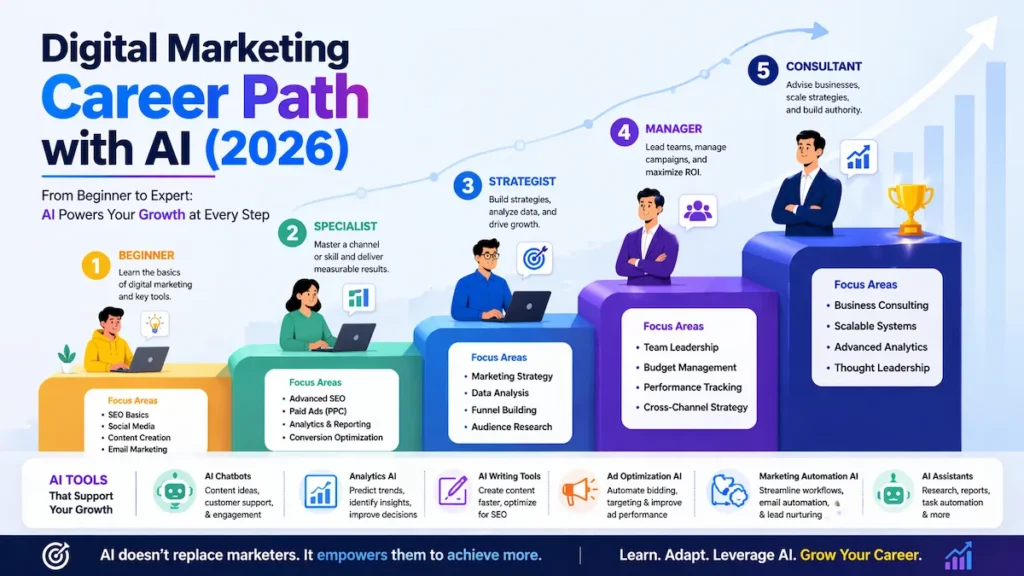
The Digital Marketing Career with AI is no longer linear; it now evolves through smart automation, data-driven decisions, and AI-assisted strategies at every stage of growth.
Before diving deep, here’s the short version:
- AI is replacing tasks, not entire careers
- High-income marketing roles are growing, not shrinking
- The future strongly favors marketers who combine AI fluency with strategic thinking
- Entry-level execution work is being automated — but strategic roles are expanding
- With the right skills, digital marketing remains one of the most flexible, high-earning careers available in the US today
So, is digital marketing a good career with AI today? Yes — but only for those willing to move beyond surface-level execution.
Who Should Choose Digital Marketing in 2026?
The Digital Marketing Career with AI is expanding fast because businesses now rely on AI tools for content creation, analytics, and campaign optimization.
Not everyone is a natural fit for this field in the AI era. This career path works best for:
- People who enjoy combining data analysis with creative thinking
- Those who are willing to learn continuously as tools and platforms evolve
- Freelancers and remote job seekers who want location independence
- Individuals genuinely interested in AI-powered tools and marketing automation
- Anyone drawn to strategy, persuasion, and understanding human behavior
If that describes you, keep reading. This path has real upside.
The Truth About AI in Digital Marketing (What Most People Get Wrong)
At the beginner level, the Digital Marketing Career with AI focuses on learning core marketing basics while using AI tools for content ideas, keyword research, and social media planning.
In today’s AI-driven marketing landscape, the most common answer people get when researching this career is fear-based and oversimplified. Let’s correct that.
The biggest misconception floating around is that AI will eliminate digital marketing jobs the same way factory automation replaced assembly line workers. That comparison doesn’t hold up.
A factory worker performs a physical, repetitive task a machine can replicate identically. A digital marketer interprets human behavior, builds brand trust, adapts messaging to culture, and makes judgment calls that require context no AI model currently has.
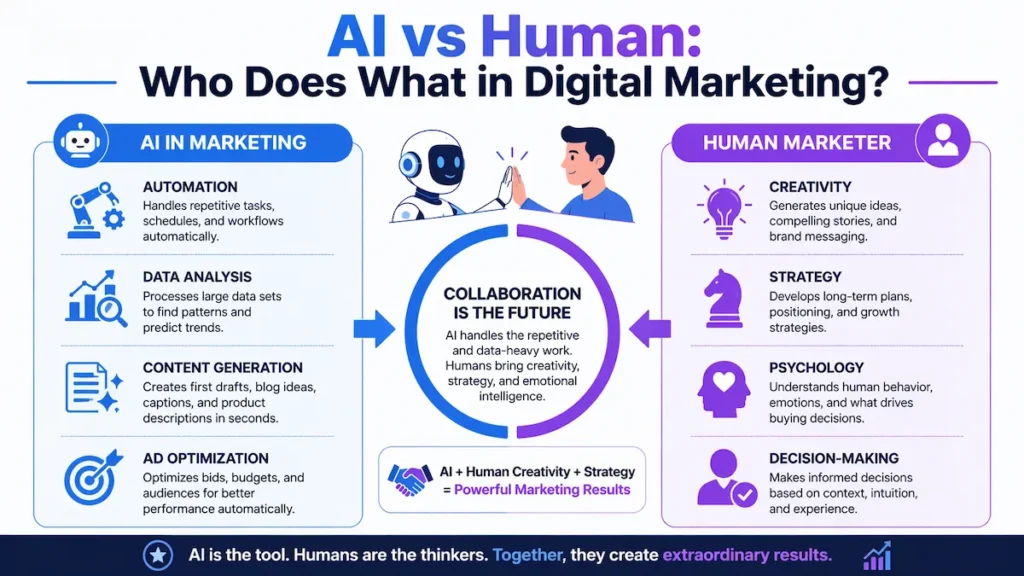
What AI is doing — and doing well — is automating the mechanical parts of marketing: scheduling posts, generating first drafts, running A/B tests at scale, pulling reports.
But someone still has to decide what to test, why a campaign isn’t converting, and how to position a brand against competitors.
The AI impact on digital marketing careers is really a story about leverage, not replacement. Marketers who learn to use AI tools work faster, handle more clients, and produce better results. That makes them more valuable, not less.
According to a McKinsey Global Survey on AI adoption, over 70% of organizations are now using AI in at least one business function — and marketing is consistently among the top three. That’s not a threat to marketers. That’s a signal that AI literacy is now a core professional requirement.
Why a Digital Marketing Career with AI Is Still Powerful in 2026
Many professionals wonder whether a digital marketing career with AI in the picture is still worth pursuing. The data says yes — clearly. In the early stage of the Digital Marketing Career with AI, tools like AI writers, SEO assistants, and analytics dashboards help speed up learning and execution.
Demand for skilled digital marketers in the United States isn’t shrinking — it’s shifting. The Bureau of Labor Statistics projects marketing manager roles to grow roughly 6–8% over the next decade.
That figure doesn’t even account for the explosion of AI-adjacent marketing roles that didn’t exist three years ago.
Every business — from a local dental office in Ohio to a SaaS startup in Austin — needs online visibility, lead generation, and customer retention. AI tools for marketers have made running campaigns cheaper and faster, but they’ve also raised the bar.
Now that any small business can generate basic content with a prompt, what actually cuts through is strategy, originality, and insight.
The AI in digital marketing career landscape is one where specialists who combine platform expertise with analytical thinking are genuinely hard to find and well-compensated.
The supply of truly skilled marketers has not kept up with demand, even as AI makes surface-level marketing more accessible.
Remote work has made this even more attractive. A performance marketer based in Nashville can work for a tech company in San Francisco, a retail brand in New York, and a European e-commerce store — all at the same time, as a freelancer. The geographic ceiling is gone.
How AI Is Changing Digital Marketing Jobs
Artificial intelligence is rapidly changing the way marketing jobs work, and the Digital Marketing Career with AI is at the center of this transformation. Tasks that once required hours of manual effort, such as data analysis, content creation, and campaign optimization, are now being handled more efficiently through AI-powered tools. As a result, marketers are shifting from repetitive execution to more strategic roles where creativity, decision-making, and AI collaboration play a key part in career growth.
With AI reshaping marketing roles at every level, you need a clear picture of exactly what it’s taking over — and what it isn’t.
That divide is what separates marketers who stay relevant from those who get left behind.
Tasks AI Is Replacing in Digital Marketing
AI is reshaping job roles, and the Digital Marketing Career with AI now requires marketers to work alongside automation tools instead of relying only on manual strategies.
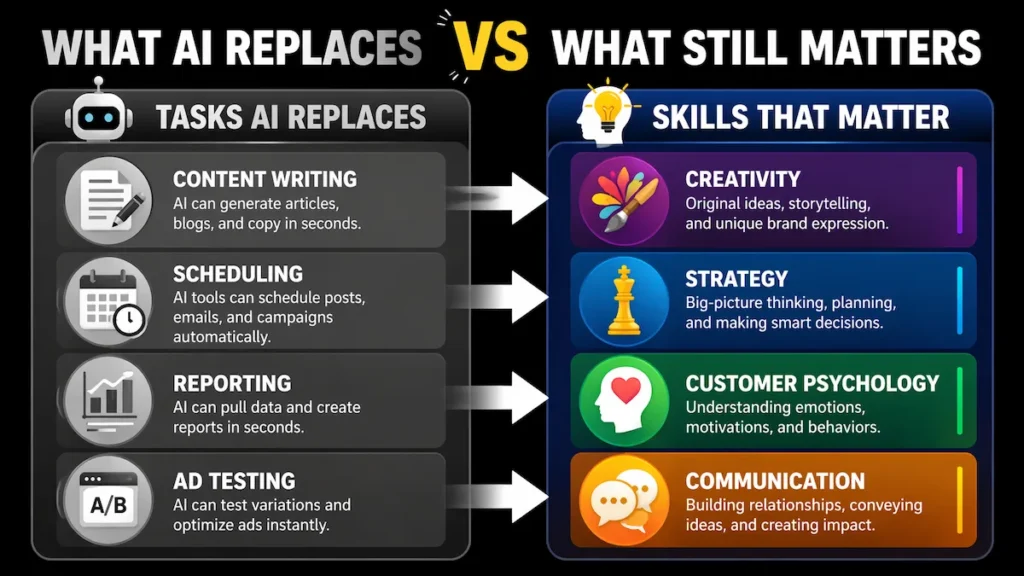
Automation has been absorbing low-skill marketing tasks for years. AI has accelerated that process significantly. Here’s what’s genuinely being replaced:
Basic content generation — Product descriptions, meta tags, social captions, and email subject line variations can be produced at scale with tools like Claude, ChatGPT, and Jasper. Businesses no longer need to hire someone full-time to write 200 product listings.
Ad copy testing — Platforms like Meta and Google now use machine learning to auto-optimize ad variations. The manual process of writing 20 headline variations and testing them over weeks is largely automated.
Reporting and analytics summaries — Marketing analytics dashboards powered by AI can now generate plain-English summaries of campaign performance, reducing the time analysts spend compiling reports.
Scheduling and posting — Social media management tools handle automated publishing, optimal send-time detection, and basic engagement responses.
Basic SEO audits — Tools like Semrush and Ahrefs now flag technical issues, keyword gaps, and content opportunities with minimal human input.
If your entire value as a marketer sits in these tasks alone, it’s time to upgrade. These aren’t “safe” skill sets anymore.
The full picture of which marketing jobs AI is replacing is more nuanced than most coverage suggests — some roles are shrinking, others are accelerating fast.
Skills AI Cannot Replace in Marketing
This is where the real opportunity lives. The digital marketing scope in 2026 is heavily weighted toward capabilities that require judgment, creativity, and interpersonal intelligence — three things AI still lacks.
Customer psychology is the clearest example. Understanding why a specific audience hesitates before buying, what emotional triggers drive a purchase decision, and how to build trust over time requires genuine human insight. AI can analyze behavior patterns, but it can’t feel what a customer feels.
Brand strategy is another. Positioning a brand in a competitive market, making the call to pivot messaging, deciding whether a campaign fits the brand voice — these require context, intuition, and experience from past failures.
Conversion funnel architecture requires understanding the full buyer journey: awareness, consideration, intent, and retention. Building a funnel that actually converts is a strategic skill that AI assists with but cannot drive on its own.
Stakeholder communication — presenting campaign strategy to a CEO, managing a client relationship, or convincing a team to change direction — is entirely human territory.
AI is a powerful assistant. It is not a strategist.
Pros and Cons of Choosing Digital Marketing in 2026
This is why many professionals asking is digital marketing a good career with AI are still choosing it — the upside is genuine, as long as you go in with clear eyes.
Here’s the honest trade-off:
Pros:
- High demand across virtually every industry
- Strong remote and freelance opportunities across the US
- AI tools multiply your output, making it realistic to manage multiple clients
- Entry points are accessible — certifications, bootcamps, and self-study all work
- Clear upward path from specialist → strategist → director → consultant
- Income ceiling is higher than most people realize, especially in consulting
Cons:
- Entry-level is getting more competitive as AI commoditizes basic work
- Keeping up with platform changes, algorithm updates, and new tools requires constant learning
- Freelance income can be volatile, especially early on
- Some niches — generic social media management, basic content writing — are genuinely shrinking
- Results-based pressure is real — underperforming campaigns get noticed quickly
The honest takeaway: if you’re willing to go deeper than the surface, this is a strong career. If you’re looking for something easy that doesn’t require ongoing learning, digital marketing in the AI era will be frustrating.
Best Digital Marketing Careers with AI (High-Income Roles in 2026)
AI helps elevate the Digital Marketing Career with AI by forecasting trends and optimizing marketing budgets with higher accuracy.
If you’re evaluating this career path in the AI era, the most important question is: which roles are actually growing?
The best digital marketing careers with AI in 2026 sit at the intersection of strategy and technology. Here are the ones with the strongest growth and income potential:
AI SEO Specialist
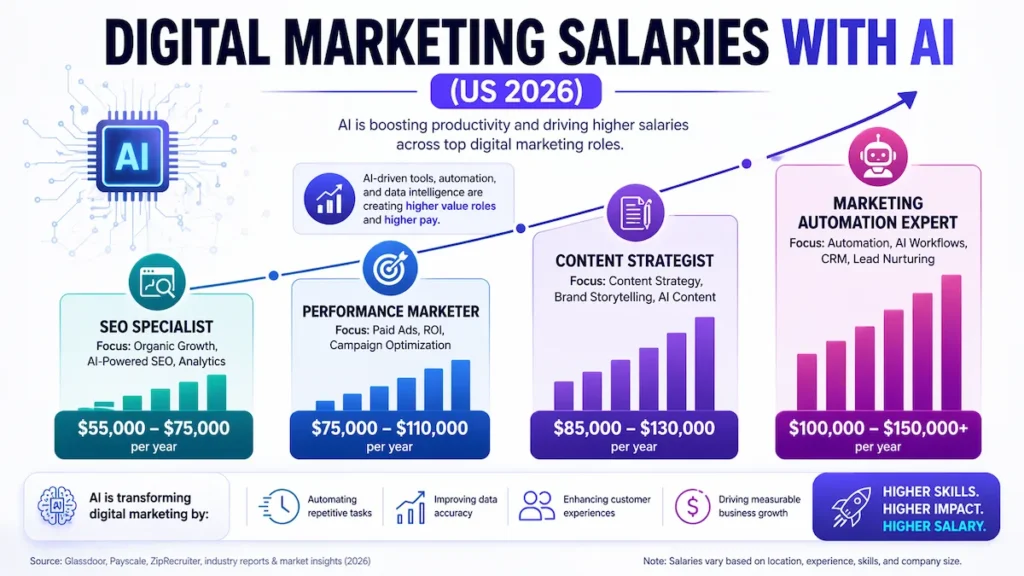
SEO is not dead — it’s evolved. An AI SEO specialist uses tools like Surfer SEO, Clearscope, and AI-assisted content platforms to build topical authority at scale. This role requires understanding search intent, semantic content strategy, and technical SEO. Salaries range from $65,000–$110,000+ in the US, with senior consultants earning significantly more.
Performance Marketer (Paid Media Specialist)
Running paid campaigns on Google, Meta, and TikTok requires ongoing optimization, budget management, and analytical thinking. AI handles bidding and audience segmentation to a degree, but the strategy — which funnel to build, which audience to target, which offer to test — is still human-driven. Strong performance marketers with AI fluency earn $70,000–$130,000.
Content Strategist
Someone needs to decide what gets created, for whom, and why. Content strategists plan topical clusters, oversee the editorial calendar, and ensure content marketing automation serves business goals rather than just generating volume. This role pays $60,000–$100,000 and is growing.
Marketing Automation Expert
Platforms like HubSpot, Klaviyo, ActiveCampaign, and Marketo power the revenue engines of thousands of US businesses. A specialist who can build complex automation workflows, segment audiences intelligently, and connect CRM data to campaign behavior is extremely valuable. Salaries range from $75,000–$120,000.
Fractional CMO / Marketing Consultant
Experienced marketers who understand AI agents for digital marketing at a strategic level are moving into fractional executive roles — serving multiple companies part-time. This is one of the highest-income paths in the field, with many earning $150,000–$250,000+ annually.
Skills You Must Learn to Stay Relevant in AI-Powered Marketing
Whether this career works for you specifically depends heavily on what you’re willing to learn. The skill set required in 2026 is meaningfully different from what got people hired in 2019.
AI Tool Proficiency
You don’t need to be a developer. But you do need to know how to use AI tools for marketers productively — including prompt engineering for content, using AI for SEO research, and integrating AI outputs into real workflows.
Familiarity with ChatGPT, Claude, Midjourney, Perplexity, and platform-native AI features is now baseline.
Marketing Analytics
Data literacy is non-negotiable. Understanding Google Analytics 4, attribution models, cohort analysis, and funnel drop-off data separates marketers who guess from marketers who know.
You don’t need a data science degree — but you need to be comfortable with numbers.
Copywriting and Persuasion
AI can write a lot. It cannot write well without direction. Copywriters who understand messaging frameworks, customer psychology, and brand voice are the ones who make AI output actually useful. This skill is arguably more valuable now, not less.
Funnel Building
Understanding how to architect a conversion funnel — from top-of-funnel awareness to post-purchase retention — is a strategic skill that commands serious compensation. Learn landing page design, email sequence architecture, and offer positioning.
SEO Strategy
Not just keyword research. Real SEO strategy includes topical authority building, internal linking architecture, and understanding how Google’s ranking systems evaluate content quality and trust. This remains one of the most durable skills in the field.
Salary and Career Growth in AI-Driven Digital Marketing
Here’s a realistic picture of income in the US digital marketing market in 2026:
| Role | Entry Level | Mid-Level | Senior/Expert |
|---|---|---|---|
| SEO Specialist | $45,000–$60,000 | $65,000–$90,000 | $95,000–$130,000+ |
| Paid Media Specialist | $50,000–$70,000 | $75,000–$100,000 | $110,000–$140,000+ |
| Content Strategist | $45,000–$65,000 | $70,000–$90,000 | $95,000–$120,000+ |
| Marketing Automation | $55,000–$75,000 | $80,000–$105,000 | $110,000–$140,000+ |
| Marketing Manager | $65,000–$85,000 | $90,000–$120,000 | $130,000–$180,000+ |
Freelancers and consultants often earn above these ranges due to client diversity and premium project fees.
The career trajectory is clear: start as a specialist, develop cross-channel expertise, move into strategy and leadership.
AI accelerates this path for people who invest in the right skills early — because they produce better results faster.
According to LinkedIn’s Jobs on the Rise data, AI-related marketing roles consistently rank among the fastest-growing positions in the US — reinforcing that this isn’t a shrinking field.
Future of Digital Marketing Jobs: Is It Still Worth It?
The future of digital marketing jobs is one of the most searched questions alongside is digital marketing a good career with AI — and it deserves a direct answer. The Digital Marketing Career with AI at consultancy level opens opportunities to advise brands on scaling with automation and predictive marketing systems.
Yes — but with a clear condition: you have to move beyond execution-only skills.
The minimum viable marketer in 2026 needs more skills than in 2020. The future doesn’t belong to people who can set up an ad campaign or write a blog post. Those tasks are increasingly automated or commoditized.
The future belongs to marketers who can think, interpret, persuade, and adapt.
Businesses will always need more customers. Online channels will continue to be where attention lives. And someone will always need to understand those channels deeply, make strategic decisions, and connect brand messaging with human behavior.
What’s also changing is the ceiling — the best marketers, armed with AI tools, can now accomplish what used to require entire teams. That’s not a threat; it’s a career advantage for anyone willing to develop genuine expertise.
For a broader look at where the industry is heading, this guide on the future of digital marketing with AI covers the structural shifts happening across every major channel in 2026.
Step-by-Step Roadmap: How to Start Digital Marketing with AI
If you’ve read this far, you’re probably already leaning toward yes. Here’s the practical roadmap to actually get started.
Step 1 — Choose a Specialization
Don’t try to learn everything at once. Pick one area: SEO, paid ads, email marketing, or content strategy. Go deep before going wide.
Step 2 — Learn the Fundamentals
Complete Google’s free certifications (Google Analytics, Google Ads), HubSpot’s free courses, and Meta Blueprint. These cover the foundational mechanics of each channel.
Step 3 — Get Hands-On Fast
Build a website or help a local business for free. Nothing replaces real campaign experience. You learn more from one live campaign than from twenty hours of coursework.
Step 4 — Learn AI Tools Alongside Your Specialty
If you’re in SEO, use AI for content briefs, keyword clustering, and internal linking analysis. If you’re in paid media, use AI for ad copy variation and audience research.
Step 5 — Build a Portfolio, Not Just a Resume
Document your results. Screenshot your analytics. Write case studies. A portfolio showing real outcomes is worth far more than a list of certifications.
Step 6 — Start Freelancing or Apply for Junior Roles
Platforms like Upwork, LinkedIn, and Indeed have consistent demand for junior digital marketers. Start building client relationships and real-world experience as early as possible.
Step 7 — Specialize Further as You Grow
Once you have baseline experience, double down on your highest-earning specialty. Add adjacent skills — analytics, CRO, automation — to increase your value over time.
It’s also worth understanding how AI in advertising is reshaping paid strategies with targeting capabilities and automation tools that are transforming what a performance marketer can accomplish.
Final Verdict: Should You Choose Digital Marketing as a Career with AI?
Is digital marketing a good career with AI defining so much of the industry in 2026? The answer is yes — with clear conditions attached.
It’s a good career if you’re willing to learn continuously, develop genuine strategic thinking, and see AI as a tool you wield rather than a threat you fear.
The marketers who thrive in this environment combine creative judgment with analytical discipline and stay genuinely curious about how the landscape evolves.
It’s a harder path if you expect to coast on surface-level skills or follow templates without understanding the reasoning behind them. That version of the job is, frankly, being automated.
The opportunity is real. The demand is genuine. The income ceiling is higher than most people realize. What the field is asking for in return is a willingness to go deeper — and that’s a trade most serious professionals should be willing to make.
For anyone still weighing the decision, the detailed breakdown of whether AI can truly replace digital marketers lays out the reality with specific role-by-role analysis.
Frequently Asked Questions
Is digital marketing a good career with AI in 2026?
Yes. The demand for skilled digital marketers in the US remains strong, and AI has increased — not decreased — the value of strategic marketing expertise. Marketers who learn to work with AI tools rather than compete against them are among the most in-demand professionals in today’s job market.
Is digital marketing dying because of AI?
No. Digital marketing is evolving, not dying. AI automates repetitive tasks but cannot replace strategic thinking, brand judgment, or customer psychology. New AI-adjacent marketing roles are being created faster than traditional ones are being reduced.
Can AI replace digital marketers?
AI can replace marketers who only perform mechanical, low-skill tasks. It cannot replace marketers who interpret data, build strategy, understand customer behavior, and make creative decisions. The real answer to whether AI is replacing digital marketers is nuanced — some roles are shrinking, others are growing significantly.
Is digital marketing a stable career in the United States?
Yes. According to Statista, US digital ad spend is projected to exceed $370 billion by 2026. Every business operating online needs marketing expertise, and the transition to AI tools has increased the value of experienced marketers rather than reducing it.
Which AI tools should digital marketers learn first?
Start with tools relevant to your specialty. For content and SEO: ChatGPT, Claude, and Surfer SEO. For paid media: Meta Advantage+ and Google’s Performance Max. For automation: HubSpot or ActiveCampaign’s AI features. For analytics: GA4 with Looker Studio. Go deep on the tools that directly impact your work before branching out.
Is digital marketing still in demand with AI in the picture?
Absolutely. AI has lowered the barrier to entry for basic tasks, but it has raised the value of genuine strategy and expertise. Companies are not cutting marketing teams because of AI — many are expanding them to take full advantage of what AI-powered marketing tools make possible at scale.