
What does it mean to learn AI marketing skills online?
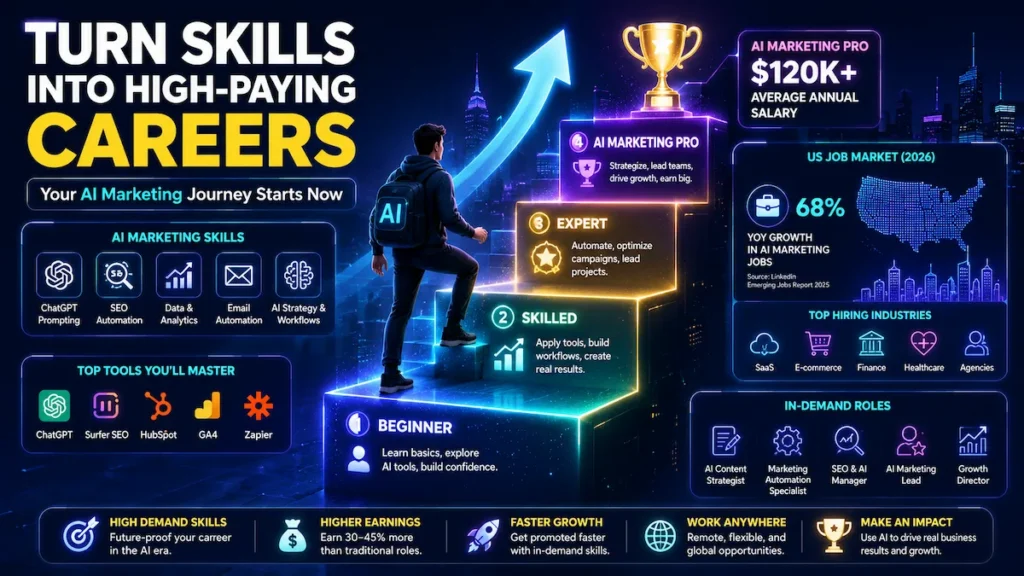
Learning AI marketing skills online means acquiring the technical and strategic capabilities to use artificial intelligence tools—ChatGPT, SEO automation systems, and predictive analytics platforms—within real digital marketing workflows. In 2026, AI-fluent marketers earn 30–45% more than peers using traditional methods alone, and US employer demand for these skills grew 68% year-over-year according to LinkedIn’s Emerging Jobs data.
Executive Snapshot: This guide covers everything US-based beginners and career switchers need to learn AI marketing skills online — including the AI Marketing Skill Stack Ladder™ framework, real case studies, a structured learning roadmap, salary benchmarks, and a complete internal content map for topical authority building.
What Are AI Marketing Skills Online and Why They Matter in Today’s Industry
If you want to learn AI marketing skills online, understanding how AI changes modern marketing is the essential first step.
AI marketing skills combine strategic thinking with hands-on technical ability: prompting large language models like ChatGPT for content creation, deploying SEO automation systems to scale organic search, using machine learning in marketing platforms to predict customer behavior, and building data-driven marketing workflows that reduce manual execution without sacrificing output quality.
For US-based career switchers, the contrast with traditional digital marketing is stark:
| Traditional Marketing Workflow | AI-Augmented Marketing Workflow |
|---|---|
| 60–70% time on execution (writing, research, reporting) | 60–70% time on strategy, oversight, optimization |
| One content piece per day | 4–8 pieces per day with AI-assisted drafting |
| Manual keyword research (2–3 hrs) | AI keyword clustering (15–20 min) |
| Reactive campaign reporting | Predictive performance modeling |
| Single-channel expertise | Multi-channel automation design |
According to LinkedIn’s 2025 Emerging Jobs Report, roles requiring AI fluency in marketing grew 68% year-over-year, with the steepest increases in SaaS, e-commerce, healthcare, and financial services. If you are planning a future-proof digital marketing career in 2026, understanding where this shift is heading is your most important first step.
Real-World Importance of AI Marketing Skills in Modern Industries
Businesses increasingly expect professionals who learn AI marketing skills online and apply those capabilities to measurable growth.
E-commerce: AI content generation tools produce and A/B test hundreds of product descriptions simultaneously, reducing production time while improving conversion rates through precision keyword targeting.
SaaS and B2B marketing: ChatGPT workflows integrated into email nurture sequences allow small teams to personalize outreach at scale—faster pipeline movement with leaner headcounts.
Agency environments: SEO automation systems have reshaped what a single strategist can manage. A practitioner fluent in digital marketing automation can now oversee workflows that previously required a full team.
Retail and CPG: Machine learning in marketing enables predictive audience segmentation — serving different creatives to micro-cohorts based on behavioral signals rather than demographic assumptions.
The practical question many career switchers ask is whether digital marketing still makes sense as a career in the AI era. The answer is yes — but only for those who learn to direct AI systems rather than compete against them.
The AI Marketing Skill Stack Ladder™
This framework helps beginners learn AI marketing skills online through a structured progression from tools to strategic execution.
Rather than following a generic beginner-to-advanced arc, structure your learning around the AI Marketing Skill Stack Ladder™—a four-level competency framework that mirrors how US employers actually evaluate AI marketing candidates.
┌─────────────────────────────────────────────────────┐
│  LEVEL 4: Strategic AI Leadership                   │
│  Evaluate tools, lead teams, connect AI to ROI      │
│  ▶ Avg. Salary: $120,000–$160,000+                  │
├─────────────────────────────────────────────────────┤
│  LEVEL 3: Automation Design                         │
│  Build multi-step systems that run independently    │
│  ▶ Avg. Salary: $90,000–$120,000                    │
├─────────────────────────────────────────────────────┤
│  LEVEL 2: Workflow Integration                      │
│  Connect tools into repeatable, measurable flows    │
│  ▶ Avg. Salary: $65,000–$95,000                     │
├─────────────────────────────────────────────────────┤
│  LEVEL 1: Tool Fluency                              │
│  Use individual AI tools to complete specific tasks │
│  ▶ Entry point for most career switchers            │
└─────────────────────────────────────────────────────┘
Level 1 — Tool Fluency: You can use individual tools to complete specific tasks—generate a content draft in ChatGPT, run a keyword report in Surfer SEO, and set up a basic automation in HubSpot. Necessary but not sufficient for professional roles.
Level 2—Workflow Integration: You connect tools into repeatable workflows: a content brief feeds ChatGPT, which produces a draft, which gets optimized in Clearscope, which gets scheduled in a CMS with UTM tracking. This is the level that gets you hired.
Level 3 — Automation Design: You build multi-step marketing automation systems that run with minimal intervention—trigger-based email sequences, AI-assisted content calendars, and automated performance reporting.
Level 4 — Strategic AI Leadership: You evaluate tools critically, onboard teams, connect AI capabilities to measurable business outcomes, and make build-vs-buy decisions on marketing technology. This level is in extreme short supply in the US market.
Use this ladder to assess where you are and identify your next concrete step — not your next course.
Complete Step-by-Step Guide to Learn AI Marketing Skills Online
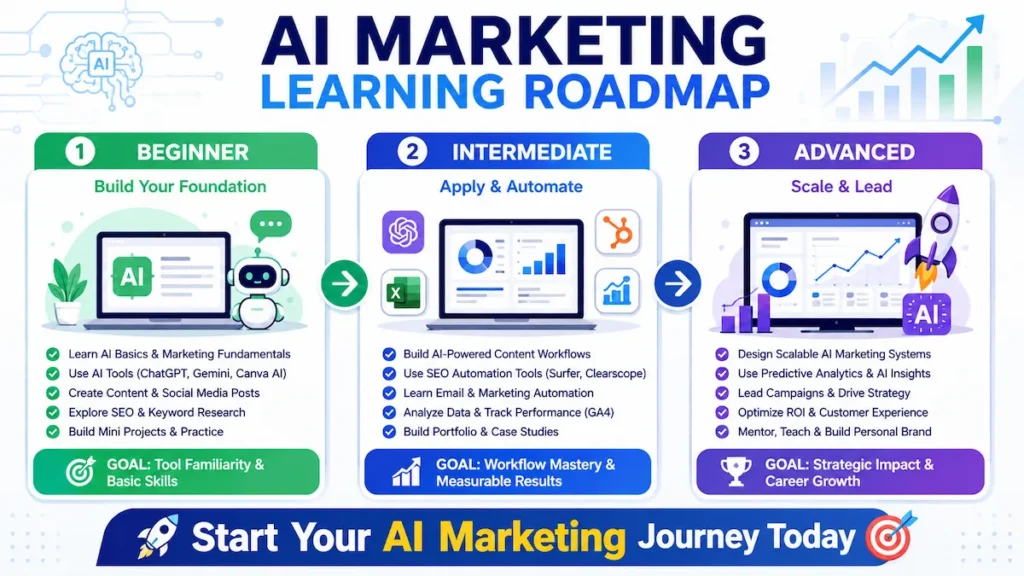
Use this roadmap to learn AI marketing skills online with practical milestones and real-world workflow experience.
Beginner Stage: Reaching Level 1 Tool Fluency (4–6 Weeks)
The beginner stage helps you learn AI marketing skills online by building confidence with foundational tools and concepts.
✅ Beginner Checklist
- Read 2 weeks of practitioner content (Marketing AI Institute, Search Engine Journal, HubSpot AI blog)
- Complete one foundational course: Google AI Essentials (free) or HubSpot AI for Marketers
- Build ChatGPT proficiency: write briefs, generate headlines, draft email sequences, calibrate brand voice
- Choose one AI content platform (Jasper, Copy.ai, or Claude) and develop genuine proficiency
- Join one practitioner community (LinkedIn groups, Marketing AI Institute Slack)
- Document every prompt and output—this is your portfolio seed
For a structured overview of how generative AI fits into marketing execution at this stage, this generative AI for marketers guide covers the practical application layer in detail.
Intermediate Stage: Reaching Level 2 Workflow Integration (6–10 Weeks)
At this stage, you learn AI marketing skills online by connecting tools into repeatable marketing systems.
✅ Intermediate Checklist
- Map and execute one full AI content production workflow end-to-end
- Build SEO automation systems fluency: Surfer SEO, Clearscope, or NeuronWriter
- Learn Google Analytics 4 AI insights and basic attribution modeling
- Build 2–3 niche portfolio pieces (not generic — industry-specific)
- Implement one marketing strategy automation using Zapier or HubSpot Workflows
- Develop working knowledge of trigger-based email automation
Understanding how AI is reshaping SEO execution is essential at this stage. The detailed breakdown of whether AI will replace SEO professionals clarifies exactly which SEO skills to double down on versus which to automate. Similarly, before building email automation workflows, it is worth reading whether AI is genuinely replacing email marketers—the answer shapes which automation skills to prioritize.
Advanced Stage: Reaching Levels 3 and 4 (Ongoing)
To fully learn AI marketing skills online, focus on automation design, business outcomes, and leadership capabilities.
✅ Advanced Checklist
- Build at least one proprietary AI marketing framework or prompt library
- Develop machine learning in marketing literacy (predictive scoring, recommendation engines, segmentation logic)
- Lead an AI tool evaluation and onboarding process within a team or client context
- Connect AI output to measurable business outcomes in documented case studies
- Build a personal methodology that can be taught, templated, and scaled
The highest-value AI marketing professionals are not the heaviest tool users — they are the most effective systems designers. The digital marketing skills that matter most in the AI era identify exactly which competencies employers are paying premiums for at this level.
Tools and Technologies Used to Learn AI Marketing Skills Online
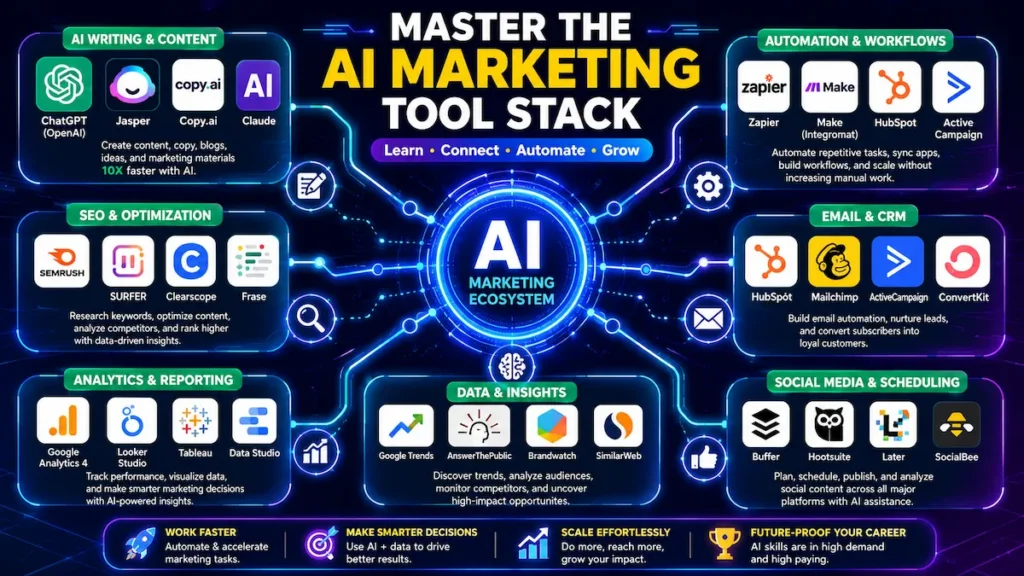
The right technology stack makes it easier to learn AI marketing skills online and develop employer-ready experience.
| Tool Category | Key Platforms | Skill Stack Level | Primary Use |
|---|---|---|---|
| AI Content Generation | ChatGPT, Claude, Jasper, Gemini | Level 1–2 | Drafting, ideation, copywriting |
| SEO Automation Systems | Surfer SEO, Clearscope, MarketMuse | Level 2–3 | Semantic optimization, gap analysis |
| Marketing Automation | HubSpot, Marketo, ActiveCampaign | Level 2–3 | Lead scoring, email sequences, CRM |
| Workflow Automation | Zapier, Make (Integromat) | Level 3 | Cross-platform automation, no-code systems |
| Analytics | GA4, Looker Studio, Tableau | Level 2–4 | Performance tracking, attribution, reporting |
| AI Image/Creative | Midjourney, Adobe Firefly | Level 2 | Ad creative, social visuals |
Understanding where AI tools are augmenting versus displacing human roles shapes which skills to build first. The ongoing debate about whether AI is replacing content writers is particularly relevant for anyone entering the AI content space—the honest answer informs what portfolio work to prioritize.
The practical rule for all tool use: Automate the repetitive. Scale the strategy. Protect the human editorial layer for work requiring genuine expertise, original perspective, and brand voice calibration.
Mini Case Studies: AI Marketing Skills Online Applied in the Real World
These examples show how people learn AI marketing skills online and turn practice into results.
Case Study 1: SaaS Startup Cuts Content Cost by 62%
This case demonstrates how teams can learn AI marketing skills online and improve operational efficiency.
A US-based B2B SaaS startup with a three-person marketing team implemented a structured AI content workflow: ChatGPT for first drafts, Surfer SEO for optimization, HubSpot for distribution and tracking. Within four months, content production cost per article dropped 62%, while organic traffic increased 38%.
What made it work: Not the tools — the workflow design. The team built a standardized prompt library, a human editorial checklist, and a weekly performance review cadence. AI handled speed. Humans controlled quality and strategic direction.
Key lesson: Workflow architecture, not tool selection, is the primary determinant of AI marketing outcomes.
Case Study 2: Freelancer Scales From 8 to 22 Monthly Deliverables
A freelance content marketer with five years of traditional experience integrated ChatGPT workflows into her client delivery system: intake brief → AI draft → human edit → SEO optimization → client review. Monthly deliverable capacity increased from 8 to 22 pieces without quality reduction.
She deliberately specialized in AI-resistant marketing roles—specifically workflow design and content strategy—which allowed her to move upmarket toward higher-value retainer clients rather than competing on volume.
Key lesson: Niche specialization in AI-adjacent strategic work commands higher rates than generalist AI execution.
Case Study 3: Career Switcher Hired in 90 Days With No Marketing Degree
This example shows that anyone can learn AI marketing skills online and build career-ready evidence.
A former project manager with no formal marketing background used the AI Marketing Skill Stack Ladder™ to build a portfolio over 90 days: Google AI Essentials certification, three documented content workflow case studies using free tool trials, and consistent LinkedIn documentation of her learning process.
She received two job offers—both from companies specifically seeking candidates who could bridge AI tool fluency with project management thinking. Her portfolio, not her certifications, drove the interviews.
Key lesson: Documented workflow evidence outperforms credential accumulation in AI marketing hiring.
Career Opportunities and Industry Demand for AI Marketing Skills Online
People who learn AI marketing skills online are positioning themselves for emerging marketing opportunities.
US Salary Benchmarks by Role and Skill Stack Level
| Role | Skill Stack Level | Experience Required | US Salary Range |
|---|---|---|---|
| AI Content Specialist | Level 1–2 | 0–1 years | $50,000–$72,000 |
| Marketing Automation Specialist | Level 2–3 | 1–3 years | $70,000–$95,000 |
| SEO & AI Content Manager | Level 2–3 | 2–4 years | $80,000–$115,000 |
| AI Marketing Strategist | Level 3 | 3–5 years | $95,000–$130,000 |
| Head of Marketing AI | Level 4 | 5+ years | $125,000–$165,000+ |
Industries with the strongest current demand: SaaS and technology, e-commerce and retail, digital marketing agencies, financial services and fintech, and healthcare and wellness.
Future Demand Trends for AI Marketing Professionals
Automation creates roles faster than it eliminates them. McKinsey’s research on generative AI’s economic potential consistently finds that declining roles are purely executional; growing roles require judgment, strategy, and AI systems’ direction.
SMB adoption is accelerating. Enterprise AI marketing adoption has been underway for years. The next hiring wave will come from small and mid-size businesses adopting these tools at scale, as costs have dropped and interfaces have simplified. This is a significant opportunity for career switchers and freelancers.
Regulatory specialization is emerging. As FTC guidance and state-level regulation around AI-generated content disclosure, data privacy, and brand safety in AI-driven personalization develops, marketers combining AI fluency with compliance literacy will command meaningful salary premiums.
Common Mistakes When Learning AI Marketing Skills Online
Avoiding these mistakes will help you learn AI marketing skills online more effectively and faster.
| Mistake | Why It Limits Career Growth | The Correction |
|---|---|---|
| Over-relying on tools without strategic judgment | Makes you replaceable; hiring managers can’t evaluate your thinking | Build decision-making evidence into every portfolio piece |
| Collecting certifications without portfolio work | Certifications show course completion, not capability | Every course produces one documented real-world artifact |
| Learning tools in isolation, not in workflows | Employers hire workflow thinkers, not tool operators | Always document the end-to-end process, not just the output |
| Skipping human editorial review | Raw AI output fails Google’s EEAT quality standards | Build editorial checklists into every content workflow |
| No measurement or iteration cadence | Loses the compounding advantage of AI-assisted testing | Define KPIs before every campaign and review weekly |
Keyword Mapping Strategy for AI Marketing Skills Online (SEO Architecture)
This keyword structure supports websites designed to help users learn AI marketing skills online.
Primary Keyword: Learn AI marketing skills online
Secondary Keywords: AI marketing courses online | AI marketing certification US | Best AI tools for digital marketing | Digital marketing automation skills | AI content marketing training
Long-Tail Targets: How to learn AI marketing from scratch | ChatGPT marketing skills for career switchers | How to get a job in AI marketing with no experience | Free AI marketing courses for beginners | AI marketing automation tools for Small Businesses
Semantic Keyword Clusters:
- Machine learning in marketing / predictive marketing / behavioral targeting
- SEO automation systems / AI-powered keyword research / semantic SEO architecture
- ChatGPT workflows / prompt engineering for marketers / AI copywriting systems
- Marketing strategy automation / trigger campaigns / automated email marketing
- Data-driven marketing systems / GA4 AI insights / performance attribution
Internal Content Map — Hub and Spoke Structure:
Learn AI Marketing Skills Online
(Pillar Authority Page)
| Cluster Article | Intent |
|---|---|
| AI-Proof Marketing Jobs 2026 | Career |
| Will AI Replace Content Writers? | Informational |
| Digital Marketing Skills for AI Era | Educational |
| Generative AI for Marketers Guide 2026 | Commercial |
Supporting Cluster Expansion
→ Will AI Replace SEO Jobs?
→ Will AI Replace Email Marketers?
→ Is Digital Marketing a Good Career with AI?
→ Future-Proof Digital Marketing Career 2026
FAQ: People Also Ask About AI Marketing Skills Online
These answers help clarify common questions for readers who want to learn AI marketing skills online.
Can I get a job if I learn AI marketing skills online?
Yes — and in 2026, online learning is the primary pathway into AI marketing roles for career switchers. Employers evaluate candidates on portfolio evidence and workflow fluency rather than formal credentials. Two documented real-world workflow case studies carry more weight in most hiring decisions than a marketing degree.
Do I need coding skills to learn AI marketing?
No. The vast majority of AI marketing tools are designed for non-technical users. Platforms like ChatGPT, Jasper, HubSpot, Surfer SEO, and Zapier require no coding. Conceptual literacy—understanding what AI can and cannot do and how to direct it strategically—matters far more than programming ability.
How long does it take to learn AI marketing skills online?
Reaching Level 1 (Tool Fluency) takes approximately 4–6 weeks of structured daily practice. Level 2 (Workflow Integration)—the level most employers expect at hire—typically takes 3–4 months. Levels 3 and 4 develop through sustained real-world application over 1–2+ years.
What is the highest-paying AI marketing skill in 2026?
Marketing automation architecture — designing and implementing multi-step AI-driven campaign systems — commands the strongest compensation premium. This is followed by AI-assisted SEO strategy, AI content operations management, and predictive analytics literacy. Senior roles in these specializations start at $95,000+ in major US markets.
Is AI replacing digital marketers or creating more demand?
Both, depending on the role. Purely executional positions are contracting. Strategic, workflow-design, and client-facing roles are expanding. Marketers who direct and optimize AI systems—rather than compete with them on execution—have the strongest career trajectory through 2027 and beyond.
Final Expert Conclusion: Your Path to AI Marketing Skills Online
The most effective way to learn AI marketing skills online is through structured practice and documented workflows
This is a genuine opportunity — not a hype cycle. The tools are accessible, the learning resources are structured and often free, and US employer demand has reached the point where AI fluency is a baseline expectation rather than a differentiator.
The AI Marketing Skill Stack Ladder™ gives you a clear, honest progression path:
Level 1 → Tool Fluency (4–6 weeks)
Level 2 → Workflow Integration (3–4 months) — the hiring threshold
Level 3 → Automation Design (6–12 months of applied practice)
Level 4 → Strategic AI Leadership (ongoing, highest compensation tier)
Your five immediate action steps:
- This week: Choose one tool—start with ChatGPT—and build genuine proficiency before expanding your stack
- Week two: Begin documenting every workflow you build—that documentation is your portfolio
- Month one: Apply the AI Marketing Skill Stack Ladder™ to honestly assess your current level and identify your next concrete step
- Month two: Build a niche portfolio — two strong, industry-specific pieces outperform ten generic ones
- Month three: Apply for roles before you feel fully ready—real-world application is the fastest learning accelerator available
The demand for marketers who have successfully learned AI marketing skills online will continue expanding through 2027 and beyond. The only question is whether you will build the competency to compete for roles being created right now.