
Introduction
Every few months, a new headline screams that AI is coming for marketing jobs.
And every time, thousands of marketers, students, and career switchers feel the same knot in the stomach: Am I learning the wrong skills? Will any of this matter in five years?
Here’s the reality check nobody’s giving you: AI is not the threat. Staying generic is.
Digital marketing is not dying. It’s evolving faster than almost any other profession—and that’s exactly why it’s one of the most valuable career paths you can build right now, especially in the United States, where marketing technology adoption is accelerating.
The role of AI in digital marketing is not about replacement. It’s about raising the floor of what’s expected from every marketer. The ones who struggle are those who treat digital marketing as a set of tools to memorize. The ones who thrive understand strategy, human behavior, and data — skills that AI can assist but will never own.
This guide gives you the complete picture: which skills define a future-proof digital marketing career, the highest-income career paths, the tools that matter, the mistakes to avoid, and a clear 90-day plan to start executing immediately.
No hype. No filler. Just clarity.
Is a Future-Proof Digital Marketing Career Still Worth It in the USA?
A future-proof digital marketing career remains one of the most attractive career paths in the United States because businesses continue increasing investments in digital channels, customer acquisition, and data-driven growth.
The short answer is yes—but only if you build it strategically. Plenty of people enter digital marketing thinking any exposure to social media or basic SEO will carry them. That’s not the career path that survives. The future-proof digital marketing career is built on strategic thinking, not platform familiarity.
Job Market Demand and Growth Trends
The growing demand for skilled marketers shows that a future-proof digital marketing career is supported by long-term hiring trends across technology, healthcare, finance, e-commerce, and SaaS industries.
According to the U.S. According to the Bureau of Labor Statistics, employment for advertising, promotions, and marketing managers is projected to grow 6% through 2032—faster than the average for all occupations. But the real story in digital marketing isn’t just volume. It’s specialization.
Demand is clustering around specific skills: paid media management, marketing analytics, automation, and SEO strategy. Companies are cutting generalist roles and doubling down on specialists who can connect marketing activity to measurable revenue outcomes.
The industries hiring most aggressively include e-commerce, SaaS, healthcare technology, and financial services — all sectors where digital marketing directly drives customer acquisition and retention.
Salary Expectations in Digital Marketing Careers
Salary varies significantly based on specialization and experience in the U.S. market:
| Role | Entry Level | Mid-level | Senior Level |
|---|---|---|---|
| SEO Specialist | $45,000–$60,000 | $65,000–$90,000 | $95,000–$130,000+ |
| PPC / Paid Media Specialist | $50,000–$65,000 | $70,000–$100,000 | $105,000–$145,000+ |
| Marketing Analyst | $55,000–$70,000 | $75,000–$105,000 | $110,000–$150,000+ |
| Growth Marketing Manager | $60,000–$80,000 | $90,000–$120,000 | $130,000–$170,000+ |
| Marketing Automation Specialist | $55,000–$75,000 | $80,000–$110,000 | $115,000–$155,000+ |
Analytics, paid media, and growth marketing consistently land at the higher end. Pure content creation without strategy skills trends lower. The ceiling in digital marketing is higher than most people realize—senior performance marketers at tech companies regularly earn above $150,000.
Remote Work and Freelancing Opportunities
The flexibility of remote work makes a future-proof digital marketing career especially appealing for freelancers, consultants, and professionals seeking location-independent opportunities.
Digital marketing is one of the most remote-friendly careers available. Most digital marketing work is deliverable-based rather than location-dependent, which means remote and hybrid arrangements are standard — not exceptional — across U.S. companies.
Freelancing is a realistic path too. Platforms like Upwork and direct LinkedIn outreach give skilled marketers access to U.S. and international clients. Freelance specialists in paid ads and SEO with a trackable portfolio can command $75–$150+ per hour within two to three years.
Consider what that looks like in practice: a freelance marketer managing SEO, Google Ads, and GA4 reporting for five local businesses can generate $1,500–$2,000 per client per month on retainer—$7,500–$10,000 monthly from a fully remote workflow. That’s a realistic target for a focused marketer within 18–24 months of skill-building, not a best-case scenario.
Why a Future-Proof Digital Marketing Career Will Survive AI Disruption
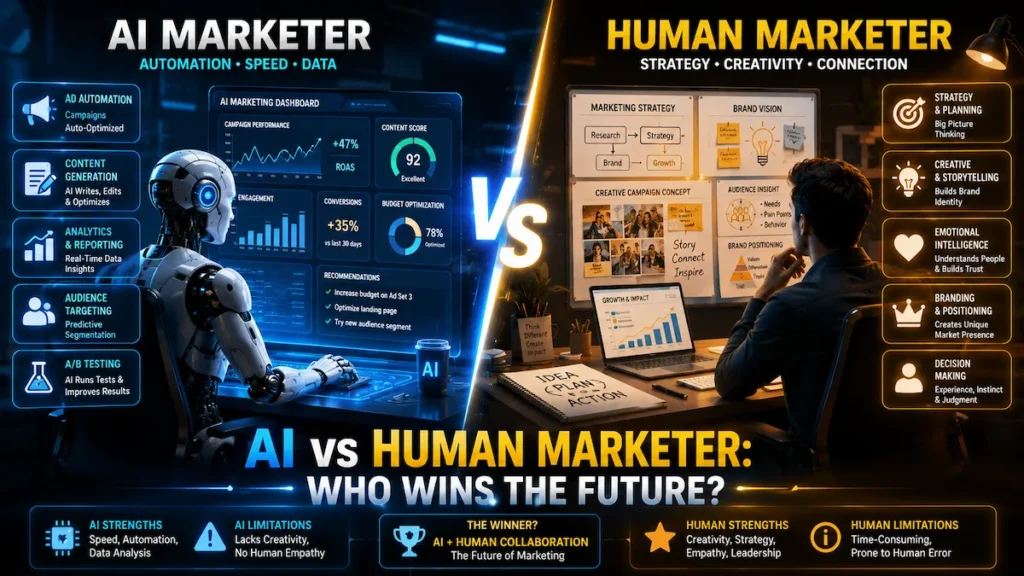
Understanding how automation affects marketing roles is essential for building a future-proof digital marketing career that remains valuable in the age of AI.
The AI disruption conversation is worth having directly, because vague reassurance isn’t helpful. Here’s what’s actually happening — and it’s more nuanced than most career advice admits.
What AI Is Actually Replacing (And What It Isn’t)
According to HubSpot’s 2024 State of Marketing Report, 64% of marketing professionals already use AI tools in some capacity — but the vast majority use them for execution acceleration, not strategic decision-making.
Tasks AI is automating:
- Basic copywriting for low-stakes content (product descriptions, meta tags, ad variations)
- Initial keyword research aggregation
- Routine social media scheduling and caption drafts
- Basic email template creation
- Reporting dashboards with pre-built templates
If your entire skill set lives in one of these buckets, that’s the real risk. Not because AI eliminates roles overnight, but because these tasks stop being billable at a premium.
Tasks AI assists but cannot replace:
- Strategic campaign architecture and audience targeting logic
- Brand voice development and competitive positioning
- Customer journey mapping across complex funnels
- Interpretation of analytics data in business context
- Relationship-driven content that builds trust over time
- Cross-channel strategy and budget allocation decisions
Whether AI will replace PPC managers, SEO professionals, content writers, social media managers, or email marketers—the answer is consistently the same: the execution layer is at risk. The strategy and judgment layer is not.
Human Strategy Advantage in Marketing
Strategic thinking remains a key differentiator in a future-proof digital marketing career, as businesses still rely on human judgment for major decisions.
AI operates on patterns. Marketing that outperforms operates on insight—the understanding of why customers behave the way they do, what emotional drivers sit beneath purchase decisions, and how brand perception shifts over time.
Companies don’t need AI to think for them. They need marketers who can use AI as a productivity layer while providing the strategic layer themselves. That combination is exactly where a future-proof digital marketing career lives.
The Future-Proof Marketing Skill Pyramid™
Mastering the right capabilities is the foundation of a future-proof digital marketing career that can adapt to changing technologies and market conditions.
Most career advice gives you a flat list of skills to learn. That’s not how value actually works in marketing.
Skills have hierarchy. AI attacks from the bottom. Your goal is to build toward the top.
          ┌─────────────────────────────┐
          │     LEVEL 5: LEADERSHIP     │  ← Most protected from AI
          │  Strategy, Vision, Business │
          │      Alignment, Teams       │
          ├─────────────────────────────┤
          │   LEVEL 4: STRATEGY         │
          │  Audience intelligence,     │
          │  Funnel architecture, CRO   │
          ├─────────────────────────────┤
          │   LEVEL 3: ANALYTICS        │
          │  GA4, Attribution, Data     │
          │  interpretation, Testing    │
          ├─────────────────────────────┤
          │   LEVEL 2: CHANNEL MASTERY  │
          │  SEO, Paid Ads, Email,      │
          │  Content, Automation        │
          ├─────────────────────────────┤
          │   LEVEL 1: TOOLS            │  ← Most exposed to AI
          │  HubSpot, Semrush, Canva,   │
          │  Scheduling, Reporting      │
          └─────────────────────────────┘
The insight: AI is replacing Level 1. It’s assisting Level 2. It’s barely touching Levels 3–5.
Most career advice focuses on Level 1 and Level 2 tool tutorials. The marketers building genuinely future-proof careers are investing in levels 3, 4, and 5—while using AI to handle the bottom layers faster.
Future-Proof Skill Scorecard: Which Skills Are Worth Your Time?
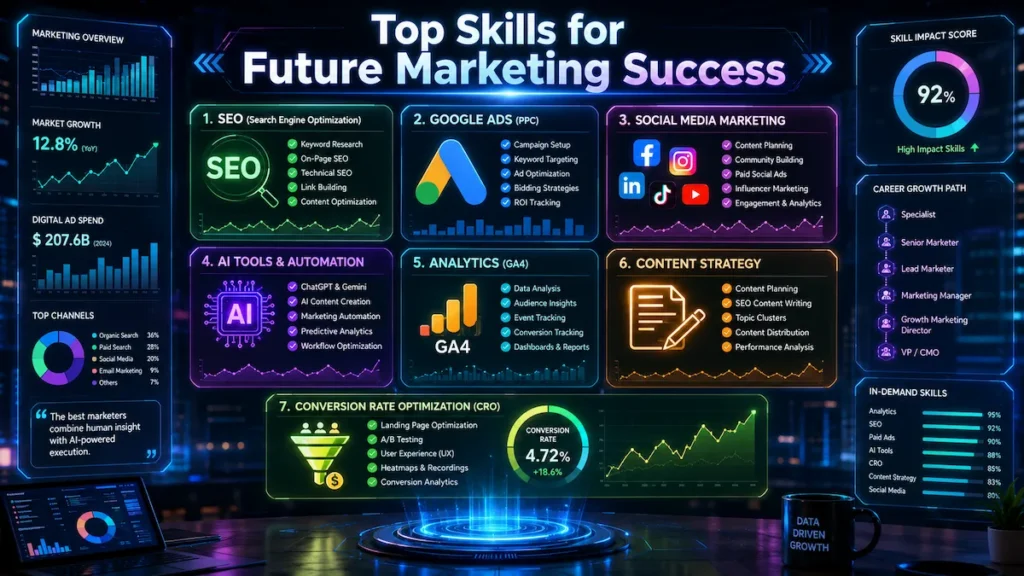
Not all marketing skills are equal. Here’s an honest assessment of demand, AI resistance, and salary potential for the core specializations:
| Skill | Market Demand (1–10) | AI Resistance (1–10) | Salary Potential (1–10) | Overall Score |
|---|---|---|---|---|
| Marketing Analytics (GA4) | 10 | 10 | 10 | 10.0 |
| Conversion Rate Optimization | 9 | 9 | 9 | 9.0 |
| Growth Marketing Strategy | 9 | 9 | 9 | 9.0 |
| SEO Strategy | 9 | 8 | 8 | 8.3 |
| Marketing Automation | 9 | 8 | 9 | 8.7 |
| PPC / Paid Media | 8 | 6 | 8 | 7.3 |
| Content Strategy | 8 | 7 | 7 | 7.3 |
| AI Prompting for Marketers | 9 | N/A | 8 | 8.5 |
| Social Media Strategy | 7 | 5 | 6 | 6.0 |
| Basic Content Creation | 5 | 2 | 4 | 3.7 |
Key takeaway: Analytics, CRO, growth strategy, and marketing automation score highest across all three dimensions. These are where your skill investment generates the best long-term return.
AI-Proof vs. AI-Vulnerable: The Honest Role Comparison
| Safer Roles (Higher AI Resistance) | Higher-Risk Roles (Lower AI Resistance) |
|---|---|
| Growth Marketing Manager | Junior Content Writer |
| CRO Specialist | Basic Social Media Scheduler |
| Marketing Analyst / Analytics Specialist | Reporting Assistant |
| SEO Strategist | Generic Ad Copy Producer |
| Marketing Automation Expert | Entry-Level Email Blast Sender |
| Performance Marketing Director | Stock Content Creator |
| Brand Strategist | Routine Meta Description Writer |
This table isn’t meant to discourage anyone in a higher-risk role. It’s meant to show where to add skills to move into safer territory. A content writer who adds SEO strategy and analytics fluency moves from the right column to the left.
Essential Skills for a Future-Proof Digital Marketing Career
These are not the skills that will make you employable in 2026. These are the skills that will make you valuable in 2030.
SEO and Organic Growth Strategy
SEO is becoming more strategic as AI-generated content floods the web. Google’s ability to reward genuinely expert, experience-based, authoritative content is improving—not degrading. According to Semrush’s State of Search 2024, long-tail keyword traffic grew significantly as search intent became more specific.
The skills that matter here are not just technical. They include topical authority building, semantic content architecture, E-E-A-T signal development, and the ability to align content production with search demand to create compound organic traffic over time.
Marketing Analytics (GA4, Data Interpretation)
Data analysis is becoming increasingly important in a future-proof digital marketing career as organizations prioritize measurable marketing performance.
Google Analytics 4 is now the standard. GA4’s event-based data model requires a fundamentally different approach to measurement, and most companies are still underskilled here—which is your opportunity.
Beyond GA4, the high-value skill is interpretation: looking at data and extracting decisions from it. Anyone can pull a report. The person who connects attribution data to a media budget recommendation, identifies a conversion bottleneck from behavior flow analysis, or explains a traffic drop in business terms—that person is the one being promoted.
Here’s a concrete scenario that plays out regularly: a mid-level marketing analyst at a SaaS company notices in GA4 that mobile users are converting at 40% the rate of desktop users on the pricing page. She runs a heatmap session with Hotjar, identifies that the CTA button is hidden below the fold on smaller screens, brings a prioritized fix to the dev team, and lifts mobile conversions by 28% within 30 days. That single insight, backed by data and communicated clearly, is worth more to that company than six months of blog content production. That’s what analytics fluency actually looks like — and it’s not automatable.
A marketer who masters SEO, GA4, and AI workflows can often outperform three separate junior specialists. That’s not hyperbole — it’s what happens when strategic skill compounds across the pyramid.
Conversion Rate Optimization
CRO is the discipline of turning existing traffic into more revenue — without spending more on acquisition. It’s inherently analytical, behavioral, and strategic, which means it sits far outside what AI can fully own.
Strong CRO skills include hypothesis formation, A/B test design, user experience analysis, landing page critique, and the ability to synthesize qualitative research with quantitative data to drive decisions.
This skill makes you directly tied to revenue — the single most powerful position to occupy in any marketing organization.
Content Strategy and Storytelling
The ability to translate complex ideas into clear, compelling, audience-specific content is one of the least automatable skills in marketing. AI can generate words. It cannot generate perspective.
The best content marketers in 2026 combine channel strategy with deep audience understanding and a distinct point of view. On platforms like LinkedIn, YouTube, and TikTok, creators who lead with genuine expertise are nearly impossible to replicate with AI output.
AI Prompting for Marketers
Learning AI prompting techniques can enhance a future-proof digital marketing career by improving efficiency, creativity, and campaign execution.
Using AI tools effectively — particularly ChatGPT, Claude, and Gemini — is no longer optional. The key distinction is using AI as a productivity multiplier rather than a replacement for marketing judgment.
Understanding how generative AI actually works for marketers separates those who dabble from those who gain a structural speed advantage. Prompt engineering for marketing means using AI for research acceleration, content brief creation, competitive analysis, and ad copy iteration—while maintaining quality control and strategic direction yourself.
Customer Psychology and Buyer Behavior
Understanding what actually motivates people to buy is the foundation that makes every other marketing skill work better. This includes jobs-to-be-done theory, cognitive biases in decision-making, emotional vs. rational purchasing triggers, and trust-building mechanisms across the customer journey.
This is learned through reading, observation, testing, and experience—not through any software tool. It compounds with time in a way raw technical skills don’t.
Best Career Paths in a Future-Proof Digital Marketing Career
Choosing the right specialization is an important step toward building a future-proof digital marketing career with long-term growth potential.
These five trajectories have the strongest long-term fundamentals: high demand, rising compensation, and genuine defensibility against automation.
SEO Strategist
The SEO strategist role remains a strong option within a future-proof digital marketing career because organic search continues to influence purchasing decisions.
As organic search becomes more technically complex and content-saturated, companies pay premium rates for strategists who understand full topical authority development, technical SEO auditing, link acquisition, and content architecture. Senior SEO Strategists and consultants regularly command $100,000–$145,000+ in the U.S.
Growth Marketing Manager
Growth marketing is the intersection of data, experimentation, and channel strategy. Growth managers run structured experiments across acquisition, activation, retention, and referral—using a scientific approach to find what actually moves revenue. This is one of the highest-value roles in modern marketing, particularly in SaaS and e-commerce.
To make this tangible: a growth marketing manager at a mid-stage SaaS startup might run 12–15 experiments per quarter across onboarding emails, landing page variants, and paid channel mix. One successful experiment — a revised free trial activation sequence that improves week-one engagement by 18% — can directly impact annual recurring revenue by hundreds of thousands of dollars. That level of business impact commands $120,000–$160,000+ compensation and makes the role extremely difficult to automate.
PPC Advertising Specialist
The complexity of modern paid media platforms—automated bidding strategies, audience segmentation, Performance Max campaigns, and conversion API integration—creates a continuously rising skill floor. Specialists who understand both the technical layer and the strategic layer (audience psychology, message-market fit, funnel alignment) remain in high demand. Learn more about how AI is reshaping advertising strategies and what that means for PPC careers specifically.
Marketing Automation Expert
Automation specialists play an increasingly important role in a future-proof digital marketing career as companies seek scalable marketing systems.
Expertise in platforms like HubSpot, Klaviyo, Marketo, or ActiveCampaign, combined with customer lifecycle strategy, makes this one of the most valuable skill sets in digital marketing. The higher your automation fluency, the more operational leverage you give any marketing org — and the more irreplaceable you become.
Data Analytics Specialist
The marketing analytics specialist role has grown significantly as companies demand clearer attribution, smarter budget allocation, and more actionable reporting. Specialists who combine GA4 proficiency, SQL basics, Looker Studio fluency, and the ability to communicate data insights to non-technical stakeholders are rare — and highly compensated.
Step-by-Step Roadmap to Build a Future-Proof Digital Marketing Career
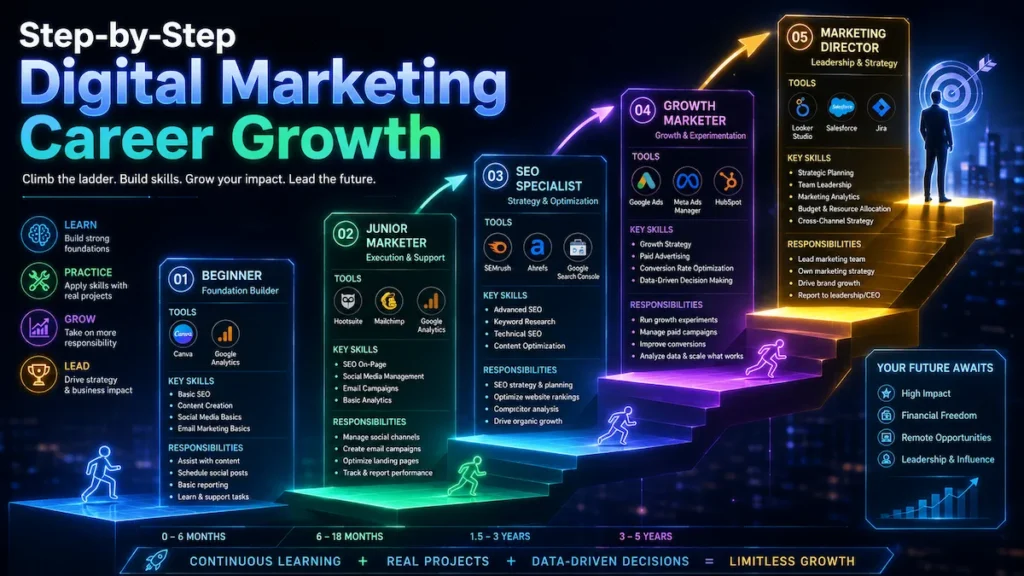
Following a structured learning plan makes it easier to build a future-proof digital marketing career with confidence and direction.
This is the sequence that works. Not “take every course available.” A deliberate progression from fundamentals to specialization to positioning.
Step 1 – Learn Marketing Fundamentals (Weeks 1–6)
The first step toward a future-proof digital marketing career is understanding core marketing principles and customer behavior.
Before touching any tool, build the conceptual foundation: marketing principles, buyer psychology, funnel stages (awareness → consideration → decision), positioning theory, and messaging frameworks.
Resources: Google Digital Garage (free), HubSpot Academy (free), and books like Building a StoryBrand by Donald Miller.
Step 2 – Master SEO and Content (Weeks 7–18)
SEO is where foundational marketing meets measurable, compound-growth skills. Start with keyword research, on-page optimization, content brief development, and internal linking strategy.
Build practice by starting a content project—either a personal website, niche blog, or portfolio site. Theoretical knowledge without a project is slow.
Tools: Google Search Console (free), Ahrefs, or Semrush (free trials).
Step 3 – Learn Paid Ads — Google + Meta (Weeks 19–28)
Google Ads and Meta Ads are the two dominant paid channels in the U.S. Start with Google Ads search campaigns. Take Google’s free Skillshop certifications and Meta Blueprint courses.
The key: get access to real ad accounts as fast as possible, even with small budgets. There is no substitute for live campaigns.
Step 4 – Master Analytics Tools (Weeks 29–36)
Analytics proficiency is essential for a future-proof digital marketing career because data-driven decisions consistently outperform assumptions.
GA4 is non-negotiable. Learn how to set up events, configure conversions, build exploration reports, and connect GA4 to Looker Studio for visualization.
Add a basic understanding of UTM parameters and attribution models—last click, first click, and data-driven. Understanding what each model means for how you interpret performance is where most marketers fall short.
Step 5 – Build Real Projects (Ongoing from Week 7)
Every hiring manager in 2026 is looking for demonstrated results, not certificates. Freelance for local small businesses at discounted rates, volunteer for nonprofits, or build your own niche project.
Document every project with before/after metrics: screenshots, data exports, and case study write-ups. This becomes your competitive advantage in job applications.
Step 6 – Build Personal Brand (Ongoing from Any Point)
Post weekly on LinkedIn about what you’re learning, testing, or observing. Share results from your projects. Comment on respected practitioners’ posts. Over 12–18 months, this builds credibility that no certification replicates.
90-Day Action Plan to Launch Your Future-Proof Marketing Career
Most roadmaps tell you what to learn. This tells you exactly when.
Month 1 — Foundation
- Complete Google Digital Garage and one HubSpot Academy course
- Set up a personal website (WordPress or similar)
- Install GA4 and Google Search Console on it
- Read one core marketing book (StoryBrand or $100M Offers)
- Start posting once per week on LinkedIn
Month 2 — Build Core Skills
- Start an SEO content project on your personal site (target 4–6 articles)
- Complete Google Ads Skillshop certification
- Create your first Google Ads campaign (even $5/day on a test account)
- Learn GA4 event tracking and set up at least two conversion goals
- Document your project progress with screenshots and metrics
Month 3 — Demonstrate Results
- Publish a case study on your site showing results from Month 2 activity
- Apply for one freelance project or an entry-level remote role
- Build your first Looker Studio dashboard from GA4 data
- Reach out to 5 businesses for a free or discounted audit
- Increase LinkedIn posting to twice per week and engage daily
By the end of 90 days, you have a live SEO project, a paid ads certification, a GA4 dashboard, and a case study. That’s more than most candidates with a one-year head start using only courses.
Tools You Must Learn for a Future-Proof Digital Marketing Career
The goal is not to master every tool. It is to build literacy across the essential stack so you can operate credibly in any modern marketing environment.
| Tool | Category | Priority Level |
|---|---|---|
| Google Analytics 4 (GA4) | Analytics | Critical |
| Google Ads | Paid Search | Critical |
| Meta Ads Manager | Paid Social | Critical |
| Google Search Console | SEO Monitoring | Critical |
| ChatGPT / Claude | AI Productivity | High |
| HubSpot | CRM / Marketing Automation | High |
| Ahrefs or Semrush | SEO Research | High |
| Looker Studio | Data Visualization | High |
| Klaviyo or Mailchimp | Email Marketing | Medium |
| Canva | Creative Production | Medium |
Start with the critical tier and build outward. Attempting to learn everything simultaneously produces shallow literacy across all tools and deep expertise in none.
What Most People Get Wrong About Future-Proof Marketing Careers
Before diving into specific execution mistakes, here are the five thinking errors that shape wrong career decisions before a single course is taken.
They learn tools before strategy. Months spent learning HubSpot workflows or Semrush dashboards without a mental model of marketing strategy produces technical literacy without judgment—and judgment is what companies pay for.
They collect certifications without projects. Google Ads certified, HubSpot certified, GA4 certified — but no real campaigns, no real traffic, no documented results. Certifications open doors slightly. Portfolio results close interviews.
They chase trends instead of fundamentals. Every six months there’s a new “most important skill.” Marketers who chase trends never build the compound depth that makes them genuinely valuable. Audience understanding, messaging clarity, and measurement discipline haven’t changed and won’t.
They underestimate personal branding. The difference between a marketer earning $65,000 and one earning $110,000 with equivalent skills is often visibility. One has a LinkedIn presence, documented results, and a clear niche. The other doesn’t.
They treat analytics as optional. Analytics fluency is no longer a specialization. It is a baseline expectation for every marketing role. Treating it as someone else’s job is a career ceiling disguised as a preference.
Common Mistakes That Destroy a Future-Proof Digital Marketing Career
Avoiding common pitfalls can significantly improve the long-term success of a future-proof digital marketing career.
These aren’t theoretical pitfalls. They’re the patterns that consistently hold marketers back.
Over-Reliance on AI Tools
Depending too heavily on automation can weaken a future-proof digital marketing career if strategic thinking is neglected.
Using AI for everything sounds like efficiency. In practice, it produces marketing that reads like AI, which audiences increasingly identify and distrust. More importantly, over-reliance on AI prevents the development of strategic judgment. Use AI to accelerate execution. Do not use it as a substitute for thinking through strategy, positioning, or audience psychology yourself.
Ignoring Data and Analytics
The number of digital marketers who cannot interpret their own campaign data is still surprisingly high. Producing content or running ads without tracking performance, diagnosing what’s working, and adjusting based on real data is the fastest path to irrelevance.
GA4 proficiency alone can meaningfully differentiate a marketer in the current job market. If this feels uncomfortable, it’s the exact area to prioritize.
Learning Tools Instead of Strategy
Focusing only on software rather than principles can limit the growth of a future-proof digital marketing career.
Knowing how to navigate HubSpot or Semrush features is useful. Understanding the marketing strategy behind why and how to use those features is what actually drives results. Tool expertise without strategic context is a ceiling — you become a platform operator, not a marketing thinker.
No Personal Branding
Talent without visibility is invisible. In a market where hundreds of applicants may submit for the same role, the person with a LinkedIn presence demonstrating thinking, results, and expertise has a structural advantage. Building a personal brand does not require a large audience. It requires consistent, credible presence in your specialization. Start before you feel ready.
Future Outlook of a Future-Proof Digital Marketing Career (2030+)
The long-term outlook for a future-proof digital marketing career remains promising as businesses continue investing in digital transformation, AI-powered experiences, and customer-centric growth strategies.
The next five years in digital marketing will be defined by five structural shifts. Understanding them now allows you to position toward them.
AI-human collaboration model: The marketing org of 2030 will not be AI-only or human-only. It will be teams of specialists who direct, evaluate, and deploy AI tools within a coherent marketing strategy. The humans who remain essential are those who own the strategic judgment layer.
Hyper-personalization at scale: First-party data, combined with AI-driven segmentation, is enabling one-to-one personalization across email, ads, and website experience at scale. Marketers who understand consent-based data collection, customer lifecycle strategy, and personalization architecture will be in high demand. According to McKinsey’s research on personalization, companies that excel at personalization generate 40% more revenue than average players.
Predictive marketing: The shift from reactive analytics (what happened?) to predictive analytics (what will happen?) is accelerating. Marketers with enough data literacy to interpret predictive models, act on customer churn signals, and allocate budget to the highest-probability segments will occupy the most senior and best-compensated roles.
Data-driven decision-making as a baseline expectation: By 2030, “data-driven” will not be a differentiator. It will be the minimum. Every marketing role will require baseline analytics fluency. The differentiation will come from the quality of the questions you ask of data and the decisions you make from it.
Strategic marketing leadership: The highest-value role in 2030 marketing is not the best prompt engineer or the most certified ad platform user. It is the leader who aligns marketing strategy with business objectives, builds teams that execute with precision, and communicates performance in board-level language. That skill set is human, compound, and deeply future-proof.
Future-Proof Marketing Career Path Matrix
Use this table to match your strengths, goals, and market conditions to the right career path. Each dimension is rated on a four-point scale: Low / Medium / High / Very High.
| Career Path | Market Demand | AI Resistance | Remote Potential | Income Potential | Best For |
|---|---|---|---|---|---|
| SEO Strategist | High | High | High | High | Analytical thinkers, content-oriented |
| Growth Marketing Manager | Very High | Very High | High | Very High | Data-driven experimenters |
| Marketing Analytics Specialist | Very High | Very High | High | Very High | Numbers-first, business-minded |
| PPC / Paid Media Specialist | High | Medium | High | High | Performance-focused, fast learners |
| Marketing Automation Expert | High | High | High | High | Systems thinkers, CRM-oriented |
| CRO Specialist | High | Very High | High | Very High | UX + psychology + data combined |
| Content Strategist | Medium | Medium | High | Medium | Writers who develop strategy skills |
| Brand Strategist | Medium | High | Medium | High | Creative + business-aligned |
How to read this: Income potential and AI resistance are the two most future-relevant dimensions. Roles with very high scores in both—growth marketing, analytics, and CRO—represent the strongest long-term bets. PPC sits at Medium AI resistance because automated bidding continues reducing the manual layer, though strategic oversight remains essential.
Conclusion
Here’s the honest summary: Digital marketing is one of the most durable career paths available to U.S. professionals right now—but only if you build it with intention.
The future-proof digital marketing career is not about collecting certifications or mastering platforms. It is about developing strategic judgment, deep analytics fluency, genuine audience understanding, and a visible personal brand that compounds with time.
AI is changing the industry’s execution layer. The strategy layer — the ability to think, decide, test, interpret, and lead — remains entirely human. That’s where your career investment belongs.
Use the Future-Proof Marketing Skill Pyramid™ as your compass. Build toward the top. Use AI to move faster at the bottom. Document everything. Publish what you learn.
Your 90-day starting point: Pick one skill from the Month 1 plan above. Start today, not next Monday. Careers in this field are built through consistent execution over time — not perfect planning followed by delayed action.
FAQ
Q: Is digital marketing still a good career in the USA in 2026?
Yes. The U.S. digital marketing job market remains strong, particularly for specialists in SEO, paid media, analytics, and marketing automation. The BLS projects 6% job growth for marketing managers through 2032 — faster than the national average.
Q: Will AI replace digital marketers?
AI automates routine execution tasks but will not replace the strategic, analytical, and creative judgment that defines high-value marketing work. Marketers who use AI as a productivity layer while maintaining strategic ownership are positioned to advance, not be displaced.
Q: What is the best digital marketing skill to learn first?
For most beginners, SEO is the best starting point — it teaches marketing fundamentals and produces compounding results over time. Paid ads are a close second for faster feedback loops.
Q: How long does it take to build a digital marketing career from scratch?
With focused effort—structured learning, real project work, and consistent personal branding—most people reach an entry-level employable skill set in 6–12 months. Mid-level competency typically takes 2–3 years of practical experience.
Q: Can I do digital marketing remotely in the USA?
Yes. Remote and hybrid digital marketing roles are standard across U.S. companies. Freelancing through direct outreach or platforms like Upwork is also a well-established path.
Q: What tools should beginners learn first?
Start with GA4 and Google Search Console (both free), then Google Ads through Skillshop, then Ahrefs or Semrush through a trial. HubSpot Academy offers free inbound marketing courses. Build free-tier literacy before investing in paid tools.
Q: What is the highest-paying digital marketing career path?
Growth Marketing Manager and Marketing Analytics Specialist roles at mid-to-large tech companies tend to have the highest compensation ceilings, frequently exceeding $130,000–$170,000 at senior levels in U.S. markets.
Q: How important is personal branding for digital marketers?
Very important — particularly for freelancers and those seeking senior roles. A consistent LinkedIn presence demonstrating expertise, results, and strategic thinking provides a durable competitive advantage that no certification replicates.