

Most marketers think AI will replace them. They’re wrong — but not for the reason they think.
AI isn’t coming for the job title. It’s coming for the tasks inside the job that never required real thinking: the first drafts, the bid adjustments, the scheduled sends, the keyword reports. The parts of marketing that were always closer to assembly than strategy.
The marketers who understand this are building something AI can’t replicate. The ones who don’t are scaling their own replaceability — faster than they realize.
Last year, a SaaS startup replaced four of its five content team members with an AI-plus-editor workflow. Output doubled. Costs dropped 65%. The one person they kept was the strategist who built the system — and who had a point of view the AI couldn’t generate. That’s not a warning about the future. That’s a Tuesday in 2025.
This article breaks down what is actually happening — with real evidence, a practical framework, and the one concept that explains why the biggest threat to marketers right now isn’t job loss. It’s invisibility. We’ve covered the full job displacement data separately — here, we go deeper on what’s driving the shift and what to do about it.
What is AI in digital marketing?
Featured snippet target — definition
Understanding what AI actually does in marketing is the only way to evaluate whether AI replacing digital marketers is a real threat or an overblown headline. It spans simple task automation (email scheduling, image resizing) to sophisticated autonomous systems that manage entire campaign workflows without human intervention.
The range matters. AI agents now run full digital marketing workflows autonomously — planning, executing, and reporting campaigns with little to no human input. At the other end, simpler tools assist with single tasks like subject line suggestions. These are not the same threat, and treating them as equivalent leads to either panic or dangerous complacency.
Is AI replacing digital marketers?
Featured snippet target — direct answer
The question of AI replacing digital marketers gets asked constantly, but most people asking it are thinking about the wrong thing. The marketers most at risk are those whose roles consist almost entirely of those tasks. Strategy, creative direction, and genuine customer understanding remain firmly in human territory.
Spreadsheets didn’t replace accountants. Email didn’t replace salespeople. But both made the professionals who refused to use them redundant — replaced not by the technology, but by colleagues who adapted faster. That’s the real pattern here.
According to McKinsey’s 2023 report The Economic Potential of Generative AI, generative AI could automate up to 70% of business tasks currently performed by knowledge workers. Marketing and sales are among the functions most directly affected — not as a distant projection, but as a near-term operational reality.
Source: McKinsey Global Institute, June 2023
Automating tasks is not the same as eliminating people. Teams are getting leaner, AI tools are covering more operational ground, and the value premium on strategic thinking is rising — not falling.
Uncomfortable truth: Most marketers using AI today are not becoming more productive — they’re becoming more replaceable, faster. They’re using AI to do what they’ve always done, just quicker, without asking whether what they’ve always done still has enough value to justify a salary.
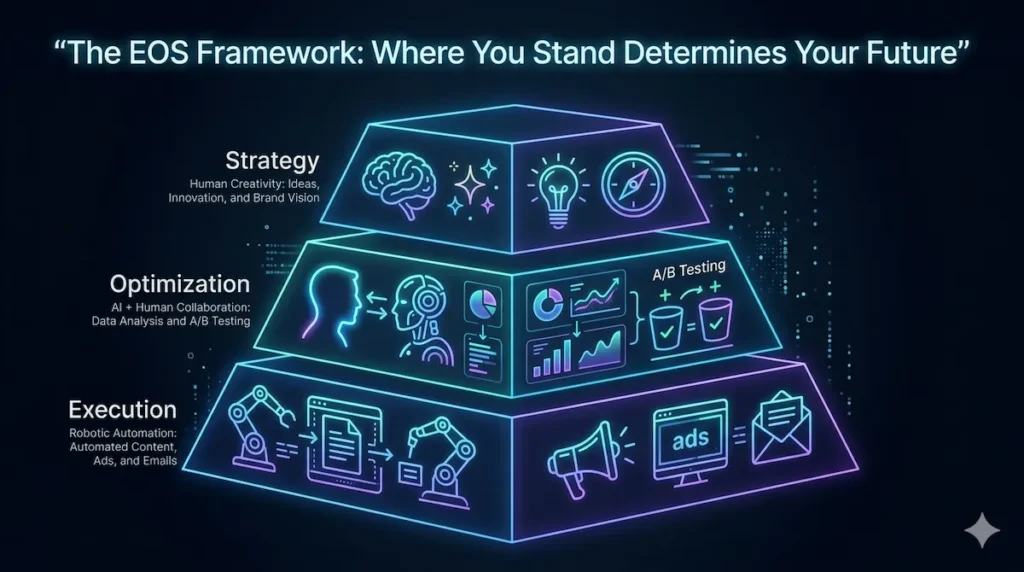
The Execution–Optimization–Strategy Shift (EOS Framework)
AI replacing digital marketers at this layer is already happening at scale, with no signs of slowing. To understand exactly where AI replacing digital marketers is happening — and where it isn’t — you need a way to categorize every task inside your current role. Every marketing task falls into one of three layers. Where your time is concentrated right now is the most important career signal you have.
The EOS Framework — Execution · Optimization · Strategy
Execution layer
Fully automated
AI handles these end-to-end. If most of your role sits here, act now — not next quarter.
- Bulk content first drafts
- Email send-time optimization
- Ad bid management
- Basic SEO data reporting
- Social scheduling
Optimization layer
AI-assisted
AI surfaces insights; humans review, approve, and direct. Relatively safe — for now.
- A/B test interpretation
- Audience segmentation
- Content brief refinement
- Campaign performance review
- Lead scoring oversight
Strategy layer
Human-led
Brand direction, creative vision, positioning. AI can support — it cannot originate.
- Brand positioning
- Market entry decisions
- Original creative concepts
- Customer empathy research
- Narrative and storytelling
“If your only value is execution, AI already does your job. The only open question is whether your employer has caught up to that yet.”
Now for the uncomfortable extension of this framework: most people who call themselves “strategists” are actually Execution-layer workers with a strategy-layer job title. If your strategy consists of deciding which blog posts to write based on keyword volume, which audience segments to run in a campaign based on last quarter’s best performers, or which email subject lines to test — that’s optimization at best, execution at worst. AI handles all of it. Real strategy is about decisions AI cannot make: what the brand should stand for, which markets to enter, what customer truth to build a campaign around. If you’re not regularly making those calls, your “strategy” title won’t protect you.
The AI Sameness Problem
While most of the conversation about AI replacing digital marketers focuses on job loss, the quieter and more damaging risk is something else entirely.
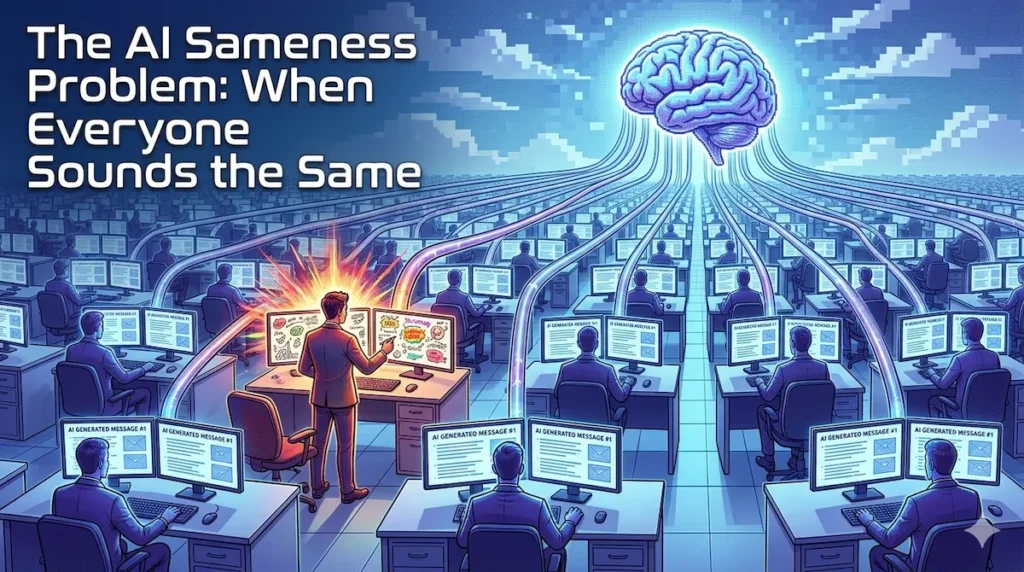
When every marketing team has access to the same AI tools, trained on the same data, generating content through the same prompts, the output converges. Blog posts start sounding alike. Ad copy follows the same emotional arcs. Email sequences hit the same beats in the same order. The distinctive voice that made a brand worth choosing gets averaged out — smoothed into something competent, coherent, and completely forgettable.
This is the AI Sameness Problem. It’s not a future risk. It’s already visible in how branded content reads across most industries right now.
The AI Sameness Problem — why it happens, what it looks like, and how to escape it
Why it happens
Convergent training data
Every major AI tool is trained on similar internet-scale data. Same inputs produce same patterns. When an entire industry uses the same tool with similar prompts, differentiation evaporates at the speed of adoption.
What it looks like
Competent but forgettable
Content that is technically correct, well-structured, and entirely unmemorable. No edge. No voice. No original perspective. It reads as though written by a committee processing everything ever published online.
How to escape it
Original thinking, visible voice
First-hand expertise. Real customer insight. Opinions specific enough to generate disagreement. A brand voice so precise it couldn’t come from anywhere else. These are now the scarcest — and most valuable — assets in marketing.
The biggest risk isn’t AI replacing marketers. It’s marketers becoming indistinguishable because they all use AI the same way. Speed is no longer a competitive advantage. It’s the baseline. What separates you now is whether you have something worth saying — and whether you’ve developed the skill to say it in a way nobody else can.
This is also why Google’s helpful content guidelines are getting more precise, not less. The guidance explicitly rewards first-hand expertise and original insight. As AI-generated content scales across the web, Google’s ability to identify and suppress averaged, undifferentiated content is improving in parallel. The AI Sameness Problem is simultaneously a brand issue, a career issue, and an SEO issue.
How AI is transforming digital marketing
Before drawing conclusions about AI replacing digital marketers, it helps to understand precisely how AI is operating inside real marketing workflows right now.
AI content creation
Content creation is the area where AI replacing digital marketers in day-to-day output is most visible — and most misunderstood.
A 2024 Marketing Week survey of over 3,000 marketing professionals found that 73% now use AI tools regularly in their workflow — up from 29% just two years prior. Among those using AI for content, 61% reported faster production times but only 38% reported measurably better content performance.
Source: Marketing Week / Econsultancy Marketing Report, 2024
That gap — faster production, but not proportionally better results — is the AI Sameness Problem showing up in the data. The marketers getting real lift from AI content are the ones investing the time savings into sharper research, more specific editorial judgment, and harder-to-replicate brand voice.
Real-world example — e-commerce content workflow
200+ product pages per month, one human editor
A mid-sized e-commerce brand shifted to an AI-first content workflow: AI generates structured first drafts across all product categories, one human editor refines tone, brand specificity, and search intent alignment. Production time dropped 70%. Organic traffic from those pages increased 34% within six months — because the editor focused entirely on quality, not volume.Output doubled. One skilled human in the loop — doing the work AI cannot do.
AI data analysis and machine learning marketing analytics
On the analytics side, AI replacing digital marketers isn’t about eliminating the analyst — it’s about eliminating the lower-value parts of what analysts used to spend most of their time doing.
Machine learning marketing analytics platforms now process millions of behavioral data points in seconds. Attribution modeling, churn prediction, and audience segmentation that once took days surface as overnight dashboard insights. The analyst’s role doesn’t disappear — it gets elevated. The shift is from “what does the data say?” to “what should we do about it?” The second question still requires human judgment, business context, and the ability to recognize when the data is pointing in the wrong direction.
AI marketing automation
Marketing automation is the clearest example of AI replacing digital marketers in end-to-end campaign execution, not just task assistance.
Predictive marketing AI embedded in platforms like HubSpot, Klaviyo, and Marketo now triggers personalized email sequences, scores leads in real time, and adjusts campaign parameters based on live behavioral signals. This is where AI replacing digital marketers in task-level execution is most visible.
If you manage paid channels or owned media: understanding how AI agents operate inside live campaign workflows is now foundational knowledge, not optional reading. This breakdown of AI marketing agents in practice covers the operational specifics.

Marketing tasks AI is already replacing
The concern about AI replacing digital marketers becomes more concrete when you look at the specific tasks being automated right now — not in theory, but in active use across real marketing teams.
Content generation
Content generation is where AI replacing digital marketers at the production level is most advanced and most measurable.
First drafts of blog posts, email subject lines, social captions, and product descriptions are increasingly AI-generated and human-refined. Writers whose entire value is producing first drafts are exposed. Writers who direct editorial strategy, build content systems, and refine AI output toward measurable performance outcomes are increasingly essential — and better compensated for it.
Ad campaign optimization
In paid media, AI replacing digital marketers on day-to-day bid management and creative testing is already the default at any company running campaigns at meaningful scale.
Google’s Smart Bidding and Meta’s Advantage+ adjust bids, placements, and creative variations in real time, often outperforming manual management at scale. The role of the ads manager is shifting from operator to strategist — setting goals, defining audience parameters, interpreting performance, and making the judgment calls the algorithm can’t.
For a practical breakdown of what’s being automated versus what still requires human direction in paid media: this guide to AI in advertising strategies and tools goes into the specifics of which decisions AI owns and which it doesn’t.
Email marketing automation
Email is another channel where AI replacing digital marketers on execution tasks is essentially complete for teams using modern automation platforms.
Personalized sequences, behavioral triggers, send-time optimization, and A/B testing are now largely automated once configured. The human role shifts from execution to strategy design and performance interpretation — which, if you’re prepared for it, is a significantly better use of intelligence.
SEO data analysis
In SEO, AI replacing digital marketers on data-gathering tasks has compressed what used to be a full-day workflow into under an hour.
Keyword research, competitor gap analysis, content briefs, and technical audits are being dramatically compressed by tools like Surfer SEO. Tasks that once took a full day now take under an hour. The SEO professional’s value has moved entirely from data gathering to editorial judgment, strategic direction, and the ability to identify opportunities that AI pattern-matching can’t surface.
HubSpot’s 2024 State of Marketing Report (surveying 1,400+ marketing professionals globally) found that marketers using AI tools save an average of 2.5 hours per day on routine tasks. Marketers who redirected that time toward strategy and creative work were 2.5x more likely to exceed their revenue targets than those who used the time savings for more execution.
Source: HubSpot State of Marketing Report, 2024
Are digital marketing jobs safe from AI?
Featured snippet target — PAA answer
The question isn’t just whether AI replacing digital marketers is happening — it’s which jobs are safe, which are exposed, and what the difference actually looks like in practice. Jobs built primarily on manual execution — bulk content production, repetitive ad management, and basic reporting — face the most disruption. The safest roles in the AI era are those combining data literacy with strategic and creative capabilities that AI demonstrably cannot replicate.
Which specific roles are most exposed, and which have the strongest long-term outlook? Here’s what the evidence shows about AI and specific digital marketing job categories — including roles that look safe but aren’t.
AI vs human marketers: side-by-side
| Capability | AI | Human | Who wins |
|---|---|---|---|
| Content volume at scale | High | Medium | AI — decisively |
| Content originality | Low | High | Humans — not close |
| Data analysis speed | High | Low | AI — decisively |
| Strategic insight | Low | High | Humans — not close |
| Creative campaign development | Low | High | Humans |
| Ad campaign optimization | High | Medium | AI at scale |
| Brand storytelling | Low | High | Humans |
| Customer empathy | Low | High | Humans |
| 24/7 execution consistency | High | Low | AI |
The highest-performing marketing teams in 2026 are not debating AI vs human. They’re using AI to dominate every row where it wins while investing human talent exclusively where humans win. That’s the structural advantage of small, well-configured teams over large ones built for an earlier era.
Marketing jobs AI cannot replace
For all the discussion about AI replacing digital marketers, there are entire categories of marketing work that AI demonstrably cannot perform at a level that produces real business results.
Marketing strategy — the real kind
Strategy is the clearest example of a domain where AI replacing digital marketers is not happening — and where the gap between AI capability and human judgment is widest.
AI can tell you what happened and model what might happen next. It cannot determine what your brand should stand for, which market to enter, or how to outmaneuver a competitor in a way that resonates emotionally with real people. These decisions require contextual judgment, industry knowledge, and the kind of creative risk-taking that has no training data. Real marketing strategy remains in human hands — and so does the accountability when it’s wrong.
Brand storytelling
When it comes to brand storytelling, AI replacing digital marketers is not a realistic near-term scenario — because authentic stories require something AI has never experienced.
The best brand stories connect because they’re human. They come from real experience, cultural specificity, and emotional nuance that AI has never felt. AI mimics narrative structure. It cannot originate the kind of surprising, authentic story that builds long-term brand equity.
Real-world example — B2B SaaS brand messaging
Three rounds of AI copy. Flat results. One human strategist. 41% lift.
A mid-market B2B software company used AI to rewrite its website messaging during a full rebrand. Three rounds of AI-generated copy tested consistently flat with the target audience — technically sound, emotionally hollow. A strategist then spent two weeks in customer interviews, extracted the actual language users used to describe their own problems, and rewrote the messaging from those conversations. The human-authored version lifted demo requests 41%.The insight came from a conversation AI cannot have. The result came from judgment AI doesn’t possess.
Customer psychology
Customer psychology is perhaps the deepest reason why AI replacing digital marketers across all functions remains impossible — empathy cannot be trained into a model from text data alone.
Understanding why customers behave the way they do — the unspoken fears and irrational tendencies driving purchasing decisions — requires empathy. AI identifies behavioral patterns in existing data. It cannot interpret the emotional context behind them, and it cannot surface the insight that doesn’t exist in any dataset yet. A skilled marketer who regularly talks to customers knows things no model will ever know.
How digital marketers can adapt
Accepting that AI replacing digital marketers at the execution level is real is the first step — the second is knowing exactly what to do about it.
Learn AI tools — with genuine intent
The marketers most insulated from AI replacing digital marketers in their specific roles are not the ones avoiding AI — they’re the ones using it with the most strategic intent.
Fluency in AI tools is now table stakes for marketing employment. The marketers building real advantage aren’t just using these tools — they’re using them strategically: prompting with specificity, editing with judgment, and applying AI to the right layer of the EOS framework instead of all of it indiscriminately.
A practical starting point for building that fluency: this guide to AI tools for creative and marketing teams covers use cases by role rather than just listing names.
Move up the EOS framework deliberately
The most direct response to AI replacing digital marketers at the Execution layer is to move your work upward — deliberately and specifically — into the layers AI cannot reach.
This is the most actionable advice in the article. Audit your last month of work. Map it honestly against the three EOS layers. Then plan — specifically, not aspirationally — how to shift more of your time toward the Optimization and Strategy layers. Learn to think in terms of audience insight, business outcomes, and brand decisions. Those are conversations AI cannot enter and that most marketers are not prepared to have.
Build a visible point of view
One reason AI replacing digital marketers feels so threatening is that generic work has no defense against a tool that produces generic work infinitely faster and cheaper.
If you don’t have a perspective that is distinctly yours, AI makes you invisible — not because it’s smarter, but because it produces content at a volume that drowns out undifferentiated voices. LinkedIn, industry writing, newsletters, speaking — pick one and build there consistently. A specific, defensible point of view is career security no algorithm can erode.
For e-commerce marketers applying this to a specific growth context: this AI for e-commerce growth guide shows how to combine AI execution with human strategic direction at the channel level.
Best AI tools — and when not to use them
Understanding AI replacing digital marketers on execution tasks becomes more practical when you know exactly which tools are doing the replacing — and where each one stops being useful.
ChatGPT (OpenAI)
Best for: Content ideation, first drafts, email copy, brainstorming campaign angles. Treat it as a thinking partner with broad knowledge and no taste. Give it real context, push back on generic output, and treat every response as a raw material — not a finished product.
When not to use it: For anything requiring brand specificity, original research, or strategic judgment. ChatGPT knows the internet. It doesn’t know your customer, your competitors’ blind spots, or what your brand is actually trying to say.Publishing raw ChatGPT output is not efficiency. It’s opting into the AI Sameness Problem at scale.
Jasper
Best for: Scaled content production with brand voice controls. Jasper’s structural advantage over generic ChatGPT is its ability to hold brand guidelines consistently across a team — strong for ad copy, blog content, and email sequences where volume and consistency both matter.
When not to use it: For thought leadership, executive voice content, or any writing where a distinctive personal perspective is the entire point. Jasper optimizes for brand consistency — not originality. Those are different problems.Consistency ≠ differentiation. Know which one you actually need.
Surfer SEO
Best for: Content structure and semantic keyword optimization. Surfer analyzes top-ranking pages for your target keyword and tells you what topics, headers, and related terms your content needs to be competitive. It makes SEO structure actionable rather than theoretical.
When not to use it: As a replacement for editorial judgment or topical expertise. Surfer optimizes against what already ranks. If you follow it exactly, you produce content that is marginally better than existing top results — not content that redefines the conversation on a topic.Surfer shows you what exists. Not what’s missing. Not what would win decisively.
HubSpot AI
Best for: Integrated marketing automation — email personalization, lead scoring, CRM insights, and campaign reporting. For teams already inside HubSpot, these features represent the most coherently integrated AI automation available without stitching together separate platforms.
When not to use it: As a substitute for understanding your own customer data. HubSpot AI surfaces patterns and triggers sequences — but you need to design the strategy, define the segments, and verify that its recommendations actually align with your business reality, not just its training patterns.The automation is only as intelligent as the strategy behind it. AI runs the workflow. Humans own the thinking.
Biggest mistakes marketers make with AI
The conversation about AI replacing digital marketers tends to focus on what AI does well — but the more pressing issue right now is the mistakes marketers are making in how they use it.
Replacing customer research with AI inference
AI analyzes existing data. It cannot surface the insight that hasn’t been captured yet — the fear a customer has never written down, the objection they’ve never voiced in a survey. The best marketers are using AI speed to do more customer research, not less.
Publishing unedited AI output
Raw AI content is recognizable, increasingly filtered by search engines, and erodes the trust readers place in a brand over time. Human editorial review is not optional — it’s the work that separates content that builds authority from content that quietly destroys it.
Letting AI set strategic direction
Letting AI set strategic direction. When AI drives which topics to cover, which channels to prioritize, and which positioning angle to take, the result is marketing that looks exactly like every competitor using the same tool. This is the AI Sameness Problem operating at the strategy level — the most expensive version of it.
Abandoning brand voice to the algorithm
AI defaults to the average of everything it has processed. Without explicit brand voice guidelines enforced at every stage of the content process, AI strips the distinctiveness that makes a brand worth choosing over a competitor.
Waiting to build AI fluency
The gap between AI-fluent marketers and those avoiding these tools is widening structurally, not gradually. “I’ll get to it later” is one of the most expensive decisions a marketer can make in the current environment. The marketers who build fluency now have advantages that compound over time.
Future of digital marketing with AI
The future of AI replacing digital marketers is not a single event — it’s a gradual restructuring already visible in how teams are being built, hired, and sized in 2025 and beyond. Human-AI collaboration — where AI handles execution at scale and humans own strategy and creative — will define the highest-performing marketing organizations of the next decade. The teams that get this balance wrong in either direction (all AI, or AI-resistant) will fall behind teams that don’t.
Predictive marketing AI becomes table stakes. Real-time personalization, dynamic creative optimization, and AI-generated campaign testing will be standard capabilities within three years — not competitive advantages. Marketers who understand what these systems are doing, well enough to direct them strategically, will be the ones driving results. Those who just trust the automation will be along for the ride.
The AI Sameness Problem becomes the defining brand challenge. As AI-generated content scales across every channel and every industry, the brands that invest in genuine original thinking, real customer research, and authentic human voices will stand out with increasing clarity. In a world where execution is commoditized, originality is the only sustainable advantage. This is not a brand positioning strategy. It’s a survival strategy.
New roles will emerge — and quickly. AI content editors, prompt strategists, and AI workflow architects are already real job titles at forward-thinking companies. The marketers building competence in these areas now will define what senior marketing leadership looks like in five years.
“AI raised the floor in marketing. It didn’t raise the ceiling. When the floor rises, average disappears — and everything beneath it.”

FAQ
Will AI replace digital marketers completely?
No — but it will replace the version of marketing that was built on execution without strategic thinking. AI is automating specific, repetitive tasks at scale. Strategy, creative judgment, brand storytelling, and customer empathy remain in human territory. The marketers most at risk are those whose roles consist almost entirely of the tasks AI now handles faster and cheaper.
What marketing jobs will AI replace first?
Entry-level and execution-focused positions face the most disruption first. Roles built around bulk content production, basic performance reporting, repetitive ad management, and routine scheduling are being automated most aggressively. Roles that combine creative direction, strategic thinking, and genuine customer understanding are significantly more durable. For the full role-by-role breakdown, the evidence is here.
Can AI replace marketing strategy?
Not real marketing strategy. AI can analyze what happened and model what might happen next. Deciding what a brand should stand for, which market to enter, how to position against a specific competitor, or what customer truth to build a campaign around — those decisions require contextual judgment that AI doesn’t have. They also require someone willing to be held accountable if the decision is wrong. That’s still a human job.
What is the AI Sameness Problem?
The AI Sameness Problem occurs when every marketing team uses the same AI tools, trained on the same data, producing content through similar workflows — resulting in output that converges toward competent, averaged, forgettable. No distinctive voice. No original angle. No reason to choose one brand over another based on the content alone. The solution is investing in original thinking, real customer insight, and brand voice specific enough that it couldn’t be generated by any model.
Is digital marketing safe from AI as a career?
As a profession, digital marketing is not being eliminated — it’s being restructured around a different set of skills. The execution layer is increasingly automated. The strategy and creative layers are increasingly premium. Marketers who invest in strategic thinking, creative capability, and AI tool fluency simultaneously have strong long-term career prospects. Those who invest in only one of those three are exposed.
Should marketers learn AI tools?
Yes — with one important clarification. Learning AI tools matters. But learning AI tools without developing the strategic and creative judgment to direct them productively just makes you faster at producing averaged content. Build both. HubSpot’s 2024 research found that AI-using marketers are 2.5x more likely to exceed revenue targets — but only when AI fluency is paired with genuine strategic direction.
Conclusion
The real picture of AI replacing digital marketers is not the one most headlines describe — it’s more specific, more actionable, and ultimately more manageable than the fear suggests.
Here is what is actually happening: AI is eliminating the version of digital marketing that was always closer to assembly than thinking. The first drafts, the bid adjustments, the scheduled sends, the keyword pulls — that version of marketing was mechanical, and AI does mechanical work faster, cheaper, and without complaints.
What AI cannot do is think originally, understand people emotionally, take creative risks, or make the kind of judgment calls that require genuine accountability. Those capabilities are not being replaced. They are becoming the entire premium.
The AI Sameness Problem will get worse before it gets better. As AI-generated content scales across every channel, the differentiation gap between brands that invest in original human thinking and those that don’t will widen dramatically. Originality isn’t a creative indulgence in this environment. It’s a strategic necessity.
The marketers who thrive in the next five years are those who understood this early — who used AI to handle execution while doubling down on the capabilities that make them irreplaceable: genuine customer understanding, strategic clarity, and a point of view distinctive enough that no model could have generated it.
“In the AI era, the scarcest resource in marketing isn’t attention, budget, or talent. It’s original thinking. The marketers who protect it will own the ceiling AI cannot reach.”