

Your Favorite AI Tool Might Be Your Biggest Security Liability
AI security risks for small businesses are growing fast in 2026 — not because AI is unsafe, but because most businesses use it without understanding how it exposes sensitive data, systems, and workflows. From prompt injection attacks to data leaks, AI introduces new risks that traditional cybersecurity tools don’t fully cover.
Cybersecurity experts increasingly warn that AI adoption without proper safeguards can expose businesses to new types of cyber threats that traditional security tools are not designed to handle.
A team member discovers a free AI writing tool. Within a week, three people are using it to draft client emails, proposals, and financial summaries. Nobody asked whether it was secure. Nobody read the Terms of Service. And nobody realized that every document pasted into that tool just left the building.
AI tools are genuinely transforming how small businesses operate. They cut hours from your week, reduce costs, and give lean teams capabilities that used to require entire departments. If you’ve already been exploring the best AI tools available in 2026, you know the options are expanding faster than most business owners can track.
But here’s what the productivity headlines don’t mention: every AI tool you adopt is also a potential exposure point. The AI security risks for small businesses hiding inside everyday workflows are real, growing, and almost entirely preventable — if you know where to look.
This guide covers exactly that.
What Are AI Security Risks for Small Businesses?
AI security risks refer to vulnerabilities created when businesses use artificial intelligence tools without proper safeguards. These risks include data exposure, manipulation of AI outputs, unauthorized access to systems, and AI-driven cyberattacks that can target small businesses with limited security resources.
AI-related security risks can occur at every stage—from data input to model deployment—making them harder to detect than traditional cyber threats.
Many of these risks arise from how tools are used, so it’s important to understand the platforms themselves—here’s a complete guide to the best AI tools for 2026 used by businesses today.
Quick Answer:
AI security risks for small businesses include data leaks, prompt injection attacks, AI-generated phishing, and unauthorized access to sensitive systems. These risks arise when AI tools process business data without proper security controls.
Hidden AI Security Risks Most Small Businesses Ignore
Prompt Injection Attacks
Hackers manipulate AI tools by injecting malicious instructions, causing the system to reveal sensitive data or perform unintended actions.
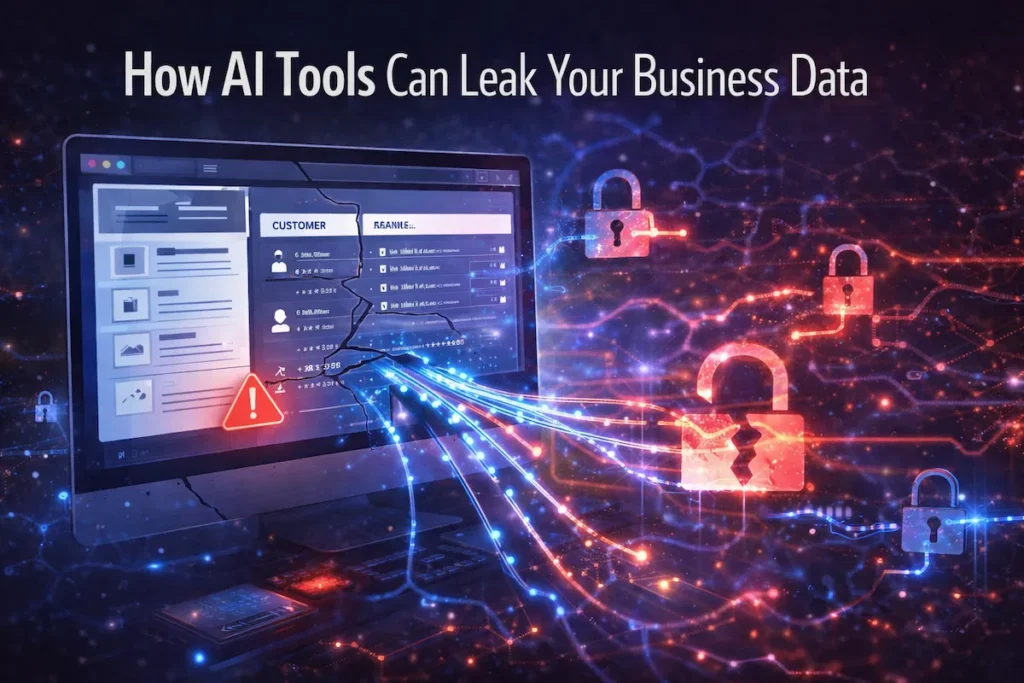
Data Leakage Through AI Tools
AI platforms may store or process inputs, exposing confidential business data if not properly secured.
AI Model Manipulation
Attackers can influence AI outputs, leading to incorrect decisions, biased responses, or harmful automation.
AI-Powered Phishing Attacks
Cybercriminals use AI to generate highly personalized phishing emails that are harder to detect.
Advanced AI Security Risks for Small Businesses
AI systems can introduce vulnerabilities at every stage—from data processing to model deployment—making them a complex security challenge for small businesses.
Adversarial Attacks
Adversarial attacks involve manipulating AI inputs—such as text or images—to trick systems into producing incorrect or harmful outputs. Even small changes in input data can cause AI systems to misinterpret information and make flawed decisions.
Data Poisoning
Data poisoning is a cyberattack where attackers inject malicious or misleading data into AI training datasets. This can permanently alter how the AI behaves, leading to inaccurate predictions, biased outputs, or hidden vulnerabilities.
Model Inversion Attacks
In these attacks, hackers analyze AI outputs to extract sensitive information from the model’s training data. This can expose confidential business or customer data without direct system access.
AI System Exploitation
If attackers gain access to AI systems or APIs, they can manipulate outputs, extract sensitive data, or use the system to launch further cyberattacks.
What Are AI Security Risks for Small Businesses?
Understanding AI security risks for small businesses is no longer optional — it’s one of the most important things an owner can do before adopting any new tool in 2026.
AI security risks for small businesses refer to the data privacy vulnerabilities, compliance exposures, and cybersecurity threats that emerge when small business owners and their teams adopt and use artificial intelligence tools — often without formal policies, security reviews, or an understanding of how those tools handle sensitive data.
Unlike traditional cybersecurity threats, most AI security risks don’t require a hacker. They stem from everyday decisions: pasting a client contract into a chatbot, connecting an AI tool to your CRM, or using a free browser extension that quietly accesses your inbox. The threat isn’t always external. Often, it’s already inside your workflow.
Why Small Businesses Face Disproportionate AI Security Risks in 2026
The scale of AI security risks for small businesses has grown so significantly that cybersecurity experts now rank them alongside traditional threats like phishing and ransomware.
It would be easy to assume that big companies are the main targets. They have more data, more money, and more to lose. But in practice, small businesses face a disproportionately high risk — and it comes down to one simple structural disadvantage.
Large enterprises have dedicated IT teams, compliance officers, legal counsel, and cybersecurity budgets. Most small businesses have none of those. They’re running lean, moving fast, and adopting tools based on productivity — not security. That gap is precisely where AI security risks for small businesses take root and quietly expand.
According to research from the Ponemon Institute, the average cost of a data breach for a small business now exceeds $2.98 million. Many smaller organizations never recover — more than half close within six months of a major incident. That’s not a scare statistic. That’s the real stakes.
Three specific forces are making the AI security risk landscape worse heading into 2026:
1. Adoption without governance. Tools get adopted in days. Security reviews happen — if they happen at all — weeks later, once the tool is already embedded in workflows.
2. Misplaced trust. A well-designed interface feels safe. It isn’t. Many small business owners assume their AI vendors are handling security on their behalf. Often, that assumption is dangerously wrong.
3. No baseline awareness. A 2025 Cyber Readiness Institute survey found that over 60% of small business owners couldn’t identify what data their AI tools were storing or sharing. Most simply didn’t know to ask. For a clearer picture of where those gaps are widest, the latest AI-driven cybersecurity statistics for SMBs in 2026 paint a sobering picture before you do anything else.
📊 Estimated Insight
Over 60% of small businesses using AI tools have no formal AI usage policy in place — meaning every employee is effectively making their own security decisions, daily, without a framework to guide them. This single gap accounts for the majority of AI-related data incidents in small business environments.
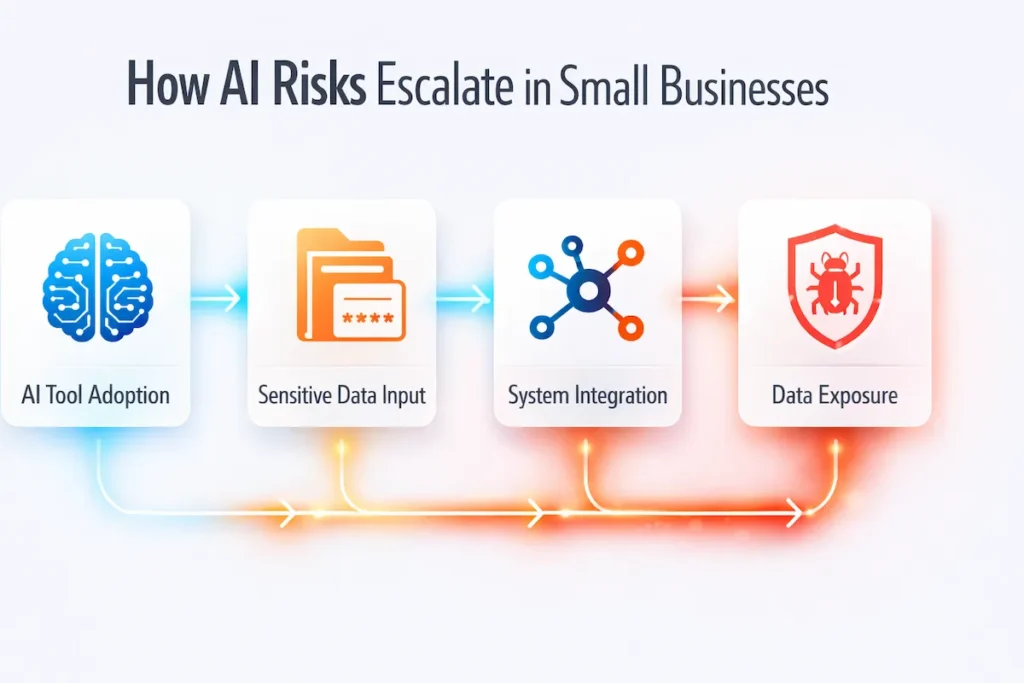
The 3-Level AI Security Risk Model: How Incidents Actually Escalate in Small Businesses
What makes this model so valuable is that it maps exactly how AI security risks for small businesses move from a single uninformed decision to a full-scale data incident.
Many businesses use chatbots for customer interactions, so it’s important to understand how they work—this chatbot guide explains how to use them effectively and securely.
Most AI security incidents don’t start with a sophisticated attack. They follow a predictable escalation pattern. Understanding this model helps you identify where your business currently sits — and where the real danger builds.
Level 1 — Tool Misuse An employee uses an unapproved AI tool or pastes sensitive data into a platform without realizing the risk. No malicious intent. Just an uninformed decision with real consequences.
Level 2 — Data Exposure The data shared with that tool is retained, used for model training, or exposed in a vendor breach. The business has no visibility into what happened or when.
Level 3 — System Integration Risk The AI tool is connected to the CRM, email platform, or payment system. A single vulnerability in one tool now has access to the entire ecosystem. This is where incidents become business-ending.
Most small businesses experiencing a serious AI security incident passed through all three levels — often without recognizing any of them at the time.
📌 AI Risk Flow — How Exposure Escalates
[AI Tool Adopted] → [Sensitive Data Entered] → [Tool Integrated With Business Systems] → [Vendor Breach or Data Leak] → [Full Business Exposure]Each arrow represents a missed checkpoint. Most small businesses have controls at none of them.
The 6 Hidden AI Security Risks Small Businesses Face Every Day
Each of the AI security risks for small businesses listed below has been observed in real-world incidents — not constructed for the sake of argument.
These aren’t hypothetical vulnerabilities dreamed up in a research lab. They’re patterns that show up repeatedly in real businesses — including, quite possibly, yours.
Risk 1: Data Leakage Through AI Prompts Is the Most Common AI Security Risk for Small Businesses
Of all the AI security risks for small businesses documented in 2025 and 2026, data leakage through AI prompts consistently ranks as the most frequent and the hardest to detect after the fact.
This is the most widespread AI data privacy issue in small business settings — and it’s almost entirely invisible until something goes wrong.
Every time someone on your team pastes a client contract, financial summary, internal strategy document, or customer email into an AI tool, that information leaves your environment. It’s processed on a third-party server. It may be stored. And depending on the platform’s data policies, it may be used to train the model.
Consider this scenario: A bookkeeper at a small accounting firm uses an AI tool to summarize a client’s tax return. In the prompt, she includes the client’s full name, income details, and tax identification number. She’s trying to save twenty minutes. What she doesn’t know is that the platform retains user inputs by default — and the client’s private financial data is now sitting in a system she doesn’t control.
What most people don’t realize is that this isn’t a technical failure. Nobody hacked anything. An employee made a reasonable productivity decision without understanding the downstream risk.
For businesses using AI in client-facing roles — especially those relying on AI tools for public relations and reputation management — the exposure goes beyond data. One leaked client communication can destroy a professional relationship that took years to build.
The FTC’s guidance on AI and data privacy is one of the clearest free resources available. Check whether your AI vendors offer enterprise or API plans that disable training on your inputs. Many do — but only if you opt in.
Risk 2: Shadow AI Is a Growing AI Security Risk That Starts Inside Your Own Team
Shadow AI represents one of the AI security risks for small businesses that grows in direct proportion to how productive and self-motivated your team is — the better your people, the faster unsanctioned tools spread.
What is Shadow AI? Shadow AI refers to artificial intelligence tools that employees adopt and use for work purposes without official approval, IT review, or management awareness. It’s the small business equivalent of shadow IT — but faster-moving, harder to detect, and far more data-hungry.
Think: the browser extension that rewrites emails, the Chrome plugin that summarizes meeting notes, the AI image tool someone installed last Tuesday. None of these went through any vetting. All of them have access to real business data.
In many small businesses, this problem is most acute in marketing departments. With so many free AI tools available for digital marketing, a motivated team member can adopt half a dozen new tools in a single afternoon — each one accessing emails, documents, or client files without anyone registering the exposure being created.
The core problem is simple: you cannot audit tools you don’t know exist.
One common mistake is assuming employees need malicious intent to create a security incident. They don’t. A well-meaning person using an unvetted tool can expose months of client communications without doing anything wrong by their own understanding. The gap isn’t bad judgment — it’s missing policy.
Risk 3: API Key Exposure Is an AI Security Risk That Scales Quietly and Quickly
API key exposure is the AI security risk for small businesses that tends to stay invisible the longest — often only surfacing when an unexpected bill arrives or a breach notification lands in your inbox.
If your business uses developer-accessible AI tools — increasingly common with automation platforms, custom chatbots, and CRM integrations — API keys are part of how those tools function.
An API key is effectively a password. It authenticates your access to a service and, in many cases, grants access to the data connected to that service.
The problem is that API keys are regularly handled carelessly:
- Hardcoded into scripts or shared spreadsheets
- Passed to contractors in plain-text emails
- Accidentally pushed to public code repositories
- Left active long after the tool or contractor is no longer in use
Attackers don’t need sophisticated methods to find exposed API keys. Automated scanners crawl GitHub and public repositories constantly, specifically hunting for them.
The NIST AI Risk Management Framework identifies API credential management as a critical control point for organizations using AI systems — a warning that applies just as directly to a five-person business as it does to a five-hundred-person one.
The consequences range from unexpected billing charges to full exposure of every customer record the API can reach.
Risk 4: Third-Party Integrations — A Compounding AI Security Risk for Small Businesses
Third-party integrations have quietly become one of the most consequential AI security risks for small businesses precisely because they feel productive — every new connection seems to add value right up until it becomes a liability.
Modern AI tools rarely operate in isolation. They plug into your CRM, your email platform, your project management system, your payment tools. Each connection is deliberate and useful. Each one is also a new attack surface — and one of the most underestimated AI security risks for small businesses in 2026.
This is especially true for businesses relying on AI marketing automation tools, where deep platform integrations aren’t optional — they’re the entire point.
Small business cybersecurity has a consistent blind spot here. Owners lock the obvious entry points — strong passwords, two-factor authentication — and overlook the dozens of third-party connections running quietly in the background.
Here’s how this plays out in practice: A marketing agency connects an AI content platform to a client’s CRM to streamline campaign workflows. Six months later, the AI platform experiences a breach. Because the integration granted broad access, attackers reach the client’s full contact database, deal pipeline, and internal communication history. The agency had no contractual disclosure requirement with that vendor. The client had no idea the connection existed.
Each integration you add multiplies your attack surface. The weakest security standard among all the tools in your stack becomes, effectively, your security standard.
CISA’s free cybersecurity resources for small businesses offer specific, practical guidance on managing third-party risk without enterprise-level budgets.
Risk 5: No Data Handling Policy — The Silent AI Security Risk for Small Businesses Nobody Discusses
The absence of a data handling policy is the AI security risk for small businesses that requires no external attacker, no technical exploit, and no sophisticated breach — just the absence of a single documented decision. Most cybersecurity conversations focus on technical threats. This particular AI security risk for small businesses is different — and in many ways more dangerous because it is entirely self-inflicted.
In many small businesses, there is simply no written policy governing AI tool usage. No approved tool list. No guidance on what data can or can’t be shared with AI systems. No process for evaluating new tools before adoption.
What that means in practice:
- Every employee is making their own daily security decisions
- No one has a framework to reference
- No one is behaving recklessly — they genuinely don’t know the rules, because no rules exist
For businesses operating in Europe or serving European customers, this creates direct GDPR compliance exposure. What many small business owners don’t realize is that sharing customer data with an AI tool — even unintentionally — can constitute a data processing activity under GDPR, with real legal consequences attached.
Risk 6: AI-Powered Phishing — An Escalating External AI Security Risk for Small Businesses
The AI security risks for small businesses don’t only flow from your own tools. They also come from the tools bad actors are using against you — and this external threat is accelerating rapidly in 2026.
AI-powered phishing has transformed from a background nuisance into one of the most financially damaging AI security risks for small businesses operating without dedicated security training programs.
AI has made phishing dramatically more dangerous. The spelling errors and awkward phrasing that used to betray scam emails are gone. Modern AI-generated phishing messages are fluent, contextually accurate, and frighteningly personalized.
A fake invoice from your regular supplier. A payment request from your accountant. An urgent message appearing to come from your own CEO. All of it now lands in inboxes looking entirely legitimate.
Small businesses are disproportionately targeted because they lack the email filtering, security training, and incident response protocols that larger organizations maintain. One successful phishing attack can drain a business account, expose client data, or compromise every system the affected employee accessed.
The Governance Gap Is the Core AI Security Risk for Small Businesses in 2026
Every conversation about AI security risks for small businesses eventually arrives at the same uncomfortable truth — the technology is rarely the problem, and the governance gap almost always is.
“Most small businesses adopt AI tools faster than they build the policies to govern them. That gap — between adoption speed and governance readiness — is where the majority of AI security risks for small businesses begin.”
Here’s the pattern, repeated endlessly across industries and business sizes.
A team member finds a useful AI tool. Mentions it to a colleague. Within a week it’s woven into daily operations. Leadership finds out later — sometimes much later — and by then, removing it would disrupt half a dozen workflows.
No one behaved badly. The tool is probably genuinely useful. But no one asked: what does this tool do with our data? Does it comply with our client agreements? Is it covered under our insurance?
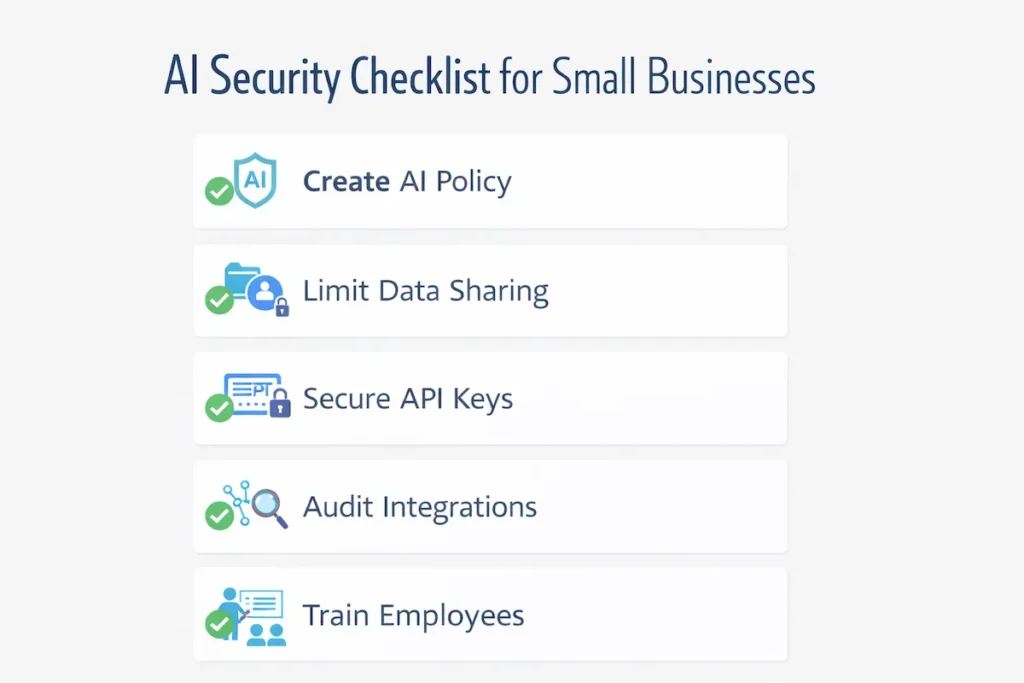
What most people don’t realize is that the businesses best protected against AI security risks for small businesses aren’t the most technically sophisticated. They’re the ones that built a simple, clear governance habit — a one-page policy, a short approval checklist, a 10-minute review step — before the tools became too embedded to question.
The window to build those habits is now. Before the next tool gets adopted. Before the next incident forces the conversation.
How to Protect Your Business from AI Security Risks
AI security risks for small businesses can be reduced by following practical steps that focus on data protection, access control, and safe AI usage.
AI systems can introduce vulnerabilities at every stage, from data processing to deployment, making proper security essential for businesses using AI technologies.
If you’re using AI for campaigns or lead generation, it’s important to understand both the benefits and risks—this guide on AI marketing automation tools for small businesses covers how to implement them safely.
1. Avoid Sharing Sensitive Data with AI Tools
Never enter confidential business data such as customer information, financial records, passwords, or internal documents into public AI tools. Many AI platforms process and store inputs, which can lead to unintended exposure.
2. Choose AI Tools with Strong Security Standards
Use AI platforms that offer encryption, data privacy policies, and compliance with security standards like GDPR, SOC 2, or ISO certifications. Always review how your data is handled.
3. Implement Access Control and Permissions
Limit access to AI tools within your business. Only authorized team members should be able to use AI systems, and permissions should be managed carefully to prevent misuse.
4. Train Employees on AI Security Risks
Human error is one of the biggest causes of security breaches. Train your team to understand risks like prompt injection, phishing, and unsafe data sharing when using AI tools.
5. Monitor and Review AI Outputs
Always review AI-generated content before using it in business operations. AI outputs can be manipulated or incorrect, which may lead to security or compliance issues.
6. Use Secure Integrations and APIs
If you connect AI tools with other platforms (CRM, email, automation tools), ensure secure API connections and avoid exposing sensitive data through integrations.
7. Keep Software and AI Tools Updated
Regularly update your AI tools and connected systems to protect against vulnerabilities and security flaws that hackers may exploit.
Real-World Example of AI Security Risk
A small business used an AI writing tool to generate client proposals. Without realizing it, they entered sensitive client data into the system. Later, similar data appeared in unrelated AI-generated responses, exposing confidential information.
Key Takeaways: What Every Owner Must Know About AI Security Risks for Small Businesses
These takeaways distill the most actionable intelligence on AI security risks for small businesses into the kind of short, memorable points that actually change how decisions get made day to day.
The businesses navigating AI safely in the next three years are building governance habits right now — not waiting for a breach to justify the conversation.
Your biggest AI security risk isn’t a hacker. It’s a well-meaning employee making an uninformed decision with a tool nobody vetted.
Shadow AI is already happening in your business. If you haven’t asked your team what tools they’re using, you don’t know your actual exposure.
A simple AI usage policy is one of the highest-ROI investments you can make in 2026. It costs nothing except the hour it takes to write.
Every third-party integration is a potential liability. Audit your connected apps quarterly and remove what you no longer need.
Free AI tools carry the highest risk. If you’re not paying for the product, your data is often what funds it.
Small business cybersecurity doesn’t require a big budget. It requires clear decisions, made consistently, before something forces your hand.
Key AI Security Risks for Small Businesses
- Data leakage from AI tools
- Prompt injection attacks
- AI-powered phishing scams
- Unauthorized access to systems
- Data poisoning and model manipulation
FAQs About AI Security Risks for Small Businesses
What is the biggest AI security risk for small businesses?
The biggest risk is data leakage, where sensitive information is exposed through AI tools without proper safeguards.
Are AI tools safe for small businesses?
AI tools can be safe if used correctly, with proper security policies, data protection, and employee training.
How do hackers use AI for attacks?
Hackers use AI to create phishing emails, automate attacks, and manipulate AI systems.
Should small businesses avoid AI tools?
No, but they should use them carefully with security best practices in place.
Who This Guide Is For
This guide is designed for:
- Small business owners using AI tools
- Marketers and entrepreneurs adopting automation
- IT teams managing AI-powered systems
Why AI Security Matters More for Small Businesses
Small businesses are often more vulnerable to AI-related security risks because they lack dedicated cybersecurity teams and resources. As AI adoption increases, attackers increasingly target smaller organizations knowing they have weaker defenses and less monitoring in place.
Conclusion
AI security risks for small businesses are becoming more serious as AI adoption grows in 2026. From data leaks to advanced threats like data poisoning and adversarial attacks, these risks can significantly impact business operations and customer trust. The key is not to avoid AI, but to use it securely by implementing strong data protection, employee training, and proper access controls. Businesses that take AI security seriously today will be better prepared for future cyber threats.
Because here’s the truth that every small business owner needs to hear:
AI won’t break your business. But unmanaged AI might.
This article is intended for informational purposes and should be supplemented with professional cybersecurity advice tailored to your specific business needs and industry compliance requirements.