
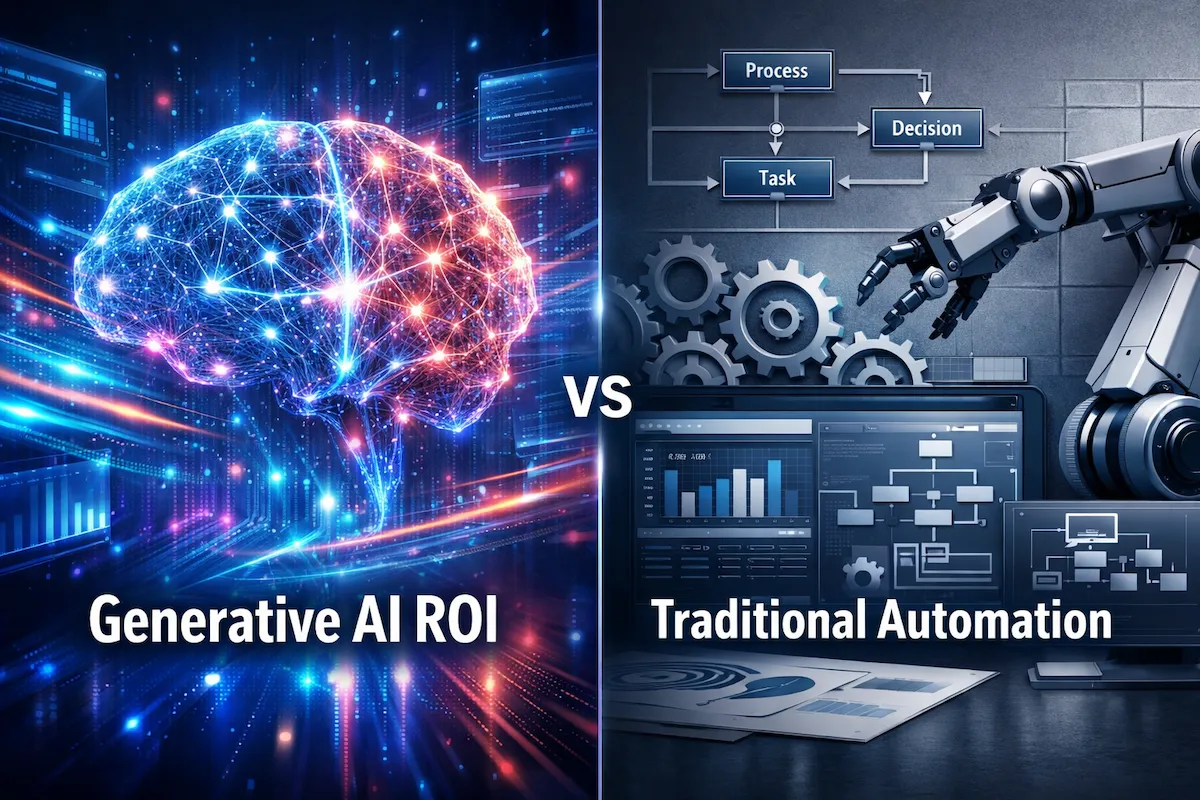
Business leaders across America face a critical decision: invest in generative AI or stick with traditional automation? The answer isn’t obvious, and the stakes are high. Companies that choose wrong waste millions on systems that don’t deliver. Those that choose right see measurable returns within months.
This isn’t about buzzwords or trend-chasing. It’s about dollars, efficiency, and competitive advantage. Generative AI ROI looks different from traditional automation ROI in ways most executives don’t expect. Understanding these differences determines whether your technology investment becomes a profit center or a budget drain.
Both approaches automate work, but they operate on fundamentally different principles. Traditional automation follows scripts you write. Generative AI creates outputs you never explicitly programmed. That distinction changes everything about implementation costs, scalability, and long-term returns.
What Is Generative AI? (ROI Perspective)
Generative AI ROI starts with understanding what these systems actually do for your business. Unlike software that executes predetermined tasks, generative AI creates new content, insights, and solutions based on patterns learned from massive datasets. It writes marketing copy, generates code, and produces visual content without human template creation.
The technology uses large language models and neural networks trained on billions of examples. When you ask it to draft an email campaign or summarize quarterly reports, it synthesizes new output rather than selecting from pre-written options.
How Generative AI Creates Business Value
Generative AI ROI emerges from three core capabilities traditional systems lack. First, it handles unstructured tasks that previously required human judgment. Your customer service team spends hours crafting personalized responses to complex complaints. The system analyzes the situation, considers your brand voice, and drafts contextually appropriate replies in seconds.
Second, it scales creative work without proportional cost increases. Need 1,000 product descriptions? Generative AI ROI becomes obvious when you generate unique descriptions from basic specifications. The hundredth description costs nothing more than the first.
Third, generative AI ROI holds steady during market shifts because the system adapts without reprogramming. When your messaging strategy changes, it adjusts output based on new examples and feedback, reducing the technical debt that kills automation returns.
Cost Structure of Generative AI Systems
Generative AI ROI calculations must account for distinct cost patterns. Initial implementation runs between $50,000 and $500,000 for mid-sized companies, depending on use case complexity. That includes API costs, infrastructure setup, and initial training.
Ongoing expenses follow a per-use model. A company processing 10,000 customer inquiries monthly might spend $2,000 to $5,000 on API calls. Personnel costs shift rather than disappear—budget $120,000 to $180,000 annually for an AI operations specialist. However, AI-powered data analytics for small businesses can start with significantly lower entry costs using cloud-based solutions, making generative AI ROI accessible even for smaller operations.
Revenue Opportunities Enabled by Generative AI
Generative AI ROI often comes from revenue growth, not just cost reduction. Companies use these systems to enter markets previously too expensive to serve. A B2B software company creates customized proposals for thousands of prospects at a fraction of traditional costs.
Content businesses see direct revenue impact. Publishers generate more articles and personalize user experiences without proportional headcount increases. One media company reported 40% traffic growth after using generative AI ROI strategies to expand content production while maintaining quality standards.
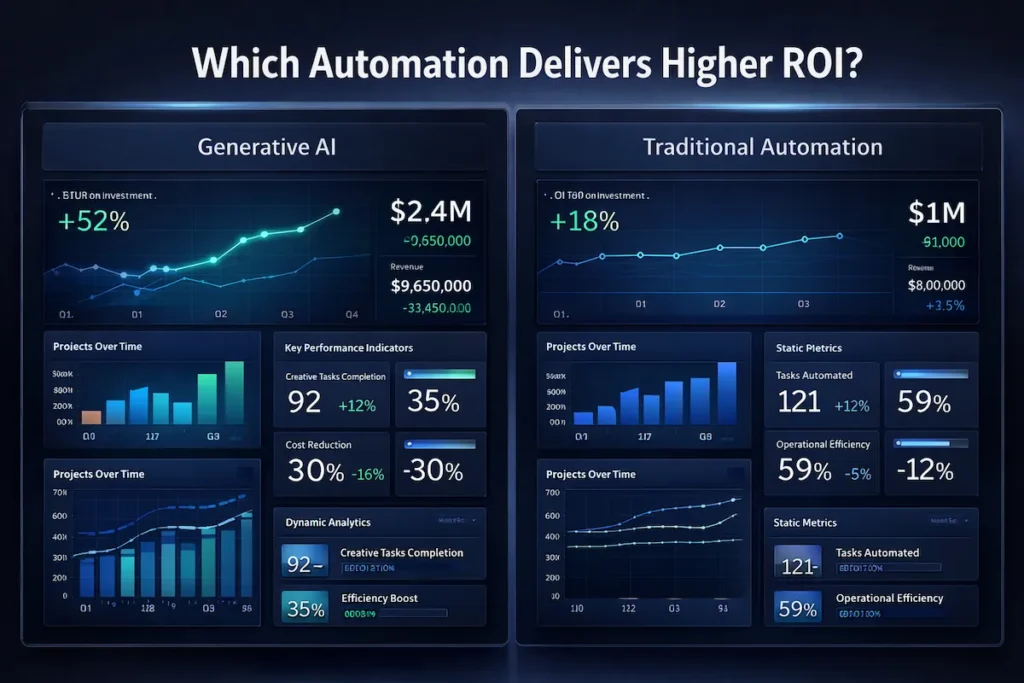
What Is Traditional Automation? (ROI Reality Check)
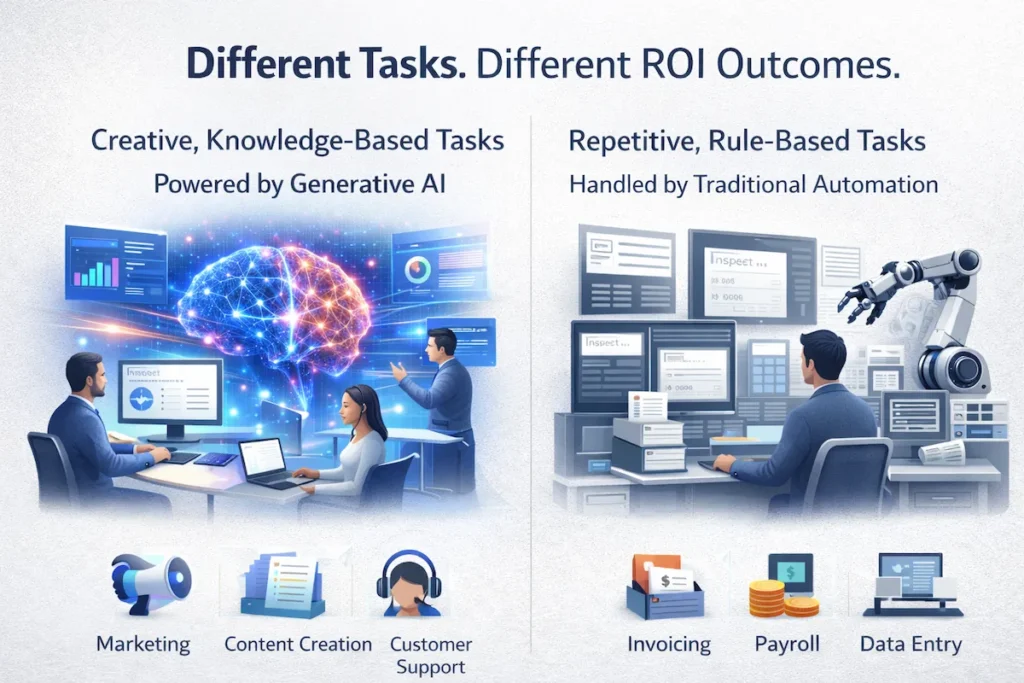
Traditional automation ROI has a 30-year track record, which means we can measure it accurately. These systems execute predefined workflows using if-then logic, robotic process automation, and integration between business applications. They excel at repetitive, rules-based tasks where the process rarely changes.
Your accounts payable department processes invoices the same way every time. Traditional automation extracts data, validates it against purchase orders, routes approvals, and triggers payments.
Rule-Based Automation Explained
Traditional automation ROI depends on process stability and volume. The system follows explicit instructions: if an invoice matches a purchase order within a 5% tolerance, approve automatically. Every scenario requires programming.
A mid-complexity process takes 200 to 400 hours to automate properly. One manufacturing company saw traditional automation ROI eliminate 15 full-time positions while reducing processing time from 4 hours to 15 minutes. That’s classic generative AI ROI’s biggest competitor: predictable, measurable returns when business processes stay constant.
Cost vs Output in Traditional Automation
Traditional automation ROI follows a different economic model than generative AI. Initial costs run $30,000 to $200,000 for typical business processes. Once deployed, the system runs on fixed costs regardless of volume.
Budget $10,000 to $40,000 annually for ongoing expenses. Many companies hit break-even within 8 to 18 months, then enjoy pure savings for years. However, like common cloud security mistakes companies still make, underestimating maintenance costs is a common pitfall that erodes traditional automation ROI over time.
Where Traditional Automation Still Wins
Traditional automation ROI exceeds generative AI in specific scenarios. High-volume, rules-based processes with zero tolerance for creativity deliver better returns. Your payroll processing doesn’t need artificial intelligence—it needs perfect accuracy executing the same calculations every pay period.
Regulated industries often prefer traditional automation because it’s auditable and deterministic. Mission-critical operations where failures are expensive also favor traditional automation ROI. When reliability matters more than flexibility, traditional systems deliver superior returns compared to generative AI ROI.
Generative AI ROI vs Traditional Automation ROI
The real question isn’t which technology is better—it’s which delivers more value for your specific situation. Generative AI ROI and traditional automation ROI follow different curves and depend on different business conditions.
| Factor | Generative AI ROI | Traditional Automation ROI | Winner |
|---|---|---|---|
| Best For | Variable, creative tasks | High-volume, rules-based tasks | It depends on use case |
| Cost Model | Usage-based (scales with volume) | Fixed-cost (license + maintenance) | Traditional at scale |
| Implementation Time | 2–6 months to optimize | 3–9 months to deploy | Generative AI |
| Time to Value | Immediate partial value | Full value only after launch | Generative AI |
| Flexibility | High (adapts to changes) | Low (requires reprogramming) | Generative AI |
| Compliance Risk | Higher (probabilistic outputs) | Lower (deterministic logic) | Traditional automation |
| Maintenance Cost | 10–20% of implementation | 20–40% of implementation | Generative AI |
Implementation Costs Comparison
Generative AI ROI faces higher upfront uncertainty. Implementation costs vary between $50,000 and $500,000, but expect the higher end if you need custom models. The first 90 days involve more experimentation than traditional automation allows.
Traditional automation benefits from predictable scoping. Business analysts estimate costs within 20% accuracy. The gap narrows when you consider reusability—a generative AI ROI system trained for customer service often handles marketing copy with minimal additional investment. Traditional automation requires separate development for each workflow.
Scalability and Flexibility Impact on ROI
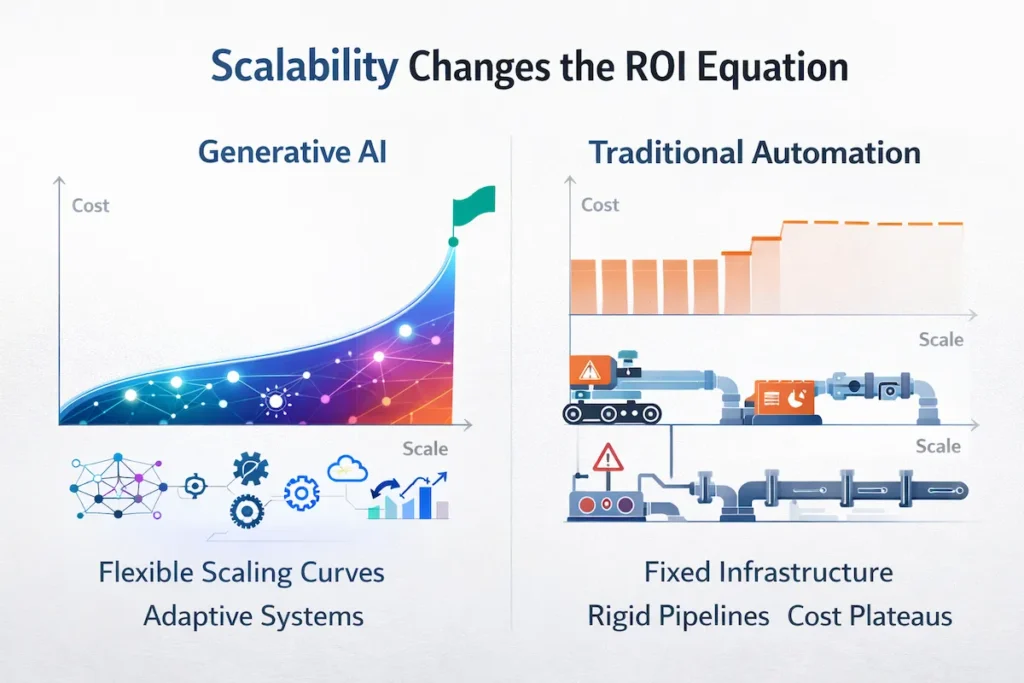
Generative AI ROI scales differently than traditional automation ROI, and that difference determines long-term value. Traditional automation hits capacity limits based on infrastructure. The cost curve is relatively flat after the initial investment.
Generative AI costs scale linearly with usage. Flexibility creates hidden value that financial models miss. Companies spend 30% to 50% of original costs annually keeping traditional automations current. Generative AI ROI holds up better during business changes because the system adapts through prompt adjustments rather than code rewrites.
Time-to-Value: Generative AI vs Automation
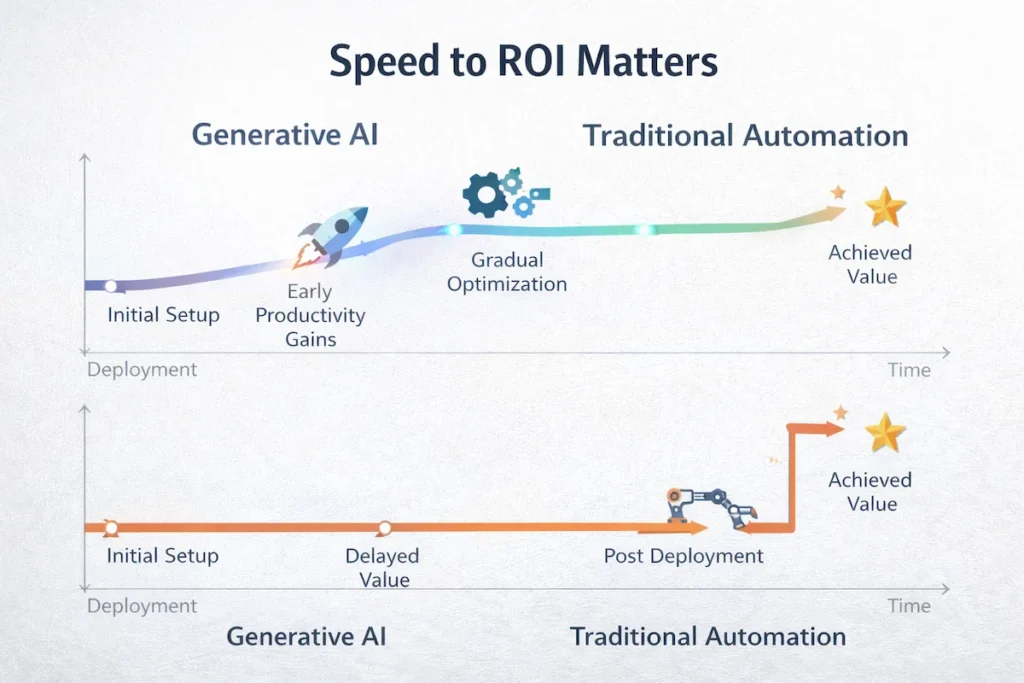
Traditional automation ROI delivers nothing until deployment completes. You spend months planning before processing your first transaction automatically. The value curve looks like a hockey stick: flat during implementation, then jumping to full value at launch.
Generative AI ROI can start accumulating during implementation. Teams use the system for real work while optimizing it. A marketing team might achieve 60% efficiency gains in month one, 75% in month three, and 85% in month six as they refine their approach. Break-even timelines favor generative AI ROI for knowledge work, often achieving payback in 6 to 18 months versus 12 to 24 months for traditional automation.
Long-Term ROI Sustainability
Five-year calculations tell a different story than year-one returns. Traditional automation delivers consistent value if your processes remain stable. The system that saves $200,000 annually will likely save $200,000 in year five.
Generative AI ROI trajectories are less predictable but potentially more valuable. The technology improves continuously as underlying models get better. Your system gets more capable over time without additional investment. Traditional automation faces obsolescence risk when business models change, while generative AI ROI is more resilient because systems adapt to new tasks.
Real-World ROI Use Cases
Abstract comparisons matter less than specific business scenarios. Generative AI ROI and traditional automation ROI vary dramatically based on use case and industry.
Marketing and Content Automation ROI
Marketing departments see the starkest differences between generative AI ROI and traditional automation ROI. Traditional automation excels at email workflow and lead scoring. One e-commerce company used generative AI to create unique product descriptions for 50,000 SKUs, costing $120,000 for implementation but replacing $400,000 in annual freelance copywriting costs.
For businesses exploring AI tools for digital marketers in 2026, the combination delivers 3X to 5X higher conversion rates. Traditional automation handles segmentation while generative AI ROI emerges through personalized message content.
Customer Support ROI Comparison
Customer support operations reveal traditional automation ROI limitations clearly. Rule-based chatbots resolve 20% to 30% of inquiries automatically. Generative AI ROI in customer support addresses the 70% of inquiries traditional bots escalate. One software company saw first-contact resolution improve from 30% to 65%, reducing support staff needs by 40%.
Companies implementing AI for customer experience in SaaS platforms report that generative AI ROI includes indirect benefits like identifying product issues from support conversations. These secondary benefits often exceed primary cost savings.
Data Analysis and Decision-Making ROI
Data analytics represents traditional automation’s strongest domain. Business intelligence tools automate report generation, delivering clear traditional automation ROI through faster decision-making.
Generative AI ROI in analytics comes from insight generation rather than data processing. The system analyzes trends and generates strategic recommendations in plain English. One retail company combined both approaches—traditional automation handles data processing while generative AI ROI drives value through weekly strategic briefings that reduced analysis time from 20 hours to 2 hours.
Hidden Costs That Reduce ROI
ROI calculations fail when they ignore indirect costs that emerge months after implementation. Both generative AI ROI and traditional automation ROI suffer from hidden expenses.
Training and Skill Gaps
Traditional automation ROI depends on having developers who understand your business processes. Most companies hire consultants at $150 to $300 per hour. Training existing staff costs $5,000 to $15,000 per person.
Generative AI ROI faces different skill challenges. Your team needs to understand prompt engineering and output validation. Companies either hire AI specialists at $150,000 to $250,000 annually or train existing staff for $8,000 to $20,000 per person. The ongoing learning curve affects sustainability—budget 40 to 60 hours annually per team member for keeping generative AI ROI skills current.
Model Maintenance vs Automation Maintenance
Traditional automation ROI deteriorates through technical debt. Maintenance consumes 20% to 40% of original implementation costs annually. A $100,000 automation project requires $20,000 to $40,000 yearly to keep functioning.
Generative AI ROI has different maintenance patterns. Models improve automatically as providers update them. However, you need continuous output monitoring and prompt optimization, costing $50,000 to $100,000 annually. Quality drift affects generative AI ROI in ways traditional automation avoids—model updates occasionally degrade performance on your specific use case.
Compliance, Risk, and Governance Costs
Regulated industries face substantial hidden costs with generative AI ROI. Financial services and healthcare need audit trails proving how systems make decisions. This creates compliance headaches costing $50,000 to $200,000 annually in additional oversight.
Traditional automation ROI benefits from deterministic processes that satisfy regulators. Audit costs are minimal because the logic is transparent. Risk management costs hurt generative AI ROI even in unregulated industries—companies need human review workflows and escalation procedures that add ongoing expenses.
Which Delivers More ROI for Different Business Sizes?
Business size fundamentally changes the generative AI ROI versus traditional automation ROI equation. Technologies that work brilliantly for enterprises might destroy value for startups.
Startups and Small Businesses
Small businesses under $10 million revenue typically see better generative AI ROI than traditional automation ROI. Implementation costs for traditional automation represent enormous percentages of revenue, and small companies lack the transaction volumes that make fixed-cost systems profitable.
Generative AI ROI works for small businesses because they can use pre-built tools with minimal customization. A startup spends $200 monthly on AI writing tools and $500 monthly on AI customer support, getting enterprise capabilities for a few thousand dollars annually. The flexibility advantage matters more for small businesses navigating uncertain markets—generative AI ROI survives pivots because the same tools apply to new use cases.
Mid-Sized Companies
Companies between $10 million and $500 million revenue face the most complex decisions. They have enough volume for traditional automation to deliver strong returns but enough complexity that generative AI ROI creates substantial value through flexibility.
The optimal strategy combines both technologies. One manufacturing company with $80 million revenue spent $180,000 on traditional automation for supply chain and $140,000 on generative AI ROI initiatives for customer service. Combined returns exceeded 300% in year one.
Large Enterprises
Enterprises above $500 million revenue see the highest absolute returns from both technologies. Traditional automation ROI at enterprise scale can be extraordinary—one insurance company saves $6.8 million annually after a $2.4 million implementation.
Generative AI ROI for enterprises comes from tackling previously impossible automation targets. Large companies have thousands of knowledge workers doing creative tasks. Giving each worker AI tools that increase productivity 20% to 40% creates hundreds of millions in value. However, enterprises spend 60% to 70% of project costs on change management rather than technology itself, which impacts generative AI ROI timelines significantly.
Frequently Asked Questions
What’s the typical generative AI ROI timeline for mid-sized businesses?
Most mid-sized companies achieve positive generative AI ROI within 6 to 18 months. Initial value appears in weeks as teams start using the technology, but full optimization takes several months. The exact timeline depends on use case complexity and organizational adaptation speed. Companies that invest in proper training typically see break-even at the 12-month mark.
Can small businesses afford generative AI implementation?
Yes. Small businesses see some of the best generative AI ROI because they can use pre-built tools with minimal customization. Monthly costs run $200 to $2,000 depending on usage, far more affordable than traditional automation starting at $30,000. Cloud-based solutions eliminate infrastructure costs and allow pay-as-you-go pricing that scales with growth.
Does generative AI ROI improve over time?
Generative AI ROI typically improves as your team learns better prompt engineering and underlying models get more capable. Companies often see 20% to 40% efficiency improvements between month 3 and month 12. Traditional automation returns remain constant after implementation, while generative AI ROI compounds through continuous model improvements.
What industries see the highest generative AI ROI?
Professional services, marketing, content creation, and customer support show the strongest generative AI ROI. These industries have high labor costs for creative work that scales poorly. Manufacturing and logistics often see better traditional automation returns because their processes are standardized and rule-based.
How do you measure generative AI ROI accurately?
Track both hard and soft metrics for accurate generative AI ROI measurement. Hard metrics include cost savings from reduced labor and increased output per employee. Soft metrics include customer satisfaction improvements and employee retention. Most companies see 60% of returns in direct savings and 40% in strategic benefits like market expansion.
What’s the biggest mistake companies make with generative AI ROI calculations?
Underestimating ongoing quality assurance costs is the biggest generative AI ROI mistake. Many companies budget for implementation and API costs but forget that outputs require human review. This oversight leads to projections that are 30% to 50% too optimistic. Always include monitoring and governance costs for realistic returns.
Final Verdict: Generative AI or Traditional Automation?
Neither technology dominates across all scenarios. Generative AI ROI exceeds traditional automation ROI for creative, variable, and complex tasks. Traditional automation delivers superior returns for high-volume, rules-based, and mission-critical processes.
The decisive factors are task variability and volume. When processes stay constant and volumes are high, traditional automation wins on cost-efficiency. When tasks require judgment or creativity, generative AI ROI pulls ahead despite higher per-transaction costs.
Most companies benefit from both. Use traditional automation as your operational backbone. Layer generative AI on top for customer-facing interactions and content creation. Businesses exploring how AI is redefining social media marketing in 2026 find that generative AI ROI excels at content creation while traditional automation handles scheduling. This hybrid approach delivers 40% to 60% better combined returns than choosing one technology exclusively.
The long-term advantage tilts toward generative AI for most knowledge work. As models improve and costs decline, generative AI ROI will strengthen while traditional automation remains static. Companies should build generative AI expertise now, even if current returns slightly favor traditional approaches.
3 thoughts on “Generative AI ROI vs. Traditional Automation: Which Delivers Higher Returns?”