
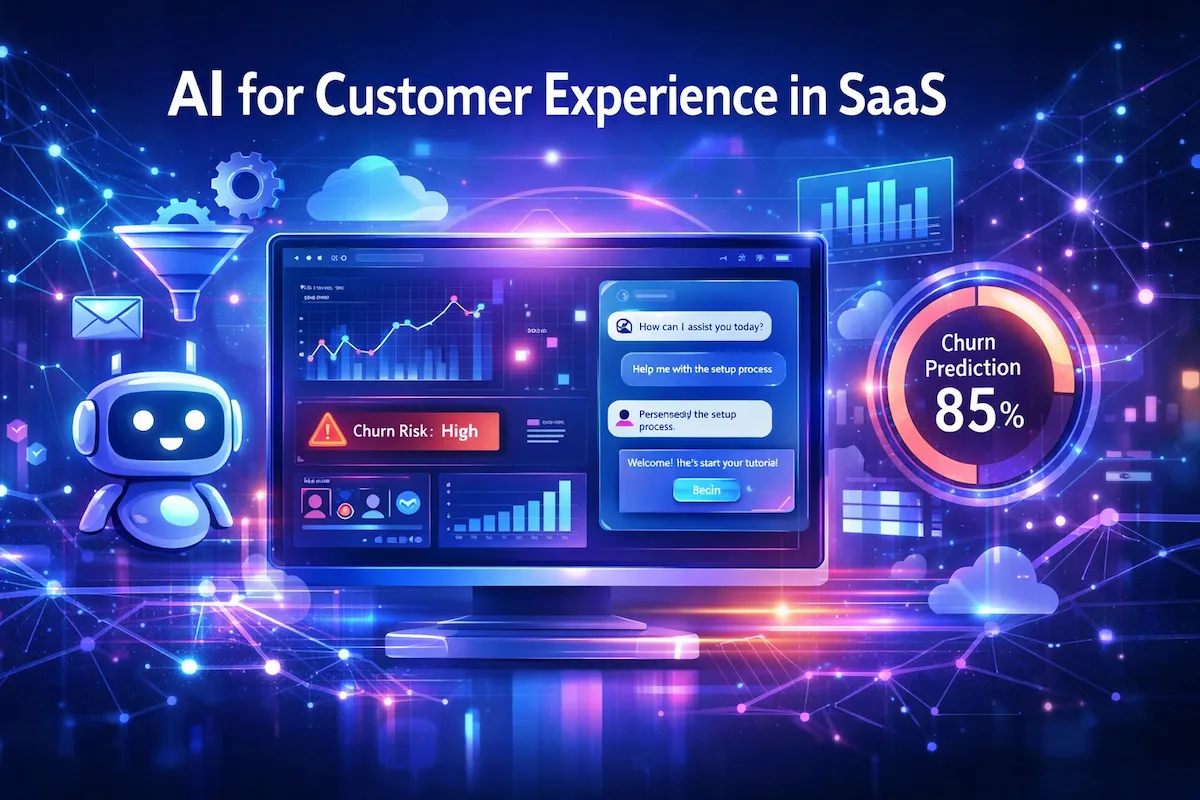
Why Customer Experience Is a Make-or-Break Factor for SaaS Companies
According to Gartner, customer experience has overtaken price and product as the primary competitive differentiator in digital markets. SaaS companies operate in a brutally competitive landscape where a single friction point during onboarding can trigger churn. Slow support responses push users toward competitors. Generic product experiences fail to engage.
Research from ProfitWell reveals that poor onboarding drives significant early churn in SaaS, with many users abandoning products within the first week. Traditional customer support struggles to scale with growth, creating bottlenecks that damage retention and revenue. The Salesforce State of the Connected Customer Report confirms that customers now expect personalized, proactive engagement rather than reactive support.
AI for customer experience in SaaS has emerged as the solution that bridges this gap. Instead of hiring proportionally to user growth, smart SaaS companies deploy AI to personalize interactions, predict issues before they escalate, and deliver instant support at any scale. Just as businesses prioritize cloud security tips for protecting your data online, implementing AI requires careful attention to data protection and user privacy.
What Is AI-Driven Customer Experience in SaaS?
AI for customer experience in SaaS means using machine learning, natural language processing, and predictive analytics to automate and enhance how users interact with your platform. According to Forrester, AI-driven CX automation improves operational efficiency while delivering the personalized experiences customers demand. Unlike traditional tools that react to problems, AI anticipates needs, personalizes journeys, and resolves issues proactively.
AI vs Traditional CX Tools for SaaS
Traditional customer experience tools follow rigid, rule-based workflows. A user submits a ticket, waits for assignment, and receives a templated response. This approach fails when complexity increases or user volume spikes.
AI for customer experience in SaaS works differently through pattern learning. Systems detect when a user struggles with a specific feature and trigger contextual help. The Zendesk CX Trends Report shows that AI routing significantly improves ticket resolution time by automatically directing queries to the right agents. These systems analyze sentiment in support conversations and predict which accounts will churn based on usage patterns and engagement scores.
Where SaaS Platforms Struggle Without AI for Customer Experience
Without AI for customer experience in SaaS, companies face consistent pain points. New users get identical onboarding flows regardless of their technical skill or use case. Support teams drown in repetitive questions that could be automated. Churn happens silently because engagement drops go unnoticed until cancellation.
Manual processes cannot scale. The HubSpot Customer Service Trends Report emphasizes that customers expect fast, personalized responses across all channels. Traditional approaches require linear hiring, while AI provides logarithmic efficiency gains. Understanding cloud visibility vs understanding in 2026 helps companies recognize that merely seeing data is not enough—AI transforms raw visibility into actionable insights.
How AI Improves Customer Experience in SaaS Platforms
Implementing AI for customer experience in SaaS transforms how platforms serve users. The technology works across three critical dimensions: personalization, prediction, and automation. Research from IBM demonstrates that AI chatbots can reduce support costs by up to 30% while maintaining or improving service quality.
Personalized Onboarding Flows Using AI for Customer Experience in SaaS
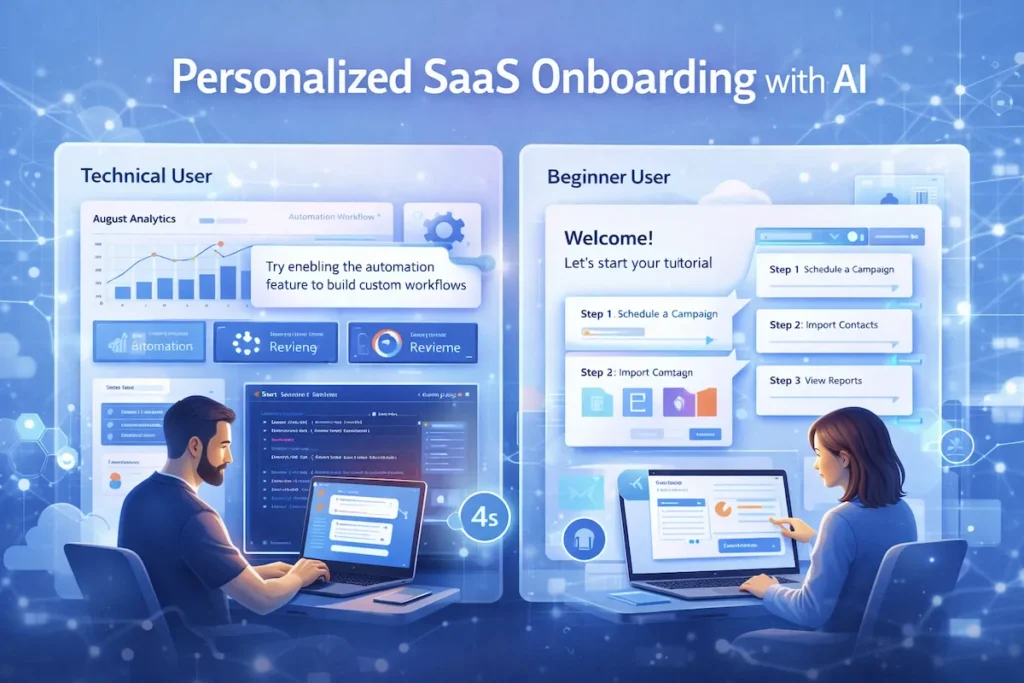
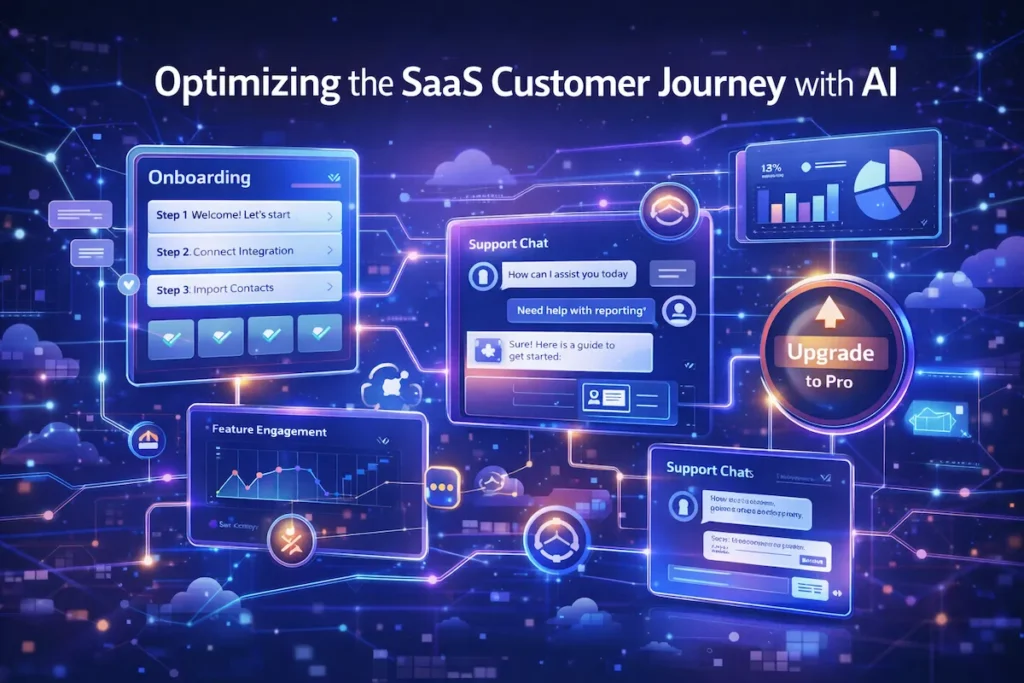
AI analyzes user behavior from the first login. If someone skips tutorials and navigates directly to advanced features, the system recognizes technical proficiency and adjusts. New users who hesitate receive progressive disclosure, showing one feature at a time rather than overwhelming them.
This personalization addresses what the Salesforce State of the Connected Customer Report identifies as a critical expectation: customers want experiences tailored to their specific needs and context. AI for customer experience in SaaS delivers role-based guidance where a marketing manager sees campaign templates, while a developer gets API documentation. The platform adapts in real-time based on clicks, time spent, and feature adoption patterns.
Predictive Support & Issue Detection with AI for Customer Experience in SaaS
AI for customer experience in SaaS monitors behavioral signals that precede problems. Repeated attempts to access a locked feature suggest confusion about plan limits. Multiple failed imports indicate data formatting issues. A sudden drop in daily logins flags potential abandonment.
Smart systems intervene before frustration becomes churn. They surface help articles contextually, trigger proactive outreach from customer success teams, or automatically adjust permissions to unlock workflows. Research from McKinsey indicates that predictive analytics can reduce churn by 15-20% when paired with structured intervention workflows. The goal is solving problems users have not yet articulated.
Real-Time User Behavior Analysis in AI for Customer Experience in SaaS
Every interaction generates data that AI for customer experience in SaaS processes instantly uses to understand intent, detect friction, and optimize experiences. If users consistently abandon a multi-step process at step three, AI identifies the drop-off point and can recommend simplified workflows or additional support.
Behavior analysis also powers feature discovery. Users rarely explore full product capabilities, but AI can suggest relevant tools based on current activities. Someone building reports frequently might benefit from automation features they never noticed.
Key Use Cases of AI for Customer Experience in SaaS
Real-world applications demonstrate how AI for customer experience in SaaS solves specific business challenges. These use cases represent proven approaches already deployed at scale.
AI Chatbots for 24/7 SaaS Customer Experience Support
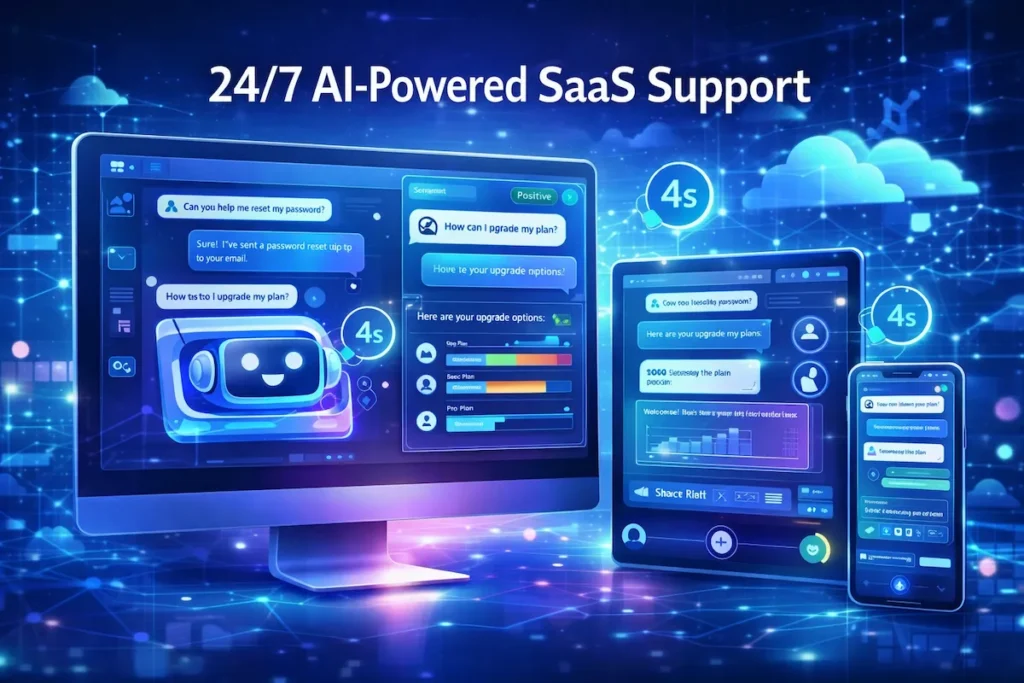
Modern AI chatbots handle tier-one support autonomously in AI for customer experience in SaaS implementations. They answer billing questions, explain features, troubleshoot common errors, and guide users through complex workflows without human intervention. IBM research shows that organizations implementing AI chatbots reduce support costs by up to 30% while handling higher volumes.
What separates effective implementations from basic FAQ bots is contextual awareness. Advanced systems know user history, current plan details, and recent activity. They provide answers specific to individual situations rather than generic responses. When complexity exceeds AI capability, seamless handoff to human agents preserves conversation context.
The business impact is measurable: significant reduction in support ticket volume, response times under 10 seconds, and 24/7 availability that improves customer satisfaction across time zones.
Predictive Churn Detection Through AI for Customer Experience in SaaS
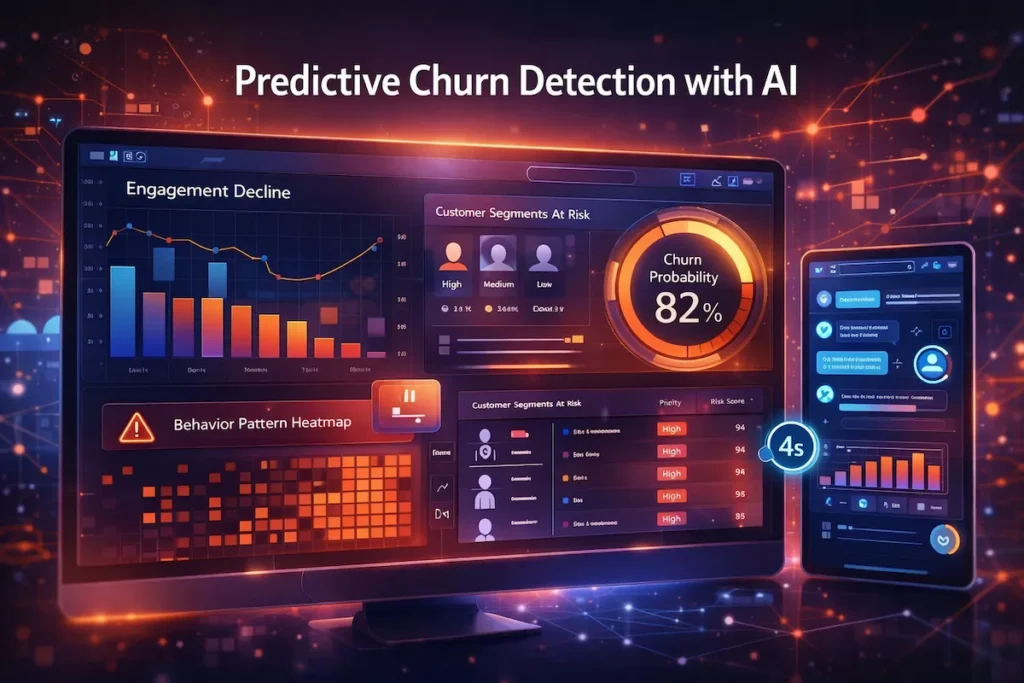
AI for customer experience in SaaS excels at identifying at-risk accounts before they cancel. Machine learning models analyze dozens of variables: login frequency, feature adoption, support ticket sentiment, invoice payment speed, and engagement with marketing emails.
These signals combine into churn probability scores. Accounts above the threshold trigger retention workflows: personalized check-ins, feature training offers, or discount incentives. McKinsey research demonstrates that predictive analytics can reduce churn by 15-20% when companies act on insights with systematic intervention. Early intervention recovers customers who would otherwise leave silently.
The key is acting on predictions. Knowing an account might churn is useless without systematic follow-up. Successful SaaS companies integrate churn scores directly into CRM systems, creating automated playbooks for customer success teams.
Smart Product Recommendations Using AI for Customer Experience in SaaS
Product-led growth depends on users discovering value through AI for customer experience in SaaS. Recommendation engines surface relevant features, integrations, and workflows based on how similar users behave.
If your analytics show that project management users who enable time tracking upgrade to premium plans at higher rates, AI pushes that feature prominently to new accounts matching the profile. Cross-sell opportunities emerge from usage patterns, not generic marketing campaigns.
Automated Feedback & Sentiment Analysis in AI for Customer Experience in SaaS
Collecting feedback is easy. Making sense of thousands of responses is where AI for customer experience in SaaS proves essential. Natural language processing categorizes comments, identifies recurring themes, and flags urgent issues requiring immediate attention.
Sentiment analysis goes deeper than star ratings. It detects frustration in support conversations, excitement in product reviews, and confusion in onboarding surveys. Product teams get actionable insights without manually reading every response.
AI-Based User Journey Optimization for SaaS Customer Experience
User journeys rarely follow intended paths. AI for customer experience in SaaS maps actual behavior, revealing where users struggle, which features drive activation, and what sequences lead to conversion.
This visibility enables optimization. If data shows users who complete integration setup within 48 hours retain at significantly higher rates than slower adopters, AI can prioritize integration prompts during onboarding. Small adjustments compound into significant retention improvements.
Best AI Tools for Customer Experience in SaaS Platforms
Choosing the right AI for customer experience in SaaS requires matching capabilities to specific needs. These platforms represent current market leaders, each with distinct strengths and limitations.
Zendesk AI – Support Automation for SaaS Customer Experience
Zendesk AI excels at ticket deflection and agent productivity in AI for customer experience in SaaS deployments. Its Answer Bot handles common questions autonomously, while intelligent routing assigns complex issues to specialists based on content analysis. The Zendesk CX Trends Report highlights how AI routing significantly improves resolution times.
Key strength: Enterprise-grade reliability with proven scalability for large support operations.
Limitation: Higher cost structure makes it prohibitive for early-stage SaaS companies with limited budgets.
Intercom AI – Conversational Customer Experience for SaaS
Intercom combines messaging, automation, and AI for customer experience in SaaS into a unified platform. Resolution Bot answers questions, while Product Tours guide users through features contextually.
Key strength: Seamless integration between marketing, sales, and support creates continuous customer journeys.
Limitation: Complex pricing tiers and feature gates can lead to unexpected costs as usage scales.
Freshdesk AI for Mid-Market SaaS Customer Experience
Freshdesk Freddy AI automates repetitive support tasks in AI for customer experience in SaaS environments, suggests solutions to agents, and predicts ticket fields to speed up workflows.
Key strength: Competitive pricing with robust features makes it accessible for mid-market SaaS companies.
Limitation: AI capabilities lag behind specialized platforms in advanced use cases like deep sentiment analysis.
HubSpot Service Hub AI for Integrated SaaS Customer Experience
HubSpot leverages AI for customer experience in SaaS across its Service Hub for customer feedback analysis, conversation routing, and knowledge base optimization. Their Customer Service Trends Report shows that customers increasingly expect fast, personalized responses across channels.
Key strength: Native CRM integration provides complete customer context for AI-powered support.
Limitation: Best results require full HubSpot ecosystem adoption, limiting flexibility for companies using other tools.
Gainsight – Customer Success AI for Enterprise SaaS Experience
Gainsight specializes in AI for customer experience in SaaS through proactive success management. Its platform predicts renewal likelihood, identifies expansion opportunities, and automates health scoring.
Key strength: Purpose-built for B2B SaaS with sophisticated account management capabilities.
Limitation: Enterprise focus and pricing exclude smaller SaaS businesses from access.
AI for Customer Experience in SaaS: Tool Comparison
| Tool | Best For | SaaS Size | Key Benefit |
|---|---|---|---|
| Zendesk AI | Enterprise support | Large | Proven scalability |
| Intercom AI | Conversational CX | Medium to Large | Unified platform |
| Freshdesk AI | Mid-market support | Small to Medium | Cost-effective |
| HubSpot Service Hub | CRM-integrated support | All sizes | Full context |
| Gainsight | Customer success | Enterprise | Proactive management |
Benefits of Using AI for Customer Experience in SaaS
Deploying AI for customer experience in SaaS delivers measurable advantages, but understanding both benefits and drawbacks ensures realistic expectations.
Pros:
Reduced churn: Predictive models in AI for customer experience in SaaS identify at-risk accounts early, enabling intervention before cancellation. McKinsey research shows that predictive analytics can reduce churn by 15-20% when paired with structured retention workflows.
Faster response times: AI chatbots resolve tier-one issues instantly, eliminating queue times for common questions. IBM data confirms that AI chatbots reduce support costs by up to 30% while delivering faster service.
Scalable support: Traditional support requires linear hiring as user base grows. AI for customer experience in SaaS handles exponential volume increases without proportional cost increases, maintaining quality as you scale. According to Forrester, AI-driven CX automation significantly improves operational efficiency.
Cons:
Initial setup complexity: Implementing AI requires data integration, model training, and workflow redesign. Expect 3-6 months before seeing full value from enterprise deployments.
Over-automation risk: Excessive reliance on AI frustrates users who need human judgment. Balance automation with accessible escalation paths to real agents.
Data dependency: AI quality reflects data quality in AI for customer experience in SaaS implementations. Incomplete customer records, inconsistent tagging, or insufficient historical data limit AI effectiveness.
Challenges of Implementing AI for Customer Experience in SaaS
Understanding obstacles helps SaaS companies prepare realistic implementation strategies for AI for customer experience in SaaS.
Data Quality Issues in AI for Customer Experience in SaaS
AI models trained on poor data produce poor results. Common problems in AI for customer experience in SaaS include duplicate customer records, inconsistent field formatting, missing contact information, and outdated usage data.
Address this by implementing data governance before AI deployment. Standardize customer data entry, deduplicate records systematically, and establish ongoing data quality monitoring. Just as cloud backup and disaster recovery readiness protects business continuity, solid data governance protects AI effectiveness.
AI Bias in SaaS Customer Experience Systems
Machine learning models in AI for customer experience in SaaS reflect biases in training data. If your historical support data shows faster resolution for enterprise accounts versus small businesses, AI may perpetuate preferential treatment.
The World Economic Forum emphasizes that ethical AI deployment requires governance and transparency. Mitigate bias through diverse training data, regular audits of AI decisions, and human oversight of automated actions. Learning from major cybersecurity incident analysis in 2026 shows that systematic auditing prevents small issues from becoming major problems.
User Privacy Concerns with AI for Customer Experience in SaaS
AI systems in AI for customer experience in SaaS process sensitive customer data including usage patterns, support conversations, and behavioral analytics. Users increasingly question how companies use this information.
Transparency builds trust. Clearly communicate what data AI uses, how predictions are generated, and what controls users have over their information. The European Commission GDPR guidelines require rigorous compliance with data protection standards. Follow GDPR, CCPA, and relevant regulations strictly.
Is AI for Customer Experience in SaaS Safe & Ethical?
Responsible deployment of AI for customer experience in SaaS requires attention to compliance, transparency, and human oversight.
Compliance mindset: Treat data privacy as a foundation, not an afterthought. The European Commission’s GDPR guidelines establish clear standards for handling personal data. Implement compliant data handling, obtain proper consent for AI processing, and provide clear opt-out mechanisms. Regular compliance audits identify gaps before they become violations. Conducting a cloud security audit of modern cloud environments helps ensure your AI systems meet security and privacy standards.
Human-in-the-loop approach: The World Economic Forum’s guidelines for trustworthy AI emphasize that AI should augment human judgment in AI for customer experience in SaaS, not replace it entirely. Maintain clear escalation paths where complex issues route to experienced agents. Review AI decisions periodically to catch errors and bias.
Transparency and trust: Users deserve to know when AI handles their interactions. Disclose AI usage in support conversations, explain how churn predictions work, and document what data feeds recommendation engines. Transparency reduces suspicion and builds confidence in your platform.
FAQs About AI for Customer Experience in SaaS
How does AI improve customer experience in SaaS?
AI for customer experience in SaaS improves interactions by personalizing onboarding, predicting problems before they escalate, automating repetitive support tasks, and analyzing user behavior to optimize journeys. According to McKinsey, these capabilities can reduce churn by 15-20% while IBM research shows AI chatbots cut support costs by up to 30%.
Can small SaaS companies use AI tools?
Yes, small SaaS companies can leverage AI for customer experience in SaaS through affordable platforms like Freshdesk AI, basic chatbot services, and lightweight analytics tools. Start with focused use cases like FAQ automation or simple sentiment analysis rather than enterprise-scale implementations.
Is AI customer support reliable?
AI customer support in AI for customer experience in SaaS reliably handles routine questions and tier-one issues when properly trained. However, complex problems requiring judgment, empathy, or creative solutions still need human agents. The most effective approach combines AI automation for common issues with seamless escalation to humans for complexity.
Which AI tool is best for SaaS CX?
The best AI for customer experience in SaaS depends on your specific needs and size. Zendesk AI suits large enterprises prioritizing support scalability. Intercom AI works well for companies wanting unified messaging. Freshdesk AI offers cost-effective features for mid-market companies. Evaluate based on your primary use case, budget, and existing tech stack.
Should SaaS Companies Invest in AI for Customer Experience?
The decision to implement AI for customer experience in SaaS depends on your stage, resources, and specific pain points. Gartner research confirms that customer experience has become the primary competitive battlefield, making AI implementation increasingly essential.
For early-stage SaaS companies, start small with targeted AI applications. Deploy a basic chatbot for FAQ deflection, or implement simple sentiment analysis on support tickets. These low-cost implementations deliver immediate value while you build the data foundation for more sophisticated AI later.
For scaling SaaS companies facing growth challenges, AI for customer experience in SaaS becomes essential rather than optional. When support volume overwhelms your team, when churn rates climb despite hiring customer success managers, or when personalization is impossible to deliver manually, AI provides the leverage needed to maintain quality at scale.
The competitive advantage goes to companies that deploy AI strategically. Match tools to specific problems, maintain human oversight following World Economic Forum guidelines for trustworthy AI, and treat implementation as an ongoing process rather than a one-time project.
Ready to improve your customer experience? Start by auditing current pain points, researching platforms that address your specific challenges, and testing free trials before committing. AI for customer experience in SaaS works best when aligned with clear business objectives and measured against concrete outcomes.
3 thoughts on “Using AI for Customer Experience in SaaS Platforms: Practical Use Cases & Tools”
Comments are closed.