
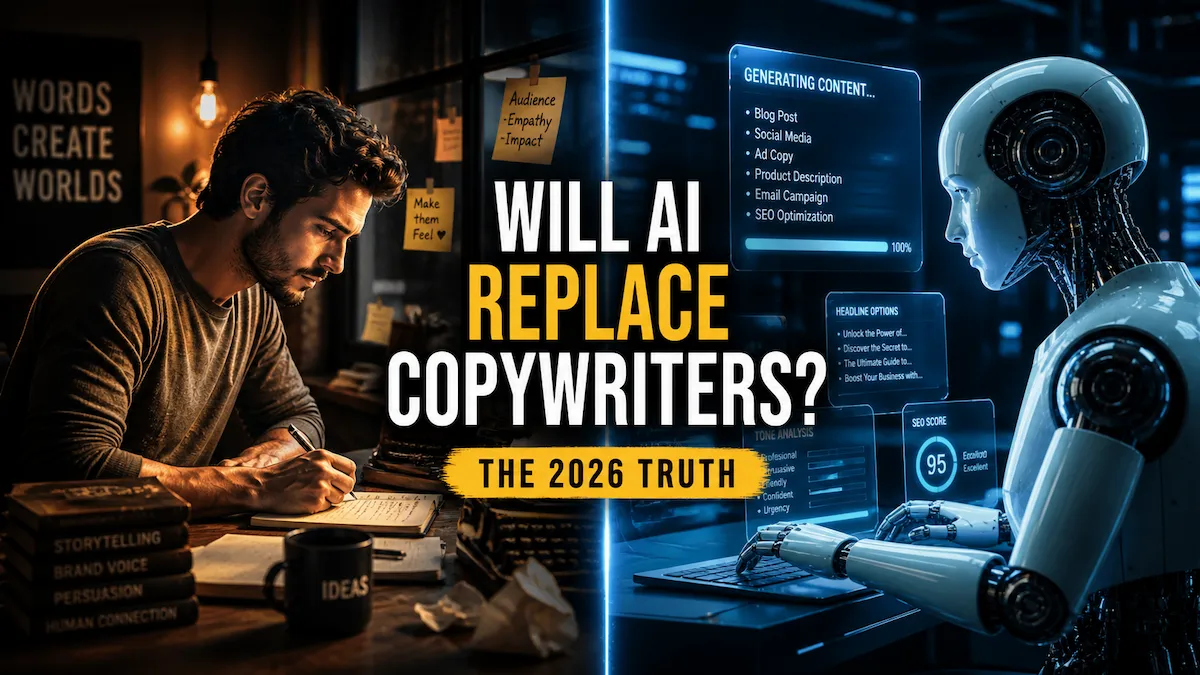
Will AI replace copywriters? It’s the question keeping thousands of writers up at night—and you deserve a straight answer, not corporate fluff.
Here it is upfront: No. AI will not fully replace copywriters. But it will absolutely destroy the ones who refuse to adapt.
AI isn’t replacing copywriters. It’s exposing them.
The biggest threat to copywriters isn’t AI—it’s being average in an AI-powered world.
This isn’t a lukewarm take. It’s backed by what’s actually happening in the marketplace right now. According to a 2026 industry study, 97% of content marketers now plan to use AI to support their content efforts—and yet brands are still hiring skilled copywriters at premium rates. That tension tells you everything.
📊 Key Insight: 97% of marketers now use AI—but brands using human-led strategy consistently outperform AI-only content in both engagement and conversions.
Below is the complete, unfiltered breakdown of what AI can and cannot do, what the data says, and exactly how to win in this new era.
Quick Answer: Will AI Replace Copywriters?
Will AI replace copywriters?
No. AI will replace low-skill, repetitive writing tasks—but it cannot replace strategic, emotionally driven, and experience-based copywriting.
Writers who adapt will thrive. Writers who treat copy as a mechanical task will be replaced.
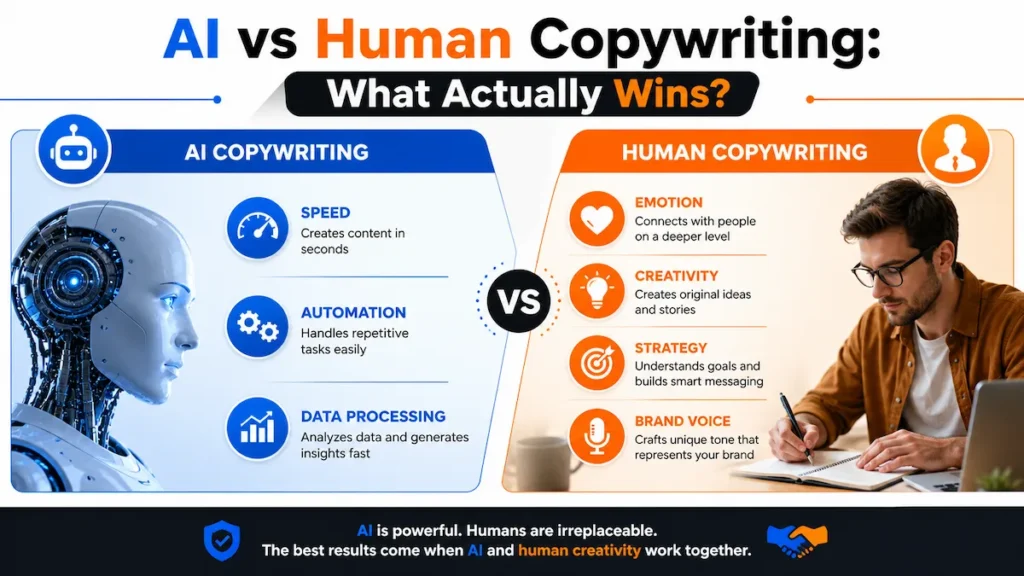
Will AI Replace Copywriters? The Honest Expert Answer
The answer is no—with a massive asterisk.
Will AI replace copywriters who only offer speed and volume? Yes. Already happening.
If your value is purely putting words on a page fast, AI does that cheaper and better than any human ever could. But if your value lies in strategic thinking, emotional intelligence, brand intuition, and persuasion built on real human experience—you’re in a stronger position than ever.
The copywriters who will lose jobs are those who treat writing as a mechanical task. The ones who will thrive treat it as a strategic discipline.
Here’s where most people get it wrong:
They assume AI is competing with skilled copywriters. It’s not. AI is competing with low-skill content production—and winning easily.
What remains untouched is everything that actually moves people to act: strategy, empathy, voice, and persuasion rooted in real human understanding.
The real disruption isn’t AI taking copywriters’ jobs. It’s AI exposing which copywriters were never truly skilled to begin with.
AI doesn’t lose jobs. Mediocre positioning does.
Why Everyone Thinks Will AI Replace Copywriters Is Already Happening
Will AI Replace Copywriters? The Explosion of AI Writing Tools Made Everyone Panic
The explosion of AI writing tools like ChatGPT, Claude, Jasper, and Copy.ai has been staggering in speed and scale. These tools produce a 1,000-word blog post in under 30 seconds. They write product descriptions in bulk, generate email sequences, and mimic brand voice—passably, if not authentically.
For business owners watching content costs, this looks like a miracle. Why pay a human copywriter $150 per article when AI produces something serviceable for pennies?
This single question is driving the will AI replace copywriters debate harder than anything else right now. But that logic misses the entire point of what great copywriting actually does.
For how brands are actually deploying AI in marketing versus what people fear, read the full breakdown: AI in Advertising: Powerful Strategies and Tools.
Will AI Replace Copywriters? Cost Reduction Pressure Is the Real Business Driver Behind This Debate
Let’s be blunt: money is what’s truly fueling this conversation.
Companies are under enormous pressure to cut content costs, and AI offers the easiest lever available. In the short term, many businesses are replacing entry-level writing roles with AI tools and slashing freelance budgets dramatically.
This is a real trend—not scaremongering. But cost-cutting rarely wins in marketing long-term. Businesses that sacrifice copy quality for volume almost always see engagement drop, trust erode, and conversions stall within two to three content cycles.
To understand how this same pressure is reshaping all content roles, explore the full breakdown on will AI replace content writers in 2026 to understand the broader shift happening across the industry.
Will AI Replace Copywriters by Winning the Speed vs. Quality Debate? Not Even Close
AI is blindingly fast. Humans are comparatively slow. That’s not a debate worth having—AI wins on raw speed every single time.
But the real question was never speed. It’s results.
Which copy actually converts? Which content builds brand loyalty? Which words make someone feel understood enough to click “Buy”?
Here’s the reality: nearly 69% of readers can still sense when writing lacks human depth or personal tone—even when they can’t articulate exactly why.
Speed without results is just noise. And the internet is already drowning in AI-generated noise. Will AI replace copywriters by being faster? No—because fast and effective are not the same thing.
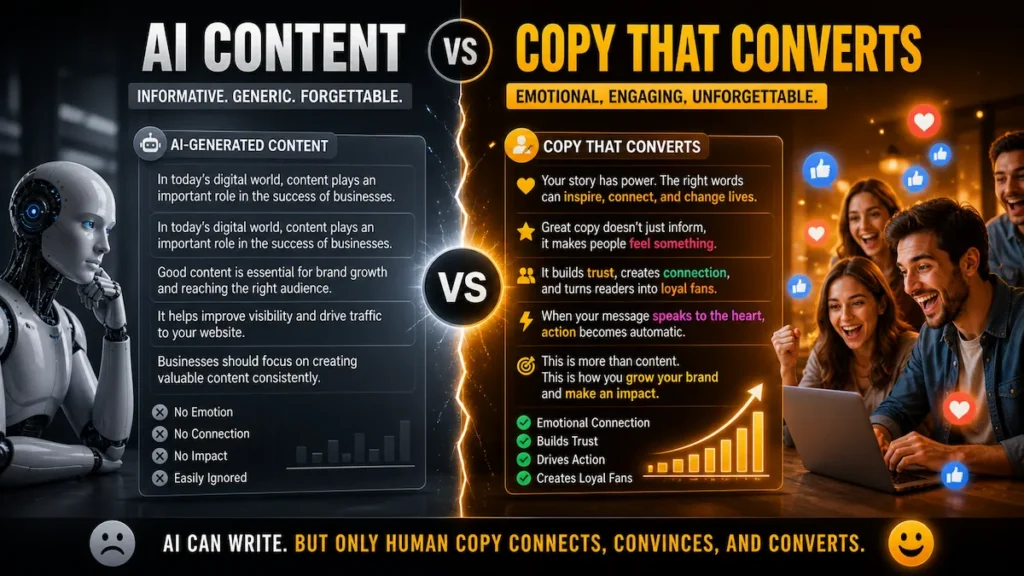
Will AI Replace Copywriters in These Areas?
What AI Actually Does Better Than Human Copywriters
Let’s be blunt: AI genuinely excels at volume.
Five hundred product descriptions following the same template? Done in minutes instead of weeks. SEO-driven location pages, meta descriptions, standardized email templates—for content automation at this scale, AI is a superior tool. Full stop.
Studies show AI-assisted teams produce up to 3x more content without sacrificing performance when guided by human strategy. Brands combining AI and human editing are already reducing production time by 50–70%.
That’s not a threat to great copywriters. That’s AI handling the boring, repetitive work human writers never wanted to do anyway.
Will AI Replace Copywriters for Data-Driven SEO Writing?
AI tools trained on massive datasets can optimize for semantic relevance and content structure faster than any human. They identify content gaps, analyze top-ranking pages, and scaffold SEO articles in seconds.
Google’s Search Central guidelines make clear that what matters is accuracy, quality, and genuine helpfulness—not whether AI or a human wrote the first draft.
The key word is assisted. AI informs and accelerates. Humans shape the narrative and ensure it serves a real reader, not just an algorithm.
Explore the full picture of how this is reshaping search roles: will AI replace SEO jobs in 2026 to understand how search roles are evolving under these exact pressures.
Will AI Replace Copywriters for Repetitive Automation Tasks?
AI can personalize email sequences based on user behavior, update ad copy based on live performance data, and generate A/B test variants at a volume no human team could match.
Now here’s the part nobody talks about: this automation isn’t the threat writers fear—it’s actually a gift.
It eliminates the lowest-value work from the copywriter’s plate entirely, freeing skilled writers to focus on the strategic, creative, high-conversion work that AI genuinely cannot do.
So will AI replace copywriters for mechanical execution tasks? Yes. And skilled copywriters should welcome it.
AI vs. Human Copywriting—Full Comparison
| Factor | AI Copywriting | Human Copywriting |
|---|---|---|
| Speed | Extremely fast | Moderate |
| Creativity | Pattern-based recombination | Original and insight-driven |
| Emotional Depth | Simulated | Real and lived |
| Strategy | Limited | Advanced |
| Brand Voice | Generic default | Distinct and authentic |
| EEAT Compliance | Weak alone | Strong with expertise |
| Conversion Power | Medium | High |
| Cost at Scale | Very low | Higher |
The verdict on will AI replace copywriters: AI wins on speed and scale. Humans win on everything that actually drives results.
Where the “Will AI Replace Copywriters” Argument Completely Fails
Will AI Replace Copywriters’ Emotional Intelligence? Here’s Why That’s Impossible
Great copywriting isn’t about words. It’s about understanding people at a deeply human level—their fears, desires, identity, and ambitions.
The best copy makes readers feel seen. It triggers something visceral. It builds trust through emotional resonance that logic alone cannot manufacture.
AI has no emotional intelligence. It has pattern recognition trained on descriptions of human emotion—which is fundamentally not the same thing.
“AI can write words that look like empathy. It cannot write words that feel like empathy. That difference is the entire job.”
Here’s where most people get it wrong: they judge AI copy on how it reads, not on how it converts. Copy that reads fine but fails to connect emotionally does not convert.
That gap—between readable and resonant—is where human copywriters live and where AI cannot follow.
📊 Case Study Snapshot:
A SaaS brand A/B tested AI copy versus human-written messaging on their homepage. The human version—written after three hours of real customer interviews—outperformed AI copy by 34% in click-through rate and 21% in trial sign-ups within 30 days.
The difference wasn’t polish. It was the use of exact language real customers use—language that only comes from genuine human conversation, not a dataset.
Will AI Replace Copywriters’ Ability to Build Brand Voice? No—It Actually Destroys It
Every AI model is trained on the same internet. Which means every AI model produces the same default voice: neutral, clear, vaguely professional, and completely forgettable.
Brands spend years developing a distinctive voice that cuts through noise. AI averages that voice toward mediocrity every single time.
Now here’s the part nobody talks about: the brands most aggressively using unedited AI copy are actively eroding the brand equity they spent years building.
Copywriters who specialize in tone of voice development, brand messaging frameworks, and cross-channel consistency are among the most in-demand professionals in marketing right now—precisely because AI keeps proving it cannot do this.
Will AI Replace Copywriters and Satisfy Google’s EEAT Standards? Absolutely Not
Google’s EEAT framework—Experience, Expertise, Authoritativeness, Trustworthiness—is explicitly designed to surface content from humans with genuine lived experience.
AI has none of that. It has synthesized knowledge, not real experience. It has never used the product, interviewed the customer, or worked in the industry it’s writing about.
Here’s the reality: high-performing copy still requires human strategy and real insight. AI cannot replace voice-of-customer research.
For medical, legal, financial, and technical content especially, AI-generated material is actively penalized under modern search algorithms. Human copywriters with verifiable credentials and real expertise have a growing competitive advantage—not a shrinking one.
Explore the full breakdown on will AI replace SEO jobs in 2026 to understand how EEAT is reshaping what search actually rewards across every content role.
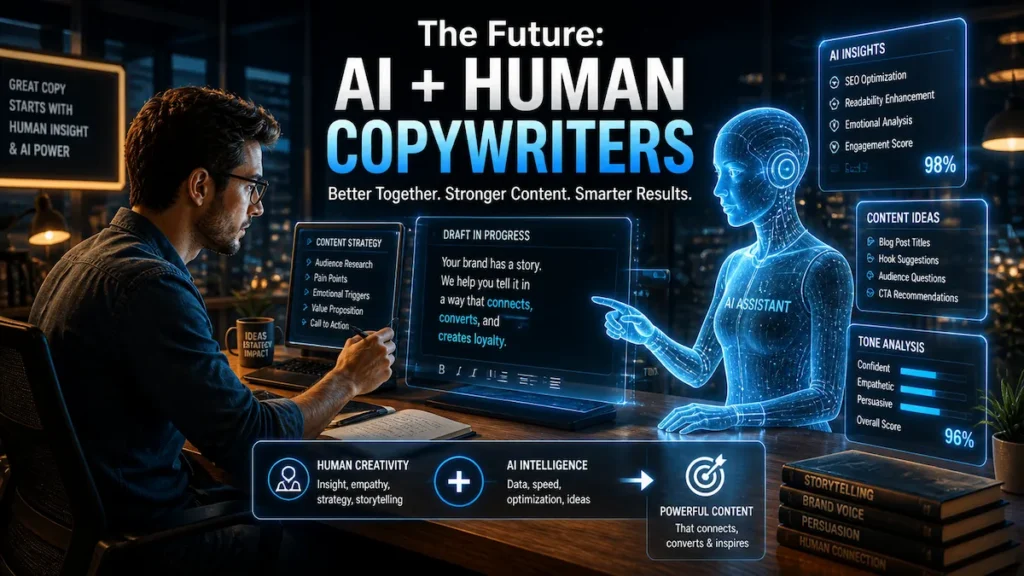
Is Copywriting Dead? The Truth Behind the Will AI Replace Copywriters Debate
No. Copywriting isn’t dead — bad copywriting is.
Let’s be blunt: what AI has killed is the market for generic, low-effort, template-driven content. That content was never great copywriting. It was content production disguised as copywriting—and it deserved to be disrupted.
Real copywriting—the kind that builds brands, shifts beliefs, drives conversions, and earns loyalty—is more alive and more valuable than it has ever been.
Here’s the reality: in a world where AI can produce unlimited average content for free, content that is genuinely exceptional becomes exponentially more rare and more valuable.
The question was never “is copywriting dead?” The question is whether you are doing copywriting that is worth keeping alive.
Why AI Content Is Becoming a Liability—The Part Nobody Talks About
Here’s where most people get it completely wrong:
They assume more AI content equals more traffic. The data says the opposite.
Near-universal AI adoption has made AI-generated content a commodity rather than a differentiator. With 97% of content marketers now using AI tools, the competitive advantage has shifted from using AI to using it well.
Brands flooding the internet with unedited AI copy are not outcompeting great copywriters. They are competing with each other for the bottom of the market—a race to mediocrity that is already producing diminishing returns in both rankings and conversions.
The copywriters asking will AI replace copywriters are worried about the wrong threat entirely. The real danger isn’t AI. It’s remaining generic in a world drowning in generic.
This same dynamic is reshaping every digital marketing role. See how other specialists are navigating this exact shift:
The Future of Will AI Replace Copywriters—What 2026–2030 Actually Looks Like
Will AI Replace Copywriters or Build a Hybrid Model? The Industry Has Already Decided
The future isn’t AI or human. It’s AI and human, in a specific hierarchy.
AI handles the mechanical layer—first drafts, research summaries, SEO structure, volume content. Humans handle strategy, emotional calibration, brand voice, and final editorial judgment.
This hybrid model is already the dominant operating structure at leading content agencies. By 2027, analysts project that over 60% of all content production workflows will involve AI assistance in some form.
The question won’t be will AI replace copywriters—it will be which copywriters know how to use AI well enough to be worth hiring.
Writers who resist this model are being left behind. Writers who master it are handling 3–5x more output—and charging accordingly.
Will AI Replace Copywriters or Create a New High-Value Professional Role?
Now here’s the part nobody talks about: the highest-paid tier of copywriting is growing, not shrinking.
A powerful new professional category is emerging: the AI-assisted copywriter.
These writers use AI tools with genuine skill—knowing when to trust the output, when to override it, and how to use AI as a creative accelerator rather than a shortcut. Research shows generative AI can improve a highly skilled worker’s productivity by nearly 40%—and skilled copywriters harnessing that multiplier are commanding above-market rates.
For how this is reshaping digital marketing career paths more broadly: Is a Digital Marketing Career Worth It in 2026?.
Will AI Replace Copywriters at the Low-Skill Level? This Part Is Already Done
Here’s the reality: if your primary value as a copywriter is speed and basic structure, AI has already surpassed you.
Entry-level content mills, low-rate article farms, and purely mechanical writing jobs are disappearing—and they are not coming back.
This isn’t catastrophe. It’s professional evolution. The same thing happened when desktop publishing replaced typesetters and when analytics replaced gut-feel reporting. The professionals who adapted thrived.
The will AI replace copywriters question, for this tier of the market, already has its answer.
Will AI Replace Copywriters? Should You Still Become One in 2026?
This is one of the highest-intent questions surrounding will AI replace copywriters—and it deserves a completely direct answer.
Yes. Absolutely—if you enter with the right positioning.
The demand for skilled, strategic copywriters has not declined. What has declined is demand for writers who treat the job as purely mechanical.
If you build skills around psychology, persuasion, brand strategy, and AI-augmented production, you are entering a market that is genuinely underserved by people with that specific combination.
The U.S. Bureau of Labor Statistics projects stable demand for writers and authors through 2032, with the fastest growth specifically in digital and content marketing roles.
AI changes how the work gets done. It does not eliminate the need for people who know how to do it exceptionally well.
How to Survive and Win When Everyone Is Asking Will AI Replace Copywriters
Will AI Replace Copywriters Who Refuse to Master AI Tools? Yes—Without Question
If you’re not actively using AI writing tools in your workflow right now, you are already behind.
Not as a replacement for your thinking—but as an accelerator of it. Learn how to prompt effectively. Understand what AI does well (structure, volume, SEO scaffolding) and where it consistently fails (emotion, specificity, authentic brand voice).
Use AI for first drafts and research. Override it everywhere that actually matters.
LinkedIn’s Workforce Report shows AI fluency is rapidly becoming a baseline expectation in senior copywriter and content strategist job postings. Ignoring this in 2026 is a career-limiting move—full stop.
Will AI Replace Copywriters Who Only Write Without Thinking Strategically? Almost Certainly
The highest-value copywriting has always been strategic: understanding the audience deeply, defining message hierarchy, mapping the emotional journey, making decisions that serve real business goals.
Here’s where most people get it wrong: they think the threat to their copywriting career is AI writing better copy. The real threat is AI writing good enough copy while they offer nothing beyond execution.
Copywriters who reposition as content strategists, brand voice architects, or conversion specialists—with writing as one capability inside a broader skill set—are essentially immune to AI displacement.
Read the full breakdown of how this shift is playing out across parallel roles: will AI replace social media managers in 2026—a role facing the exact same strategic pivot.
Will AI Replace Copywriters Who Have Built Real Authority and a Personal Brand? No
In an era of content automation, human authority is a scarcity premium.
Copywriters who build a public profile—through a newsletter, LinkedIn presence, speaking engagements, or published niche expertise—create a personal brand that AI simply cannot replicate.
Invest in building your reputation as the go-to expert in a specific industry or content type. Niche authority is the most durable career protection strategy available to any writer navigating the will AI replace copywriters era.
See how this same principle applies across specialist roles: will AI replace PPC managers in 2026.
Pros and Cons: Will AI Replace Copywriters—The Full, Honest Picture
✔ Pros of AI in Copywriting:
- ✔ Cuts content production costs by 50–70%
- ✔ Generates structured first drafts in seconds
- ✔ Scales content volume without adding headcount
- ✔ Handles repetitive, data-heavy tasks effectively
- ✔ Improves skilled writer productivity by up to 40%
- ✔ Frees human writers for strategic, high-value work
✘ Cons of AI in Copywriting:
- ✘ Lacks genuine emotional depth and empathy
- ✘ Produces a generic, forgettable default voice
- ✘ Fails Google’s EEAT requirements without human oversight
- ✘ Cannot replace voice-of-customer research or strategy
- ✘ Actively damages brand voice without expert human editing
- ✘ Produces copy that reads well but consistently underconverts
The bottom line on will AI replace copywriters: AI is a powerful tool with fundamental limitations. Understanding both sides is what separates professional writers from scared ones.
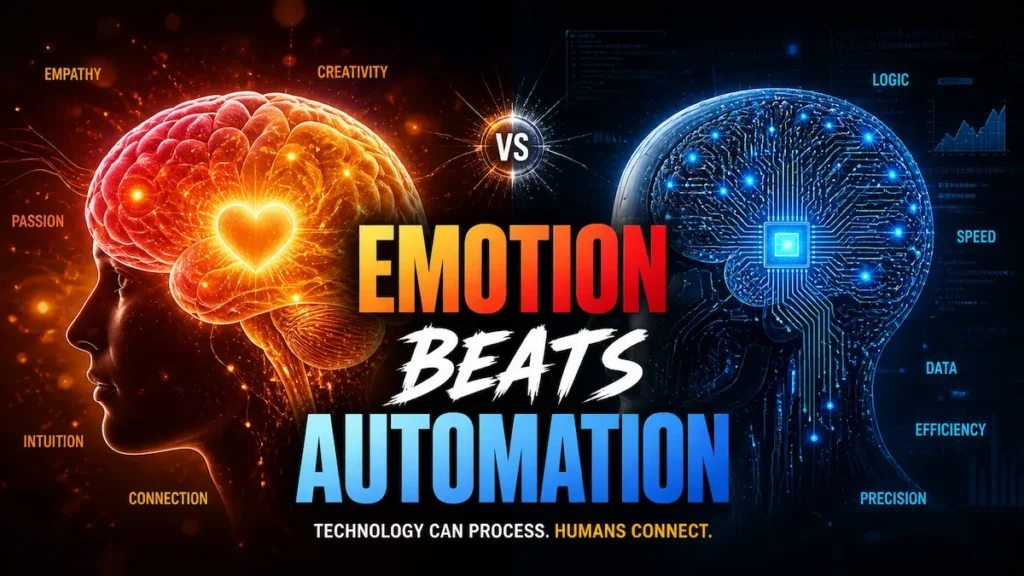
Mid-Article Reality Check: Will AI Replace Copywriters in Practical Terms?
So, will AI replace copywriters in practical, day-to-day terms?
It replaces execution-heavy, repetitive writing—but not strategy, not emotion, and not authority-driven content.
The copywriters at risk are those whose entire value proposition is execution speed. The copywriters who are safe—and thriving—are those whose value proposition is strategic thinking, audience understanding, and the ability to produce copy that actually changes behavior.
That gap is not closing. If anything, it’s widening.
Final Definition Reinforcement: So, Will AI Replace Copywriters Overall?
So, will AI replace copywriters overall?
AI will replace execution-heavy writing—but not strategic, emotional, or authority-driven copywriting.
The future belongs to hybrid writers who combine AI efficiency with human intelligence. That is not a compromise position. It is the dominant operating model for the highest-earning copywriters working today.
Final Verdict: Will AI Replace Copywriters?
Will AI replace copywriters? Not the good ones. Not the strategic ones. Not the ones who understand that their job isn’t to write words—it’s to change minds.
AI will replace writers who write like machines. It will not replace writers who think like strategists, feel like humans, and communicate like artists.
That distinction has never been clearer or more commercially valuable than it is right now.
The future of copywriting belongs to writers who use AI to go further, faster—not to writers who fear it, and not to businesses arrogant enough to think AI alone is enough.
The brutal final truth about will AI replace copywriters: AI hasn’t made copywriting less important. It has made great copywriting more important than ever.
In a world drowning in mediocre AI content, a human voice that genuinely connects is the rarest and most valuable asset in marketing.
If you’re a copywriter: adapt, upskill, and reposition. If you’re a business: invest in human writers who understand AI—because the brands winning in 2026 are the ones combining both, not choosing between them.
AI doesn’t lose jobs. Mediocre positioning does.
FAQs: Will AI Replace Copywriters?
Will AI replace copywriters in the next 5 years?
Not entirely. Low-skill, high-volume content roles are already under significant pressure. But strategic, emotionally intelligent, brand-focused copywriting will remain a premium human skill well through 2030. The profession is evolving—not disappearing.
Is copywriting a dying career because of AI?
No—but it’s transforming rapidly. The lowest-skill tier is under severe pressure. High-skill, strategic copywriting is growing in value. Writers who adapt to AI-augmented workflows and develop deeper strategic expertise are finding more opportunity, not less.
What type of copywriting is most at risk from AI?
Generic product descriptions, templated blog content, boilerplate email sequences, and simple ad copy variations face the most displacement. High-stakes copy—brand messaging, conversion landing pages, executive communications, and EEAT-driven long-form content—is far safer.
Can AI copywriting tools replace human copywriters for SEO?
For basic informational SEO content at volume, AI is genuinely effective. But for top-SERP competition in high-authority niches, human expertise remains essential. Google’s EEAT framework rewards demonstrated human experience and actively penalizes thin, low-value AI content.
How should copywriters use AI without losing their competitive edge?
Use AI for structural and mechanical tasks—outlines, research summaries, first drafts, and keyword optimization. Reserve human energy for strategy, emotional calibration, brand voice, and editorial judgment. Writers who master this division produce better work faster and command higher rates.
What skills should copywriters build to stay relevant through 2026 and beyond?
Priority skills: AI prompt engineering and tool fluency, content strategy and audience psychology, brand voice development, conversion rate optimization, and deep niche expertise in one or two specific industries. These are the capabilities AI cannot replicate—and the market is paying a significant premium for all of them.