
By a content strategist with 8+ years experience across SaaS, digital marketing, and editorial operations—having personally managed the transition from traditional content teams to AI-assisted workflows across multiple organizations.
Quick Answer: Will AI replace content writers? No—but it will replace writers who don’t offer expertise, strategy, or genuine differentiation. The question worth asking isn’t “will AI take my job?” It’s “am I the kind of writer AI can replace?”
Key Takeaways
- AI is replacing commodity writing—not expert, strategic, or niche content
- Most writers won’t be replaced by AI—they’ll be replaced by writers who use AI better than they do
- Fake EEAT and surface-level “humanized” AI content is flooding SERPs—and Google is getting better at identifying it
- The total supply of content is exploding—raising the bar for attention and differentiation, not just production volume
- The industry is splitting permanently into two groups: operators and authorities—and the gap is widening fast
AI Is Already Replacing Content Writers. Just Not the Ones You Think.
Will AI replace content writers is a question that reveals more about your positioning than AI’s actual capabilities. When ChatGPT launched, the fear was simple: AI would write everything, writers would lose everything.
That didn’t happen. But something more consequential did.
AI didn’t replace writers wholesale. It replaced the work that was never really worth much in the first place—the templated blog posts, the generic how-to articles, the keyword-stuffed content that existed to fill a content calendar rather than serve a real reader.
And in doing so, it exposed something the industry had been quietly ignoring for years: most content wasn’t differentiated. Most writers weren’t either.
Reality check: If your content can be replaced by a prompt, it will be. The question is whether you’ve built something that can’t.
AI didn’t create the problem of undifferentiated writing. It just made the consequences of it unavoidable—faster, more visibly, and with less recovery time than anyone predicted.
Before Anything Else: Where Do You Actually Sit?
Understanding will AI replace content writers starts with identifying where you stand in the content value chain. Answer this honestly before reading further.
Option A: You primarily produce templated blog posts, product descriptions, FAQ content, or general how-to articles without a strong niche. You follow briefs and deliver word counts.
Option B: You primarily produce content that requires domain expertise, original research, strategic judgment, or a credible professional voice a client genuinely couldn’t replicate without you.
That single answer determines your actual risk level—not AI’s capabilities in general, not the latest model release, not what’s happening to other writers in other niches.
Everything in this article flows from that distinction.
Part 1: The Reality of AI Writing—What It Does, Where It Wins, Where It Fails
To answer will AI replace content writers, you need to look at where AI already wins and where it still fails.
The Human-AI Content Pyramid: The Framework That Settles This Debate
To understand will AI replace content writers, you must first evaluate the type of content you produce.
Stop asking “will AI replace me?” Start asking “which tier am I operating in?”
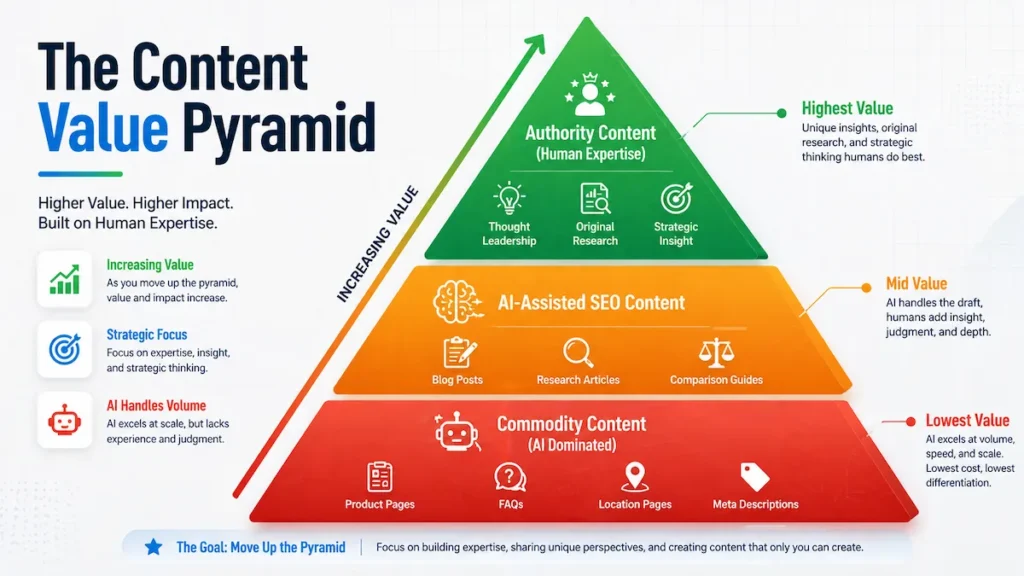
Level 1—Commodity AI Content Product descriptions, FAQ answers, location pages, meta descriptions, templated social copy. AI handles this well, fast, and cheaply. Writers operating primarily here are competing with AI on its home turf.
That competition has one outcome.
Level 2—AI-Assisted SEO Content Blog posts, resource articles, comparison guides, evergreen content. AI generates structural drafts. The human writer adds original insight, verified research, editorial voice, and strategic judgment. This is the dominant professional model in effective content teams today—and where the best efficiency-to-quality ratio lives.
Level 3—Human-Led Authority Content Thought leadership, original research, executive ghostwriting, investigative long-form, niche-specialist writing. Entirely human-driven. Highest rates. Most organic backlinks. Compounding domain authority that builds over years, not months.
What this looks like in practice:
Two writers. Both cover B2B SaaS content. Both target the same keywords.
Writer A produces well-structured 2,000-word blog posts from editorial briefs—competent, SEO-optimized, professionally written.
Writer B has five years inside SaaS sales teams, regularly interviews product leaders, and produces content that gets cited by industry analysts.
When a client integrates AI drafting tools, Writer A’s workload gets absorbed into the new workflow. Writer B gets promoted to editorial director of that workflow—because the judgment, domain network, and experiential insight behind their work can’t be replicated by a prompt.
Same industry. Same keyword targets. Completely different career outcomes.
The practical decision: look at your current work honestly. If it’s primarily Level 1, the pressure is real and the timeline is short. If you’re building toward Level 2 or Level 3—developing niche expertise, editorial strategy, and verifiable authority—AI is more likely to be leverage than a threat.
Where AI Has a Genuine, Durable Advantage
The answer to will AI replace content writers depends heavily on whether your work is commodity or expert-driven.
Most writing about AI writing fails here—by treating AI’s structural advantages as minor or temporary. They’re neither.
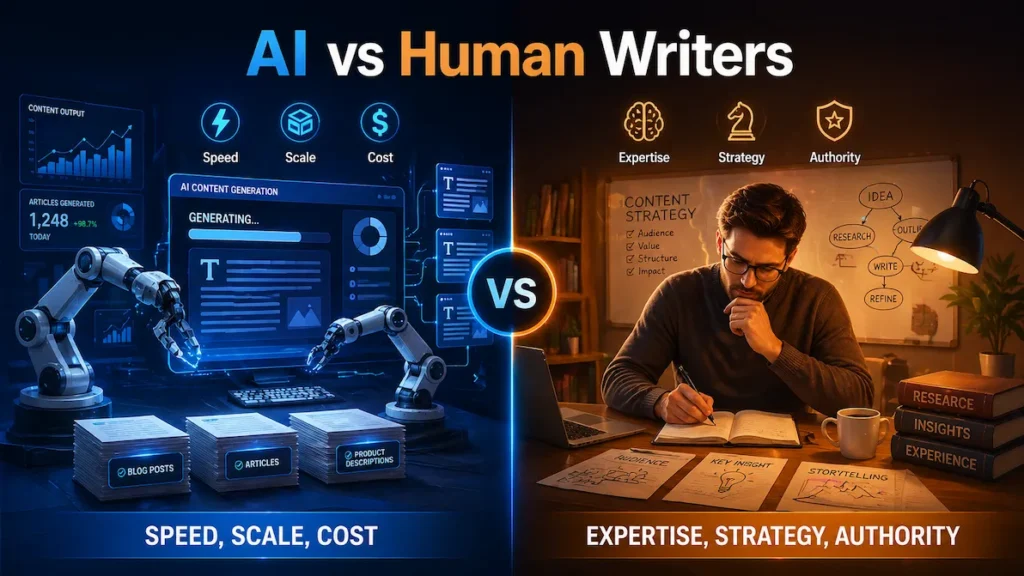
Cost structure at volume. For businesses publishing hundreds of templated pages—local landing pages, product variants, category descriptions—AI offers a cost structure no human writing team can match. This is a permanent shift for commodity-tier content production.
Iteration speed. AI allows marketing teams to test dozens of copy variations in the time it previously took to produce one piece. For conversion-focused content, this speed has measurable business value.
Localization at scale. Adapting content across languages, regions, and audience segments is a task where AI scales far faster than any human team.
Zero creative friction. AI doesn’t have burnout, scheduling constraints, or capacity limits. For high-volume content pipelines, this matters operationally and financially.
The strategic implication: Writers who accept AI’s structural advantage at Level 1—and deliberately position themselves above it—are making the smarter long-term career decision. Writers who resist this shift are fighting a structural change with individual effort. That’s not a strategy. It’s a delay.
The question is never “can AI do this?” at Level 1. It’s “what can I offer that AI cannot?” at Levels 2 and 3.
What AI Cannot Originate—Stated Precisely
When analyzing will AI replace content writers, the content pyramid offers a practical framework. AI cannot originate experience-based insight.
It generates text by predicting statistically probable word sequences from training data. It doesn’t form opinions through experience, develop judgment through professional practice, or encounter situations that genuinely change how it understands a problem. At its best, it produces a sophisticated recombination of what already exists.
This limitation is worth stating accurately—not as hyperbole, but as a structural constraint: it’s not absolute across all content types, and AI systems are improving. But for anything requiring genuine professional expertise, original perspective, or verifiable first-hand experience, this limitation is structural, not temporary.
The practical consequence flows into every category of high-value content—expert analysis, original research, trust-building authority writing, nuanced industry storytelling. These all rely on exactly what AI doesn’t replicate reliably. Not because AI lacks vocabulary. Because it lacks the accumulated experience that makes professional judgment possible.
Why Most “AI + Human” Content Still Fails
A realistic view of will AI replace content writers requires acknowledging AI’s strengths in speed and scale.
This is the section most AI writing articles skip. It requires saying something uncomfortable—and that’s exactly why it matters.
The current narrative runs like this: “Use AI for the draft, add human editing, get the best of both worlds.”
In theory, plausible. In practice, most of it is still failing—just in a way that takes longer to surface.
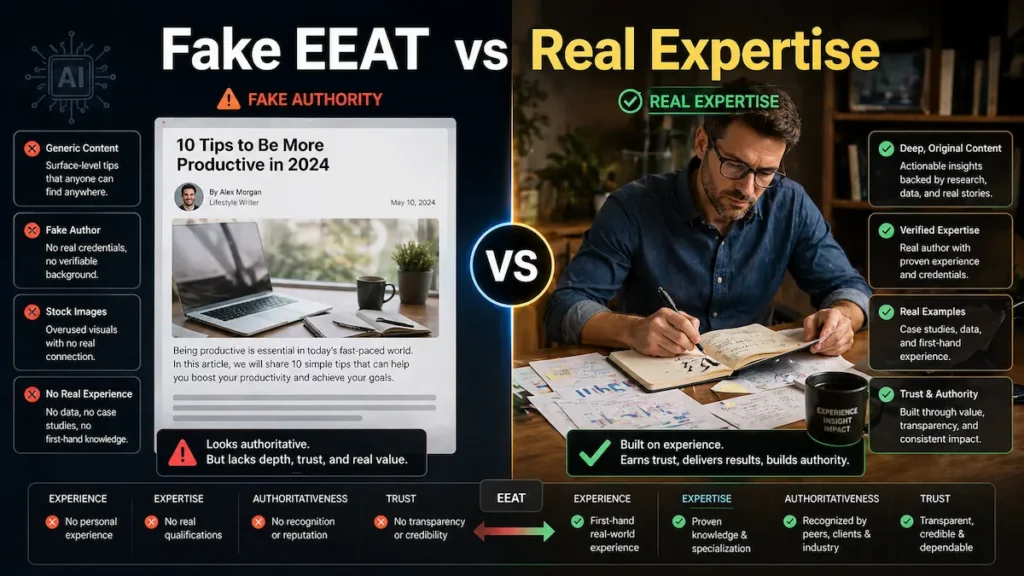
Fake EEAT is everywhere. Teams slap an author bio on AI-generated content, add a stock headshot, and call it “expert-reviewed.” Google’s quality raters are specifically trained to identify this. An author bio without a genuine publishing history, verifiable expertise, or traceable professional presence is a decorative signal—not a real one. It doesn’t fool a trained evaluator. Increasingly, it doesn’t fool the algorithm either.
Surface-level editing doesn’t add depth. Most “human-edited AI content” means someone ran a grammar check, swapped a few phrases, and added a concluding paragraph. That’s proofreading. It’s not the original insight, first-hand experience, or domain judgment that creates genuine EEAT signals. The structural problem remains beneath the surface polish.
“Humanized AI” content still lacks perspective. There’s an entire industry now built around making AI content sound more human—varying sentence length, adding transitions, removing robotic phrasing. The result reads more naturally. But it still says nothing a real expert would say differently, because there’s no real expert behind it. Fluency is not expertise. Readability is not authority.
The SEO consequence worth understanding: Google’s March 2024 Core Update wasn’t primarily targeting poorly written AI content. It was targeting content that lacked genuine helpfulness and experience signals—regardless of surface polish. The sites that recovered weren’t the ones that edited their AI content more carefully. They were the ones that rebuilt it with actual expertise behind it.
The question for any AI-assisted content workflow isn’t “does this sound human?” It’s “does this contain insight that only comes from real experience in this field?” If the answer is no, the workflow isn’t producing Level 2 content. It’s producing Level 1 content with better formatting—and Google’s quality systems are increasingly calibrated to know the difference.
Part 2: What AI Is Doing to SEO, Rankings, and Content Economics
The debate around will AI replace content writers becomes clearer when you analyze real SEO and ranking trends.
Can AI-Generated Content Rank on Google? The Precise Answer
The question will AI replace content writers becomes easier when you examine what AI cannot truly create.
Yes—under specific conditions. This is worth understanding precisely, not loosely.
Google doesn’t prohibit AI content categorically. What it targets is content produced primarily to manipulate rankings rather than serve readers—regardless of production method.
In practice, however, patterns observed across multiple domains following the March 2024 Core and Spam Updates show a strong correlation between high-volume AI publishing and significant ranking declines.
Analysis from Amsive documented sites with high proportions of AI-generated content experiencing severe visibility drops across travel, technology, and product review verticals. Animalz reported that certain sites received “Pure Spam” notifications. These outcomes were concentrated in sites that published AI content at volume without substantive editorial oversight or genuine EEAT signals.
The content decay sequence observed across affected domains:
- High-volume AI content published rapidly across the domain
- Initial rankings hold or briefly climb
- Core update triggers site-level quality reassessment
- Weak EEAT signals affect the entire domain—not just individual underperforming pages
- Recovery requires full content audits, substantive rewrites, and multiple update cycles to register
The part most businesses consistently miss: Google’s quality evaluation appears holistic. A domain where a large proportion of content lacks experience signals and original depth can see its strongest content pulled down alongside its weakest. The penalty isn’t always page-level. It’s often domain-level.
For a breakdown of how these AI content SEO changes are reshaping career trajectories in search, see our complete guide on whether AI will replace SEO jobs in 2026.
What Google Is Actually Rewarding—And What Strong EEAT Looks Like in Practice
If you’re asking will AI replace content writers, you’re really asking how the writing industry is evolving.
Google isn’t just evaluating whether content answers a query. It’s increasingly evaluating whether content was created by someone with genuine authority to answer it.
What Google appears to reward most consistently in AI-era content:
- Original experience signals—first-person workflows, documented outcomes, real operational examples
- Author identity and credentials—named authors with verifiable expertise and consistent niche publishing history
- Depth and intent satisfaction—content that answers the main question and the follow-up questions a real reader would have
- Topical consistency—domains that publish within a defined subject area rather than chasing broad, unfocused topics
What strong versus weak EEAT actually looks like:
A weak EEAT article on “how to write a content strategy” reads like a synthesized overview—definition, steps, best practices, conclusion. Competent. Forgettable. It could have been written by anyone, or anything.
A strong EEAT article on the same topic opens with the author’s specific experience running content strategy for a 50-person SaaS company. It references a documented outcome: “we reduced content production costs by 40% while doubling organic traffic over 18 months.” It names specific tools and frameworks used. It includes a direct quote from a colleague who managed the implementation.
Same keyword. Same topic. Completely different trust signal to both readers and ranking systems.
The second article is one a language model cannot produce—because the experience behind it doesn’t exist in any training dataset. Experience you document becomes SEO infrastructure. That’s not a metaphor. It’s a direct ranking signal.
The Content Inflation Problem: The Threat Most Writers Are Misreading
The truth behind will AI replace content writers lies in how content economics and demand are shifting.
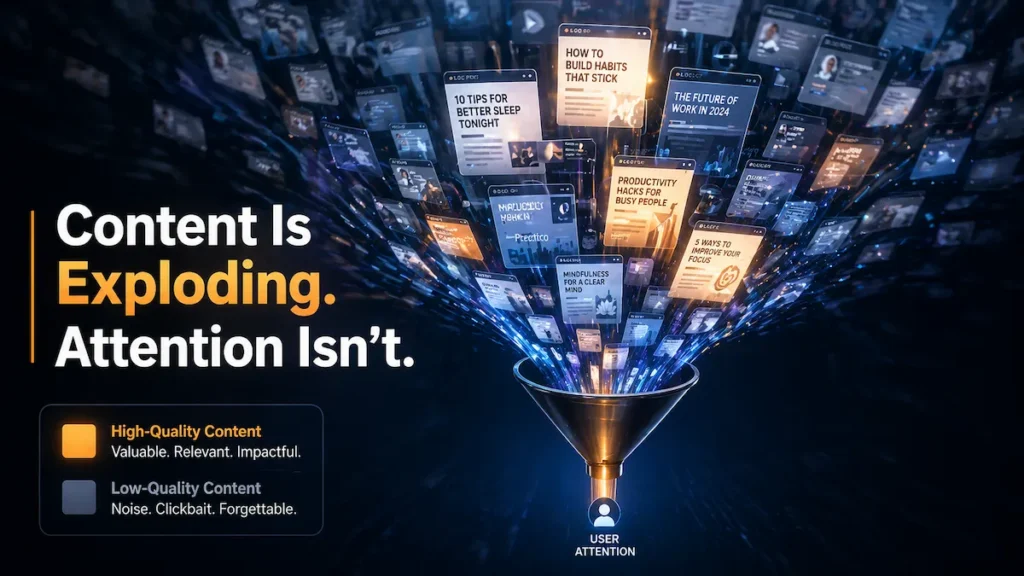
AI didn’t primarily threaten writers by replacing them. It threatened the entire content ecosystem by dramatically increasing the total supply of content.
When supply explodes while reader attention stays constant, the bar required to capture and hold that attention rises—regardless of who or what produced the content flooding the market.
In a content-inflated environment:
- Average content becomes invisible faster than ever before
- The value gap between mediocre and excellent content widens significantly
- Readers develop sharper, faster filters for authenticity and expertise
- Google’s quality signals become more, not less, consequential as spam volume scales
The future of content writing jobs belongs to writers who understand this dynamic—not the ones who are still asking whether AI writes well enough to compete.
The strategic question has shifted. It’s no longer “will I be replaced?” It’s “am I differentiated enough to be found—and trusted—in a market where content is infinite and attention is scarce?”
For a broader view of how these dynamics are reshaping digital marketing career trajectories, see our guide on the future of digital marketing with AI.
The mistake most writers make is assuming AI is the competitor. The real competitor is undifferentiated writing—and content inflation just made that impossible to ignore.
Part 3: Career Transformation—Two Groups, Two Futures
Exploring will AI replace content writers helps uncover the difference between operators and authorities.
The 2-Year Split: Where the Writing Industry Is Actually Heading
Many misunderstand will AI replace content writers because they overlook the importance of real expertise.
This is the timeline most coverage avoids stating directly—because it’s uncomfortable. But it’s the most actionable framing for anyone making career decisions right now.
Year 1–2 (Now): AI replaces production-heavy writing tasks at Level 1. Generic blog posts, templated content, and undifferentiated how-to articles are increasingly produced by AI-assisted workflows at a fraction of previous cost. Entry-level content roles face the most immediate and direct structural pressure.
Year 2–5: AI reshapes content teams from production models into strategist/editor models. The writers who grow are those who transitioned from “I write content” to “I direct content strategy and maintain editorial authority over AI-assisted output.” Content operations get leaner in headcount and higher in output—but the human roles that remain are more senior, more specialized, and better compensated than before.
Long term: The industry splits clearly and permanently into two groups.
Operators—writers who function primarily as AI-assisted execution resources. They produce volume efficiently, follow briefs, and deliver content that meets baseline quality standards. Their rates are increasingly competitive with AI-assisted production costs. Their differentiation is speed and reliability, not expertise or authority.
Authorities—writers who own a niche, demonstrate verifiable expertise, build audience trust over time, and produce content that earns links, drives decisions, and builds lasting brand authority. Their rates reflect the scarcity of genuine expertise. Their work is what AI cannot produce—and what Google increasingly rewards over everything else.
The gap between operators and authorities is not closing. It’s widening. Writers who act deliberately on that reality now—while the transition is still early—will have options that become increasingly unavailable as the market matures.
Will AI Replace SEO Writers—Or Just Undifferentiated Ones?
AI will not replace SEO content writers broadly. But it is actively displacing one specific type: the writer producing generic content at commodity rates without strategic intent or genuine domain expertise.
The edge case is worth acknowledging honestly: in content operations that rely heavily on standardized briefs and templated formats, AI-assisted workflows have reduced the need for junior writers in documented cases. The pressure on entry-level content roles is real and worth factoring into any realistic career plan.
High-level SEO content writing, however, requires capabilities current AI systems don’t replicate reliably: strategic keyword intent mapping, competitive gap analysis, editorial calibration of structure and tone, and content that earns links because it’s genuinely credible to a specific professional audience.
The future of content writing jobs in SEO belongs to writers who understand why content works—not just how to produce more of it.
For a detailed view of how AI is affecting digital marketing careers across disciplines, the pattern holds consistently—strategic roles grow in value while execution-only roles face structural pressure.
What Skills Will Content Writers Need in the AI Era?
The transition isn’t about learning to write differently. It’s about repositioning where in the content value chain your expertise lives.
Direct AI Tools—Don’t Compete With Them
Looking at SEO trends helps clarify whether will AI replace content writers in search-driven industries.
Writers who understand and use AI tools are measurably more productive than those who avoid them. The model that works: use AI for structural scaffolding and initial drafts, then apply human judgment, domain knowledge, and editorial voice to produce something that actually resonates with a real audience.
What this looks like in practice:
A freelance writer previously spent six hours producing a 2,000-word article: two hours researching, two drafting, two editing. After integrating AI drafting tools, the research summary and initial structure took thirty minutes. The remaining time went entirely to what AI couldn’t contribute: original analysis, expert source integration, editorial voice calibration, and strategic positioning.
Same output quality. Half the clock time. More articles per month, at the same rate, with more time for the differentiated work that actually builds a professional reputation.
That’s what directing AI looks like—versus competing against it.
Build Strategy-Driven Skills
The impact of will AI replace content writers is most visible in low-value, high-volume content workflows.
Content strategy, editorial planning, search intent analysis, and audience psychology are capabilities AI doesn’t replicate reliably. These translate content production into measurable business outcomes—audiences built, conversions generated, brand authority established over time.
Writers who move from execution to strategy consistently command stronger rates and more stable client relationships—because they solve problems AI tools don’t address and clients can’t easily solve themselves.
Become a Niche Expert
When asking will AI replace content writers, it’s critical to separate hype from actual market data.
A writer who deeply understands clinical research, enterprise security, derivatives regulation, or industrial logistics can produce content no AI tool matches. That judgment is the product of sustained domain immersion. It cannot be prompted into existence.
Niche expertise is what separates writers commanding $500 per article from those competing at $50. It’s also what makes a writer genuinely irreplaceable to a client in that space—not just a service provider, but a subject matter collaborator with real professional standing.
If you’re a writer trying to move from commodity to authority positioning, niche clarity is where to start—not AI tool adoption. The tools matter. The expertise matters more.
Understanding how AI is reshaping digital marketing careers clarifies why domain positioning has become the central career strategy across the entire digital profession—not just content writing specifically.
Will AI Replace Copywriters and Bloggers?
Strategic copywriters doing brand positioning, conversion optimization, and long-form sales content built on real customer research are not being replaced. Their work requires psychological insight, results accountability, and business judgment AI doesn’t replicate reliably. If anything, their value has increased—they can now direct AI to execute variations at a pace previously uneconomical, while retaining full ownership of the strategic thinking.
Can AI replace copywriters doing templated, formulaic work at scale? In many documented cases, yes—and that trend is accelerating.
Bloggers face a divided reality.
Generic informational blogging—tips articles, surface-level how-to guides, keyword targeting without credible niche expertise—is competing directly with AI output on quality and losing on cost. That trajectory has no favorable endpoint for undifferentiated bloggers.
But bloggers with genuine expertise and loyal audiences operate in a completely different economy. Readers don’t return because they want information. Information is free and infinite. They return because they trust the person—their judgment, their track record, their specific way of seeing a problem.
That trust is built through years of consistent, credible publishing. It cannot be manufactured—by AI or by anyone pretending to have expertise they don’t possess.
What Experts and Research Actually Show
A 2025 study from the University of Copenhagen, analyzing 25,000 workers across 7,000 workplaces, found AI’s actual productivity impact underwhelming relative to the hype—with most workers reporting only a 3% time savings and income growth from AI adoption ranging just 3–7%.
Freelance writing professional Elna Cain documented a telling real-world pattern: after the AI explosion of 2024, client inquiries recovered in 2025 as businesses discovered AI tools were not saving them time or money in the long run. Tools that promised to replace writers were generating new editorial problems that required skilled humans to resolve.
Microsoft and LinkedIn’s 2024 Work Trend Index—surveying 31,000 professionals across 31 countries—found that AI mentions in job posts drove a 17% increase in application growth. The labor market is treating AI fluency as a complementary professional skill, not a signal that human roles are disappearing.
Early evidence suggests the industry is bifurcating rather than collapsing. Rates for generic content work are under sustained downward pressure. Rates for specialist, strategy-level, and authority content are holding or rising. The average is obscuring a growing divide.
AI vs Human Writers: Full Comparison Table
| Content Task | AI Replaces | AI Assists | AI Cannot Replace |
|---|---|---|---|
| Templated product copy | ✓ | ||
| FAQ and meta content | ✓ | ||
| First draft outlines | ✓ | ||
| Research summarization | ✓ | ||
| Content repurposing | ✓ | ||
| Original insight | ✓ | ||
| Domain expertise | ✓ | ||
| EEAT authority signals | ✓ | ||
| Long-term audience trust | ✓ | ||
| Editorial accountability | ✓ | ||
| Niche specialist writing | ✓ | ||
| Content strategy | ✓ | ||
| Author credibility | ✓ |
Final Verdict: Three Truths and One Decision
Exploring will AI replace content writers helps uncover the difference between operators and authorities.
AI is not replacing writers. It is eliminating undifferentiated writing—and restructuring content economics in ways that reward expertise and penalize genericness at every level.
AI is not reducing content demand. It is inflating total supply—which raises the bar for attention, authority, and differentiation more than at any previous point in the industry’s history.
AI is not weakening expert writers. In a content-inflated market, genuine expertise, verifiable experience, and real audience trust become scarcer—and therefore more commercially valuable—than ever before.
The writers who define the next era of content won’t be the ones who avoided AI or the ones who let it do all the thinking. They’ll be the ones who understood exactly where it stops working—and built everything that matters on the other side of that line.
The industry is splitting. Operators on one side. Authorities on the other. The window to choose deliberately is open right now. It won’t stay open indefinitely.
Frequently Asked Questions
Will AI completely replace content writers?
No, will AI replace content writers completely is the wrong question—AI is replacing commodity content, not writers who offer expertise, strategy, and unique insights.
AI vs human writers—who actually wins in SEO?
When evaluating will AI replace content writers, neither AI nor humans win SEO outright—success depends on quality, expertise, and intent. AI excels at speed, structure, and scaling content, but human writers win where it matters most: original insight, experience, and EEAT signals. In practice, the best-performing SEO content combines both—AI for efficiency, and humans for authority, credibility, and strategic depth.
Is content writing still a good career in 2025 and 2026?
Yes—with meaningful qualification. The future of content writing jobs is bifurcating into operators and authorities. Writers who specialize in professional niches, build personal authority, and develop strategy-level skills continue to thrive and command strong rates. The most important career decision right now is identifying which tier of the content pyramid you currently occupy—and whether that positioning is sustainable over a 2–5 year horizon.
Can AI replace copywriters?
When asking will AI replace content writers, the same logic applies to copywriters—AI can replace templated, repetitive copy at scale, but not strategic, high-impact copywriting. It handles product descriptions, basic ad variations, and formulaic sales pages efficiently.
But strong copywriting depends on customer psychology, brand positioning, testing insights, and real business outcomes—areas where human judgment still leads. The copywriters who focus on strategy, messaging, and conversion thinking aren’t being replaced; they’re using AI to produce faster while staying in control of what actually drives results.
Will ChatGPT replace bloggers?
When asking will AI replace content writers in SEO, the reality is that AI can handle basic content, but high-quality, authoritative writing still depends on human expertise.
How can writers use AI tools without losing their competitive edge?
Use AI for outlines, first drafts, research summaries, and content repurposing. Apply human judgment to everything that determines actual quality: original insight, verified sourcing, editorial voice, and strategic positioning. The competitive edge isn’t in avoiding AI—it’s in applying expertise and judgment that AI cannot replicate on top of what AI produces efficiently. That combination is what Level 2 and Level 3 content looks like in practice.