
Published March 2026 | Category: Cybersecurity for SMBs | Reading time: ~10 min
Introduction
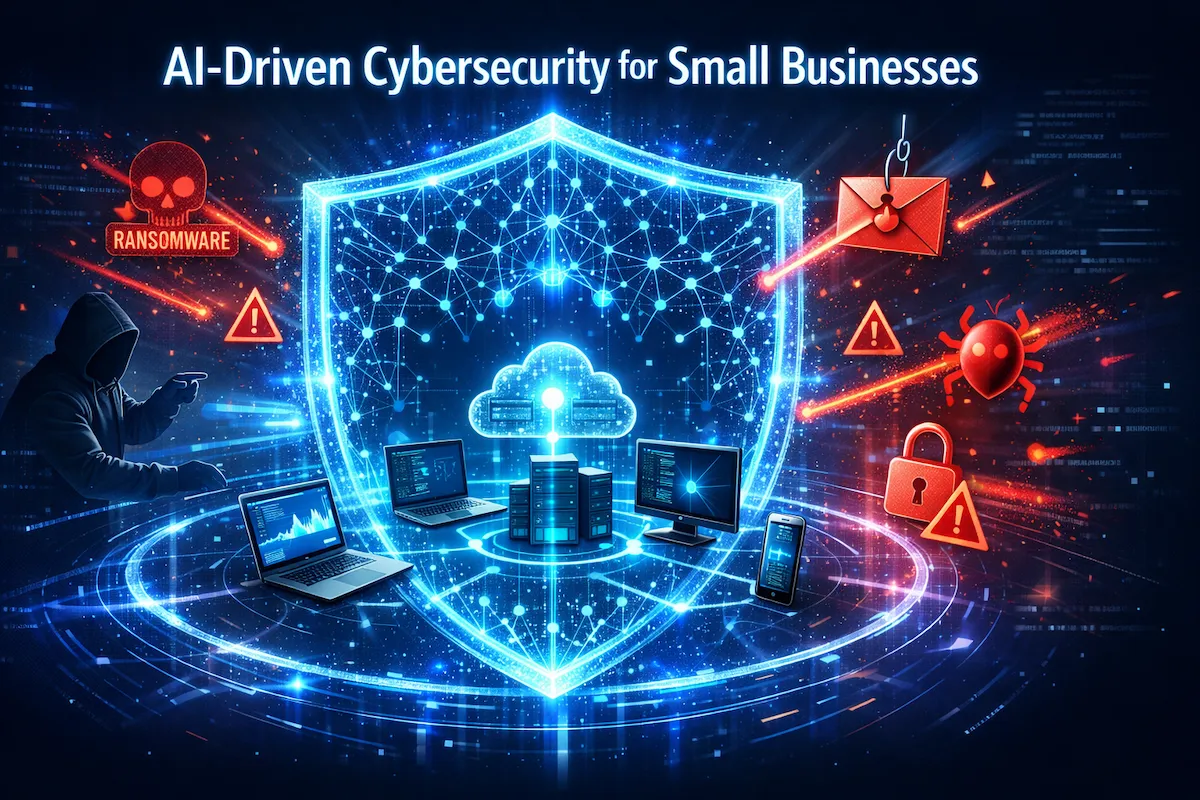
Understanding what AI-driven cybersecurity for small businesses actually involves helps owners make smarter, more confident security decisions. Small businesses have never been more exposed. In 2026, cybercriminals are no longer focused solely on Fortune 500 companies — they’re targeting the corner bakery, the two-person accounting firm, and the local law office. The numbers don’t lie: according to Verizon’s Data Breach Investigations Report, over 46% of all cyber breaches now affect businesses with fewer than 1,000 employees. That’s why AI-driven cybersecurity for small businesses has moved from a luxury to a genuine business necessity.
The problem used to be straightforward: you hired an IT person, installed antivirus software, and called it a day. But cyber threats have evolved dramatically. Ransomware, phishing campaigns, supply chain attacks — these aren’t the clumsy attempts of the early 2000s. They’re sophisticated, automated, and often impossible to catch with traditional tools.
Artificial intelligence is changing the game. AI cybersecurity tools can monitor your entire network in real time, spot anomalies in seconds, and respond to threats before your IT team even gets the alert. For small business owners working with lean teams and tighter budgets, that’s a transformative shift.
For small businesses in 2026, AI cybersecurity is no longer just a defensive upgrade — it is becoming the most affordable way to access enterprise-grade protection without building an enterprise-grade IT team.
Why AI-Driven Cybersecurity for Small Businesses Is Critical Today
Here’s the uncomfortable truth: small businesses make easy targets. Cybercriminals know that most SMBs lack dedicated security teams, run outdated software, and rarely have incident response plans. According to the IBM Security Cost of a Data Breach Report, the average cost of a data breach for small businesses exceeds $108,000.
The threat landscape has also intensified because of automation. Attackers now use AI tools themselves—launching thousands of phishing attempts, scanning for unpatched vulnerabilities, and customizing attacks based on scraped social media data. Traditional, signature-based security tools simply can’t keep pace. They’re reactive by design, catching known threats but missing novel attack patterns entirely.
Regulatory pressure is mounting too. Privacy laws like state-level data protection acts mean that a breach isn’t just a financial hit—it can carry serious legal consequences. AI-driven cybersecurity for small businesses helps them stay compliant by continuously auditing activity and flagging violations in real time, something manual processes simply can’t achieve at scale.
What AI-Driven Cybersecurity for Small Businesses Actually Means
The rise in automated attacks makes AI-driven cybersecurity for small businesses no longer optional — it is now a fundamental layer of business protection.
Let’s cut through the buzzwords. AI-driven cybersecurity isn’t magic — it’s the application of machine learning and behavioral analytics to security data. Think of it like this: traditional security tools work like smoke alarms. They go off when they detect something that matches a known trigger. AI security tools work more like a seasoned security guard who notices when something feels off, even if it’s never happened before.
In practical terms, machine learning cybersecurity systems are trained on massive datasets of normal and malicious behavior. Over time, they learn what “normal” looks like for your specific network—your employees’ login times, typical file access patterns, and regular email traffic. When something deviates from that baseline, the system flags it immediately.
For a small business, this is especially powerful. You might have a ten-person team, but AI is effectively monitoring your entire digital environment 24/7 — something that would take a dedicated security operations center to replicate manually. AI-powered security tools bring enterprise-grade protection to businesses that can’t afford enterprise-scale teams.
How AI-Driven Cybersecurity for Small Businesses Detects Threats Faster
The speed advantage that AI-driven cybersecurity for small businesses delivers is one of the clearest reasons SMBs are making the switch from legacy tools. Speed is everything in cybersecurity. The faster a threat is detected, the less damage it causes. According to IBM, organizations that contain a breach in under 200 days save an average of $1.12 million compared to those that take longer. AI threat detection dramatically compresses that window.
AI-Driven Cybersecurity for Small Businesses: AI Threat Detection
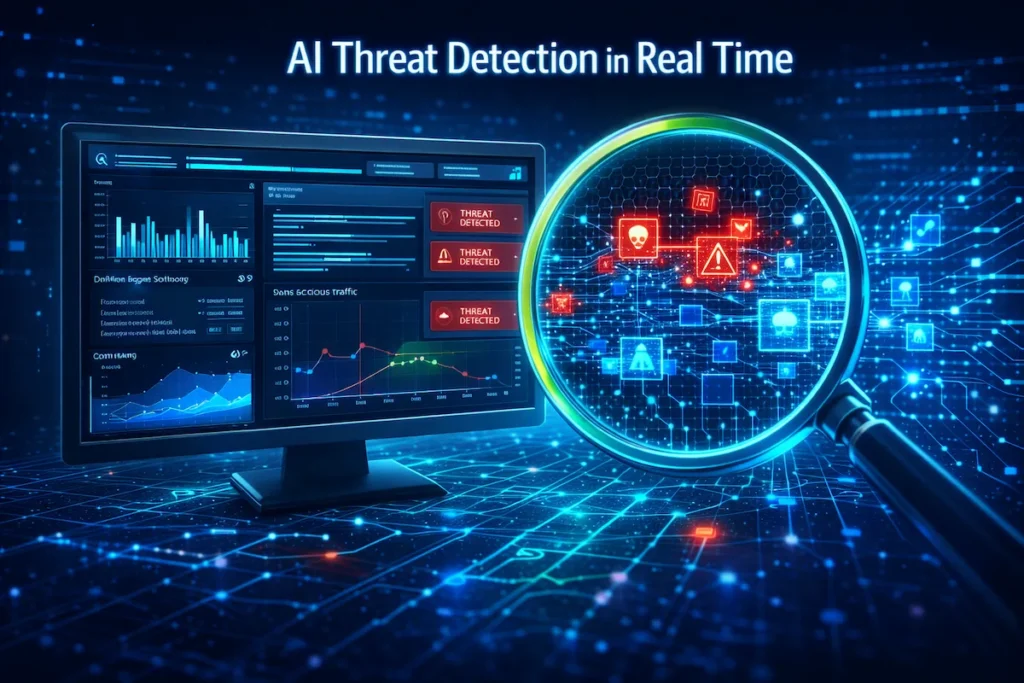
AI-driven cybersecurity for small businesses relies heavily on real-time threat detection to catch attacks that traditional tools would miss entirely. AI threat detection systems analyze thousands of data points simultaneously—network traffic, login attempts, file changes, endpoint activity—in real time. When a pattern emerges that suggests a threat, the system generates an alert within seconds. This is fundamentally different from older SIEM tools that relied on human analysts to review logs after the fact.
A key advantage for SMBs is false-positive reduction. Older tools generated alert fatigue — so many warnings that IT teams started ignoring them. Modern AI systems are trained to distinguish genuine threats from routine activity, meaning your team focuses its attention where it actually matters.
AI-Driven Cybersecurity for Small Businesses: AI Phishing Detection
Phishing defense is one of the most immediately valuable components of any AI-driven cybersecurity for small businesses solution available today. Phishing remains the most common attack vector for small businesses. Proofpoint’s State of the Phish report consistently shows that over 80% of organizations faced phishing attacks in the past year. Modern phishing emails are sophisticated — they mimic real vendors, use correct logos, and reference recent business activities pulled from LinkedIn.
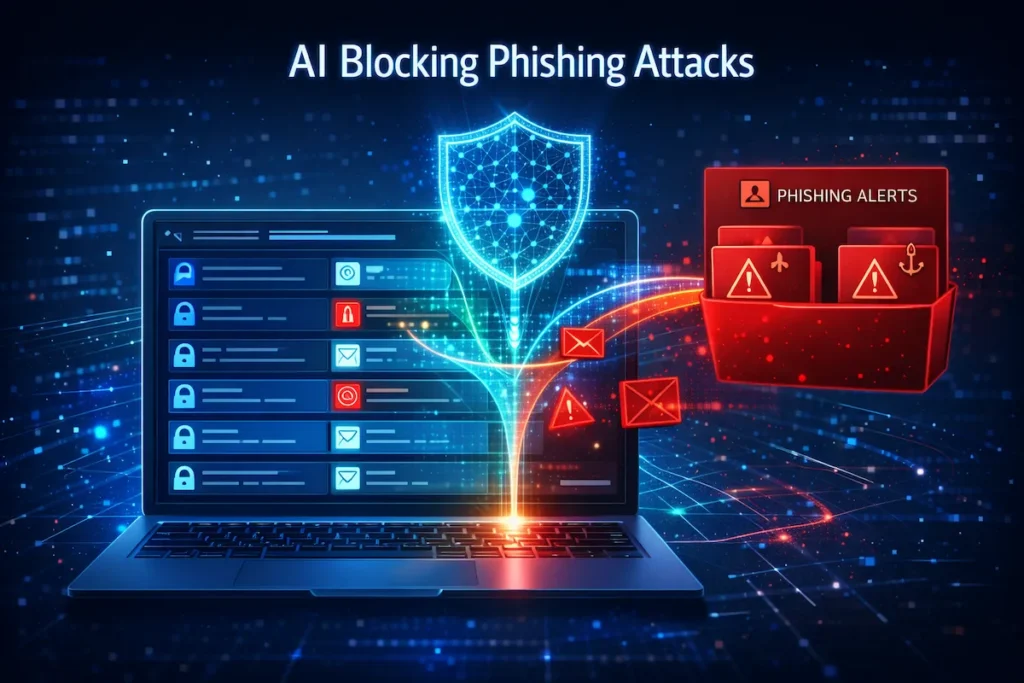
AI-powered email security tools analyze hundreds of signals humans would never catch: the sender’s IP reputation, slight domain name variations, grammar patterns typical of known phishing campaigns, embedded link behavior, and metadata inconsistencies. When a suspicious email hits your inbox, it’s quarantined automatically — often before the recipient even sees it.
AI-Driven Cybersecurity for Small Businesses: Behavioral Analytics
Behavioral analytics gives AI-driven cybersecurity for small businesses the ability to catch insider threats and compromised accounts that signature-based tools simply cannot detect.
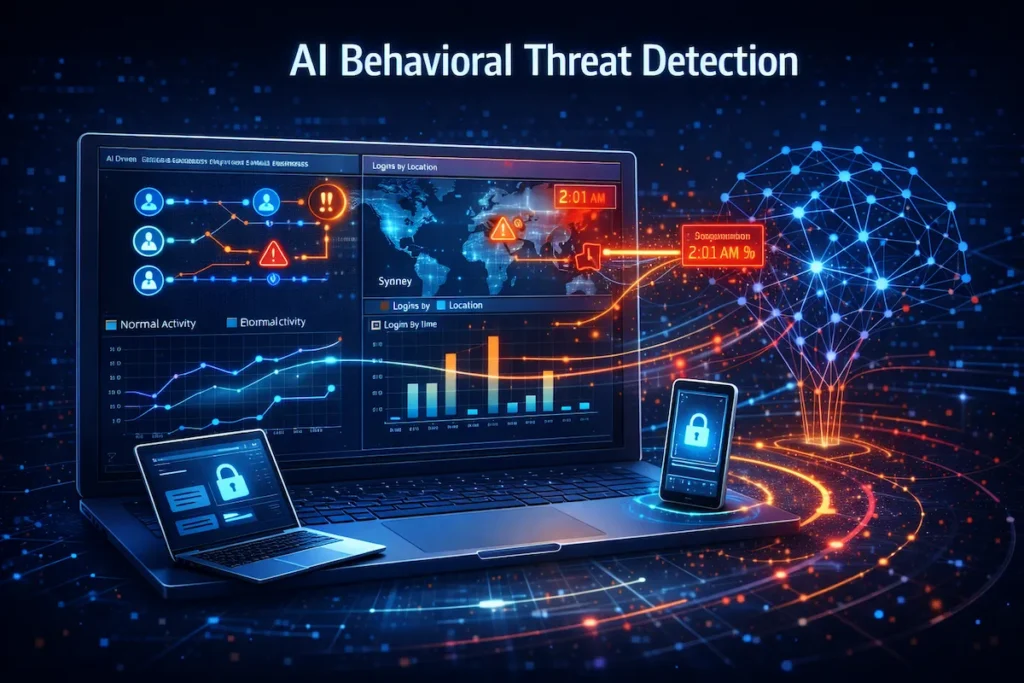
Not all threats come from outside the organization. Disgruntled employees, compromised credentials, and accidental data leaks are real risks for small businesses. Behavioral analytics — sometimes called User and Entity Behavior Analytics (UEBA) — uses AI to build a profile of normal behavior for each user and device on your network.
If your bookkeeper suddenly starts downloading thousands of customer records at 2 a.m. on a Saturday, behavioral analytics flags it immediately. The system doesn’t need a rule that says “large downloads are “bad”—it simply knows that behavior is unusual for that specific user, and that’s enough to trigger an alert or an automated lockdown.
AI-Driven Cybersecurity for Small Businesses: Automated Incident Response
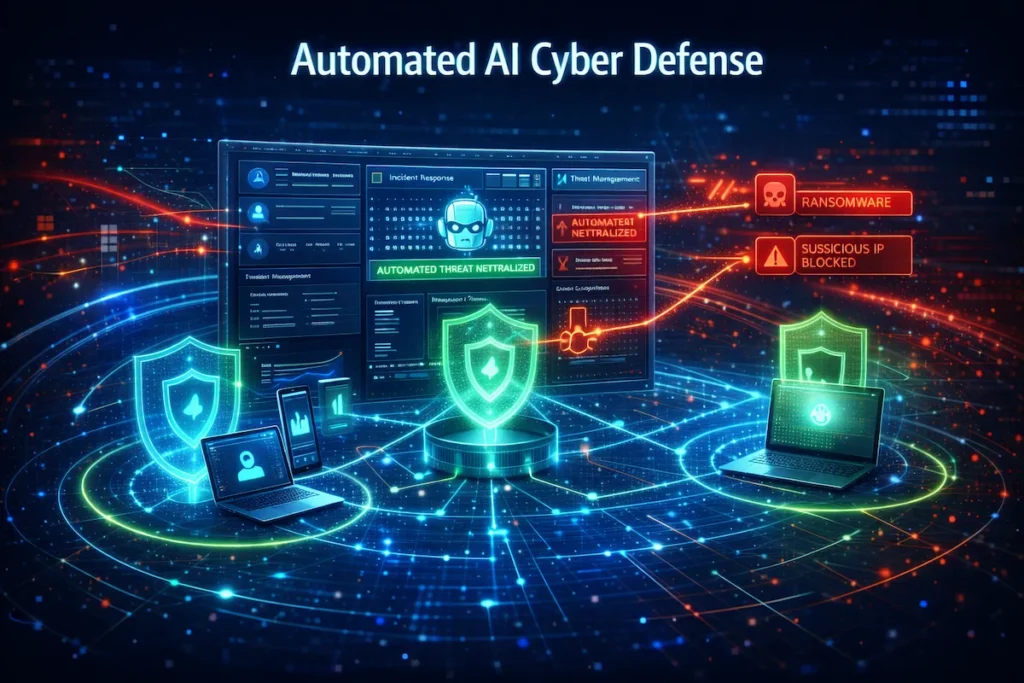
Automated incident response is what separates a reactive security posture from the proactive protection that AI-driven cybersecurity for small businesses is designed to deliver. Detection alone isn’t enough. What happens after the alert is just as important. AI-powered security platforms can now take automated action when threats are confirmed: isolating infected devices from the network, revoking compromised credentials, blocking suspicious IP addresses, and initiating rollback procedures for ransomware attacks.
For a small business without a 24/7 security team, automated incident response is a genuine lifesaver. A ransomware attack that would have encrypted your entire server can be contained to a single device in minutes — before it spreads. According to Gartner security automation research, organizations using automated security response systems significantly reduce breach costs.
Key Technologies Behind AI-Driven Cybersecurity for Small Businesses
Each of these technologies plays a distinct role in making AI-driven cybersecurity for small businesses both effective and scalable without requiring a large internal team. Understanding what’s under the hood helps you make smarter purchasing decisions. Several distinct technologies work together in modern AI cybersecurity solutions for SMBs:
- Machine Learning (ML): Algorithms trained on historical attack data to identify patterns in new threats. ML models improve continuously as they process more data from your specific environment.
- Natural Language Processing (NLP): Powers AI phishing detection by analyzing the linguistic patterns of email content and identifying suspicious language structures common in social engineering attacks.
- Threat Intelligence Feeds: AI platforms ingest real-time data from global threat databases, meaning your system knows about a new ransomware variant within hours of it being identified anywhere in the world.
- Extended Detection and Response (XDR): A unified platform that correlates threat data across endpoints, networks, email, and cloud environments—giving AI a complete picture rather than isolated data points.
- Security Orchestration, Automation, and Response (SOAR): Coordinates automated responses across multiple security tools, enabling faster, more consistent incident handling without manual intervention.
Traditional Security vs. AI-Driven Cybersecurity: A Direct Comparison
This comparison makes clear why businesses are rapidly moving toward AI-driven cybersecurity for small businesses as their primary security framework in 2026. One of the clearest ways to understand the leap forward AI represents is to compare it directly with traditional approaches. This isn’t just a technical distinction—it has real operational consequences for small businesses with limited staff and resources.
| Feature | Traditional Security | AI-Driven Cybersecurity |
|---|---|---|
| Threat Detection | Known, signature-based threats only | Known and unknown threats via behavioral patterns |
| Monitoring | Manual log review required | Automated, real-time, 24/7 monitoring |
| Response Speed | Hours to days | Seconds to minutes with automated response |
| False Positives | High — frequent alert fatigue | Low—AI filters noise and prioritizes real threats |
| Phishing Defense | Basic filter rules, easily bypassed | NLP-powered analysis of hundreds of signals |
| Scalability | Manual reconfiguration as business grows | Scales automatically with your environment |
| Cost Over Time | Lower upfront, higher breach recovery costs | Higher upfront, significantly lower breach risk |
| Insider Threat Detection | Very limited | Strong behavioral analytics flags unusual activity |
The takeaway is clear: traditional tools were built for a simpler threat environment. AI-driven cybersecurity for small businesses is built for the world as it actually exists in 2026.
Cybersecurity Statistics Related to AI-Driven Cybersecurity for Small Businesses
The numbers behind AI-driven cybersecurity for small businesses make a powerful case that early adoption is a financial advantage, not just a technical one. The data makes a compelling case. Here are some of the most critical statistics from industry research that every small business owner should understand. For a deeper breakdown of the numbers, the full analysis of AI-driven cybersecurity statistics for SMBs in 2026 is worth reading before you make any security purchasing decisions.
- IBM Security found that AI and automation reduced the average breach identification time by 74 days compared to organizations without these tools.
- Verizon’s DBIR reports that 74% of all data breaches involve the human element — phishing, stolen credentials, or employee error — all areas where AI security tools provide direct protection.
- Gartner predicts that by 2027, over 50% of enterprises will replace legacy threat detection tools with AI-powered alternatives — a trend already accelerating among SMB-focused vendors.
- CompTIA’s cybersecurity research indicates that 45% of small businesses experienced a cyberattack in the past year, yet fewer than 25% had formal incident response plans.
- Proofpoint research shows that 99% of email-based attacks require human interaction to succeed — underscoring why AI-powered email filtering is one of the highest-ROI security investments available.
Benefits of AI-Driven Cybersecurity for Small Businesses
Every benefit listed here reflects a real operational advantage that AI-driven cybersecurity for small businesses delivers over conventional security approaches. The advantages go beyond catching threats faster. Here’s what AI-powered security actually delivers for small businesses in practice:
- 24/7 Protection Without a Full-Time Team: AI monitors your systems around the clock, giving you the equivalent of a security operations center without the six-figure staffing costs.
- Faster Mean Time to Detect (MTTD): AI systems flag suspicious behavior in seconds versus the hours or days a human analyst reviewing logs manually would take.
- Reduced Alert Fatigue: Machine learning filters out noise and prioritizes genuine threats, so your IT team isn’t wading through hundreds of false alarms every day.
- Scalability: AI security scales with your business automatically. Whether you add five employees or five hundred, the system adapts without manual reconfiguration.
- Regulatory Compliance Support: AI tools automate audit trails and compliance reporting, simplifying adherence to frameworks like HIPAA, PCI-DSS, and state privacy laws.
- Cost Efficiency Over Time: The cost of AI cybersecurity tools is far lower than the average breach cost — and significantly less than hiring equivalent human security talent.
Challenges of AI-Driven Cybersecurity for Small Businesses
Being aware of these barriers helps small business owners implement AI-driven cybersecurity for small businesses in a realistic, sustainable way from day one. AI-powered cybersecurity is powerful, but it’s not plug-and-play for every small business. Here are the real challenges you’ll need to navigate:
- Initial Cost: Quality AI cybersecurity tools aren’t free. While prices have dropped significantly, budget-conscious SMBs may find upfront licensing or subscription costs challenging alongside other operational expenses.
- Implementation Complexity: Some platforms require technical expertise to configure properly. Without correct setup, AI models may generate excessive false positives or miss context-specific threats unique to your business.
- Over-Reliance Risk: AI is a tool, not a complete solution. Businesses that treat it as a “set and forget” system without periodic review and human oversight can develop dangerous blind spots.
- Data Privacy Considerations: AI systems require access to significant amounts of internal data to function effectively. Ensure any vendor you choose has clear data handling policies, especially in sensitive industries like healthcare or finance.
- Adversarial AI: Attackers are also using AI. Some sophisticated threat actors now test their attacks against AI detection systems before launching them — an emerging challenge the security community is actively working to counter.
Best AI Security Tools Supporting AI-Driven Cybersecurity for Small Businesses
Choosing the right tools is the most practical step toward building a reliable AI-driven cybersecurity for small businesses strategy that actually holds up under real-world conditions. The market for AI cybersecurity tools tailored to SMBs has matured considerably. Rather than listing specific products that change rapidly, here are the key categories to evaluate:
- AI-Powered Endpoint Detection and Response (EDR/XDR): Protects individual devices by monitoring process activity, file changes, and network connections in real time. Look for platforms with behavioral detection, not just signature-based scanning.
- Intelligent Email Security Gateways: Purpose-built to filter phishing, business email compromise (BEC), and malware-laced attachments using NLP and reputation analysis. These quarantine threats before delivery.
- Cloud-Native Security Information Platforms: Modern AI-driven SIEM alternatives that aggregate logs across your environment and use machine learning to identify correlated threats. Many offer affordable SaaS subscription tiers built for SMBs.
- Zero Trust Network Access (ZTNA) Solutions: AI-enhanced identity and access management tools that enforce least-privilege access policies, continuously verifying users and devices rather than trusting once and forgetting.
- Managed Detection and Response (MDR) Services: For SMBs that want AI capabilities without managing the technology themselves, MDR providers combine AI tools with human security analysts available around the clock — effectively outsourcing your SOC.
When evaluating any tool, prioritize vendors with SMB-specific pricing, minimal setup requirements, strong integration with tools you already use (Microsoft 365, Google Workspace, AWS), and transparent data practices.
How to Start with AI-Driven Cybersecurity for Small Businesses
This roadmap gives any SMB owner a clear, step-by-step path to implementing AI-driven cybersecurity for small businesses without needing deep technical expertise. Knowing the technology is one thing — knowing where to begin is another. Here is a practical starting roadmap for SMB owners who are ready to act:
- Audit your biggest risks first. Identify where your most sensitive data lives, who has access to it, and what your current tools are actually protecting. You can’t secure what you haven’t mapped.
- Secure email before anything else. Phishing is the number one entry point for attackers. Deploying an AI-powered email security gateway is the single highest-impact first step most small businesses can take.
- Deploy endpoint protection on every device. Every laptop, workstation, and mobile device connected to your network is a potential entry point. AI-powered EDR tools cover these automatically and continuously.
- Train your employees on phishing awareness. AI catches the majority of phishing attempts, but employee awareness is still a critical backup layer. Short, regular training sessions reduce human-element risk significantly. For context on just how targeted these attacks are, reviewing current phishing and ransomware trends affecting small businesses is a useful starting point.
- Consider MDR if you lack in-house expertise. If your team doesn’t have a dedicated security person, a Managed Detection and Response service gives you 24/7 AI-powered monitoring plus human analysts — without hiring a full security team internally.
The goal isn’t to implement everything at once. It’s to eliminate the most likely attack paths first and build your security posture systematically from there.
The Future of AI-Driven Cybersecurity for Small Businesses
The direction is clear — AI-driven cybersecurity for small businesses will become faster, more autonomous, and more affordable over the next several years. The trajectory is clear: AI security tools will become faster, cheaper, and more accessible over the next few years. Several trends are worth watching closely.
Generative AI is being integrated into security platforms to explain threats in plain English, generate remediation guidance, and automate security awareness training for employees. Instead of a cryptic alert, a small business owner will receive a clear summary: “A device on your network tried to connect to a known ransomware command server. Here’s what we blocked, and here’s what you should do next.”
Autonomous security operations — where AI not only detects and responds but continuously improves its own detection models based on new threat data — are moving from enterprise-only offerings to SMB-accessible platforms. Gartner has identified autonomous security as one of the top strategic technology trends for the coming years.
We’re also likely to see deeper integration between AI cybersecurity tools and business operations software. Your accounting platform, HR system, and customer database will all fall under the same AI security umbrella — meaning protection becomes a seamless part of running your business rather than a separate, burdensome function.
FAQ: AI-Driven Cybersecurity for Small Businesses
Q1: Why are small businesses increasingly targeted by cybercriminals?
Small businesses are attractive targets because they often lack the security infrastructure of larger enterprises. Attackers know most SMBs run outdated software, have no dedicated IT security staff, and rarely train employees on threat awareness.
That combination makes them low-effort, high-reward targets — especially for automated attacks that scan thousands of businesses simultaneously looking for open vulnerabilities.
Q2: How does AI-driven cybersecurity for small businesses detect threats?
AI-driven cybersecurity for small businesses works by first establishing a baseline of normal activity across your network — login patterns, file access habits, email traffic, device behavior.
When anything deviates from that baseline, the system flags it in real time. Unlike traditional tools that only catch known threats, AI identifies brand-new attack patterns simply because the behavior looks wrong — no prior exposure required.
Q3: Is AI-powered cybersecurity affordable for small businesses on a tight budget?
The market has shifted significantly. Many AI cybersecurity platforms now offer cloud-based, subscription-priced tiers designed specifically for small businesses — some starting at well under $20 per user per month.
When weighed against the average $108,000 cost of a data breach for SMBs (per IBM Security), the math strongly favors investing in protection upfront rather than recovering from an incident.
Q4: What is the difference between AI threat detection and traditional antivirus software?
Traditional antivirus works from a library of known threats — it scans for signatures it already recognizes. If a new malware variant appears that isn’t in its database yet, it won’t catch it.
AI threat detection analyzes behavior instead. It doesn’t need to have seen a specific threat before to recognize that something unusual is happening. That behavioral approach is what makes machine learning cybersecurity so much more effective against today’s rapidly evolving attacks.
Q5: Can small businesses implement AI cybersecurity without a dedicated IT team?
Yes — and this is one of the strongest arguments for AI-driven cybersecurity for small businesses. Managed Detection and Response (MDR) services pair AI tools with human security analysts who handle monitoring, alerting, and incident response on your behalf.
Many cloud-native platforms also offer guided onboarding and automated configuration, so a non-technical business owner can be protected without deep technical expertise. The key is choosing solutions designed with SMBs in mind from the start.
Q6: How does AI specifically help with phishing attacks?
AI-powered email security tools analyze far more signals than a traditional spam filter. They evaluate sender domain reputation, flag subtle address variations that mimic real vendors, analyze message body language using NLP, and inspect embedded links before the recipient clicks.
The result: sophisticated phishing emails that easily bypass basic filters get caught and quarantined automatically. Given that Proofpoint reports 99% of email-based attacks require human interaction to succeed, removing that human exposure point is enormously valuable.
Q7: What should small businesses prioritize when starting with AI cybersecurity?
Start with the two areas that create the most exposure: email security and endpoint protection. These cover the two most common attack vectors — phishing and device compromise — and both have mature, affordable AI-powered solutions available today.
From there, layer in behavioral analytics and network monitoring as your budget allows. The goal isn’t to implement everything at once; it’s to eliminate the most likely attack paths first.
Q8: How does AI cybersecurity support regulatory compliance for SMBs?
Many small businesses in healthcare, finance, and retail operate under frameworks like HIPAA, PCI-DSS, or state privacy laws. AI security platforms help by maintaining continuous, automated audit logs of all network activity and flagging policy violations in real time.
They also generate compliance reports that would otherwise require significant manual effort — a meaningful operational benefit for resource-constrained teams.
Key Takeaways
- Small businesses are now primary targets for cybercriminals — not an afterthought.
- AI-driven cybersecurity for small businesses works by learning “normal” behavior and flagging deviations in real time.
- Key capabilities include AI threat detection, phishing prevention, behavioral analytics, and automated incident response.
- AI security provides 24/7 protection at a fraction of the cost of hiring an equivalent human security team.
- The direct comparison shows AI dramatically outperforms traditional security across every meaningful dimension — speed, accuracy, scalability, and insider threat detection.
- A practical starting roadmap: audit risks → secure email → deploy endpoint protection → train employees → consider MDR.
- Real challenges exist — cost, implementation complexity, and over-reliance risk — but all are manageable with the right vendor.
- The future points toward autonomous, integrated, and increasingly affordable AI security built specifically for SMBs.
Conclusion
The cybersecurity landscape in 2026 is unforgiving for businesses that aren’t prepared. Attackers are faster, smarter, and more targeted than ever — and they’ve made it clear that company size is no protection. AI-driven cybersecurity for small businesses has emerged as the most practical answer to this challenge, offering capabilities that were simply unavailable to SMBs just a few years ago.
This isn’t about keeping up with enterprise companies. It’s about survival. A single ransomware attack, a successful phishing email, or a credential theft incident can derail years of hard work and cost more than most small businesses can absorb. AI security changes the odds — and the data backs that up at every level.
The good news: you don’t need a massive IT budget or an in-house security team to benefit from AI-driven cybersecurity for small businesses. The market has matured, prices have dropped, and managed options mean you can get enterprise-grade protection without enterprise-grade complexity. Start with the highest-risk areas — email security and endpoint protection — and build from there. The cost of inaction, as thousands of businesses discover each year, is always higher.