
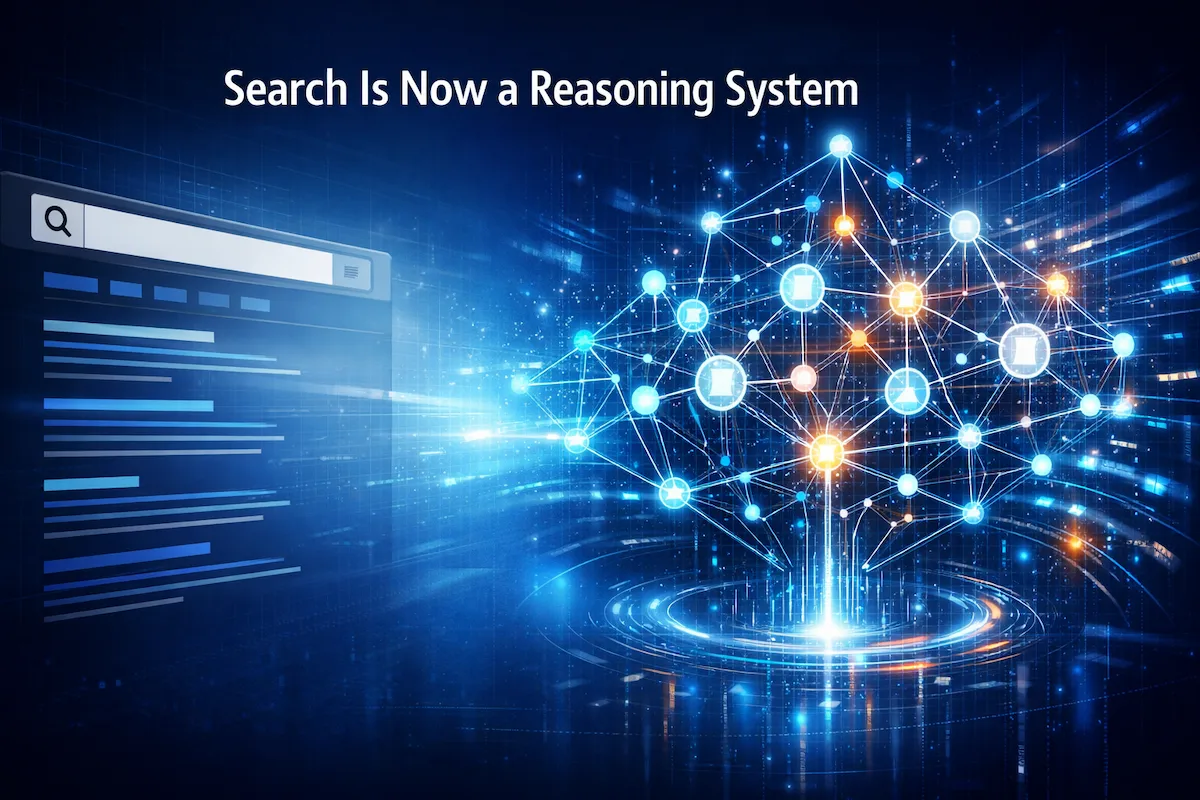
Search is no longer a retrieval system. It is a reasoning system. And most SEO strategies are still optimized for retrieval.
While SEO teams debate backlink profiles and meta descriptions, the fundamental architecture of how search engines process queries has evolved from document matching into semantic synthesis. The gap between what practitioners optimize for and what algorithms actually evaluate has never been wider—and that gap represents both existential risk and asymmetric opportunity.
This article presents a strategic framework for organizations navigating SEO in 2026, where semantic intent, entity relationships, and conversational context have replaced keyword matching as the primary ranking signals. The shift isn’t incremental; it’s architectural.
The Evolution from Search Engines to Answer Engines
Generative AI SEO begins with understanding how search has transformed from document retrieval into intelligent answer synthesis. Traditional search engines retrieved documents matching query terms. Generative AI systems synthesize answers from corpus knowledge, reducing the need for users to click through to source documents. This distinction matters operationally: when Google’s AI Overviews, Perplexity’s answer summaries, or Bing’s conversational search surfaces direct answers, organic click-through rates compress dramatically.
The Zero-Click Reality
The foundation of generative AI SEO strategy must account for the fact that 57-62% of searches now end without clicks, as AI-generated answers satisfy user intent directly on the SERP. Data from enterprise analytics platforms indicates that zero-click searches now represent between 57 and 62% of all queries in competitive commercial verticals. AI Overviews appear in approximately 35% of informational queries and 18% of transactional queries. The SERP itself has become the destination rather than the gateway.
Conversational Search Dynamics
Conversational SERPs introduce multi-turn query refinement, where follow-up questions modify previous context without explicit keyword re-entry. This fundamentally disrupts traditional keyword targeting strategies. A user might search “enterprise SaaS security compliance frameworks,” receive an AI-generated overview, then ask, “Which ones support GDPR and HIPAA?” without restating the initial context. Both queries require ranking consideration, but only the first contains explicit keywords.
Economic Implications for Organic Strategy
Organizations investing in generative AI SEO must shift from optimizing for clicks to optimizing for visibility within AI-synthesized results and answer summaries. The economic implications are substantial. Brands optimized exclusively for click acquisition face traffic compression. The strategic pivot requires optimizing for visibility within AI-synthesized results, not just organic listings. This demands different content structures, semantic depth, and entity reinforcement strategies—similar to how AI-powered data analytics transforms decision-making by shifting from reactive reporting to predictive intelligence.
The Collapse of Traditional Keyword-Centric SEO
Generative AI SEO has rendered traditional keyword density and exact-match optimization largely obsolete, replacing them with semantic understanding and intent mapping. Keyword density, exact-match targeting, and page-level keyword optimization represented rational strategies when search engines matched strings. Generative models process semantic meaning, contextual relationships, and conceptual proximity. They don’t count keyword frequency; they evaluate whether content demonstrates comprehensive understanding of a topic’s conceptual boundaries.
From Keywords to Intent Clusters
Consider the term “customer retention strategies.” Traditional SEO-optimized pages around this exact phrase plus modifiers (best, top, effective). Generative search evaluates whether your content addresses the underlying intent cluster: churn analysis, engagement metrics, lifecycle value optimization, behavioral triggers, segmentation models, retention economics, and predictive analytics. If your content mentions “retention strategies” forty times without addressing these connected concepts, generative models classify it as shallow.
The Intent Cluster Framework
Successful generative AI SEO implementation requires building content around intent clusters rather than isolated keyword phrases, addressing the full spectrum of user needs.
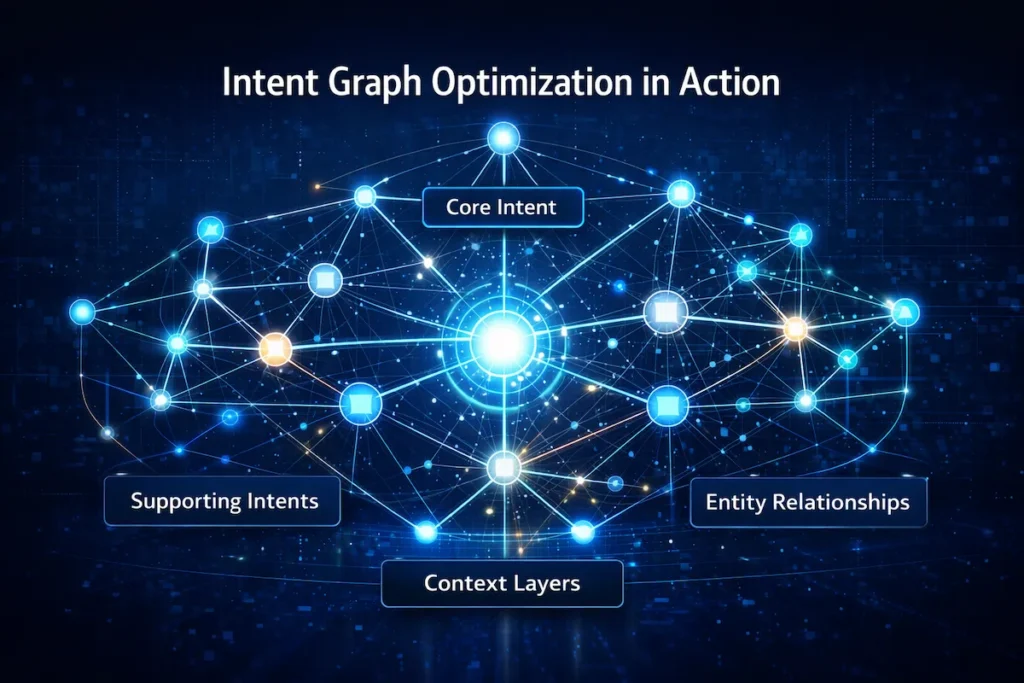
Core Intent: The primary information need (e.g., improve customer retention)
Supporting Intents: Adjacent problems users need solved (measure churn, calculate LTV, design re-engagement campaigns)
Context Layers: Industry-specific considerations (SaaS vs. e-commerce retention), operational constraints (budget, team size), decision-stage requirements (awareness vs. implementation)
Entity Relationships: Connected concepts that validate expertise (NPS, cohort analysis, CAC:LTV ratio, engagement scoring)
Instead of targeting “customer retention strategies” as a keyword, you’re architecting content that maps the complete conceptual space around retention optimization. Generative models reward comprehensiveness and conceptual depth over keyword frequency.
What Legacy Tactics No Longer Work
Generative AI SEO has invalidated keyword stuffing, exact-match domains, and meta keyword tags, replacing them with structured data, entity relationships, and semantic signals. This shift invalidates several legacy practices: keyword stuffing is algorithmically invisible, exact-match domains provide minimal advantage, and meta keyword tags remain irrelevant. Conversely, structured data markup, entity disambiguation, and semantic layering have become essential ranking factors because they help AI models understand what your content means, not just what words it contains.
Generative AI and the Rise of Intent Graph Optimization
The Intent Graph SEO Model represents the structural foundation of generative AI SEO, mapping how AI systems evaluate content authority through entity relationships and semantic connections. The Intent Graph SEO Model represents a structural framework for how generative search systems evaluate content authority. Unlike traditional link graphs that measure page relationships through hyperlinks, intent graphs map conceptual relationships between entities, topics, and user needs.
Intent Graph SEO Model Framework
| Component | Traditional SEO Equivalent | AI-First Optimization |
|---|---|---|
| Node Structure | Individual keywords | Entities + concepts + intent states |
| Connection Logic | Internal links + external backlinks | Semantic relationships + contextual co-occurrence |
| Authority Signal | Domain authority + PageRank | Entity salience + conceptual coverage depth |
| Ranking Factor | Keyword relevance + link equity | Intent satisfaction completeness |
| Content Organization | Keyword silos | Multi-dimensional topic networks |
Practical Implementation Strategy
Implementing generative AI SEO means consolidating keyword-focused pages into comprehensive semantic resources that address multiple related intents simultaneously.
Instead of creating separate pages for “email marketing automation,” “email marketing software,” and “email marketing tools” (traditional keyword targeting), you architect a comprehensive resource on marketing automation that addresses workflow design, trigger logic, personalization mechanics, integration architecture, performance measurement, and comparative platform capabilities. The content demonstrates entity relationships (ESP platforms, CRM systems, data warehouses) and addresses multiple intent states (evaluation, implementation, optimization).
The Intent Graph Authority Pyramid
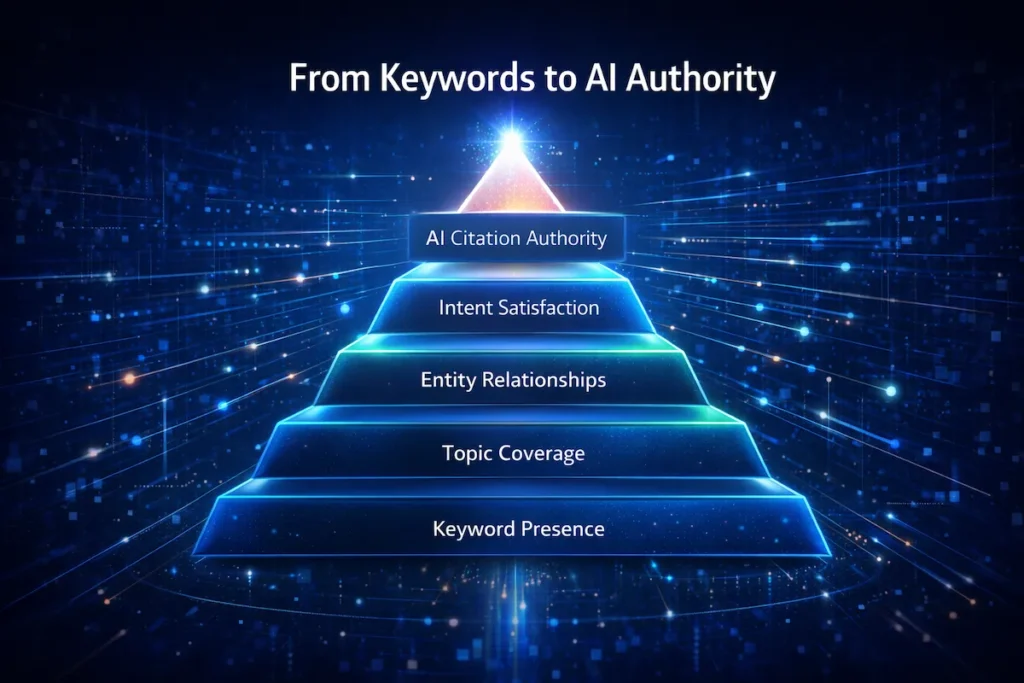
Understanding where your content ranks in AI evaluation requires thinking vertically, not horizontally. The Intent Graph Authority Pyramid maps five distinct levels of search optimization maturity:
Level 1 – Keyword Presence: Content contains target terms (where most SEO still operates)
Level 2 – Topic Coverage: Content addresses the broader subject comprehensively
Level 3 – Entity Relationships: Content demonstrates connections between concepts, validating expertise
Level 4 – Intent Satisfaction Depth: Content resolves complete user needs, not just surface queries
Level 5 – AI Citation Authority: AI systems reference your content as authoritative sources in synthesized answers
Traditional SEO operates at Levels 1-2. Generative AI ranking happens at Levels 4-5. Organizations still optimizing for keyword presence are competing in a game that no longer determines visibility.
Entity Reinforcement Techniques
Entity reinforcement forms a critical component of generative AI SEO, helping AI models verify your authority by evaluating how comprehensively you address related concepts. Entity reinforcement becomes critical. When discussing “predictive analytics,” generative models verify your authority by checking whether you appropriately reference related entities: machine learning algorithms, training data requirements, model validation techniques, statistical significance, and overfitting risks. Missing these connections signals surface-level treatment.
Semantic Layering for Multiple Audiences
Advanced generative AI SEO embeds multiple sophistication levels within unified content, using structured data to help AI models surface appropriate sections for different user intents.
Semantic layering means addressing topics at multiple sophistication levels simultaneously. Enterprise buyers need strategic frameworks; practitioners need implementation details; executives need ROI models. Traditional SEO created separate pages for each audience. AI-first content architecture embeds multiple layers within unified resources, using structured data and entity markup to help AI models surface appropriate sections for different query intents.
Real-World Application: Semantic Consolidation in Practice
This cybersecurity company’s generative AI SEO transformation demonstrates how consolidating keyword-targeted pages into semantic architectures drives AI citation authority, even as traditional organic traffic declines.
A B2B cybersecurity company historically ranking for “cloud compliance software” consolidated 17 keyword-focused pages into one semantic architecture covering regulatory entities (SOC 2, ISO 27001, HIPAA), implementation models, audit workflows, automation tools, and compliance economics. The consolidated resource addressed cloud security implementation challenges alongside compliance frameworks, creating comprehensive entity coverage.
Within 8 months, AI summaries began citing the brand for regulatory comparison queries despite no increase in backlinks. Traffic from AI Overview citations grew 34%, while traditional organic traffic declined 12%—a net positive outcome that would have appeared negative under legacy measurement frameworks. The company’s entity authority for “compliance automation” increased measurably across multiple AI platforms, including ChatGPT, Perplexity, and Google’s generative results.
The strategic insight: They stopped optimizing for keyword rankings and started optimizing for AI citation authority. That shift required measuring different metrics and accepting that traditional visibility indicators (rankings, organic traffic) no longer correlated directly with business outcomes.
Content Architecture for AI-First Search
Content architecture for generative AI SEO requires structuring information as interconnected knowledge networks rather than isolated keyword-optimized pages. Generative search systems prefer content structured as interconnected knowledge networks rather than isolated pages. This requires architectural thinking beyond traditional on-page optimization.
Topic Cluster Architecture 2.0
Modern generative AI SEO extends traditional hub-and-spoke models by adding semantic interconnection layers that map conceptual relationships between pillar and cluster content.
Topic Cluster Architecture 2.0 extends hub-and-spoke models by adding semantic interconnection layers:
- Pillar Content: Comprehensive resources covering complete conceptual domains (not just keyword themes)
- Cluster Content: Specialized deep-dives into sub-topics with explicit entity relationships
- Connective Tissue: Semantic bridges using structured data to map relationships between concepts
- Multi-Format Assets: Video, interactive tools, data visualizations that address different query modalities
Structured Data and Entity Annotation
Structured data implementation has become essential for generative AI SEO, helping AI models understand not just what your content says, but why it should be considered authoritative.
Structured data implementation has evolved from basic schema markup to comprehensive entity annotation. JSON-LD should define: primary entities discussed, related concepts, prerequisite knowledge, authorship credentials, organizational expertise, and factual claims with source attribution. This metadata helps AI models understand not just what your content says, but why it should be trusted as authoritative.
Entity Reinforcement Requirements
Generative AI SEO demands consistent entity terminology, proper noun disambiguation, and explicit conceptual connections that validate your topical expertise. Entity reinforcement requires consistent terminology, proper noun disambiguation, and conceptual precision. When discussing “conversion rate optimization,” explicitly connect it to: statistical significance testing, user experience design, behavioral psychology, analytics implementation, and experimentation methodology. Use structured data to annotate these relationships.
Multi-Format Content Strategy
A comprehensive generative AI SEO approach includes video transcripts, visual assets, interactive tools, and data visualizations that reinforce authority through different modalities.
Multi-format content addresses how different AI systems process information. Video transcripts provide textual content for language models; visual assets support multimodal search; interactive tools generate engagement signals; data visualizations demonstrate analytical rigor. Each format reinforces authority through different modalities.
Practical Implementation Checklist
This generative AI SEO checklist ensures content includes entity annotations, semantic linking, structured data mapping, and multi-format assets that AI systems can process effectively.
- Primary entities identified and marked with schema annotations
- Related concepts explicitly discussed and semantically linked
- Topic depth measured by conceptual coverage, not word count
- Multiple formats addressing the same core intent
- Structured data mapping entity relationships
- Internal linking based on semantic relevance, not just keyword matching
- Content addresses multiple user sophistication levels
Similar to how identity and access management requires layered security rather than single-point solutions, semantic SEO demands multi-dimensional content architecture rather than page-level optimization.
AI-Powered SERP Volatility and Predictive SEO Strategy
Generative AI SEO introduces unprecedented ranking volatility as AI models learn continuously from emerging query patterns, new research, and real-time user satisfaction signals. Generative search introduces unprecedented ranking volatility. Traditional algorithms updated periodically; AI models learn continuously. Rankings now shift based on: emerging query patterns, newly published research, changing entity relationships, and real-time user satisfaction signals.
Dynamic Ranking Framework
Traditional SEO reacted to periodic algorithm updates; generative AI SEO requires continuous semantic monitoring and adaptive intent coverage strategies.
| Volatility Factor | Traditional Response | AI-First Response |
|---|---|---|
| Algorithm update | Wait, analyze, react | Continuous semantic monitoring |
| Competitor content | Keyword gap analysis | Intent coverage assessment |
| Topic evolution | Historical trend analysis | Predictive entity tracking |
| SERP feature changes | Position tracking | AI summary monitoring |
| User behavior shifts | CTR optimization | Intent satisfaction scoring |
Optimizing for AI Overview Citations
Advanced generative AI SEO focuses on citation inclusion within AI-generated answers, not just organic rankings, requiring monitoring of how AI systems summarize and attribute your content.
AI Overviews and generated summaries represent a new optimization target. Your content doesn’t need to rank #1 organically if it’s consistently cited in AI-generated answers. This requires monitoring: which sources AI systems cite, how they summarize your content, whether your entity assertions appear in synthesized answers, and what conceptual gaps might reduce citation frequency.
Predictive Content Development
Predictive generative AI SEO means publishing authoritative content on emerging topics before significant search volume materializes, establishing entity authority early. Predictive SEO strategy means anticipating intent evolution before query volume materializes. When new technologies, regulatory changes, or market shifts occur, generative models immediately begin answering questions about them—even before significant search volume exists. Organizations that publish authoritative content early gain entity authority that persists.
Enterprise Monitoring Infrastructure
Enterprise generative AI SEO requires specialized tools for tracking AI summary citations, entity mentions across platforms, and semantic gap analysis. Enterprise SEO teams should implement: AI summary tracking tools, entity mention monitoring across AI platforms, semantic gap analysis comparing your content coverage to emerging query patterns, and predictive content development based on adjacent market signals.

Enterprise SEO Strategy in 2026
Enterprise generative AI SEO has evolved into an interdisciplinary function requiring collaboration between SEO, AI, product, data, and content teams. SEO has become an interdisciplinary function requiring collaboration across teams that traditionally operated independently.
Cross-Functional SEO Framework
Successful generative AI SEO implementation demands cross-team collaboration to develop semantic models, engagement signals, analytics frameworks, and content workflows.
SEO + AI Teams: Develop semantic models, entity relationship mapping, and AI system monitoring capabilities
SEO + Product Teams: Design user experiences that generate strong engagement signals; implement structured data at the product level
SEO + Data Teams: Build intent satisfaction measurement, semantic search analytics, and entity authority scoring
SEO + Content Teams: Create AI-assisted content workflows that maintain quality while scaling semantic coverage
AI-Assisted Content Workflows
Generative AI SEO workflows use AI to identify semantic gaps, suggest entity relationships, and analyze competitor coverage—while human experts provide strategic thinking and original research.
AI-assisted content workflows don’t mean AI-generated content published without human expertise. They mean using AI to: identify semantic gaps, suggest entity relationships, draft structural outlines, analyze competitor conceptual coverage, and recommend internal linking patterns—while human experts provide strategic thinking, original research, and authoritative perspective.
The ROI calculation for AI integration follows a similar framework to generative AI versus traditional automation—the value comes not from cost reduction but from capability expansion. AI tools enable semantic analysis at scale that was previously impossible, allowing SEO teams to identify intent gaps across thousands of content pieces simultaneously.
Continuous Semantic Optimization
Continuous semantic optimization replaces periodic content refreshes. Monitor: entity mentions in AI summaries, citation patterns, semantic coverage gaps, emerging related concepts, and user intent evolution. Update content based on conceptual relevance, not just keyword trends.
New Measurement Frameworks
As generative AI SEO becomes accessible to all organizations, differentiation requires original research, proprietary data, and authentic expertise rather than AI-generated content volume. Measurement frameworks must evolve beyond rankings and traffic. Track: AI summary inclusion rates, entity authority scores, intent cluster coverage completeness, semantic search visibility, and ultimately—business outcome correlation.
Risks, Ethical Concerns, and Over-Automation
The accessibility of generative AI has created content saturation. Every organization can now produce vast quantities of technically coherent but strategically generic content. Differentiation comes from: original research, proprietary data, expert analysis, unique methodological frameworks, and authentic perspective.
Authenticity as a Ranking Signal
Generative AI SEO algorithms increasingly prioritize authenticity signals including author credentials, organizational expertise, and methodological transparency over content quantity. Authenticity signals matter more as AI-generated content proliferates. Generative search systems increasingly weight: author credentials, organizational expertise, methodological transparency, source attribution, and demonstrated domain authority. Content that reads like AI synthesis without human insight gets algorithmically devalued.
Brand Trust and Entity Authority
Brand trust functions as a ranking factor. Known entities with established expertise gain preferential treatment in AI summaries. Building brand authority requires: consistent publication of original research, subject matter expert visibility, industry contribution, and thought leadership that advances discourse rather than summarizing existing knowledge.
Over-Automation Risks
Over-automation risks include: conceptual homogenization where everyone addresses the same intent clusters similarly, loss of brand voice, decreased content differentiation, and algorithmic detection of AI-generated patterns. The strategic balance involves using AI for structural efficiency while maintaining human expertise for substantive value.
Ethical Considerations
Ethical considerations extend to: transparency about AI-assisted processes, factual accuracy verification, avoiding manipulation of entity relationships, and respecting user intent rather than gaming algorithmic systems.
Strategic Predictions for 2027 and Beyond
The evolution of generative AI SEO will accelerate as multimodal integration, real-time synthesis, and personalized intent graphs reshape how content authority is evaluated.
Multimodal Search Integration
Future generative AI SEO will incorporate visual, audio, and video content directly into entity authority calculations, requiring multimedia documentation of expertise. Visual, audio, and video content will factor directly into entity authority calculations. Organizations with robust multimedia documentation of expertise will gain ranking advantages.
Real-Time Intent Synthesis
Next-generation generative AI SEO will emphasize content freshness and structured data update frequency as AI models synthesize answers from real-time sources. Generative models will increasingly synthesize answers from real-time data sources, making content freshness and structured data update frequency critical ranking factors.
Personalized Intent Graphs
Advanced generative AI SEO must address diverse conceptual entry points as AI systems build user-specific intent graphs based on individual search histories. AI systems will build user-specific intent graphs based on search history, making content that addresses diverse conceptual entry points more valuable than content optimized for single intent paths.
Collaborative Knowledge Validation
Future generative AI SEO may require cross-source validation where entity claims need corroboration from multiple authoritative sources, making original research strategically valuable. Search systems may implement cross-source validation where entity claims require corroboration from multiple authoritative sources, making original research and data publication strategically valuable.
Semantic Search Advertising
Paid search evolution in generative AI SEO will shift from keyword bidding to intent cluster targeting, requiring semantic territory mapping rather than query string optimization. Paid search will evolve beyond keyword bidding to intent cluster targeting, requiring advertisers to map their offerings against semantic territories rather than query strings.

FAQ
Q: How do we measure semantic authority vs domain authority?
In a Generative AI SEO environment, authority is measured less by backlink volume and more by how AI systems interpret and cite your content. Track entity mentions in AI summaries, citation frequency, intent cluster coverage, and structured data validation. While domain authority still influences visibility, Generative AI SEO prioritizes semantic depth and intent satisfaction over raw link equity.
Q: Should we consolidate keyword pages into broader resources?
For most organizations adopting Generative AI SEO, consolidation improves performance. AI systems favor comprehensive resources that demonstrate entity relationships and full intent coverage. However, maintain separate pages when user intent differs significantly. The goal in Generative AI SEO is not fewer pages—it’s clearer semantic architecture.
Q: How do we optimize for AI platforms beyond Google?
Monitor citation patterns per platform. Perplexity describes its approach as web-search + synthesis with cited sources, so visibility strategies include being a “citable” source.
Q: What’s the ROI timeline?
Generative AI SEO is cumulative. Expect early improvements in AI summary visibility within 6–9 months, with stronger semantic authority developing over 12–18 months. Unlike traditional SEO, Generative AI SEO compounds as entity recognition and conceptual coverage strengthen over time.
Q: How do we reduce misrepresentation in summaries?
While full control isn’t possible, Generative AI SEO reduces misinterpretation through clear structure, explicit entity definitions, factual precision, and strong internal linking. The clearer your semantic signals, the more accurately AI systems can synthesize and represent your content.
Conclusion: Authority Through Semantic Leadership
Success in generative AI SEO requires establishing your organization as the authoritative entity AI systems trust when synthesizing answers—and that trust determines both visibility and market position.
The enterprises that dominate search in 2026 won’t be those with the most backlinks or the highest keyword density. They’ll be the organizations that AI systems recognize as authoritative entities within specific conceptual domains—companies whose content demonstrates comprehensive understanding, original thinking, and semantic depth.
This transition rewards strategic thinking over tactical execution. The competitive advantage lies in understanding intent architectures, mapping conceptual territories, and building entity authority that transcends individual keywords or pages.
For SEO leaders, this represents an opportunity to elevate the function from technical execution to strategic intelligence. Organizations that view SEO as merely traffic acquisition will struggle. Those that recognize it as semantic positioning within AI knowledge systems will capture disproportionate visibility.
The work ahead isn’t optimizing pages for algorithms. It’s establishing your organization as the authoritative entity within your domain—the source AI systems trust when synthesizing answers to user needs. That authority builds through comprehensive content, semantic precision, entity reinforcement, and original contribution.
In generative search, the question is not “Can you rank?” It is “Does the AI trust you enough to speak on your behalf?”
That trust determines visibility. And visibility determines market position.
3 thoughts on “From Keywords to Intent Graphs: How Generative AI Is Reshaping SEO in 2026”