
Why AI Tools for Digital Marketers Matter in 2026
Digital marketing moves fast. Campaigns that took weeks to plan now need to launch in days. Content calendars that required entire teams can be managed by smaller groups. The difference? Smart automation.
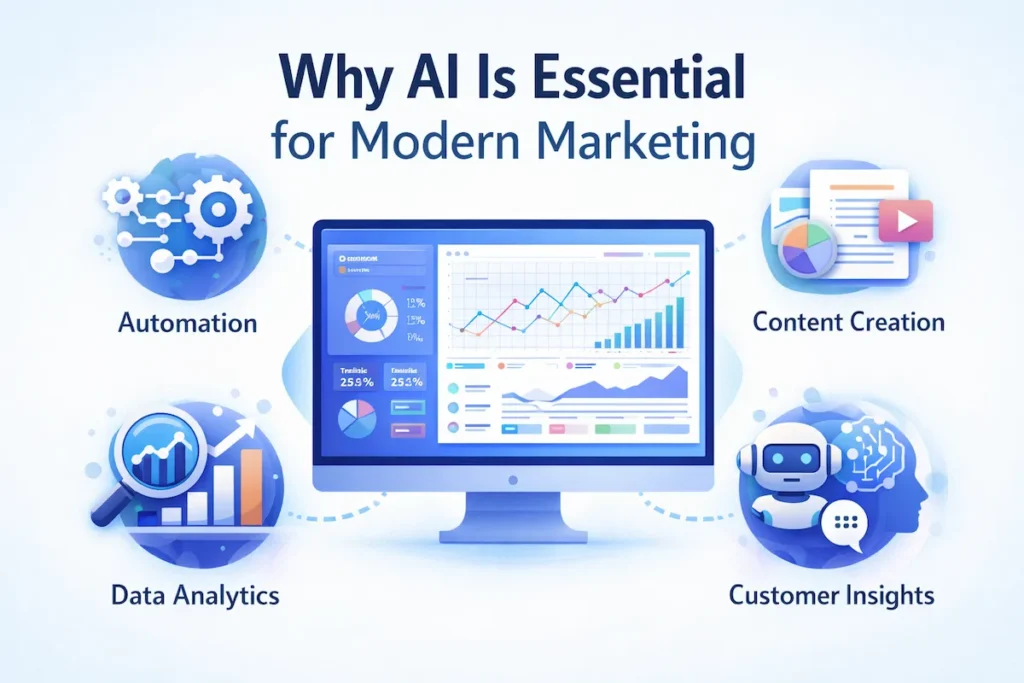
AI tools for digital marketers have shifted from optional to essential. They handle repetitive tasks, analyze data faster than any human team, and uncover insights buried in spreadsheets. For US-based marketers juggling multiple channels, tight budgets, and demanding KPIs, these tools deliver three critical advantages: speed, accuracy, and scale.
Competition is another factor. Your competitors are already using AI to optimize ad copy, predict customer behavior, and personalize email campaigns. If you’re still doing everything manually, you’re not just slower—you’re less effective.
This isn’t about replacing human creativity. It’s about removing friction. When AI handles data analysis, formatting, and initial drafts, you spend more time on strategy, testing, and decisions that actually move the needle.
However, as AI tools for digital marketers become more integrated into workflows, data security becomes paramount. Just as businesses need robust cloud security tips for protecting their data online, marketers must ensure their AI platforms handle customer information responsibly and comply with privacy regulations.
The question isn’t whether to use AI. It’s which tools solve your specific problems without wasting time or budget.
How We Selected the Best AI Tools for Digital Marketers
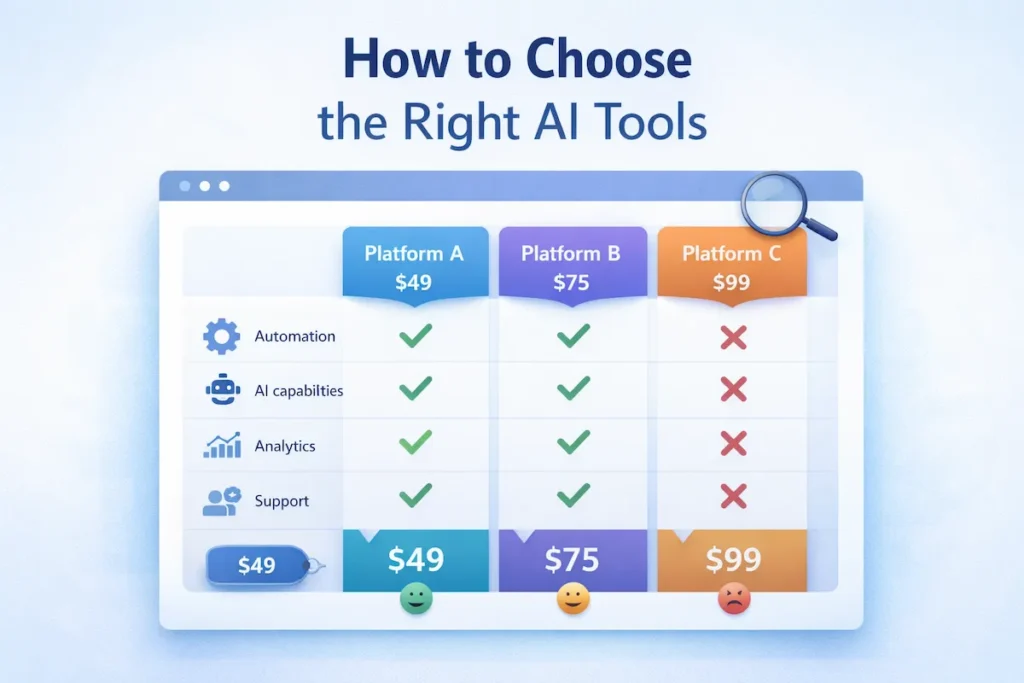
We evaluated dozens of platforms based on four criteria: usability, pricing structure, feature depth, and real-world application for US marketers.
Usability matters because complex tools sit unused. We prioritized platforms with clean interfaces, fast learning curves, and reliable customer support. Pricing structure matters because SaaS costs add up. We looked for transparent plans, free trials, and clear ROI potential.
Feature depth separates serious tools from basic apps. We tested each platform’s core functions, integration options, and output quality. Real-world application means the tool solves actual marketing problems—not just theoretical ones.
We also considered team size. Some AI tools for digital marketers work best for solo consultants. Others require team collaboration features or enterprise-level security. Understanding cloud visibility vs. understanding in 2026 helps marketers grasp how these platforms actually process and store marketing data behind the scenes.
No tool is perfect. We highlight both strengths and limitations so you can match platforms to your workflow, not someone else’s sales pitch.
Top 10 AI Tools for Digital Marketers (Detailed Breakdown)
ChatGPT—AI Content Creation for Digital Marketers
ChatGPT handles brainstorming, drafting, and content repurposing. Need 10 email subject lines for a product launch? Done in seconds. Struggling with a blog outline? Provide a topic and get a structured framework.
For digital marketers, ChatGPT excels at rapid ideation and first drafts. It’s not a replacement for the final copy, but it cuts down writing time significantly. You can use it to draft social media captions, generate FAQ content, or even outline video scripts.
Strengths: Free tier available, versatile across content types, conversational interface, regular updates with improved capabilities.
Limitations: Requires fact-checking, lacks brand voice consistency without detailed prompts, has no direct integrations with marketing platforms, and has occasional inaccuracies in specialized topics.
AI tools for digital marketers like ChatGPT work best when you treat them as assistants, not autopilot. Always review, edit, and verify outputs before publishing to maintain brand standards and factual accuracy.
Jasper AI—Advanced AI Writing Tool for Marketing Teams
Jasper is built specifically for marketing content. It offers templates for blog posts, ad copy, email campaigns, and landing pages. Unlike general AI tools, Jasper includes brand voice customization and SEO optimization features.
Teams use Jasper to maintain consistency across campaigns. The platform learns your tone, style preferences, and key messaging. It integrates with Surfer SEO for real-time content scoring and optimization.
The collaboration workspace allows multiple team members to work on content simultaneously, tracking changes and maintaining version control. Jasper’s Boss Mode provides longer-form content capabilities with better context retention than basic AI writers.
Strengths: Marketing-focused templates, brand voice training, collaboration features for teams, SEO integration, and a command-based interface for experienced users.
Limitations: Higher price point than general tools, learning curve for advanced features, output still requires human editing, monthly word limits on lower-tier plans.
For agencies or in-house teams producing high volumes of content, Jasper streamlines workflow without sacrificing quality control. It’s one of the most robust AI tools for digital marketers managing multiple clients or campaigns simultaneously.
Canva AI—Visual Design Tool Powered by AI
Canva’s AI features simplify graphic design for non-designers. Magic Design generates complete templates from text prompts. Background remover isolates subjects instantly. Magic Eraser removes unwanted elements from images. Text-to-image creates custom visuals from descriptions.
Digital marketers use Canva AI to create social media graphics, presentation decks, infographics, and ad creatives without hiring designers for every asset. The platform includes templates optimized for Facebook, Instagram, LinkedIn, TikTok, and other channels.
Brand Kit features allow teams to maintain visual consistency by storing logos, color palettes, and fonts. The collaboration tools let multiple stakeholders review and approve designs before publishing.
Strengths: Intuitive drag-and-drop interface, massive template library, affordable pricing, regular feature updates, and mobile app for on-the-go editing.
Limitations: Advanced design work still requires professional tools, limited video editing capabilities compared to dedicated platforms, and can produce generic-looking designs without customization.
Canva democratizes visual content creation. For marketers without design budgets, it’s an essential addition to any toolkit of AI tools for digital marketers focused on maintaining consistent brand presence across channels.
Surfer SEO – AI SEO Optimization Tool
Surfer SEO analyzes top-ranking pages and provides data-driven recommendations. It covers keyword density, content structure, headings, and semantic terms. The content editor scores your draft in real time as you write.
Digital marketers use Surfer to reverse-engineer what’s working in search results. Instead of guessing at keyword placement, you get specific guidance based on actual ranking factors. The audit feature identifies optimization opportunities in existing content.
Surfer’s SERP Analyzer breaks down the top 50 results for any keyword, showing word count, keyword usage, domain authority, and backlink profiles. This competitive intelligence helps you understand what it takes to rank.
Strengths: Real-time content scoring, competitive analysis, integration with Google Docs and WordPress, outline builder for content briefs, and topic cluster tools.
Limitations: Requires SEO knowledge to interpret recommendations effectively, pricing scales with usage, best for content-heavy strategies, can sometimes over-optimize for keyword density.
For US marketers focused on organic traffic, Surfer removes guesswork from on-page optimization. It’s one of the most targeted AI tools for digital marketers, prioritizing search visibility and content performance.
Grammarly AI—Smart Writing Assistant for Marketers
Grammarly goes beyond spell-check. It analyzes tone, clarity, engagement, and delivery. The Business tier includes brand tone consistency, snippets for repetitive content, and analytics dashboards.
Digital marketers use Grammarly to polish everything from email campaigns to blog posts. The tone detector helps match messaging to audience expectations—professional for B2B, conversational for DTC brands.
The plagiarism detector ensures content originality, which is critical for maintaining SEO rankings and brand credibility. Style guides help teams maintain consistent voice across all communications.
Strengths: Real-time editing across platforms, tone analysis, plagiarism detection, browser extension works everywhere, and mobile keyboard integration.
Limitations: Premium features require paid plans; suggestions sometimes miss industry-specific context; can be overly aggressive with corrections on creative content.
Clean, error-free copy builds credibility. Grammarly ensures your messaging looks professional across every channel. It’s a foundational tool among AI tools for digital marketers focused on written content quality and consistency.
Pictory AI – AI Video Creation Tool
Pictory converts text into video. Upload a blog post, and it generates a video with relevant stock footage, captions, and voiceover. You can also repurpose long-form videos into short clips for social media.
Digital marketers use Pictory to scale video production without expensive equipment or editing skills. The platform works for product demos, testimonial compilations, social clips, and educational content.
The script-to-video feature analyzes your text and automatically matches relevant visuals from its stock library. You can customize scenes, adjust timing, and add music to match brand aesthetics.
Strengths: No video editing experience required, fast turnaround, stock library included, automatic caption generation, multiple aspect ratios for different platforms.
Limitations: Limited customization compared to manual editing, generic visuals without custom footage, voiceover quality varies, watermark on free tier.
Video drives engagement, but production bottlenecks slow campaigns. Pictory solves this for marketers who need volume without sacrificing quality. It’s a game-changer among AI tools for digital marketers expanding into video content without large production budgets.
HubSpot AI – AI CRM & Marketing Automation Platform
HubSpot’s AI features span content generation, email optimization, and predictive lead scoring. Content Assistant drafts blog posts and social updates. Smart Send Time predicts when contacts are most likely to engage.
Digital marketers use HubSpot AI to personalize campaigns at scale. Lead scoring identifies high-intent prospects automatically. Workflow automation triggers emails, tasks, and notifications based on behavior.
The platform’s AI analyzes historical data to predict deal closure probability, helping sales teams prioritize efforts. ChatSpot, HubSpot’s AI assistant, answers questions about your data and performs tasks through conversational commands.
Since AI tools for digital marketers often store sensitive customer data, implementing proper cloud backup and disaster recovery readiness strategies ensures your marketing operations remain resilient against data loss or system failures.
Strengths: All-in-one platform, deep integration across marketing functions, robust analytics, extensive app marketplace, strong customer support.
Limitations: Higher cost for full feature access, complexity for small teams, requires time investment to set up properly, some advanced AI features locked behind higher tiers.
For teams managing complex funnels and multiple touchpoints, HubSpot centralizes operations. It’s one of the most comprehensive AI tools for digital marketers running integrated campaigns across email, social, content, and sales channels.
Copy.ai – AI Copywriting Tool for Ads and Sales
Copy.ai specializes in short-form copy. Think ad headlines, product descriptions, landing page hooks, and CTAs. The platform includes templates for specific use cases like Facebook ads, Google ads, and email subject lines.
Digital marketers use Copy.ai to test multiple variations quickly. Generate 20 headline options, pick the top three, and A/B test. The Infobase feature stores brand information for consistent output across projects.
The platform’s workflow tools help teams collaborate on copy development, from initial drafts to final approval. Long-form editor handles blog posts and landing pages when you need more than snippets.
Strengths: Fast output, affordable pricing, templates for common marketing formats, unlimited projects, Chrome extension for writing anywhere.
Limitations: Better for short copy than long-form content, requires editing for brand voice alignment, limited collaboration features compared to enterprise tools, occasional repetitive suggestions.
Ad performance often hinges on small copy tweaks. Copy.ai accelerates testing cycles, making it a valuable addition to AI tools for digital marketers optimizing paid campaigns and conversion-focused messaging.
Hootsuite AI – Social Media Marketing Automation Tool
Hootsuite’s AI features include OwlyWriter for caption generation, best time to publish recommendations, and sentiment analysis. The platform manages scheduling, monitoring, and analytics across Facebook, Instagram, Twitter, LinkedIn, and more.
Digital marketers use Hootsuite to centralize social media operations. Instead of logging into multiple platforms, you schedule posts, respond to comments, and track performance from one dashboard. AI suggestions streamline content creation and timing.
The social listening tools monitor brand mentions, competitor activity, and industry trends. AI-powered sentiment analysis categorizes feedback as positive, negative, or neutral, helping teams respond appropriately.
When managing multiple social accounts with AI tools for digital marketers, regular cloud security audits for modern cloud environments help verify that your social media management platforms properly protect account credentials and customer data.
Strengths: Multi-platform management, team collaboration, comprehensive analytics, inbox for all social messages, approval workflows for larger teams.
Limitations: Pricing increases with social accounts, learning curve for advanced features, occasional platform integration delays, mobile app less robust than desktop.
Social media demands consistency and speed. Hootsuite delivers both, making it essential among AI tools for digital marketers managing active social presences across multiple platforms and team members.
Semrush AI – AI Keyword and Competitor Research Tool
Semrush combines keyword research, competitor analysis, and content optimization. The Keyword Magic Tool uncovers search volume, difficulty, and intent. Content Marketing Toolkit provides SEO recommendations similar to Surfer.
Digital marketers use Semrush to identify opportunities competitors are missing. Track their ad spend, backlinks, and top-performing content. The Position Tracking feature monitors ranking changes daily.
The competitive analysis shows which keywords competitors rank for, their estimated traffic, and content gaps you can exploit. Traffic Analytics reveals where competitors get visitors and which campaigns drive results.
Strengths: Comprehensive toolset, competitive intelligence, global database for international campaigns, advertising research tools, backlink analysis.
Limitations: Expensive for small budgets, feature overload for beginners, requires SEO knowledge to maximize value, data accuracy varies by region.
For data-driven marketers, Semrush reveals what’s working in your niche. It’s one of the most powerful AI tools for digital marketers building long-term organic and paid strategies based on competitive intelligence.
Key Benefits of Using AI Tools for Digital Marketers
Efficiency tops the list. Tasks that consumed hours now take minutes. Content drafts, data analysis, and design work happen faster, freeing time for strategic decisions that require human judgment and creativity.
Better decision-making comes from deeper insights. AI processes more data than human teams, identifying patterns and trends you’d otherwise miss. Predictive analytics help forecast campaign performance before spending budget, reducing waste and improving ROI.
Cost and time savings add up quickly. Hiring specialists for every task isn’t feasible for most teams. AI tools for digital marketers handle functions that previously required freelancers or full-time hires, from graphic design to copywriting to data analysis.
Competitive advantage matters in crowded markets. When you ship campaigns faster, optimize better, and personalize deeper, you win attention and conversions. Teams using AI effectively level the playing field between small operations and large agencies.
Scalability without proportional cost increases becomes possible. You can double content output, manage more social accounts, or analyze larger datasets without doubling headcount. This scalability supports growth without killing margins.
These benefits compound over time. Faster execution enables more testing. More testing improves results. Better results justify budget increases. The cycle accelerates growth for AI tools for digital marketers users who implement systematically.
Pros and Cons of AI Tools for Digital Marketers
Pros:
- Automate repetitive tasks like data entry, reporting, and formatting
- Generate content faster without sacrificing baseline quality
- Analyze datasets too large for manual review in reasonable timeframes
- Personalize campaigns at scale across thousands of contacts
- Reduce dependency on specialized skills for basic tasks
- Enable 24/7 productivity through automated workflows
- Lower operational costs compared to equivalent human labor
- Provide data-driven recommendations removing guesswork
Cons:
- Require human oversight to maintain quality and accuracy
- Subscription costs accumulate across multiple tools
- Learning curves slow initial adoption and ROI realization
- Generic output lacks unique brand voice without proper training
- Data privacy concerns with third-party platforms handling customer information
- Over-reliance can diminish creative thinking and strategic skills
- Integration challenges between different platforms
- Potential for algorithmic bias in recommendations
Understanding the recent major cybersecurity incident analysis in 2026 highlights why vetting AI platforms for security practices matters. Marketing data breaches can damage customer trust permanently.
The value proposition depends on your specific workflow. If you’re manually performing tasks AI handles well, the trade-off favors adoption. If your work demands deep creativity or nuanced judgment, AI tools for digital marketers support rather than replace human effort.

Frequently Asked Questions About AI Tools for Digital Marketers
What are AI tools for digital marketers?
AI tools for digital marketers are software platforms that use artificial intelligence to automate, optimize, and enhance marketing tasks. They handle functions like content creation, data analysis, SEO optimization, social media management, and customer relationship management. These tools use machine learning, natural language processing, and predictive analytics to help marketers work faster and make better decisions based on data rather than guesswork.
Do I need technical skills to use AI tools for digital marketers?
No. Most modern AI tools for digital marketers are designed for non-technical users. Platforms like Canva AI, Copy.ai, and ChatGPT have intuitive interfaces that require no coding or technical expertise. More advanced tools like Semrush or HubSpot may have learning curves, but they provide tutorials, documentation, and support to help you get started. The key is choosing tools that match your current skill level and gradually expanding capabilities as you become comfortable.
How much do AI tools for digital marketers cost?
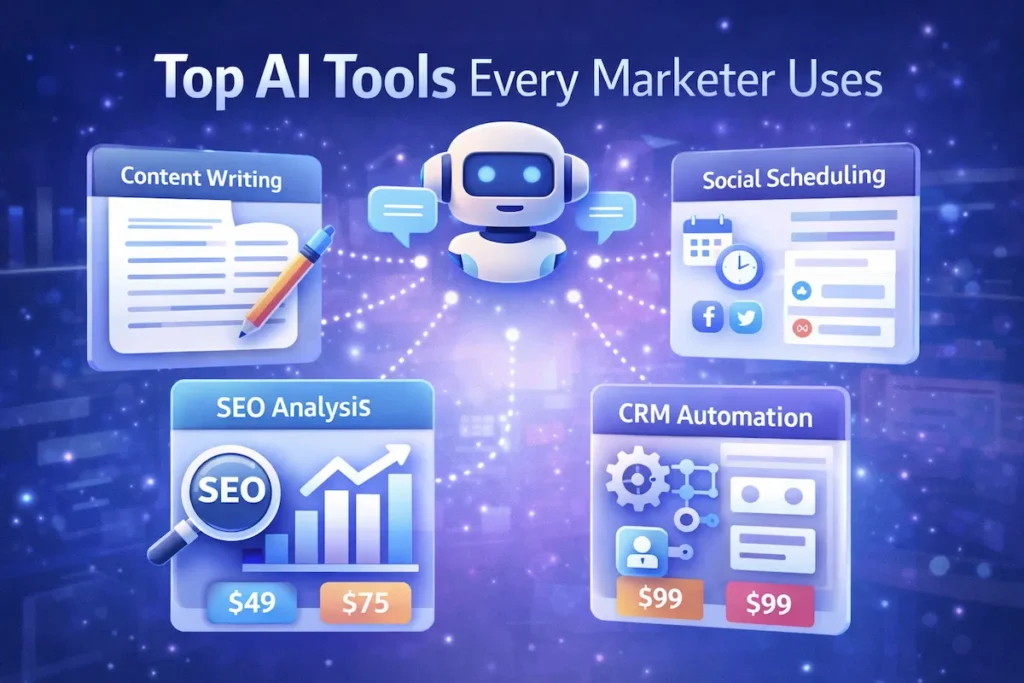
Pricing varies widely. Free options like ChatGPT and Canva’s basic tier let you start without investment. Mid-tier tools like Jasper AI and Surfer SEO typically range from $49 to $99 per month. Enterprise platforms like HubSpot and Semrush can cost $200 to $500+ monthly depending on features and usage limits. Many AI tools for digital marketers offer free trials, so you can test functionality and fit before committing to paid plans.
Can AI tools replace human digital marketers?
No. AI tools for digital marketers enhance human capabilities but don’t replace strategic thinking, creativity, emotional intelligence, or relationship building. AI handles repetitive tasks, data processing, and initial drafts. Humans provide strategy, brand understanding, nuanced judgment, and final quality control. The most effective marketing teams use AI to handle grunt work while focusing human effort on high-value activities that require experience and creativity.
Which AI tool should I start with as a beginner?
Start with ChatGPT or Canva AI. Both have free tiers, simple interfaces, and solve common marketing problems immediately. ChatGPT helps with content ideation and drafting. Canva AI handles visual design without requiring graphic design skills. Once comfortable, add a tool addressing your specific pain point—Grammarly for writing quality, Hootsuite for social management, or Surfer SEO for organic traffic. Focus on mastering one AI tools for digital marketers platform at a time to avoid overwhelm and ensure adoption.
Are AI-generated content and designs effective for marketing?
Yes, when used correctly. AI-generated content serves as a strong starting point but requires human editing for brand voice, accuracy, and strategic alignment. Designs from tools like Canva AI work well for social media, presentations, and quick assets but may need customization for premium campaigns. The effectiveness depends on how you refine AI output. Treat AI tools for digital marketers as assistants that speed up production, not autopilot solutions that work without oversight.
How do AI tools help with SEO?
AI tools for digital marketers like Surfer SEO and Semrush analyze top-ranking pages and provide optimization recommendations. They identify relevant keywords, suggest content structure, analyze competitor strategies, and score your content in real-time. These tools remove guesswork by showing exactly what’s working in search results for your target keywords. They help you optimize faster and more accurately than manual research, improving your chances of ranking and driving organic traffic.
Can I use multiple AI tools together?
Absolutely. Most marketers use 3-5 tools covering different functions. You might use ChatGPT for drafting, Grammarly for editing, Canva for visuals, and Hootsuite for scheduling. Many platforms integrate with each other—Jasper works with Surfer SEO, Canva connects to social media schedulers, and HubSpot integrates with numerous tools. The key is building a stack where AI tools for digital marketers complement rather than duplicate each other’s functions, creating efficient workflows.
What are the biggest mistakes when using AI marketing tools?
The biggest mistakes include: relying on AI output without editing or fact-checking, using too many tools without mastering any, expecting AI to fix strategic problems, ignoring brand voice consistency, not measuring ROI, choosing tools based on hype rather than actual needs, and neglecting data security. Focus on AI tools for digital marketers that solve specific problems in your workflow, always review AI-generated content before publishing, and verify platforms handle data responsibly.
How do I measure ROI from AI tools for digital marketers?
Track time saved, cost reductions, and performance improvements. Before adopting a tool, document how long tasks currently take and what they cost in hours or freelancer fees. After 30 days, measure the difference. Also track quality metrics—engagement rates, conversion rates, ranking improvements, or content output volume. If an AI tools for digital marketers platform saves 10 hours monthly and costs $50, but those hours were worth $500 in labor or opportunity cost, the ROI justifies continued investment.
Final Verdict: Are AI Tools Worth It for Digital Marketers?
Yes, with conditions.
AI tools for digital marketers deliver measurable value when matched to real problems. If content production bottlenecks your campaigns, tools like Jasper or Copy.ai remove friction. If SEO gaps hurt organic traffic, Surfer or Semrush provide actionable fixes. If visual content slows social media consistency, Canva accelerates design work.
They’re not worth it if you expect magic. AI won’t fix broken strategy, unclear positioning, or poor product-market fit. It accelerates execution—it doesn’t replace thinking, relationship building, or strategic vision.
Start small. Pick one tool addressing your biggest pain point. Test it for 30 days. Measure time saved, quality improvements, or cost reductions. If it delivers, expand usage or add another tool. If it doesn’t, move on without sunk cost fallacy.
For solo marketers and small teams, AI multiplies capacity. You can compete with larger competitors by matching their output without matching their headcount. For agencies and enterprises, AI tools for digital marketers standardize quality and speed delivery across client accounts.
The marketers winning in 2026 aren’t using every tool. They’re using the right tools for their workflow, optimizing ruthlessly based on results, and staying focused on outcomes that matter to business goals—not vanity metrics.
Security considerations remain critical. Before adopting any platform, review its data handling practices, compliance certifications, and security track record. The convenience of AI shouldn’t compromise customer data protection or regulatory compliance.
Integration matters more than individual features. Choose tools that work together smoothly rather than best-in-class platforms that don’t connect. A slightly less powerful but well-integrated stack often outperforms disconnected premium tools.
Ready to test AI in your workflow? Start with one tool from this list, commit to 30 days of consistent use, and measure what changes in time saved, content quality, or campaign performance.
2 thoughts on “Top 10 AI Tools for Digital Marketers Every Marketer Should Try This Year”
Comments are closed.