
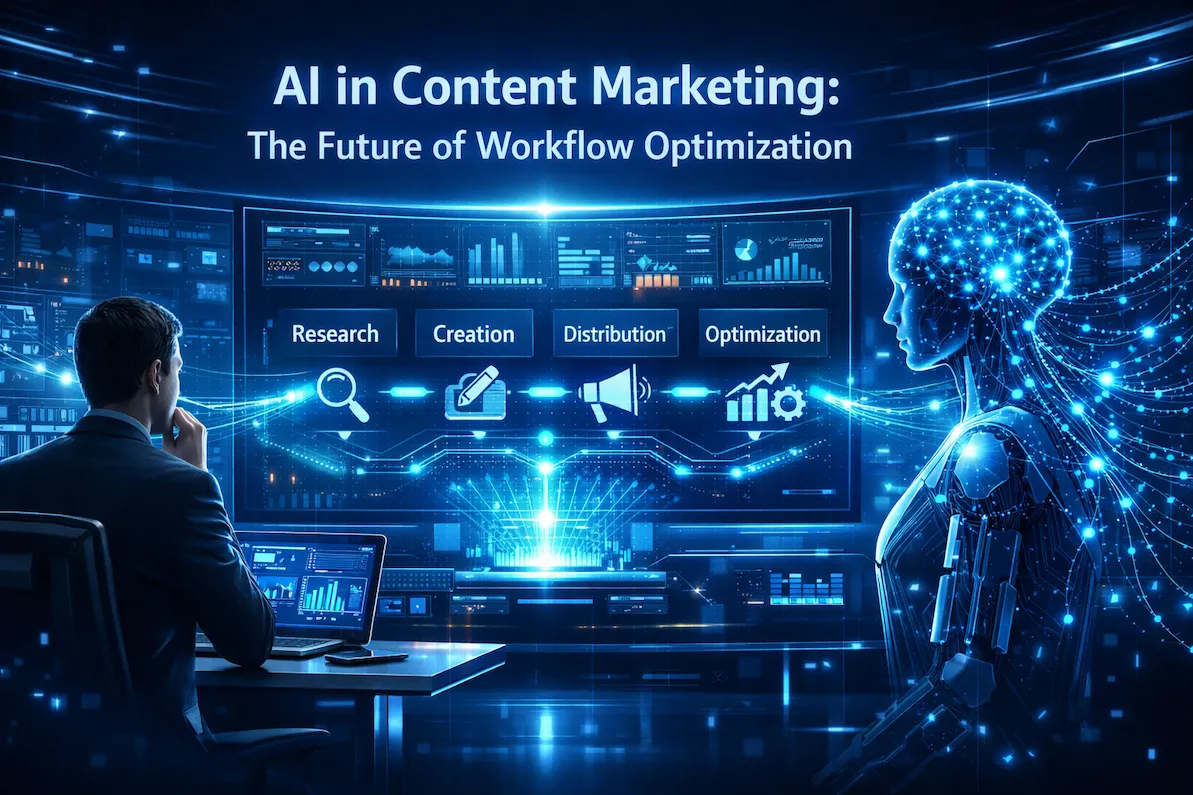
“AI in content marketing” refers to the use of artificial intelligence technologies—including machine learning, generative AI, and predictive analytics—to automate, optimize, and scale content strategy and execution across every stage of the marketing lifecycle.
The content marketing landscape has shifted dramatically. What once required a team of writers, analysts, strategists, and editors working in silos can now be orchestrated by intelligent systems that learn, adapt, and execute at machine speed. This is no longer a futuristic concept—it’s an operational reality reshaping how US businesses plan, create, distribute, and measure content at scale.
According to HubSpot’s 2024 State of Marketing Report (which found widespread AI adoption among marketers), many teams are using AI daily — saving significant time on routine tasks before human refinement. This guide breaks down exactly how that transformation is happening, what tools and strategies are driving it, and how your team can implement AI-powered content workflows without losing the human edge that makes great marketing resonate.
Current Challenges in Content Marketing That AI Directly Solves
Before understanding the solution, it’s worth diagnosing the problem. Intelligent content workflows address a set of persistent, costly pain points that even the most sophisticated marketing teams face today.
Content Creation Bottlenecks and AI in Content Marketing
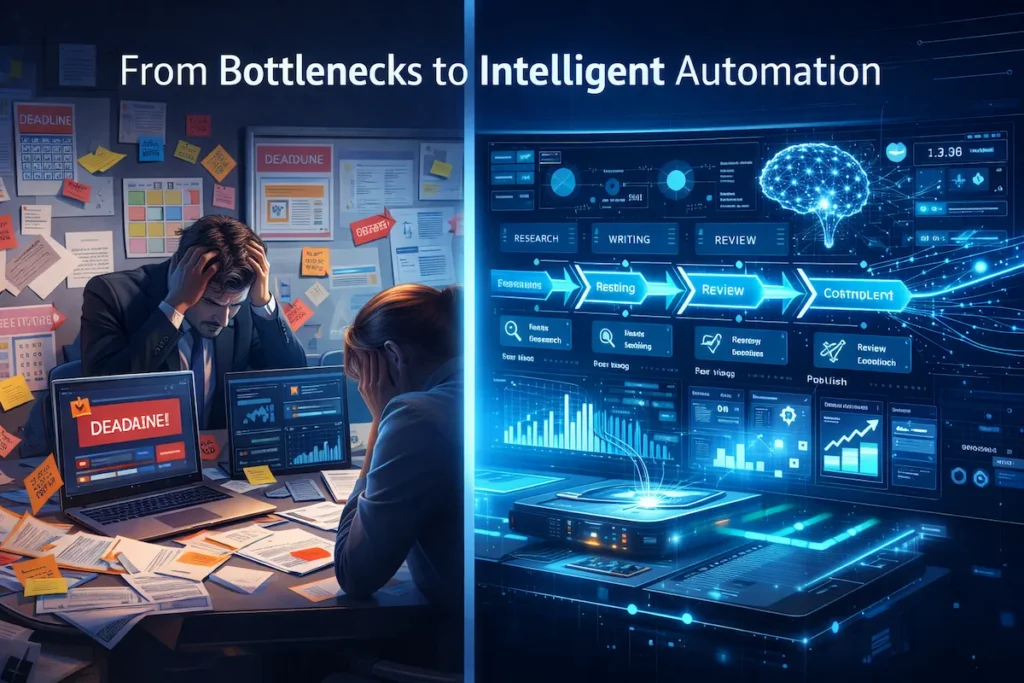
The demand for content has never been higher. Brands are expected to publish across blogs, social media, email, video scripts, and landing pages—often simultaneously. Traditional content production is inherently bottlenecked by human bandwidth. Writers burn out. Approval cycles stretch for days. Topic research consumes hours. The result is either delayed publishing schedules or lower-quality content rushed out the door. AI in content marketing directly attacks this bottleneck at every stage.
Industry research from the Content Marketing Institute shows most marketers still list content volume and quality among their biggest challenges. This bottleneck isn’t just a capacity problem—it compounds into missed SEO opportunities, inconsistent brand voice, and declining audience engagement.
Lack of Data-Driven Insights Costs Marketers Without AI
Many content teams still operate on intuition rather than data. Topics are chosen based on gut feel, headlines are tested rarely, and performance analytics are reviewed retrospectively—often weeks after a piece goes live. Without AI workflow optimization, marketers are flying blind, publishing without knowing whether content will rank, engage, or convert before it goes out. This is where AI in content marketing shifts the entire decision-making model.
This lag between action and insight is particularly damaging in fast-moving industries where trends shift weekly. By the time traditional analytics reveal what worked, the opportunity has passed.
Human Error in Workflow Execution
AI in content marketing replaces fragile manual handoffs with structured, automated pipelines. Even the best teams make mistakes. Inconsistent formatting, missed publishing deadlines, incorrect keyword placement, and broken internal links all erode content quality. Manual workflows are inherently fragile—a single missed handoff can delay an entire campaign. AI-driven systems introduce automated checks, structured pipelines, and approval gates that catch errors before they become visible to audiences.
How AI Streamlines Content Workflows: The 4-Layer Model
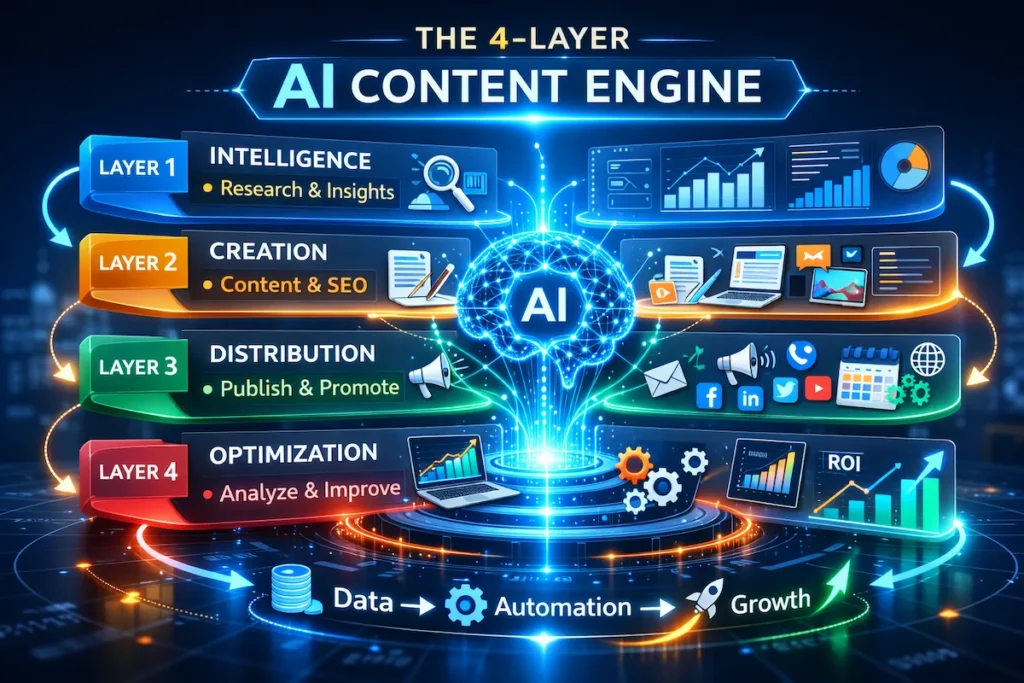
The transformative power of AI in content marketing isn’t just about writing faster — it’s about optimizing every stage of the content lifecycle. The most effective AI-enabled marketing teams operate across four distinct layers:
Layer 1 — Intelligence: AI research, topic modeling, and competitive gap analysis Layer 2 — Creation: AI-assisted drafting, editing, and SEO scaffolding Layer 3 — Distribution: Smart scheduling, channel optimization, and automation Layer 4 — Optimization: Real-time analytics, A/B testing, and performance feedback loops
AI in content marketing becomes truly powerful when it operates across all four workflow layers simultaneously. Each layer feeds the next. Together, they create a self-improving content engine that gets measurably better over time.
Automated Content Research and Ideation
AI in content marketing starts with smarter research, not faster writing. AI-powered content tools like Clearscope, MarketMuse, and Semrush’s AI features can scan thousands of top-ranking pages in seconds, identify content gaps, and generate data-backed topic clusters. Instead of spending three hours researching what to write about, a strategist can generate a prioritized content calendar in under 30 minutes.
This connects directly to how generative AI is reshaping SEO intent and content discovery — understanding search intent at a granular level is now a prerequisite for content that ranks. Machine learning models analyze what users search for, how long they stay on specific pages, and what questions they ask in forums, surfacing content opportunities before competitors claim them.
AI-Powered Content Generation Accelerates Every Workflow
At the creation layer, AI in content marketing compresses hours of work into minutes. Modern AI-powered content tools like Jasper, Copy.ai, and Writer.com don’t replace writers—they augment them. A skilled writer using AI can produce a polished 1,500-word blog post in 60–90 minutes instead of half a day. AI handles the first draft, structure, and SEO scaffolding; the human brings original analysis, brand voice, and editorial judgment.
Content marketing automation extends beyond blog posts. AI can generate meta descriptions, email subject lines, social media captions, and ad copy variations—all drawn from the same core content brief. This multiplier effect dramatically increases output without proportionally increasing cost.
Smart Content Scheduling and Distribution
AI in content marketing doesn’t stop at creation — distribution is where automation multiplies ROI. Tools like Buffer, Hootsuite, and HubSpot now integrate AI scheduling that determines the optimal time to publish based on historical engagement data for each platform and audience segment. AI workflow optimization in distribution means content doesn’t just get published—it gets published at the moment its target audience is most likely to engage.
AI also powers automated A/B testing of headlines, CTAs, and send times—running experiments continuously without requiring manual setup for each variant. Over time, this produces compounding performance improvements as the system learns what resonates with each specific audience segment.
AI-Driven Content Strategy: From Planning to Prediction
AI in content marketing has made reactive strategy obsolete. Content strategy used to mean quarterly planning meetings and long-horizon editorial calendars. An AI-driven content strategy means dynamic, responsive planning informed by real-time market signals—a fundamental shift in how decisions get made.
Predictive Content Performance
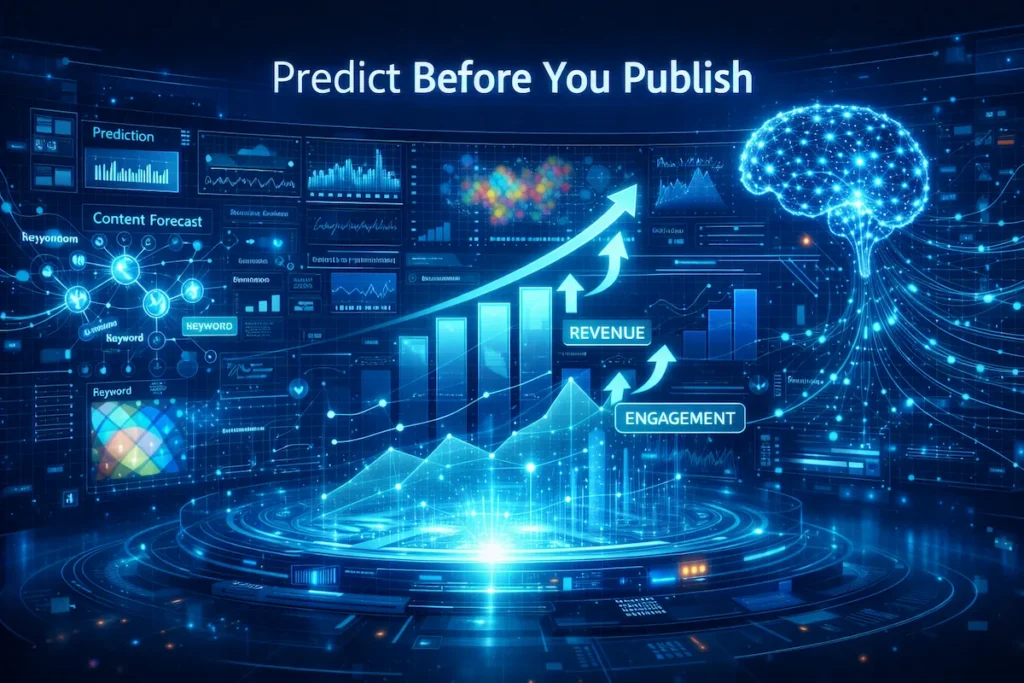
AI in content marketing now answers the question every strategist wants answered before publishing: will this work? Platforms like BrightEdge and Conductor use machine learning in marketing to predict how a piece of content will perform before it’s published. By analyzing historical data, keyword difficulty, backlink profiles, and competitive landscape, these tools give marketers a projected traffic range, likely ranking position, and recommended improvements—all before a word is submitted for review.
This predictive capability fundamentally changes the ROI calculus of content. Teams can prioritize high-probability winners and deprioritize content unlikely to move the needle, making every resource allocation decision more defensible and data-backed.
Personalization at Scale
AI in content marketing makes genuine 1-to-1 personalization operationally viable for the first time. Personalization has been a marketing goal for decades, but true 1-to-1 personalization at scale has only become feasible with AI. Platforms like Persado and Mutiny use AI to dynamically alter headlines, body copy, CTAs, and even images based on visitor attributes—industry, company size, behavior history, and geographic location.
This is especially powerful in SaaS environments. As explored in how AI is transforming customer experience in SaaS, intelligent personalization is rapidly becoming the baseline expectation — not a premium feature. Industry research shows that 76% of consumers expect personalized experiences and feel frustrated when they don’t receive them. According to a Salesforce study on AI for marketing, many marketers believe AI frees time for strategic work, and personalization expectations remain high among consumers.
Real-Time Analytics and Decision-Making
AI in content marketing turns analytics from a reporting function into a real-time decision engine. AI-driven analytics tools like Google Analytics 4 (with predictive metrics), Adobe Sensei, and Einstein Analytics process data continuously. Instead of monthly performance reviews, content teams get live dashboards that alert them when a piece is underperforming, when a topic is trending, or when a competitor has published into a gap your strategy hasn’t addressed.
This real-time responsiveness is the core competitive edge AI workflow optimization delivers. Teams that can pivot within hours rather than weeks consistently outperform those locked into static editorial calendars.
Case Studies and Real-World Examples
The ROI of AI in content marketing is no longer speculative — the numbers are in. The impact of AI in content marketing isn’t theoretical. Brands across industries are documenting measurable, reproducible results.
Brands Using AI-Powered Content Tools to Drive Growth
These brands treat AI in content marketing as core infrastructure, not a productivity hack. HubSpot integrated AI writing assistance into its content creation workflow and reported a 40% reduction in production time. By using AI for first drafts, outline generation, and keyword clustering, their team was able to publish 3x more blog posts per month while maintaining quality standards.
The Washington Post uses its proprietary AI system, Heliograf, to auto-generate short-form content at scale—thousands of articles covering sports scores, election results, and local news—freeing human journalists for investigative and long-form work.
Gong, the revenue intelligence platform, used AI-powered content tools to identify which types of sales enablement content actually influenced deal closure. By realigning their content strategy around those insights, they reduced their content-to-close lag by 22% in two quarters.
AI Optimizing Marketing Campaigns with Measurable ROI
At the campaign level, AI in content marketing delivers precision that traditional methods simply cannot match. Coca-Cola has piloted AI-generated ad copy and personalized content variants across digital campaigns, reporting improved click-through rates and reduced cost-per-engagement. Their AI-driven content strategy enables rapid testing across markets without proportional increases in creative spend.
Unilever used machine learning in marketing to analyze consumer language patterns across social media and reviews, then fed those insights directly into content briefs. The result was product messaging that mirrored how customers actually talked — a tactic that lifted conversion rates on targeted landing pages by 17%.
For organizations evaluating the financial case, a detailed breakdown of generative AI ROI versus traditional automation shows why AI-powered approaches consistently outperform legacy systems on cost-per-output and speed-to-market metrics.
Risks and Guardrails: What Most AI Content Guides Won’t Tell You
Responsible adoption of AI in content marketing means knowing exactly where it can fail you. Authority-level implementation of AI in content marketing requires acknowledging what can go wrong — not just what can go right.
Brand voice dilution is the most common failure point. When AI generates content without tight brand guidelines and human editorial review, output becomes generic. The solution is building a brand voice document that feeds every AI prompt as a system instruction.
Over-automation creates audience disconnect. Content marketing automation is most effective when it handles process — not personality. Fully automated content pipelines that skip human review often produce technically correct but emotionally flat content that fails to build audience trust.
Data governance matters. AI content tools trained on proprietary company data — customer insights, internal research, product roadmaps — must comply with data handling policies. Marketing teams operating in regulated industries (finance, healthcare) need to ensure their AI tools meet compliance requirements before feeding sensitive inputs into third-party platforms.
SEO over-optimization backfires. AI tools optimizing purely for keyword density can produce content that ranks briefly but earns poor engagement signals, ultimately damaging domain authority. Human editorial judgment remains essential for balancing SEO mechanics with genuine reader value.
Understanding AI governance is not just a legal concern — it’s a content quality concern. Teams investing in AI infrastructure should align closely with their technical and security counterparts on deployment standards.
Best Practices for Implementing AI in Content Marketing
Getting AI in content marketing right is less about the tools and more about the rollout strategy. Successful adoption requires more than selecting the right tools. It demands a strategic implementation approach that respects existing workflows and develops internal capability over time.
Start Small with Pilot Projects
The smartest entry point for AI in content marketing is a single, measurable pilot — not a full overhaul. Rather than overhauling your entire content operation at once, identify one high-friction area — perhaps social media caption writing or meta description generation — and pilot AI tools there first. Measure time savings, quality comparisons, and team satisfaction before expanding. This minimizes disruption, builds organizational confidence, and generates internal proof points that justify broader investment.
Pilot projects also surface integration challenges early. Most teams discover that the technology itself is rarely the obstacle — workflow redesign and change management are the harder parts.
Integrate AI into Existing Workflows Without Disruption
Sustainable AI in content marketing adoption fits around your team’s existing habits, not against them. AI workflow optimization works best when it augments established processes rather than replacing them wholesale. Map your current content workflow — from brief to publish — and identify the three highest-friction handoffs. Introduce AI tools at those specific points first.
Content marketing automation tools integrate directly with platforms your team already uses — Notion, Asana, Google Docs, WordPress — reducing the learning curve and preventing workflow fragmentation. Integrations matter as much as raw capabilities.
Train Teams to Leverage AI Insights
The human side of AI in content marketing is what separates teams that scale from teams that stall. AI tools are only as valuable as the people using them. Invest in training that goes beyond technical onboarding. Help your team understand how to write effective prompts, how to evaluate AI-generated content critically, and how to use AI analytics to inform editorial judgment rather than replace it.
The most effective AI-enabled marketing teams treat AI as a research and drafting partner — not an autonomous publisher. The human role shifts from execution to direction, curation, and quality assurance. Teams that embrace this shift consistently outperform those that resist it.
Small and mid-sized businesses have a particular advantage here. As detailed in how AI-powered data analytics benefits small businesses, leaner teams often achieve faster ROI from AI adoption because fewer bureaucratic layers slow down implementation and iteration.

Comparison: Traditional vs. AI-Powered Content Marketing
No side-by-side comparison makes the case for AI in content marketing more clearly than raw operational data. The following comparison illustrates the operational differences across three critical dimensions.
Efficiency and Productivity
In throughput terms, AI in content marketing operates on a fundamentally different scale than traditional methods. Traditional content marketing relies on sequential, human-dependent processes. Each step — research, writing, editing, publishing — waits for the previous one to complete. Intelligent content workflows enable parallel processing: research and ideation happen simultaneously, first drafts are generated in minutes, and scheduling is handled automatically. The result is a 3–5x increase in content throughput without proportional cost increases.
Accuracy and Personalization
AI in content marketing doesn’t just produce more content — it produces more relevant content. Traditional personalization is segment-based — broad audience buckets with shared messaging. AI-driven content strategy enables individual-level personalization based on real-time behavioral signals. Dynamic content platforms serve dozens of page variants to different visitor profiles without manual configuration, and accuracy in keyword targeting, headline testing, and audience matching all improve substantially with machine learning.
ROI and Scalability
The financial argument for AI in content marketing becomes undeniable at scale. The scalability gap becomes most apparent at volume. Doubling content output with a traditional team means doubling headcount and cost. AI-powered teams can often double output with 20–30% incremental tool spend. ROI tracking is also more precise — AI attribution models trace conversions back through multiple touchpoints in real time, replacing the guesswork of last-click models.
| Metric | Traditional Marketing | AI-Powered Marketing |
|---|---|---|
| Content output | 5–10 pieces/week per writer | 50–100+ pieces/week |
| Personalization | Broad segments | 1-to-1 hyper-personalization |
| Campaign setup time | 1–2 weeks | Hours to days |
| Data analysis | Weekly/monthly reports | Real-time dashboards |
| Error rate | Higher (manual) | Lower (automated QA) |
| ROI tracking | Delayed, estimated | Immediate, precise |
| Scalability | Requires added headcount | Scales without added cost |
Future Trends in AI and Marketing
The next chapter of AI in content marketing will make today’s capabilities look like a starting point. The current state of AI in content marketing is impressive — but it’s still early. The next three to five years will bring capabilities that make today’s tools look rudimentary.
Increasing Adoption of Generative AI
AI in content marketing is moving from early-adopter advantage to baseline expectation. Generative AI — large language models, image generators, and video synthesis tools — will become standard content infrastructure by 2026. Industry analysts project that the majority of enterprise content will involve AI assistance in some form within two years. The competitive advantage will shift from simply having AI tools to using them with more strategic intent than competitors. Human creativity, brand voice, and editorial judgment become the differentiators — not access to the technology itself.
Hyper-Personalization Through Machine Learning in Marketing
Future AI systems will move beyond demographic and behavioral personalization to predictive intent modeling — anticipating what a user needs before they articulate it. This means content that adapts not just to who someone is, but to where they are in their decision journey, what obstacles they’re facing, and what format will resonate most at that specific moment.
AI Integration with Omnichannel Marketing
The next frontier is seamless omnichannel orchestration. AI systems will manage consistent messaging, timing, and personalization across email, web, social, paid, SMS, and in-app experiences — with a unified model of each customer’s journey. Content marketing automation will evolve from channel-specific scheduling to cross-channel narrative management, ensuring every touchpoint tells a coherent and adaptive story.
Frequently Asked Questions (FAQ)
How Does AI Improve Content Marketing Workflows?
AI in content marketing improves workflows by automating time-intensive tasks like research, first-draft writing, SEO optimization, scheduling, and performance analysis. This frees marketing teams to focus on strategy, creativity, and quality control. Teams using AI consistently report 30–50% reductions in content production time, with no proportional drop in output quality when human editorial oversight is maintained.
What Are the Best AI Tools for Content Marketing?
Top AI-powered content tools include Jasper and Copy.ai for AI-assisted writing, MarketMuse and Clearscope for SEO content optimization, HubSpot and Marketo for content marketing automation, Mutiny and Persado for personalization at scale, and BrightEdge and Conductor for predictive analytics and AI-driven content strategy. The right stack depends on your team’s size, existing tech infrastructure, and primary content channels.
Can Small Businesses Benefit from AI in Content Marketing?
Absolutely. AI in content marketing tools are available at every price point, with many offering free tiers or accessible plans suited to small teams. A solo marketer using Jasper, Surfer SEO, and Buffer’s AI scheduling can produce and distribute content at a volume and quality that previously required a full team. Small businesses often see the fastest ROI from AI adoption because productivity gains translate directly into competitive advantage without the organizational friction that slows larger enterprises.
How to Integrate AI Without Disrupting Existing Processes?
Start by auditing your current workflow to identify the three biggest friction points. Introduce AI tools at those specific stages first, choosing tools that integrate with software your team already uses. Run a 30-day pilot, measure results, gather team feedback, and iterate before expanding. Training and change management matter as much as tool selection — ensure your team understands the strategic reasoning behind the change, not just the mechanics of the tools.
Conclusion and Call to Action
The evidence is clear: AI in content marketing is not a trend to monitor — it’s a capability to build now. Teams that integrate AI-powered content tools into their workflows today are compounding advantages in speed, personalization, and strategic insight that will be difficult for late adopters to close.
From eliminating content creation bottlenecks and introducing the 4-Layer AI Workflow Model, to enabling real-time AI-driven content strategy and navigating the genuine risks of over-automation, the value of intelligent content workflows spans every stage of the marketing funnel. The brands winning on content right now are not the ones with the largest teams or the biggest budgets — they are the ones using machine learning in marketing to work smarter, test faster, and personalize deeper.
The starting point doesn’t need to be complex. Pick one workflow challenge, identify an AI tool that addresses it, run a 30-day pilot, and measure the results. Content marketing automation is not an all-or-nothing investment — it’s an incremental journey toward a more efficient, more effective, and more intelligent marketing operation.
Your content strategy is either evolving with AI or falling behind without it. The time to act is now.
→ Start your AI content marketing transformation today. Audit your current workflow, identify your biggest bottleneck, and implement your first AI-powered tool this week.