
Whether you’re already using AI in marketing or just getting started, this guide covers everything you need to know about AI review generators — the tools, the prompts, the legal lines, and the workflows that save real time.
But first, why does this matter so much right now?
According to BrightLocal’s 2024 Local Consumer Review Survey, 98% of U.S. consumers read online reviews before buying. That one stat explains why reviews have become one of the most valuable — and most time-consuming — parts of running an online business.
Even satisfied customers often forget to leave reviews. Writing thoughtful responses to dozens of reviews every week is more work than most small business owners can keep up with. That’s the exact gap an AI review generator fills.
An AI review generator uses artificial intelligence to produce review drafts, testimonial copy, and response templates on demand. It doesn’t replace real customer feedback — it speeds up the workflow around it. If you’re already using AI tools for marketing agencies, this fits right into that stack.
What Is an AI Review Generator?
An AI review generator is software that uses artificial intelligence to create review-style content. Feed it details about a product or service, and it produces something that reads like a real customer wrote it.
Here’s what businesses use it for:
- Drafting example reviews to share with happy customers who aren’t sure what to write
- Creating illustrative testimonials for landing pages, clearly labeled as examples
- Generating response templates for Google, Yelp, and Amazon reviews
- Building training content for customer service teams
- Writing review-style copy for e-commerce product pages
It’s a drafting and workflow tool—not a fake review machine. The human is always involved before anything goes public.
AI Review Generator Workflow: How It Actually Works
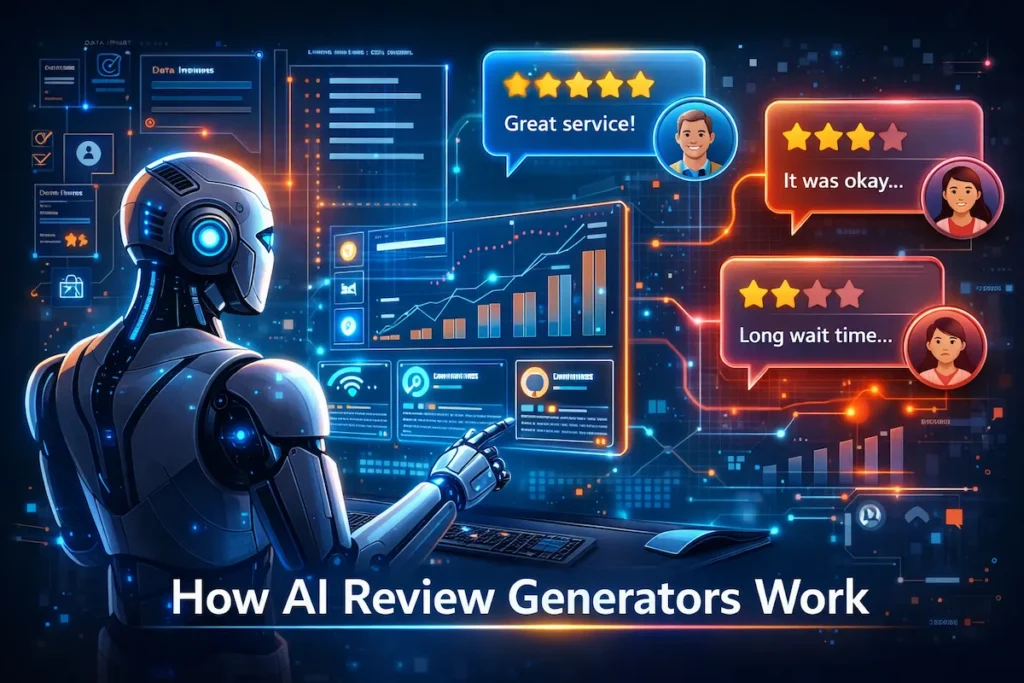
Most AI review-writing tools run on large language models—or LLMs. Think of these as AI tools trained on so much human text that they know how people actually write. You give the tool a prompt, it processes that input, and it returns a review that matches the tone and structure of real customer feedback.
It works best when your prompts are clear — otherwise, you get generic output.
A vague prompt like “write a review for a coffee shop” produces something forgettable. A prompt like “write a 4-star Yelp review for a family-owned coffee shop in Austin, Texas, from a remote worker who loves the fast Wi-Fi and the pour-over selection” produces something that actually sounds like a person wrote it.
AI Technology Behind Automated Review Generation
Here’s the plain-English version of how it works:
- LLMs (large language models) are AI tools trained on billions of text samples—reviews, articles, and conversations. They learn how humans write across different topics and platforms.
- Natural language processing (NLP) lets the AI understand context and adjust tone so the output feels natural rather than robotic.
- Sentiment analysis allows some tools to generate content with a specific emotional tone—enthusiastic, neutral, or constructively critical—based on your instructions.
You don’t need to understand the tech deeply to use it. What matters is that output quality is directly tied to input quality.
If you’re already exploring AI automation for your online business, adding an AI review generator is a natural next step. Let AI handle the repetitive drafting. Keep humans in charge of the final call.
Why U.S. Businesses Use an AI review generator.
Small business owners, SaaS founders, and e-commerce brands all share the same constraint: not enough hours. An AI review generator solves three specific problems at once—time, scale, and consistency.
Saving Time With an AI Review Generator Tool
Here’s how this plays out in practice.
A Shopify store owner selling home goods gets around 60 new reviews a month across Google and Amazon. Before using an AI review generator, she spent 3 to 4 hours a week writing responses. After building a prompt library in ChatGPT, that same task takes under 40 minutes—with responses that are more consistent than what she was writing manually.
Fast output can tempt teams to skip the essential editing step, which is the one real risk. But used correctly, the time savings are significant.
If you’re already looking at tools to automate your sales workflow, review response automation fits naturally into that same efficiency approach.
Creating Customer Testimonials at Scale With AI
When you’re launching a new product or redesigning your website, you often need testimonial content before real reviews have come in.
Here’s a practical SaaS example: a founder launching a project management tool uses an AI testimonial generator to produce five example testimonials across different customer types — a marketing manager, a freelancer, and an agency owner. She shares these with beta users and asks them to edit based on their own experience. The result? A testimonials section that’s ready on launch day, built from real customer input rather than placeholder copy.
For local service businesses, the same approach works for Google and Yelp. Draft example reviews that reflect your actual service, share them with loyal customers, and let them personalize and post.
Improving Social Proof With AI Review Generation Software
Social proof is one of the strongest conversion drivers in e-commerce. According to Trustpilot’s research on consumer trust, displaying reviews meaningfully increases purchase confidence — especially for first-time buyers.
An AI review generator helps you build that proof faster, without waiting months for organic reviews to accumulate on their own.
Best AI Review Generator Tools in 2026
Here’s an honest breakdown of the tools that work best for automated review generation—who they’re suited for, what they cost, and what you can realistically expect.
| Tool | Best For | Pricing (2026) | Rating | Free Plan? |
|---|---|---|---|---|
| ChatGPT (GPT-4o) | Flexible prompting, any review type | Free / $20 per month | ★★★★★ | Yes |
| Jasper AI | Marketing teams, brand voice consistency | From $49 per month | ★★★★☆ | Trial only |
| Copy.ai | Ecommerce brands, Shopify stores | Free tier available | ★★★★☆ | Yes |
| Writesonic | Response templates, multi-tone content | From $16 per month | ★★★★☆ | Yes (limited) |
| Rytr | Budget-conscious small businesses | Free / $9 per month | ★★★☆☆ | Yes |
ChatGPT as an AI Review Generator
Rating: ★★★★★ | Best for: Anyone who writes clear prompts
ChatGPT is the most flexible AI review writing tool on this list. Write a custom prompt, get back a review that sounds natural and specific. It works across every platform — Google Business Profile, Amazon, Yelp, Trustpilot, and more.
It works best when your prompts are clear. For teams willing to spend 30 minutes learning effective prompting, it’s the best value available — especially at zero monthly cost.
Pro Tip: Build a prompt library in a shared Google Doc so your whole team can generate consistent review responses without starting from scratch each time.
Jasper AI Review Generator Features
Rating: ★★★★☆ | Best for: Marketing teams and agencies
Jasper is built for teams that need consistent brand voice across all their content. It includes templates for testimonials and review copy, with tone controls built right in. If your team already uses Jasper for blog posts or ads, adding automated review generation takes minutes to set up.
It’s not cheap. But agencies managing multiple clients will find it pays for itself quickly.
Copy.ai Automated Review Generator
Rating: ★★★★☆ | Best for: Ecommerce brands and Shopify store owners
Copy.ai is the most beginner-friendly AI review writing tool on this list. The testimonial templates are easy to customize, the interface requires zero learning curve, and the free tier gives you enough output to test the tool before committing.
It won’t match ChatGPT for flexibility. But for standard review formats, it’s fast and reliable.
Writesonic AI Review Generation Software
Rating: ★★★★☆ | Best for: Local businesses managing high review volume
Writesonic stands out when you need review responses across different tones. Switch between professional, casual, and empathetic without rewriting the prompt. Well-suited for service businesses handling a steady mix of positive and critical reviews every week.
Rytr Review Generation Tool
Rating: ★★★☆☆ | Best for: Solo owners on a tight budget
Rytr is the most affordable entry point into AI review generation. Its testimonial template handles straightforward use cases well, and the free plan covers basic needs. Not the most powerful tool — but for a small business owner just getting started, it’s a solid first step.
How to Use an AI Review Generator Step by Step
Here’s a process that consistently produces better results than just clicking “generate” and hoping for the best.
Step 1: Choose the Right AI Review Generator Tool
Match the tool to your workflow and budget:
- Free and learning? Start with ChatGPT.
- Running a Shopify store? Try Copy.ai.
- Managing agency clients? Look at Jasper.
- On a tight budget? Start with Rytr’s free plan.
Don’t pay for a premium tool until you’ve confirmed the use case fits your actual needs.
Step 2: Write Clear AI Review Generator Prompts
This is where most people underinvest. A strong prompt includes four things:
- Who the reviewer is — age, role, context
- What they experienced — the specific product or service details
- What they specifically liked — concrete details, not generalities
- Which platform the review is for — Google, Amazon, Yelp, etc.
The more specific your input, the more realistic and usable your output.
Step 3: Generate Multiple Review Variations
Run the same prompt three to five times. Different outputs will highlight different features and use different sentence structures. Compare them, combine the best parts, or use the strongest one as your editing base.
Step 4: Edit, Humanize, and Publish
This step is non-negotiable. Add something only a real customer would know — a specific date, a staff member’s name, a personal outcome, or a before-and-after comparison.
Pro Tip: Always humanize AI-generated reviews before posting. This is what separates professional AI-assisted content from generic machine output — and what keeps you compliant with platform guidelines.
AI Review Generator Prompt Examples
These are ready to use in ChatGPT, Writesonic, or any AI review writing tool. Paste them in and customize the bracketed details.
Product Review Prompt for Ecommerce
Write a 5-star Amazon product review for a [product name]. The reviewer is a [age]-year-old [description of customer] who has used it for [time period]. Mention that they specifically liked [feature 1] and [feature 2]. Note one minor drawback like [small con]. Keep it under 150 words and make it sound like a real customer wrote it — not a marketing team.
Google Review Prompt for Local Businesses
Write a Google review for a [type of business] located in [city, state]. The customer visited for [occasion or reason]. Mention that they appreciated [specific detail about the service or atmosphere], that [specific product or experience] stood out, and that they would recommend it to friends. Keep the tone warm and genuine. Limit it to 3 to 4 sentences.
Service Review Prompt for Agencies
Write a professional testimonial for a [type of agency] from the perspective of a small business owner. The agency helped them achieve [specific result] over [time period]. The tone should sound like something a real business owner would post on Google or Clutch — direct, specific, and not over-the-top. Keep it under 120 words.
Negative Review Response Prompt
Write a professional, empathetic response to a 2-star Google review for a [type of business]. The customer complained about [specific issue]. The response should apologize sincerely, acknowledge the specific problem, explain what the business is doing to fix it, and invite the customer to reach out directly. Keep it under 100 words and avoid sounding defensive.
Pros and Cons of Using an AI Review Generator
| Factor | Pros | Cons |
|---|---|---|
| Speed | Drafts in seconds, not minutes | Fast output can tempt teams to skip the essential editing step |
| Scalability | Generate 50 variations in the time it takes to write 2 | Volume without quality control hurts credibility |
| Cost | Far cheaper than hiring copywriters at scale | Premium tools run $50+ per month |
| Authenticity | Matches real customer language with strong prompts | Generic output is easy for readers to spot |
| SEO Value | Keyword-rich review content supports local rankings | Thin or duplicate AI content risks search penalties |
| Ethics & Compliance | Fully ethical as a drafting and workflow tool | Publishing as real reviews violates platform terms |
AI Review Generator vs. Human Review Writing
Both approaches belong in a smart content strategy. Here’s how they compare directly:
| Factor | AI Review Generator | Human Writer |
|---|---|---|
| Speed | Draft in under 10 seconds | 20–30 minutes per piece |
| Quality | Good with editing; great with strong prompts | Nuanced, emotionally specific |
| Authenticity | Needs human editing to feel real | Highest authenticity when from real customers |
| Cost | $0–$50/month for unlimited drafts | $50–$200+ per piece at scale |
| Best Use | Response templates, volume drafting | High-stakes testimonials, case studies |
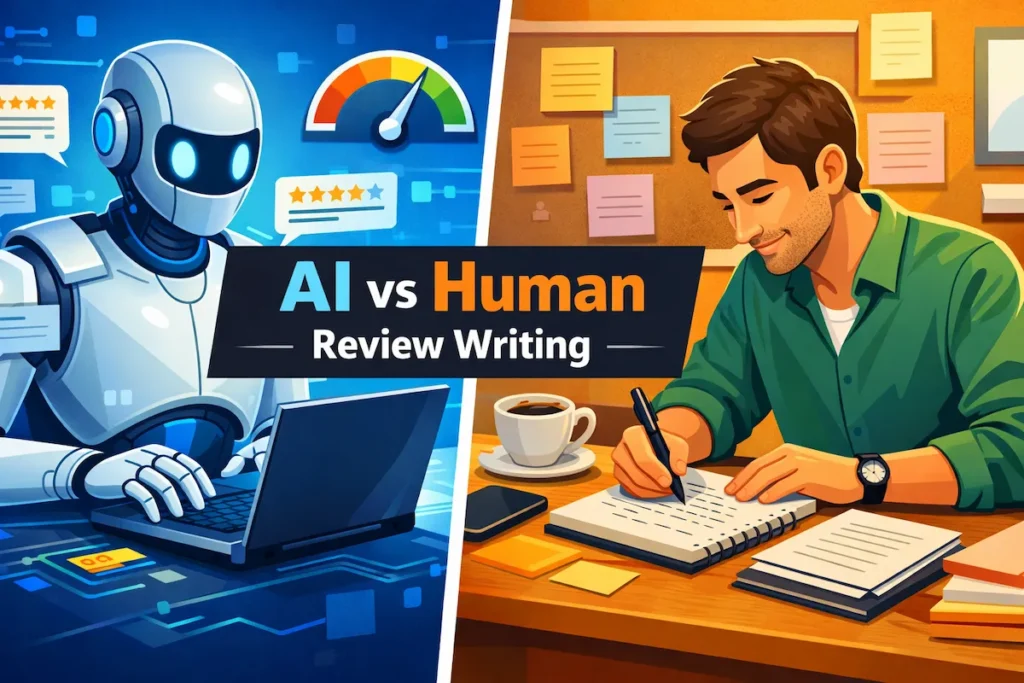
The smartest approach is a hybrid. Use the AI review generator for fast first drafts. Have a human tighten the best outputs before anything goes live.
Are AI Generated Reviews Legal? What U.S. Businesses Need to Know
This is where businesses get into real trouble — and it’s worth reading carefully.
Publishing AI-generated content as if it came from a real customer violates the terms of service of nearly every major platform:
- Google explicitly prohibits fake or manipulated reviews under its review policies
- Amazon has some of the strictest review guidelines in ecommerce and actively removes content flagged as inauthentic
- Yelp uses automated detection systems to identify and remove reviews it suspects are not genuine
The FTC’s endorsement guidelines require that testimonials reflect real experiences. Publishing AI-generated content as a verified customer review isn’t just a platform violation — it’s a federal compliance risk.
There’s a data angle here too. If you’re feeding customer details into AI prompts — names, complaints, purchase history — you need to know how that data is stored and used. Our guide on AI data security risks in marketing walks through exactly what to watch for before building AI into any customer-facing workflow.
Where AI review generators are completely safe and ethical:
- Drafting examples that real customers then personalize and submit as their own
- Creating illustrative testimonials for landing pages, clearly labeled as examples
- Writing response templates that a human approves before posting
- Training customer service staff with realistic feedback scenarios
- Building prompt libraries that help customers articulate their genuine experience
If you’re a small business owner thinking through the broader security picture, this guide on AI security risks for small businesses is a practical starting point.
The Future of AI Review Generators in Digital Marketing
The role of AI review generators in reputation management is expanding fast. Here’s where things are heading.
All-in-one AI reputation dashboards are emerging that handle everything in one place — monitoring incoming reviews, drafting responses, flagging urgent complaints, and tracking sentiment trends over time. Instead of logging into Google, Yelp, and Amazon separately, businesses will manage their entire review presence from a single hub.
Smarter sentiment analysis is making AI more useful at the diagnostic level. Future review generation software won’t just produce content — it will analyze your incoming reviews to spot satisfaction patterns before they become visible public problems. Think of it as an early warning system built into your reputation stack.
Tighter automated feedback loops are already becoming standard among top ecommerce brands. A purchase triggers a review request. The request includes an AI-assisted prompt that makes it easy for customers to write something specific. Incoming feedback gets triaged automatically. This kind of end-to-end customer review automation is no longer advanced — it’s quickly becoming expected.
For U.S. businesses that build these workflows now, the advantage over slower competitors compounds significantly within 12 to 18 months.
Frequently Asked Questions About AI Review Generators
What is an AI review generator?
An AI review generator is a software tool that uses artificial intelligence to create review-style content — including customer testimonials, response templates, and product review drafts. Businesses use it to save time, build social proof, and manage their online reputation more efficiently.
Can AI generate reviews that sound like real customers wrote them?
Yes — with a specific, detailed prompt. AI review generators trained on large language models can match the tone, structure, and detail level of real customer feedback. The output improves significantly when you give the AI clear context about who the reviewer is, what they experienced, and which platform the review is for.
Is it legal to use an AI review generator for Google or Amazon?
It depends entirely on how you use it. Using AI to draft response templates or help customers articulate their genuine experience is fine. Publishing AI output as if it came from a real customer violates Google’s and Amazon’s review policies and may conflict with FTC endorsement guidelines.
Which AI review generator is best for local businesses in the U.S.?
ChatGPT is the most flexible free option for local businesses. Writesonic is strong for managing high volumes of mixed reviews across different tones. For Google-specific response templates, both tools work well — ChatGPT gives you more control, Writesonic gives you more speed.
How do AI review generators impact Google Maps SEO?
Review quantity, recency, and response rate are all ranking factors in Google Maps. Using an AI review generator to respond to reviews faster — and more consistently — can improve your response rate, which is a positive local SEO signal. Publishing fake AI reviews, however, risks review removal, which hurts rankings.
What are the FTC rules for AI-generated testimonials in the U.S.?
The FTC requires that testimonials and endorsements reflect genuine experiences. AI-generated testimonials published as real customer reviews without any authentic experience behind them violate FTC guidelines. Using AI to help draft content that a real customer then personalizes and submits is compliant.
What is the best free AI review generator right now?
ChatGPT’s free tier (GPT-4o) is the most capable free option. Copy.ai and Rytr also offer free plans with testimonial templates. For most small businesses, ChatGPT’s free tier is more than enough to start building a review response workflow.
Can I use AI to respond to negative reviews?
Yes — and this is one of the most practical applications of an AI review generator. Prompt the AI with the specifics of the complaint and get a professional, empathetic draft in seconds. Always personalize and review it before posting. Never let unedited AI output go live on your business profile.
Conclusion
An AI review generator is one of the most practical tools a U.S. business can add to its marketing workflow in 2026. Whether you want to cut hours from your review response process, build social proof before organic reviews come in, or help customers articulate their genuine experiences more easily — these tools deliver real value without a steep learning curve.
The rules are simple: use AI to draft and assist, not to fabricate. Keep a human in the loop. Edit every output so it reflects the specific, authentic details that make a review genuinely useful to real buyers.
Start with ChatGPT’s free tier and the prompt templates in this guide. Once you see how much time it saves, you’ll find more places to put it to work. For a broader look at what AI can do across your operations, our guide on AI automation for online businesses is the natural next read.
The businesses winning at reputation management in 2026 aren’t necessarily the ones with the most reviews. They’re the ones using smart tools consistently, ethically, and with a human touch that AI alone can’t replicate.