
Small business owners across the United States face a familiar problem: drowning in data but starving for insights. Your point-of-sale system tracks sales, your email platform monitors campaigns, and your website collects visitor behavior—but connecting these dots feels impossible without a dedicated analyst or expensive software.
Traditional analytics tools demand technical expertise, months of setup, and budgets that only enterprises can afford. Meanwhile, your competitors are making faster, smarter decisions. This gap is where AI-powered data analytics for small businesses changes everything. It democratizes intelligence, turning raw numbers into actionable strategies without requiring a data science degree or draining your bank account.
What Is AI-Powered Data Analytics for Small Businesses?
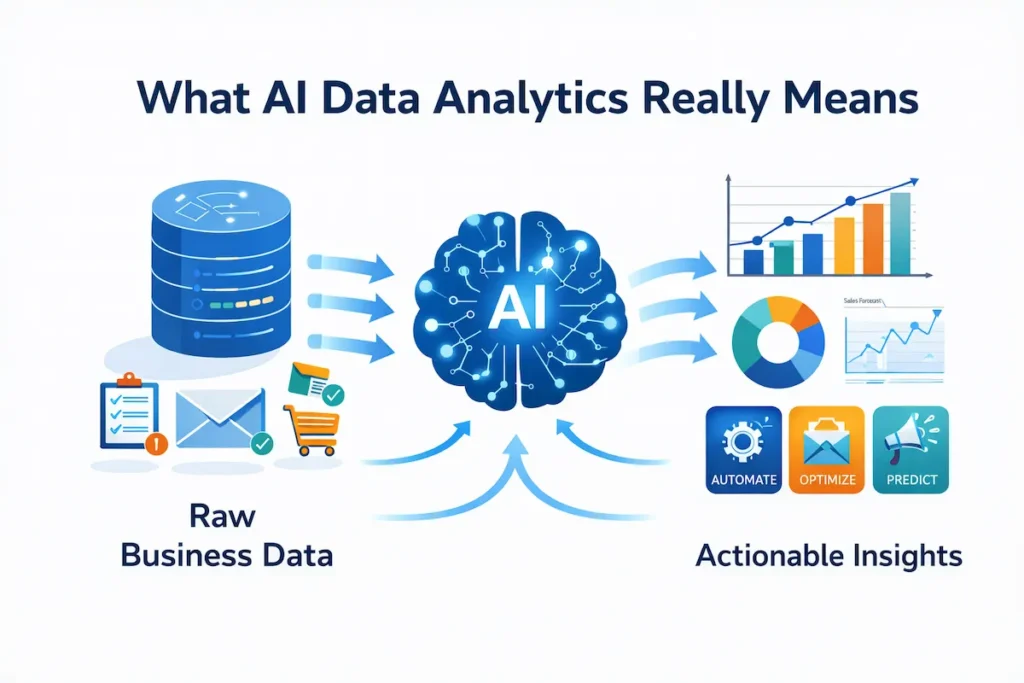
AI-powered data analytics for small businesses uses artificial intelligence to automatically collect, analyze, and interpret business data. Instead of manually building spreadsheets or hiring analysts, AI algorithms identify patterns, predict outcomes, and recommend actions—all in plain English.
How AI-powered data analytics works for small businesses
The technology behind AI-powered data analytics for small businesses operates through machine learning models that improve over time. These systems connect to your existing tools—accounting software, CRM platforms, and social media accounts—and pull data automatically. Natural language processing translates complex metrics into readable insights, while predictive algorithms forecast trends based on historical patterns.
You ask questions in everyday language like “Which products will sell best next month?” and receive answers backed by statistical analysis. The AI handles data cleaning, removes duplicates, fills gaps, and spots anomalies that humans miss. Similar to how AI tools transform digital marketing workflows, these analytics platforms automate tedious tasks so you can focus on strategy.
Traditional analytics vs AI-powered data analytics for small businesses
Traditional analytics requires you to define what to measure, build dashboards, and interpret results manually. You spend hours creating reports that become outdated by the time they’re finished. AI-powered data analytics for small businesses flips this model—the system proactively surfaces important findings without waiting for you to ask.
Where conventional tools show what happened, AI explains why it happened and what’s likely next. Traditional methods demand statistical knowledge; AI platforms use conversational interfaces anyone can navigate. The cost difference is equally stark: enterprise analytics licenses start at thousands monthly, while AI-powered solutions for small businesses begin under $100.
Why AI-powered data analytics for small businesses matters today
The US market moves faster than ever. Consumer preferences shift overnight, supply chains fluctuate unpredictably, and digital competition intensifies daily. Small businesses can’t afford slow decision-making based on gut feelings or outdated reports.
AI-powered data analytics for small businesses levels the playing field against larger competitors. It provides the same quality of intelligence that corporations spend millions achieving, but packaged for teams of five instead of five hundred. In markets where margins are tight and customer loyalty is fragile, this accessibility determines who survives and who thrives.
Key Benefits of AI-Powered Data Analytics for Small Businesses
Smarter decision-making using AI-powered data analytics for small businesses
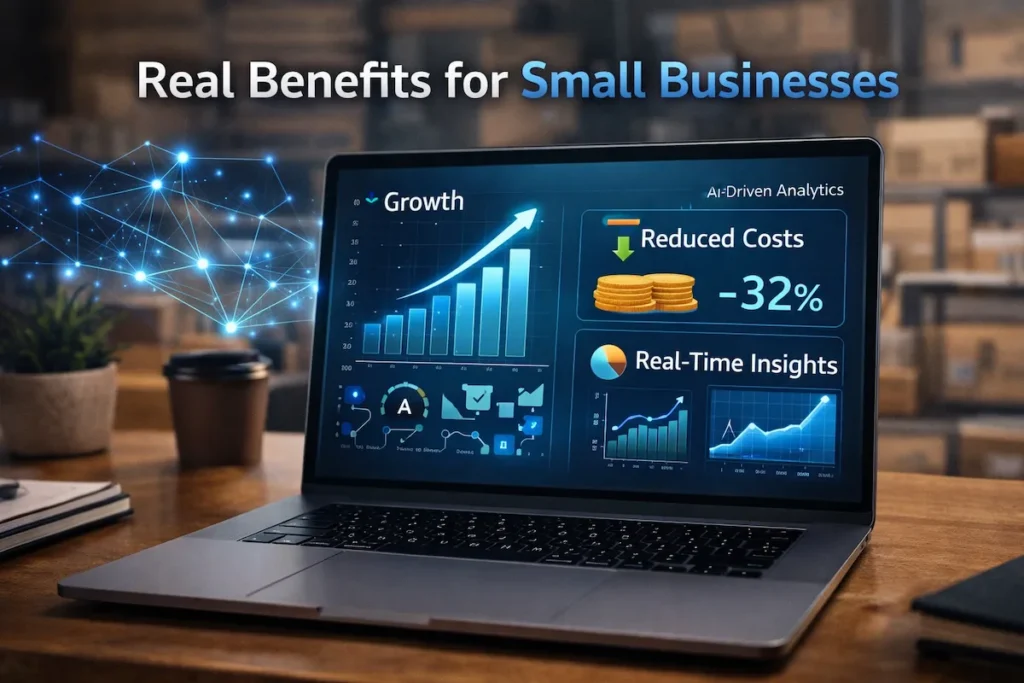
Every business decision carries risk—which products to stock, which markets to enter, and which employees to hire. AI-powered data analytics for small businesses reduces that risk by replacing hunches with evidence. When a bakery owner wonders whether to expand catering services, AI analyzes past order patterns, seasonal trends, and local event calendars to project demand with measurable confidence levels.
These systems catch opportunities humans overlook. They notice that customers who buy product A return 40% more often when offered product B, or that email campaigns sent Tuesday mornings generate double the conversions of Friday afternoons. Small improvements compound quickly when decisions are consistently data-informed.
Cost reduction with AI-powered data analytics for small businesses
Waste drains small business budgets silently. Excess inventory ties up cash, underperforming marketing channels burn ad spend, and operational inefficiencies multiply labor costs. AI-powered data analytics for small businesses identifies these leaks with precision.
A retail shop using AI might discover that 30% of its inventory sits unsold for over 90 days, freeing up $15,000 in working capital by adjusting orders. A service business could learn that certain customer segments cost more to acquire than they generate in lifetime value, redirecting marketing budgets toward profitable demographics. The technology pays for itself by eliminating guesswork expenses.
Real-time insights through AI-powered data analytics for small businesses
Yesterday’s data produces yesterday’s decisions. AI-powered data analytics for small businesses delivers current intelligence that adapts as conditions change. When a restaurant notices a sudden drop in weekend reservations, the AI immediately flags the trend and suggests causes—a new competitor opened nearby, social media reviews mention slow service, or recent menu changes aren’t resonating.
This immediacy enables agile responses. You adjust pricing before losing market share, address customer complaints before they spread, and capitalize on viral moments while they’re still relevant. Real-time monitoring transforms reactive management into proactive leadership.
Common Use Cases of AI-Powered Data Analytics for Small Businesses
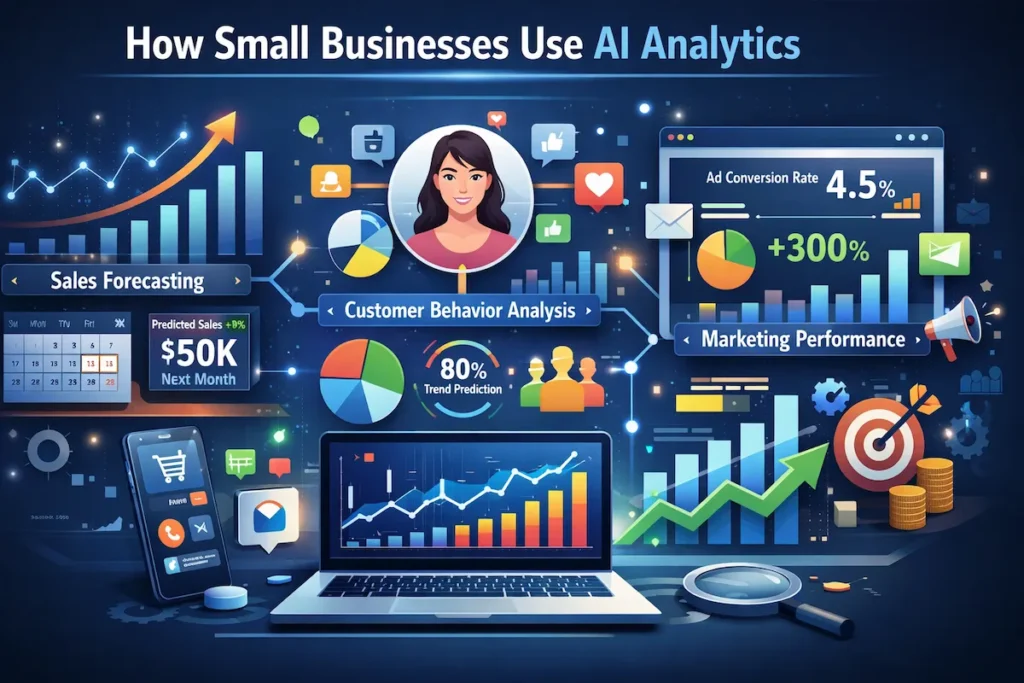
Sales forecasting with AI-powered data analytics for small businesses
Accurate sales predictions prevent two costly mistakes: running out of popular items and overstocking slow movers. AI-powered data analytics for small businesses examines years of transactions, identifies seasonal patterns, accounts for external factors like holidays or weather, and projects future demand with granular accuracy.
A hardware store preparing for spring can predict not just that lawn equipment will sell, but exactly how many units of each model based on neighborhood demographics, local housing starts, and historical purchase cycles. This precision optimizes inventory investment and maximizes revenue during peak seasons.
Customer behavior analysis using AI-powered data analytics for small businesses
Understanding why customers buy, return, or leave requires analyzing thousands of interactions. AI-powered data analytics for small businesses segments audiences automatically, revealing which groups prefer discounts versus premium quality, which channels they engage with, and which pain points drive their purchasing decisions.
An online boutique might discover that customers from Instagram value trendy styles and respond to influencer partnerships, while Google searchers prioritize durability and read detailed product reviews. These insights shape personalized marketing strategies that speak directly to each segment’s priorities, similar to how businesses optimize customer experience using AI.
Marketing optimization with AI-powered data analytics for small businesses
Marketing budgets are small business lifelines that can’t afford waste. AI-powered data analytics for small businesses tracks campaign performance across channels, attributes revenue to specific ads or posts, and calculates true return on investment including indirect effects like brand awareness and repeat purchases.
When a local gym runs Facebook ads, Google search campaigns, and direct mail simultaneously, AI determines which channel actually drives memberships versus which gets credit by default. It reveals that gym-goers often see multiple touchpoints before joining, optimizing the budget mix to emphasize the combinations that convert best.
Best AI-Powered Data Analytics Tools for Small Businesses
Affordable AI-powered data analytics tools for small businesses
Budget-conscious options include platforms like Zoho Analytics, starting around $24 monthly, which connects to common business apps and generates automated reports. Microsoft Power BI offers free versions with AI capabilities suitable for basic analytics needs. Tableau’s small business tier provides drag-and-drop visualization with predictive modeling features under $70 per user monthly.
These affordable AI-powered data analytics tools for small businesses balance functionality with accessibility, avoiding the overwhelming feature sets of enterprise software while delivering meaningful intelligence. They require minimal training and include templates designed for common small business scenarios like inventory tracking, customer lifetime value calculation, and cash flow forecasting.
Cloud-based AI-powered data analytics platforms for small businesses
Cloud deployment eliminates hardware investments and IT maintenance headaches. Platforms like Google Analytics 4 incorporate machine learning at no cost for website intelligence, while Salesforce Einstein integrates AI-powered data analytics for small businesses directly into CRM workflows with pricing that scales based on usage.
Domo and Sisense offer cloud-based solutions with mobile apps, enabling business owners to monitor metrics anywhere. However, when adopting cloud-based tools, it’s essential to implement proper cloud security measures to protect your business intelligence from unauthorized access.
How to choose the right AI-powered data analytics tool for small businesses
Start by listing your top three business questions—the decisions that most impact profitability. Evaluate whether potential platforms answer these questions clearly without requiring data science expertise. Test ease of integration with your current software stack; tools that demand extensive manual data uploads create unsustainable workloads.
Consider the learning curve for your team. The best AI-powered data analytics tool for small businesses matches your technical comfort level while leaving room to grow. Check whether pricing scales affordably as your company expands, and verify that customer support includes practical guidance, not just technical troubleshooting.
Challenges and Limitations of AI-Powered Data Analytics for Small Businesses
Data quality challenges in AI-powered data analytics for small businesses
AI algorithms only perform as well as the information they analyze. Incomplete records, inconsistent naming conventions, and duplicate entries produce unreliable insights. Many small businesses discover their data isn’t ready for AI-powered data analytics for small businesses without cleanup efforts that feel overwhelming.
A consulting firm might track client interactions across email, phone logs, and meeting notes in separate systems with no unified client IDs, making comprehensive analysis impossible. Before implementing AI solutions, businesses must establish basic data hygiene practices: standardized formats, regular audits, and centralized storage. Poor data quality leads to confident-sounding recommendations based on flawed assumptions.
Skill gaps in AI-powered data analytics for small businesses
While modern platforms emphasize user-friendliness, effectively using AI-powered data analytics for small businesses still requires critical thinking about what questions matter and whether answers make business sense. Teams accustomed to intuition-based decisions may struggle to interpret probabilistic forecasts or understand confidence intervals.
There’s also a learning curve in recognizing when AI suggestions should be questioned. If a model recommends drastically increasing prices based solely on recent demand spikes without considering competitive pressures, blind implementation could backfire. Small businesses need training not in programming, but in data literacy—understanding AI’s strengths, limitations, and the contexts where human judgment remains essential.
Hidden costs of AI-powered data analytics for small businesses
Beyond subscription fees, AI-powered data analytics for small businesses carries indirect expenses. Time spent learning new platforms, reformatting data for compatibility, and adjusting workflows represents opportunity cost. Some businesses need paid consultants to handle initial setup or integration challenges that technical support doesn’t cover.
As companies grow more data-dependent, they become vulnerable to service outages, vendor pricing changes, or platform discontinuations. Additionally, storing sensitive business data requires implementing advanced encryption techniques and robust access management practices to prevent data breaches.
How Small Businesses Can Get Started with AI-Powered Data Analytics
Preparing data for AI-powered data analytics for small businesses
Begin with inventory. List every system storing business-critical information: accounting software, payment processors, customer databases, inventory management tools. Identify overlaps where data exists in multiple locations and inconsistencies in how information is recorded across systems.
Clean the most valuable datasets first—customer purchase history typically offers the highest return. Standardize product names, unify customer records, and fill obvious gaps. Many AI-powered data analytics tools for small businesses include data preparation features that automate portions of this work, but human oversight ensures accuracy.
Step-by-step implementation of AI-powered data analytics for small businesses
Start narrow. Choose one specific problem AI-powered data analytics for small businesses can solve—perhaps predicting which customers are likely to make repeat purchases. Select a tool specifically designed for that use case rather than a comprehensive platform requiring months to master.
Connect the tool to relevant data sources and run it on historical information to test accuracy against known outcomes. If the AI successfully predicts past patterns, apply it to current data for actionable insights. Learn from this focused implementation before expanding to additional use cases.
Measuring ROI from AI-powered data analytics for small businesses
Track specific metrics tied to the problems you’re solving. If you implemented AI-powered data analytics for small businesses to reduce inventory costs, measure working capital freed and carrying cost savings. For customer retention improvements, calculate the revenue value of reduced churn rates.
Compare decision outcomes before and after AI adoption. A retailer might find that AI-guided purchasing reduced stockouts by 40% while cutting excess inventory 25%, translating to measurable revenue gains and cost savings. Document these wins to justify continued investment and identify which analytics applications deliver the most value.
Future of AI-Powered Data Analytics for Small Businesses
Emerging trends in AI-powered data analytics for small businesses
Voice-activated analytics are simplifying access further—business owners ask smart speakers for sales updates or customer insights without opening computers. Automated insight delivery grows more sophisticated, with AI proactively alerting owners to problems and opportunities before they’re asked.
Integration between AI-powered data analytics for small businesses and operational systems is tightening. Rather than just providing recommendations, AI will directly adjust pricing, trigger inventory orders, or personalize customer communications with minimal human intervention.
How AI-powered data analytics for small businesses will evolve
Expect dramatic improvements in predictive accuracy as AI models train on broader datasets including economic indicators, social media sentiment, and industry benchmarks. Small businesses will access the same quality of market intelligence currently available only through expensive consulting firms.
Natural language interfaces will become truly conversational, allowing complex multi-step analysis through dialogue rather than navigating dashboards. AI-powered data analytics for small businesses will incorporate visual recognition, analyzing photos of stores, products, or documents as easily as numerical data.
FAQs About AI-Powered Data Analytics for Small Businesses
How much does AI-powered data analytics cost for small businesses?
Entry-level platforms start around $20-50 monthly for basic features, with most comprehensive small business solutions ranging $100-300 monthly. Free options like Google Analytics 4 provide significant AI capabilities for website data. Costs increase with team size, data volume, and advanced features, but remain far below traditional enterprise analytics requiring $10,000+ annual commitments.
Do I need technical skills to use AI-powered data analytics for small businesses?
Modern platforms are designed for non-technical users with conversational interfaces and pre-built templates. You need business knowledge to ask relevant questions and interpret insights, not programming or statistics expertise. Most tools offer tutorials and support to help beginners, though investing a few hours in training maximizes value.
Can AI-powered data analytics for small businesses work with my existing software?
Most platforms integrate with popular business tools through direct connections or APIs: QuickBooks, Shopify, Mailchimp, Square, Salesforce, and hundreds more. Check integration lists before purchasing. Cloud-based systems typically offer the widest compatibility.
How accurate are predictions from AI-powered data analytics for small businesses?
Accuracy depends on data quality, historical patterns, and prediction complexity. For stable scenarios like seasonal inventory planning, AI often achieves 85-95% accuracy. For volatile situations like predicting which specific prospects will convert, accuracy may be 60-70%—still far better than guessing.
Conclusion
AI-powered data analytics for small businesses transforms competitive disadvantages into opportunities. Where budget and team size once limited intelligence capabilities, accessible AI platforms now deliver enterprise-quality insights at small business prices. The technology handles tedious analysis, identifies hidden patterns, and predicts future trends—freeing owners to focus on strategy rather than spreadsheets.
Success doesn’t require technical expertise or massive datasets. Start with clear business problems, choose tools designed for your scale, and build analytics capabilities incrementally. The small businesses thriving in today’s US market aren’t necessarily the largest or best-funded—they’re the ones making consistently smarter decisions backed by AI-powered data analytics.
Ready to move beyond gut feelings and outdated reports? Identify one critical business question you’re facing today and explore how AI-powered data analytics for small businesses can answer it. The competitive advantage waiting in your data won’t extract itself.