
Modern cloud environments look transparent on the surface. Everything appears measurable, trackable, and observable in real time. Dashboards pulse with activity, logs stream endlessly, and asset inventories promise total coverage. Yet despite this apparent openness, critical failures still arrive as surprises. Breaches feel sudden. Outages feel unexplained. Costs spiral without warning. This contradiction defines the real tension behind cloud visibility vs understanding.
The issue is not blindness. Organizations can see more of their cloud than ever before. The issue is meaning. Visibility shows fragments, but understanding requires synthesis. Without that synthesis, risk doesn’t disappear—it hides in plain sight. What remains invisible isn’t data, but consequence.
Why Cloud Visibility Is Often Mistaken for Control
The cloud has trained organizations to equate exposure with mastery. When teams can enumerate resources, track configurations, and monitor activity in real time, it feels like authority has been established. This is where cloud visibility vs understanding quietly diverges. Visibility creates confidence; control requires comprehension.
Cloud environments reward surface-level awareness. Being able to see workloads, users, permissions, and network flows creates the impression that nothing critical can escape notice. But this perception is fragile. Visibility answers what exists, not how it behaves under stress, why it was configured that way, or what happens when assumptions fail. Control does not emerge from observation alone—it emerges from insight.
This is why cloud visibility often feels reassuring right up until the moment it proves insufficient. Teams believe they are in control because the system appears legible. Yet when something breaks, the same visibility offers no guidance, only more information. The second appearance of cloud visibility vs understanding exposes the illusion: seeing everything is not the same as knowing how anything truly works. Control lives in interpretation, not exposure.
Dashboards Show Data, Not Meaning
Dashboards are designed to inform, but they rarely explain. In the discussion around cloud visibility vs understanding, this distinction matters more than most teams realize. Metrics feel authoritative because they are quantified, timestamped, and precise. But precision does not guarantee relevance.
Most dashboards answer operational questions: utilization, latency, error rates, spend. They do not answer contextual ones. A sudden increase in cloud risk visibility may show that something changed, but not whether that change is dangerous, intentional, or acceptable. Numbers describe conditions, not implications.
The calm danger here is saturation. When teams monitor everything, urgency dissolves. Signals blur together, and meaningful deviations become harder to distinguish. The second mention of cloud visibility vs understanding highlights a quiet truth: dashboards create awareness only when humans can translate metrics into narratives. Without narrative, data becomes background noise—technically accurate, strategically empty.

When Seeing Everything Still Means Knowing Very Little
Total visibility can paradoxically reduce comprehension. Cloud visibility vs understanding becomes stark when teams discover that exhaustive inventories don’t prevent blind spots. They simply relocate them.
Knowing every asset does not reveal how risk accumulates. Cloud risk awareness depends on understanding interactions, not counts. A harmless-looking service becomes dangerous only when paired with an over-permissioned role, a shared network path, or an undocumented dependency. These risks don’t announce themselves individually.
This is why organizations often “see” incidents only after impact. All the components were visible beforehand, but their combined behavior was not understood. Bringing cloud visibility vs understanding back into focus exposes the paradox: the more complete the picture appears, the less likely teams are to question it. Familiarity dulls scrutiny, allowing risk to form quietly between known parts.
How Cloud Environments Outgrow Human Awareness
Cloud systems do not remain static long enough for understanding to settle. Cloud visibility vs understanding becomes strained as environments grow faster than institutional memory. What begins as a well-understood architecture gradually fragments through iteration, optimization, and turnover.
Each addition makes sense in isolation. A new service accelerates delivery. A temporary workaround becomes permanent. Ownership shifts, documentation decays, and assumptions persist unchallenged. Cloud complexity risks emerge not from recklessness, but from accumulation.
Visibility tools may still present a clean snapshot of the present, but they cannot explain the past decisions embedded in the system. The second appearance of cloud visibility vs understanding underscores a structural mismatch: humans reason through stories and intent, while cloud systems evolve through configuration and automation. As scale increases, awareness thins—not because teams fail, but because cognition has limits.
Why Most Cloud Risks Are Invisible by Design
The cloud is engineered to reduce friction, not to surface uncertainty. This is where cloud visibility vs understanding reveals its most uncomfortable insight. Many of the riskiest conditions exist precisely because they are meant to feel effortless.
Managed services abstract away complexity to improve speed and reliability. Defaults encourage rapid adoption. Automation minimizes manual intervention. These features are strengths—but they also conceal assumptions. Invisible cloud risks thrive where responsibility feels diffuse and outcomes feel guaranteed.
Teams trust what “just works.” They stop interrogating systems that rarely fail. When cloud visibility vs understanding reappears mid-section, the realization sharpens: risk is not hidden due to negligence or lack of tooling. It is hidden because modern cloud design intentionally removes signals that would otherwise prompt caution. The absence of friction becomes the absence of awareness.
Understanding Emerges From Relationships, Not Resources
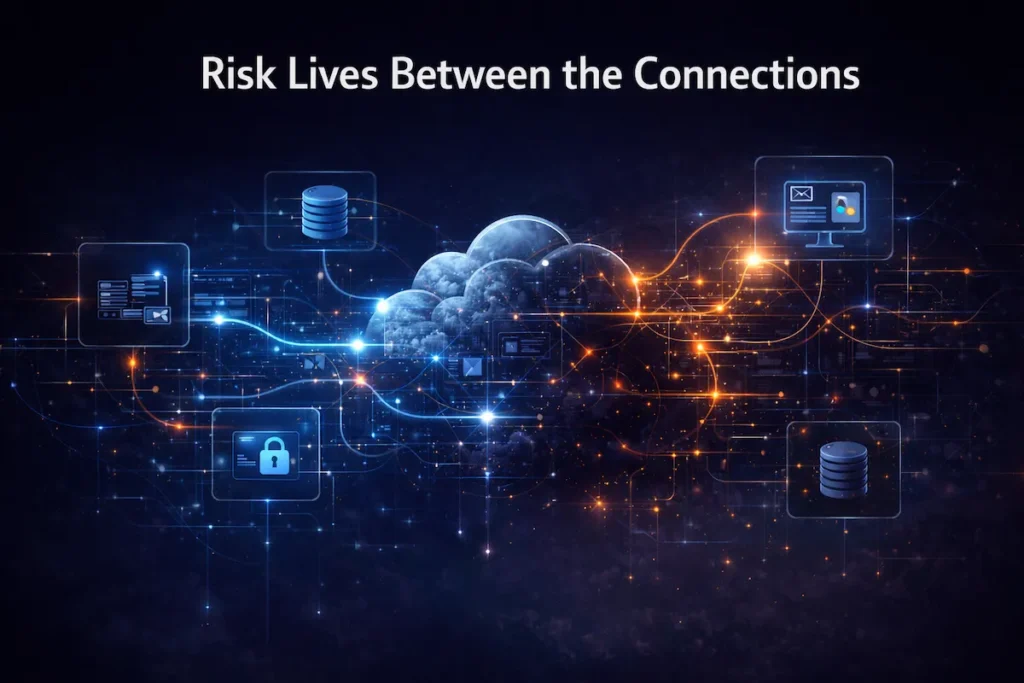
Resources do not exist in isolation. Cloud visibility vs understanding shifts meaningfully when teams stop cataloging assets and start examining relationships. Every real failure in the cloud is relational—a breakdown between services, teams, permissions, or expectations.
Cloud architecture understanding grows when dependencies are treated as first-class citizens. Data paths, trust boundaries, fallback behaviors, and shared services define risk far more than individual components. Visibility tools list relationships; understanding interprets their consequences.
The second mention of cloud visibility vs understanding reinforces a crucial mental shift: knowing what exists is static knowledge, but knowing how things influence each other is dynamic insight. Risk lives in motion, not inventory. Teams that grasp this stop chasing completeness and start seeking coherence.
The Difference Between Knowing What Exists and Knowing What Matters
Relevance is the filter that visibility lacks. Cloud visibility vs understanding becomes a business concern when organizations fail to distinguish presence from importance. An unused resource and a mission-critical one appear equal in an inventory, but their risk profiles are not.
Cloud risk prioritization depends on context—business criticality, data sensitivity, customer impact, and recovery tolerance. Without these lenses, teams respond to alerts instead of consequences. Everything feels urgent until nothing truly is.
When cloud visibility vs understanding appears again, it emphasizes that meaning is selective by nature. Understanding requires deciding which signals deserve attention and which can safely fade into the background. Visibility shows everything; understanding protects what matters most.
Why Security, Resilience, and Cost Fail for the Same Reason
Security breaches, outages, and runaway spend are often treated as separate problems. Cloud visibility vs understanding reveals why they frequently occur together. Each discipline optimizes within its own frame of reference, guided by visibility but isolated from shared meaning.
Security tracks exposure, resilience tracks uptime, and finance tracks consumption. Each sees risk clearly within its domain, yet cloud operational risk emerges where those domains overlap. A cost optimization undermines resilience. A security control degrades performance. No single dashboard captures these tradeoffs.
The second appearance of cloud visibility vs understanding clarifies the root cause: failures occur not because teams lack data, but because insight remains siloed. Risk forms at the boundaries between perspectives—exactly where visibility fragments and understanding dissolves.
From Observability to Judgment: The Missing Human Layer
Observability answers what is happening. Judgment answers what should be done. Cloud visibility vs understanding reaches its most mature interpretation when organizations recognize that no tool can replace discernment.
Cloud decision making relies on experience, context, and values—elements no metric can encode. Observability provides raw signals, but humans supply interpretation, prioritization, and restraint. Without this layer, teams mistake activity for insight.
When cloud visibility vs understanding appears again, it underscores a senior truth: the cloud does not fail because systems are unobservable. It fails when decisions are made without judgment. Understanding is not automated—it is cultivated through reflection and responsibility.
What Mature Cloud Teams Do Differently
Maturity in the cloud is quiet. Cloud visibility vs understanding separates advanced organizations not by the sophistication of their tools, but by the discipline of their thinking. They resist the urge to monitor everything equally.
Cloud governance maturity emerges when teams align on shared interpretations of risk, ownership, and acceptable uncertainty. They invest in conversations, not just controls. Visibility supports these conversations, but it does not replace them.
The second mention of cloud visibility vs understanding reinforces that maturity is less about prevention and more about awareness. These teams accept that risk cannot be eliminated, only understood. Their strength lies in clarity, not coverage.
Frequently Asked Questions
What is the core difference in cloud visibility vs understanding?
The distinction lies in exposure versus interpretation. Cloud visibility shows what exists and what is happening, while understanding explains why it matters, how components interact, and what risks emerge from those interactions. Most organizations have visibility but lack the contextual insight required to make confident decisions. This gap is why incidents often feel surprising despite abundant data.
Why doesn’t more monitoring automatically reduce cloud risk?
Monitoring increases signal volume, not clarity. As environments grow, additional metrics often dilute attention rather than sharpen it. Without a shared mental model of architecture and impact, teams react to noise instead of risk. Cloud failures persist not because data is missing, but because meaning is fragmented.
Can cloud visibility tools ever replace human judgment?
No, because tools describe conditions, not consequences. Visibility platforms excel at detection and measurement, but they cannot evaluate intent, business impact, or acceptable tradeoffs. Judgment requires experience and context—elements that exist outside automation. Tools inform decisions; they do not make them.
Why do cloud risks often appear suddenly even in well-monitored environments?
Because most risks are emergent rather than explicit. They form through combinations of permissions, dependencies, and assumptions that appear harmless in isolation. Visibility shows individual elements clearly but rarely highlights how those elements behave together under stress. Risk becomes visible only after impact, when relationships fail simultaneously.
How does cloud complexity affect organizational awareness over time?
Complexity grows incrementally and invisibly. Each change is logical in context, but cumulative effects are rarely reassessed. As systems scale, no single person retains a full mental model of the environment. Awareness fades not due to negligence, but because complexity outpaces human cognition.
Why do security, reliability, and cost issues often overlap in cloud incidents?
Because they share the same underlying failure: fragmented understanding. Each discipline optimizes within its own metrics, while risk accumulates at their intersections. When teams lack a shared interpretation of system behavior, improvements in one area can quietly degrade another. Visibility remains siloed; impact does not.
Clarity Is a Capability, Not a Feature
Clarity does not arrive through procurement. Cloud visibility vs understanding ultimately teaches that insight is a learned capability—developed through context, relationships, and judgment. Visibility provides inputs; understanding creates outcomes.
Organizations that internalize this stop chasing perfect observability and start cultivating shared meaning. They recognize that the most dangerous risks are not unseen, but misunderstood. In the cloud, clarity is not something you buy—it is something you build.