
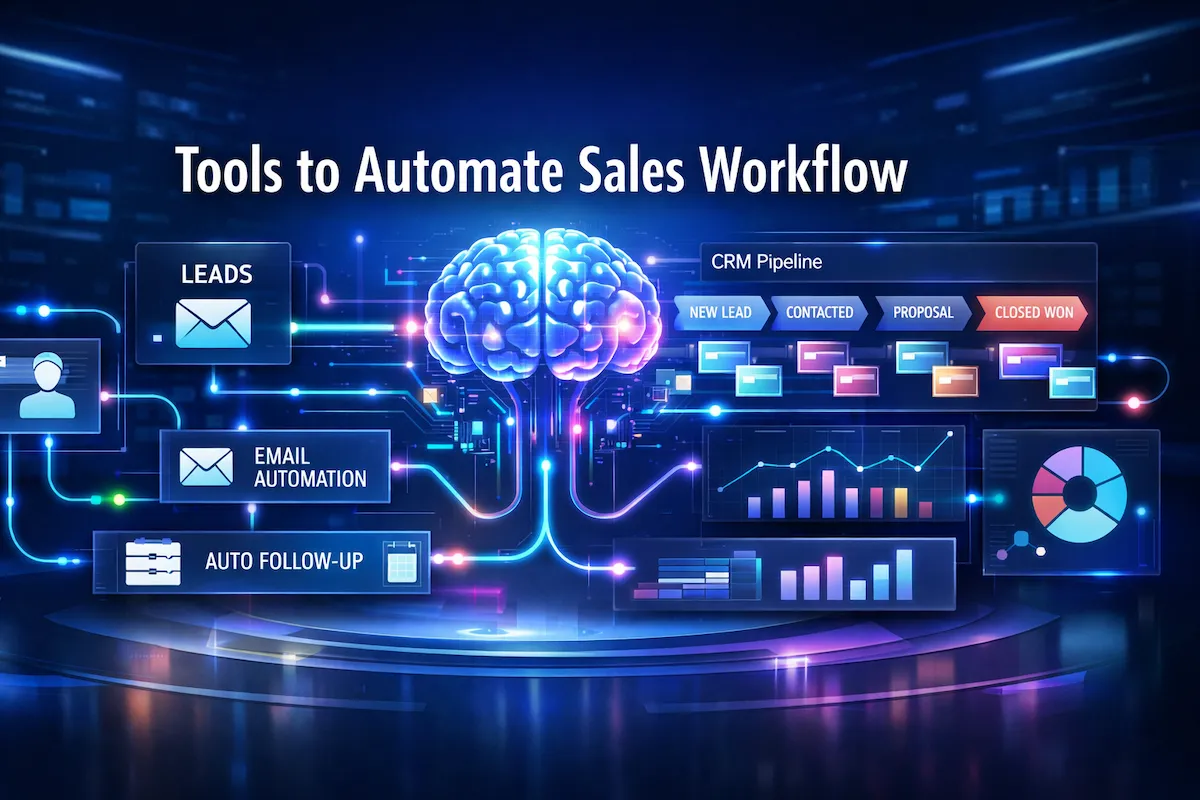
If your sales team is still manually logging calls, chasing leads through a shared spreadsheet, and sending follow-up emails one by one — you’re losing deals you should be winning. The fix isn’t hiring more reps. It’s using the right tools to automate sales workflow so your team can focus on selling instead of admin work.
Today, more U.S. businesses are turning to tools to automate sales workflow to eliminate delays, improve follow-ups, and close deals faster.
This guide covers the 10 best tools to automate sales workflow, what to look for before you choose one, and how to build a system that actually sticks.
What are tools to automate sales workflow? Tools to automate sales workflow are software platforms that automatically handle repetitive sales tasks — like lead capture, follow-up emails, pipeline updates, and CRM data entry — without manual input. They connect your systems so every lead is captured, every follow-up is sent on time, and every deal is tracked in real time.
What are the best tools to automate sales workflow? The best tools to automate sales workflow include HubSpot, Salesforce, Pipedrive, Zoho CRM, Apollo.io, and Freshsales. The right choice depends on your team size, budget, and sales process complexity.
How to automate sales workflow (quick overview):
- Map your current sales process
- Choose a CRM or automation tool that fits your team size
- Connect your lead sources (forms, ads, email)
- Build automated follow-up sequences
- Define rules for pipeline stage movement
- Track results and refine monthly
Who This Guide Is For
Tools to automate sales workflow aren’t just for large enterprise teams. This guide is written for:
- Small business owners who want to compete without adding headcount
- Sales managers looking to reduce manual work and improve follow-up consistency
- Startups scaling their outbound or inbound sales process
- Agencies managing leads across multiple clients
- Anyone tired of deals dying because a follow-up got forgotten
Whether you’re running a two-person sales operation or managing a 50-rep team, the tools and strategies in this guide apply directly to your situation. These are exactly the types of teams that benefit most from tools to automate sales workflow in real-world business environments.
Why Businesses Need Tools to Automate Sales Workflow
Most sales teams don’t lose deals because their reps aren’t good enough. They lose deals because the process around those reps is broken. A lead comes in and sits uncontacted for hours. A follow-up gets forgotten. A hot deal stalls because no one triggered the next step.
These aren’t one-off mistakes — they’re what happens when you run a modern sales process on manual effort. According to recent sales statistics and trends, faster response times and consistent follow-ups significantly increase conversion rates.
Tools to automate sales workflow fix this by building structure directly into your sales process so every lead and follow-up is handled automatically. Every lead gets captured, assigned, and followed up with based on rules your team defines once. Nothing gets dropped because the system handles it.
Here’s what most U.S. sales teams see after implementing sales workflow automation tools:
- Faster response times — automated follow-ups go out within seconds of a new inquiry, not hours
- Consistent pipeline movement — deals advance through stages without relying on individual memory
- Less admin work — reps stop spending time on data entry and start spending it on conversations
- Real-time visibility — managers see exactly where every deal stands without chasing anyone down
If you’re using AI-powered platforms to handle marketing alongside sales, check out this guide on AI marketing automation tools for small business — many of the tools overlap and can be connected directly to your sales workflow.
What Is Sales Workflow Automation?
This is the core purpose of tools to automate sales workflow — removing delays between actions and responses. Sales workflow automation is the use of software to complete repetitive sales tasks automatically — without someone manually triggering each action every time. If you’re new to automation, understanding what CRM is and how it works will help you see how these tools manage customer data and workflows.
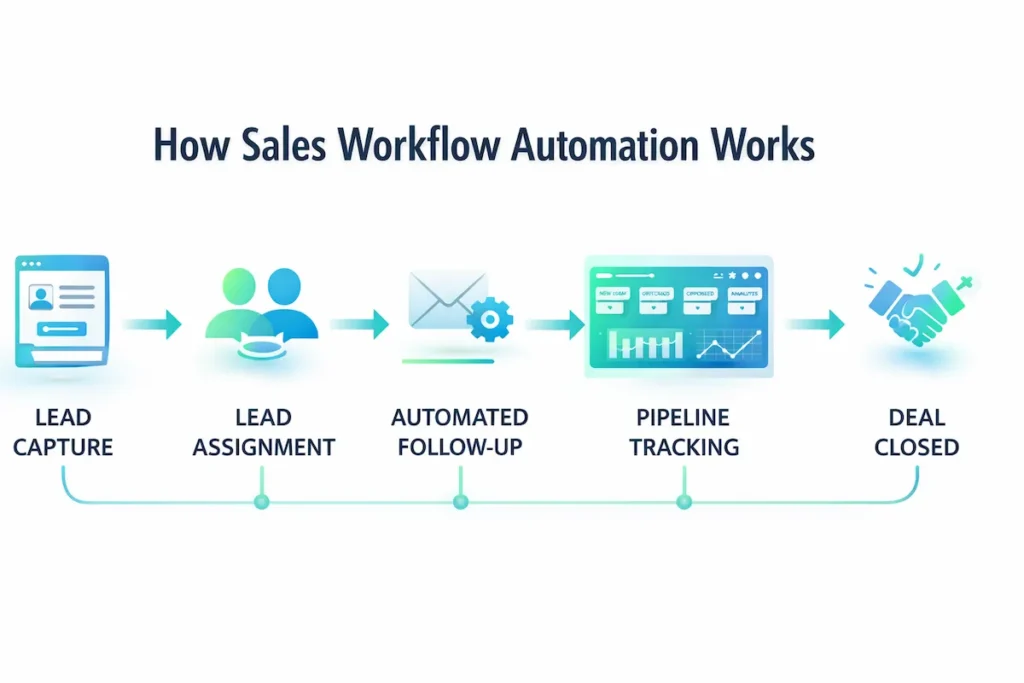
Here’s a simple example: a prospect fills out a form on your website. Without any manual work, the automation captures that lead, adds them to your CRM, assigns them to the right rep, sends a personalized welcome email, and creates a follow-up task for the next morning. The rep walks in and their day is already organized.
That’s what tools to automate sales workflow are built to do — remove the gap between “something happened” and “someone responded to it.”
Common tasks these tools handle include:
- Lead capture from web forms, ads, and live chat
- Automated follow-ups via email, SMS, and task reminders
- Deal tracking and pipeline stage updates
- CRM data entry and record management
- Lead scoring and priority ranking
- Sales performance dashboards and reporting
The result is a sales process that runs on a consistent set of rules rather than on whoever remembers to do what.
For a broader look at the AI tools powering modern automation, the 2026 complete guide to the best AI tools covers how these platforms are evolving — many of them feed directly into sales automation stacks.
Key Features to Look for in Tools to Automate Sales Workflow
Not every platform delivers the same value. Before you choose one, make sure it covers these four areas. Skipping any of them usually creates gaps that cost you deals later. If you want a deeper understanding of automation logic, this guide on workflow automation explains how systems trigger actions automatically.
Lead Tracking Automation in Tools to Automate Sales Workflow
Your tool should capture leads from every channel — web forms, ad campaigns, email, and live chat — and log them automatically. Look for auto-assignment rules that route leads to the right rep instantly, duplicate detection to keep your CRM clean, and lead scoring so reps always know which prospects deserve attention first.
Strong lead management automation is the foundation everything else builds on. Without it, every other automation you set up is working with incomplete data. Without this foundation, tools to automate sales workflow cannot deliver accurate results.
Automated Follow-Ups Using Tools to Automate Sales Workflow
This is one of the highest-impact ways tools to automate sales workflow improve conversions. This is where most sales teams get the biggest return. Automated follow-ups let you build multi-step sequences that keep prospects engaged without reps manually sending every message.
Look for behavioral triggers — so the sequence adapts when someone opens an email or clicks a link — along with personalization options and A/B testing to refine performance over time.
Pipeline Management with Tools to Automate Sales Workflow
Effective tools to automate sales workflow ensure deals move forward without manual tracking. Good sales pipeline automation tools don’t just show you where deals are — they move deals forward based on actions. When a proposal gets sent, the deal advances. When a contract is signed, an onboarding task is created automatically.
Look for drag-and-drop pipeline views, deal aging alerts, and forecasting dashboards that help managers catch stalled deals before they go cold.
CRM Integration in Tools to Automate Sales Workflow
If your automation platform doesn’t sync cleanly with your CRM, you’ll end up with fragmented data and duplicated work. Prioritize CRM automation tools that offer native integrations with platforms like HubSpot, Salesforce, and Zoho — and check for Zapier support if you need custom connections.
If you’re also using advanced strategies like these AI SEO tools, make sure your sales automation platform can capture and convert those inbound leads effectively. Strong integration is what makes tools to automate sales workflow operate as a unified system.
10 Best Tools to Automate Sales Workflow for Sales Teams
Here’s a practical breakdown of the best tools to automate sales workflow used by U.S. sales teams today. Each one is built differently — so we’ve highlighted not just what it does, but where it genuinely stands out and when to avoid it.
1. HubSpot Sales Hub — Tools to Automate Sales Workflow
HubSpot is the most complete all-in-one platform for teams that want tools to automate sales workflow without managing five separate apps. The free CRM is a legitimate starting point — not a stripped-down demo — and paid tiers unlock serious automation depth including multi-step sequences and AI-assisted lead scoring.
Where it stands out: The combination of CRM, email automation, meeting scheduling, and deal tracking in a single dashboard is genuinely hard to beat at this price point.
Real-world use case: A U.S. SaaS startup uses HubSpot sequences to automatically follow up with trial users who haven’t logged in within 48 hours — driving a 28% increase in activation without adding a single rep.
Best for: Startups and SMBs that want everything in one place.
When to avoid it: If you need deep enterprise customization, the cost scales fast and can become difficult to justify for smaller teams.
Pricing: Free CRM available. Sales Hub Starter from $15/user/month. Professional from $90/user/month.
2. Salesforce Sales Cloud — Tools to Automate Sales Workflow
Salesforce is the gold standard for enterprise sales workflow automation tools. Its Flow Builder lets teams create complex multi-step automations without writing code, and Einstein AI adds predictive intelligence — flagging which deals are at risk and which leads are most likely to convert.
Where it stands out: The depth of customization is unmatched. If you can describe a workflow, Salesforce can automate it.
Real-world use case: A 200-rep B2B company uses Salesforce to auto-route inbound leads by industry and deal size, cutting average first-response time from 4 hours to under 10 minutes.
Best for: Mid-market and enterprise teams with dedicated sales ops or RevOps support.
When to avoid it: Small teams without admin resources will spend more time maintaining it than selling.
Pricing: Starter Suite from $25/user/month. Professional from $80/user/month.
3. Pipedrive — Tools to Automate Sales Workflow
Pipedrive is built by salespeople for salespeople. It’s one of the cleanest sales pipeline automation tools available and is especially good at keeping reps focused on the next action rather than getting lost in a bloated CRM. The automation features handle routine tasks so nothing slips through the cracks.
Where it stands out: The visual pipeline is the most intuitive in this category. Deal rotting alerts flag deals that haven’t moved in a set number of days — a simple feature that prevents a surprising number of lost deals.
Real-world use case: A five-person sales team uses Pipedrive to automatically assign new leads from their website, send an intro email, and create a call task — all triggered the moment a form is submitted.
Best for: Small and mid-sized teams that want a simple, visual sales process.
When to avoid it: If you need deep marketing automation alongside sales, HubSpot covers more ground.
Pricing: Essential from $14/user/month. Advanced from $29/user/month.
4. Zoho CRM — Tools to Automate Sales Workflow
Zoho CRM gives you enterprise-level CRM automation tools at small business prices. Its standout feature is Blueprint — a process enforcement tool that maps your sales workflow step by step and prevents deals from skipping stages. This is one of the best tools to automate sales workflow for teams that need structure without the enterprise price tag.
Where it stands out: Blueprint is genuinely unique. You can design your exact sales process, define what’s required at each stage, and enforce it automatically across your whole team.
Real-world use case: A U.S. real estate agency uses Zoho Blueprint to ensure every lead goes through qualification, property matching, and follow-up steps before being marked as a deal — reducing skipped steps by 40%.
Best for: Budget-conscious small businesses that want real automation depth.
When to avoid it: If design and interface quality matter a lot to your team, it feels dated compared to HubSpot.
Pricing: Standard from $14/user/month. Professional from $23/user/month.
5. Apollo.io — Tools to Automate Sales Workflow
Apollo.io combines a massive B2B lead database with built-in sales engagement tools — making it the strongest option for outbound teams that need to find prospects and reach them at scale. Tools to automate sales workflow are baked directly into the prospecting flow, so you can go from finding a lead to launching a sequence in minutes.
Where it stands out: 275M+ contact database plus built-in email sequences plus a dialer — all in one platform. For outbound teams, this eliminates the need for three separate tools.
Real-world use case: A B2B SaaS company uses Apollo to pull 500 targeted leads weekly, enroll them in a 6-step email sequence, and sync replied contacts directly to HubSpot — all automatically.
Best for: Outbound sales teams that need prospecting and automation in one tool.
When to avoid it: Data accuracy varies by industry. Always verify contact info before running large campaigns.
Pricing: Free plan available. Basic from $49/user/month. Professional from $99/user/month.
6. Close CRM — Tools to Automate Sales Workflow
Close is built specifically for inside sales teams. Every communication channel — calls, emails, SMS — lives inside the CRM, so reps never have to context-switch. As one of the most focused tools to automate sales workflow for high-volume teams, it keeps the full activity history visible without digging through multiple apps.
Where it stands out: The built-in power dialer is the best in this price range. Reps can move through a call list at speed, with automatic logging and follow-up creation after each call.
Real-world use case: An SDR team of 8 uses Close’s power dialer to make 80+ calls per day per rep, with automatic voicemail drops and follow-up email sequences triggered when a call goes unanswered.
Best for: High-volume inside sales teams where speed is the primary metric.
When to avoid it: Not a great fit for complex enterprise sales with long, multi-stakeholder deal cycles.
Pricing: Startup from $49/month (up to 3 users). Professional from $99/user/month.
7. Freshsales — Tools to Automate Sales Workflow
Freshsales brings AI into the CRM at a price point that makes sense for small teams. Its Freddy AI assistant handles lead management automation in the background — scoring prospects, suggesting next actions, and flagging deals that need attention. These tools to automate sales workflow are particularly well-suited to teams that want intelligent automation without the enterprise complexity.
Where it stands out: Freddy AI provides one of the most accessible AI sales assistants in this price range. It surfaces at-risk deals and recommends actions without requiring manual configuration.
Real-world use case: A U.S. digital agency uses Freshsales to auto-score leads from their website, prioritize follow-ups based on AI recommendations, and send templated proposals triggered by deal stage changes.
Best for: Growing teams that want AI-powered automation without enterprise complexity.
When to avoid it: Advanced reporting and some integrations are locked behind higher-tier plans.
Pricing: Free for up to 3 users. Growth from $9/user/month. Pro from $39/user/month.
8. Lemlist — Tools to Automate Sales Workflow
Lemlist takes a different approach to email automation for sales. Instead of just swapping in a first name, it lets you insert personalized images and custom landing pages into every email automatically — at scale. For outbound teams, this level of creative personalization in tools to automate sales workflow is genuinely hard to replicate elsewhere.
Where it stands out: Personalized images inside cold emails — showing the prospect’s website on a laptop screen, for example — generate significantly higher reply rates than standard text personalization alone.
Real-world use case: A sales consulting firm uses Lemlist to send 300 personalized cold emails per day with custom screenshots of each prospect’s website. Reply rates jumped from 4% to 11% after switching.
Best for: Outbound sales teams running creative cold email campaigns at scale.
When to avoid it: Not a full CRM — works best alongside one. Not suited for inbound lead management.
Pricing: Email Starter from $39/month. Multichannel Expert from $99/month.
9. Outreach — Tools to Automate Sales Workflow
Outreach is what enterprise sales teams use when they need serious horsepower. Its AI sales assistants provide real-time deal coaching, flag at-risk opportunities, and help managers understand exactly where revenue is being lost. For large teams, these tools to automate sales workflow provide a level of pipeline intelligence that lighter platforms simply can’t match.
Where it stands out: Deal intelligence is genuinely useful at scale — it surfaces which deals need attention before the manager even asks, based on engagement signals and historical win patterns.
Real-world use case: An enterprise SaaS company uses Outreach’s AI forecasting to identify at-risk Q3 deals in August, allowing the sales team to intervene early and recover 15% of deals that would otherwise have been lost.
Best for: Mid-market and enterprise teams with dedicated sales ops or RevOps support.
When to avoid it: The cost and setup complexity make it impractical for teams under 25 reps.
Pricing: Custom pricing, typically $100+/user/month.
10. Monday Sales CRM — Tools to Automate Sales Workflow
Monday Sales CRM brings workflow automation for sales teams into a visual, board-based interface that non-technical users can actually manage. If your team already uses Monday.com for project management, the CRM layer slots in with almost no learning curve. These tools to automate sales workflow are ideal for teams that need flexibility over rigid structure.
Where it stands out: The no-code automation recipe builder is the most visual and accessible in this category. You can create “if this then that” workflows without any technical knowledge whatsoever.
Real-world use case: A marketing agency uses Monday Sales CRM to manage client acquisition, with automated status updates sent to the account team whenever a deal moves to “Proposal Sent” or “Closed Won.”
Best for: Teams that want a flexible, visual approach to managing their sales pipeline.
When to avoid it: If your team needs deep CRM-specific features like call logging or advanced email sequences, a dedicated CRM will serve you better.
Pricing: Basic CRM from $12.50/user/month. Standard from $17/user/month.
Quick Comparison: Tools to Automate Sales Workflow
Use this table to shortlist two or three tools based on your team’s situation before diving into free trials.
| Tool | Best For | Starting Price | Free Plan |
|---|---|---|---|
| HubSpot Sales Hub | All-in-one SMBs | $15/user/month | Yes |
| Salesforce Sales Cloud | Enterprise teams | $25/user/month | No |
| Pipedrive | Pipeline management | $14/user/month | No |
| Zoho CRM | Budget SMBs | $14/user/month | Yes |
| Apollo.io | Outbound prospecting | $49/user/month | Yes |
| Close CRM | Inside sales teams | $49/month | No |
| Freshsales | Growing teams + AI | $9/user/month | Yes |
| Lemlist | Cold email campaigns | $39/month | No |
| Outreach | Enterprise engagement | Custom | No |
| Monday Sales CRM | Flexible teams | $12.50/user/month | No |
How to Automate Sales Workflow Step-by-Step Using These Tools
Implementing tools to automate sales workflow correctly is what separates high-performing sales teams from those stuck in manual processes. Choosing the right tool is only half the job — here’s how to actually put it to work so it sticks and produces results, not just sits unused in your tech stack.
Step 1: Map your current process first. Before you automate anything, document every step from lead capture to close. Find where deals stall, where follow-ups get dropped, and where reps spend the most manual time. This map is your automation blueprint. Automating a broken process just makes it break faster.
Step 2: Choose a tool that matches your team size and budget. A five-person startup doesn’t need Salesforce. A 50-rep team will outgrow Pipedrive quickly. Use the comparison table above to shortlist two or three options and run free trials before committing.
Step 3: Automate lead capture before anything else. Connect your web forms, landing pages, and ad platforms so every lead goes straight into your CRM. Set auto-assignment rules so leads reach the right rep instantly. This alone eliminates one of the most common revenue leaks in small business sales.
Step 4: Build your follow-up sequences. Create email sequences that cover multiple touchpoints — mix value-driven content with clear calls to action. Set behavioral triggers so the sequence adapts based on what prospects actually do. Someone who opens three emails in a row is a different prospect than someone who hasn’t opened one.
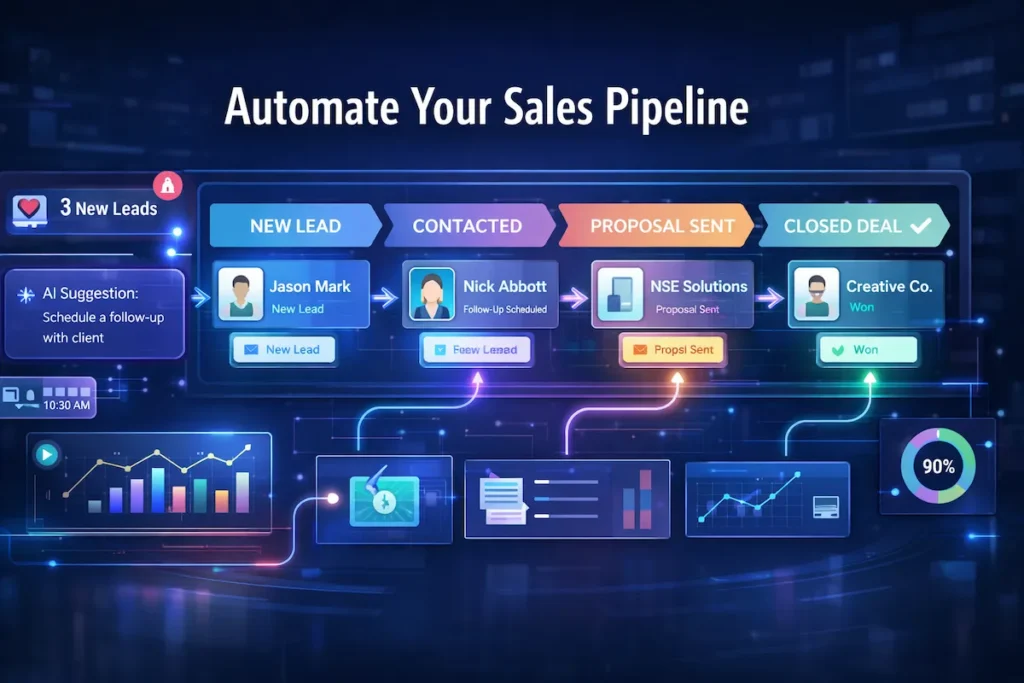
Step 5: Define pipeline stage automation. Decide which actions advance a deal. Sending a proposal moves it to “Proposal Sent.” A signed contract triggers “Closed Won” and kicks off an onboarding task automatically. This removes deal-stage management from the rep’s mental load entirely.
Step 6: Review and refine every month. Tools to automate sales workflow improve over time — but only if you look at the data. Set a monthly cadence to check which sequences are converting, which deals are stalling, and what needs updating. Automation isn’t set-and-forget.
Best Tools to Automate Sales Workflow for Small Businesses
For small teams, tools to automate sales workflow reduce workload without increasing headcount. Small businesses need tools to automate sales workflow that are fast to set up, affordable, and manageable without a dedicated IT team. These are the strongest fits:
- HubSpot — Zero-risk starting point. The free CRM is genuinely useful, not a watered-down demo.
- Zoho CRM — Enterprise-grade automation at a price small businesses can actually afford.
- Pipedrive — Most teams are fully operational within a day. Minimal setup time required.
- Freshsales — Best value for AI-powered automation. Free for up to three users.
- Apollo.io — Best choice if your main challenge is finding and reaching new leads at scale.
If budget is your primary constraint, there are also several free AI tools for digital marketing that can complement your sales automation stack — particularly for lead generation and content at the top of your funnel.
Start by automating two things: lead capture and follow-ups. These two alone deliver the fastest ROI and give your team a solid foundation to build from.
Benefits of Using Tools to Automate Sales Workflow
When teams implement tools to automate sales workflow correctly, the payoff goes well beyond saving a few hours per week:
- Faster lead response — automated follow-ups contact new leads in seconds, not hours. Companies that respond within 5 minutes are 9x more likely to convert. Research on lead response time shows that contacting leads quickly dramatically improves the chances of conversion.
- Fuller pipeline — no lead goes unlogged when capture is automated. Tools to automate sales workflow ensure every inquiry is accounted for.
- Higher close rates — consistent, timely follow-up keeps deals alive that would otherwise go cold quietly.
- Better forecasting — real-time pipeline tracking means fewer surprises at month-end and more accurate revenue projections.
- Scalable output — with sales task automation handling the repetitive work, your team can manage more deals without adding headcount.
- Lower admin overhead — reps stop spending time on data entry and start spending it on conversations that actually close deals.
These results are exactly why more U.S. businesses are investing in tools to automate sales workflow as a core part of their growth strategy — not a nice-to-have, but a competitive necessity. These results clearly show why tools to automate sales workflow are now essential for modern businesses.
Common Mistakes When Implementing Tools to Automate Sales Workflow
Even the best tools to automate sales workflow fail when teams make these avoidable errors:
- Automating a broken process. If your sales workflow is unclear before automation, it’ll just be broken faster afterward. Fix the process first, then automate it.
- Over-automating too quickly. Start with two or three high-impact automations — lead capture and follow-ups — before adding complexity.
- Generic sequences. Template-sounding automated follow-ups damage your brand. Personalization tokens and behavioral triggers keep outreach feeling human.
- Dirty CRM data. Sales automation software is only as good as the data it runs on. Clean your CRM before building workflows on top of it.
- No review cadence. Set a monthly check-in to review what’s converting and what isn’t. Tools to automate sales workflow improve only when someone’s paying attention to the results.
- Skipping team training. The best platform in the world doesn’t help if your reps don’t trust it or know how to use it. Buy-in matters as much as features.
Even powerful tools to automate sales workflow fail if these mistakes are ignored.
The Future of AI-Powered Tools to Automate Sales Workflow
AI is making tools to automate sales workflow smarter, faster, and more predictive than ever before. The next wave of tools to automate sales workflow is being driven by artificial intelligence — and it’s already changing how competitive sales teams operate. Studies on AI transforming sales processes show that automation and predictive insights are reshaping how modern sales teams operate.
AI sales assistants are moving beyond basic chatbots. They now draft personalized emails, summarize call recordings, suggest next best actions, and flag at-risk deals in real time. Platforms like Salesforce (Einstein), HubSpot (Breeze AI), and Outreach are investing heavily here. For a broader view of where AI assistants are heading, the 2026 AI tools guide covers the latest developments across the category.
Predictive lead scoring is getting significantly sharper. Instead of static rule-based scoring, AI analyzes historical win data, firmographics, and behavioral signals to predict which leads are most likely to close — and when. This makes pipeline tracking more actionable and less of a gut-feel exercise.
Adaptive workflow automation is the next frontier. Future tools to automate sales workflow will learn from outcomes and adjust sequences automatically when performance drops — without anyone needing to manually log in and change settings.
For teams using conversational tools as part of their outreach, it’s also worth exploring how WhatsApp chatbots are becoming a practical channel for automated sales follow-ups — particularly for businesses with a mobile-first customer base.
For U.S. teams evaluating sales pipeline automation tools today, choosing platforms with strong AI roadmaps means you won’t be starting over in two years when these capabilities become standard across the industry.

Frequently Asked Questions
What are tools to automate sales workflow?
Tools to automate sales workflow are software platforms that automatically handle repetitive sales tasks such as lead capture, follow-ups, and pipeline tracking without manual input. These tools help sales teams respond faster, stay consistent, and close more deals while reducing administrative work.
Which tools to automate sales workflow are best for small businesses?
The best tools to automate sales workflow for small businesses include HubSpot, Zoho CRM, and Freshsales due to their affordability, ease of setup, and strong free plans. Pipedrive is also a great option for teams that want a simple visual pipeline without a steep learning curve.
How long does it take to set up tools to automate sales workflow?
Most tools to automate sales workflow can be set up within a day for basic automations like lead capture, assignment, and simple follow-ups. More advanced workflows, including pipeline automation and multi-step sequences, typically take one to two weeks to fully configure and optimize.
Do I need technical skills to use tools to automate sales workflow?
No, most tools to automate sales workflow are designed for non-technical users. Platforms like HubSpot, Pipedrive, Monday Sales CRM, and Zoho CRM offer no-code workflow builders that allow sales teams to set up automation without developer support.
What is the difference between CRM and tools to automate sales workflow?
A CRM is used to store and manage customer data, while tools to automate sales workflow use that data to trigger automated actions such as follow-ups, task assignments, and pipeline updates. Many modern platforms combine both CRM and automation features into a single system.
Conclusion: Choosing the Right Tools to Automate Sales Workflow
The right tools to automate sales workflow don’t replace your sales team — they make your team sharper. Leads get followed up faster. Deals move through the pipeline more consistently. Reps spend their time on conversations that matter instead of tasks a system can handle.
Start by identifying your biggest manual bottleneck. Is it lead capture? Follow-ups? Pipeline visibility? Pick the tool that solves that problem best, implement it cleanly, and measure results before adding more complexity.
The goal is a sales process that runs on a consistent system — not on whoever happened to remember to send the email. Once you have that foundation, everything else becomes easier to scale.
Ready to pick your tool? Use the comparison table above to shortlist two or three options based on your team size and budget. Take advantage of free trials from HubSpot, Zoho, Freshsales, and Apollo.io before committing to anything. Businesses that consistently use tools to automate sales workflow gain a clear advantage in speed, efficiency, and deal conversion.