
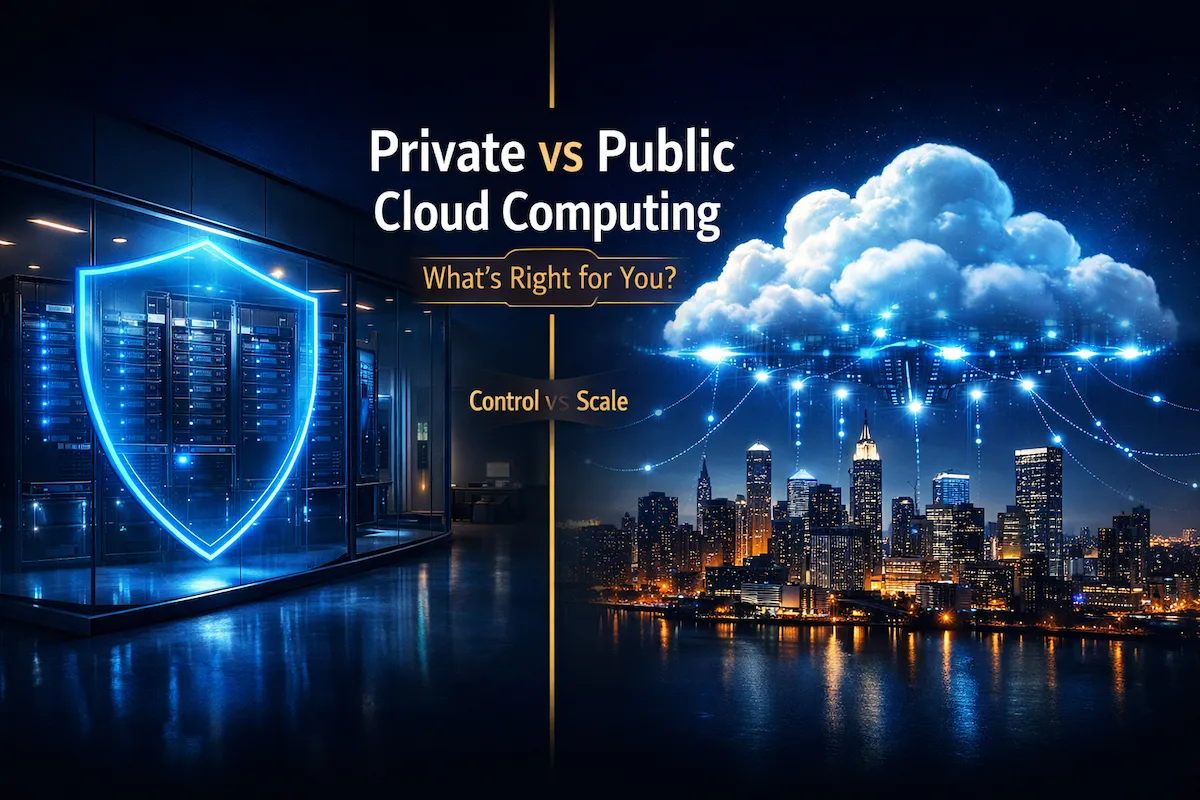
When you’re building or scaling your IT infrastructure, the private vs. public cloud computing decision can make or break your budget, security posture, and long-term agility. This isn’t a theoretical debate—it’s a real choice with real consequences for US startups, mid-size companies, and enterprise IT teams.
Most businesses get this decision wrong because they focus on the wrong variables. They compare sticker prices without factoring in governance costs. They assume the public cloud is always cheaper or that the private cloud is always more secure. Neither is automatically true.
This guide cuts through those assumptions and gives you a practical, decision-focused breakdown based on what actually matters for your business.
What Is Private Cloud Computing in the Private vs. Public Cloud Computing Debate?
A private cloud is a dedicated computing environment built exclusively for one organization. Whether it’s hosted on-premise or through a managed service provider, no other company shares your infrastructure. You own the walls, the roof, and everything inside.
Infrastructure Ownership in Private vs. Public Cloud Computing
In the private vs. public cloud computing landscape, infrastructure ownership is the defining factor for private clouds. Your organization either owns the physical hardware outright — servers, storage, networking — or leases it from a dedicated hosting provider. Either way, it’s a single-tenant environment built around your specific needs, with no shared risk from neighboring workloads.
This matters for companies that can’t afford to share compute resources with unknown third parties. Banks, healthcare systems, and defense contractors consistently fall into this category. For these organizations, the question of who physically controls the infrastructure is never a minor detail.
Security Control in Private vs Public Cloud Computing
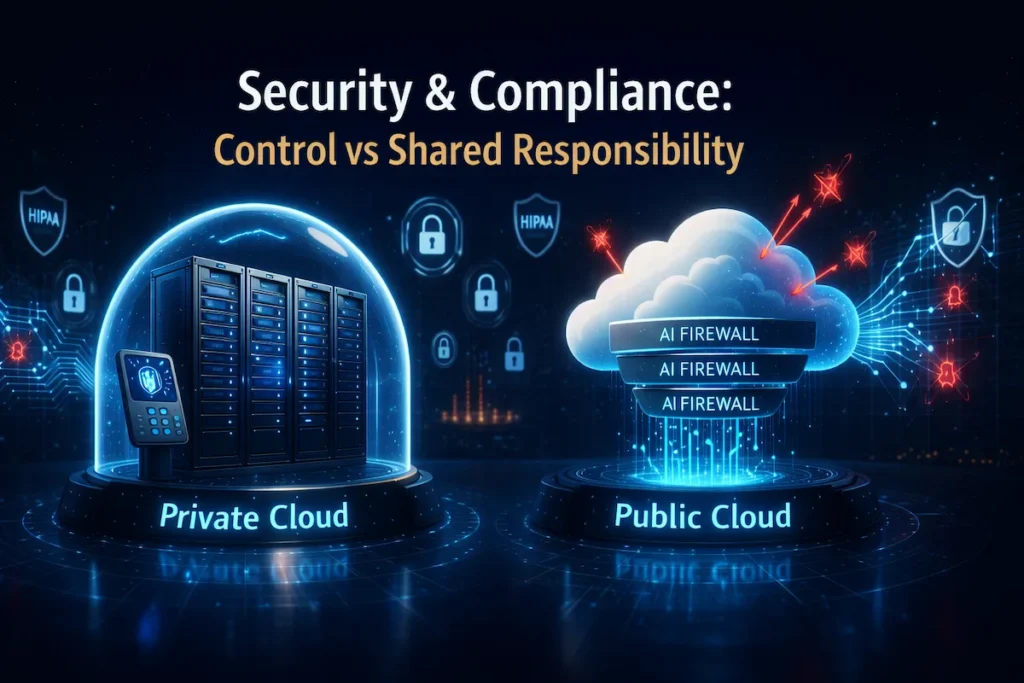
When evaluating private vs. public cloud computing from a security standpoint, private clouds give you full, uncompromised control. You define the firewall rules, access policies, encryption standards, and audit trails. There’s no shared risk from neighboring tenants and no surprise policy changes from a third-party vendor.
For industries governed by strict compliance standards — HIPAA, SOC 2, or internal security frameworks — this level of control is often non-negotiable. If your security team needs to demonstrate direct ownership of every layer of the stack during an audit, private cloud is the cleaner path. To understand the broader practices that protect data regardless of which model you choose, it’s worth reviewing these essential cloud security tips for protecting your data online.
Cost Structure of Private vs Public Cloud Computing (Private Model)
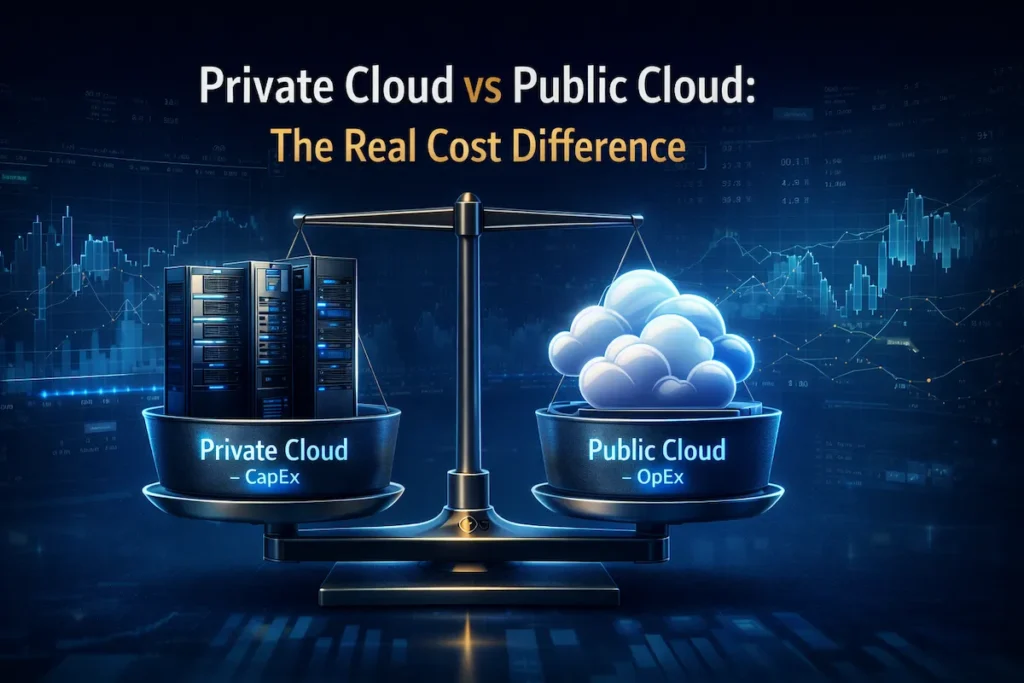
The cost structure in private vs. public cloud computing heavily favors private clouds only when you have consistent, predictable workloads at significant scale. Private clouds require substantial capital expenditure (CapEx) upfront—hardware purchases, data center space, cooling, power, and dedicated IT staff.
Over a three-to-five year horizon, those sunk costs can be justified. But for smaller teams without a dedicated infrastructure team, the operational burden often outweighs the perceived control benefits. If you’re also evaluating whether dedicated cloud storage fits your budget, it’s worth reviewing the best cloud storage alternatives available in 2026 before locking into a full private infrastructure commitment.
What Is Public Cloud Computing? In the Private vs. Public Cloud Computing Comparison,
According to the NIST cloud computing definition, cloud computing provides on-demand network access to shared configurable computing resources. Public cloud computing delivers shared computing resources — servers, storage, databases, networking — over the internet on a pay-as-you-go basis. Providers manage everything behind the scenes. You log in, provision what you need, and scale up or down on demand.
Amazon Web Services, Microsoft Azure, and Google Cloud are the dominant players in this space. Between them, they power a significant portion of the modern internet and support everything from two-person startups to Fortune 100 enterprises.
Multi-Tenant Architecture in Private vs Public Cloud Computing
The defining characteristic of public cloud in the private vs. public cloud computing comparison is multi-tenant architecture. Multiple businesses share the same physical infrastructure, though logically separated through advanced virtualization layers. This shared model is what makes public cloud cost-efficient—providers spread infrastructure costs across thousands of customers and pass those savings on through competitive pricing.
For most businesses, this poses no meaningful security risk. Virtualization technology has matured significantly over the past decade, and top-tier providers maintain rigorous workload isolation standards backed by independent third-party audits.
Scalability in Private vs Public Cloud Computing
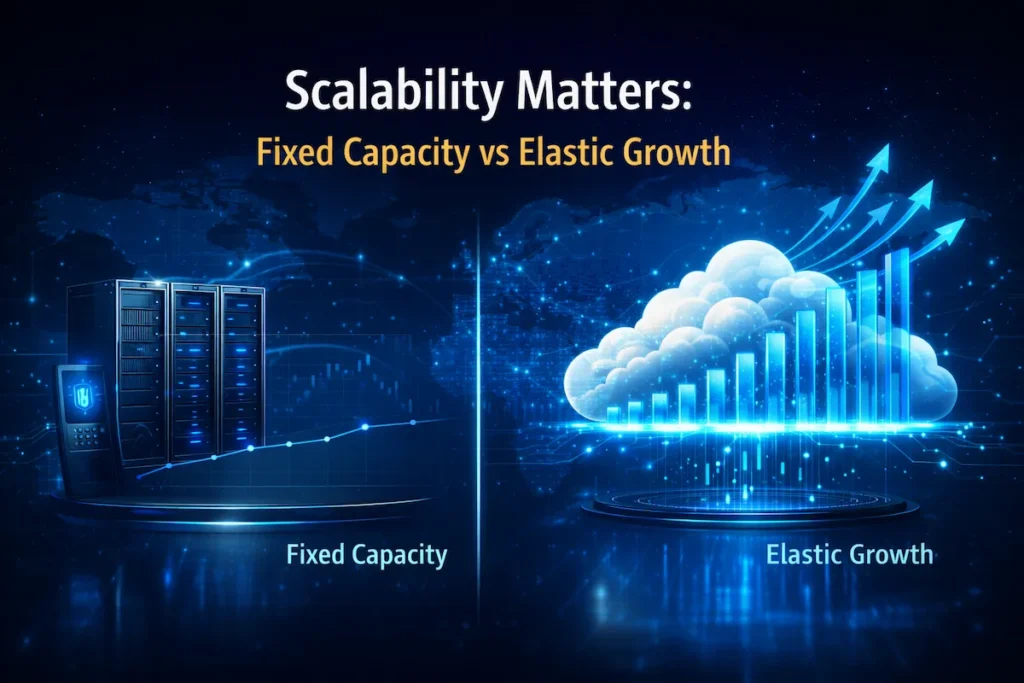
Scalability is where public cloud definitively dominates the private vs. public cloud computing debate. Need to spin up 500 additional servers for a product launch? Done in minutes. Need to scale back down after the holiday rush? You stop paying the moment you stop using.
This elastic infrastructure model is transformational for startups and fast-growing companies that can’t accurately predict compute needs six months out. It’s also a strategic advantage for businesses entering new markets or running time-boxed campaigns.
Operational Expense Model in Private vs Public Cloud Computing
Public cloud runs entirely on operational expenditure (OpEx). No upfront hardware investment. You pay monthly or hourly for what you consume. This fundamentally shifts the financial model and makes the public cloud accessible to companies that couldn’t afford meaningful private infrastructure. It also improves cash flow predictability—assuming you implement proper cloud cost governance from day one.
In practice, most enterprises underestimate cloud governance costs. Unchecked public cloud spending can grow faster than the workloads it supports. Visibility into what you’re running — and why — is critical from the start. Understanding cloud visibility and what it really means for your operations in 2026 is a practical next step before committing to any cloud deployment model.
Core Differences Between Private vs. Public Cloud Computing
Here’s a direct comparison of where these two cloud computing models diverge on every key dimension.
Infrastructure Ownership
In the private vs. public cloud computing model comparison, ownership is binary. “Private cloud” means your organization owns or leases dedicated hardware—you control the physical layer entirely. Public cloud means the provider owns everything, and you rent access to resources that are logically partitioned but physically shared.
This distinction matters most when regulatory auditors, data sovereignty requirements, or internal security policies require documented control over physical infrastructure.
Security & Compliance
Private vs. public cloud computing security is one of the most debated topics in enterprise IT—and one of the most misunderstood. Private cloud gives you granular control over data sovereignty, access management, and audit logging. You configure every policy. Public cloud security has improved dramatically, but you’re ultimately operating within the provider’s framework and must trust their compliance certifications rather than setting your own.
That said, a poorly managed private cloud is far less secure than a well-governed AWS or Azure environment. Security is about implementation, not just architecture.
Cost Comparison
In the private vs. public cloud computing cost comparison, the honest answer is it depends entirely on your scale and workload profile. A private cloud requires heavy CapEx and sustained operational costs for your IT team. Public cloud converts most costs to OpEx with predictable monthly billing — though without governance, that billing can spiral well beyond budget.
The difference between private and public cloud cost structures becomes most significant at enterprise scale, where predictable workloads over multi-year periods shift the math decisively toward private infrastructure.
Performance & Scalability
Private vs. public cloud computing performance differences matter in specific scenarios. A private cloud delivers consistent, low-latency performance because resources aren’t shared—ideal for latency-sensitive workloads like financial trading systems or real-time healthcare applications. Public cloud offers near-unlimited scalability, but performance can vary under peak demand depending on your service tier and geographic region.
Maintenance & Management
In the private vs. public cloud computing operational comparison, maintenance responsibility is the clearest differentiator. “Private cloud” means your team handles everything—patches, upgrades, hardware failures, and disaster recovery planning. With a public cloud, the provider manages all infrastructure maintenance, freeing your internal team to focus on applications, strategy, and business outcomes.
For organizations without large IT staff, this difference alone often decides the question. Ensuring your disaster recovery protocols are cloud-ready is critical regardless of which model you choose — our guide on cloud backup and disaster recovery readiness walks through what that preparation actually looks like.
Customization Flexibility
Private cloud wins the private vs. public cloud computing customization comparison without contest. You can configure the environment precisely as your workloads demand—custom networking topologies, specialized hardware, and proprietary security tools. Public cloud offers meaningful configuration options but ultimately operates within predefined service boundaries set by the provider.
Deployment Speed
Public cloud wins the private vs public cloud computing deployment speed comparison decisively. A new environment can be provisioned in minutes through a web console or API call. Private cloud deployments — especially on-premise builds — can take weeks or months from hardware procurement through infrastructure configuration to go-live.
For businesses where time-to-market is a competitive factor, this speed gap has real strategic implications.
Private vs. Public Cloud Computing Cost Comparison for US Businesses
Let’s be direct: private cloud is not cheaper by default. That assumption costs US companies real money every year.
For a mid-size business running consistent enterprise workloads, private cloud can make financial sense after year three or four once CapEx is amortized across the full infrastructure lifecycle. Before that breakeven point, public cloud almost always wins on total cost of ownership.
For startups and growing companies, public cloud is the default smart choice. No hardware purchases. No data center lease. No cooling overhead. You scale spending proportionally with revenue.
The inflection point worth watching: when your monthly public cloud bill consistently approaches $50,000–$100,000 and your workloads are highly predictable, a serious private or hybrid cost evaluation becomes financially justified. Below that threshold, the economics rarely favor private infrastructure.
A common mistake US businesses make is comparing raw compute costs without factoring in the full operational cost of private cloud — staffing, power, cooling, physical security, and hardware refresh cycles every three to five years. When you account for all of those, the difference between private and public cloud cost structures looks very different from the headline numbers.
Security Analysis of Private vs Public Cloud Computing
Security in the private vs public cloud computing debate is nuanced — and often misrepresented. Private cloud gives you control, but control doesn’t automatically translate to security. Numerous enterprise breaches have occurred on private infrastructure due to poor patch management, misconfigured access controls, or inadequate internal monitoring.
Public cloud providers like AWS, Azure, and Google Cloud invest billions annually in security research, threat detection, and compliance infrastructure. Public cloud providers operate under a shared responsibility framework, clearly outlined in the AWS Shared Responsibility Model. Most small and mid-size US businesses genuinely cannot replicate that investment or expertise in-house.
That said, regulated industries face specific compliance requirements that shape the decision in concrete ways.
HIPAA — Healthcare organizations must follow strict requirements outlined in the HIPAA Security Rule guidance. US healthcare organizations handling protected health information must demonstrate strict access controls, audit trails, and data encryption. Both models can achieve HIPAA compliance, but private cloud gives more direct, demonstrable control over how those controls are implemented and documented — which matters during audits.
SOC 2 — Many SaaS businesses operate under the SOC 2 compliance framework for security and availability controls. Major providers publish detailed compliance frameworks, including Microsoft Azure compliance documentation.
GDPR — While primarily a European regulation, US companies serving EU customers must address data residency requirements. Private cloud with dedicated infrastructure in specific geographic regions offers cleaner, more auditable data sovereignty guarantees than multi-region public cloud environments.
Regardless of which model you operate in, your day-to-day security practices determine your actual risk exposure. Architectural choices set the baseline — your team’s practices determine outcomes.
Performance & Scalability in Private vs. Public Cloud Computing
For steady, predictable workloads — a manufacturing ERP system, a healthcare records platform, an internal enterprise application — private cloud typically delivers better consistent performance. You’re not competing for shared resources, and you can tune the infrastructure specifically for your application’s requirements.
Real-world scenario: A regional US hospital network running electronic health records on private cloud handles 40,000 daily transactions with sub-100ms response times consistently. Moving that same workload to public cloud without careful architecture would introduce variable latency during peak hours — unacceptable in a clinical environment.
For variable workloads — e-commerce platforms, SaaS products, media streaming, AI and machine learning training jobs — public cloud scalability is unmatched. The ability to burst compute capacity on demand and then release it keeps costs tightly aligned with actual business activity.
In the private vs public cloud computing evaluation, workload analysis is more valuable than conventional wisdom. Map your actual performance requirements against each model before drawing conclusions.
When Should US Businesses Choose Private vs. Public Cloud Computing?
When Private Cloud Makes Sense in the Private vs. Public Cloud Computing Decision
Private cloud is the right call when your organization handles highly sensitive data that requires strict data sovereignty controls and regulatory compliance. If you’re in healthcare, financial services, defense contracting, or government — and you have the IT staff and budget to manage the environment properly — private cloud is worth the investment.
It also makes sense when your workloads are large, consistent, and long-term. At enterprise scale with predictable demand, owning your infrastructure often beats renting it indefinitely.
Choose private cloud if:
- You handle HIPAA, FedRAMP, or ITAR-regulated data
- Your monthly public cloud costs have exceeded $75,000+ with stable workloads
- Your security team requires direct ownership of every infrastructure layer
- You have experienced in-house IT staff capable of managing the environment
When Public Cloud Makes Sense in the Private vs. Public Cloud Computing Decision
Public cloud is the right default for startups that need to move fast without infrastructure bottlenecks. It’s also the smart choice for businesses with variable demand, distributed teams, remote workforces, or limited IT resources.
If your team doesn’t want to manage servers, patches, and hardware failures — and most growing teams don’t — public cloud eliminates that operational burden while giving you access to world-class infrastructure immediately.
Choose public cloud if:
- You’re an early-stage or growth-stage startup
- Your workloads fluctuate seasonally or unpredictably
- You need global deployment across multiple regions quickly
- Your IT team is small and focused on product, not infrastructure
Hybrid Strategy: Combining Private vs. Public Cloud Computing
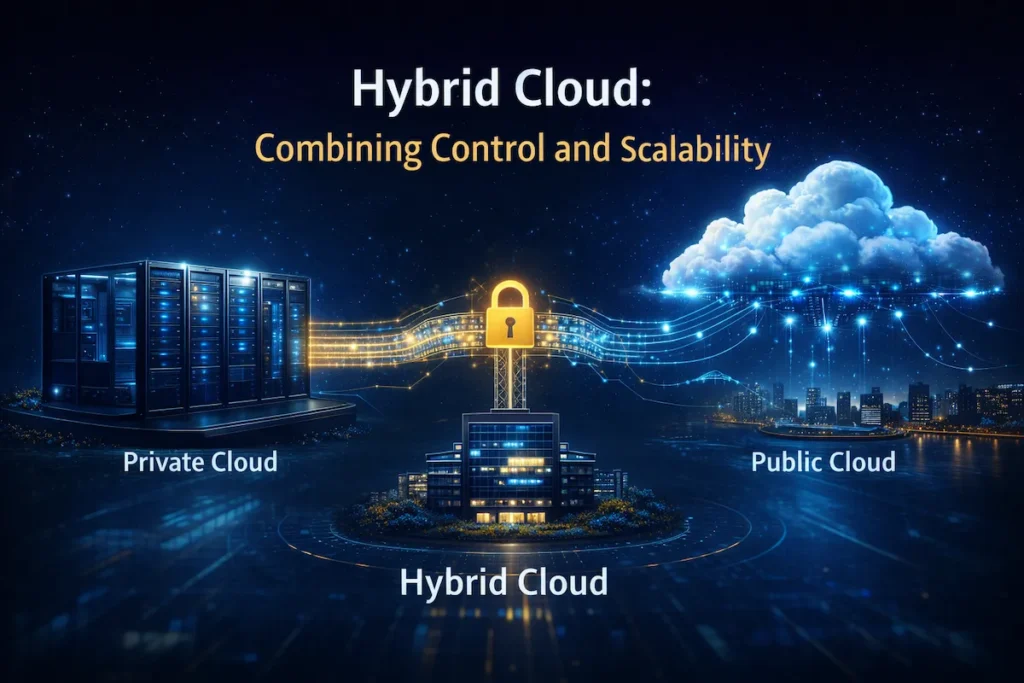
The most sophisticated US enterprises don’t treat private vs public cloud computing as a binary choice — they combine both in a strategically designed hybrid model. Sensitive, regulated workloads stay on private infrastructure. Scalable, customer-facing applications run on public cloud. The two environments connect through secure, low-latency networking layers with unified management and monitoring.
IBM has been a leading advocate of enterprise hybrid cloud solutions, particularly for large organizations navigating legacy infrastructure alongside modern cloud-native application development. IBM’s hybrid approach allows companies to modernize incrementally without abandoning substantial existing infrastructure investments.
In the private vs public cloud computing world, hybrid isn’t a compromise — it’s often the most architecturally sound and financially responsible answer for mid-to-large enterprises. If you’re at the point of evaluating whether to go fully public or blend environments, our detailed hybrid vs public cloud decision guide walks through exactly how to make that call based on your specific workload profile, compliance requirements, and budget reality.
Pros and Cons of Private vs. Public Cloud Computing
| Factor | Private Cloud | Public Cloud |
|---|---|---|
| Cost (Upfront) | High CapEx required | Low / No CapEx |
| Cost (Long-term) | Lower at scale with stable workloads | Can escalate without governance |
| Security Control | Full, direct control | Provider-managed, limited customization |
| Compliance | Easier for strict regulated industries | Achievable but requires careful configuration |
| Scalability | Limited by physical hardware | Near-unlimited, elastic on demand |
| Deployment Speed | Slow — weeks to months | Fast — minutes to hours |
| Maintenance | Full in-house IT responsibility | Provider-managed |
| Customization | High — fully configurable | Moderate — within provider boundaries |
| Performance | Consistent, low-latency | Generally reliable, variable under peak load |
| Disaster Recovery | Requires dedicated planning and investment | Built-in options available from providers |
| Best For | Enterprise, regulated industries | Startups, SaaS, variable or unpredictable workloads |
Frequently Asked Questions
Q: What is the main difference between private and public cloud?
Private cloud is dedicated infrastructure used exclusively by one organization — a single-tenant environment with full control. Public cloud is shared infrastructure managed by a third-party provider, accessed over the internet on a pay-as-you-go model. The key differences are control, cost structure, scalability, and security posture.
Q: Is private cloud more secure than public cloud?
Not automatically. Private cloud gives you more direct control over security configuration, but security outcomes depend entirely on how well you implement and manage those controls. Major public cloud providers maintain security standards — and dedicated security teams — that most mid-size organizations genuinely cannot match in-house.
Q: Which is cheaper — private or public cloud?
It depends on scale and workload predictability. Public cloud is almost always cheaper for startups and small-to-mid-size businesses. Private cloud becomes cost-competitive for large enterprises running consistent, high-volume workloads across a multi-year horizon where CapEx amortizes favorably against ongoing OpEx.
Q: Can a business use both private and public cloud at the same time?
Yes — this is the hybrid cloud model, and it’s increasingly the standard approach for mid-to-large US enterprises. Regulated or sensitive workloads run on private infrastructure. Scalable, customer-facing applications run on public cloud. The environments connect through secure networking with unified monitoring.
Q: What compliance frameworks are easier to meet on private cloud?
HIPAA, FedRAMP, ITAR, and certain government-level frameworks are typically easier to manage on private cloud because your team has direct, demonstrable control over the entire infrastructure stack. SOC 2 Type II compliance, however, is routinely and efficiently achieved on major public cloud platforms.
Final Verdict: Choosing the Right Private vs. Public Cloud Computing Model
There’s no universal winner in the private vs public cloud computing debate. There’s only the right fit for your specific business reality — your workloads, your compliance obligations, your team’s capacity, and your financial position.
Quick decision summary:
- Startup or fast-growing business with limited IT staff? → Start with public cloud. AWS, Azure, or Google Cloud will give you enterprise-grade infrastructure at a fraction of the cost of building your own.
- Enterprise organization in healthcare, finance, or defense with strict compliance requirements? → Private cloud gives you the control and data sovereignty your situation demands.
- Mid-size or large enterprise with a mix of workloads? → Hybrid is almost certainly your answer. Protect sensitive workloads on dedicated infrastructure while leveraging public cloud for scale and speed.
- Unsure where your workloads actually stand? → Audit first. Map workload types, compliance requirements, and cost projections before committing to any model.
Whatever you choose, base the decision on data — your actual workloads, your real compliance requirements, your honest IT capacity, and your true total cost of ownership over a multi-year horizon. Not industry hype. Not what your competitors are doing. What your business actually needs.
Your next step: Download a cloud TCO worksheet, run a 30-day workload audit, or engage a cloud architect for an independent assessment before you sign any infrastructure commitment. The cost of getting this decision right upfront is far lower than the cost of migrating away from the wrong model two years from now.