
Every year, US companies lose billions of dollars — not because their firewalls failed, but because an employee clicked the wrong link. According to IBM’s Cost of a Data Breach Report, human error drives the majority of security incidents. That’s not a technology problem. It’s a people problem.
Cybersecurity awareness for employees is the most direct solution to that problem. It’s not about installing better software or upgrading your infrastructure. It’s about making sure every person in your organization — from the receptionist at the front desk to the VP of Finance — understands how attacks happen, why they’re targeted, and what they can do to stop a breach before it starts.
This guide covers everything US businesses need to build a cybersecurity awareness program that actually changes employee behavior, reduces human error, and protects the bottom line.
What Is Cybersecurity Awareness for Employees?
Cybersecurity awareness for employees is the ongoing practice of educating your workforce to recognize, avoid, and respond correctly to cyber threats in the workplace. It goes well beyond technical controls. Awareness is about behavior — the daily decisions employees make that either protect your data or put it at risk.
Think of it this way: the most sophisticated firewall in the world doesn’t help if an employee holds the door open for a stranger who asked nicely. Technical defenses are the lock. Cybersecurity awareness for employees is the judgment that keeps the door closed.
Why Employees Are the Weakest Security Link in Cybersecurity Awareness for Employees
Attackers have figured out that exploiting people is far easier than breaking through enterprise security systems. Social engineering tactics — especially phishing attacks — bypass technical defenses entirely by targeting human psychology instead. A busy accountant rushing to clear invoices before a deadline doesn’t stop to verify whether an urgent wire transfer request from “the CEO” is legitimate. A customer service rep under pressure doesn’t question why a caller needs account access they can’t verify.
These aren’t failures of intelligence. They’re failures of cybersecurity awareness for employees — and professional attackers count on them. As highlighted in recent major cybersecurity incident analyses from 2026, the overwhelming majority of successful breaches traced back to a single human action that proper awareness training could have prevented.
Cybersecurity Awareness for Employees vs IT Security Training
These two are routinely confused but serve completely different purposes. IT security training is technical — it equips your IT team to configure firewalls, manage patches, and run incident response. Cybersecurity awareness for employees is for everyone in your organization, regardless of their technical role.
Awareness training focuses on recognition, habits, and judgment. You don’t need to teach your HR coordinator how to write a network intrusion detection rule. You do need to teach her not to plug a random USB drive she found in the parking lot into her work laptop.
Why Cybersecurity Awareness for Employees Is Critical in 2025
The threat environment has shifted dramatically. Attackers are faster, more targeted, and better resourced than ever before. Cybersecurity awareness for employees has moved from a compliance checkbox to a strategic business necessity — and the data makes that case clearly.
Rising Cyber Attacks Targeting Employees Demand Stronger Cybersecurity Awareness for Employees
Cybercriminals have learned that targeting individual employees yields faster returns than trying to brute-force enterprise systems. Phishing attacks have grown more sophisticated, with AI-generated messages that are nearly indistinguishable from legitimate communications. Business email compromise (BEC) scams cost US companies over $2.9 billion in 2023 alone, according to the FBI’s Internet Crime Report — and that number has only grown since.
The attacks are also more personalized. Spear phishing — where attackers research a specific employee and craft a message tailored to their role, their manager’s name, or a current project — is now common even against mid-sized businesses. Generative AI has made this kind of targeted content faster and cheaper to produce at scale, a shift explored in depth in this analysis of generative AI’s impact on SEO and intent in 2026. The same AI capabilities that drive business innovation are also supercharging attacker efficiency — which makes cybersecurity awareness for employees more urgent, not less.
Cost of Human Error in Cybersecurity Breaches Makes Cybersecurity Awareness for Employees a Business Priority
Human error in cybersecurity takes many forms: clicking a malicious link, misconfiguring cloud storage and exposing customer records, reusing passwords across personal and work accounts, or sharing sensitive files through an unapproved app because it’s more convenient than the approved channel. Each of these is a documented, recurring cause of breaches across US industries.
According to IBM’s Cost of a Data Breach Report, the average cost of a U.S. data breach continues to exceed $9 million. Verizon’s Data Breach Investigations Report consistently shows that the majority of breaches involve a human element. That math is stark: if your employees aren’t trained, your most expensive security risk isn’t your technology — it’s your workforce.
Strong cybersecurity awareness for employees, combined with solid data protection practices, is one of the highest-ROI investments a business can make. It costs a fraction of what a single breach does, and unlike most technology investments, it improves with time as behavior changes compound.
Remote Work and Increased Security Risks Reinforce the Need for Cybersecurity Awareness for Employees
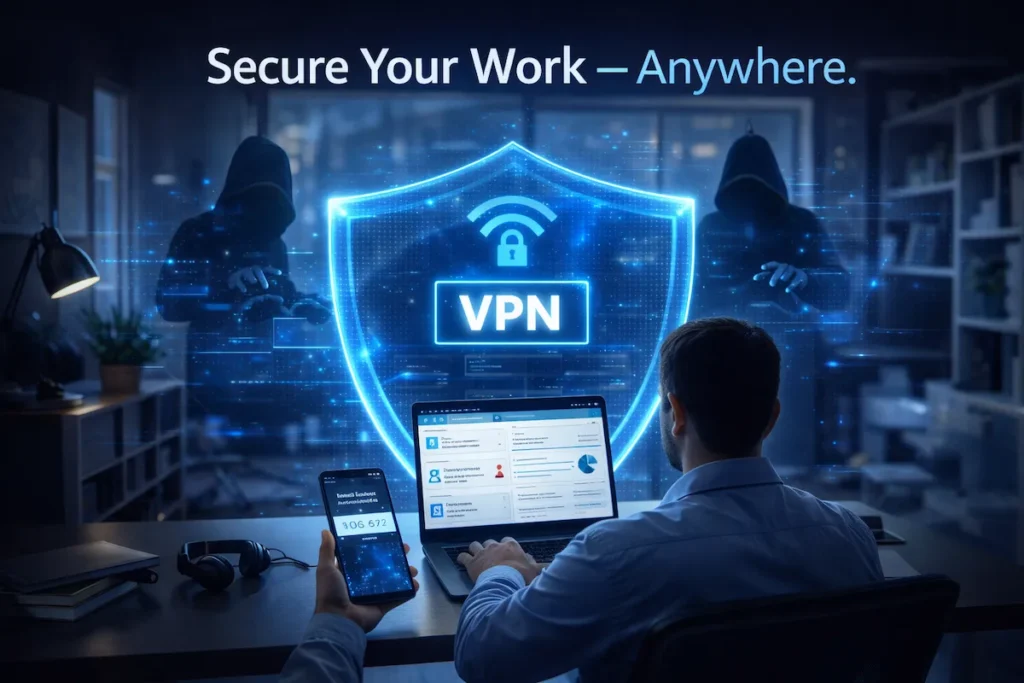
Remote work permanently expanded the attack surface for most US businesses. Employees working from home use personal routers with default passwords, connect to public Wi-Fi at coffee shops and airports, and blur the boundary between personal and professional devices in ways that create real, ongoing exposure.
Without cybersecurity awareness for employees that specifically addresses remote work security risks — separate from office-based policies — you’re trusting that every person working from their kitchen table is making sound security decisions independently. That’s not a strategy. That’s a liability.
Common Cybersecurity Threats Employees Must Know for Effective Cybersecurity Awareness for Employees
Before your workforce can defend against cyber threats in the workplace, they need to know what those threats actually look like on a Tuesday afternoon — not in a theoretical textbook scenario.
Phishing and Social Engineering Attacks Are the Core Focus of Cybersecurity Awareness for Employees
Phishing attacks remain the single most common entry point for data breaches in the US. Employees receive emails that appear to come from trusted sources — a bank, a software vendor, Microsoft, even their own HR department — asking them to click a link, open an attachment, or verify their credentials. Employees should follow best practices outlined in CISA’s phishing prevention guidance, including verifying requests through separate communication channels.
Social engineering goes beyond email. Vishing (voice phishing) involves attackers calling employees and impersonating IT support or company executives. Smishing targets employees through text messages. Pretexting involves fabricating a convincing backstory to extract information. The common thread in all of these is manipulation — exploiting trust, urgency, and authority to get employees to act before they think.
Weak Password Practices Undermine Cybersecurity Awareness for Employees Progress
Weak passwords are a persistent and underappreciated problem in workplace security. Using “Password123,” reusing the same password across work email, banking, and streaming accounts, sharing login credentials with teammates for convenience — each of these habits creates serious vulnerabilities that attackers actively exploit through credential stuffing and brute-force attacks.
Password security needs to be a core pillar of any cybersecurity awareness for employees program. It’s not enough to tell employees to use strong passwords. They need to understand why password reuse is dangerous, how credential stuffing actually works, and what tools — like password managers and MFA — make secure habits easier to maintain.
Malware, Ransomware, and Suspicious Downloads Challenge Cybersecurity Awareness for Employees
Ransomware has shut down hospitals, municipal governments, and small businesses across the US. It typically enters through a single employee decision — opening a malicious email attachment, downloading software from an untrusted website, or clicking through a drive-by download on a compromised page.
Employees need to understand that malware doesn’t announce itself. A suspicious download might look exactly like a legitimate PDF invoice, a software update notification, or a shared file from a colleague’s hacked account. Building the habit of pausing and verifying before downloading is one of the most impactful behavioral changes that cybersecurity awareness for employees training can drive.
Unsafe Use of Public Wi-Fi and Devices Threatens Cybersecurity Awareness for Employees Goals
A sales rep connecting to airport Wi-Fi and accessing the company CRM, or an HR manager reviewing employee records over a hotel network — these are common, real scenarios that create serious exposure. Public networks are frequently unencrypted, making it straightforward for attackers on the same network to intercept unprotected traffic.
The blurring of personal and work devices creates parallel risks. If an employee’s personal phone — used to access work email — gets compromised through a malicious app, company data is exposed through no failure of your IT team. Cybersecurity awareness for employees must address both the physical environment and the devices employees use to work.
Essential Cybersecurity Awareness Topics for Employees to Master
A well-designed cybersecurity awareness for employees program covers these foundational areas — each addressing a documented, high-frequency source of workplace security incidents.
Password Management Best Practices Within Cybersecurity Awareness for Employees
Employees should understand, and actually use, a password manager; create long, unique passphrases for every account; and enable multi-factor authentication (MFA) wherever available. MFA alone dramatically reduces account compromise risk even when passwords are leaked in third-party breaches — which happens routinely, regardless of how careful your employees are with their own credentials.
Make password security concrete in training. Show employees a simulated credential stuffing attack. Let them see how quickly a weak password falls. That kind of demonstration is more effective than any slide deck.
Identifying Phishing Emails and Fake Links Is Central to Cybersecurity Awareness for Employees
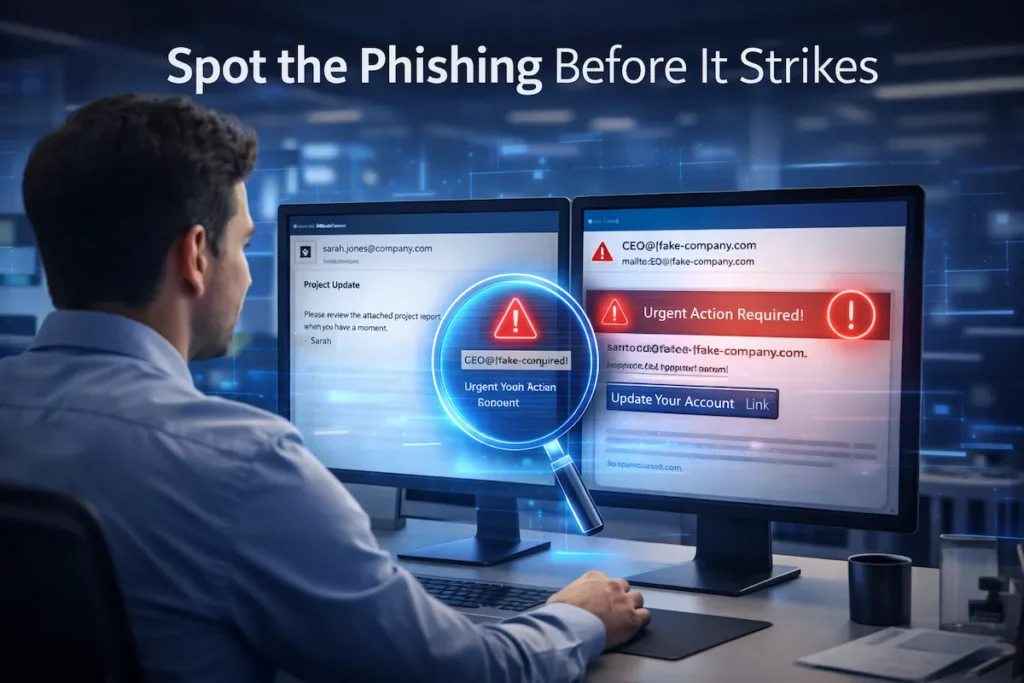
Teach employees to recognize the consistent red flags that appear across phishing attempts: artificial urgency (“Act now or your account will be suspended”), mismatched sender addresses, generic greetings in messages that claim to be personal, and requests for credentials or financial transactions delivered by email.
Show them the hover trick — hovering over a link before clicking reveals the actual destination URL. Teach them to verify suspicious requests through a completely separate channel: if the “CEO” emails asking for an emergency wire transfer, call the CEO on a known number before doing anything else. That one habit has saved companies millions of dollars.
Safe Internet and Email Usage at Work Extends Cybersecurity Awareness for Employees Into Daily Habits
Cybersecurity awareness for employees isn’t just about dramatic attack scenarios. It’s about everyday digital hygiene: not using work email for personal subscriptions, not clicking “unsubscribe” in obvious spam (which can confirm your address is active to spammers), not downloading unapproved software on company devices, and being deliberate about what professional information is shared publicly on LinkedIn or other platforms that attackers use for reconnaissance.
Data Protection and Privacy Responsibilities Are Non-Negotiable in Cybersecurity Awareness for Employees
Every employee who touches customer data, financial records, or confidential business information has a legal and ethical responsibility to protect it — whether or not they work in IT. That means understanding your organization’s data classification system, knowing what can and can’t be shared externally, using encrypted channels for sensitive communications, and properly disposing of physical documents.
This is particularly important for businesses operating in regulated industries. For a deeper look at how data protection applies across cloud environments — which now house most corporate data — this guide on securing data in multi-cloud environments is an essential companion resource for security teams building employee-facing training.
Cybersecurity Awareness Training for Employees: Building an Effective Program
Understanding threats is only half the work. How you structure and deliver training is what converts knowledge into lasting behavioral change — which is the entire point of cybersecurity awareness for employees.
What Makes Effective Employee Cybersecurity Awareness Training
The most effective cybersecurity awareness for employees programs share several characteristics: they’re short and frequent rather than long and annual, scenario-based rather than lecture-based, and connected to real consequences that employees can feel rather than abstract statistics.
Modules that run 10 to 15 minutes — and require active responses, not passive watching — consistently outperform 45-minute compliance sessions. Training that uses realistic simulations, actual workplace scenarios, and immediate debriefs on what happened and why creates memory traces that last. Training that reads like a legal disclaimer is forgotten by the time the employee closes the browser tab.
Online vs In-Person Cybersecurity Awareness Programs for Employees
Both formats contribute meaningfully to a complete cybersecurity awareness for employees strategy. Online training scales efficiently across distributed and remote teams, allows flexible completion, and generates trackable data on completion rates, quiz scores, and phishing simulation results. In-person or live virtual sessions create room for discussion, scenario walkthroughs, and the kind of Q&A that surfaces the real questions employees are afraid to ask in formal settings.
For most US organizations, a blended model delivers the best results: regular online micro-learning modules maintained throughout the year, supplemented by periodic live sessions — especially following significant security incidents, policy changes, or new threat intelligence.
Frequency of Cybersecurity Awareness Training for Employees
Annual training is insufficient. The threat landscape changes too rapidly, and human memory fades too quickly, for once-a-year sessions to have meaningful behavioral impact. Organizations with mature cybersecurity awareness for employees programs train their workforce quarterly at minimum, with monthly micro-learning content and unannounced phishing simulations distributed throughout the calendar year.
Best Practices to Improve Cybersecurity Awareness for Employees Across Your Organization
Training programs are necessary but not sufficient on their own. Cybersecurity awareness for employees needs to be embedded in how your organization operates every single day, not just during scheduled training windows.
Creating a Security-First Culture Anchors Cybersecurity Awareness for Employees
A genuine security awareness culture starts at the leadership level and flows downward through every layer of the organization. When executives follow the same policies they require of their teams — completing training on time, using MFA, not pressuring IT to bypass security controls for convenience — employees internalize the message that security applies to everyone.
Build psychological safety around security reporting. Employees who catch themselves in a near-miss, or who receive a suspicious email and aren’t sure what to do, need to feel completely safe raising that without fear of embarrassment or disciplinary consequences. Organizations that punish mistakes drive them underground. Organizations that reward reporting get better visibility into real threats and faster incident response times.
Regular Security Updates and Awareness Campaigns Sustain Cybersecurity Awareness for Employees
Keep security top of mind between formal training events with regular internal communications: brief email newsletters, Slack updates, digital signage in common areas, or a two-minute security segment in monthly all-hands meetings. When a major new threat emerges — a ransomware variant hitting companies in your sector, a new phishing campaign targeting your industry — communicate proactively with specific, actionable guidance.
Timely, relevant communications around real events are dramatically more memorable than abstract training content delivered on a fixed schedule.
Real-World Cyber Attack Simulations Accelerate Cybersecurity Awareness for Employees
Simulated phishing campaigns are among the highest-value tools available for both measuring and building cybersecurity awareness for employees. Controlled phishing emails sent to your workforce — tracked for click rates, report rates, and non-engagement — provide diagnostic data that reveals exactly where your training needs to focus. They also give employees a low-stakes, no-consequences way to experience a realistic phishing attempt and learn from the outcome.
The goal of simulations is not to catch employees and embarrass them. It’s to close the gap between knowing what a phishing email looks like in training and actually recognizing one in the real inbox on a busy Thursday morning.
Role of Management in Employee Cybersecurity Awareness Programs
Cybersecurity awareness for employees doesn’t sustain itself without active management involvement. IT departments can design excellent programs, but managers drive the adoption, culture, and accountability that make those programs stick. Many U.S. organizations align their security awareness programs with the NIST Cybersecurity Framework to ensure structured risk management.
Leadership Responsibility in Cybersecurity Awareness Training for Employees
Managers should enforce training completion as a business requirement — not an optional activity — and model the secure behavior they expect from their teams. More importantly, they should create the conditions where employees can ask security questions and report mistakes without fear of negative consequences.
Senior leadership needs to understand and communicate clearly that cybersecurity is a business risk issue, not just a technical function. When the CEO discusses a phishing attempt in an all-hands meeting and treats it as a company-wide concern, that signal reaches every level of the organization in a way that no IT announcement ever could.
Cybersecurity Policies Employees Must Follow as Part of Cybersecurity Awareness for Employees
Every organization needs written, accessible, and enforced cybersecurity policies. These include acceptable use policies for company devices and networks, data handling and classification standards, remote work security requirements, incident reporting procedures, and password and authentication requirements.
Policies that employees have never read — or can’t easily locate — don’t influence behavior. Cybersecurity awareness for employees must include explicit training on what the policies are, why they exist, and what the consequences of violating them are. For organizations running on WordPress, having a solid foundation of platform-level security policies is equally important; this complete guide to securing a WordPress site covers the technical side that complements employee-facing policy work.
Measuring the Effectiveness of Cybersecurity Awareness for Employees Programs
You cannot improve what you don’t measure. Strong cybersecurity awareness for employees programs track behavioral outcomes — not just training completion checkboxes.
Employee Security Behavior Metrics That Prove Cybersecurity Awareness for Employees Is Working
The right metrics focus on actual behavior change over time. Phishing simulation click rates trending downward quarter over quarter, percentage of employees correctly reporting suspicious emails, time-to-report for potential security incidents, and MFA adoption rates across the organization — these tell you far more than completion percentages alone.
Break these metrics down by department, office location, tenure, and role. That granularity tells you precisely where your cybersecurity awareness for employees program is succeeding and where you need to redirect investment.
Reducing Human Error Through Cybersecurity Awareness for Employees Training
The most meaningful outcome metric is a documented reduction in human-caused security incidents over time. Track how many incidents in a given period involved employee action as the root cause. Track near-misses where employees correctly identified and reported a threat. Track the time from incident occurrence to internal reporting — faster reporting limits breach scope dramatically.
Well-run cybersecurity awareness for employees programs consistently demonstrate measurable reductions in phishing susceptibility, credential-related incidents, and accidental data exposure within 12 to 18 months of sustained implementation. That’s a return on investment that any CFO can evaluate clearly. Organizations increasingly frame this alongside broader automation and AI ROI analysis — similar to how business leaders are now comparing generative AI ROI versus traditional automation to prioritize where training and technology investments deliver the greatest risk reduction.
Common Mistakes Companies Make in Cybersecurity Awareness for Employees Programs
Many US organizations invest meaningfully in awareness training and still experience preventable breaches. Often, the root cause is one of these recurring program design failures.
One-Time Training Programs Undermine Cybersecurity Awareness for Employees Results
Annual compliance training that employees rush through to get a green checkmark is one of the most common and expensive mistakes in data breach prevention. Without reinforcement, people forget. Without repeated exposure to realistic scenarios, behavior doesn’t change. Treating cybersecurity awareness for employees as a one-time annual event rather than a continuous program is the single most common reason training investments fail to reduce incidents.
Ignoring Non-Technical Employees Weakens Cybersecurity Awareness for Employees Coverage
IT staff and developers tend to receive the most security attention — and they need it. But cybersecurity awareness for employees must reach the full workforce: receptionists, HR coordinators, accounting staff, operations managers, and executives. Attackers don’t filter targets by job title.
In fact, administrative assistants with broad access to executive calendars, financial systems, and sensitive communications are prime targets for social engineering. So are employees in finance, who receive payment requests. And senior executives, who are targeted in whale phishing attacks specifically because of their authority and access levels.
No Real-World Testing Leaves Cybersecurity Awareness for Employees Unvalidated
Training without testing is guessing. Without phishing simulations, tabletop incident response exercises, and periodic security drills, you have no empirical way of knowing whether employees can apply what they’ve learned when it actually matters.
Real-world testing reveals gaps that surveys and quiz scores miss. It gives employees a safe environment to experience and recover from a realistic attack scenario. And it provides the data you need to continuously improve your cybersecurity awareness for employees program in response to actual organizational vulnerabilities — not assumed ones.
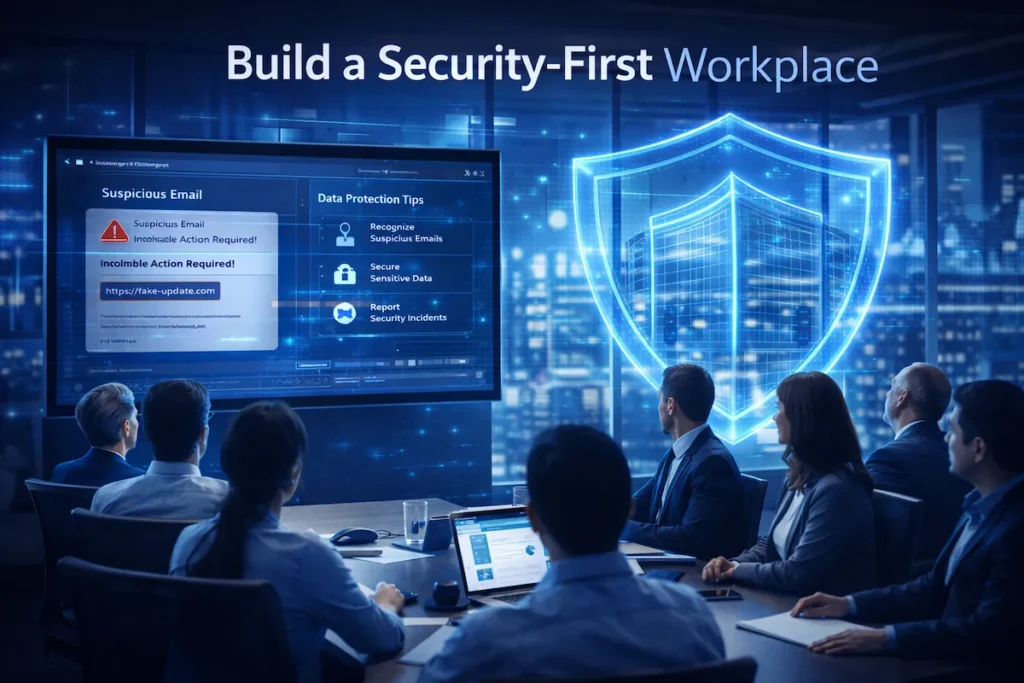
Frequently Asked Questions About Cybersecurity Awareness for Employees
Q1. What is the main goal of cybersecurity awareness for employees?
The goal of cybersecurity awareness for employees is to reduce human error by training staff to recognize threats and respond correctly. It turns your workforce from a vulnerability into a first line of defense.
Q2. How often should employees receive cybersecurity training?
Annual training is not enough. Most experts recommend quarterly modules, monthly micro-learning content, and periodic unannounced phishing simulations to keep security habits sharp year-round.
Q3. What are the most common cyber threats employees face at work?
Phishing attacks, weak passwords, ransomware through malicious downloads, and unsafe public Wi-Fi use are the most frequent threats. All of them are preventable with consistent awareness training.
Q4. Why do small and mid-sized US businesses need cybersecurity awareness programs?
Attackers frequently target smaller businesses assuming weaker defenses. Cybersecurity awareness for employees is one of the most cost-effective ways to close that gap and avoid costly breach recovery expenses.
Q5. Does cybersecurity awareness training actually reduce data breaches?
Yes — measurably. Organizations with active cybersecurity awareness for employees programs report lower phishing click rates and fewer human-caused incidents over time. Verizon’s research shows human error drives 74% of breaches, meaning training directly reduces that risk.
Q6. What topics should a cybersecurity awareness program cover?
Core topics include phishing recognition, password security, MFA, safe email and internet habits, data protection responsibilities, and incident reporting procedures. The mix should reflect your industry and the data your employees handle daily.
Q7. How do you measure whether cybersecurity awareness training is working?
Track phishing simulation click rates, suspicious email report rates, and MFA adoption — not just training completion. Cybersecurity awareness for employees is working when those behavioral metrics improve consistently over time.
Q8. Who is responsible for employee cybersecurity awareness in a company?
It’s a shared responsibility. IT designs the program, managers enforce participation, HR embeds it in onboarding, and leadership sets the cultural tone. Security works best when every level of the organization owns it.
Conclusion — Building Long-Term Cybersecurity Awareness for Employees
Cybersecurity awareness for employees is not a project you complete and archive. It’s a capability you build continuously — one that strengthens as your workforce develops security instincts, improves judgment under pressure, and begins to look out for each other in ways no software can replicate.
The organizations that consistently avoid costly breaches aren’t always the ones with the biggest security budgets or the most sophisticated technology stacks. They’re the ones where every employee — from the newest hire on their first week to the CEO in the boardroom — understands that their individual decisions directly affect the security of the entire company.
As regulatory pressure around data protection continues to intensify across US industries in 2025 and beyond, companies that treat cybersecurity awareness for employees as a strategic business investment — not a compliance task — will consistently outperform peers in breach resilience, customer trust, and regulatory standing. The financial case is equally clear: a single prevented breach typically delivers returns that dwarf the cost of years of ongoing awareness training.
Start with the fundamentals: clear and accessible policies, relevant and scenario-based training, realistic simulations, and leadership that models the behavior it expects from the workforce. Measure outcomes rigorously. Adjust based on what the data tells you. And make security a permanent, visible part of your organizational culture.
That’s how cybersecurity awareness for employees becomes one of your most durable competitive advantages — because in an environment where every organization is a potential target, the ones that invest seriously in their people are the hardest ones to breach.