

The US IT services market is undergoing a permanent structural shift — from hardware-based contracts to recurring cloud revenue. Businesses that miss this transition don’t just fall behind; they become irrelevant. For founders and IT professionals paying attention, the cloud computing business represents one of the most accessible and scalable opportunities in the American technology market today.
US cloud spending has continued to grow strongly year over year, According to industry analyst reports such as Gartner, enterprise cloud investment continues to expand across sectors. That growth isn’t concentrated in Silicon Valley — it’s happening across mid-size companies in Ohio, healthcare networks in Texas, logistics firms in Georgia, and law offices in New York. Every one of those businesses needs cloud expertise they don’t have in-house.
This guide is written specifically for US-based entrepreneurs, startup founders, and IT professionals who are serious about building a profitable cloud computing business in 2026. No fluff. Just what works.
What Is a Cloud Computing Business?
A cloud computing business delivers IT resources — servers, storage, software, or development platforms — over the internet instead of through physical hardware sitting in a client’s building. Rather than selling one-time hardware or setup services, these companies generate recurring revenue by giving clients ongoing, managed access to computing infrastructure.
Here’s how it works in practice: you either build cloud infrastructure directly, resell cloud capacity from major providers like AWS or Microsoft Azure, or offer specialized services on top of existing cloud platforms. Clients pay monthly, annually, or based on usage. You manage the environment. They focus on their core business.
How this differs from traditional IT companies:
- Traditional IT companies sell hardware, software licenses, or one-time implementation projects
- A cloud computing business sells ongoing access, management, and development—with predictable recurring revenue
- Delivery is remote and scalable—you can serve clients in multiple states without expanding headcount proportionally
- Subscription-based revenue creates higher company valuations than project-based IT firms
One of the most critical distinctions for US founders: a cloud computing business shifts client IT spending from capital expenditure (buying servers) to operating expenditure (paying monthly). CFOs prefer that model — which makes selling cloud services considerably easier than selling hardware in 2026.
Before building your cloud strategy, it pays to understand one foundational infrastructure question your clients will always raise: private vs. public cloud—which model actually fits their business. Knowing the answer positions you as an advisor, not just a vendor.
Types of Cloud Computing Business Models
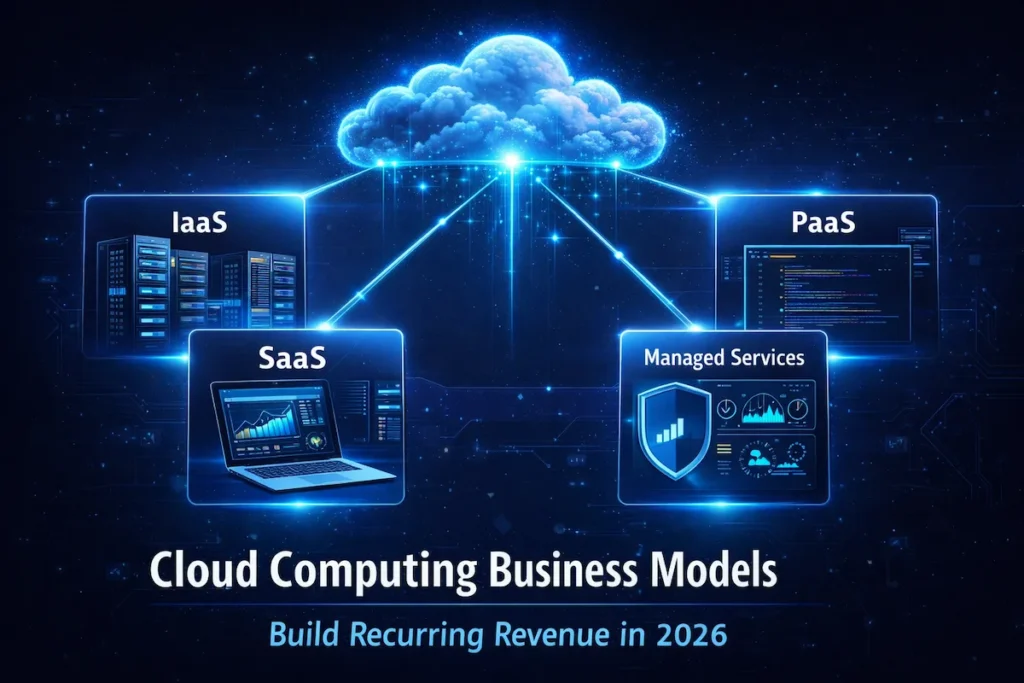
There are five distinct ways to build a cloud computing business. Each has different startup requirements, margin profiles, and revenue potential. Understanding them helps you choose where to compete.
Infrastructure as a Service (IaaS) in a Cloud Computing Business
IaaS providers deliver virtualized computing resources — servers, storage, and networking — over the internet. The client manages their own operating systems and applications; the IaaS provider manages the underlying infrastructure.
Revenue potential: High but capital-intensive at the hyperscale level. There is, however, a strong mid-market opportunity for specialized IaaS providers targeting specific US industries like healthcare, legal, or financial services.
US use cases: Startups needing flexible compute capacity without upfront hardware investment; enterprises running disaster recovery environments; media companies handling variable workloads during peak events.
Most new cloud computing businesses won’t build IaaS from scratch — they’ll resell AWS, Azure, or Google Cloud capacity with value-added management and support layered on top.
Platform as a Service (PaaS) in a Cloud Computing Business
A PaaS cloud computing business provides a development environment in the cloud. Developers build and deploy applications without managing underlying servers or networking. Your role is to provide the platform and keep it stable.
Revenue potential: Moderate to high, especially when targeting niche developer communities or specific tech stacks. DevOps-focused PaaS businesses serving US software companies can build strong recurring revenue lines.
US use cases: SaaS startups that want to deploy faster without managing cloud infrastructure; enterprise app development teams on tight release schedules; companies running containerized workloads via Kubernetes.
Software as a Service (SaaS) in a Cloud Computing Business
SaaS is the most recognized cloud computing business model in the US. You build software and deliver it over the internet on a subscription basis. The client never installs anything — they log in and use it.
Revenue potential: Very high with strong unit economics once you achieve product-market fit. Subscription revenue compounds well and makes SaaS companies among the highest-valued businesses in the technology sector.
US use cases: Every major industry has deep SaaS penetration—healthcare, legal, construction, logistics, retail, and finance. Niche SaaS tools serving underserved verticals often face less competition and command higher willingness to pay.
Managed Cloud Service Providers as a Cloud Computing Business
A managed service provider (MSP) handles a client’s cloud environment on their behalf—monitoring, managing, optimizing, and securing it around the clock. The client gets enterprise-grade management without hiring a full internal IT team.
Revenue potential: Steady and highly recurring. US MSP monthly retainers typically range from $1,500 to $20,000+ depending on environment complexity and client size. Churn is low because switching costs are high.
US use cases: SMBs with 10–200 employees that use cloud services but lack internal IT expertise; mid-market companies that need 24/7 monitoring without the overhead of a full internal team.
One of the fastest-growing MSP revenue lines is cloud cost management. As client cloud bills grow, controlling spend becomes a priority—and clients will pay specifically for this capability. Understanding cloud cost optimization strategies is a direct service you can offer from day one.
Cloud Consulting and Migration as a Cloud Computing Business
Cloud migration and consulting firms help businesses move from on-premise infrastructure to the cloud or transition between providers. You assess the client environment, design a cloud architecture, and execute the migration.
Revenue potential: Project-based but high per engagement. US cloud migration projects range from $25,000 for small business environments to several million dollars for full enterprise migrations. Post-migration managed services contracts extend revenue significantly.
US use cases: Legacy enterprises decommissioning old data centers; companies switching providers to reduce costs; organizations evaluating a hybrid cloud vs. a public cloud approach—one of the most common consulting engagements in the market right now.
Why the Cloud Computing Business Is Growing Rapidly in the United States
The cloud computing business continues to expand because of structural shifts in how American companies operate — and those shifts have proven durable.
Remote work has held sway across most industries. Since 2020, distributed teams have remained standard across US businesses of all sizes. Cloud infrastructure is now required to function, not optional to explore. Companies that haven’t moved workloads to the cloud are actively behind, and they need outside expertise to catch up.
AI is driving cloud demand at an accelerating pace. Every company exploring machine learning, generative AI, or large-scale data analytics needs cloud computing power. Training models and processing data at scale requires infrastructure that most businesses can’t build or manage themselves. AI growth is a sustained tailwind for any cloud computing business with the right capabilities.
SME adoption continues to accelerate across sectors. Small and medium-sized businesses in the US once saw cloud services as complex and expensive. That perception has shifted significantly. Simplified platforms and affordable managed services have brought millions of SMEs into the cloud ecosystem — and the majority need service providers to manage the transition and ongoing operations.
Digital transformation remains budget-backed and ongoing. Healthcare systems, law firms, manufacturers, and retailers are all modernizing infrastructure. Digital transformation spending across US enterprises has remained a priority budget line through economic cycles, and it almost always includes cloud migration and cloud management as core components.
Cybersecurity pressure is pushing more businesses to the cloud. On-premise security is increasingly difficult and expensive to maintain. Cloud providers offer enterprise-grade security features and compliance certifications that small businesses couldn’t afford to build independently — and that gap creates a consistent, repeatable sales argument for cloud services.
How to Start a Cloud Computing Business in the US (Step-by-Step Guide)
Starting a cloud computing business takes more than technical skills. It requires clear positioning, a solid legal foundation, and a realistic go-to-market strategy. Here’s what actually needs to happen.
Choosing a Profitable Niche in a Cloud Computing Business
Don’t compete with AWS or Azure on breadth. The cloud computing businesses winning in the US right now are specialists, not generalists. The most profitable niches in 2026 include:
- Healthcare cloud services: HIPAA-compliant environments, EHR migrations, telehealth infrastructure
- Legal tech cloud: Document management, compliance workflows, e-discovery platforms
- Retail and e-commerce: Scalable infrastructure for seasonal traffic spikes, inventory systems
- Financial services: SOC 2-compliant environments, data security, regulatory reporting
- Construction and trades: Vertical SaaS tools for field operations and project management
Your niche determines your marketing, pricing, partner relationships, and hiring. Generalist cloud companies compete on price. Specialists compete on expertise — and win on margin.
Targeting the Right US Market Segment
Niche tells you what problem you solve. Market segment tells you who you’re selling to. In the cloud computing business, the right segment shapes your entire sales model.
- SMBs (10–200 employees): Faster to close, lower contract values ($500–$3,000/month), but high volume potential and low churn when managed well
- Mid-market (200–1,000 employees): Longer sales cycles (2–4 months), but contracts of $5,000–$25,000/month are common and defensible
- Enterprise (1,000+ employees): Longest cycles (6–18 months), highest revenue, but requires established credibility and reference clients
Most cloud computing businesses should start with SMB or mid-market clients to build case studies, then move upmarket as credibility and team capacity grows.
Building Technical Expertise for a Cloud Computing Business
Certifications are non-negotiable in the US cloud market. Clients — especially in regulated industries — will ask directly about your team’s credentials before signing.
Certifications that carry the most weight in 2026:
- AWS Certified Solutions Architect (Professional level for senior engagements)
- Microsoft Azure Administrator / Solutions Architect Expert
- Google Cloud Professional Cloud Architect
- CompTIA Cloud+ (solid entry-level foundation)
- CISSP or CCSP for security-focused service lines
If you’re a solo founder, get at least one major platform certification before your first pitch. If you’re building a team, make certifications a hiring requirement from day one.
Partnering with Major Cloud Providers
Becoming a registered partner with AWS, Azure, or Google Cloud gives you access to co-selling opportunities, deal registration, technical support resources, and sales materials — most at no cost at the entry level.
- AWS Partner Network (APN): Strong for MSPs and consulting firms serving US businesses of all sizes
- Microsoft Cloud Partner Program: Best reach for mid-market clients running Microsoft 365 environments
- Google Cloud Partner Advantage: Optimal if your clients are data-heavy or running Google Workspace
Partner status adds sales credibility and gives you access to resources you’d otherwise spend months building independently.
Pricing Strategy for a Cloud Computing Business
Pricing is where most new cloud computing businesses lose money — usually by underpricing early to win clients, then struggling to raise rates later.
Match pricing to your delivery model:
- MSP retainers: Flat monthly fee based on user count, server count, or environment complexity
- Consulting and migration: Fixed-price after a paid scoping engagement (never scope for free)
- SaaS: Per-seat monthly subscriptions with annual contract discounts
- Hybrid pricing: Base retainer plus usage-based overage charges
The fastest path to pricing confidence is productizing your services. Define exactly what’s included at each tier, put a clear number on it, and stop negotiating scope without adjusting price.
Legal, Compliance, and Licensing in the US
Before you sign your first client contract, get the legal foundation right:
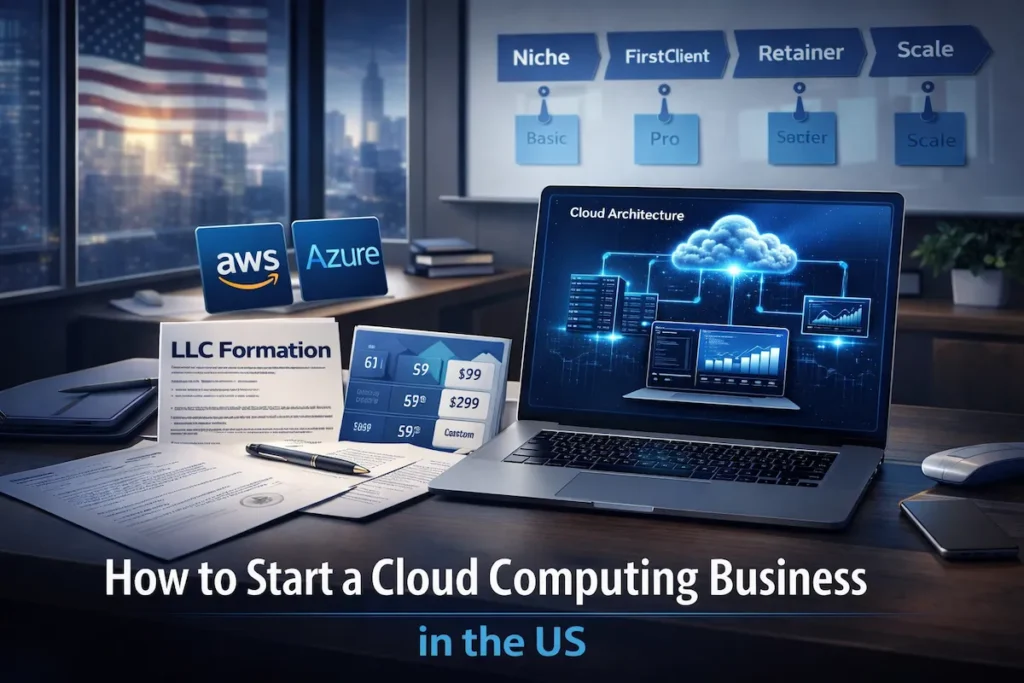
- Business entity: Form an LLC or C-Corp. C-Corp is better if you plan to raise venture funding
- Insurance: Minimum $1M general liability plus Errors & Omissions (E&O) coverage — E&O is essential for any cloud business
- Contracts: Have a US-based tech attorney draft your Master Service Agreement (MSA) and Statement of Work (SOW) templates
- HIPAA compliance: Required for any healthcare clients — no exceptions
- SOC 2 certification: Will come up early with enterprise prospects even if you’re not yet certified; have a roadmap ready
- PCI-DSS: If you touch payment data in any client environment, expect detailed PCI questions
- State data laws: California’s CCPA is the most demanding; know your obligations by state before you sign clients there
Legal setup is not where you cut corners. A solid MSA protects you when client relationships go sideways — and eventually, one will.
Marketing Strategy for a Cloud Computing Business
The most effective marketing channels for a US cloud computing business in 2026:
- LinkedIn: Organic content targeting CTOs, IT directors, and operations managers; paid retargeting for warm audiences
- SEO and content marketing: Long-form guides and technical articles targeting search queries your ideal clients use — a long-term asset that compounds over time
- Referral partnerships: IT consultants, managed print providers, VoIP companies, and business accountants all serve SMBs and can consistently refer cloud clients
- Cold outbound: Targeted email sequences to companies in your niche vertical — segment tightly, personalize deliberately
- Webinars and live demos: Especially effective for SaaS and MSP models where a live walkthrough closes deals faster than any content
Don’t invest heavily in Google Ads until you have a proven sales conversation that converts consistently. Start with referrals and organic, use paid to scale what’s already working.
Go-to-Market Example: First 3 Clients Plan (US SMB MSP)
Week 1: Finalize your niche and productize your service into 2–3 clear tiers with defined pricing
Week 2: Outreach — LinkedIn DMs to IT decision-makers in your niche + email to warm contacts
Week 3–4: Run discovery calls + offer a paid 2-hour cloud assessment ($300–$500)
Close: Convert the assessment into a 6-month retainer with a 90-day onboarding roadmap included
That first client funds your certifications. The second client funds your tools. The third gives you enough revenue to hire your first contractor.
Best Cloud Platforms to Build a Cloud Computing Business On
Platform choice shapes your technical capabilities, partner ecosystem access, and market positioning as a cloud computing business.
Amazon Web Services (AWS) is the largest and most feature-rich platform in the market. It’s the safest foundation for US businesses targeting enterprise clients. The partner ecosystem is the deepest, documentation is extensive, and client demand is higher than any other platform.
Microsoft Azure is the strongest option for clients running Microsoft 365 and Windows Server environments — which describes the majority of US mid-market and enterprise companies. Azure’s hybrid cloud capabilities are industry-leading and create significant consulting opportunity for cloud businesses that bridge on-premise and cloud workloads. If you’re deciding which environments your clients should run where, the hybrid cloud vs. public cloud decision guide is worth reviewing before recommending an architecture.
Google Cloud Platform (GCP) leads in data analytics, machine learning infrastructure, and Kubernetes-native workloads. If your cloud computing business targets clients building AI-powered applications or running large-scale data pipelines, GCP specialization creates real differentiation.
IBM Cloud serves heavily regulated industries — banking, insurance, federal government. Contracts tend to be large, long-term, and sticky. Not the fastest-growing platform, but highly valuable in specific verticals.
Oracle Cloud is the natural choice for enterprises running Oracle databases, ERP systems, or JD Edwards. If you target manufacturing, distribution, or retail enterprises with Oracle infrastructure, this is a defensible niche.
For most new cloud computing businesses in the US, AWS or Azure provides the lowest-risk path to early client revenue and meaningful partner resources.
Revenue Models in a Cloud Computing Business
How you charge clients determines cash flow predictability, scalability, and business valuation. The strongest cloud computing businesses layer multiple revenue streams intentionally.
- Subscription model: Fixed monthly fee for software access or ongoing services. Predictable, investor-friendly, and scales without proportional cost increases
- Pay-as-you-go: Clients pay based on actual resource consumption. Common in IaaS and SaaS — works well for variable or seasonal workloads
- Managed service retainers: Fixed monthly fee for ongoing cloud environment management. Highest client retention due to switching costs and operational dependency
- Hybrid pricing: Combines a base retainer with usage-based overage charges. Common in MSP businesses managing dynamic environments
- Enterprise contracts: Multi-year deals with fixed pricing, defined SLAs, and dedicated resources. Highest revenue per client; requires proven track record to close
The most resilient cloud computing businesses use retainers as their revenue foundation and project work as a growth driver. Retainers provide stable cash flow; projects convert to long-term management contracts.
Startup Costs and Investment Required for a Cloud Computing Business
Here are realistic cost ranges for launching a cloud computing business in the US — actual market-rate figures, not best-case estimates.
| Category | Estimated Cost (US) |
|---|---|
| Business formation (LLC or C-Corp) | $500 – $2,000 |
| Legal fees (MSA, SOW templates, attorney review) | $2,000 – $5,000 |
| Cloud certifications (per person) | $300 – $1,500 |
| Cloud platform tools and test environments | $500 – $3,000/month |
| Business insurance (GL + E&O) | $2,000 – $5,000/year |
| Website and brand identity | $2,000 – $8,000 |
| CRM and sales tools | $100 – $500/month |
| Marketing (first 6 months) | $5,000 – $20,000 |
| Initial staffing or contractors | $5,000 – $30,000 |
| Total Estimated Startup Cost | $15,000 – $70,000 |
Solo consultants can launch a cloud computing business for under $20,000. Building a team-based MSP or SaaS operation from day one typically requires $50,000–$100,000 to establish properly. Do not cut corners on legal, insurance, or certifications — the cost of fixing those gaps later is always higher.
Part of running a sustainable cloud computing business is also controlling your own platform costs. Applying cloud cost optimization strategies to your own tools and client environments improves margins and creates a billable service line simultaneously.
Common Mistakes in a Cloud Computing Business
Most early-stage cloud computing businesses don’t fail because of bad technology decisions. They fail from operational and strategic mistakes that are entirely avoidable.
Competing on price. Discounting to win early clients sets a pricing precedent that’s nearly impossible to reverse. Compete on specialization and documented results instead.
Overhiring too early. Landing a large client triggers the impulse to hire. If that client churns or delays onboarding, payroll becomes a crisis fast. Build with contractors until revenue is consistent and proven.
Not productizing services. Selling “whatever the client needs” without a defined scope leads to creep, underpricing, and team burnout. Package services into clear tiers with defined deliverables and stick to them.
Ignoring documentation. Cloud environment documentation is a business asset. Poor documentation increases operational risk, makes client transitions costly, and exposes you to direct liability when things go wrong.
Building single-platform expertise only. Clients have diverse environments. If your team only knows AWS and a prospect runs Azure, you lose the deal. Build at least two-platform competency early on.
Underestimating multi-cloud security complexity. As clients expand across platforms, security gaps multiply in ways that aren’t always obvious. Understanding how to secure data in multi-cloud environments is a core service competency — and a direct liability shield for your business.
Major Challenges in a Cloud Computing Business
Competition is intense at every level. AWS, Google, and Microsoft all have their own managed service and consulting arms. Boutique MSPs compete on responsiveness and relationships. You need a clear differentiation — industry specialization, vertical expertise, or demonstrably faster response times — to win consistently.
Security risks are ongoing. You’re handling client infrastructure and often sensitive data. A single breach can result in client loss, litigation, and lasting reputational damage. Cybersecurity is a foundational operating standard, not a feature you add later. Managing exposure across multi-cloud deployments requires specific, documented expertise in securing data across cloud environments.
Compliance requirements are complex and evolving. US cloud businesses working across industries contend with HIPAA, SOC 2, PCI-DSS, CCPA, and state-specific data laws. Staying current requires ongoing investment in both legal counsel and technical controls.
Client acquisition cost is high. Enterprise deals take 6–12 months to close. Mid-market deals take 2–4 months. Build your runway accordingly and maintain a pipeline of 3–5x your revenue target to account for deals that fall through or delay.
Scalability pressure grows with revenue. As you win more clients, operational complexity increases faster than headcount. Processes, automation, PSA software, and clear escalation paths need to be built early — not retrofitted when you’re managing 30+ clients.
Cloud Computing Business vs. Traditional IT Business
| Factor | Cloud Computing Business | Traditional IT Business |
|---|---|---|
| Revenue model | Recurring (subscription / retainer) | Project-based or one-time |
| Scalability | High — remote delivery model | Limited by on-site headcount |
| Startup cost | Moderate | Higher (hardware, inventory) |
| Gross margins | 30–70% | 10–30% |
| Client retention | High (switching costs) | Variable |
| Growth potential | Very high | Moderate |
| Remote delivery | Standard | Mostly on-site |
| Valuation multiple | 4–10x revenue | 1–2x revenue |
The financial case for building a cloud computing business over a traditional IT firm is clear. Recurring revenue creates predictable cash flow, and higher valuation multiples matter significantly if you plan to raise capital or exit.
Future Trends Shaping the Cloud Computing Business in 2026
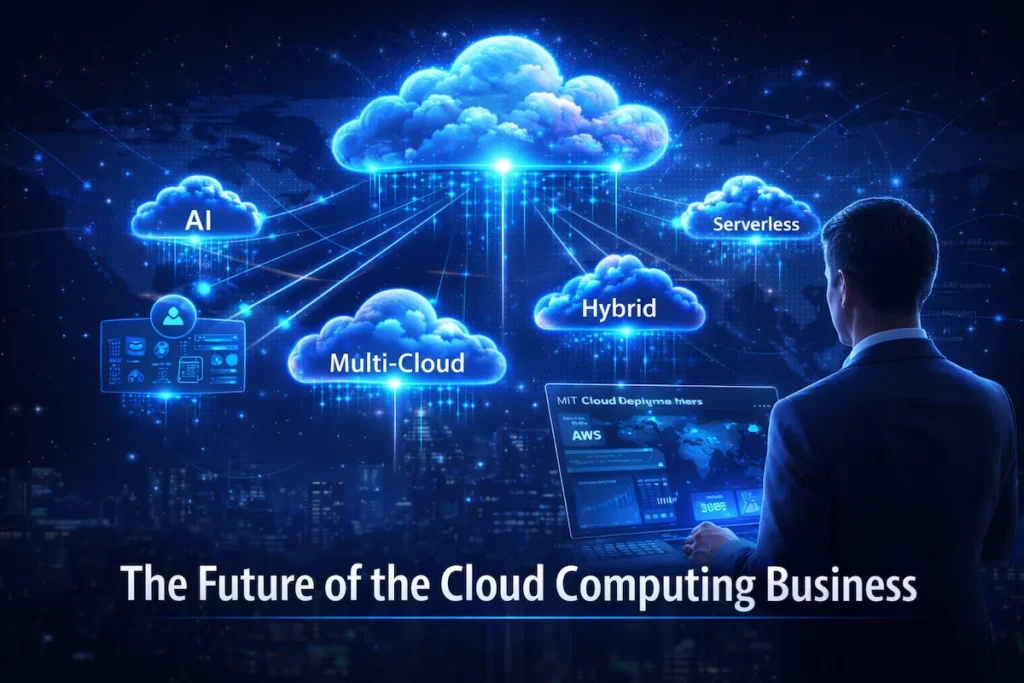
AI integration is the most significant new revenue opportunity in the cloud computing business right now. Cloud providers are embedding AI capabilities directly into their platforms, and most US businesses lack the internal expertise to implement them effectively. AI consulting and AI-ready infrastructure management are among the fastest-growing cloud service lines in 2026.
Edge computing is expanding as IoT devices multiply and latency-sensitive applications grow across manufacturing, retail, and healthcare. Computing is moving closer to the data source — and cloud businesses with edge expertise are positioned well for these emerging contracts.
Multi-cloud deployment has become standard among US enterprise clients. Most large organizations now use two or more cloud providers to avoid vendor lock-in and manage costs. Managing these environments requires specialized expertise that commands premium rates.
Hybrid cloud strategy continues to matter for enterprises that cannot fully exit on-premise infrastructure due to compliance, latency, or legacy application requirements. Understanding when a client should stay private, go fully public, or run a hybrid model is a core advisory competency — and knowing how private and public cloud environments compare gives you a real consulting advantage.
Serverless computing is maturing. More development teams are building serverless-first applications to reduce operational overhead and improve cost efficiency. Understanding serverless architecture and its pricing implications is becoming a standard expectation for US cloud architects.
Cloud storage diversification is accelerating as companies reconsider their storage strategies for cost and compliance reasons. Knowing the landscape of cloud storage alternatives and how to evaluate them helps position your cloud computing business as a trusted strategic advisor rather than just a managed service vendor.
Is a Cloud Computing Business Profitable in 2026?
es — for founders who specialize, execute consistently, and price their services correctly.
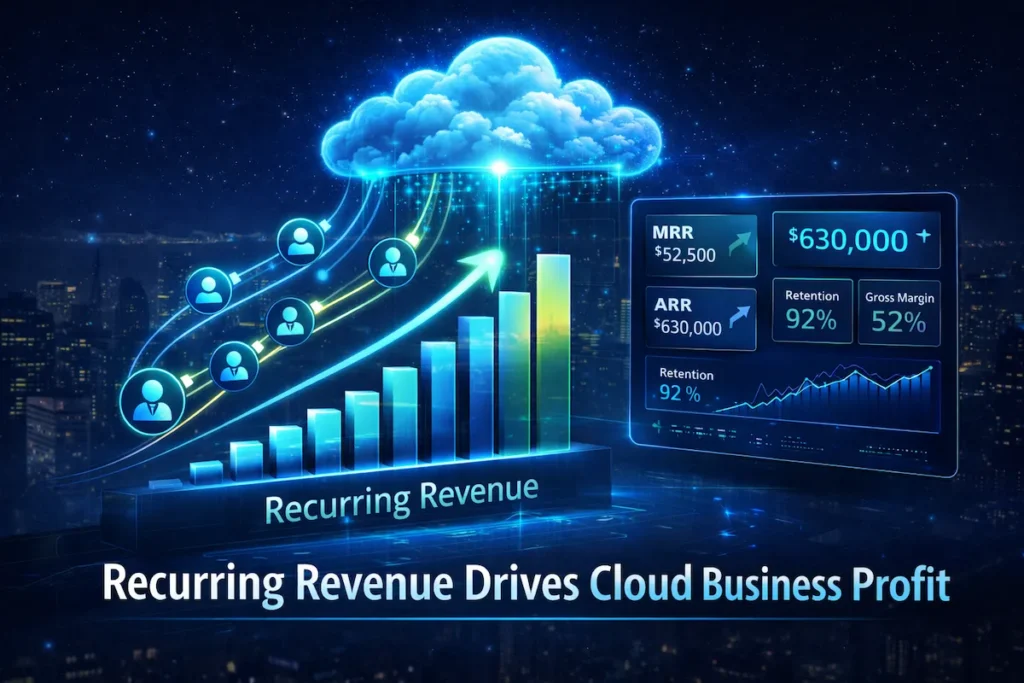
Here’s a realistic profitability snapshot for a US-based managed cloud services business in year two:
- 15 clients at an average of $3,500/month in retainers = $52,500/month gross revenue
- Labor and platform tool costs: approximately $25,000/month
- Gross margin: approximately 52%
- Annual gross revenue: approximately $630,000
- Net profit after overhead: $150,000–$200,000
SaaS businesses in the cloud computing space take longer to reach profitability but scale more efficiently once traction is established. A focused niche SaaS product with strong retention can reach $1M ARR within 18–24 months of launch with the right go-to-market approach.
The cloud computing businesses that fail aren’t failing because the market isn’t there. They fail because of poor niche selection, premature scaling, underpriced services, or lack of operational structure. The market is sound. Execution is the differentiator.
Frequently Asked Questions
Q: How much does it cost to start a cloud computing business in the US?
Most founders can launch a cloud consulting or MSP business for $15,000–$50,000. SaaS startups require more — typically $50,000–$200,000 depending on product complexity, development costs, and go-to-market investment.
Q: Do I need technical certifications to start a cloud computing business?
Yes — especially for MSP and consulting models. AWS, Azure, and Google Cloud certifications are expected by US clients and are often required to win contracts in regulated industries like healthcare and finance.
Q: Which cloud computing business model is most profitable for beginners?
Managed cloud services (MSP) and cloud migration consulting are the most accessible entry points. They require lower upfront investment than building a SaaS product and generate revenue faster — typically within 60–90 days for well-positioned consultants with an established niche.
Q: What certifications do I need to start a cloud computing business?
Start with AWS Certified Solutions Architect or Microsoft Azure Administrator — these carry the most weight with US clients. Add Google Cloud credentials if your niche is data-heavy. Prioritize the platform your target clients already use.
Q: Is a cloud computing business viable without a large team?
Yes. Many profitable US cloud consulting and MSP businesses run with 1–3 people in their first two years. Start solo or with one contractor, productize your services tightly, and hire only when a specific revenue threshold is consistently hit.
Q: How long does it take to land the first client in a cloud computing business?
Most focused founders close their first client within 60–90 days of launch. The fastest path is warm referrals from existing professional contacts, not cold outreach. A paid assessment offer ($300–$500) removes the barrier better than a free consultation.
Q: Do I need to build my own infrastructure to run a cloud computing business?
No — and most successful US cloud businesses don’t. You resell and manage capacity from AWS, Azure, or Google Cloud, layering your expertise and support on top. Building your own infrastructure only makes sense at significant scale with very specific use cases.
Conclusion
The cloud computing business represents one of the strongest opportunities available to US technology entrepreneurs in 2026. Market demand is real, margins are strong, and the recurring revenue model creates durable enterprise value that traditional IT businesses simply can’t match.
The path is clear: pick a niche, get certified, build the right legal and operational foundation, partner with major cloud platforms, and deliver consistent results for clients. The cloud computing business rewards specialists who understand their market deeply — not generalists competing on price.
If you’re building a cloud computing business in 2026, the demand is there. What’s left is positioning and execution.