
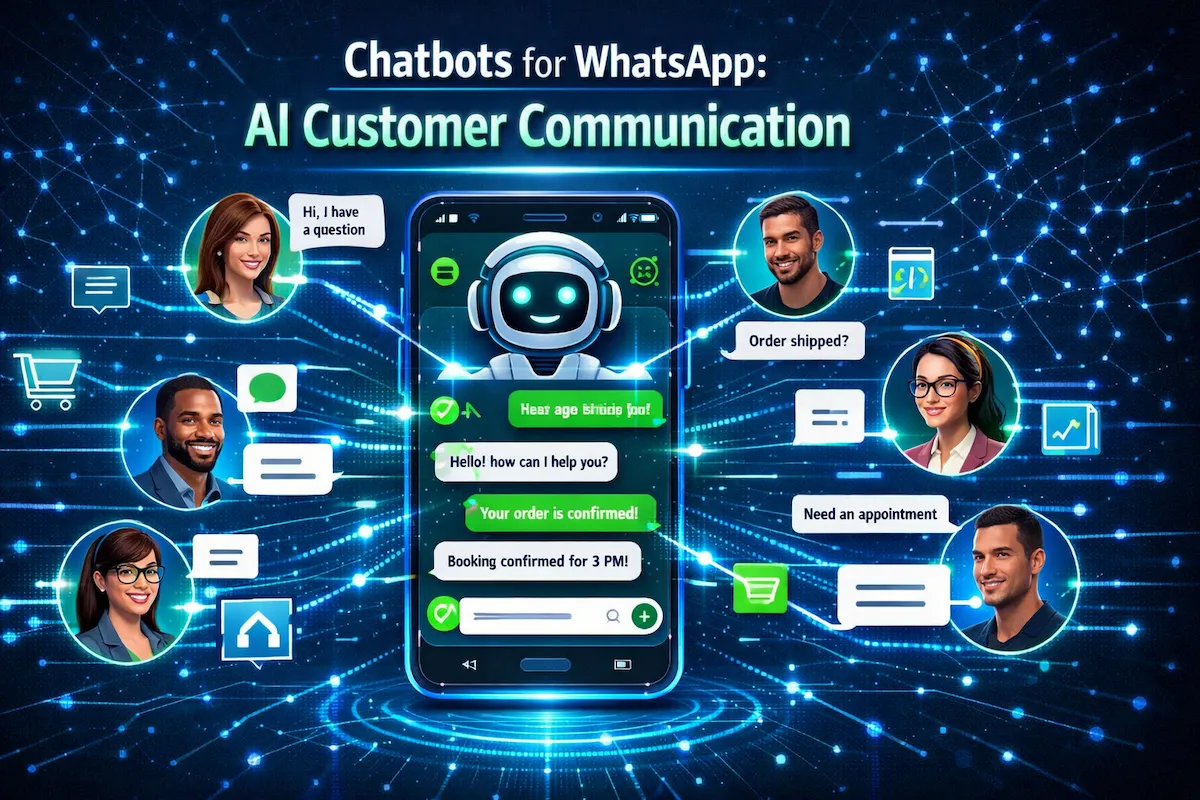
Introduction to Chatbots for WhatsApp
If your business is losing leads because nobody’s available at 2 a.m., or your support team is drowning in repetitive questions, you’ve probably started looking at chatbots for WhatsApp. And honestly? You’re onto something big.
WhatsApp has over 2 billion active users worldwide, and in the US, it’s rapidly growing as a preferred business communication channel. Combining that massive reach with chatbot automation is a strategy more and more American businesses are using to stay competitive.
If you’ve already explored chatbots for websites, WhatsApp takes that same concept and puts it directly inside the messaging app your customers are already using every single day. The barrier to engagement drops dramatically—and results follow.
This guide walks you through everything — what these chatbots do, how to set them up, the best tools available, real business use cases, and the mistakes you absolutely need to avoid. Whether you run a small online store or manage a large support team, there’s something practical here for you.
WhatsApp by the Numbers: Why This Channel Matters
Before diving into setup and strategy, it helps to understand just how powerful this platform is for businesses right now.
- WhatsApp has 2+ billion active users globally, making it the world’s most widely used messaging app
- WhatsApp messages consistently achieve significantly higher open rates than email—many businesses report dramatic differences in engagement
- 175 million people message a WhatsApp Business account every single day (Meta, WhatsApp Business)
- Businesses using WhatsApp chatbot automation commonly report major reductions in repetitive support ticket volume after launch
- Response times drop from hours to near-instant with automated replies
For many US businesses, chatbots for WhatsApp combine high visibility with faster response times than email or website forms—making it one of the highest-ROI communication channels available today.
These numbers explain why so many businesses are prioritizing chatbot integration on WhatsApp over other channels. The reach is there. The engagement is real. The only question is how to use it effectively.

What Are Chatbots for WhatsApp? (Featured Snippet Optimized Answer)
Quick Answer Chatbots for WhatsApp are automated software programs that communicate with users through the WhatsApp messaging app. They use preset rules or AI to respond to customer messages instantly, handle FAQs, book appointments, qualify leads, and process orders—all without human involvement, around the clock.
How Chatbots for WhatsApp Work Inside Messaging Platforms
How do chatbots for WhatsApp work?
- A user sends a message to your WhatsApp Business account
- The chatbot receives it through the WhatsApp Business API
- AI or rule-based logic identifies the user’s intent
- Automated replies are sent instantly—text, images, buttons, or product cards
- If the query is too complex, the conversation transfers to a live human agent
- All interactions are logged for analytics and ongoing optimization
Most platforms support both rule-based chatbot workflows (decision trees) and AI-powered conversational AI that understands natural language. The WhatsApp Business API is the backbone of all of it — it’s what connects your chatbot builder to WhatsApp’s infrastructure and makes real-time messaging automation possible.
Chatbots for WhatsApp vs Traditional Live Chat Support
Live chat agents are great, but they cost money, get tired, and can only handle one conversation at a time. A WhatsApp business chatbot can handle thousands of simultaneous conversations with zero downtime and consistent quality across every single interaction.
That doesn’t mean replacing your team entirely. The smartest businesses use chatbots for WhatsApp to handle routine queries and escalate the edge cases to humans. It’s about working smarter, not harder.
Key Benefits of Chatbots for WhatsApp for Businesses
The real-world advantages go well beyond saving time. Here’s what US businesses are actually seeing when they implement chatbots for WhatsApp effectively.
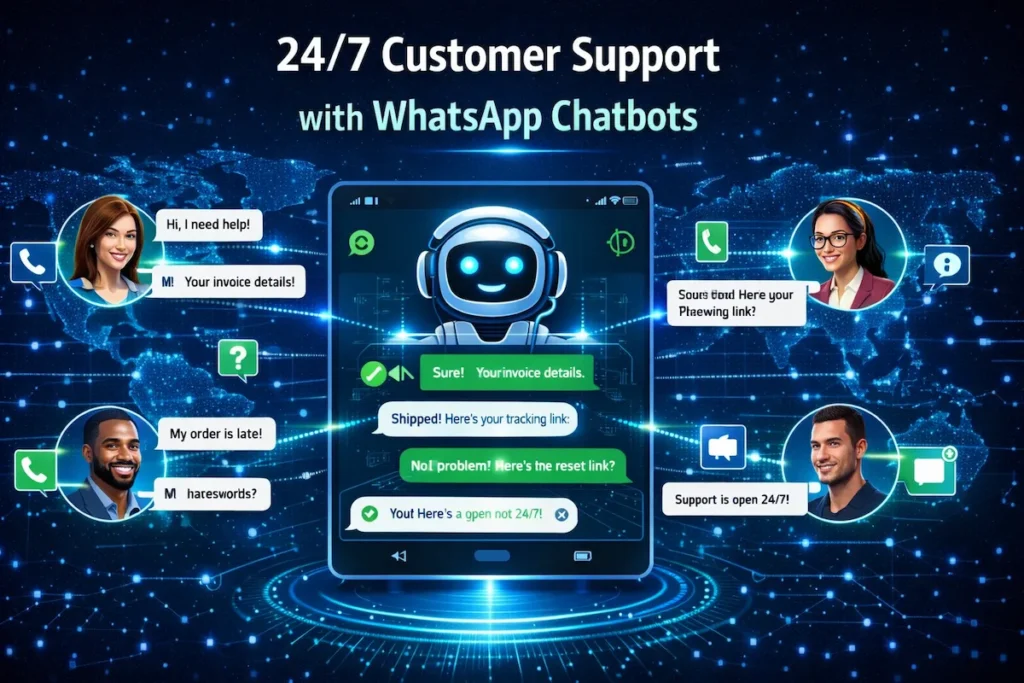
24/7 Customer Support Using Chatbots for WhatsApp
Your customers don’t keep office hours — and neither do chatbots for WhatsApp. Whether someone sends a message at noon or midnight, they get an instant, helpful response every single time.
This is especially valuable for e-commerce businesses or service companies with customers across different time zones. Automated replies powered by conversational AI keep customers satisfied and engaged even when your team is completely offline.
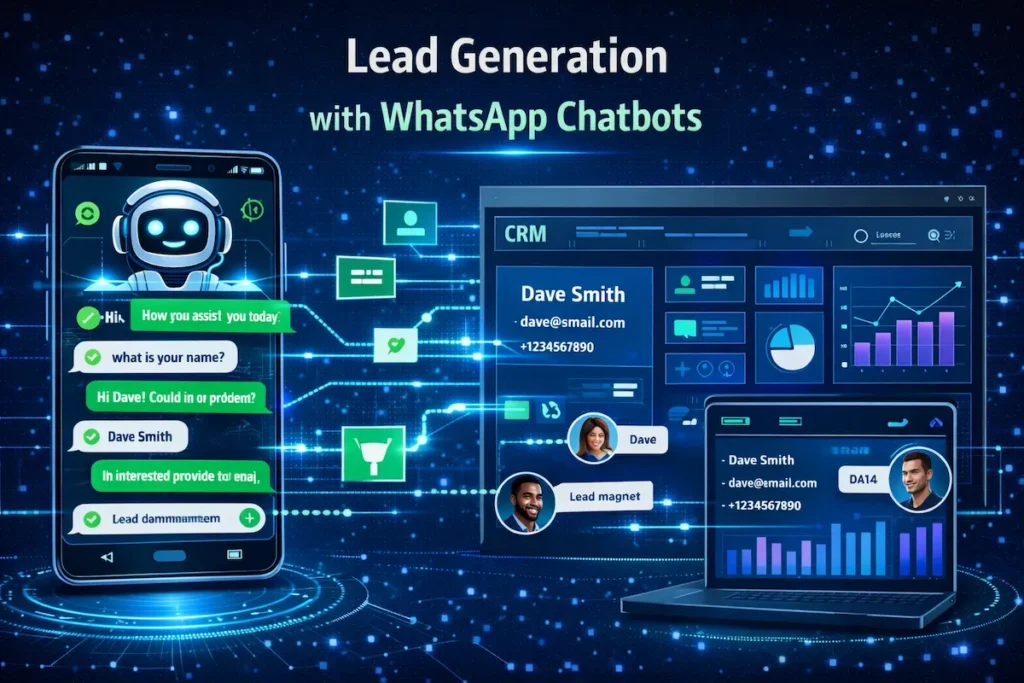
Lead Generation and Sales Automation with Chatbots for WhatsApp
A lead generation chatbot on WhatsApp can ask qualifying questions, collect contact info, and route hot leads straight to your sales team — all automatically, without any manual effort.
For example, a real estate business might use WhatsApp chatbot automation to ask prospects about their budget and preferred location, then schedule a callback with an agent. No spreadsheets, no missed follow-ups. Combined with the right AI tools for mobile productivity, your sales team can manage and act on those leads from anywhere, at any time.
Faster Customer Responses with Chatbots for WhatsApp
Customers expect replies within minutes — and chatbots for WhatsApp deliver instant responses every single time. No wait queue, no hold music, no delay regardless of how busy your business gets.
Faster response times directly impact customer satisfaction scores and reduce drop-off rates. In competitive markets, that speed can be the deciding factor between winning and losing a customer.
Reducing Support Costs Using Chatbots for WhatsApp
Hiring and training support agents is expensive. A customer support chatbot on WhatsApp can automatically handle a large share of common questions — things like order status, return policies, business hours, and FAQs — without any human involvement.
That means your human team can focus on complex issues that actually require their judgment, dramatically cutting operational costs without sacrificing service quality.
Best AI Chatbots for WhatsApp Platforms and Tools
Choosing the right platform is one of the most important decisions you’ll make when setting up chatbots for WhatsApp. Not all builders are created equal, and the right choice depends entirely on your business size, technical ability, and goals.
No-Code Builders for Chatbots for WhatsApp
If you’re not a developer, no-code platforms are your best bet for getting chatbots for WhatsApp up and running quickly. These tools let you build full chatbot workflows visually, without writing a single line of code:
- ManyChat — User-friendly interface, great for marketing-focused chatbot automation
- Tidio—Strong e-commerce chatbot features with solid WhatsApp integration
- WATI — Built specifically for WhatsApp business chatbot campaigns and broadcast messaging
- Interakt — Popular with US businesses for scalable WhatsApp chatbot integration and CRM syncing
Most platforms offer free trials so you can test your chatbot workflow before committing to a paid plan.
AI-Powered Platforms for Chatbots for WhatsApp
For more complex needs, AI chatbot for WhatsApp platforms use machine learning and natural language processing to handle open-ended, unpredictable conversations. These are ideal for businesses that receive a wide variety of customer queries that simple decision trees can’t cover:
- Landbot — Excellent visual interface with strong AI chatbot for WhatsApp functionality
- Dialogflow (Google) — Powerful for fully custom AI chatbot builds using advanced NLP
- Twilio — Developer-friendly API platform built for custom chatbot integration at scale
- Respond.io — Reliable multi-channel conversational AI platform with deep WhatsApp support
Step-by-Step Guide to Creating Chatbots for WhatsApp
Ready to build your first chatbot? Here’s a clear, practical guide to getting chatbots for WhatsApp set up without the overwhelm.
Step 1 – Setting Up WhatsApp Business
Before anything else, you need a verified WhatsApp Business account. For smaller operations, the free WhatsApp Business app may be enough to start. For larger deployments or full chatbot integration, you’ll need access to the WhatsApp Business API through a verified Business Solution Provider (BSP).
Make sure your business profile is complete — include your business name, description, address, and website URL. This builds immediate credibility with customers before they even read your first message.
Step 2 – Choosing a Chatbot Builder
Pick a platform based on your budget, technical skill level, and specific use case. A lead generation chatbot built for a marketing campaign has very different requirements than a customer support chatbot handling returns and refund disputes.
Start with a no-code builder if you’re new to chatbot automation. You can always upgrade to an AI-powered platform as your customer volume and complexity grow.
Step 3 – Designing Automation Workflows
This is the most important step — and the one most businesses rush through. A chatbot workflow is essentially a conversation map: a series of if/then decisions that guide users toward the right answer or action.
Design your flows around your most common customer questions. Keep messages short, use quick-reply buttons wherever possible, and always include a fallback path that routes to a human agent. Practical tips:
- Start with the top 10 questions your support team gets every single week
- Map each question to a clear, direct automated reply
- Add a visible “Talk to a human” option for complex or sensitive issues
- Test every conversation path thoroughly before going live — broken flows destroy trust fast
Step 4 – Integrating CRM and Marketing Tools
The real power of chatbot integration happens when you connect your WhatsApp chatbot to your existing business systems. Link it to:
- Your CRM (HubSpot, Salesforce, Zoho) to automatically capture and track every lead
- Your ecommerce platform (Shopify, WooCommerce) for real-time order status and shipping updates
- Your calendar or scheduling tool for seamless automated appointment booking
- Email marketing tools to trigger follow-up sequences after WhatsApp conversations end
This transforms your chatbot from a basic FAQ tool into a complete business automation engine that works around the clock.
Real Business Use Cases of Chatbots for WhatsApp
Ecommerce Automation with Chatbots for WhatsApp
An ecommerce chatbot on WhatsApp can handle order confirmations, shipping updates, return requests, and product recommendations — all through automated replies that feel personal. Customers love the convenience, and businesses see significant drops in their support ticket volume almost immediately.
Imagine a Shopify store where a customer messages asking about their order. The WhatsApp chatbot automation instantly pulls the current status from your system and replies in seconds. No agent needed, no waiting, no friction.
Appointment Booking Using Chatbots for WhatsApp
Healthcare providers, salons, law firms, and fitness studios across the US are using chatbots for WhatsApp to handle appointment bookings around the clock. A customer messages to schedule a time, the chatbot checks real-time availability, confirms the booking, and sends a reminder automatically — all without a single staff member involved.
This dramatically reduces no-shows and eliminates the back-and-forth of manual scheduling that wastes hours every week.
Customer Support Automation Through Chatbots for WhatsApp
A well-built customer support chatbot can deflect a large percentage of routine inquiries automatically. Common use cases include answering FAQs, processing refund requests, sharing policy documents, and walking customers through troubleshooting steps.
The key is a smart human handoff system. When a customer’s issue is too nuanced for the chatbot, it smoothly transfers the conversation to a live agent — along with the full chat history, so no one has to repeat themselves.
Marketing Campaigns Powered by Chatbots for WhatsApp
More US businesses are using chatbot integration on WhatsApp for outbound marketing — sending personalized promotions, flash sale alerts, event reminders, and new product launches directly to opted-in customers.
WhatsApp messages consistently outperform email by a significant margin in terms of open and engagement rates. A well-designed conversational AI campaign on WhatsApp can drive real engagement and measurable conversions in ways that email simply can’t match anymore.
Pros and Cons of Chatbots for WhatsApp
| ✅ Pros | ❌ Cons |
|---|---|
| Available 24/7 — no breaks, no holidays | Poorly designed bots frustrate users quickly |
| Handles thousands of conversations at once | Cannot replace human empathy in sensitive cases |
| Significantly reduces support team workload | Requires upfront setup time and ongoing maintenance |
| Speeds up lead capture and qualification | Over-automation can feel impersonal to customers |
| Integrates with CRM, ecommerce, and booking tools | WhatsApp API requires business verification to access |
| Boosts conversion rates with instant automated replies | Analytics must be monitored and acted on regularly |
Common Mistakes Businesses Make When Using Chatbots for WhatsApp
Most guides skip this section entirely. These are the real reasons chatbot deployments fail — and exactly how to avoid every one of them.
1. Poor Chatbot Conversation Design The biggest mistake is building a chatbot that sounds like a robot. Stiff, scripted language drives customers away fast. Your chatbot workflow should feel natural, warm, and genuinely helpful. Write conversational scripts, use first names where possible, and eliminate corporate jargon entirely.
2. Lack of Human Handoff Chatbots for WhatsApp are powerful, but they can’t handle everything. Businesses that fail to build a clear human escalation path into their chatbot workflow end up frustrating the customers who need help the most. Always include a visible, frictionless path to a live agent.
3. Automation Overuse Not every message should be automated. Complaints, refund disputes, and emotionally sensitive issues require human judgment and empathy. Over-relying on WhatsApp chatbot automation in these situations damages customer trust in ways that are genuinely hard to recover from.
4. Ignoring Analytics and Optimization Your chatbot is not a set-it-and-forget-it tool. Most businesses launch one and never look at the data again. Track drop-off points, failed intents, and satisfaction scores. Use that information to continuously sharpen your automated replies and conversation flows. The businesses that optimize consistently will always outperform those that don’t.
5. Skipping Opt-In Compliance WhatsApp has strict rules about messaging customers. Sending unsolicited messages can get your number permanently banned. Always follow the WhatsApp Business Policy and obtain clear consent before launching any outbound campaign.
6. Overlooking Cybersecurity Risks This one catches a lot of businesses off guard. When your chatbot is collecting customer data — names, emails, phone numbers, purchase details — you’re responsible for keeping it secure. Many small businesses underestimate this exposure. Taking time to understand AI-driven cybersecurity for small businesses before you launch is a genuinely smart move that most competitors skip entirely.
Future of AI-Powered Chatbots for WhatsApp
The future of chatbots for WhatsApp is moving in one clear direction: smarter, more personalized, and increasingly human-like in every interaction. Here’s what’s already in motion across the industry:
- AI chatbot for WhatsApp platforms will get significantly better at understanding context across long, multi-turn conversations
- Voice-enabled chatbots will handle spoken WhatsApp messages naturally and accurately
- Deeper ecommerce chatbot integration will allow complete end-to-end transactions inside WhatsApp without ever leaving the app
- Conversational AI will analyze customer sentiment in real time and adapt its tone and messaging accordingly
- Analytics dashboards will become more intuitive, making optimization accessible even for non-technical business owners
According to Meta’s official WhatsApp Business platform, the company is actively expanding its commerce and automation features — signaling that chatbots for WhatsApp will become an even more central part of business communication in the years ahead.
Businesses that invest in WhatsApp chatbot automation now will have a meaningful head start as this channel continues to grow in the US market.
FAQ About Chatbots for WhatsApp
Are chatbots for WhatsApp free to use?
Some platforms offer free tiers with limited features. However, accessing the WhatsApp Business API — which is required for full chatbot integration at scale — typically involves fees charged by Business Solution Providers. Pricing varies based on message volume and the specific platform you choose.
Do I need coding skills to build a WhatsApp business chatbot?
No. No-code builders like ManyChat, WATI, and Tidio let you build and launch chatbots for WhatsApp using drag-and-drop interfaces. No technical background is required for basic to intermediate deployments.
Can a chatbot for WhatsApp replace my customer support team?
Not entirely — and that’s not the goal. A customer support chatbot handles routine, high-volume queries really well. But for complex issues requiring empathy, judgment, or nuanced problem-solving, human agents remain essential. The strongest setups combine both intelligently.
Is WhatsApp chatbot automation legal and compliant?
Yes, provided you follow WhatsApp’s Business Policy and applicable US regulations like the TCPA. Customers must actively opt in before receiving automated messages, and a clear opt-out option must always be available. Always work through a verified BSP.
What types of businesses benefit most from chatbots for WhatsApp?
Ecommerce stores, healthcare providers, real estate agencies, restaurants, salons, and SaaS companies all see strong results. Any business that receives high volumes of repetitive customer messages is a strong candidate for WhatsApp chatbot automation.
What is the difference between a WhatsApp chatbot and the WhatsApp Business app?
The WhatsApp Business app is a free tool for small businesses to manage customer conversations manually, with some basic automated replies like greeting messages and away messages. A WhatsApp chatbot — built on the WhatsApp Business API — goes far beyond that. It handles full automated conversations, integrates with your CRM and ecommerce tools, runs 24/7 without staff involvement, and scales to handle thousands of simultaneous users. They’re built for very different stages of business growth.
How do I measure the success of my WhatsApp business chatbot?
Track response rate, resolution rate (issues resolved without human escalation), customer satisfaction scores, and conversion rates from lead generation chatbot flows. Most platforms include built-in dashboards that make this straightforward, even without a dedicated analytics team.
Final Thoughts on Using Chatbots for WhatsApp
Chatbots for WhatsApp are no longer just a nice-to-have — they’re becoming a competitive necessity for US businesses that want to scale communication without scaling headcount.
Our team has worked with ecommerce and SaaS businesses implementing WhatsApp chatbot automation across multiple industries. The results are consistent: businesses that design thoughtful, customer-first chatbot workflows routinely reduce support tickets and improve response times within the first 90 days of deployment.
From instant automated replies to full-scale conversational AI campaigns, the possibilities are genuinely impressive. The key is starting simple, designing your chatbot workflows with the customer experience front and center, and always keeping humans in the loop for situations that need a personal touch.
Whether you’re building your first WhatsApp business chatbot or refining an existing setup, the opportunity is clear. Customers want fast, frictionless communication. Chatbot automation delivers exactly that.
Start small. Test everything. Optimize constantly. Businesses adopting chatbots for WhatsApp today will be far better positioned for the future of automated customer communication than those who wait.