
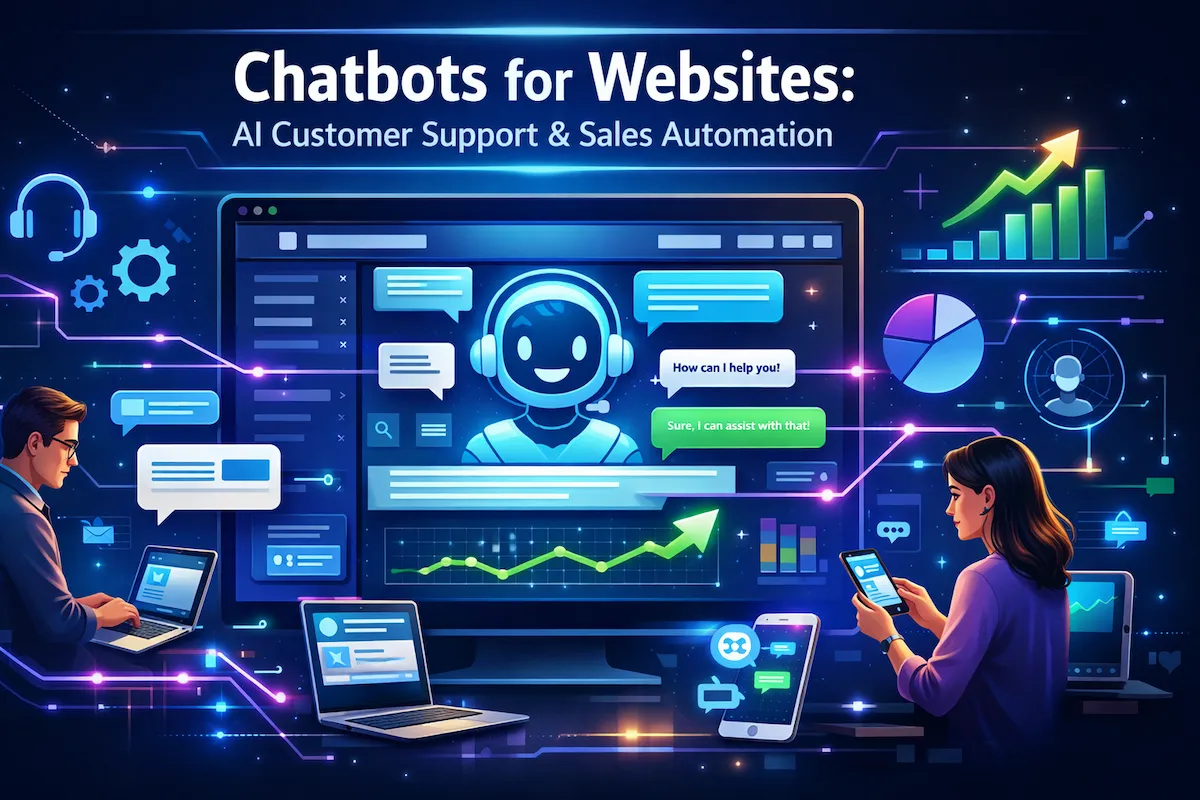
If you run a business website and you’re not using chatbots for websites yet, you’re likely leaving money and customer relationships on the table. More US businesses than ever are turning to AI chatbots to handle customer questions, capture leads, and keep visitors engaged — all without hiring extra staff. This guide breaks down exactly how chatbots for websites work, why businesses use them, and how you can get started quickly, whether you’re a solo founder or managing a growing team.
What Are Chatbots for Websites?
Chatbots for websites are automated software programs that interact with visitors through a chat interface — usually a pop-up window in the corner of a webpage. Instead of making users wait for a human agent or dig through FAQs, a chatbot steps in immediately to answer questions, collect contact details, or guide the visitor to the right page.
Modern website chatbots range from simple rule-based bots that follow preset scripts to sophisticated AI chatbots for websites that use machine learning to understand natural language and improve over time.
How Chatbots for Websites Work
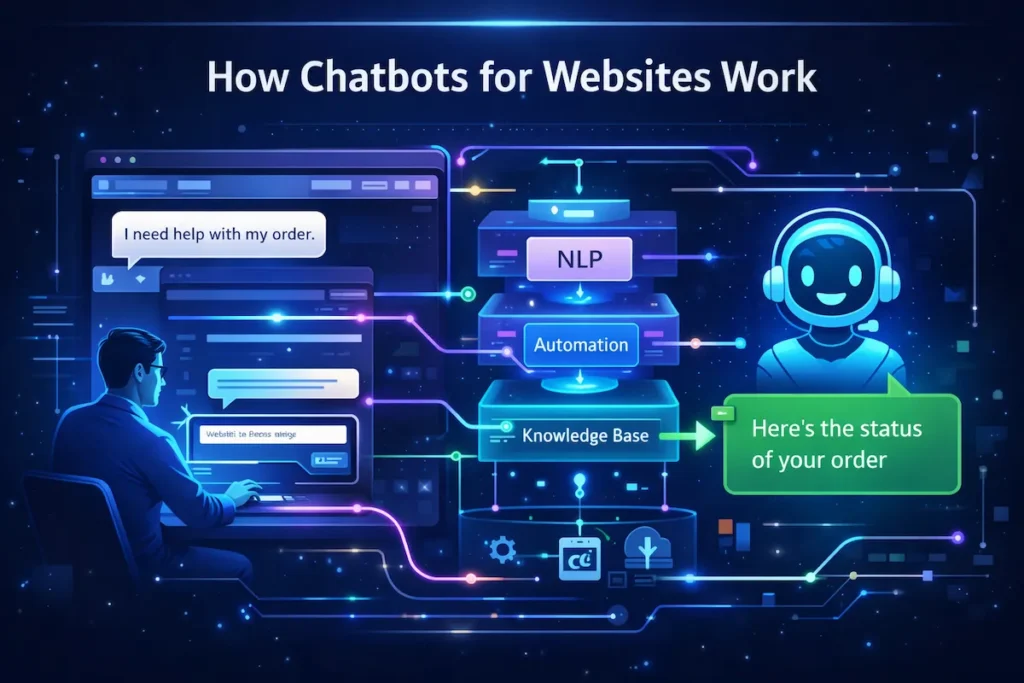
When a visitor lands on your site, the chatbot automation for websites activates — either automatically or when the user clicks the chat widget. The bot receives the visitor’s message, processes it, and returns a response. With AI-powered chatbots, this processing involves natural language understanding (NLU), which allows the bot to interpret intent rather than just match keywords.
Behind the scenes, the chatbot connects to a knowledge base, your product catalog, a CRM, or a ticketing system. It pulls relevant information and replies in seconds. The whole interaction feels like talking to a knowledgeable assistant — without any human being online at that moment.
Types of Chatbots for Websites (AI vs Rule-Based)
There are two main types of chatbots for websites:
Rule-based chatbots: These follow a fixed decision tree. They work well for simple, predictable interactions like collecting a name and email or answering a set of five common questions. They’re easy to set up but limited in scope.
AI-powered chatbots: These use machine learning and conversational AI technology to understand open-ended questions. They can handle a much wider range of topics, learn from past conversations, and deliver a more human-like experience. Tools like ChatGPT-based chatbots fall into this category.
For most growing US businesses, AI chatbots for websites offer a better long-term investment because they adapt and scale with your customer base.
\Benefits of Chatbots for Websites for Modern Businesses
Before diving into specific use cases, it’s worth understanding the core advantages that chatbots for websites deliver to businesses of all sizes:
- Reduced response time — visitors get answers in seconds, not hours
- Automated support — routine questions are handled without staff involvement
- Increased conversions — engaged visitors convert at significantly higher rates
- Scalable customer service — one bot handles hundreds of conversations simultaneously
- Lower operational costs — chatbot automation for websites reduces the need for large support teams
These benefits compound over time. As your bot learns from more interactions and you refine its knowledge base, performance improves without additional cost. For businesses already investing in AI-driven content marketing workflows, adding a chatbot creates a seamless AI-powered customer journey from first click to conversion.
Benefits of Chatbots for Websites for Modern Businesses
Before diving into specific use cases, it’s worth understanding the core advantages that chatbots for websites deliver to businesses of all sizes:
- Reduced response time — visitors get answers in seconds, not hours
- Automated support — routine questions are handled without staff involvement
- Increased conversions — engaged visitors convert at significantly higher rates
- Scalable customer service — one bot handles hundreds of conversations simultaneously
- Lower operational costs — chatbot automation for websites reduces the need for large support teams
These benefits compound over time. As your bot learns from more interactions and you refine its knowledge base, performance improves without additional cost. For businesses already investing in AI-driven content marketing workflows, adding a chatbot creates a seamless AI-powered customer journey from first click to conversion.
Why Businesses Are Using Chatbots for Websites
The adoption of chatbots for websites has exploded in the past few years. Here’s why businesses across every industry are making the switch.
24/7 Customer Support with Chatbots for Websites
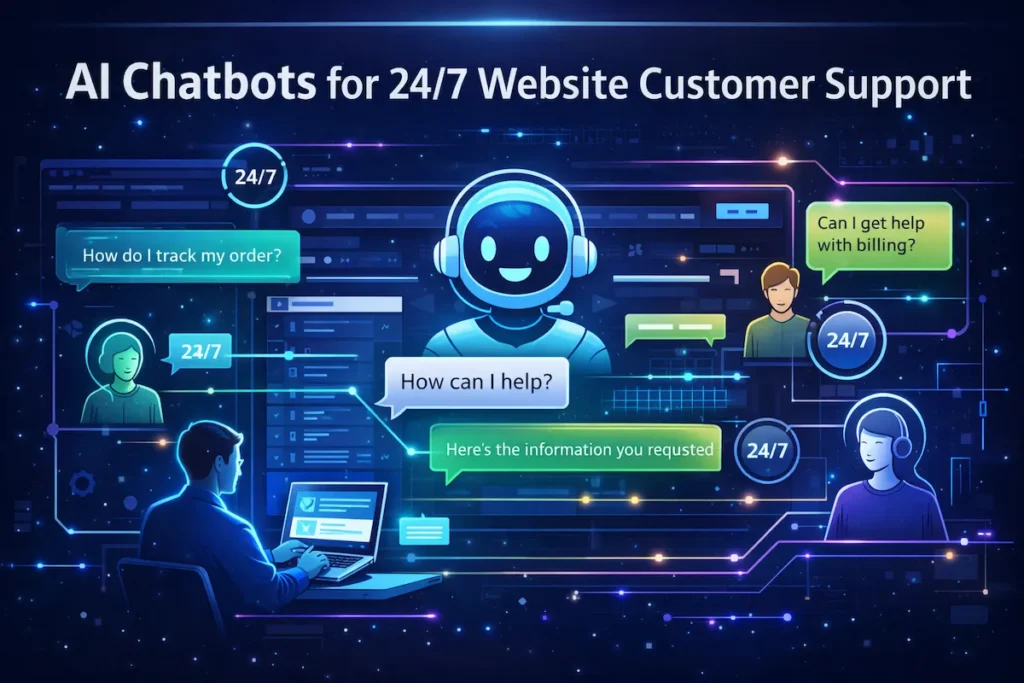
One of the biggest draws is around-the-clock availability. A customer browsing your site at 11 PM on a Sunday won’t get a “We’re closed” message — they’ll get immediate, helpful responses from AI customer support. This matters especially for e-commerce stores, SaaS companies, and service businesses where questions before purchase directly impact sales.
Customer support chatbots can handle hundreds of simultaneous conversations without fatigue or inconsistency. For small business owners, this is like having a full-time support agent working every hour of every day for a fraction of the cost. According to Salesforce’s State of Service report, 83% of customers now expect to interact with someone immediately when they contact a company — a standard only chatbots can realistically meet around the clock.
Lead Generation and Sales Automation Using Chatbots for Websites
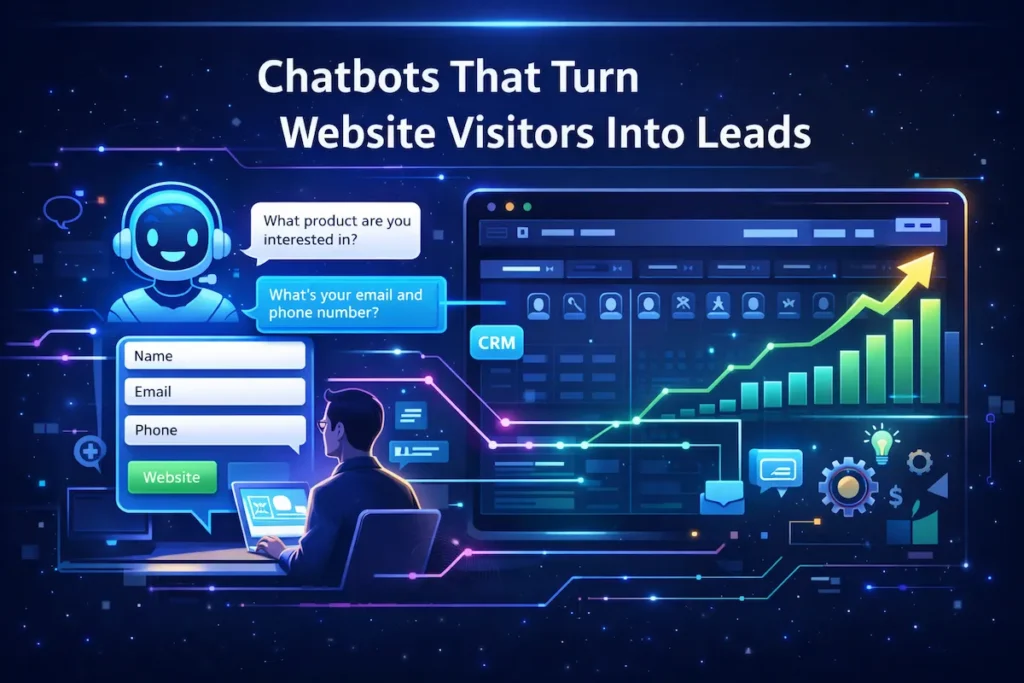
Chatbot lead generation is one of the most powerful use cases. Instead of relying on a static contact form, a chatbot can proactively start a conversation, ask qualifying questions, and collect the visitor’s contact details — all while they’re still browsing.
For example, a local roofing company could use a chatbot to ask whether a visitor needs repair or a full replacement, then collect the address and phone number before passing the lead directly to the sales team. That kind of automated qualification — running 24/7 without staff — is where chatbot automation for websites delivers its most immediate ROI.
If you’re thinking about how AI fits into your broader growth strategy, understanding generative AI ROI vs traditional automation is a smart starting point before committing to a platform.
How Chatbots for Websites Improve Visitor Engagement
Website visitor engagement drops sharply when users can’t find answers quickly. Chatbots solve this by being interactive and immediately responsive. Visitors who interact with a chatbot tend to spend more time on the site, view more pages, and convert at higher rates.
Chatbots for websites can also personalize the experience — greeting returning visitors by name (if logged in), recommending products based on browsing behavior, or offering a discount when a visitor lingers on a pricing page. Businesses focused on SEO and search intent optimization will find that lower bounce rates driven by chatbot engagement also send positive ranking signals to search engines.
Key Features of Modern Chatbots for Websites
Not all chatbot software for websites is the same. Here are the features that separate the good from the great.
Natural Language Processing in Chatbots for Websites
Natural Language Processing (NLP) is the technology that lets chatbots for websites understand human language rather than just commands. With NLP, a visitor can type “I need help with my bill” instead of clicking a menu option, and the bot will understand and respond appropriately. The better the NLP engine, the more natural and useful the conversation feels. IBM’s explanation of NLP describes it as technology that enables systems to understand, interpret, and generate human language in a way that is both meaningful and useful — exactly what makes modern chatbots feel less robotic.
CRM and Marketing Integration in Chatbots for Websites
Chatbot integration for websites becomes far more valuable when the bot connects to your existing tools. Most modern chatbot platforms integrate with CRMs like HubSpot, Salesforce, or Zoho. This means every lead captured by the bot gets automatically added to your pipeline, tagged, and assigned to a rep — no manual data entry required.
Integrated chatbot workflows can improve lead routing, response speed, and support efficiency when connected to CRM and marketing tools. Marketing integrations also allow chatbots to trigger email sequences, add contacts to SMS lists, or fire off Slack notifications when a high-value visitor starts a conversation.
Live Chat Handoff Features in Chatbots for Websites
The best chatbots for websites know their limits. When a visitor’s question is too complex or emotionally sensitive, the bot smoothly transfers the conversation to a human agent — complete with the full chat history so the agent doesn’t need to ask the same questions again. This hybrid approach keeps response quality high while still benefiting from automation.
Best Chatbots for Websites Businesses Use Today
The market for chatbot software for websites is crowded. Here’s how to think about the main categories — and which type fits your situation best.
AI-Powered Chatbots for Websites
Platforms like Intercom, Drift, and Tidio’s AI tier use conversational AI to handle complex conversations. These are best suited for B2B SaaS companies, online service providers, and larger e-commerce stores that need flexible, intelligent responses. They typically offer deep CRM integrations, analytics dashboards, and multi-language support.
Best for: Growing businesses that need flexible AI conversations and deep integrations.
Customer Support Chatbots for Websites
Tools like Freshchat, Zendesk’s bot, and Zoho SalesIQ are built specifically for AI customer support workflows. They excel at ticket deflection — handling common questions automatically so human agents can focus on more complex issues. According to Gartner’s conversational AI research, by 2028 at least 70% of customers will use a conversational AI interface to start their customer service journey — making early investment in these tools a strategic advantage.
Best for: Support-heavy teams looking to reduce ticket volume and response time.
Ecommerce Chatbots for Websites
For online stores, chatbot solutions like Gobot, Gorgias, or even Shopify’s built-in chat tools are optimized for product recommendations, order tracking, and abandoned cart recovery. These ecommerce chatbots for websites directly tie into your product catalog and order management system, making them incredibly effective at driving repeat purchases and reducing support tickets.
Best for: Online retailers focused on conversions, order support, and cart recovery.
How to Add Chatbots for Websites Step-by-Step
Adding chatbots for websites doesn’t have to be complicated. Here are your main options depending on your technical comfort level.
No-Code Tools for Chatbots for Websites
Platforms like Tidio, ManyChat, and Chatfuel offer drag-and-drop bot builders that require zero coding. You sign up, connect your website (usually by pasting a small snippet of code), and build your conversation flows visually. Most offer free tiers, making them a good starting point for small business owners testing the waters with chatbot integration for websites.
Best for small businesses: Tidio — affordable, beginner-friendly, and includes live chat handoff.
WordPress Plugins for Chatbots for Websites
If your site runs on WordPress, adding a chatbot is as simple as installing a plugin. WP-Chatbot, Tidio Live Chat, and HubSpot’s free CRM plugin all include chatbot functionality. Install, activate, configure your greetings and flows, and you’re live in under an hour. These plugins handle the technical side so you can focus entirely on crafting good conversations.
Best for support teams: Zendesk bot — purpose-built for ticket deflection and escalation workflows.
Custom AI Development for Chatbots for Websites
Larger businesses with unique requirements sometimes build custom chatbots for websites using APIs from OpenAI, Anthropic, or Google. This approach gives you full control over the bot’s behavior, data handling, and branding. It requires developer resources but delivers a fully tailored chatbot experience — particularly useful in regulated industries like healthcare, finance, or legal services.
Best for ecommerce: Gorgias — deeply integrated with Shopify and built around order and return management.
Best for custom AI workflows: A custom API build using OpenAI or Anthropic gives you complete flexibility with no platform constraints.
Chatbots for Websites vs Live Chat Support
A common question: should you use chatbots for websites or invest in live chat staffed by humans? The honest answer is that both have their place, and they work best together.
| Intent Type | What the user wants |
|---|---|
| Informational intent | What chatbots for WhatsApp are |
| Commercial intent | Best tools and platforms |
| Practical intent | Step-by-step implementation |
| Problem-solving intent | How chatbots solve business communication problems |
Use chatbots when: volume is high, questions are repetitive, or coverage outside business hours is needed. Chatbot automation for websites handles these situations efficiently and cost-effectively.
Use live chat when: conversations involve emotional situations, complex troubleshooting, or high-stakes sales where human judgment makes a real difference.
The smartest approach is a hybrid model: chatbots handle the routine, and humans step in when it really counts. Most modern chatbot software for websites supports this handoff natively.
If your website gets repeat questions, after-hours traffic, or unqualified form submissions, a chatbot is usually worth testing first. You can always layer in live chat once you’ve identified the conversations that actually need a human.
Common Problems and Limitations of Chatbots for Websites
Chatbots for websites are powerful, but they’re not perfect. Here’s what you need to watch out for.
Poor Training Data Problems in Chatbots for Websites
AI chatbots for websites are only as good as the data they’re trained on. If you feed your bot vague, incomplete, or outdated information, it will give vague, incomplete, or outdated responses. Before launching, invest time in building a solid knowledge base — FAQs, product info, return policies, and common objections. Review and update this content regularly to keep the bot accurate and trustworthy.
When Chatbots for Websites Need Human Support
No chatbot should try to handle every single conversation. Certain situations — angry customers, legal questions, medical advice requests, complex refund disputes — require a human who can use empathy, judgment, and authority. Businesses that ignore this end up frustrating customers and damaging trust. Set clear escalation triggers so your bot knows exactly when to hand off, and make sure a real person is available to take those conversations.
Security Considerations for Chatbots for Websites
One area businesses often overlook is chatbot security. Any tool that collects visitor data — names, emails, payment questions — is a potential attack surface. Businesses handling sensitive customer information through chatbots should ensure their platforms comply with data privacy regulations and follow secure data handling practices. For a practical overview of how AI tools introduce new security risks, AI-driven cybersecurity for small businesses covers the key vulnerabilities worth understanding before you deploy. For supporting data, AI cybersecurity statistics for SMBs in 2026 provides useful benchmarks on where threats most commonly appear.
Are Chatbots for Websites Worth It for Small Businesses?
For most US small businesses, the answer is a clear yes. Here’s why the math usually works out:
Cost: Many solid chatbot software for websites options start free or at $20–$50/month. Compare that to even one part-time customer service hire and the ROI is obvious.
Speed to launch: No-code tools let you go live in an afternoon. You don’t need a developer.
Lead generation impact: Even a basic chatbot that captures name, email, and phone number from visitors who would otherwise bounce can meaningfully improve your conversion rate.
Customer satisfaction: Customers get faster answers. Faster answers mean happier customers and fewer support headaches for you.
Start with a free plan, test one or two conversation flows, and measure the impact on leads and support volume before upgrading. Most small business owners see clear results within the first 30 days.
The Future of Chatbots for Websites and AI Customer Support
The next wave of chatbots for websites is already arriving. Here’s where things are heading:
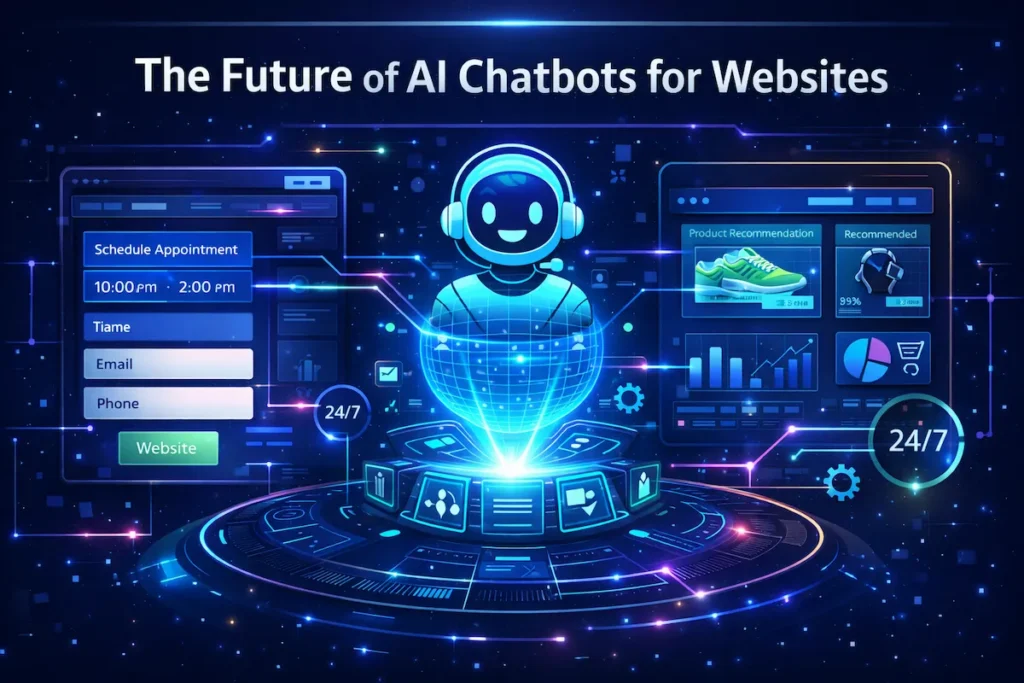
Agentic AI: Chatbots are evolving from reactive responders to proactive agents that can take actions — book appointments, process refunds, update account details — without any human involvement.
Voice and multimodal bots: Conversational AI is moving beyond text. Bots will increasingly handle voice queries, image uploads, and video-based interactions on websites.
Hyper-personalization: AI chatbots for websites will use deeper behavioral data to deliver conversations tailored to individual visitor profiles — not just their current question, but their full relationship with your brand.
Search and AI integration: As AI reshapes how people find information online, chatbots will increasingly serve as the first point of contact for visitors arriving from AI-powered search. Understanding how generative AI is changing SEO and search intent gives useful context for where customer discovery is heading.
For business owners, this means the gap between early adopters and everyone else will keep growing. The businesses that invest in chatbot integration for websites now will have a significant competitive advantage as AI capabilities accelerate.
Frequently Asked Questions About Chatbots for Websites
What are chatbots for websites?
Chatbots for websites are automated programs that engage visitors through a chat interface. They can answer questions, collect leads, book appointments, and guide users — without needing a human agent online. They range from simple rule-based scripts to sophisticated AI-powered systems using conversational AI.
Are chatbots for websites expensive?
Not necessarily. Many chatbot software for websites platforms offer free plans with basic features. Paid plans typically start at $20–$100/month for small to mid-sized businesses. Enterprise custom solutions cost more, but the ROI from lead generation and reduced support costs usually more than justifies the investment.
Can chatbots replace human support?
Chatbots for websites can handle a high percentage of routine inquiries — some businesses report 60–80% ticket deflection rates. But they shouldn’t fully replace human support. Complex issues, emotional situations, and high-stakes decisions still benefit from a human touch. The best approach combines chatbot automation for websites with a live chat handoff option.
How do chatbots for websites generate leads?
Chatbot lead generation works by initiating conversations with visitors before they leave. The bot asks qualifying questions, captures contact information, and delivers it directly to your CRM or email system. Unlike passive forms, a chatbot is interactive — which dramatically increases the chance a visitor will engage and share their information.
Is it hard to set up chatbots for websites?
With no-code tools and WordPress plugins, chatbot integration for websites is accessible to anyone — no coding required. Most platforms offer templates you can customize and launch within a day. For more advanced AI chatbots or custom builds, you may need developer help, but entry-level chatbots are genuinely easy to set up.
Conclusion
Chatbots for websites have moved from a nice-to-have feature to a genuine business necessity. Whether you’re trying to reduce support costs, capture more leads, or simply give your visitors a better experience at 2 AM, a well-configured chatbot delivers real, measurable results.
The good news for US businesses: you don’t need a big budget or a technical team to get started. Free and low-cost chatbot software for websites can be live on your site today. Start small, measure what matters, and scale as you see results.
In a world where customers expect instant answers, chatbots for websites aren’t just a productivity tool — they’re your always-on frontline. The businesses that deploy them thoughtfully now will be the ones pulling ahead of the competition tomorrow.