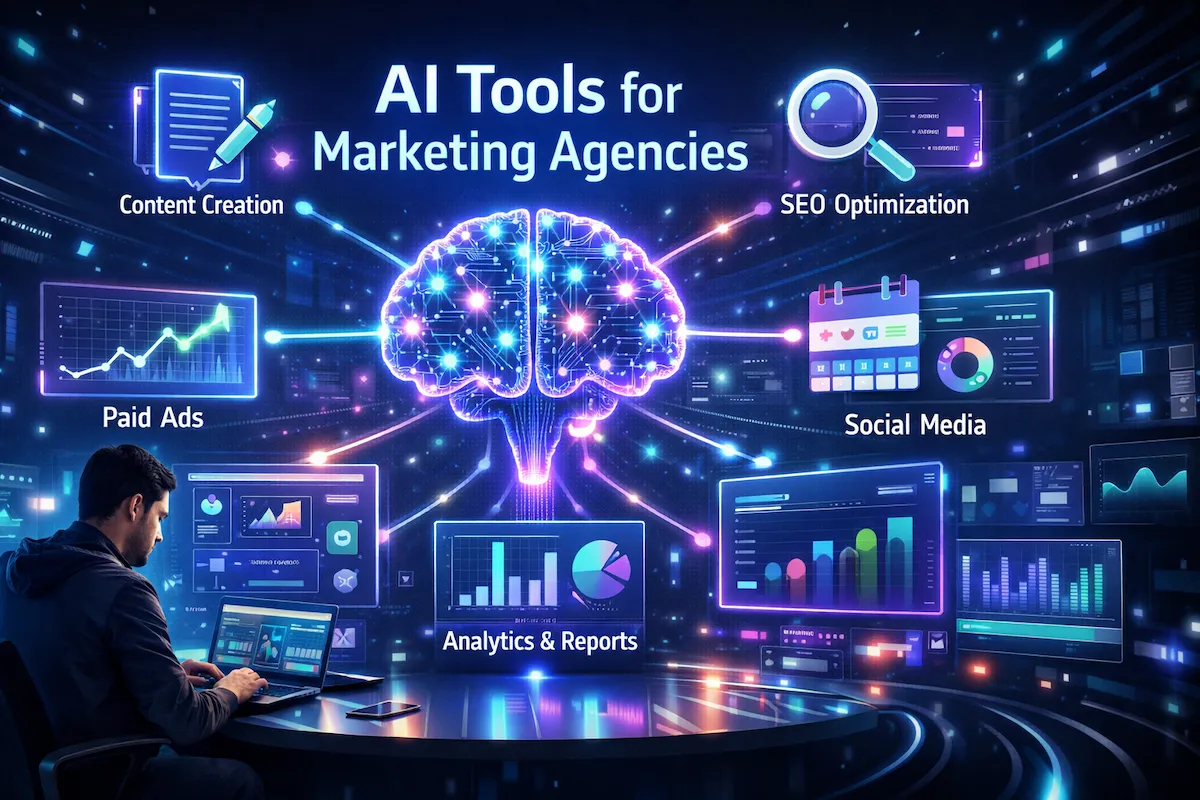
Quick Answer: AI tools for marketing agencies help automate content creation, SEO, advertising, reporting, and client management. The best AI tools enable agencies to scale workflows, improve ROI, and deliver faster results without increasing team size.
What Are AI Tools for Marketing Agencies?
If you’re new to AI adoption, start with this complete breakdown of the best AI tools in 2026 to understand the broader landscape before choosing agency-specific platforms.
AI tools for marketing agencies are software platforms that use artificial intelligence to automate, optimize, and scale core agency functions — including content creation, SEO, paid advertising, social media management, analytics, and client reporting. Instead of replacing your team, these tools multiply what your existing team can deliver.
If you run a marketing agency in the U.S. and you’re not using AI yet, you’re already behind the curve. The agencies winning the most clients right now are the ones that deliver faster results, smarter reporting, and bigger ROI — and they’re doing it with AI automation tools that handle the heavy lifting.
Whether you’re a boutique SEO shop in Austin or a full-service digital agency in Chicago, building a strong agency AI stack is no longer optional. It’s the foundation of competitive agency operations. In this guide, we break down the best platforms, explain how real agencies use them, and help you figure out which tools actually belong in your stack. If you’re just getting started with AI across the board, the Best AI Tools in 2026 Complete Guide is a solid starting point before diving into agency-specific platforms.
📊 Key Insight: 74% of U.S. marketing agencies now use AI marketing software daily — up from 38% just two years ago.
Who This Guide Is For
- Marketing agency owners
- SEO and PPC specialists
- Growth marketers and consultants
- Agencies looking to scale with AI automation
Key AI Tools for Marketing Agencies at a Glance
- ChatGPT — Best overall AI tool for agencies
- Surfer SEO — Best for SEO optimization
- Jasper — Best for content creation
- Madgicx — Best for ad optimization
- Looker Studio — Best for reporting
- Sprout Social — Best for social media management
- Google Gemini — Best free AI tool
Why Marketing Agencies Are Rapidly Adopting AI Tools
Marketing agencies across the U.S. are increasingly relying on AI tools for marketing agencies to reduce manual work, improve campaign performance, and scale client results faster than traditional workflows allow.
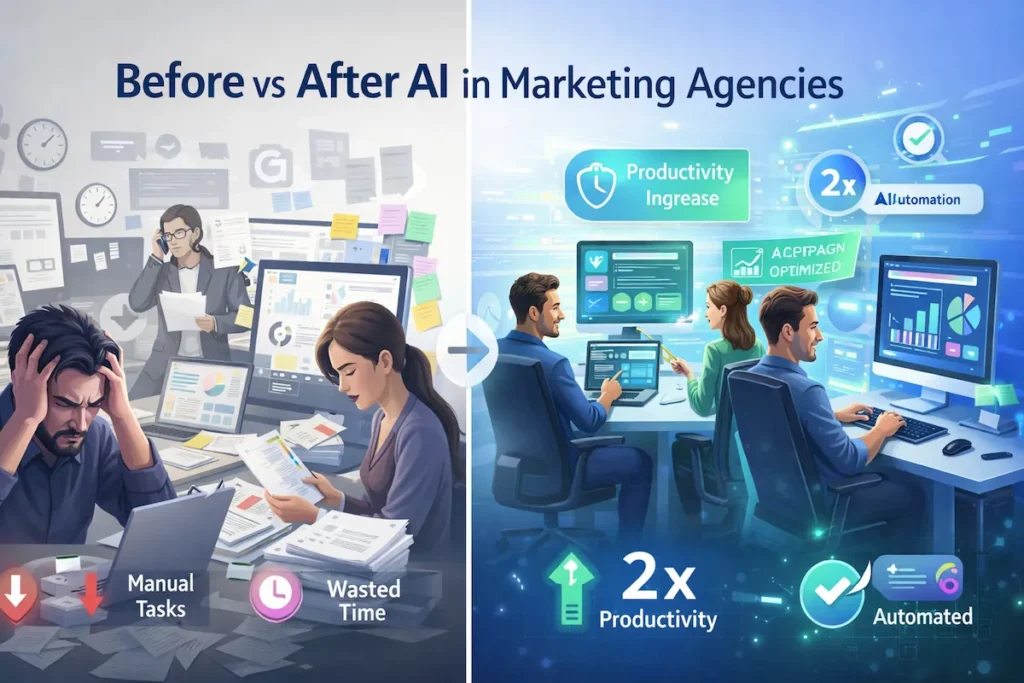
The numbers tell a clear story: agencies using AI marketing software are reporting 30–50% productivity gains across content, ads, and reporting workflows. For agencies billing by the hour or managing dozens of client accounts, that kind of efficiency means more revenue without proportional headcount growth.
According to industry reports, agencies that integrate AI into their workflows consistently outperform competitors in efficiency, campaign performance, and client retention.
Here’s what’s actually driving adoption across U.S. agencies right now:
- Client demand for faster turnaround. Clients expect campaign assets, reports, and optimization recommendations yesterday — not next week.
- Rising labor costs. Hiring skilled copywriters, analysts, and ad managers is expensive. AI-powered marketing solutions let lean teams punch above their weight.
- Increased campaign complexity. Managing multi-channel campaigns across Google, Meta, LinkedIn, and email manually doesn’t scale. AI campaign management tools handle the optimization layer automatically.
- Competitive pressure. If your competitor is using AI workflow automation and you’re not, they can take on more clients at lower cost — and undercut you on price.
Key Stat: HubSpot’s 2025 State of Marketing Report found that 74% of U.S. marketing agencies are now using at least one form of AI marketing software in their daily workflows — up from 38% just two years prior. Industry reports consistently show that agencies using AI-driven marketing tools achieve significantly higher efficiency and campaign performance compared to traditional workflows.
Categories of AI Tools for Marketing Agencies
To build an effective system, agencies must understand how different types of AI tools for marketing agencies support specific workflows like content, SEO, ads, and analytics.
Here’s where most agencies get this wrong: they treat AI like a single product instead of a category. The agencies seeing the biggest gains are building a deliberate stack — one tool per workflow bottleneck. Here’s how to think about the main categories and what each one solves.
AI Content Creation Tools for Marketing Agencies
One of the most widely adopted categories of AI tools for marketing agencies is content generation, helping teams produce blogs, emails, and ad copy at scale.
Many content tools are powered by models developed by OpenAI, enabling faster and more accurate content generation.
These are probably the most widely used category. Tools like Jasper, Copy.ai, and Writer help agencies produce blog posts, ad copy, email sequences, and social captions at scale. They’re particularly effective when trained on a client’s brand voice and existing content. The key isn’t replacing writers — it’s using generative AI marketing tools to produce first drafts your writers can refine in a fraction of the time.
AI SEO Tools for Marketing Agencies
For agencies focused on organic growth, AI tools for marketing agencies in the SEO space provide data-driven insights for keyword research, optimization, and ranking improvements.
This is where AI actually makes — or loses — you real money on organic search. Platforms like Surfer SEO, Clearscope, and Semrush’s AI features help agencies build content strategies backed by real data. These tools analyze competitor content, identify semantic gaps, and generate content briefs that help writers produce pages that actually rank. For SEO-focused agencies, these are among the highest-ROI digital marketing AI platforms available. For a deep breakdown of the top picks, see this guide to AI SEO tools that actually boost rankings in 2026.
AI Social Media Management Tools for Marketing Agencies
Social teams use AI tools for marketing agencies to automate posting, generate captions, and analyze engagement across multiple client accounts efficiently.
Tools like Sprout Social, Publer, and Lately.ai use AI to schedule content, repurpose long-form content into short-form social posts, and analyze what’s performing best for each client. Managing 20+ client social accounts without AI is a grind — with it, a single social media manager can handle the workload of three.
AI Advertising Optimization Tools for Marketing Agencies
Paid media specialists rely on AI tools for marketing agencies to continuously optimize ad spend, improve targeting, and increase ROI across platforms like Google Ads and Meta.
Platforms like Google’s AI-powered advertising solutions automatically optimize campaigns using real-time data.
This is where the dollar impact gets obvious. Platforms like Madgicx, Albert.ai, and Google’s Performance Max continuously test and reallocate ad spend based on real-time performance signals. Instead of manually adjusting bids at the end of the week, AI campaign management tools are making micro-optimizations every hour. That compounds fast when you’re managing significant budgets.
AI Analytics and Data Tools for Marketing Agencies
Modern AI tools for marketing agencies transform raw campaign data into actionable insights, helping teams make faster and smarter decisions. Tools like Google Analytics provide essential data insights that AI platforms can further enhance with predictive analysis.
Reporting is often the biggest time sink for agency account managers. Tools like Tableau with Einstein AI, Looker Studio with AI summaries, and Narrative BI pull data from multiple sources and surface the insights that matter — in plain English. Clients get smarter reports; your team spends less time building spreadsheets.
AI Tools for Marketing Agencies — Category Overview
| Category | Top Tools | Best For | Starting Price |
|---|---|---|---|
| Content Creation | Jasper, Copy.ai, Writer | Scaling content output | $39/mo |
| SEO | Surfer SEO, Clearscope, Semrush AI | Keyword research, optimization | $29/mo |
| Social Media | Sprout Social, Lately.ai, Publer | Scheduling, analytics | $19/mo |
| Advertising | Madgicx, Albert.ai, PMax | Bid optimization | Custom |
| Analytics | Narrative BI, Looker Studio, Tableau AI | Reporting | Free–$70/mo |
AI Tools for Marketing Agencies — Quick Picks
| Use Case | Best Tool | Why |
|---|---|---|
| Best overall | ChatGPT (GPT-4o) | Versatile, fast, works across every channel |
| Best for SEO | Surfer SEO | Content scoring + briefs that rank |
| Best for ads | Madgicx | Real-time bid optimization |
| Best for reporting | Looker Studio | Free and customizable |
| Best for social | Sprout Social | Scheduling + AI suggestions |
| Best for content | Jasper | Brand voice + CMS integration |
| Best free tool | Google Gemini | Research + content ideas |
How Marketing Agencies Use AI Tools in Real Workflows
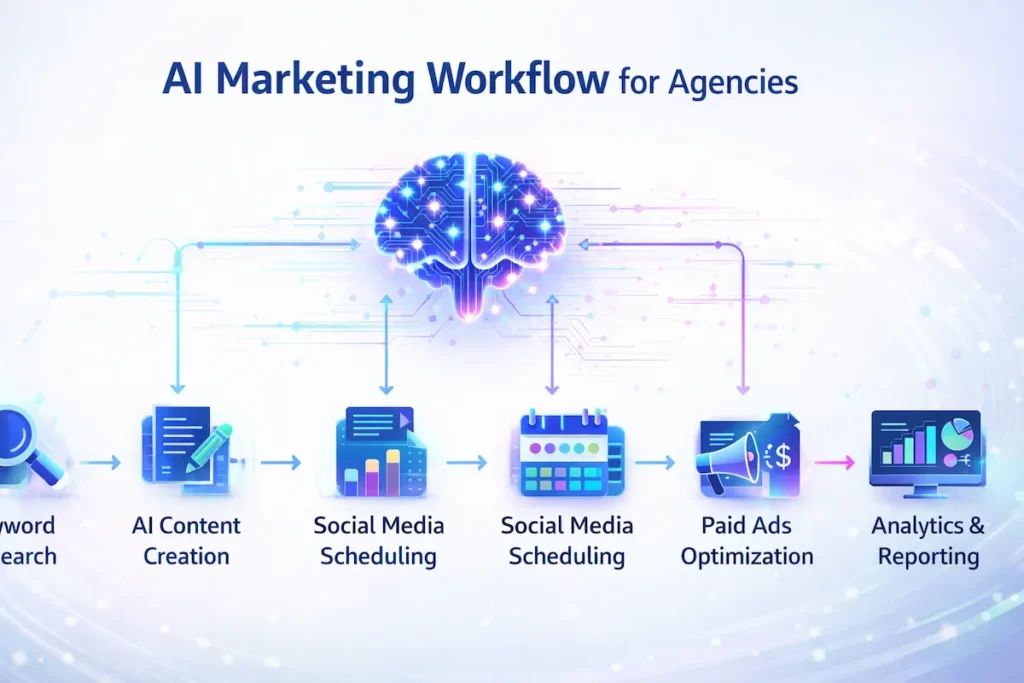
Real-world workflows show how AI tools for marketing agencies integrate across content, ads, and analytics to create a seamless campaign execution process. Automation platforms like Zapier allow agencies to connect multiple tools and build seamless workflows without coding.
Knowing which tools exist is one thing. Understanding how they fit into actual agency workflows is where the real value shows up. Here’s a realistic example from a mid-size U.S. digital agency managing 15 clients:
- Strategy Monday: Account managers use Semrush AI to pull weekly ranking reports and keyword opportunities for each client. Briefing documents are generated with Clearscope.
- Content Tuesday–Wednesday: Writers use Jasper drafts as starting points, editing for tone and factual accuracy. Final pieces go through Surfer SEO for on-page optimization before publishing.
- Ad Creative Thursday: The PPC team reviews AI-generated ad variants from Madgicx, approves the top performers, and pauses underperformers — a process that used to take a full day now takes two hours.
- Reporting Friday: Narrative BI pulls all client dashboards automatically. Account managers spend 30 minutes reviewing and personalizing insights instead of building reports from scratch.
The agencies growing fastest aren’t hiring more people. They’re using AI workflow automation to get dramatically more done with the team they already have.
To understand how AI tools improve search performance alongside agency workflows, see this guide on AI SEO tools for 2026.
How to Choose the Right AI Tools for Your Marketing Agency
Choosing the right AI tools for marketing agencies requires understanding your biggest bottlenecks and selecting platforms that align with your workflow. Most agencies waste money on AI tools they don’t actually need. Buying 10 platforms won’t fix a broken workflow — it’ll just make it more expensive. Here’s a practical framework for choosing well:
- Start with your biggest bottleneck. Is it content production? Reporting? Ad optimization? Pick one problem and solve it before adding more tools.
- Check integration compatibility. The best agency AI stack connects with your existing CRM, project management tool, and ad platforms. A tool that stands alone creates more work, not less.
- Pilot before you commit. Most platforms offer free trials. Run one real client account through the tool for 30 days before buying team licenses.
- Consider your team’s technical comfort level. A powerful but complex tool that nobody actually uses is a waste. Prioritize usability alongside capability.
- Think about client-facing output. Will the AI-generated content, reports, or recommendations reflect well on your agency? Quality control matters — especially for white-label agencies.
Pros and Cons of AI Tools for Marketing Agencies
Like any technology, AI tools for marketing agencies offer significant advantages but also come with limitations that agencies must manage carefully.
Advantages
- Massive time savings on repetitive tasks
- Scale content and campaigns without hiring
- Faster reporting and insight generation
- Better ad performance through continuous optimization
- Competitive edge over non-AI agencies
- Frees senior staff for strategic work
Limitations
- AI content needs human editing for quality
- Tools require onboarding time to set up right
- Subscription costs add up across multiple tools
- Over-reliance can reduce strategic thinking
- Data privacy concerns with client information
- Outputs can feel generic without customization
Best Free AI Tools for Marketing Agencies
Many free options exist, making AI tools for marketing agencies accessible even for small teams looking to automate workflows without high upfront costs.
You can explore a complete list of free AI tools for digital marketing if you’re looking to scale without increasing costs. If your agency also handles affiliate campaigns, these free AI tools for affiliate marketing can significantly improve performance.
Not every valuable AI marketing software option comes with an enterprise price tag. The good news: some of the most useful platforms for agencies are either free or offer meaningful free tiers. For a broader breakdown beyond this list, check out this roundup of the best free AI tools for digital marketing that covers tools suitable for agencies of every size.
| Tool | What It Does | Free Tier |
|---|---|---|
| ChatGPT | Content drafting, brainstorming | Yes (limited) |
| Google Gemini | Research, summarization | Yes |
| Canva AI | Image and design generation | Yes (limited) |
| Looker Studio | Reporting dashboards | Fully free |
| HubSpot AI | Email + CRM automation | Yes |
| Notion AI | Writing + project management | Trial |
AI Tools for SEO Agencies vs. Full-Service Marketing Agencies
The ideal stack of AI tools for marketing agencies varies depending on whether you run an SEO-focused agency or a full-service marketing business.
For a deeper breakdown, explore this guide to AI SEO tools that boost rankings in 2026. If your agency also handles outreach or media campaigns, these AI tools for public relations are worth integrating into your workflow. These tools align with best practices outlined in Google Search Central guidelines for creating helpful, high-quality content.
The right tool mix depends on what kind of agency you run. An SEO-focused agency and a full-service shop have very different needs when it comes to digital marketing AI platforms.
SEO agencies should prioritize: Surfer SEO, Clearscope, Semrush AI, and Ahrefs AI features. These tools directly support the core deliverable — organic rankings — and pay for themselves quickly through improved client results.
Full-service agencies need a broader stack: content generation tools, social media AI, advertising AI, and robust analytics. Full-service shops also often handle PR and reputation management for clients — if that’s part of your service mix, this guide to the best AI tools for public relations covers the top platforms for press releases, media monitoring, and journalist outreach. The challenge is integration — making sure data flows cleanly between tools without creating more manual work than you saved.
How AI Tools Help Marketing Agencies Scale Client Work
Scaling operations becomes significantly easier when agencies implement AI tools for marketing agencies to automate repetitive tasks and increase output. For agencies working with SMB clients, these AI marketing automation tools for small businesses can help deliver scalable solutions.
The traditional agency growth model: more clients = more headcount = more overhead. AI workflow automation changes that math entirely. Here’s how agencies are using AI to scale without proportional hiring:
- Content multiplication: One writer + Jasper can produce 3–4x the content output compared to writing from scratch. That means more value delivered per billable hour.
- Automated reporting: Tools like Narrative BI cut monthly reporting time by 60–80%, freeing account managers to focus on strategy instead of data wrangling.
- Client onboarding: AI tools can rapidly analyze a new client’s existing content, backlink profile, ad account history, and social presence — turning a week-long discovery process into a two-day sprint.
- Campaign templates: Agencies build AI-powered campaign frameworks that can be customized and launched for new clients in hours, not days.
It’s worth noting that the principles behind agency-level AI scaling apply to smaller operations too. If your agency works with small business clients, pointing them toward AI marketing automation tools built for small businesses can actually become a value-add service that differentiates your agency.
Common Mistakes Agencies Make When Using AI Tools for Marketing
Many agencies misuse AI tools for marketing agencies by over-automating workflows or relying on AI without proper human oversight. Adopting AI-powered marketing solutions without a clear strategy leads to wasted spend and poor results. Avoid these common pitfalls:
- Publishing AI content without editing. Unedited AI content is easy for both readers and search engines to detect. Every piece needs a human pass for accuracy, brand voice, and depth.
- Buying too many tools at once. Tool sprawl is real. Start with one or two platforms, master them, then expand your stack strategically.
- Ignoring data privacy. When you feed client data into third-party AI platforms, understand what that data is used for. Review terms of service carefully — especially for healthcare, legal, and financial clients.
- Not training the team properly. An AI tool no one knows how to use is dead weight. Budget time for onboarding and internal training.
- Using AI as a replacement for strategy. AI is exceptionally good at execution. It’s still limited at thinking strategically about what a client actually needs. Keep humans in charge of the “why.”
AI Tools That Integrate With Marketing Agency Workflows
The most effective AI tools for marketing agencies are those that integrate seamlessly with CRM systems, analytics platforms, and marketing automation tools. The most effective AI-powered marketing solutions aren’t standalone islands — they plug directly into your existing agency stack. Here’s how the top platforms connect:
| AI Tool | Key Integrations | Best Agency Use |
|---|---|---|
| Jasper | WordPress, HubSpot, Webflow | Publishing AI content |
| Semrush AI | Google Analytics, Search Console | SEO reporting |
| Sprout Social | Salesforce, HubSpot, Slack | Social management |
| Madgicx | Meta Ads, Google Ads | Ad optimization |
| Narrative BI | GA4, HubSpot, Stripe | Automated reporting |
| Zapier AI | 5,000+ apps | Workflow automation |
Future of AI Tools for Marketing Agencies
The trajectory is clear: the agency AI stack is getting faster, cheaper, and more capable every quarter. The agencies that adapt early will have a compounding advantage — better tools, better workflows, and a growing gap between them and agencies still doing everything manually.
A few developments that will matter for U.S. agencies in the next 12–24 months:
- Agentic AI workflows. The next wave isn’t just AI that answers questions — it’s AI that takes action. Imagine a system that detects a drop in a client’s rankings, identifies the likely cause, and drafts a recovery plan before your Monday morning meeting.
- Multimodal content AI. Tools that generate text, images, video, and audio from a single brief are becoming mainstream. This changes the economics of creative production for agencies significantly.
- AI-native agency operating systems. Platforms like AgencyAnalytics and Vendasta are embedding AI throughout — from client communication to billing — creating end-to-end AI-powered marketing solutions for agencies.
- Personalization at scale. AI that can customize campaigns down to the individual prospect level, across channels, in real time — without a massive team behind it.
Key Takeaway
AI-powered platforms for marketing agencies are no longer optional — they are essential for scaling workflows, improving performance, and staying competitive in modern digital marketing.
Frequently Asked Questions
What are the best AI tools for marketing agencies in 2026?
The best AI tools for marketing agencies depend on your needs. ChatGPT and Jasper are great for content creation, Surfer SEO and Semrush AI are ideal for SEO optimization, Madgicx helps with ad performance, and Looker Studio is excellent for reporting. Most agencies use a combination of tools to build an effective AI workflow.
Are AI tools for marketing agencies worth it?
Yes, AI tools are highly valuable for marketing agencies. They help automate repetitive tasks, improve campaign performance, and save significant time. Many agencies report productivity gains of 30–50% after adopting AI tools in their workflows.
Can AI replace marketing agency teams?
No, AI tools are not designed to replace marketing teams. Instead, they act as productivity enhancers by handling repetitive tasks like content drafting, data analysis, and reporting. Human expertise is still essential for strategy, creativity, and client relationships.
How do marketing agencies use AI tools in real workflows?
Marketing agencies use AI tools across different stages of their workflow. They use AI for keyword research, content creation, ad optimization, social media management, and automated reporting. This allows teams to handle more clients without increasing workload.
Are there free AI tools for marketing agencies?
Yes, many AI tools offer free versions or trials. Tools like ChatGPT, Google Gemini, Looker Studio, and HubSpot AI provide free features that are useful for small agencies. These can be a great starting point before investing in paid tools.
Is AI-generated content good for SEO?
AI-generated content can perform well in SEO if it is properly edited and optimized. Search engines prioritize high-quality, helpful content regardless of how it is created. Agencies should always review AI content to ensure accuracy, depth, and alignment with search intent.
What should agencies consider before choosing AI tools?
Agencies should consider their biggest workflow bottlenecks, budget, integration capabilities, and team expertise. It’s important to choose tools that fit into existing processes and deliver measurable improvements in efficiency and performance.
What is the difference between AI tools and marketing automation platforms?
Traditional marketing automation platforms follow predefined rules, while AI tools analyze data, generate insights, and make dynamic decisions. AI tools are more adaptive and can optimize campaigns in real time without manual input.
Conclusion: Why AI Tools for Marketing Agencies Are Now Non-Negotiable
Ultimately, adopting the right AI tools for marketing agencies is the fastest way to improve efficiency, scale operations, and stay competitive in today’s digital landscape.
The agencies that will dominate U.S. markets over the next five years aren’t necessarily the biggest — they’re the ones smart enough to use an agency AI stack to deliver bigger results with leaner teams. Whether you start with an AI content tool, an automated reporting platform, or an AI ad optimization engine, the key is to start somewhere and build momentum.
Pick one bottleneck. Find the right AI marketing software to solve it. Measure the time saved. Then expand. That’s the approach that turns AI from a buzzword into a genuine competitive advantage for your agency.