

Running an online business sounds like freedom until you’re the one answering support emails at 11 PM, manually uploading articles, chasing leads that went cold, and building the same content brief for the hundredth time.
Most online businesses — whether they’re niche content sites, affiliate plays, SaaS tools, or e-commerce stores — are way more manually operated than they look from the outside. The founder is the system. And that’s a problem.
AI automation for online businesses is no longer optional — it’s becoming the backbone of scalable, sellable digital assets. The operators who’ve implemented it aren’t just saving time. They’re building businesses that look fundamentally different to buyers, brokers, and investors.
In my own workflows and client projects, I’ve seen these systems reduce operational workload by over 50% within the first 60 days of implementation. Not by cutting corners — but by replacing repetitive manual tasks with structured, tested automations that run in the background 24/7.
This article breaks down exactly where you’re probably losing time, which systems to build first, and how doing this makes your business more valuable — whether you’re scaling it or preparing to sell.
Why Operational Efficiency Matters More Than Traffic
When buyers — especially sophisticated buyers on platforms like Empire Flippers — evaluate an online business, they’re not just looking at your traffic graph. They’re trying to figure out how much of the business is you.
High traffic with a lean, documented, automated operation? That’s a premium asset. High traffic but the owner is handling content, support, publishing, outreach, and reporting manually? That’s a risk discount baked into the multiple.
Buyers ask: “How many hours per week does this take to run?” And if the honest answer is 30+ hours of owner-dependent work, that narrows your buyer pool and your valuation ceiling.
Operational efficiency — meaning more output with fewer manual inputs — is directly tied to how attractive and scalable your business appears. Automating even 40–50% of your recurring tasks doesn’t just save you time. It changes the story you tell when you’re ready to sell or raise.
That’s why AI automation for online businesses matters so much in acquisition conversations — it lowers owner dependency and makes performance easier to sustain after the handover.
Where Most Online Businesses Waste Time
I’ve seen this pattern across dozens of content and affiliate sites. The time loss isn’t usually one big thing. It’s death by a thousand small manual tasks that compound week over week.
Content production bottlenecks. Most site owners are still doing keyword research, outlining, writing, editing, formatting, and publishing as completely separate manual steps. That’s 4–6 hours per article if you’re doing it right. Multiply that by 12 posts a month and you’ve got a part-time job just from content.
Manual customer support. Even “simple” sites get FAQs, affiliate questions, product inquiries, and complaints. Without a system, you’re answering the same five questions every week.
Lead handling and follow-ups. If you capture leads through opt-ins, contact forms, or product interest, and you’re manually following up — or worse, not following up at all — you’re losing revenue and wasting time.
Repetitive admin tasks. Scheduling posts, sending weekly reports, updating spreadsheets, sharing content to social, managing team updates — this stuff feels small but it adds up to 5–10 hours a week easily.
This is exactly where AI automation for online businesses creates immediate impact by removing repetitive operational bottlenecks.
AI Automation Systems That Actually Reduce Workload
AI Content Workflow Automation
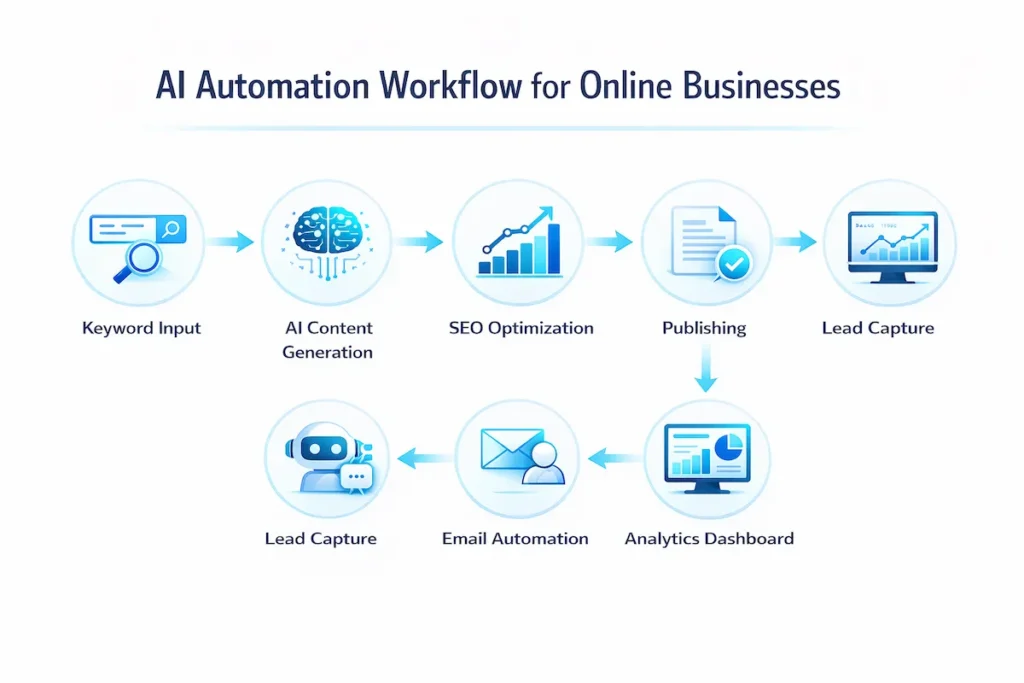
When implemented correctly, AI automation for online businesses transforms content production from a manual process into a scalable system. This is where I’ve personally seen the biggest time savings. The old workflow: find keyword → research → outline → write → edit → format → SEO check → publish. That’s a full day per article.
The new workflow looks like this: pull target keyword from your tracking sheet → push it through a prompt chain in ChatGPT or Claude to generate a structured outline → use that outline to produce a full draft → run the draft through Surfer SEO for on-page optimization → human review and edit → publish.
With a dialed-in prompt system, that process takes about 90 minutes instead of 6–8 hours. That’s not an estimate — that’s what I consistently see when this workflow is set up properly. You go from maybe 4 articles a month to 12–15 without adding headcount.
The human review step matters. AI-written content without a human pass is how you end up with thin, repetitive output that tanks your E-E-A-T signals. But AI assisted content, where a person is steering and editing, is a completely different thing.
Many operators are now building structured workflows similar to what’s described in modern AI marketing automation tools for small businesses — allowing them to scale content production and distribution without increasing headcount or cost per article.
Chatbots and Customer Support Automation
A website chatbot handling your most common questions is one of the easiest wins you can implement this week. Not a clunky old rule-based bot — modern AI-powered chatbots can understand context, pull from your documentation, and hand off to a human when things get complicated.
Here’s a real example: a content site I worked with was getting 40–50 support emails per week. About 70% of those were the same five questions about affiliate discounts, product recommendations, and site navigation. After setting up an AI chatbot trained on their FAQ and product content, that inbox dropped to under 15 emails per week. No new hires. No extra cost beyond the tool subscription.
Response time went from “whenever the owner checks email” to instant. That matters for conversions too — leads that get responses in seconds convert at a dramatically higher rate than those waiting 24–48 hours.
The options available today are significantly more capable than what most people picture when they hear “chatbot.” A detailed breakdown of current solutions — including how to deploy them for different business types — is covered in this complete guide to chatbots for websites in 2026, which walks through platforms, pricing, and implementation without the fluff.
Lead Capture and Follow-Up Automation
If someone opts into your list, downloads your lead magnet, or fills out a contact form and your response is a manual email you send when you remember to — you’re leaving money on the table every single week.
The fix is a simple automated email sequence connected to your CRM. Tools like HubSpot (even their free tier) or a lightweight combo of ConvertKit + Zapier can trigger a 5–7 email nurture sequence the second someone enters your funnel.
You write the emails once. They run forever. And because they’re timed and contextual, they feel more personal than the blast emails most people are sending. I’ve seen email sequences like this generate 20–30% of a site’s affiliate revenue on total autopilot — money the owner didn’t even know they were missing before the system was in place.
Done properly, AI automation for online businesses turns follow-up from a founder-dependent task into a repeatable revenue system that runs whether you’re at your desk or not.
Internal Workflow Automation (SOPs + Task Flows)
At a systems level, AI automation for online businesses ensures that processes continue running smoothly without constant manual oversight.
This is the unglamorous one, but it might be the most important for anyone looking to sell a business. Buyers want to see that operations don’t depend on you specifically.
Tools like Zapier, Make (formerly Integromat), or even simple Notion + automation combos can handle things like: auto-assigning tasks when content enters a new stage, sending Slack alerts when a new lead comes in, publishing scheduled posts across platforms, and generating weekly performance reports without anyone pulling data manually.
When combined with clear written SOPs, these systems mean a new operator — or a buyer — can step in and run the business without a 6-week handover process. That dramatically reduces the perceived risk of acquisition.
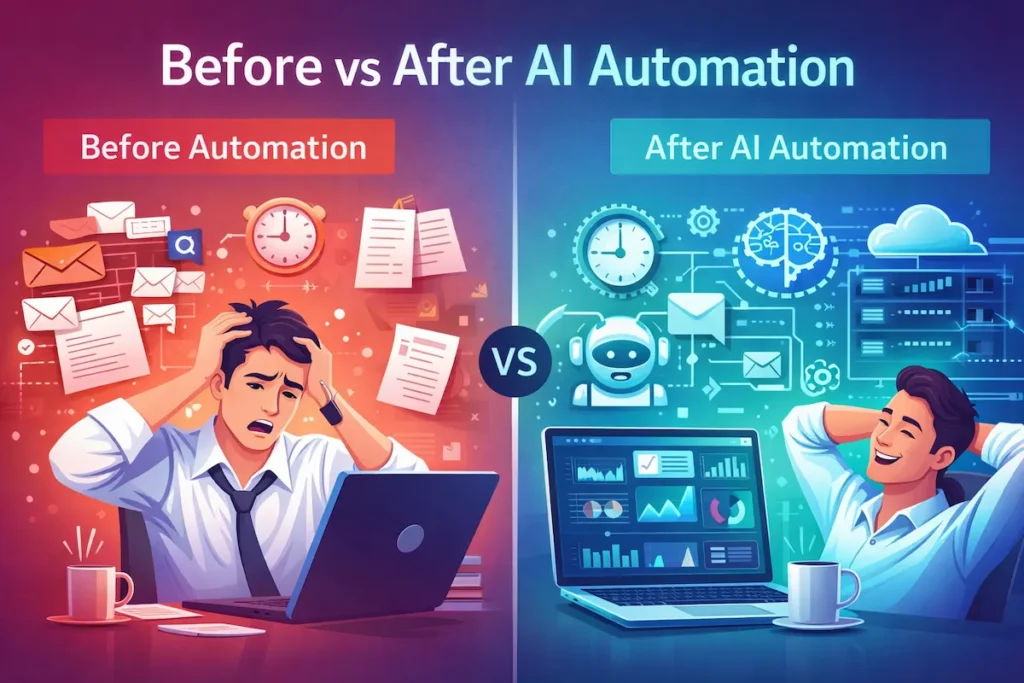
Real Impact: Before vs After AI Automation
Let’s put some numbers on this. These are realistic estimates based on a mid-sized content site doing 10–15 articles per month, with a small team or solo operator.
Based on patterns consistently observed across digital business acquisitions, operators who reduce owner dependency tend to see faster sale timelines and stronger multiples at exit. The numbers below reflect what that shift looks like in practice.
| Task Area | ⏱ Before Automation | ✅ After Automation |
|---|---|---|
| Content production (per article) | 6–8 hours | 1.5–2 hours |
| Customer support (weekly) | 5–7 hours | 1–2 hours |
| Lead follow-up | Manual, inconsistent | Fully automated, instant |
| Admin & reporting | 4–6 hours/week | Under 1 hour/week |
| Total weekly owner hours | 30–40 hours | 10–15 hours |
That’s roughly 20+ hours per week freed up — recovered without firing anyone, without cutting output, and without sacrificing quality. You can redeploy those hours into growth, or you can step further back from day-to-day operations. Either way, that shift is exactly what buyers want to see on a P&L call.

How AI Automation for Online Businesses Makes a Business More Valuable
Here’s how this connects to valuation if you’re thinking about a sale, even years down the road.
A business that runs 30+ owner hours per week gets discounted — buyers factor in the cost of replacing that labor, and many smaller buyers simply can’t commit to that workload. A business that runs 10 hours or fewer per week, with documented systems and automations in place, commands a premium. It’s lower operational risk. Easier handover. Faster path to passive income for the buyer.
“Buyers don’t buy revenue. They buy systems. The easier your business is to hand off, the more it’s worth.”— A principle every serious online business investor understands
Systemized businesses consistently sell at higher multiples. And the specific combination of documented SOPs + AI automation + reduced owner dependency is exactly what sophisticated buyers are looking for right now.
Platforms like Empire Flippers consistently show that businesses with lower operational dependency attract more serious buyers and close faster — because the buyer’s first question is always “how much of this breaks if you leave?”
Common Mistakes When Using AI Automation
A few things I see people get wrong when they first start automating:
Key Pitfalls to Avoid
- Over-automating too fast. Trying to automate everything at once creates fragile systems. Build one thing at a time, get it stable, then layer in the next.
- Publishing raw AI content. Unedited AI output is often thin, repetitive, and easy for Google to identify. Always have a human review layer before anything goes live.
- No oversight or monitoring. Automations break. Chatbots give wrong answers. Email sequences send to the wrong segment. You need to check these systems regularly, not just set and forget.
- Poor integrations. Connecting tools sloppily (without testing edge cases) leads to duplicated data, missed leads, or broken workflows. Map out the logic before you build.
- Ignoring data security. Plugging AI tools into sensitive business data or customer info has real risks that most operators don’t think about until something goes wrong. The intersection of AI and subscriber data — especially in marketing contexts — carries specific vulnerabilities outlined in this resource on AI data security risks in marketing that are worth understanding before you connect new tools to your CRM or email list.
How to Start Implementing AI Automation (Simple Plan)
You don’t need to overhaul everything in a week. Here’s how I’d approach this if I were starting from scratch:
- Audit your week first. Before automating anything, track where you’re actually spending time. Do this for one week. The answer usually surprises people.
- Pick your highest-leverage task. That’s usually content production or support. Start there. Don’t try to automate 5 things at once.
- Build and test one workflow. Set up your AI content workflow or your chatbot. Use it for 30 days. Measure time saved. Refine it.
- Add your lead automation layer. Once content is flowing, set up your email sequences and CRM triggers. This is where you start seeing revenue impact, not just time savings.
- Document everything as you build. Every automation you create should have a written SOP alongside it. This is what turns your work into a transferable asset.
- Review and optimize monthly. Check what’s working, what broke, and what can be tightened. Systems degrade if you ignore them.
The goal isn’t to automate for the sake of it. The goal is to create a business that produces results with less of your direct time involved. That’s the definition of a scalable asset.
Frequently Asked Questions
1. What is AI automation for online businesses?
AI automation for online businesses refers to using tools and workflows powered by artificial intelligence to handle repetitive tasks like content creation, customer support, lead follow-ups, and reporting. Instead of relying on manual work, these systems run in the background, helping businesses scale with less effort.
2. How does AI automation reduce workload in an online business?
AI automation for online businesses reduces workload by replacing time-consuming manual processes with automated systems. Tasks like writing content, responding to customer queries, and sending follow-up emails can be handled instantly, freeing up hours every week.
3. Is AI automation expensive for small online businesses?
Not necessarily. Many AI automation tools offer free or low-cost plans, making AI automation for online businesses accessible even for small teams. Tools like chatbots, email automation platforms, and content assistants can be implemented without a large upfront investment.
4. Does AI automation improve business value before selling?
Yes. AI automation for online businesses significantly improves valuation by reducing owner dependency and making operations more scalable. Buyers prefer businesses that run on systems rather than manual effort, which often leads to higher multiples and faster sales.
5. What are the risks of using AI automation in online businesses?
While AI automation for online businesses offers many benefits, risks include over-reliance on automation, low-quality outputs without human review, and potential data security issues. Proper oversight and system design are essential to avoid these problems.
6. How do I start implementing AI automation in my business?
The best way to start with AI automation for online businesses is to focus on one area first, such as content production or customer support. Build a simple workflow, test it, and gradually expand automation across other parts of your business.
Final Thoughts
Ultimately, AI automation for online businesses is not just about saving time — it’s about building a system that can operate, grow, and sell without relying heavily on the owner. Operational efficiency is one of the most underrated levers in online business. Most owners focus almost entirely on traffic and revenue — which matter, obviously — but ignore the systems layer that determines whether the business is truly sellable, scalable, and sustainable.
AI automation is the fastest path I’ve found to building that systems layer without a massive headcount or infrastructure investment. And when you connect it to real workflows — content, support, leads, operations — the compounding effect over 6–12 months is significant.
The best AI automation for online businesses isn’t the fanciest setup — it’s the one that consistently removes manual bottlenecks without hurting quality or creating new dependencies.
Many of these systems also overlap with broader AI marketing automation workflows, which further compound efficiency gains across content production and customer acquisition — often without adding any new tools to your stack.
You don’t have to do it all at once. Pick the one area that’s costing you the most time right now. Build one clean, tested automation. Let it run. Then build the next one.
Efficiency equals scalability. Scalability equals value. And right now, buyers are paying real premiums for businesses that prove it.
If you’re building an online business with long-term value in mind, start by systemizing just one part of your workflow this week. The earlier you build systems, the easier your business becomes to scale — and eventually, to sell.