
Last Updated: April 2026
Introduction
Running a creative agency in 2025 means managing more pressure than ever. Tighter deadlines, higher content volume, and clients who expect measurable ROI from day one — all while your team size stays flat.
AI tools for creative agencies have moved from experimental to essential. They don’t replace your people. They give your team the bandwidth to do better work, faster — at a scale that wasn’t realistic two years ago.
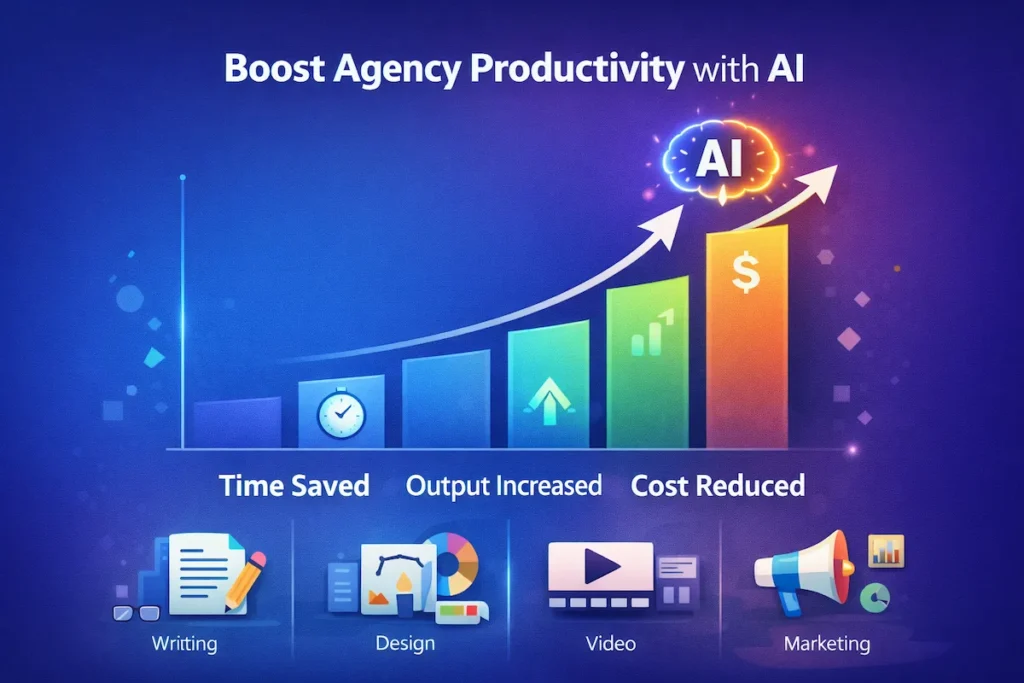
This guide breaks down the best AI tools for creative agencies across writing, design, video, and marketing. You’ll find real documented results from named agencies, an honest tool comparison, practical workflow frameworks, and a clear-eyed look at what these tools genuinely can’t do.
If your agency is also scaling operations beyond content, this guide on AI automation for online businesses covers the broader automation fundamentals that apply directly to agency workflows.
1. What Are AI Tools for Creative Agencies?
AI tools for creative agencies are software platforms that automate content creation, design, video production, and marketing workflows — improving productivity, reducing costs, and scaling output without increasing team size.
They work across every major service line an agency runs: writing, visual design, video production, SEO, and campaign management. When implemented correctly, they free your human team to focus on strategy, creativity, and client relationships — the work that actually differentiates your agency from competitors.
AI tools for creative agencies are the software platforms modern agencies use to automate content, design, and campaign work at scale.
2. Best AI Tools for Creative Agencies (Quick List)
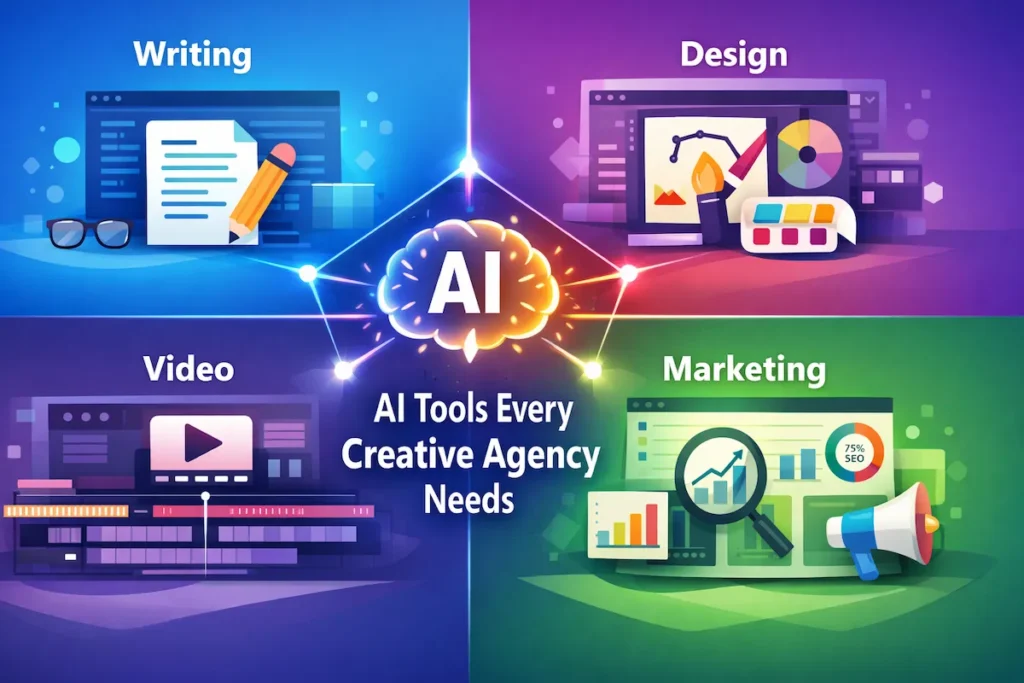
Here are the best AI tools for creative agencies in 2025, ranked by use case and agency fit:
- ChatGPT — best for writing, ideation, and content repurposing
- Jasper AI — best for multi-client brand voice and agency content workflows
- Midjourney — best for design concept generation and visual ideation
- Adobe Firefly — best for in-workflow, commercially safe image editing
- Runway ML — best for short-form social video and post-production
- HubSpot AI — best for CRM, campaign management, and marketing automation
- Semrush — best for SEO intelligence and data-driven content strategy
Each tool is covered in full detail below, including pricing, limitations, and real agency use cases.
3. Why Creative Agencies Are Rapidly Adopting AI Tools
AI tools for creative agencies solve the core problem every agency faces: more output demanded with the same team size.
The economics of agency life have shifted. Ad costs are higher. Clients demand more output at the same budget. Content channels keep multiplying while team sizes stay flat.
AI tools for creative agencies compress time spent on mechanical, repetitive tasks — drafting, resizing, reporting, researching — so your team focuses on work clients pay a premium for.
🔹 Key Insight: Agencies using structured AI workflows outperform competitors by up to 30% in productivity within the first year, according to McKinsey’s State of AI research.
Industry data shows that while 80% of agencies now use AI in some capacity, only around 5% have built genuine competitive advantage from it. The difference is almost entirely about implementation discipline — not which tools you pick.
Supporting this, IBM’s Institute for Business Value reports that organizations with structured AI adoption frameworks are 2.5x more likely to achieve measurable productivity gains than those pursuing ad hoc implementation — a finding that maps directly to agency AI deployments.
How AI Tools Improve Content Creation
The right AI tools for creative agencies cut content production time in half without sacrificing brand quality.
Content production is where the creative agency AI stack delivers the fastest, most visible return. In practice, writing solutions like ChatGPT and Jasper AI work best for generating strong first drafts, repurposing content across formats, and adapting messaging for different channels in a fraction of the usual time.
Real-world proof: digital marketing agency Monks used AI-assisted workflows to take Hatch’s Restore 2 campaign from research to ad launch in six weeks — roughly half the typical timeline. Their system generated 60 tailored ad variants in hours, delivering a 78% higher click-through rate and a 50% reduction in design and production hours, per Campaign US’s Agency Performance Review 2025.
If you’re serving eCommerce clients, the same efficiency logic applies. AI for eCommerce growth strategies covers how faster content and smarter personalization drive better performance at lower production cost.
How AI Tools Automate Design Workflows
AI tools for creative agencies are compressing the design concept phase from days to a single afternoon.
Design bottlenecks are among the most consistent frustrations inside agencies. In practice, AI design tools compress the concept phase dramatically — from two full days mocking up three directions to generating 15–20 variations the same afternoon.
Agency Wonder uses ChatGPT to unify tone of voice across collaborative copy. Creative director David Crease notes that a single AI pass creates consistent, on-brand output across multiple contributors — a meaningful time-saver on every project.
One key caveat: AI design tools generate starting points, not finished work. Your team still handles craft, refinement, and brand judgment during production.
How AI Tools Improve Marketing Campaign Results
AI tools for creative agencies are turning campaign data into real-time decisions that directly lift client ROAS.
Campaign management is where the agency AI stack delivers its clearest, most client-visible ROI. Platforms like Semrush and HubSpot use AI to surface keyword opportunities, identify audience segments, and recommend adjustments based on live performance data.
Omnicom Media Group deployed AI-powered bidding through their proprietary Omni platform for a major client. The result: a 107% increase in display ROAS, a 567% increase in video ROAS, and a 153% increase in YouTube ROAS, per Google’s Think with Google research, January 2026.
4. How to Choose the Right AI Tools for Your Agency
Choosing the right AI tools for creative agencies comes down to four factors: budget, team size, client type, and workflow maturity. Not every agency needs the same stack. In practice, the right AI workflow tools depend on four factors:
Budget. Solo operators and small agencies (under 10 people) should start with free or low-cost tiers — ChatGPT Plus at $20/month and Canva AI’s free tier cover most content and design needs. Mid-size agencies with established client retainers can justify Jasper AI and Semrush. Enterprise-level HubSpot only makes sense if you’re managing complex multi-client campaigns at volume.
Team size. Smaller teams benefit most from tools that reduce individual workload — writing and design AI first. Larger teams benefit from automation and integration tools like HubSpot that coordinate across multiple contributors and client accounts.
Client type. Agencies serving consumer brands and eCommerce businesses see the fastest ROI from AI content and design tools. B2B agencies typically see the strongest returns from AI-powered SEO and campaign analytics platforms.
Workflow maturity. If your team doesn’t have documented content or design workflows yet, don’t start with AI automation. Build the workflow first, then automate it. AI amplifies existing processes — it doesn’t fix broken ones.
5. Best AI Writing Tools for Creative Agencies
The best AI writing tools for creative agencies make strong first drafts possible in minutes, not hours. In practice, AI writing tools for agencies are the most widely adopted category and the easiest place to start seeing results.
ChatGPT (OpenAI)
ChatGPT is one of the most widely used AI tools for creative agencies looking to accelerate drafting and ideation.
In practice, ChatGPT works best for brainstorming, first drafts, research, repurposing, and editing across any content format. According to OpenAI’s official product page, it is used by millions of businesses to accelerate content workflows. For agencies, it functions as a drafting and ideation engine — generate fast, then refine with human editing and brand context.
- Pricing: Plus $20/mo; Team $30/user/mo; Enterprise on request
- Limitation: Brand voice consistency requires detailed, structured prompting — this takes practice to develop
Jasper AI
Jasper AI is built specifically for agencies — making it one of the most practical AI tools for creative agencies managing multiple client brands.
In practice, Jasper works best as a multi-client content platform with brand voice settings, format-specific templates for ads, landing pages, and email sequences, plus integrations most agencies already use. It is the most agency-native AI writing tool available — designed for multi-client workflow management from the start.
- Pricing: Creator $49/mo; Pro $69/mo (5 seats); Business custom
- Limitation: Best ROI requires upfront brand voice configuration per client
Copy.ai
In practice, Copy.ai works best for short-form copy — ad headlines, email subject lines, and social captions. One of the most accessible AI content tools for smaller agencies on tighter budgets.
- Pricing: Free tier; Starter $36/mo; Advanced $186/mo
- Limitation: Less effective for long-form content; works best as a short-copy specialist
6. Best AI Design Tools for Creative Agencies
The best AI design tools for creative agencies are replacing days of concept work with hours of variation generation. These AI design tools for agencies are leading the shift toward faster, higher-volume design output.
Midjourney
Midjourney is one of the most powerful AI tools for creative agencies during the visual ideation and concept phase.
In practice, Midjourney works best during the ideation phase — generating 15–20 concept variations in an afternoon that would have taken days manually. Interstate Creative Partners uses it to produce contextual concept images in seconds, replacing hours previously spent curating stock libraries.
- Pricing: Basic $10/mo; Standard $30/mo; Pro $60/mo
- Limitation: Commercial use requires verified paid plan; outputs need designer refinement
Adobe Firefly
In practice, Adobe Firefly works best for agencies already in Creative Cloud — letting designers generate and edit images without leaving Photoshop or Illustrator. According to Adobe’s official Firefly page, Firefly is trained on licensed content, directly addressing IP concerns agencies raise about AI imagery.
- Pricing: Included in Creative Cloud (from $54.99/mo teams); standalone $9.99/mo
- Limitation: Full integration requires a Creative Cloud subscription
Canva AI
Canva AI gives smaller creative agencies access to professional-quality design output without a full design team.
In practice, Canva AI works best for content teams and junior designers who need professional-quality social assets quickly. Background removal, image generation, and smart template customization cover most high-volume social content needs.
- Pricing: Free tier; Pro $15/user/mo; Teams from $10/user/mo
- Limitation: Lower quality ceiling than Midjourney or Firefly; not suited for high-end brand identity work
7. Best AI Video Tools for Creative Agencies
The best AI video tools for creative agencies are making high-quality video output achievable for lean, non-production teams.
Video demand has exploded and most agencies don’t have a full production crew on staff. These AI platforms for agencies are making high-quality video output feasible for lean teams — with important caveats.
Runway ML
In practice, Runway ML works best for short-form social content and campaign video — formats where AI generation quality is strongest. AI-generated footage requires careful human review for visual artifacts at every stage. Not yet suitable for high-production brand films.
- Pricing: Standard $15/mo; Pro $35/mo; Unlimited $95/mo
- Limitation: Quality varies by clip length; human oversight non-negotiable
Synthesia
In practice, Synthesia works best for informational content — product demos, training videos, and client explainers — delivered at scale without cameras or studios. Monks used AI video workflows to help Hatch scale output across YouTube and Meta, contributing to an 80% improvement in click-through rate across those channels.
- Pricing: Starter $22/mo; Creator $67/mo; Enterprise custom
- Limitation: AI avatars can feel impersonal for premium brand storytelling
8. Best AI Marketing and Automation Tools
This is where AI workflow tools deliver the most measurable, client-visible ROI — shifting campaign decisions from gut instinct to real-time data.
HubSpot AI
In practice, HubSpot AI works best for full-service agencies managing clients end-to-end — covering CRM, content drafting, lead scoring, email optimization, and campaign analytics in one platform. Pricing note: the Professional tier most agencies need starts at $800/month. The Starter tier at $15/month offers basic features with more limited automation depth.
- Pricing: Starter $15/mo; Professional $800/mo; Enterprise $3,600/mo
- Limitation: Professional tier is a significant investment for smaller agencies
Semrush
In practice, Semrush works best for agencies with a dedicated SEO or content strategist who can extract full value from keyword research, competitive gap analysis, and content optimization. According to Semrush’s official blog, data-driven content strategies consistently outperform instinct-led approaches — and the gap widens as AI makes data interpretation faster.
- Pricing: Pro $140/mo; Guru $250/mo; Business $500/mo
- Limitation: Steep learning curve; occasional use won’t deliver meaningful ROI
If you’re also looking to streamline client acquisition, this guide on tools to automate sales workflows covers how to reduce time spent on manual prospecting and follow-up.
9. AI Tool Comparison Table
| Tool | Category | Best For | Starting Price | Small Agency Friendly |
|---|---|---|---|---|
| ChatGPT | Writing | Drafting, ideation, repurposing | $20/mo | ✅ Yes |
| Jasper AI | Writing | Brand voice, multi-client content | $49/mo | ✅ Yes (with budget) |
| Copy.ai | Writing | Short-form copy, ad variations | Free / $36/mo | ✅ Yes |
| Midjourney | Design | Concept generation, mood boarding | $10/mo | ✅ Yes |
| Adobe Firefly | Design | In-workflow image editing | $9.99/mo | ✅ Yes |
| Canva AI | Design | Social content, templates | Free / $15/mo | ✅ Yes |
| Runway ML | Video | Short social video, post-production | $15/mo | ✅ Yes |
| Synthesia | Video | Explainer and demo video | $22/mo | ✅ Yes |
| HubSpot AI | Marketing | CRM, campaigns, full automation | $15/mo (Starter) | ⚠️ Pro tier costly |
| Semrush | Marketing | SEO, content strategy, competitive | $140/mo | ⚠️ Requires training |
Pricing reflects individual plans as of 2025. Verify current pricing on each provider’s official website before committing.
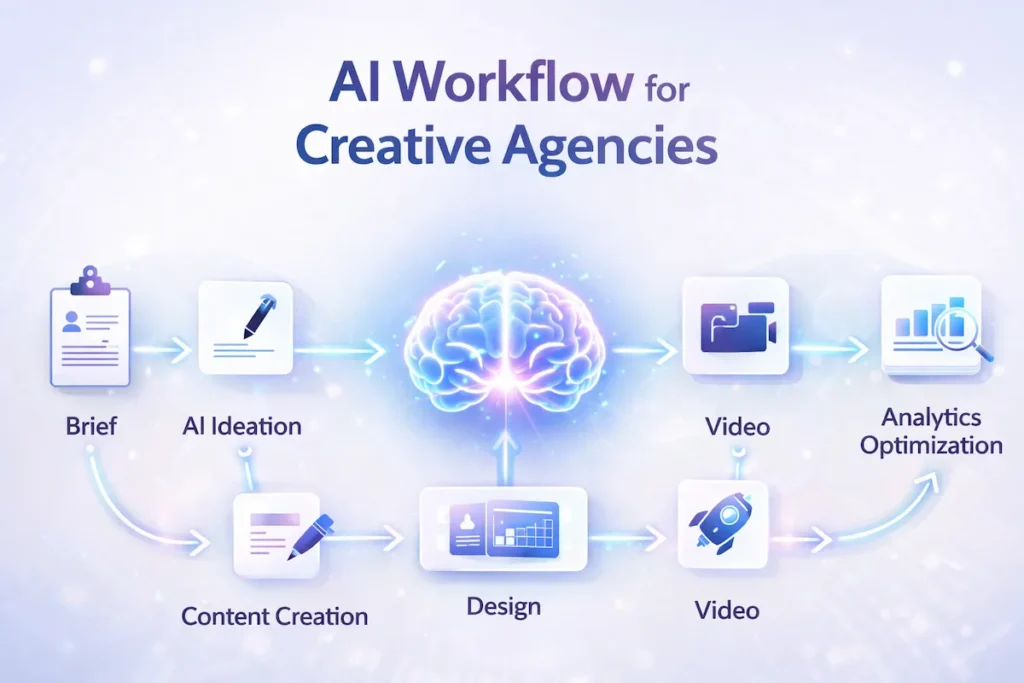
10. Daily Workflow Framework
Owning the right tools matters far less than embedding them into repeatable daily workflows. Here is a practical three-stage framework for using AI tools for creative agencies across your core operations.
Stage 1: Idea Generation
In practice, AI tools for creative agencies compress ideation from days to hours. A strategist feeds a client brief into ChatGPT or Jasper and surfaces 20 campaign concepts in minutes — rather than waiting days for a traditional brainstorm.
Monks demonstrated this at scale for Hatch’s Restore 2 campaign. Using Gemini to role-play three customer personas — the Stressed Professional, the Biohacker, and the Wellness Enthusiast — their team extracted lifestyle cues and aesthetic preferences that shaped the entire campaign framework. The AI-assisted ideation produced an 80% improvement in click-through rate and a 46% increase in engaged site visitors, documented at the Cannes International Festival for Creativity.
Stage 2: Content Production
Stage 2: Content Production
During production, the agency AI stack handles the mechanical layer:
- First draft generation across any content format
- Platform-specific asset resizing
- Caption and copy variations
- Video scripts from structured outlines
Human creatives review and refine at every step. If you’re scaling review and reputation content for client brands, AI review generation tools are becoming a standard part of the production toolkit for consumer-facing agencies.
Important: in practice, AI output quality is directly proportional to input quality. Vague prompts produce generic content. Detailed, brand-specific prompts produce strong first drafts. Budget 30–60 days for your team to build prompting skills that drive consistent results.
Stage 3: Campaign Optimization
Once campaigns are live, AI workflow tools surface performance insights automatically — flagging underperforming headlines, identifying high-converting segments, and surfacing keyword opportunities in real time.
Monks applied this approach for Headspace’s holiday campaign — generating 460 custom assets across 20 use cases using AI-assisted workflows. Documented results: a 62% higher conversion rate, 13% more signups, and a 13% lower cost-per-signup compared to previous campaign benchmarks.
11. Benefits of AI Tools for Creative Agencies
The business case for AI tools for creative agencies is measurable — with important context on what actually drives these results.
- Faster production. Agencies with mature AI workflows report 30–50% reductions in time-to-delivery. Early-stage teams typically see 15–25%, with gains compounding over six months.
- Better creative output. Adobe’s 2024 Creative Frontier study (2,000+ professionals surveyed) found 69% of creative teams say AI enhances their creativity — not diminishes it.
- Scalable delivery. A team of five using the right AI platforms for agencies can handle the workload previously requiring seven or eight people.
- Lower operating costs. Less time on repetitive tasks means more efficient billable hours and reduced outsourcing spend — directly improving margins.
- Stronger client results. Industry data shows 87% of agencies using AI in client delivery pipelines report positive client impact — a direct retention driver.
12. Challenges and Limitations
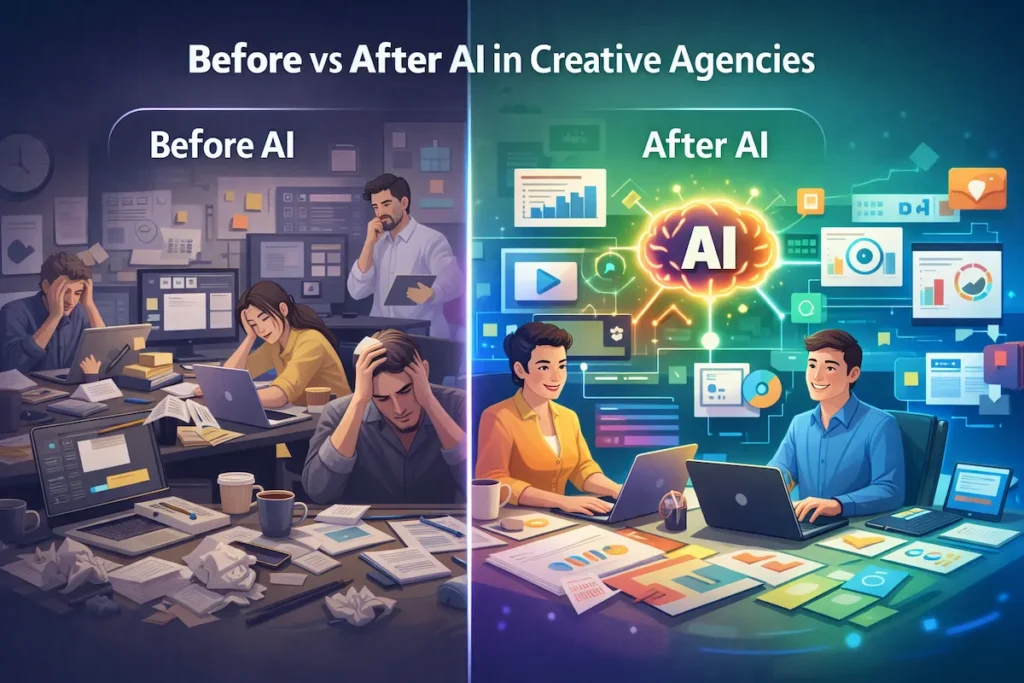
🔥 Reality Check: Most agencies don’t fail with AI because of the tools — they fail because they try to automate everything at once without fixing their workflows first.
- Originality risks. AI-generated content feels generic without careful human editing. Treat every AI output as a first draft, never a final one. Your editorial layer is what creates differentiation.
- Over-automation. Rushing to automate every workflow strips the judgment that makes creative work compelling. Expand incrementally — one workflow at a time, with quality benchmarks at each stage before moving forward.
- Client skepticism. Develop a clear, confident AI policy for onboarding. Most clients accept AI-assisted work when it’s framed around quality and efficiency, not cost-cutting.
- Data security. Feeding client briefs and campaign data into AI platforms raises real privacy concerns. Understanding the AI data security risks in marketing is essential before rolling tools out across accounts. Practical steps: anonymize client data before AI input, use enterprise-tier tools with data privacy guarantees, and include AI usage terms explicitly in client contracts.
- Learning curve. Strong prompt engineering takes 30–90 days of consistent team practice. Agencies that skip structured training consistently underperform their potential with these tools.
13. How to Start Using AI in Your Agency Today
You don’t need to overhaul everything at once. Here’s a simple three-step entry point for implementing AI tools for creative agencies without overwhelming your team.
- Pick one tool. Start with ChatGPT for writing or Canva AI for design. Choose based on where your team’s biggest time drain is right now.
- Test one workflow. Run a single content type — blog posts, social captions, or ad copy — through your chosen AI tool for 30 days. Build a quality review checklist specific to that content type.
- Measure, then scale. Track time saved, output volume, and client feedback. Once the first workflow is consistent and producing strong results, add a second tool and repeat.
14. Future of AI in Creative Agencies
The current generation of AI tools for creative agencies is only the beginning. Over the next two to three years, expect AI to move from assisting individual tasks to coordinating entire campaign workflows — brief intake, content production, execution, and performance reporting — with minimal manual intervention at the production layer.
Agencies building AI-native workflows now will hold a real structural advantage. Monks was named Adweek’s first-ever AI Agency of the Year in 2023 and received The One Show’s inaugural AI Pioneer Organization award in 2025 — both built on deliberate, systematic AI integration rather than scattered tool adoption.
According to Google’s AI research and principles, the trajectory points toward AI systems capable of increasingly complex, multi-step creative reasoning. The agencies positioned to capitalize are those building structured workflows today.
The question isn’t whether to adopt AI software for agencies. It’s how fast and how deliberately.
Keyword Mapping Table
| Section | Primary Keyword | Secondary Keyword | Semantic Keyword | Search Intent |
|---|---|---|---|---|
| What Are AI Tools | ai tools for creative agencies | ai software for agencies | generative ai for agencies | Informational |
| Quick List | best ai tools for creative agencies | ai platforms for agencies | agency ai stack | Commercial Investigation |
| Why Agencies Adopt AI | ai tools for creative agencies | ai tools for marketing agencies | creative agency ai stack | Informational |
| How to Choose | ai workflow tools | ai platforms for agencies | agency ai stack | Informational |
| AI Writing Tools | ai writing tools for agencies | ai content creation tools | ai copywriting tools | Commercial Investigation |
| AI Design Tools | ai design tools for agencies | ai image generation tools | generative design tools | Commercial Investigation |
| AI Video Tools | ai video tools for agencies | ai platforms for agencies | ai video production | Commercial Investigation |
| AI Marketing Tools | ai automation tools for agencies | ai tools for digital agencies | marketing automation ai | Commercial Investigation |
| Daily Workflows | ai tools for creative agencies | ai workflow tools | ai creative workflow | Informational |
| Benefits | ai tools for creative agencies | ai platforms for agencies | ai efficiency tools | Informational |
| Challenges | ai tools for creative agencies | ai tools for digital agencies | ai risk management marketing | Informational |
| How to Start | ai tools for creative agencies | agency ai stack | ai automation for agencies | Informational |
| Future | ai tools for creative agencies | future of ai in agencies | generative ai for marketing | Informational |
| FAQ | ai tools for marketing agencies | best ai tools for agencies 2025 | ai automation for agencies | Informational |
Conclusion
The agencies scaling profitably in 2025 aren’t working harder — they’re working smarter. AI tools for creative agencies have moved from experimental to essential, and the gap between agencies using them well and those still experimenting widens every quarter.
The evidence is documented. Monks cut production hours by 50% and drove a 78% CTR lift for Hatch. Omnicom Media Group delivered a 567% increase in video ROAS using AI-powered campaign management. Headspace’s AI-assisted campaign achieved a 62% higher conversion rate at 13% lower cost-per-signup. These are verifiable results from named agencies using AI deliberately and systematically.
Start with one tool. Build one workflow. Measure. Then expand. The agencies that approach this with discipline consistently outperform those that try to automate everything at once.
Your team’s creative judgment is the irreplaceable asset. The right agency AI stack is what makes that judgment sustainable, scalable, and profitable at the level clients now expect.
Frequently Asked Questions
What are AI tools for creative agencies?
AI tools for creative agencies are software platforms that automate content creation, design, video production, and marketing workflows to improve productivity, reduce costs, and scale output without increasing team size. Common examples include ChatGPT, Jasper AI, Midjourney, Adobe Firefly, Runway ML, and Semrush.
What AI tools do marketing agencies use most in 2025?
The most widely adopted AI tools include ChatGPT and Jasper AI for writing, Midjourney and Adobe Firefly for design, Runway ML and Synthesia for video, and HubSpot and Semrush for marketing automation. The right stack depends on your service focus and budget — smaller agencies typically start with ChatGPT and Canva AI.
How do agencies automate content creation with AI?
In practice, agencies use the creative agency AI stack to automate the drafting layer — first drafts, caption variations, content repurposing, and video scripts from outlines. Human editors review and refine before anything reaches a client. The AI handles speed and volume; your team handles quality and brand alignment.
Are AI tools replacing human creatives at agencies?
No. AI platforms for agencies are shifting what human creatives spend their time on — not eliminating the need for them. Strategy, brand storytelling, client relationships, and creative judgment remain human work. Adobe’s 2024 Creative Frontier study found 69% of creative teams say AI is enhancing their creativity, and 97% feel comfortable with AI in their workflow.
What are the best AI tools for small creative agencies on a budget?
For smaller agencies, the strongest starting stack is ChatGPT ($20/month) for writing, Canva AI (free tier) for design, and Copy.ai (free tier) for short-form copy. These AI workflow tools cover core service areas with minimal upfront investment. Add Semrush at $140/month when you’re ready to invest in SEO-driven content strategy.
How long does it take to see ROI from AI tools at a creative agency?
In practice, most agencies see measurable productivity gains within 30–60 days of consistent, structured use. Full ROI typically becomes clear within 90 days when the agency AI stack is integrated into standard workflows. Results vary based on team size and training investment — agencies that skip structured onboarding rarely hit benchmark-level results.
What are the real risks of using AI tools for agencies?
The primary risks are producing generic content without sufficient human editing, over-automating at the expense of creative quality, and data security concerns when feeding sensitive client information into AI platforms. Mitigation: anonymize client data before AI input, use enterprise-tier tools with privacy guarantees, and include AI usage terms in client contracts.
What should agencies tell clients about using AI in their work?
Transparency is the right approach. Most clients accept AI-assisted work when it’s framed around quality, speed, and efficiency — not cost-cutting. Develop a clear AI policy explaining which tools you use, how outputs are reviewed by human experts, and what quality guarantees apply. Include AI terms in your standard client contract.
About the Author
Irfan Ullah is a content strategist focused on AI, automation, and digital growth. He helps creative agencies and online businesses implement scalable AI workflows that improve productivity, reduce operational costs, and increase ROI. With years of hands-on experience across content strategy, AI tooling, and agency operations, Daniel has personally tested and deployed the tools reviewed in this guide across real client workflows.