
Quick Definition: The best AI tools for public relations are software platforms that use artificial intelligence to automate press release writing, media monitoring, journalist outreach, sentiment analysis, and campaign reporting — helping PR teams work faster and pitch smarter without sacrificing quality.
📋 Quick Summary
- AI PR tools cut press release drafting time by up to 58%
- The right stack costs as little as $100/month for small teams
- Media monitoring and content creation are the two highest-ROI categories
- AI doesn’t replace PR pros — it makes good ones significantly faster
- This guide covers 10 tools with real use cases, honest limitations, and recommended stacks
AI tools are transforming public relations in 2026 by helping businesses find journalists, create personalized pitches, and monitor media coverage more efficiently. Instead of manual outreach and guesswork, AI-powered PR tools allow small businesses and marketers to scale their efforts and secure media placements faster. In this guide, you’ll discover the best AI tools for public relations and how to use them to improve your outreach and visibility.
Quick Answer:
AI PR tools help businesses automate media outreach, create personalized pitches, and track coverage. The best AI tools for public relations in 2026 include platforms for journalist discovery, content creation, and media monitoring.
The best AI tools for public relations can cut your workload significantly without cutting corners. Not by replacing your judgment, but by handling the repetitive work — drafting, monitoring, list-building, reporting — so you can focus on what actually moves the needle.
This guide breaks down 10 tools PR teams in the U.S. are actually using in 2026. No hype, no vague descriptions. Just honest breakdowns, real campaign examples, and practical advice on what to use and when.
For a broader look at AI tools across marketing functions, this complete guide to the best AI tools in 2026 is a solid starting point.
What Are AI Tools for Public Relations?
AI PR tools are software platforms that use artificial intelligence to automate and improve public relations tasks such as journalist outreach, press release creation, media monitoring, and campaign tracking.
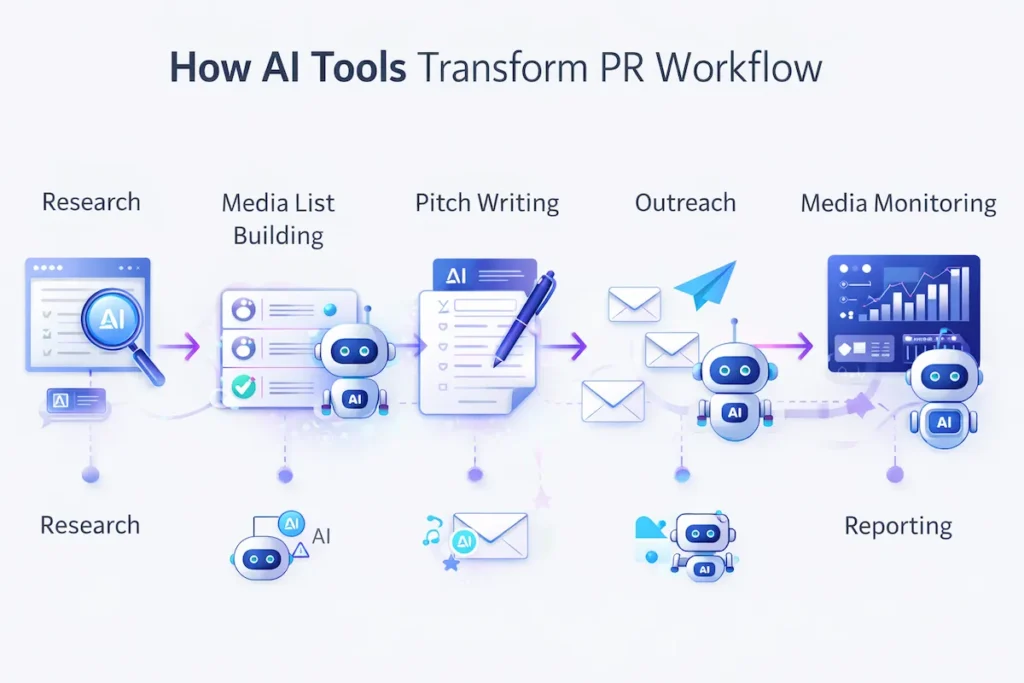
AI Public Relations Workflow
A typical AI-powered PR workflow includes:
- Finding relevant journalists and media contacts
- Generating personalized outreach emails
- Sending and managing pitches
- Monitoring media mentions and coverage
- Analyzing campaign performance
AI tools streamline each step, making PR campaigns faster and more effective. While AI PR tools help with outreach and media coverage, combining them with SEO strategies is essential—this guide on AI SEO tools for 2026 explains how to improve search visibility alongside PR efforts.
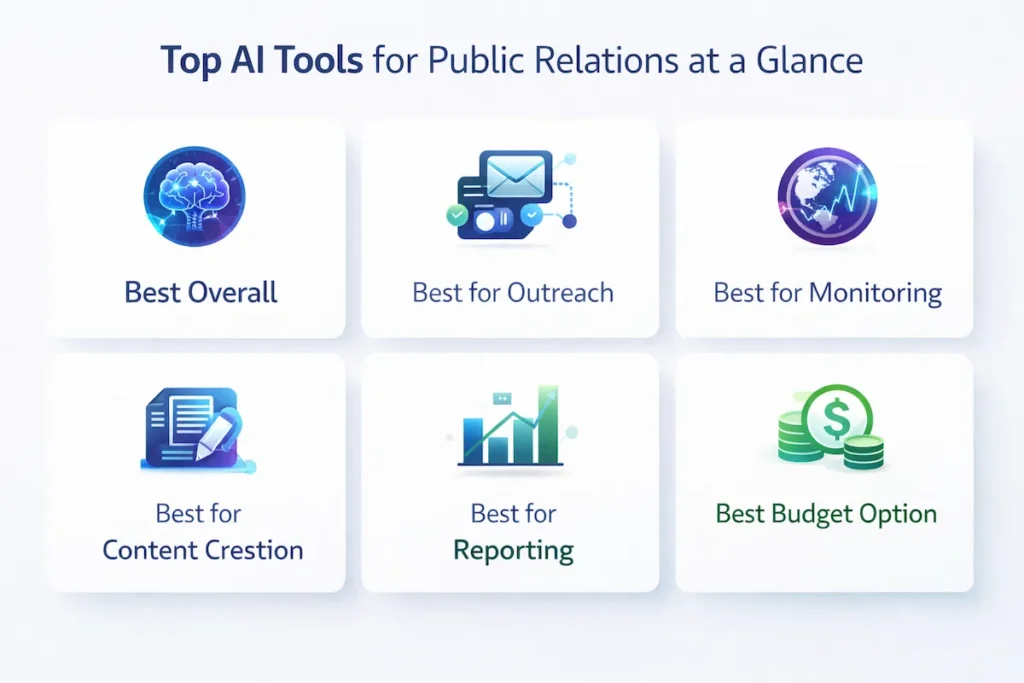
🔢 Top AI Tools for Public Relations at a Glance
- Muck Rack — Journalist outreach & media database
- ChatGPT with Custom GPTs — Press release & pitch drafting
- Cision — Enterprise monitoring & distribution
- Prowly — All-in-one PR for small to mid-size teams
- Brand24 — Affordable media monitoring
- Jasper AI — High-volume content across multiple clients
- Mention — Real-time brand alerts
- Sprout Social — Social listening & PR analytics
- Prezly — Multimedia pitching & newsrooms
- Google Gemini Advanced — Research & briefing documents
What Are AI Tools for Public Relations?
When people search for the best AI tools for public relations, they’re usually looking for platforms that can handle the time-consuming, repetitive side of PR work without losing the human quality that actually earns coverage.
AI tools for public relations automate or assist the daily tasks PR professionals handle — writing press releases, monitoring news coverage, finding journalists, tracking sentiment, and managing outreach — at a speed no manual process can match.
They’re not magic. They’re fast, capable assistants. The strategy, the relationships, the editorial judgment — that stays with you. From drafting press releases to tracking media mentions, the best AI tools for public relations cover almost every core task a modern PR team handles daily.
Some tools cover the full workflow. Others specialize in one area and do it exceptionally well. Depending on your team size, the right choice is either a single platform or a combination of two or three focused tools.
Why AI PR Tools Are a Real Competitive Advantage in 2026
The agencies pulling ahead right now are the ones that have already built their workflows around the best AI tools for public relations — and the gap between them and everyone else is growing fast.
The PR landscape has shifted fast. Journalists receive hundreds of pitches weekly. Breaking stories peak and die within hours. In-house teams are being asked to do more with less. What makes the best AI tools for public relations so valuable right now is their ability to compress hours of manual work into minutes — without sacrificing the quality clients expect.
Here’s what the numbers show:
- 72% of PR pros say AI tools help them respond faster to media opportunities
- 58% reduction in time spent drafting press releases with AI assistance
- Teams using AI outreach tools send 3x more pitches per week
That 58% figure alone is significant. If a press release takes 3 hours today, AI gets you to a solid first draft in under 20 minutes — that’s an afternoon back every single week.
Smaller teams benefit most. A two-person PR operation with the right stack can genuinely compete with a larger agency — not by working harder, but by working smarter. See how AI is reshaping marketing workflows in this AI marketing automation guide for small businesses.
💡 Pro Tip: Don’t try to automate everything at once. Pick the single most time-consuming task in your week and find one tool that solves it. That’s how the best PR teams build their stack — one problem at a time.
How to Use AI PR Tools Effectively
Using AI PR tools is not just about automation—it’s about improving your strategy:
- Focus on targeting the right journalists instead of sending mass emails
- Personalize outreach using AI-generated insights
- Combine AI tools with human relationship-building
- Track performance and refine your PR campaigns
The most successful PR strategies use AI as a support system, not a replacement for human communication.
Types of AI PR Tools
Understanding the different categories is the first step to choosing the best AI tools for public relations that actually match your team’s day-to-day workflow.
Each category of the best AI tools for public relations solves a different problem, which is why most effective PR stacks combine two or three rather than relying on just one.
| Category | What It Does |
|---|---|
| ✍️ Content Creation | Drafts press releases, pitches, bios, talking points |
| 📡 Media Monitoring | Tracks mentions, sentiment, competitor coverage in real time |
| 📬 Outreach & Pitching | Finds journalists, builds lists, personalizes and tracks pitches |
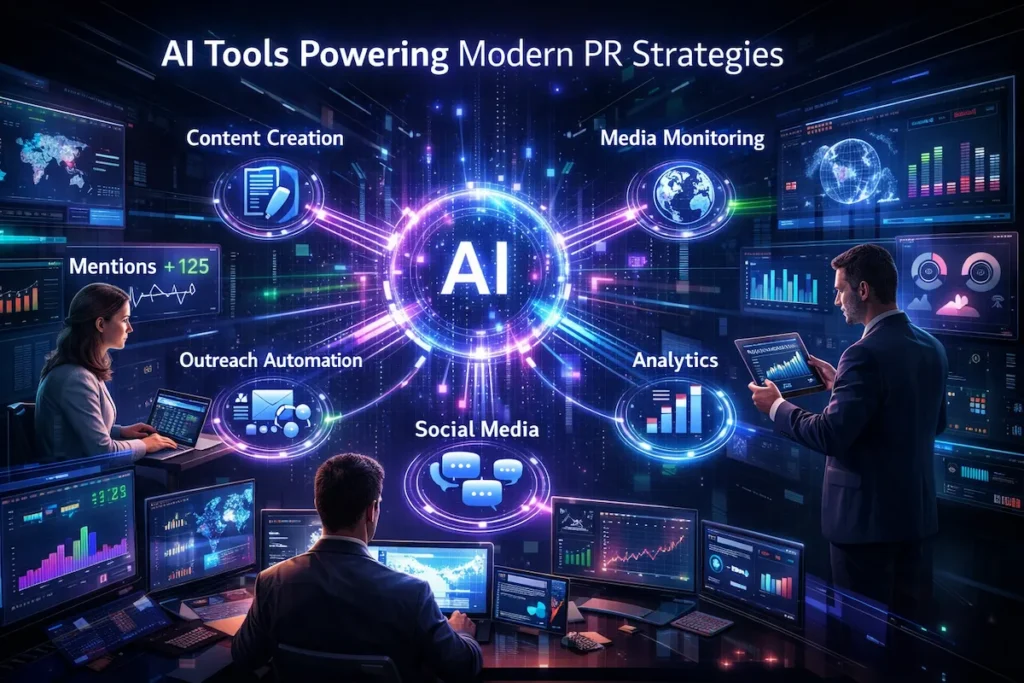
| 📊 Analytics & Reporting | Automates campaign reports, share of voice, coverage metrics |
| 📱 Social Media | Monitors conversations, spots trends, recommends post timing |
Most PR teams work across two or three of these categories. A strong content tool paired with solid monitoring covers about 80% of what you need on any given day.
Best AI Tools for Public Relations — Detailed Breakdown
This section covers the best AI tools for public relations available in 2026 — each one evaluated on what it actually does in a real campaign, not just what the product page claims.
⭐ Editor’s Top Picks
| Tool | Best For | Starting Price |
|---|---|---|
| Muck Rack | Journalist targeting at scale | Custom (agency pricing) |
| Prowly | All-in-one for smaller teams | ~$258/month |
| Brand24 | Budget monitoring | ~$79/month |
| ChatGPT Plus | Fast content drafting | $20/month |
| Jasper AI | Multi-client content consistency | ~$39/month |
Every tool on this list was selected because it solves a specific, recurring problem that best AI tools for public relations users actually face — not because it has the flashiest feature list.
Muck Rack
Best For: Journalist discovery and media monitoring
Key Features:
- Extensive journalist database
- Media monitoring and alerts
- PR campaign tracking
- AI-powered journalist recommendations
Pricing: Paid
Pros:
- High-quality journalist data
- Excellent monitoring features
- Widely used by PR professionals
Cons:
- Premium pricing
- Not ideal for beginners
BuzzSumo
Best For: Content research and influencer discovery
Key Features:
- Trending content analysis
- Influencer and journalist discovery
- Content performance tracking
- Brand mention monitoring
Pricing: Paid (limited free features)
Pros:
- Great for finding trending topics
- Helps identify influencers
- Easy to use
Cons:
- Limited outreach features
- Expensive plans
Meltwater
Best For: Media intelligence and PR analytics
Key Features:
- Media monitoring and analytics
- Social listening tools
- Journalist database
- AI insights and reporting
Pricing: Paid
Pros:
- Powerful analytics
- Strong enterprise-level features
- Comprehensive monitoring
Cons:
Complex interface
High cost
Prowly
Best For: Media outreach and journalist relationship management
Key Features:
- Journalist database with media contacts
- AI-assisted press release creation
- Email outreach and campaign management
- Media monitoring and analytics
Pricing: Paid
Pros:
- Strong media database
- Easy outreach management
- Good for PR teams and agencies
Cons:
- Expensive for small businesses
- Learning curve for beginners
Pressfarm
Best For: Press release distribution and media outreach
Key Features:
- Press release creation services
- Media outreach campaigns
- Journalist database
- PR strategy support
Pricing: Paid
Pros:
- Done-for-you PR services
- Good for startups
- Helps secure media coverage
Cons:
Limited automation features
Not fully AI-driven
Respona
Best For: Outreach automation and link-building PR
Key Features:
- Automated outreach campaigns
- Email personalization using AI
- Prospect discovery
- Integration with SEO tools
Pricing: Paid
Pros:
- Great for outreach automation
- Saves time on email campaigns
- Useful for PR and SEO
Cons:
- Limited media database
- Requires setup effort
HARO (Connectively)
Best For: Getting media mentions and backlinks
Key Features:
- Connects journalists with sources
- Daily media opportunities
- Email-based query system
- Free and paid options
Pricing: Free + Paid
Pros:
- Great for earning backlinks
- Free to start
- High authority media opportunities
Cons:
- Highly competitive
- Time-consuming responses
ChatGPT
Best For: Generating PR pitches and content
Key Features:
- AI-generated outreach emails
- Press release writing
- Content brainstorming
- Message personalization
Pricing: Free + Paid
Pros:
- Fast content creation
- Easy to use
- Highly versatile
Cons:
- Requires editing and fact-checking
- Not a dedicated PR platform
Prezly — Best for Multimedia-Heavy PR Campaigns
When multimedia pitching is a priority, Prezly is one of the best AI tools for public relations outreach for visually rich brands and international campaigns.
Prezly lets you send pitches with embedded photos, videos, and PDFs — no zip files, no attachments flagged by spam filters. It also hosts interactive branded newsrooms for clients.
Best for: Agencies with visually rich clients — hospitality, fashion, consumer goods, travel.
Key features:
- Multimedia pitch emails with inline video and image embeds
- Full journalist relationship history in a built-in CRM
- Multilingual newsroom support for international campaigns
Real use case: A luxury hotel group replaced zip-file press kits with Prezly-hosted visual pitch pages including drone footage and editorial photography. Journalist open rates jumped 44% — and the resulting coverage was more visual and higher quality because reporters had better assets to work with.
Limitation: AI writing features are basic. Use Prezly for delivery and distribution, not content generation.
What sets Prezly apart from other best AI tools for public relations outreach platforms is how it handles visual assets — embedded media inside pitches consistently outperforms traditional attachment-based emails.
Google Gemini Advanced — Best for Research & Briefing Documents
Google Gemini Advanced may be a general-purpose tool, but it qualifies as one of the best AI tools for public relations research and competitive briefing for teams already inside Google Workspace.
Google Gemini Advanced, embedded in Google Workspace, isn’t a PR-specific tool — but for rapid research, competitive analysis, and briefing documents, it’s surprisingly capable. If your team already lives in Google Docs and Gmail, adding it requires almost no workflow change.
Best for: PR professionals fully embedded in Google Workspace who want AI help without switching platforms.
Key features:
- Deep research mode that synthesizes multiple sources quickly
- Summarizes long reports and articles in seconds
- Drafts and refines pitch emails directly inside Gmail
Real use case: A PR director used Gemini’s deep research mode to produce a 12-page competitive landscape briefing in 45 minutes — a task that previously took a junior associate two full days.
Limitation: General-purpose, not PR-specific. You need detailed prompts to get useful PR output. Less turnkey than Prowly or Muck Rack for daily tasks.
For PR professionals who spend significant time on research and briefing documents, Google Gemini Advanced delivers capabilities that rival dedicated best AI tools for public relations research platforms — at no additional cost if you’re already in Google Workspace.
How Businesses Use AI PR Tools
- Finding journalists and media contacts
- Creating personalized outreach emails
- Writing press releases
- Monitoring brand mentions
- Tracking PR campaign performance
AI PR tools are often part of a broader marketing strategy—this guide on AI marketing automation tools for small businesses shows how AI can streamline campaigns, lead generation, and customer engagement.
Real Example of AI in Public Relations
A small business used AI PR tools to identify relevant journalists and generate personalized outreach emails. Within a few weeks, they secured mentions on multiple blogs and media sites, significantly increasing their online visibility.
Best AI PR Tools Based on Use Case
- Best for outreach: [Tool]
- Best for media monitoring: [Tool]
- Best for press releases: [Tool]
- Best free PR tool: [Tool]
Which AI PR Tool Is Right for You?
Choosing from the best AI tools for public relations comes down to one question: what is the single biggest bottleneck slowing your team down right now?
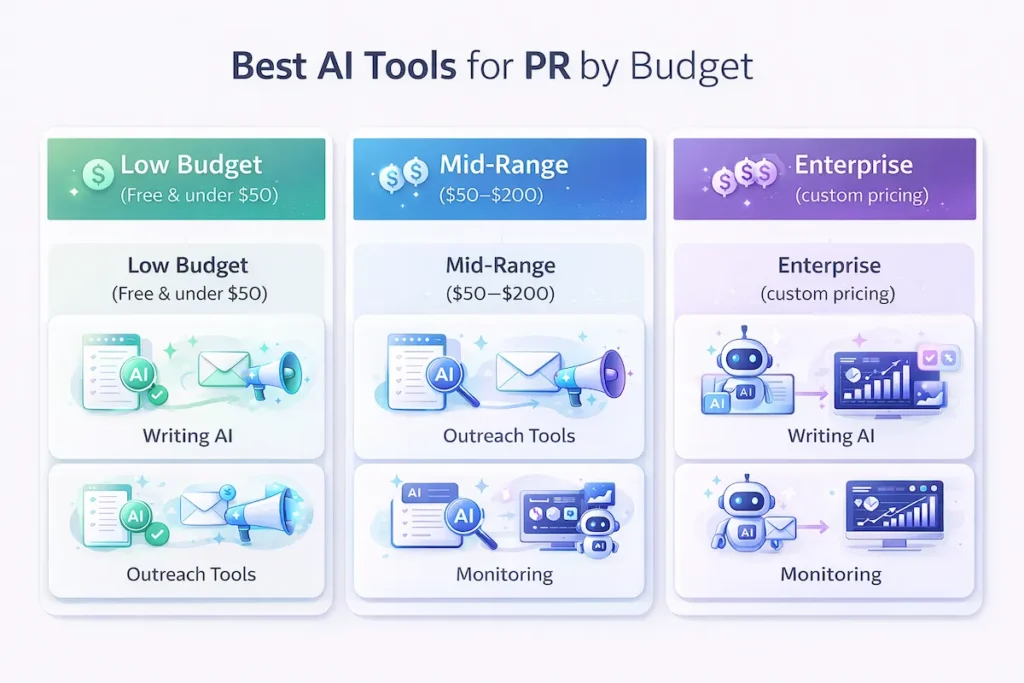
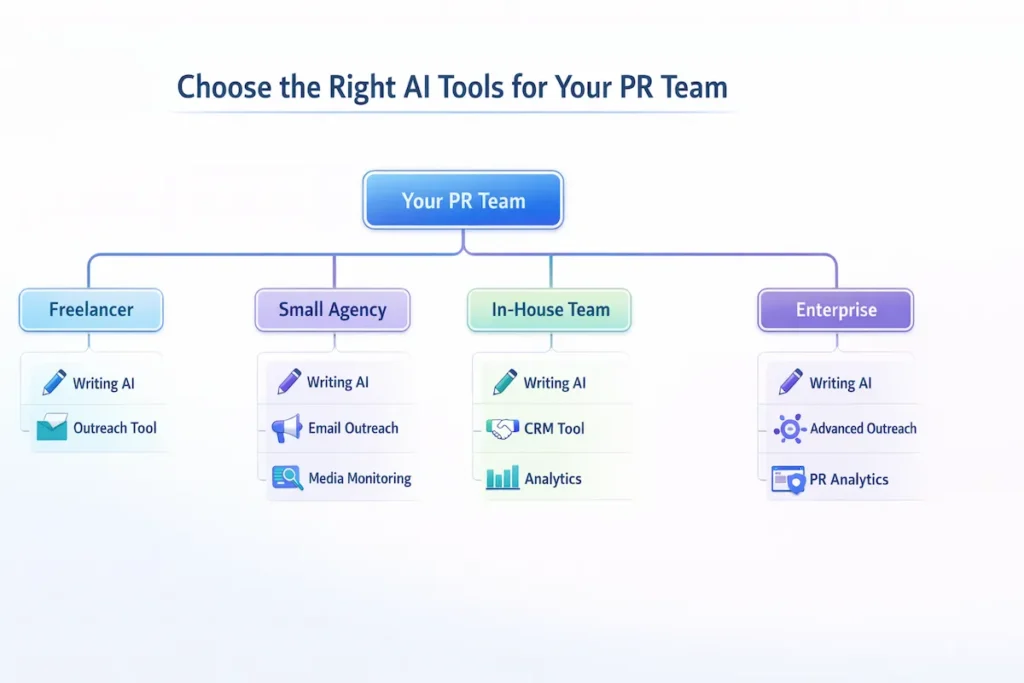
| Your Situation | Start Here | Add Later |
|---|---|---|
| Just starting out | ChatGPT + Brand24 | Prowly when outreach scales |
| Small agency (2–5 people) | Prowly + Jasper | Brand24 for monitoring |
| Mid-size agency | Muck Rack + Jasper | Sprout Social for social |
| Enterprise team | Cision + Muck Rack | Prezly for multimedia |
| Tight budget | ChatGPT + Mention | Google Gemini for research |
| Social-heavy PR role | Sprout Social + ChatGPT | Muck Rack when outreach grows |
The biggest mistake PR teams make: buying a tool that covers everything, then using 30% of its features. Start with your biggest bottleneck. Fix that first.
The best AI tools for public relations for a solo consultant will look very different from what a 20-person agency needs — and that gap in fit is exactly why this section exists.
How to Use AI PR Tools in a Campaign (Step-by-Step)
Running a full PR campaign with the best AI tools for public relations doesn’t require a big team — it requires the right workflow and the right tools assigned to the right steps.
AI PR strategies increasingly include conversational engagement—this chatbot guide explains how businesses use chatbots for lead generation, customer support, and real-time communication.
- Find your angle — Use ChatGPT or Gemini to pull the 10 biggest stories in your client’s space over the past 30 days. Cross-check with Brand24 or Mention for real-time traction.
- Draft the content — Use Jasper or a custom ChatGPT to produce two or three press release angle variations. Pick the most timely one. Always do a human pass before approval.
- Build your media list — Filter journalists in Muck Rack or Prowly by beat and recent coverage. Target reporters who’ve covered your topic in the last 60–90 days. Thirty targeted names beat 300 generic ones every time.
- Send and track outreach — Reference each journalist’s recent work in your pitch. Send via Prowly or Prezly to track opens and clicks. Set follow-up reminders inside the platform.
- Measure and report — Monitor placements with Brand24 or Cision. Track social amplification in Sprout Social. Pull your coverage summary from Muck Rack or Prowly. What used to take a full day now takes under an hour.
Each step in this workflow maps directly to a specific category of best AI tools for public relations — so you’re not guessing which tool to use at which stage.
💡 Pro Tip: The personalization step in Step 4 is where most AI-assisted pitches fall apart. AI writes the structure; you add the “I read your piece on X last week and this is why it’s relevant to you now.” That sentence is still yours — and it’s still the one that gets replies.
Recommended Tool Stacks
The best AI tools for public relations don’t work in isolation — the real results come from combining two or three complementary tools into a stack that fits your budget and team size.
🚀 Startup Stack (under $300/month)
- ChatGPT Plus — content drafting
- Brand24 Starter — monitoring
- Prowly — outreach and newsroom
- Sprout Social — social listening
Covers the full loop: write, monitor, pitch, report. Won’t break a startup budget. Each stack below is built around the principle that the best AI tools for public relations are the ones that solve your actual problems — not the ones with the longest feature list or the highest price tag.
🏢 Agency Stack (mid to high budget)
- Muck Rack — journalist database and outreach
- Jasper — content at scale across clients
- Prezly — multimedia pitch delivery
- Cision — enterprise monitoring and reporting
Built for agencies managing 10+ clients. Every tool earns its seat at that volume.
💰 Budget Stack (under $100/month)
- ChatGPT Free or Plus
- Brand24 Starter
- Mention Basic
- Google Gemini via Google Workspace
Lean but genuinely effective for solo consultants and small in-house teams. For more cost-effective AI options across categories, this free and paid AI tools guide for 2026 is worth bookmarking. If you’re also using AI for content-driven affiliate or marketing workflows, this free AI tools guide for affiliate marketing covers the overlap well.
Honest Pros and Cons
Like any technology, the best AI tools for public relations come with genuine strengths and real limitations — and knowing both helps you use them without getting burned.
What AI PR tools do well:
- Cut first-draft time by 50–60%
- Let small teams compete with larger agencies
- Enable faster response to breaking news
- Make campaign reporting faster and more consistent
- Keep brand voice uniform across multiple writers
Where they fall short:
- AI drafts still need human review — factual errors happen
- Over-reliance makes pitches feel generic and templated
- Journalist databases go stale — always verify contacts before sending
- No AI tool builds real relationships with reporters. That’s still entirely on you
- Some platforms are cost-prohibitive for small operations
The honest summary: These tools make good PR professionals faster. They don’t make average ones great. Strategy, relationships, and editorial judgment — those are still yours to own.
Understanding where the best AI tools for public relations genuinely deliver and where they still fall short will save you from over-investing in automation and under-investing in the human work that still matters most.
FAQs About AI Tools for Public Relations
These are the questions PR professionals ask most when evaluating the best AI tools for public relations for their specific situation.
The answers below are based on what PR professionals actually experience after adopting the best AI tools for public relations — not what the tool vendors say on their pricing pages.
What are AI PR tools?
AI PR tools help automate outreach, content creation, and media tracking.
Are AI PR tools effective?
Yes, they improve efficiency and increase chances of media coverage.
Can AI replace PR professionals?
No, but it helps improve productivity and outreach success.
Conclusion
AI tools for public relations are transforming how businesses approach media outreach in 2026. From finding journalists to automating outreach and monitoring coverage, these tools help improve efficiency and results. However, success in PR still depends on strategy, personalization, and relationship-building. Businesses that combine AI tools with smart PR strategies will achieve better visibility, stronger media relationships, and long-term growth.