
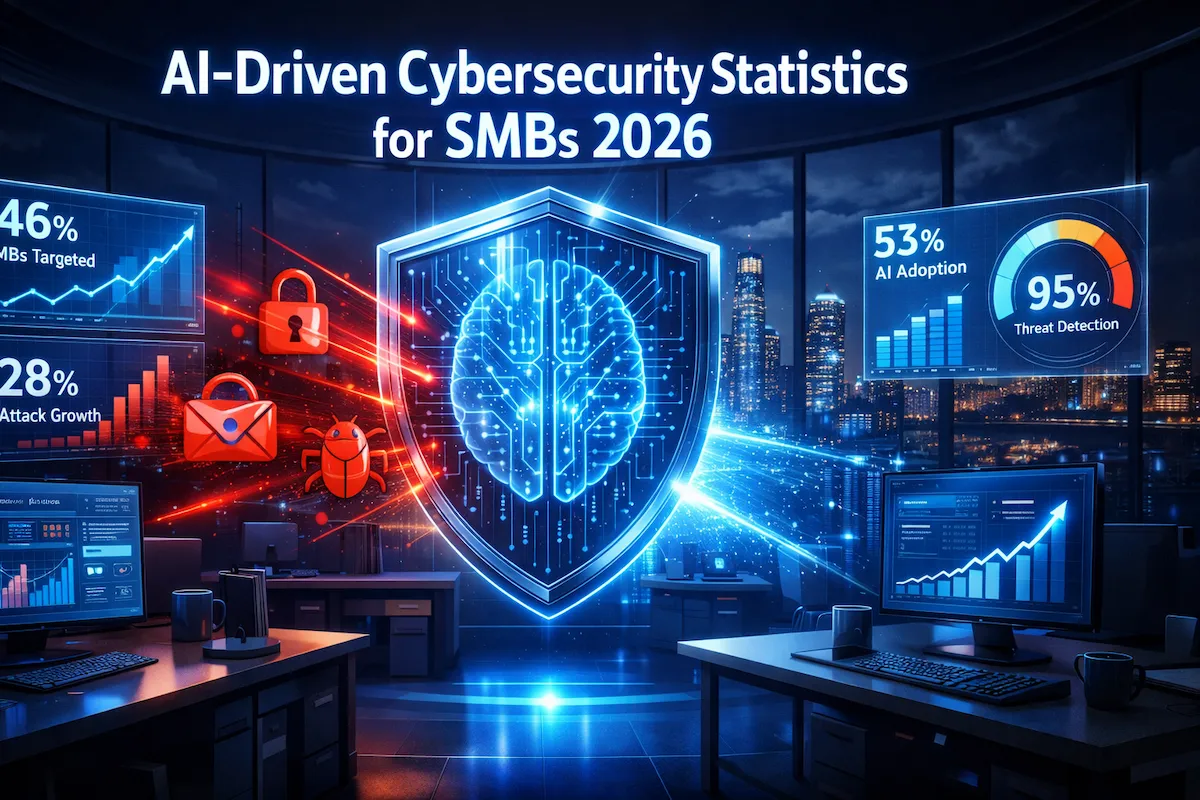
Small businesses in the U.S. are under more digital pressure than ever. Cybercriminals increasingly target companies with fewer than 500 employees because they know these businesses often lack enterprise-grade defenses. The AI-Driven Cybersecurity Statistics for SMBs 2026 show a clear story: the threat landscape is growing faster than most small business budgets can keep up with. For SMBs without a 24/7 security team, AI-driven monitoring is becoming the most practical way to detect and contain threats fast.
This article breaks down the latest numbers, trends, and data points you need to make smarter security decisions in 2026. Whether you run a retail shop, a SaaS startup, a healthcare practice, or a financial services firm, these statistics directly affect your risk exposure and your bottom line.
Methodology: Statistics in this article are compiled from IBM Security, Verizon DBIR, FBI IC3, CompTIA surveys, Gartner, Forrester Research, Coveware, Proofpoint, and select vendor threat reports (2024–2026). Where sources vary, ranges are provided rather than single figures.
Why AI-Driven Cybersecurity Is Critical for SMBs in 2026
The numbers behind AI-Driven Cybersecurity Statistics for SMBs 2026 are not just alarming — they’re a call to action. Small businesses account for 46% of all cyberattack victims in the U.S., according to Verizon’s Data Breach Investigations Report. Yet, as of 2024, nearly 60% of SMBs still had no formal incident response plan in place.
Small business cyber threats in 2026 are becoming more targeted, more automated, and harder to detect without machine-level speed. Small businesses account for a significant share of breach victims, according to the Verizon Data Breach Investigations Report (DBIR). Traditional firewalls and antivirus software that scan for known signatures simply can’t keep pace with polymorphic malware, AI-generated phishing lures, and credential-stuffing attacks running 24 hours a day.
SMB breach rates grew by 28% year-over-year between 2023 and 2025, according to CompTIA’s State of Cybersecurity report. Projections for 2026 suggest an additional 15–20% increase in attacks specifically targeting businesses with under 100 employees. Attackers now use AI tools to automate reconnaissance, generate convincing phishing emails, and identify open vulnerabilities — all at scale, all at low cost.
One accelerating factor most SMBs overlook is cloud infrastructure exposure. Many small businesses have moved critical workloads to cloud environments without securing them properly. The top cloud security mistakes companies still make — misconfigured storage buckets, weak access controls, and absent encryption in transit — are precisely what automated scanners probe for first. These gaps are being actively exploited, not theorized.
Machine learning cybersecurity platforms directly address this by filtering out irrelevant alerts and focusing detection on genuine behavioral anomalies. That alone reduces the false positive fatigue that causes manual teams to miss real threats.
2026 AI-Driven Cybersecurity Statistics for SMBs (Core Data Section)
The AI-Driven Cybersecurity Statistics for SMBs 2026 below are drawn from IBM Security, Verizon DBIR, Gartner, Forrester Research, CompTIA, and FBI IC3 reports. These figures are meant to directly inform budgeting decisions, tool selection, and risk management strategy for U.S. small business owners.
AI Adoption Rates Among SMBs
The AI-Driven Cybersecurity Statistics for SMBs 2026 on adoption reflect a fast-moving shift in how small businesses approach security. In 2024, approximately 34% of U.S. small businesses reported using at least one AI-powered security tool. By early 2026, that number has climbed to 53%, according to CompTIA and Cybersecurity Ventures surveys.
That’s a 56% jump in just two years — driven largely by affordable, cloud-based AI security platforms that require no on-site infrastructure. These AI security solutions for small businesses are increasingly accessible through managed service providers (MSPs), significantly lowering the barrier to entry.
The AI-Driven Cybersecurity Statistics for SMBs 2026 on adoption reflect a fast-moving shift in how U.S. small businesses are choosing to defend themselves. Among businesses that adopted AI security tools, 68% cited reduced response times as the primary benefit, followed by lower overall security costs (54%) and improved compliance tracking (41%).
- AI security tool adoption: 34% (2024) → 53% (2026) — Source: CompTIA / Cybersecurity Ventures
- Most common tools: AI-powered endpoint detection, email filtering, and behavioral analytics
- 68% of AI-adopting SMBs report faster threat containment — Source: CompTIA SMB Cybersecurity Survey 2025
- Cloud-native AI tools account for 79% of new SMB security deployments
A major driver of this cloud-native adoption is the shift toward hybrid and multi-cloud infrastructure. As SMBs split workloads between public and private environments, the security surface expands. Understanding the core differences between private vs. public cloud computing is now a prerequisite for choosing the right AI security tools — because the correct platform depends entirely on where your data lives and how it moves.
AI Threat Detection Effectiveness
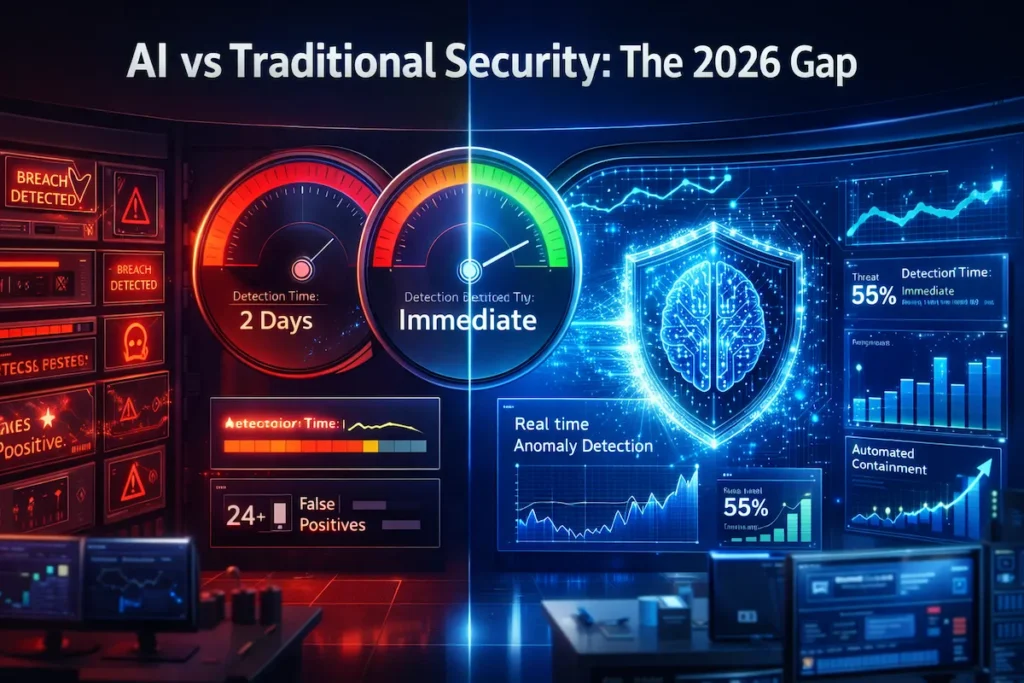
The AI-Driven Cybersecurity Statistics for SMBs 2026 on detection speed reveal one of the most consequential gaps in modern security. According to IBM’s Cost of a Data Breach Report, legacy security environments take an average of 194 days to identify a breach. AI-powered platforms reduce that to under 60 days — and for known threat patterns, detection can occur near real-time, within seconds to minutes of an anomaly appearing on the network.
This matters most in ransomware scenarios, where every minute of dwell time compounds the damage. AI threat intelligence platforms continuously analyze network traffic, user behavior, and endpoint activity to surface anomalies as they emerge. Automated incident response capabilities can isolate a compromised endpoint within seconds of detecting lateral movement — without requiring a human to approve the action. Among the most consequential AI-Driven Cybersecurity Statistics for SMBs 2026 are those measuring how fast threats are caught — because in a breach, every hour of delay has a direct dollar cost.
False positives remain a serious operational drain. According to Gartner’s Security Operations benchmarks, traditional SIEM and signature-based tools generate false positive rates between 40% and 60%. AI platforms using behavioral analysis reduce that rate to 5–12%, according to Forrester Research’s 2024 Security Automation Wave report. That means IT teams spend measurably less time chasing ghost alerts.
- Average breach detection: 194 days (legacy) vs. under 60 days (AI) — Source: IBM Security 2024
- False positive rate: 40–60% (traditional) vs. 5–12% (AI) — Source: Gartner / Forrester 2024
- Automated incident response reduces containment time by up to 74% — Source: IBM Security
- Real-time behavioral analytics detect insider threats 3x faster than rule-based systems — Source: Forrester Research
Financial Impact Statistics
The AI-Driven Cybersecurity Statistics for SMBs 2026 on financial impact require careful reading. According to IBM’s 2024 Cost of a Data Breach Report, the overall U.S. average breach cost reached $4.45 million across all business sizes. For small businesses specifically, that figure is lower but still severe: costs typically range from $180,000 to over $500,000 depending on industry, with mid-market companies often exceeding $1 million once legal fees, regulatory fines, and reputational losses are counted.
According to the IBM Cost of a Data Breach Report 2024, the overall U.S. average breach cost reached $4.45 million across all business sizes. Research from the National Cybersecurity Alliance shows that a large percentage of small businesses struggle to recover after a major breach.
That range is devastating at SMB scale. The data consistently shows that 60% of small businesses close within six months of a major breach — not because the breach alone wiped them out, but because the cascading costs of recovery, lost contracts, and customer attrition do. The AI-Driven Cybersecurity Statistics for SMBs 2026 on financial impact require careful reading — because the numbers look different depending on business size, and using the wrong figure undermines credibility with informed readers.
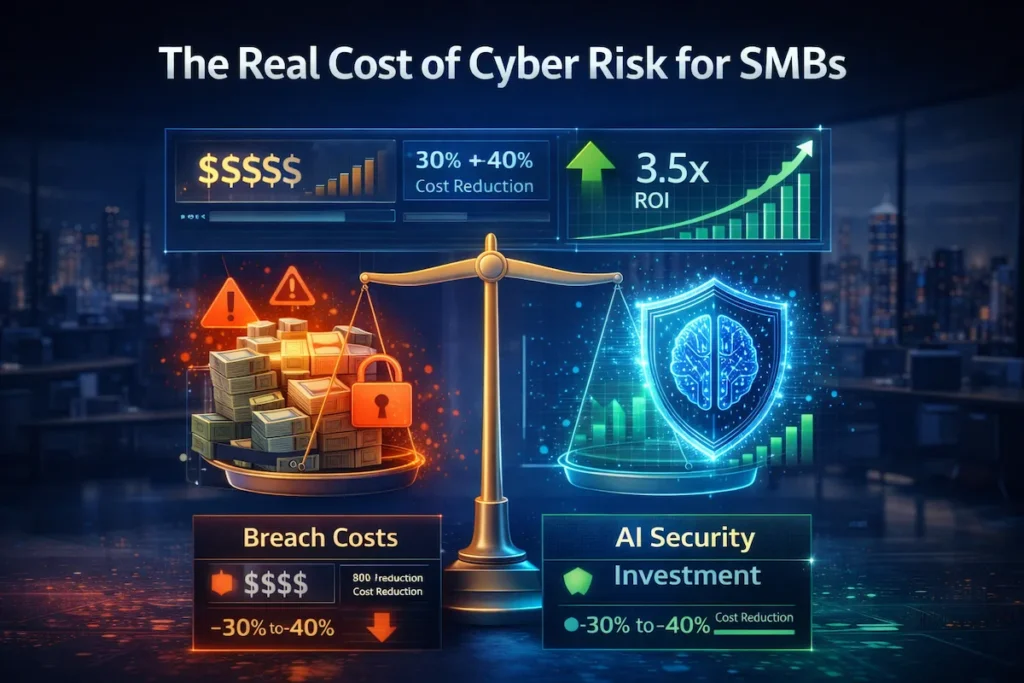
Cybersecurity automation data from IBM’s analysis shows AI platforms reduce total breach costs by 30–40% compared to organizations relying solely on manual processes. Companies investing in AI cybersecurity tools report an average 3.5x return over a three-year period, combining incident cost avoidance, reduced headcount for manual monitoring, and measurably lower cyber insurance premiums. The cybersecurity ROI for SMBs is not abstract — it is visible on the balance sheet.
- Overall U.S. average breach cost: $4.45M — Source: IBM Security 2024 (SMB range: $180K–$500K+)
- 60% of SMBs that experience a major breach fail within 6 months — Source: U.S. National Cybersecurity Alliance
- AI-based security reduces breach costs by 30–40% — Source: IBM Security Cost Analysis
- AI cybersecurity delivers average 3.5x ROI over 3 years — Source: Forrester TEI Study 2024
- Cyber insurance premiums drop 15–25% with verified AI security controls — Source: Marsh McLennan Cyber Survey 2024
Ransomware & Phishing Trends
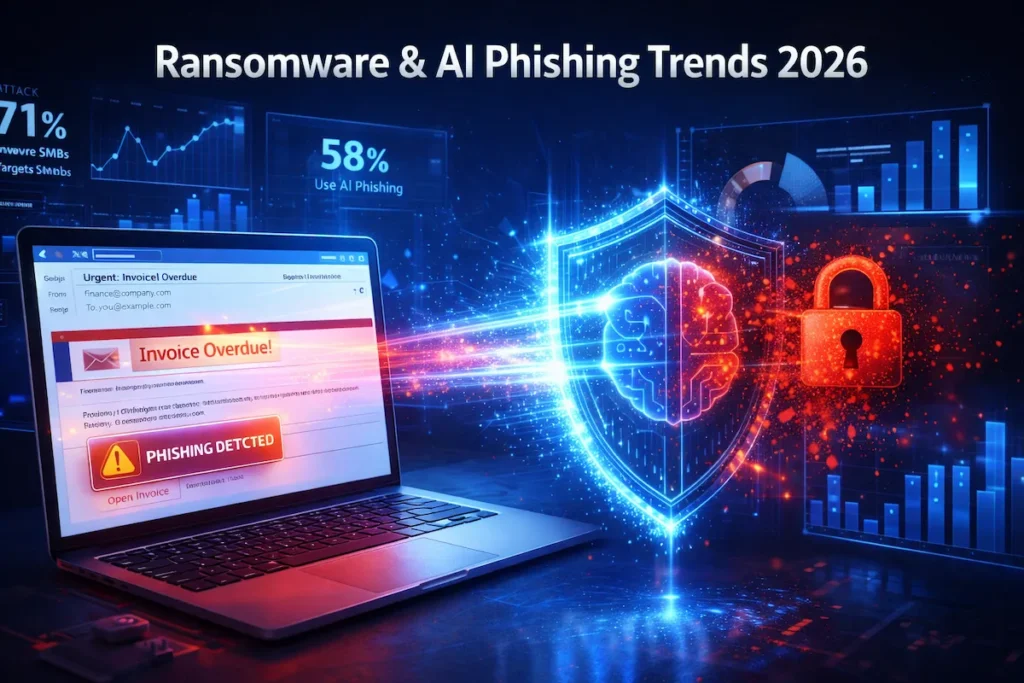
The AI-Driven Cybersecurity Statistics for SMBs 2026 on ransomware confirm that small businesses are now the primary target segment. According to Verizon’s DBIR, 71% of ransomware attacks in the U.S. targeted organizations with under 1,000 employees. According to Coveware’s Q4 2025 Ransomware Report, average ransom demands for small and mid-sized businesses climbed to approximately $285,000–$310,000, up significantly from $170,000 in 2023. The AI-Driven Cybersecurity Statistics for SMBs 2026 on ransomware and phishing confirm that small businesses are no longer collateral targets — they are the primary target segment for both attack types. Business email compromise remains one of the costliest forms of cybercrime, according to the FBI Internet Crime Complaint Center (IC3) Annual Report.
The Proofpoint State of the Phish Report 2025 found that AI-assisted phishing campaigns achieved higher filter bypass rates than traditional email attacks. According to the Coveware Q4 2025 Ransomware Report, average ransom demands for SMBs approached the $285K–$310K range.
AI-generated phishing lures are measurably more likely to evade legacy email filters than manually crafted messages. Proofpoint’s 2025 State of the Phish report found that AI-assisted spear-phishing campaigns produced substantially higher click-through rates and filter bypass rates than traditional approaches, with some enterprise tests showing bypass rates 40–50% higher. Threat actors use large language models to generate contextually accurate emails, pulling data directly from LinkedIn profiles, press releases, and company websites.
Social engineering trends in the U.S. have also shifted. Business email compromise (BEC) has overtaken ransomware as the costliest form of cybercrime, with the FBI’s Internet Crime Complaint Center (IC3) reporting $2.9 billion in U.S. losses in 2023. In 2026, deepfake voice and video cloning are being used in executive impersonation fraud at a rate that is rising sharply year over year — a trend documented by both the FBI and the World Economic Forum’s 2025 Global Cybersecurity Outlook.
- 71% of U.S. ransomware attacks target businesses under 1,000 employees — Source: Verizon DBIR 2024
- Average SMB ransom demand: ~$285K–$310K (2025–2026) — Source: Coveware Q4 2025
- AI-assisted phishing campaigns evade legacy filters at substantially higher rates — Source: Proofpoint 2025
- BEC fraud: $2.9B+ in U.S. losses — Source: FBI IC3 2023 Annual Report
- Deepfake-enabled fraud is rising sharply year over year — Source: WEF Global Cybersecurity Outlook 2025
AI vs Traditional Cybersecurity for SMBs (Statistical Comparison)
Viewing the AI-Driven Cybersecurity Statistics for SMBs 2026 side by side makes the investment case concrete. The table below covers the dimensions that matter most to small businesses without large security teams. Viewing the AI-Driven Cybersecurity Statistics for SMBs 2026 side by side makes the investment case concrete for any small business owner evaluating their current security stack.
| Factor | AI-Powered Security | Traditional Security |
|---|---|---|
| Threat detection speed | Near real-time (seconds to minutes) | 24–72 hours (avg) |
| False positive rate | ~5–12% | ~40–60% |
| Monthly cost (SMB avg) | $300–$900 | $800–$2,500+ |
| 24/7 coverage | Yes (automated) | Requires on-call staff |
| Ransomware response | Autonomous containment | Manual intervention |
| Adapts to new threats | Continuously learns | Signature-based only |
| Human dependency | Low | High |
Sources: Gartner Security Operations Benchmark 2024, Forrester Research, IBM Security Cost Analysis 2024
The cost gap is especially significant for SMBs without large IT teams. Traditional managed security typically costs $800–$2,500 per month before factoring in personnel time. AI-native platforms delivered through MSPs or SaaS subscriptions average $300–$900 per month for equivalent or better coverage.
Machine learning cybersecurity platforms also continuously update their threat models from new telemetry — catching zero-day vulnerabilities, novel malware strains, and behavioral anomalies that no signature library has ever seen. This is especially important in multi-cloud environments, where attack surfaces shift constantly. If your business stores data across more than one cloud provider, the guide on securing data in multi-cloud environments covers the layered security approach that AI tools are specifically built to enforce.
Human dependency is the quiet budget killer. With AI handling tier-1 alert triage automatically, SMBs can redirect limited IT staff to higher-value work — or significantly reduce the cost of 24/7 monitoring contracts.
Industry-Wise AI Cybersecurity Adoption in 2026
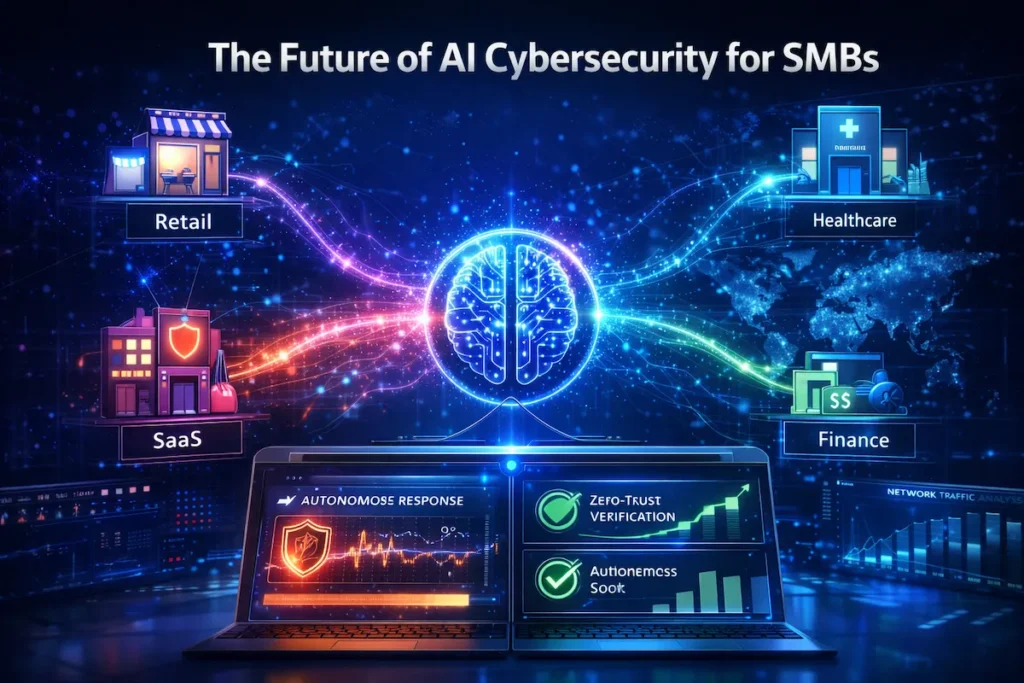
Not every sector faces identical risks, and the AI-Driven Cybersecurity Statistics for SMBs 2026 reflect clear differences in adoption rates, threat profiles, and regulatory pressure across industries.
| Industry | AI Adoption (2026) | Primary Use Case | Key Risk |
|---|---|---|---|
| Healthcare SMBs | 61% | Patient data encryption, HIPAA compliance | Ransomware |
| E-commerce SMBs | 58% | Fraud detection, checkout security | Payment skimming |
| SaaS Startups | 72% | API threat monitoring, cloud protection | Data exfiltration |
| Financial Services SMBs | 67% | Transaction anomaly detection | BEC / wire fraud |
Source: CompTIA Industry Cybersecurity Adoption Survey 2025–2026
Healthcare SMBs face the highest regulatory burden. HIPAA violations carry fines up to $1.9 million per incident category, and ransomware groups specifically target patient records for their high black-market value. In 2025, 61% of healthcare SMBs adopted AI-based encryption and access monitoring tools — the fastest adoption rate of any sector surveyed by CompTIA.
E-commerce SMBs deal primarily with payment fraud, card skimming, and account takeovers. AI fraud detection tools analyze transaction patterns in real time, flagging anomalies before chargebacks occur. Adoption reached 58% in 2026, driven largely by PCI-DSS compliance requirements. Cost efficiency matters greatly in this segment, and businesses reviewing the best cloud storage alternatives in 2026 are increasingly selecting platforms that bundle stronger built-in encryption and access controls alongside competitive pricing.
SaaS startups lead all SMB segments in AI security adoption at 72%, according to CompTIA. These companies manage cloud-native workloads, distributed API ecosystems, and remote teams — making automated cloud security posture management (CSPM) tools operationally essential. Data exfiltration via misconfigured cloud storage remains the top threat vector.
Financial services SMBs — independent accounting firms, insurance brokers, and small investment advisors — face BEC attacks and wire fraud disproportionately. AI-based anomaly detection in transaction monitoring, adopted by 67% of financial SMBs in 2026, has produced measurable reductions in successful wire fraud incidents according to Gartner’s Financial Services Security Benchmark 2025.
Future AI Cybersecurity Predictions for SMBs (2027 Outlook)
The trajectory of AI-Driven Cybersecurity Statistics for SMBs 2026 points toward significantly more automation and AI-led security operations in 2027. Here is what is coming — and what SMBs should begin planning for now.
AI-Powered Security Operations Centers (SOCs): By 2027, 40% of U.S. SMBs using managed security services will rely on AI-driven virtual SOCs rather than human-staffed monitoring centers, according to Gartner’s Security & Risk Management forecast. These platforms perform continuous threat hunting, log analysis, and incident classification autonomously — at a fraction of traditional SOC contract costs.
Zero Trust Security Model: Predictive threat detection and the zero trust security model are converging rapidly. Zero-trust architecture requires every user and device to verify access continuously — AI automates that verification at scale. Gartner projects 60% of SMBs will have implemented zero-trust principles by end of 2027, up from 22% in 2025.
Autonomous Response Systems: Automated incident response is evolving from alert-then-respond to detect-contain-remediate — without waiting for human approval. By 2027, AI systems are projected to autonomously handle 75% of tier-1 and tier-2 incident response tasks, per Gartner’s Security Automation Forecast. For SMBs without a dedicated security team, this development closes a critical coverage gap.
AI-Augmented Threat Intelligence: AI threat intelligence feeds will become standard in SMB security stacks, delivering real-time threat context from global attack telemetry. A two-person IT team using these tools can operate with situational awareness formerly available only to enterprise security operations centers.
Preparing for this future also means building the financial capacity to invest as AI tools become standard. Businesses that structure their cloud infrastructure efficiently — using proven cloud cost optimization strategies — create the budget headroom to adopt AI security tools proactively in 2027 rather than reactively after an incident.
Key Takeaways for U.S. Small Business Owners
The AI-Driven Cybersecurity Statistics for SMBs 2026 make one thing unmistakably clear: the gap between businesses using AI security tools and those that don’t is widening — in risk exposure, recovery cost, and business survival rates. Here is what the data means in practical terms.
Where SMBs Are Currently Underprepared
The AI-Driven Cybersecurity Statistics for SMBs 2026 expose several preparedness gaps that leave small businesses far more exposed than their owners typically realize.
- Only 53% have adopted AI security tools — meaning nearly half still face AI-powered attacks with non-AI defenses — Source: CompTIA 2026
- 60% lack formal incident response plans, despite SMB breach costs ranging from $180K to over $500K — Source: U.S. National Cybersecurity Alliance
- Fewer than 30% of SMBs tested their backup restoration process in the past 12 months — Source: Verizon DBIR 2024
- A significant share of SMB employees cannot correctly identify a deepfake audio or video request — a gap growing faster than training programs are addressing it
Strategic Investment Recommendations
Translating the AI-Driven Cybersecurity Statistics for SMBs 2026 into action means prioritizing the tools and practices that address the specific vulnerabilities U.S. small businesses face right now.
- Prioritize AI-native email security filtering — phishing and BEC remain the #1 entry points by volume
- Invest in AI endpoint detection and response (EDR) tools — they identify ransomware behavior before encryption executes
- Implement zero-trust access controls for all remote employees and cloud-hosted resources
- Use AI-powered cyber risk management platforms that deliver continuous risk scoring, not annual assessments
- Partner with an MSP that includes AI-based monitoring if internal IT capacity is limited
Action Steps Starting Today
The AI-Driven Cybersecurity Statistics for SMBs 2026 are only useful if they lead to concrete decisions — so here are the specific steps any U.S. small business can take immediately.
- Audit your current security stack and identify every gap where AI automation could replace a manual process
- Request a free cyber risk assessment from a reputable AI security platform — several offer no-cost baseline reports
- Review your cyber insurance policy carefully: many now require verified AI-based controls for full coverage
- Run quarterly social engineering awareness training — human error remains the leading breach enabler
- Benchmark your current defenses against your industry’s AI adoption rate using the data in this article
Cyber risk management in the U.S. has permanently changed. Small businesses that treat security as a one-time installation are now among the most attractive targets in 2026. AI security solutions for small businesses are no longer a competitive advantage — they are a baseline operational requirement for any business that stores customer data, processes payments, or operates in a regulated industry.
Frequently Asked Questions
The AI-Driven Cybersecurity Statistics for SMBs 2026 raise several practical questions from small business owners, IT managers, and startup founders trying to translate data into decisions. The five questions below are the ones that come up most consistently — answered with the same data-backed precision as the rest of this article.
Q1: What percentage of U.S. SMBs use AI-based cybersecurity tools in 2026?
As of early 2026, approximately 53% of U.S. small and mid-sized businesses have adopted at least one AI-powered security tool — up from 34% in 2024, according to CompTIA. Adoption is highest among SaaS companies (72%) and lowest in construction and traditional retail (under 35%).
Q2: How much does a data breach cost a U.S. small business in 2026?
The overall U.S. average breach cost reached $4.45 million across all business sizes in 2024, per IBM Security. For small businesses specifically, costs typically range from $180,000 to over $500,000 depending on industry — enough to force permanent closure for most SMBs operating on standard margins.
Q3: Are AI cybersecurity tools affordable for small businesses?
Yes. Cloud-native AI security platforms typically cost $300–$900 per month for SMBs when delivered through an MSP or SaaS subscription. That is 50–70% less than equivalent traditional managed security services — with faster detection and lower false positive rates included.
Q4: What is the biggest cybersecurity threat for U.S. SMBs in 2026?
Ransomware remains the most financially damaging single event, with average demands in the $285K–$310K range per Coveware’s 2025 data. However, BEC and AI-assisted phishing attacks are the most frequent entry points by volume. Deepfake-based executive impersonation is the fastest-growing emerging threat category.
Q5: How does AI improve cybersecurity for businesses without a dedicated IT team?
AI platforms automate the monitoring tasks that traditionally require around-the-clock human coverage — threat detection, alert triage, and initial incident containment. For an SMB with one or two IT staff members, a well-configured AI security platform functions as a continuous, autonomous first-responder at a fraction of the cost of a human equivalent.
Conclusion
The AI-Driven Cybersecurity Statistics for SMBs 2026 tell a story that has no comfortable middle ground. Small businesses are being targeted at record rates, attack methods are growing more sophisticated by the quarter, and the defenses most SMBs currently rely on were built for a threat environment that no longer exists.
The numbers are worth sitting with. Nearly half of all U.S. SMBs still face AI-powered attacks without AI-capable defenses. The average ransom demand now exceeds $285,000. Business email compromise cost U.S. businesses $2.9 billion in a single year. And 60% of small businesses that experience a major breach never reopen. These are not hypothetical risks — they are documented outcomes happening to businesses with the same budgets, team sizes, and infrastructure as yours.
The practical path forward is clear. AI-powered endpoint detection catches ransomware before encryption starts. AI-native email filtering stops phishing lures that legacy tools miss entirely. Behavioral analytics surface insider threats and account compromises that rule-based systems ignore. Automated incident response contains damage in seconds rather than days. And all of it is now available to SMBs through affordable MSP-delivered platforms that require no on-site infrastructure and no large internal security team.
The businesses that will look back on 2026 as the year they got serious about security are the ones making deliberate tool investments right now — not waiting for an incident to force the decision. Understanding where your data lives, how it moves, and where it is exposed is the starting point. If your business runs workloads across more than one cloud provider, reviewing the fundamentals of securing data in multi-cloud environments and avoiding the top cloud security mistakes companies still make gives your AI security tools a clean, well-structured environment to protect.
AI security solutions for small businesses are no longer a competitive advantage. They are a baseline operational requirement for any U.S. business that stores customer data, processes payments, or operates in a regulated industry. The AI-Driven Cybersecurity Statistics for SMBs 2026 make that case with numbers that are difficult to argue with and impossible to ignore.
Ready to act? Start with a free cyber risk assessment from a reputable AI security platform, audit your current cloud infrastructure against the standards outlined in this article, and evaluate MSP partners that include AI-driven monitoring as a core service — not an add-on.