
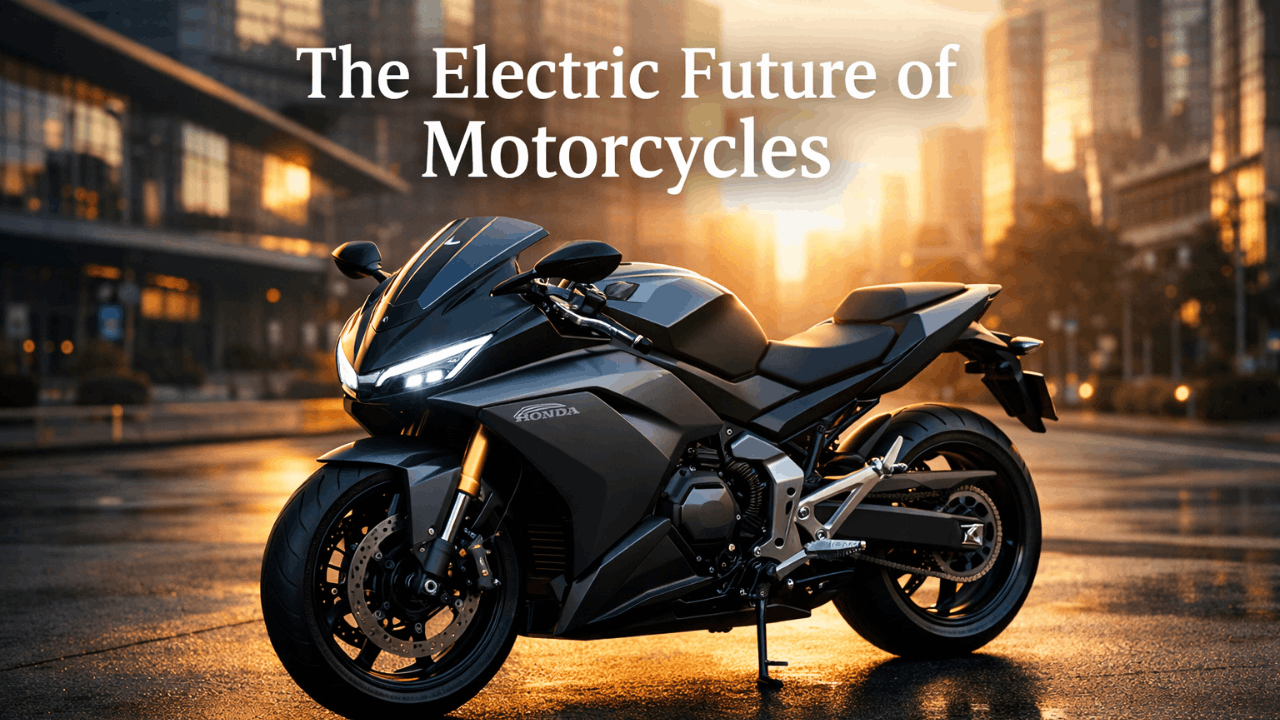
Introduction: Honda Enters the Electric Motorcycle Era
Honda EV motorcycle development marks a quiet but decisive shift for the world’s largest two-wheeler manufacturer. Honda has never chased trends—it waits, studies, and then reshapes the category on its own terms. Electric mobility is no exception. Instead of rushing half-baked products to market, Honda is aligning its engineering DNA with long-term sustainability goals that prioritize reliability, scale, and rider trust.
This move matters because motorcycles dominate personal transport across Asia, Latin America, and parts of Europe. Electrifying this segment has a far greater environmental impact than luxury EV cars ever could. When Honda commits to electrification, suppliers adapt, infrastructure follows, and competitors are forced to raise their standards.
The global appetite for electric two-wheelers is no longer speculative. Rising fuel prices, urban congestion, and tightening emission regulations are reshaping buying behavior, especially among younger riders. Cities want quieter streets; riders want lower running costs without sacrificing usability.
In this landscape, the Honda EV motorcycle represents more than a new product line—it signals a structural transition. Honda’s scale allows electric motorcycles to move beyond early adopters into mainstream mobility. That transition is already influencing how cities, governments, and consumers think about two-wheeled transport worldwide.
What Is a Honda EV Motorcycle?
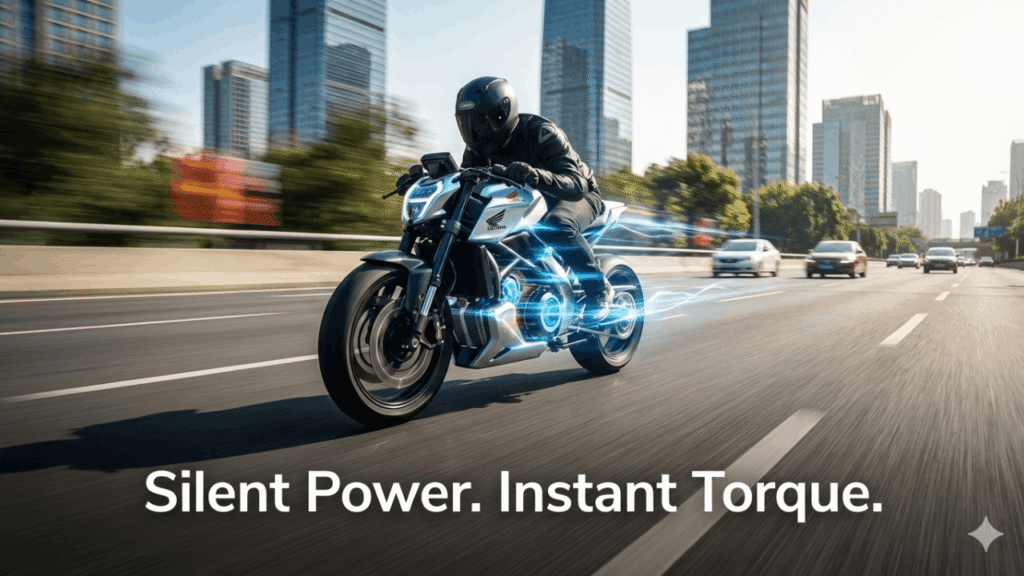
At its core, a Honda EV motorcycle is designed to replicate the familiarity of a petrol bike while quietly removing everything that makes ownership expensive or inefficient. There is no clutch to master, no engine heat, and no vibration-heavy power delivery. Instead, torque arrives instantly, silently, and with mechanical simplicity that changes how daily riding feels.
Traditional motorcycles rely on complex internal combustion systems that require frequent servicing and fuel dependency. Electric platforms replace that complexity with modular motors, battery packs, and software-driven performance tuning. The difference isn’t just mechanical—it’s philosophical. Riding becomes cleaner, calmer, and more predictable.
Honda’s approach stands out because it avoids extremes. Rather than positioning electric motorcycles as futuristic experiments, Honda focuses on usability, durability, and real-world conditions. Weather resistance, battery longevity, and serviceability remain central to the design conversation.
The Honda EV motorcycle also reflects Honda’s broader zero-emission roadmap, which includes scalable battery systems and shared platforms across vehicle categories. This strategy ensures electric motorcycles won’t remain niche products. Instead, they become integral to Honda’s ecosystem—built to last, built to scale, and built for riders who expect consistency from the badge on the tank.
Honda EV Motorcycle Design & Styling
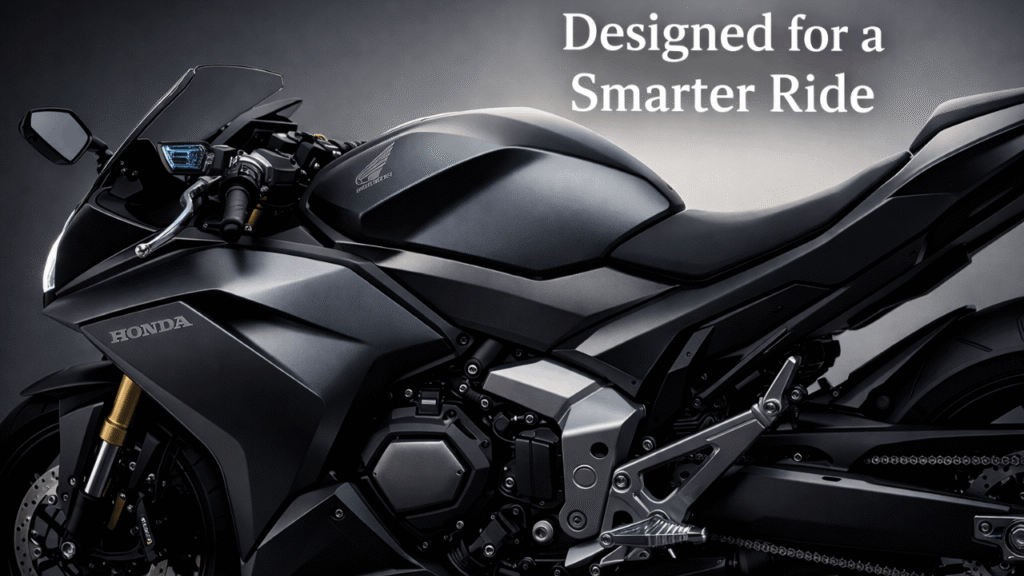
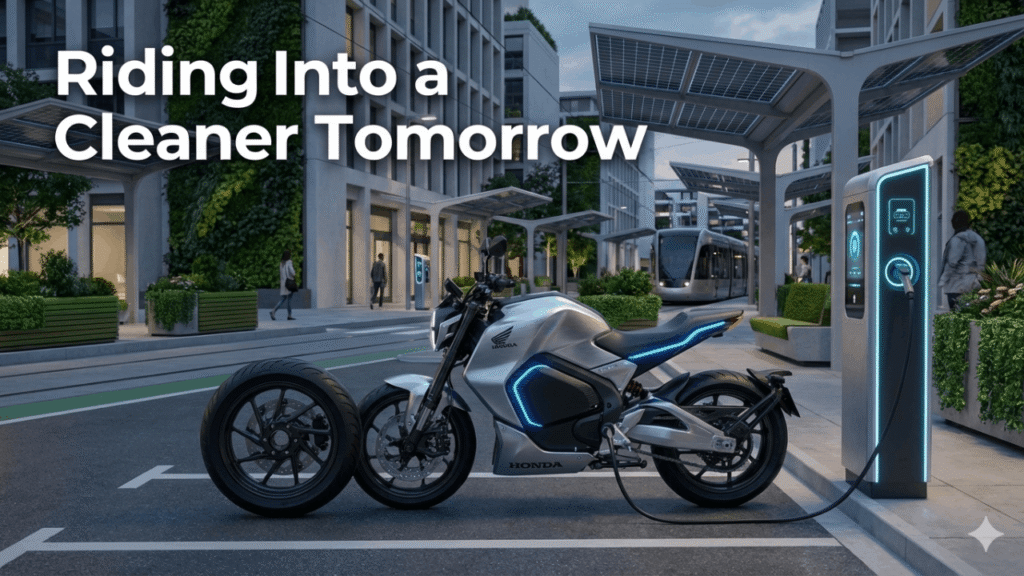
Design tells the first story, and Honda EV motorcycle styling avoids shouting for attention. Instead of exaggerated sci-fi elements, Honda leans into restrained futurism—clean surfaces, sharp proportions, and aerodynamic efficiency that feels purposeful rather than decorative. The result is modern without being alienating.
Electric architecture allows designers more freedom. Without a bulky engine, weight distribution improves, and body panels can flow naturally. Honda uses this flexibility to create a balanced silhouette that looks stable at rest and planted in motion. Every line appears functional, not ornamental.
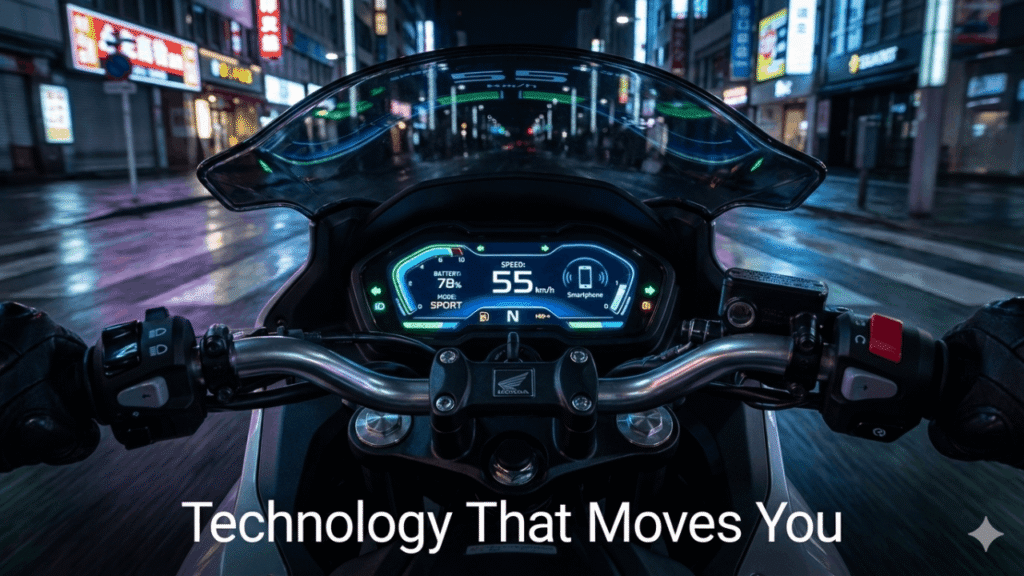
Lighting plays a major role in defining identity. Full LED systems deliver sharper visibility while reinforcing the bike’s modern character. The digital instrument cluster replaces analog clutter with crisp, readable information optimized for urban riding and varying light conditions.
Material choice reinforces Honda’s premium intent. High-grade composites, corrosion-resistant metals, and tight panel gaps communicate durability. A Honda EV motorcycle doesn’t try to look experimental—it looks finished. That visual confidence matters, especially for riders transitioning from petrol bikes who want innovation without unfamiliarity.
Electric Motor, Battery & Performance
Performance expectations change the moment electricity enters the equation, and Honda EV motorcycle engineering reflects that shift. Instead of chasing top-end speed, Honda prioritizes torque delivery, thermal stability, and consistent output across daily riding conditions. Acceleration feels immediate, smooth, and controlled.
Electric motors eliminate gear lag, allowing power to respond precisely to throttle input. This makes urban riding less stressful and highway cruising more stable. Honda’s motor tuning emphasizes efficiency without sacrificing responsiveness, ensuring predictable behavior in traffic-heavy environments.
Battery development remains central to Honda’s strategy. Advanced lithium-ion systems are engineered for longevity, with optimized charge cycles and temperature management. Fast-charging compatibility is expected, alongside home-charging solutions that fit into everyday routines.
Range and riding modes adapt to different use cases. Eco settings extend battery life for commuting, while sport modes sharpen throttle response when needed. A Honda EV motorcycle is not built for headline numbers—it’s built for repeatable, real-world performance that riders can rely on every day without compromise.
Honda EV Motorcycle Features & Technology
Technology integration is where the Honda EV motorcycle quietly excels. Instead of overwhelming riders with gimmicks, Honda focuses on tools that improve awareness, safety, and convenience. Every digital element serves a purpose, reinforcing confidence rather than distraction.
Smart connectivity allows riders to monitor battery health, navigation, and system alerts through an intuitive interface. Updates can be handled digitally, reducing service visits and keeping performance optimized over time. This software-driven approach future-proofs the motorcycle without sacrificing simplicity.
Regenerative braking subtly changes how riders interact with deceleration. Energy recovery improves efficiency while maintaining a natural braking feel. Honda’s tuning ensures transitions remain smooth, avoiding the abrupt sensations common in poorly calibrated systems.
Safety technology remains non-negotiable. ABS, traction control, and ride-assist systems are calibrated specifically for electric torque delivery. A Honda EV motorcycle treats technology as a silent partner—working constantly in the background to enhance control, stability, and rider confidence in unpredictable conditions.
Expected Price of Honda EV Motorcycle
Pricing strategy often determines adoption, and Honda EV motorcycle positioning reflects long-term thinking rather than short-term hype. Honda understands that affordability drives volume, especially in markets where motorcycles serve as primary transportation rather than lifestyle accessories.
Initial pricing is expected to sit above comparable petrol models, largely due to battery costs. However, this gap narrows significantly when ownership economics are considered. Fuel savings, reduced maintenance, and fewer mechanical failures reshape the cost equation over time.
Electric motorcycles eliminate oil changes, clutch replacements, and engine servicing. These savings accumulate quietly but meaningfully, especially for high-mileage riders. Honda’s reputation for reliability further strengthens long-term value retention.
A Honda EV motorcycle isn’t positioned as a premium novelty—it’s positioned as a practical investment. As battery costs decline and production scales increase, pricing will become increasingly competitive. Honda’s advantage lies in its ability to normalize electric mobility without inflating ownership costs.
Honda EV Motorcycle Launch Date & Availability
Launch timing reflects strategy, not hesitation. Honda EV motorcycle rollouts are expected to follow a phased approach, beginning with regions that already support electric infrastructure and regulatory incentives. This ensures early adoption remains frictionless.
Developed markets with strong EV policies are likely to receive initial models, followed by expansion into high-volume motorcycle regions. Honda’s manufacturing footprint allows localized production, reducing costs and improving supply consistency.
Asian markets remain critical. Dense urban environments, shorter commuting distances, and two-wheeler dependency make them ideal for electric motorcycles. Honda’s deep understanding of these regions gives it a structural advantage over newer competitors.
A Honda EV motorcycle launch isn’t about headlines—it’s about sustainability at scale. Availability will expand methodically, supported by service networks, charging partnerships, and consumer education. Honda prefers lasting presence over rushed visibility.
Honda EV Motorcycle vs Petrol Motorcycles
Comparisons reveal how fundamentally different electric riding feels. Honda EV motorcycle acceleration is instant and linear, removing gear-shifting delays and engine noise. Petrol bikes may still dominate top-end speed, but everyday usability favors electric powertrains.
Maintenance differences are stark. Electric motorcycles have fewer moving parts, reducing wear and unexpected failures. Service intervals become predictable, and ownership stress decreases significantly over time.
Running costs further widen the gap. Electricity remains cheaper than fuel in most markets, and efficiency gains compound with regular use. Riders who commute daily feel the savings quickly.
From an environmental perspective, the Honda EV motorcycle eliminates tailpipe emissions entirely. Reduced noise pollution also improves urban livability. While petrol motorcycles still offer emotional appeal, electric alternatives increasingly deliver practical superiority where it matters most.
Pros and Cons of Honda EV Motorcycle
Every innovation carries trade-offs, and the Honda EV motorcycle is no exception. Its strengths lie in efficiency, refinement, and long-term savings. Silent operation, zero emissions, and minimal maintenance redefine the ownership experience.
Advanced technology enhances safety and control, while electric torque simplifies riding for beginners and veterans alike. Urban riders benefit most, enjoying smoother commutes and predictable performance.
Challenges remain. Initial purchase prices are higher, and charging infrastructure varies by region. Long-distance touring still favors petrol motorcycles due to faster refueling and extended range.
A Honda EV motorcycle isn’t designed to replace every use case—it’s designed to excel where modern mobility demands efficiency, responsibility, and practicality. Understanding these boundaries ensures expectations remain aligned with reality.
Is the Honda EV Motorcycle Worth Buying?
Value depends on usage, and Honda EV motorcycle ownership shines brightest for city-focused riders. Daily commuters, delivery professionals, and eco-conscious users benefit immediately from lower operating costs and simplified maintenance.
Long-term ownership amplifies advantages. Battery warranties, software updates, and Honda’s service network reduce uncertainty. As infrastructure improves, convenience continues to increase without requiring behavioral changes.
For riders prioritizing sustainability without sacrificing reliability, the proposition becomes compelling. Honda’s conservative engineering approach minimizes risk while delivering tangible benefits.
A Honda EV motorcycle isn’t an impulse purchase—it’s a calculated shift toward smarter mobility. For the right rider, it represents progress without compromise.
Future of Honda Electric Motorcycles
Honda’s roadmap extends beyond a single product. Honda EV motorcycle development feeds into a broader ecosystem of shared batteries, modular platforms, and cross-segment integration. This approach accelerates innovation while controlling costs.
Upcoming models are expected to cover multiple categories, from commuter scooters to higher-performance motorcycles. Each iteration refines efficiency, range, and user experience.
Electric motorcycles will play a critical role in reducing urban emissions globally. Honda’s scale ensures this transition isn’t symbolic—it’s structural.
The Honda EV motorcycle is a foundation, not a finale. It represents Honda’s commitment to shaping future transportation with restraint, intelligence, and engineering discipline.
FAQs – Honda EV Motorcycle
Is Honda officially launching an electric motorcycle?
Yes, Honda has publicly committed to expanding its electric two-wheeler lineup as part of its long-term global electrification strategy. Multiple electric motorcycle and scooter platforms are already in development, signaling a phased but serious rollout.
When can we expect the first Honda EV motorcycle models?
Honda has indicated that electric motorcycles will be introduced progressively over the next few years, beginning in markets with established EV infrastructure. Exact launch dates may vary by region due to regulations and charging readiness.
What type of riders is the Honda EV motorcycle designed for?
The Honda EV motorcycle is primarily aimed at urban and suburban riders who value efficiency, low running costs, and smooth daily commuting. It is especially suitable for professionals, city commuters, and environmentally conscious users.
How does charging work for a Honda EV motorcycle?
Charging options are expected to include home charging solutions and compatibility with public charging stations. Some models may feature removable batteries, making charging more flexible for riders without dedicated parking.
Will the Honda EV motorcycle be expensive to maintain?
Maintenance costs are expected to be significantly lower than petrol motorcycles. With fewer moving parts, no engine oil, and reduced wear components, long-term servicing becomes simpler and more predictable.
How reliable will Honda electric motorcycles be compared to petrol models?
Reliability remains a core focus for Honda. Electric motorcycles are being engineered with the same durability standards as Honda’s combustion bikes, supported by battery management systems and extensive testing.
Can the Honda EV motorcycle handle highway riding?
While electric motorcycles excel in urban environments, Honda is expected to tune performance for stable highway use as well. However, these models are optimized more for consistent commuting than long-distance touring.
Will Honda EV motorcycles be available globally?
Yes, Honda plans global availability over time. Initial launches will focus on key regions, followed by expansion into high-demand markets, including Asia, where two-wheelers dominate daily transportation.
Conclusion: Where the Honda EV Motorcycle Truly Stands
The Honda EV motorcycle represents a calculated evolution rather than a dramatic disruption. Honda isn’t trying to redefine what a motorcycle is—it’s refining how a motorcycle fits into a rapidly changing world. By focusing on reliability, everyday usability, and scalable electric technology, Honda positions its electric motorcycles as practical tools rather than experimental showcases.
What makes this shift meaningful is Honda’s restraint. Instead of chasing extreme specifications or novelty-driven features, the brand emphasizes consistency, safety, and ownership confidence. That approach matters in markets where motorcycles are essential transportation, not weekend toys. Riders aren’t being asked to adapt to electric mobility; electric mobility is being shaped to adapt to them.
As infrastructure improves and battery costs decline, the value proposition strengthens further. The Honda EV motorcycle is less about being first and more about being right. For riders ready to move beyond petrol without sacrificing trust or performance, Honda’s electric direction feels not only logical—but inevitable.