
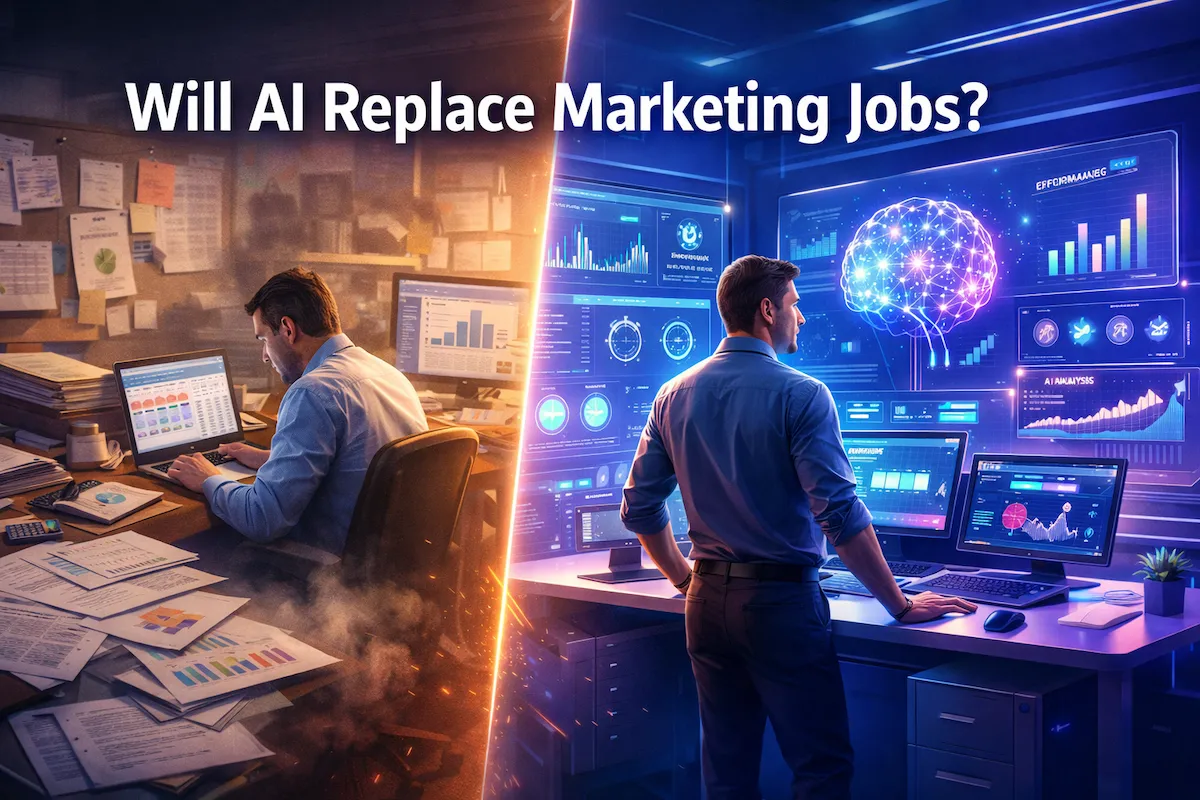
Artificial intelligence is reshaping marketing faster than most professionals predicted. The real question isn’t just whether AI will replace marketing jobs — it’s which roles are at risk, which skills will protect your career, and what opportunities are emerging on the other side of this disruption.
The answer isn’t a clean yes or no. It’s nuanced, data-backed, and — if you understand it correctly — full of opportunity. This guide includes a role-by-role risk breakdown, the full AI marketing ecosystem map, an AI impact funnel, a before/after comparison of marketing department structure, and a practical job survival guide — everything you need to navigate this shift with clarity.
How to Use This AI Marketing Jobs Guide
This guide answers the question of will AI replace marketing jobs with a complete breakdown — from ecosystem maps and risk data to career paths and skill frameworks.
This pillar covers the full picture of how AI will replace marketing jobs — from data and ecosystem maps to career paths and skills. Jump to the section most relevant to you:
- 📘 If you’re a student or early-career marketer — Start with the Marketing Job Risk Matrix and the New AI Marketing Jobs section. Understanding which roles are growing versus shrinking before you specialize is the single most valuable thing you can do right now.
- 📗 If you’re a mid-level marketing professional — Go straight to the AI Impact Funnel and the Skill Ladder. Your priority is identifying where your current role sits on the automation risk spectrum and which skills to build immediately to move up the value chain.
- 📙 If you’re a business owner or marketing leader — The AI Marketing Ecosystem Map and Before vs. After AI comparison give you the clearest picture of how marketing department structures are changing and where to redirect your team’s focus and budget.
What Is AI Doing to Marketing Jobs Right Now?
Before asking will AI replace marketing jobs, it helps to see what AI is already doing to them — and the answer, in 2025, is quite a lot.
AI in marketing is no longer experimental — it’s operational. Over 70% of marketing organizations have already integrated some form of AI into their workflows, according to recent industry surveys. Tools like ChatGPT (OpenAI), Jasper, HubSpot AI, Salesforce Einstein, Adobe Sensei, and Google Performance Max are now standard fixtures in modern marketing stacks.
Google’s Performance Max uses AI to generate creative assets, target audiences across all Google channels, and optimize bids in real time — tasks that previously required entire specialist teams. Meta’s Advantage+ operates on the same principle. Platforms like Mailchimp, ActiveCampaign, and Klaviyo now personalize email sequences, segment audiences, and recommend send times without manual input.
This is the quiet disruption: not dramatic robot replacements, but incremental automation of the task-level work that marketing jobs were built around. For a deeper look at how AI agents are being deployed across digital marketing workflows, the operational shift is already profound.
Which Marketing Job Tasks AI Is Eliminating First
Answering will AI replace marketing jobs starts at the task level — because AI is not replacing entire roles at once, it is eliminating specific tasks that used to define those roles.
AI excels at pattern recognition, scale, and speed. The marketing job tasks disappearing fastest: first-draft ad copy and social media posts, A/B testing and campaign optimization, audience segmentation and behavioral targeting, SEO keyword research and content gap analysis, campaign reporting and attribution modeling, and chatbot-powered lead qualification. These are tasks human marketers were doing manually five years ago — AI now performs most of them faster, cheaper, and with fewer errors.
To understand how AI is transforming advertising strategies and the tools driving those changes, the shift from manual campaign management to AI-orchestrated systems is one of the most significant structural changes in the industry’s history.
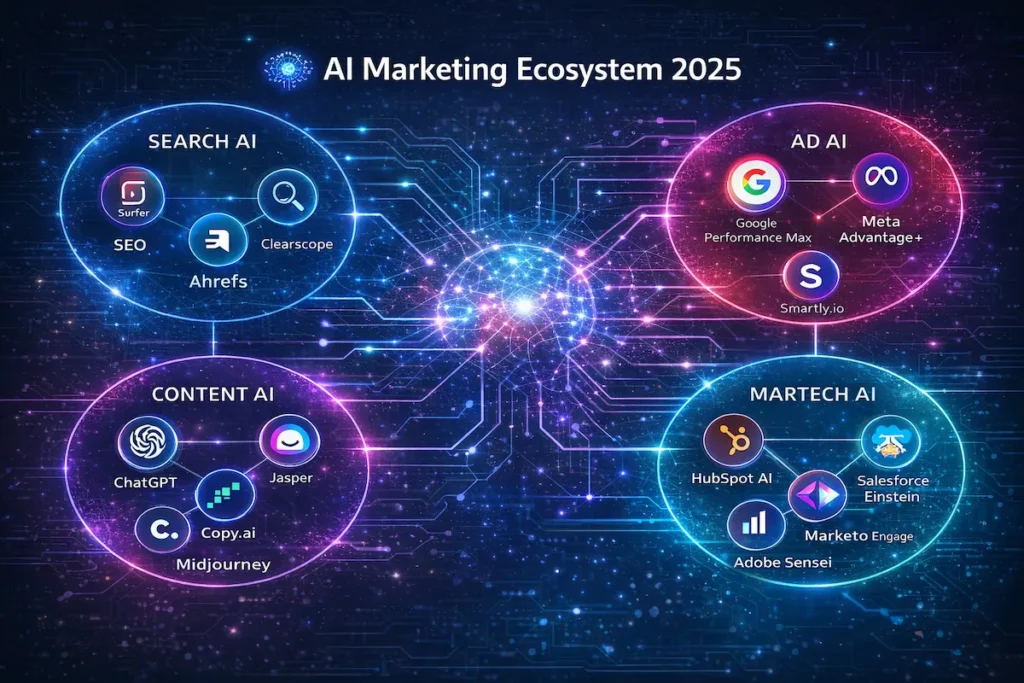
The AI Marketing Ecosystem Map: Tools Reshaping Every Marketing Job Category
Understanding will AI replace marketing jobs requires mapping the full ecosystem of tools that are already automating entire functional domains inside marketing departments.
To properly evaluate whether AI will replace marketing jobs, you need to understand the full AI marketing ecosystem — how tools cluster into functional domains that are reshaping entire departments. This is the structured entity map the industry recognizes as the AI marketing landscape in 2025.
Search AI: Changing SEO and Content Marketing Jobs
hen asking will AI replace marketing jobs in SEO and content, Google’s own AI stack provides the clearest and most immediate answer.
- Google AI Overviews (SGE) — LLM-powered answers synthesized directly in search results, reducing click-through rates for informational content and threatening volume-based SEO marketing jobs
- RankBrain and BERT/MUM — Google’s machine learning systems for query intent and natural language understanding; raise the content quality bar for every SEO marketing job
- Surfer SEO, Clearscope, MarketMuse — AI tools that analyze semantic keyword clusters and guide content structure in real time
Ad AI: Automating Paid Media Marketing Jobs
Nowhere is the answer to will AI replace marketing jobs more visible than in paid media, where platform-native AI systems have taken over targeting, creative, and bidding without human input.
- Google Performance Max — AI-managed campaigns across Search, Display, YouTube, Gmail, and Maps simultaneously; replaces manual campaign segmentation
- Meta Advantage+ — Automated audience targeting, creative selection, and bid optimization across Facebook and Instagram
- Google Smart Bidding — Auction-time AI bidding that has replaced manual CPC and CPA management entirely
Content AI: Redefining Content Marketing Jobs
The question of will AI replace marketing jobs in content creation is largely answered at the execution level — generative tools now produce drafts, image assets, and copy variations in seconds.
- OpenAI / ChatGPT — The foundational generative AI model embedded in hundreds of marketing tools; primary engine behind content draft generation at scale
- Jasper AI — Purpose-built AI writing platform trained on marketing-specific copy patterns
- Midjourney and DALL·E — AI image generation replacing stock photography and early-stage creative concepting workflows
Martech AI: Eliminating Operational Marketing Jobs at Enterprise Scale
At the enterprise level, will AI replace marketing jobs is being answered quietly inside CRM, automation, and analytics platforms that most marketers use every day without realizing what is being automated away.
- Salesforce Einstein — Predictive lead scoring, AI email recommendations, and automated customer journey optimization embedded in the world’s largest CRM
- HubSpot AI — Content generation, predictive lead scoring, conversation intelligence, and automated reporting across the full inbound marketing stack
- Adobe Sensei — AI layer across Adobe Experience Cloud driving personalized content delivery, audience segmentation, and predictive analytics at enterprise scale
- 6sense and Demandbase — Account-level intent AI platforms replacing manual B2B prospecting and account research jobs
Each cluster represents a domain where specific marketing jobs are shrinking — and adjacent, higher-value jobs are emerging for those who move up the skill ladder.
Before vs. After AI: How Marketing Department Structure Is Changing
One of the most concrete ways to see whether will AI replace marketing jobs is real is to compare how traditional marketing departments were structured versus how AI-native teams are being built right now.
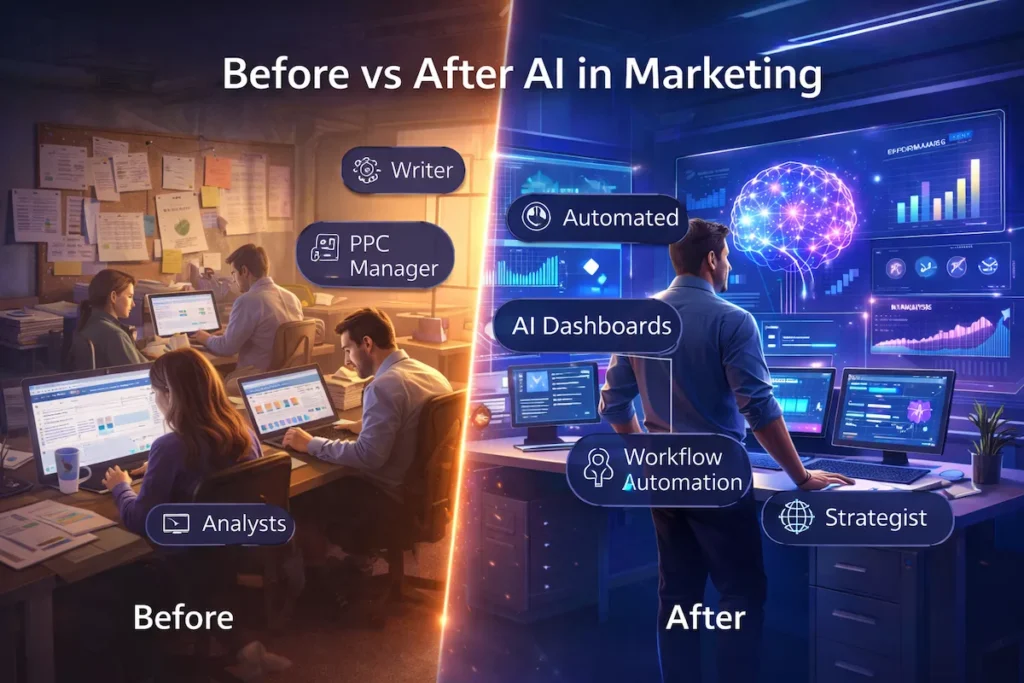
One of the clearest ways to understand whether AI will replace marketing jobs is to compare traditional marketing department structures with how AI-native teams are being built right now. This is the comparison that matters most for business owners and marketing leaders making hiring and budget decisions in 2025.
| Function | Traditional Marketing Team (Pre-AI) | AI-Augmented Marketing Team (2025) |
|---|---|---|
| Content Production | 3–5 writers producing 8–12 articles/month | 1–2 editors managing AI tools producing 30–50 AI-assisted pieces/month |
| Paid Media | PPC specialist manually managing bids, creatives, and audiences per campaign | AI strategist setting goals; Performance Max and Advantage+ handle execution |
| SEO | Keyword researcher + on-page SEO specialist working independently | Senior SEO strategist using Surfer SEO, MarketMuse, and Semrush AI for topical authority |
| Email Marketing | Email specialist manually building sequences and segmenting lists | AI-driven platform (Klaviyo, HubSpot) handles segmentation, timing, and personalization autonomously |
| Analytics & Reporting | Junior analyst pulling manual reports weekly | AI dashboards deliver real-time attribution; analyst focuses on strategic interpretation |
| Creative | Designer + copywriter producing a fixed creative set per campaign | AI generates hundreds of creative variations; creative director selects, refines, and approves |
| Strategy & Leadership | Marketing manager overseeing execution and tactical output | Marketing manager focused on AI system design, brand judgment, and business alignment |
The pattern is clear: headcount shrinks at the execution layer, while strategic and oversight marketing jobs grow in scope and compensation. For e-commerce brands navigating this shift, the application of AI to ecommerce growth strategies is already reshaping which marketing jobs are necessary and which are redundant.
Will AI Replace Marketing Jobs Entirely? What the Research Says
The short answer to will AI replace marketing jobs entirely is no — but the data from McKinsey, the WEF, and the Bureau of Labor Statistics tells a far more nuanced story than that single word suggests.
The short answer: AI will eliminate some marketing jobs, transform many more, and create entirely new ones. Blanket replacement is unlikely. Selective displacement is already happening.
The World Economic Forum’s Future of Jobs Report projects that AI will create more jobs than it eliminates across most industries by 2030 — but marketing is not immune to displacement. McKinsey’s generative AI research estimates roughly 30% of marketing and sales work activities could be automated with current technology — but “work activities” is not the same as “jobs.” The U.S. Bureau of Labor Statistics projects strong growth for marketing managers through 2030, with the composition of work shifting toward strategic, supervisory, and AI-oversight functions.
The AI Impact Funnel: How AI Replaces Marketing Jobs Layer by Layer
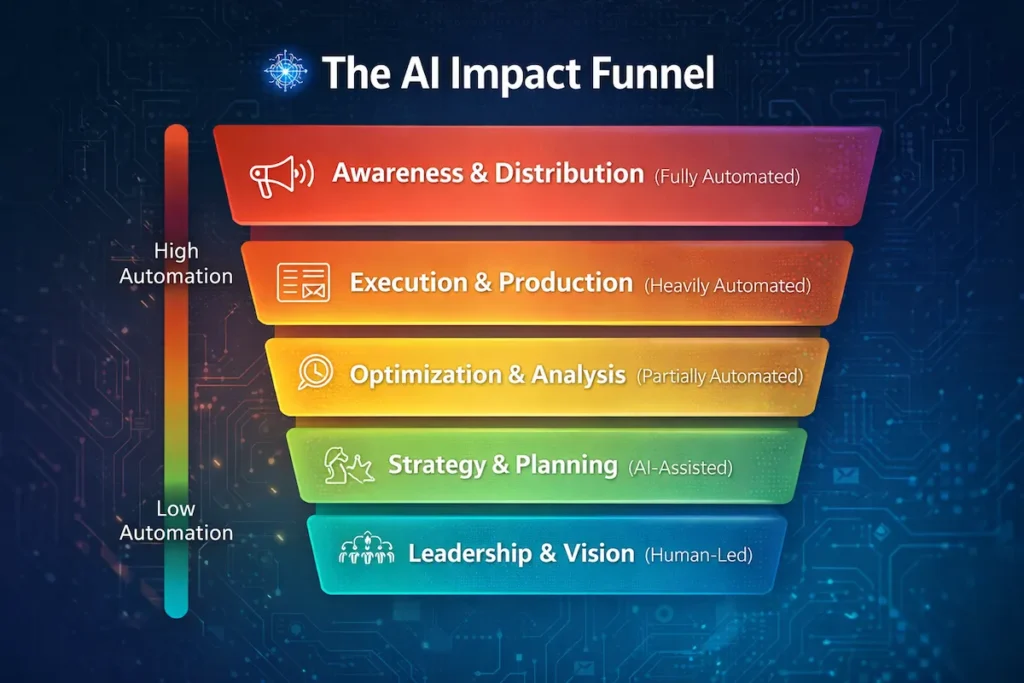
To see exactly how will AI replace marketing jobs play out across different roles, this funnel framework maps the automation process from the execution layer upward through strategy and leadership.
AI doesn’t replace marketing jobs all at once. It works through a funnel — automating from the execution layer upward. Where your marketing job sits in this funnel determines your risk level and what to do about it.
| Funnel Layer | What Happens Here | AI Takeover Status | Marketing Jobs Affected |
|---|---|---|---|
| Layer 1: Awareness & Distribution | Ad targeting, content publishing, audience reach | 🔴 Largely automated now | Media buyers, ad traffickers, social schedulers |
| Layer 2: Execution & Production | Content drafting, creative variations, A/B testing | 🔴 Heavily automated now | Entry-level copywriters, junior designers, PPC managers |
| Layer 3: Optimization & Analysis | Reporting, attribution, performance insights | 🟠 Partially automated, accelerating | Junior analysts, reporting specialists |
| Layer 4: Strategy & Planning | Campaign planning, channel strategy, brand positioning | 🟡 AI-assisted, not replaced | Marketing managers, strategists, planners |
| Layer 5: Leadership & Vision | Brand leadership, organizational direction, creative vision | 🟢 AI cannot replicate | CMOs, creative directors, senior brand leads |
The further your marketing job sits toward Layers 4 and 5, the more secure your position. The further toward Layers 1 and 2, the more urgent the need to move up the value chain through skill development.
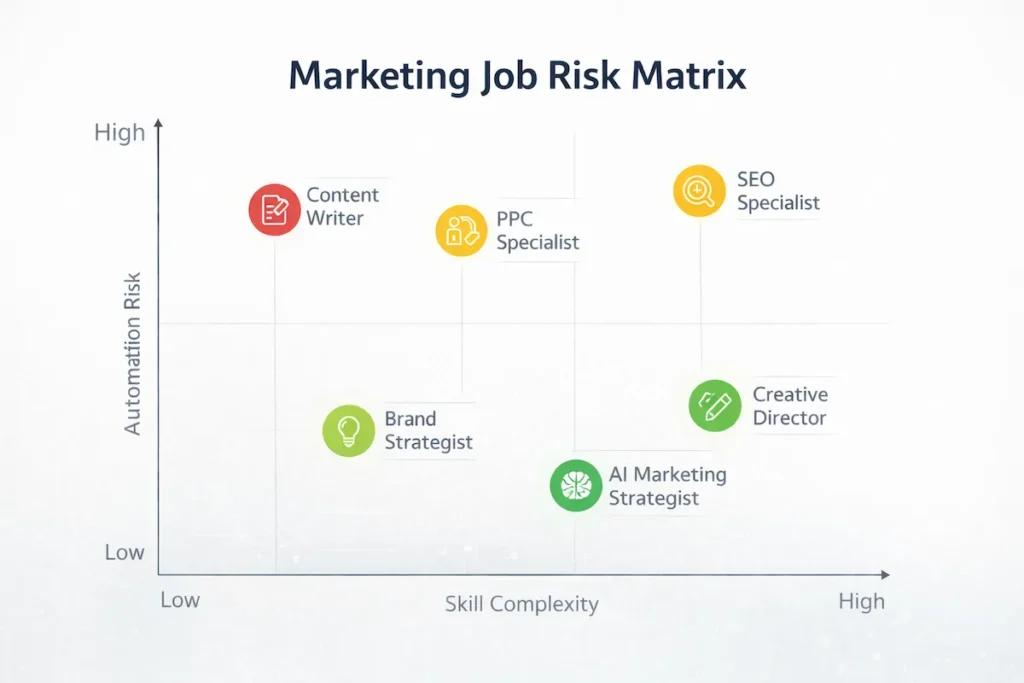
Marketing Job Automation Risk Matrix (2025–2030)
The most practical way to evaluate will AI replace marketing jobs like yours is to look at where each specific role falls on the automation risk spectrum between now and 2030.
| Marketing Role | Risk Level | Primary Risk Factor | 5-Year Outlook |
|---|---|---|---|
| Entry-level content writer (formulaic) | 🔴 High | AI content generation tools | Significant displacement |
| PPC specialist (bid management only) | 🔴 High | Performance Max, Advantage+ | Role narrowing rapidly |
| Social media scheduler / reporter | 🔴 High | Automated scheduling + AI reporting | Commoditized |
| Junior data analyst (standard reports) | 🟠 Medium-High | AI dashboards and auto-reporting | Consolidating into senior roles |
| SEO specialist (technical + content) | 🟡 Medium | AI SEO tools + AI Overviews | Evolving, not disappearing |
| Email marketing manager | 🟡 Medium | AI personalization and sequencing | Shifting to strategy-focused |
| Brand strategist | 🟢 Low | Requires cultural judgment | Growing in value |
| Creative director | 🟢 Low | AI can’t replicate original vision | Elevated importance |
| Senior content strategist | 🟢 Low | Topical authority + editorial judgment | Increasing demand |
| B2B relationship manager | 🟢 Low | Trust, relationships, human presence | Stable and growing |
| AI Marketing Strategist (emerging) | 🟢 Very Low | Emerging discipline, high demand | Above-market pay, growing fast |
For the most detailed role-by-role breakdown, see our full analysis on whether AI can truly replace digital marketing jobs — including displacement timelines and what the hiring data actually shows.
Which Marketing Jobs Are Safe from AI — and Why
Not every role is at risk when asking will AI replace marketing jobs — the positions with the longest runway are those built on skills that machine learning has consistently failed to replicate.
The marketing jobs with the longest runway require genuine human judgment, emotional intelligence, strategic thinking, and relationship-building. Brand strategists, creative directors, community managers, senior content strategists, and B2B relationship managers all hold roles AI cannot authentically perform.
A campaign that truly connects with culture — like Nike’s “Just Do It” evolution or Dove’s “Real Beauty” — requires a human who understands society, emotion, and timing. AI can generate a thousand tagline variations. It cannot tell you which one will change the conversation. That judgment is what keeps senior marketing jobs irreplaceable.
The Human Skills That Protect Marketing Jobs from AI
The deeper answer to will AI replace marketing jobs lies in this distinction: AI replaces tasks built on pattern recognition, but it cannot replace skills that require lived human experience and genuine judgment.
| Human Skill | Why AI Struggles | Marketing Job Application |
|---|---|---|
| Cultural intuition | AI has data about culture, not lived experience of it | Brand positioning, campaign timing, tone |
| Ethical judgment | AI cannot weigh competing moral considerations authentically | Crisis communications, sensitive campaigns |
| Long-term trust building | Relationships require genuine human presence over time | B2B sales, agency partnerships, PR |
| Original creative vision | AI recombines; it doesn’t originate from lived experience | Campaign concepting, brand narrative |
| Community leadership | Communities form around humans, not algorithms | Brand communities, advocacy programs |
How AI Is Changing SEO and Content Marketing Jobs
Among all the roles affected by whether will AI replace marketing jobs, SEO and content positions are experiencing some of the most rapid and structurally significant change in 2025.
SEO has been one of the most AI-disrupted corners of marketing. Google’s algorithms are now deeply AI-powered — from RankBrain and BERT to AI Overviews — and AI content tools are flooding the web with machine-written articles, raising the bar for what content marketing jobs must produce to compete.
AI Overviews and Zero-Click Search: The Biggest Threat to SEO Marketing Jobs
When people ask will AI replace marketing jobs in SEO, Google’s AI Overviews provide the most direct and underestimated answer — by eliminating the click before it ever happens.
The most significant — and underestimated — AI threat to SEO marketing jobs is not writing tools. It’s AI Overviews. When Google synthesizes a direct answer at the top of the search results page, a large share of users never click through to underlying content. For informational queries — the foundation of most content marketing deliverables — this is a structural shift:
- Traffic for informational content is declining as AI Overviews absorb user attention before organic results
- Getting cited inside an AI Overview is now as strategically valuable as ranking #1 in traditional results
- Content marketing jobs must shift toward bottom-funnel content — transactional and high-intent pages are far less exposed to zero-click behavior
- Brand authority matters more than ever — Google’s AI Overviews preferentially cite high-authority sources, making E-E-A-T signals central to every SEO marketing job
The SEO marketing jobs most at risk are those built around high-volume informational content production. The ones with the strongest future are focused on topical authority, structured data, and expert-level content that AI systems cite rather than replace.
What AI Means for Content Marketing Job Descriptions in 2025
The clearest sign of how will AI replace marketing jobs in content is the job description itself — which today looks completely different from what it required just five years ago.
The content marketer of 2025 doesn’t write 500-word posts on demand. Today’s content marketing jobs require topical authority architecture, semantic SEO, AI prompt engineering, and editorial strategy. Tools like Surfer SEO, Clearscope, and MarketMuse are now table stakes — providing real-time semantic optimization that was impossible to do manually at scale.
The Rise of New AI Marketing Jobs Replacing Old Ones
While most of the debate around will AI replace marketing jobs focuses on displacement, an equally important story is emerging on the other side — new roles are being created at a pace that most coverage ignores.
While AI eliminates some marketing jobs, it is simultaneously creating entirely new career paths. According to job listing data from LinkedIn, Indeed, and Glassdoor, postings for AI-native marketing roles have surged significantly since 2023. The new marketing jobs appearing most frequently include:
- AI Marketing Strategist — designs AI-driven campaign architectures; commands above-median salaries at mid-size and enterprise companies
- Prompt Engineer (Marketing) — one of the fastest-growing new marketing jobs by posting volume; specializes in high-quality AI inputs for content, ad tools, and automation
- Marketing AI Trainer — fine-tunes AI models on brand-specific data, tone, and voice guidelines
- Automation Workflow Architect — builds multi-platform marketing automation systems using HubSpot, Klaviyo, and Make
- AI Content Editor — reviews, refines, and humanizes AI-generated content at scale while maintaining brand consistency
- AI Review and Reputation Specialist — manages AI-assisted review generation and monitoring at a scale impossible through manual effort
Understanding how AI review generator tools and strategies are reshaping reputation management is becoming a distinct marketing job category with genuine and growing career demand. For creative agencies specifically, understanding which AI tools genuinely enhance creative agency output is a strategic decision that separates thriving agencies from disrupted ones.
How Marketing Jobs Are Evolving: Career Timeline 2020–2030
Seeing how will AI replace marketing jobs unfold decade by decade makes the transition far less alarming — and far more actionable for professionals at every stage of their career.
| Period | Dominant Model | Key Marketing Job Skills | AI’s Role |
|---|---|---|---|
| 2020–2022 | Platform-native digital marketing | Google Ads, Facebook Ads, SEO, email | Minimal, experimental |
| 2023–2024 | AI-assisted marketing | Prompt engineering, AI tool proficiency, content editing | Assisting humans on specific tasks |
| 2025 | AI-augmented teams | AI strategy, automation architecture, brand judgment | Executing most routine tasks autonomously |
| 2027–2028 (projected) | AI-native departments | AI oversight, creative direction, relationship management | Managing most execution end-to-end |
| 2030 (projected) | “Centaur” marketing model | Human-AI collaboration, strategic leadership, brand ownership | Primary executor; humans provide direction and judgment |
Skills That Protect Marketing Jobs from AI Disruption
The most reliable way to answer will AI replace marketing jobs for yourself personally is not to look at your title — it is to look honestly at your current skill set and where it sits on the automation risk spectrum.
The marketers who will thrive treat AI as a force multiplier, not a threat to their marketing jobs. The most resilient skill set combines deep marketing fundamentals with practical AI tool proficiency and skills that are genuinely hard to automate.
The Marketing Job Skill Ladder for the AI Era
Every professional wondering will AI replace marketing jobs like mine can use this skill ladder to identify exactly what to build next to stay ahead of what AI is automating below them.
| Skill Tier | Skills | AI Replaceability | Priority |
|---|---|---|---|
| Tier 1: Foundation | Marketing strategy, brand thinking, consumer psychology | Very Low | 🔴 Essential |
| Tier 2: AI Proficiency | ChatGPT, Midjourney, HubSpot AI, Semrush AI, Salesforce Einstein | N/A — operating AI tools | 🔴 Essential |
| Tier 3: Data Literacy | Interpreting AI-generated insights, attribution modeling, analytics | Medium | 🟠 High Priority |
| Tier 4: Prompt Engineering | Consistent, high-quality outputs from AI tools at scale | Low-Medium | 🟠 High Priority |
| Tier 5: Human-Only Skills | Emotional intelligence, cultural judgment, relationship management, creative direction | Very Low | 🟡 Differentiating |
AI proficiency without strategic judgment produces commoditized outputs. Strategic judgment without AI proficiency produces slow, expensive outputs. The combination is what commands premium compensation — and what protects your marketing job long-term.
Is Digital Marketing Still a Good Career Given AI’s Impact on Marketing Jobs?
Even as will AI replace marketing jobs becomes one of the most searched career questions of 2025, the Bureau of Labor Statistics data makes clear that digital marketing as a profession is not disappearing — it is restructuring.
Yes — with important caveats. The Bureau of Labor Statistics projects strong growth through 2030 for marketing managers and digital specialists. Entry-level commoditized marketing jobs are shrinking. Senior, strategy-oriented, and AI-augmented roles are growing.
Students entering marketing today should treat AI literacy the way previous generations treated Google Analytics — not optional, foundational. As McKinsey and the WEF have both documented: automation raises the floor for all marketing jobs while simultaneously raising the ceiling for those with irreplaceable human judgment and AI fluency combined.
Where Marketing Job Salaries Are Moving in the AI Era
As will AI replace marketing jobs plays out at the execution layer, compensation across the industry is shifting sharply — and knowing which direction your role is trending is critical career intelligence.
- Falling or flat: Entry-level content writers, manual PPC managers, basic social media coordinators
- Stable: Mid-level marketers who have added AI tool proficiency to their existing skill set
- Rising: AI Marketing Strategists, Automation Architects, Senior Brand Strategists, Creative Directors
- Premium: Marketers who can credibly lead AI-driven marketing systems at department or agency scale
Explore the Full AI Marketing Jobs Cluster
Every resource in this cluster examines a different dimension of will AI replace marketing jobs — from advertising automation and ecommerce to creative agencies and reputation management.
This guide is the topical anchor for a full content cluster on AI and marketing careers. Each resource below goes deeper on a specific dimension of how AI will replace — and create — marketing jobs across the industry.
- 🤖 AI Agents for Digital Marketing — How autonomous AI agents are taking over campaign management, real-time bidding, and customer journey orchestration
- 📣 AI in Advertising: Strategies and Tools — The complete breakdown of AI-powered ad systems, from Performance Max to Advantage+, and what they mean for paid media marketing jobs
- ❓ Can AI Replace Digital Marketing Jobs? — A deeper role-by-role analysis of displacement timelines and the hiring data behind them
- 🎨 Best AI Tools for Creative Agencies — Which AI tools enhance creative output versus which create a false sense of productivity
- 🛒 AI for Ecommerce Growth — How ecommerce brands are restructuring marketing jobs around AI-driven personalization, creative, and conversion
- ⭐ AI Review Generator Tools and Strategies — How AI is creating a new category of reputation marketing jobs at a scale manual processes could never reach
Frequently Asked Questions About AI Replacing Marketing Jobs
The most common searches around will AI replace marketing jobs share one thing in common — people want honest, data-backed answers rather than hype in either direction, and that is exactly what this section delivers.
Will AI completely replace marketing jobs?
No — not completely. AI will automate specific tasks and eliminate some entry-level marketing jobs, but strategic thinking, emotional intelligence, brand creativity, and relationship management all require human judgment AI cannot replicate. The accurate picture is transformation, not elimination: what marketers do is changing significantly, while the need for skilled professionals persists and grows at the senior level.
Which marketing jobs are most at risk from AI right now?
Marketing jobs involving repetitive, high-volume, or template-driven work face the greatest immediate risk: entry-level content writers, basic PPC managers, social media schedulers, and junior data reporters. These roles are being automated fastest by Google Performance Max, Meta Advantage+, and AI writing platforms already in widespread use.
Will AI take over marketing jobs completely in the next 5 years?
No — but marketing teams will look substantially different by 2027–2030. AI will handle most execution: content drafts, campaign optimization, targeting, and reporting. Human marketers will focus on strategy, creative direction, and brand judgment. Teams will be smaller in headcount and significantly larger in output.
Can AI replace marketing manager and CMO jobs?
Not in any foreseeable timeframe. These marketing jobs operate at the intersection of business strategy, brand leadership, and stakeholder relationships — domains requiring contextual judgment and long-term trust AI cannot replicate. Senior marketing jobs become more valuable as AI frees them from execution work.
Which marketing jobs are safe from ChatGPT and generative AI?
Brand strategists, creative directors, senior content strategists, community managers, and B2B relationship specialists hold marketing jobs that require lived experience, cultural intuition, and authentic human connection — things generative AI can approximate but not replicate in ways that matter at the brand level.
What new marketing jobs is AI creating?
Strategic planning, brand development, emotional storytelling, community leadership, creative direction, and high-stakes relationship management. These require lived experience and human connection — things AI can approximate in output but cannot replicate in origin, keeping marketing jobs built around them secure for the foreseeable future.
How is Google’s AI Overviews changing SEO marketing jobs?
Not in any foreseeable timeframe. These marketing jobs operate at the intersection of business strategy, brand leadership, and stakeholder relationships — domains requiring contextual judgment and long-term trust AI cannot replicate. Senior marketing jobs become more valuable as AI frees them from execution work.
What marketing job skills are AI-proof in 2025?
The fastest-growing new marketing jobs include AI Marketing Strategist, Prompt Engineer, Marketing Automation Architect, AI Content Editor, Marketing AI Trainer, and AI Reputation Specialist. These roles are already appearing consistently in job listings and paying above industry medians at AI-forward companies.
How fast should I upskill in AI to protect my marketing job?
As fast as strategically possible. Start with tools most relevant to your current marketing job: ChatGPT for content, Semrush or Surfer SEO for search, HubSpot or Klaviyo for automation. Build fluency with one tool at a time. The gap between AI-literate and AI-resistant marketers is already visible in hiring and compensation — and it will only widen.