
The question is everywhere right now. Can AI replace digital marketing jobs? If you’re a marketer, freelancer, or marketing student, you’ve probably asked it yourself — maybe with a little anxiety attached.
According to McKinsey’s 2024 State of AI report, over 65% of organizations now use AI regularly — double the figure from just two years prior. In marketing specifically, adoption is accelerating faster than almost any other business function.
Let’s break down the full picture — honestly, without hype on either side.
⚡ Quick Answer: Can AI Replace Digital Marketing Jobs?
No — not fully. AI replaces repetitive, mechanical tasks like content drafting, ad bid optimization, and performance reporting. But human marketers remain essential for strategy, creative direction, brand positioning, and decision-making. The future of marketing careers belongs to professionals who learn to work with AI, not those who compete against it.
What Is AI in Digital Marketing?
Before we can fully answer whether can AI replace digital marketing jobs, we first need to understand what AI is actually doing inside modern marketing today.
Artificial intelligence in digital marketing refers to the use of machine learning, natural language processing, and predictive algorithms to automate, analyze, and optimize marketing functions. This includes everything from AI-powered ad bidding to automated content generation and customer behavior analysis.
AI marketing tools are now embedded into platforms marketers already use daily — Google Ads, Meta, HubSpot, Semrush, and dozens more. Understanding how AI in advertising actually works is no longer optional for competitive marketing teams — it’s foundational knowledge every professional needs right now.
How AI Is Transforming Digital Marketing Workflows
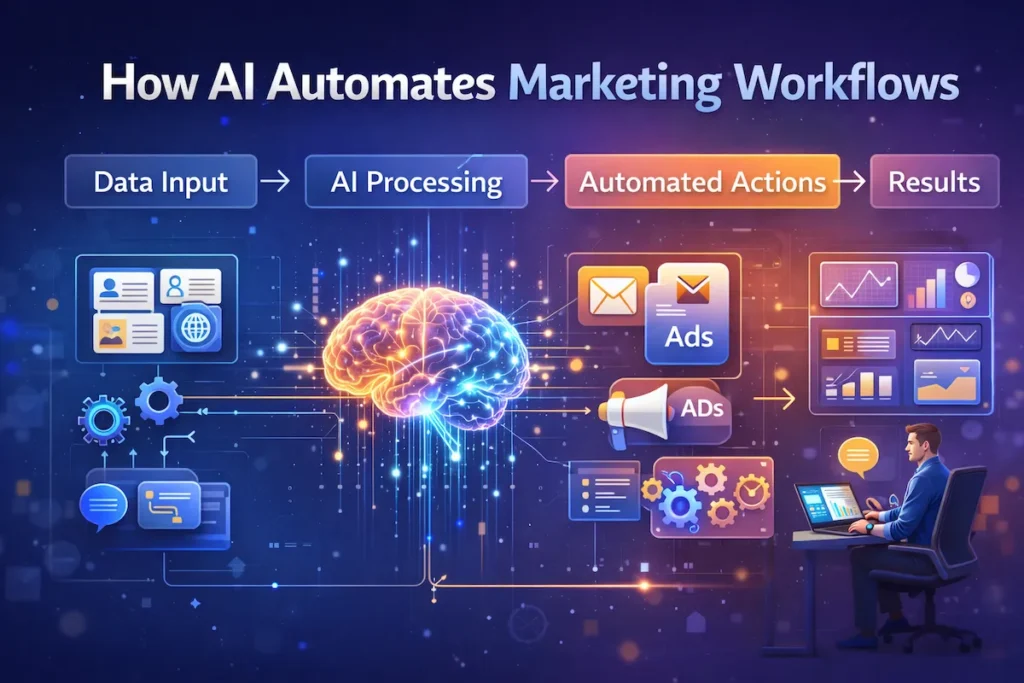
One of the biggest reasons marketers are asking can AI replace digital marketing jobs is the speed at which AI is transforming day-to-day marketing workflows. AI has fundamentally changed how marketing work gets done at the operational level. Tasks that once took hours now take minutes — and this acceleration is precisely why so many professionals are asking about the future of marketing careers.
A paid media manager who once manually adjusted bids across hundreds of keywords now uses Google’s Smart Bidding — a machine learning system that processes millions of signals in real time to optimize for conversions. Similarly, tools like Jasper, Copy.ai, and ChatGPT allow content teams to draft briefs, outlines, and full articles in a fraction of the time.
AI is actively being used across marketing workflows for:
- Predictive analytics — identifying which leads are most likely to convert before they raise their hand
- Dynamic content personalization — tailoring emails and landing pages to individual users automatically
- Automated A/B testing — running and reading split tests faster than any human team
- AI-driven marketing analytics — extracting actionable insights from massive datasets without manual reporting
- Customer behavior analysis — mapping purchase intent signals across touchpoints in real time
AI marketing automation is no longer experimental — it’s standard practice in competitive teams.
Why Businesses Are Rapidly Adopting AI Marketing Tools
Simple: efficiency and measurable ROI. This rapid adoption is a key reason the question — can AI replace digital marketing jobs — is no longer theoretical but a very real professional concern. According to Salesforce’s State of Marketing report, high-performing marketing teams are 2.5x more likely to use AI than underperforming ones.
AI tools help businesses do more with fewer resources. A small business can now run sophisticated email campaigns, retargeting ads, and SEO workflows with a lean team. For e-commerce brands especially, AI-driven growth strategies are becoming the primary driver of scalable revenue.
This efficiency is exactly why concern about AI replacing marketing jobs is growing. When one person with AI tools can do what a three-person team used to handle, companies do reconsider headcount.
Can AI Replace Digital Marketing Jobs?
This is the core question, and it deserves a direct, honest answer.
So, can AI replace digital marketing jobs? The honest answer requires separating what AI actually does well from what it fundamentally cannot do.
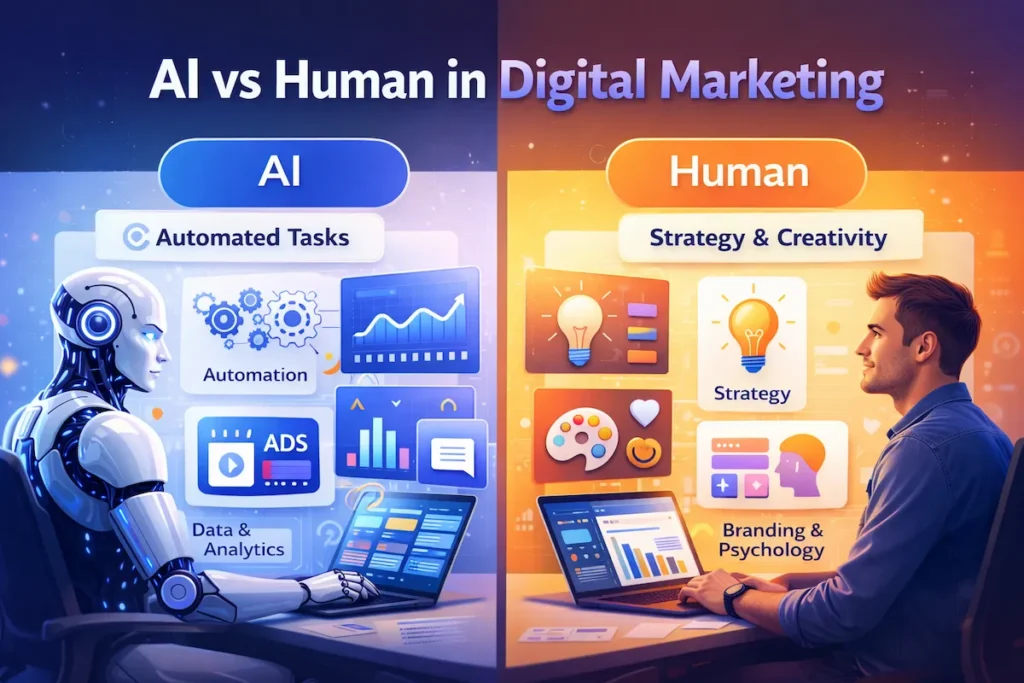
The distinction matters enormously. Marketing isn’t just task execution — it’s judgment, creativity, relationship-building, and strategic thinking. AI excels at data processing and pattern recognition. It struggles with nuance, brand voice, cultural context, and original ideas.
“AI won’t replace marketers — but it will replace average marketers. The ones who treat AI as a threat are the ones who will be replaced by someone who treats it as a superpower.”
Understanding the Real Impact on Marketing Careers
To understand whether can AI replace digital marketing jobs is a real threat or an overstated fear, we need to look at what the data actually shows about marketing career growth. The impact of AI on digital marketing roles is real but frequently misunderstood. The key distinction: AI is replacing tasks, not entire roles.
Entry-level positions built around repetitive execution — manual reporting, basic social scheduling, boilerplate copywriting — are shrinking in scope. But the broader picture tells a different story.
The U.S. Bureau of Labor Statistics projects marketing research analyst roles to grow 8% through 2033 — faster than the national average — confirming that human marketing expertise remains firmly in demand. What’s changing is what marketers are expected to do, not whether they’re needed.
Real-world proof:
A mid-sized SaaS company integrated AI bid optimization into their Google Ads campaigns and reduced wasted ad spend by 28% while increasing conversions by 35%. But they still needed a senior strategist to interpret the data, adjust audience targeting, and realign campaign goals with shifting business objectives.
The AI handled execution. The human handled direction. Both were essential.
Think of it like the introduction of spreadsheet software. Accountants didn’t disappear — they became more powerful. AI is doing the same for digital marketers.
Why the Fear of AI Replacing Marketing Jobs Is Growing
The fear is understandable. The growing anxiety around can AI replace digital marketing jobs isn’t irrational — it’s rooted in visible, everyday automation that marketers are experiencing firsthand. ChatGPT can draft a blog post. Google Ads can manage bidding automatically. AI can generate social captions, design ad creatives, pull analytics reports, and even respond to customer reviews. This automation is expanding rapidly — you can see it in tools covered in AI review generator strategies for 2026.
But fear outpaces reality when we forget that AI marketing tools are powerful assistants, not autonomous strategists. Without a skilled marketer guiding the process:
- AI-generated content becomes generic and off-brand
- AI campaigns drift away from business objectives
- AI analytics produce data without actionable insight
- AI automation creates efficiency without strategic direction
The core truth: AI doesn’t remove the need for marketers. It removes the need for marketers who only do what AI can do.
Digital Marketing Jobs That AI May Replace
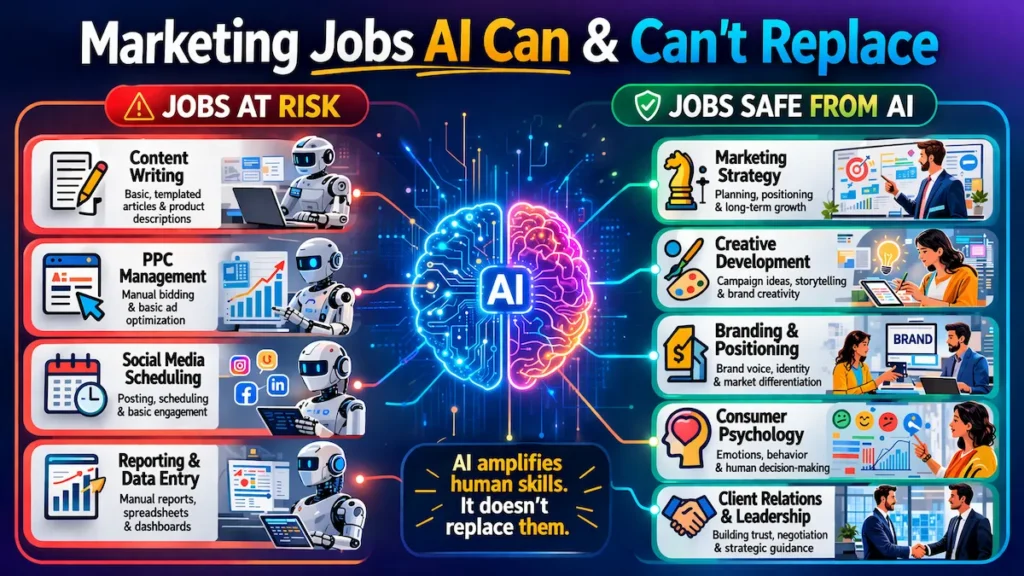
When examining can AI replace digital marketing jobs, it’s critical to be specific — because not every marketing role faces the same level of risk. Not all roles face equal risk. The vulnerability is concentrated in positions built around predictable, repeatable task execution — not strategic or creative thinking.
Content Writing and AI Automation
Basic, formulaic content is the most obvious area at risk. In the content space specifically, the question of can AI replace digital marketing jobs has the clearest and most immediate answer. If your value as a writer is producing generic product descriptions, templated email copy, or boilerplate blog posts with no original insight — AI can do that faster and cheaper today.
What AI handles well in content:
- First drafts and structural outlines
- Product descriptions at scale
- Templated email sequences
- Social media caption variations
- Basic FAQ and meta description writing
What AI still gets consistently wrong:
- Brand voice consistency across long campaigns
- Original reporting and expert interviews
- Thought leadership with genuine industry perspective
- Culturally nuanced or emotionally resonant storytelling
Content roles that survive — and thrive — will be those focused on original thinking, strategic narrative, and human perspective that AI cannot manufacture.
PPC Campaign Automation
Paid advertising is one of the most visible areas where can AI replace digital marketing jobs becomes a genuine operational reality for marketing teams.
Routine PPC management is one of the clearest examples of AI replacing tasks at scale. Manual bid adjustments, basic keyword research, and standard ad copy testing are increasingly handled automatically inside Google’s and Meta’s own platforms.
Real-world example:
An e-commerce brand running Meta Advantage+ campaigns saw a 22% improvement in ROAS within 60 days — without a human touching bid settings. The automation handled execution. But the brand’s strategist was still responsible for offer development, audience strategy, creative direction, and business goal alignment.
Junior PPC roles focused purely on execution are at risk. Senior paid media strategists who understand full-funnel architecture and business-level thinking remain essential.
Social Media Scheduling and Automation
Tools like Buffer, Hootsuite, and Later have automated scheduling for years. When people ask can AI replace digital marketing jobs in the social media space, the answer depends heavily on which part of the job you’re talking about. Now AI layers on top — suggesting optimal posting times, generating captions, and drafting responses to comments.
The mechanical side of social media management is being automated rapidly. Community-building, brand voice development, creator relationships, and real-time cultural responsiveness — those remain deeply human functions.
Digital Marketing Jobs AI Cannot Replace
Understanding where human marketers hold an unassailable advantage is just as important as answering can AI replace digital marketing jobs from the risk side.
Marketing Strategy and Brand Positioning
At the strategic level, can AI replace digital marketing jobs? The answer is a clear and definitive no — and here’s exactly why.
Strategy is about making decisions under uncertainty, reading competitive dynamics, and aligning marketing with business goals. AI can surface data, but it cannot decide what matters most or where to place your bets.
An AI tool can tell you:
- Engagement dropped 20% last quarter
- Competitor X gained 15% share of voice
- Your top-performing content covers topic Y
An AI tool cannot tell you:
- Why your brand is losing emotional relevance with a key demographic
- What bold repositioning move could win back that audience
- Whether now is the right moment to take a risk on a new message
That strategic judgment is irreplaceable — and it’s what separates great marketers from average ones.
Creative Campaign Development
When it comes to creative work, can AI replace digital marketing jobs that require original thinking, cultural awareness, and emotional resonance? Not even close.
The best marketing campaigns are born from genuine human insight. They tap into cultural moments, emotional truths, and unexpected angles that resonate with real people in real contexts.
AI can assist with ideation and accelerate production. But breakthrough creative — the kind that builds brands and creates cultural moments — still comes from human imagination.
Campaigns like Apple’s “Think Different” or Nike’s “Just Do It” weren’t produced by predictive algorithms. They came from bold human thinking about what a brand truly stands for.
Consumer Psychology and Emotional Marketing
Understanding why people make decisions — the emotional triggers, cognitive biases, and social pressures at play — is one of the highest-value skills in marketing. Marketers who wonder can AI replace digital marketing jobs rooted in human psychology and emotional connection will find a reassuring answer in this section. AI can identify behavioral patterns across large datasets, but it cannot truly empathize with or understand human motivation.
Marketers who deeply understand consumer psychology build campaigns that connect at a gut level. That skill isn’t on AI’s replacement list — it’s increasingly the most valuable thing a marketer can offer.
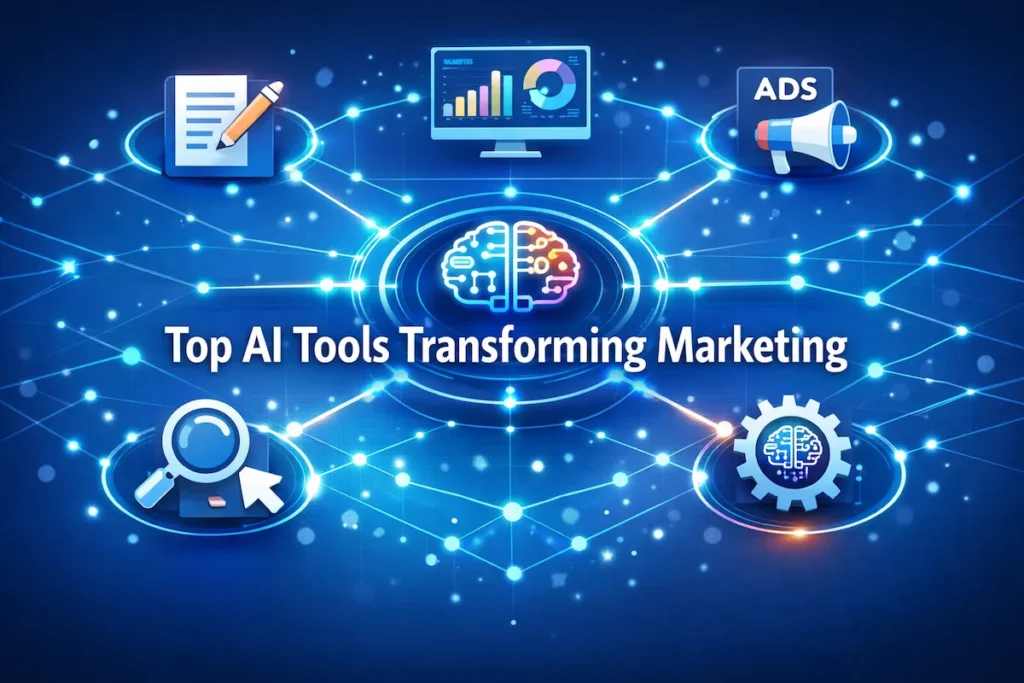
Top AI Tools Transforming Digital Marketing
To navigate the real answer to can AI replace digital marketing jobs, you need to understand the specific tools reshaping every marketing function — and where human oversight remains non-negotiable.
AI Tools for Content Creation
| Tool | Primary Use | Best For |
|---|---|---|
| ChatGPT | Drafting, brainstorming, repurposing | All-purpose content work |
| Jasper | Long-form content with brand voice | Blog posts, ad copy |
| Surfer SEO | Semantic content optimization | SEO-focused articles |
| Canva AI | Visual content generation | Social media graphics |
| Copy.ai | Short-form marketing copy | Emails, ads, captions |
Understanding these tools is essential context for anyone asking can AI replace digital marketing jobs in content — because the answer changes dramatically depending on how skilled the human using the tool is.
For agencies managing multiple clients, exploring the best AI tools for creative agencies can dramatically reduce production time without sacrificing quality or brand consistency.
The key principle: Use AI tools to accelerate your workflow — never to replace your thinking. The best content still requires skilled editorial judgment to shape, refine, and approve.
AI Tools for Advertising and Campaign Optimization
- Google Ads Smart Bidding — Machine learning bid optimization using real-time conversion signals across millions of data points
- Meta Advantage+ — Automated audience targeting and creative testing across Facebook and Instagram simultaneously
- Adzooma — AI-powered campaign management and performance recommendations across multiple ad platforms
- Albert AI — Autonomous digital campaign management for enterprise-level advertisers
The marketers winning at paid media today understand how to configure, monitor, and strategically direct these systems — not just run them on autopilot. This is precisely why can AI replace digital marketing jobs in paid advertising is the wrong question — the better question is whether you know how to direct these AI systems strategically.
AI Tools for SEO and Analytics
- Semrush AI features — Keyword research, content briefs, and competitive gap analysis at scale
- Ahrefs — Link intelligence and organic traffic analysis with AI-powered content suggestions
- Google Analytics 4 — Predictive metrics, anomaly detection, and audience modeling
- Clearscope — Semantic content optimization for stronger topical relevance and search rankings
For anyone still asking can AI replace digital marketing jobs in SEO and analytics, the answer is the same: AI accelerates discovery, but humans drive strategy.
Pro tip: AI analytics tools speed up the discovery of insights. The human marketer’s job is to interpret those insights and decide what to do about them.
Future of Digital Marketing Jobs in the AI Era
The clearest window into whether can AI replace digital marketing jobs lies in where the industry is visibly heading over the next five to ten years.
The future isn’t “humans vs. AI.” It’s “humans with AI vs. humans without AI.” The gap between those two groups is widening every quarter.
The Rise of AI-Assisted Marketers
The most in-demand professionals over the next five to ten years will work with AI fluently and strategically. The professionals who stop asking can AI replace digital marketing jobs and start asking how to use AI to multiply their output are the ones already pulling ahead of their competition. According to HubSpot’s 2024 State of Marketing report, 64% of marketers who use AI say it helps them create better campaigns, while 85% say it frees up significant time for strategic work.
The role of “content writer” is evolving into “AI content director.” The role of “PPC specialist” is evolving into “paid media strategist.” The underlying human value — judgment, creativity, accountability — remains the differentiator.
Real-world example:
A digital marketing agency shifted three junior content roles into “AI Content Strategist” positions. Each strategist now oversees AI-generated content pipelines for 12–15 clients simultaneously — work that previously required a team of eight. Output increased. Quality improved. Costs dropped.
Hybrid Roles Combining AI and Human Creativity
New hybrid roles are already appearing regularly in job listings across the industry:
- AI Marketing Strategist — Directs AI tools while owning campaign strategy and business outcomes
- Prompt Engineer for Marketing — Develops AI inputs that generate consistent, on-brand outputs
- Marketing Automation Architect — Builds and manages end-to-end AI-driven marketing workflows
- Conversational Marketing Specialist — Manages AI chatbots, automated sequences, and customer journey automation
For businesses running entirely online, AI automation for online businesses is becoming a competitive necessity — and marketers who can implement and manage these systems are among the most valuable hires available. These emerging hybrid roles are the industry’s own answer to can AI replace digital marketing jobs — and the answer they represent is a clear, resounding no.
Skills Digital Marketers Must Learn to Stay Relevant
The most empowering reframe in the entire debate over can AI replace digital marketing jobs is this: your relevance is directly and entirely within your own contro.
AI Tool Mastery for Marketers
You don’t need to be a data scientist. But you absolutely need to know how to use AI tools effectively, critically, and strategically. If you’re asking can AI replace digital marketing jobs and feeling anxious about the answer, mastering AI tools yourself is the single fastest way to flip that anxiety into competitive advantage.
Core AI competencies every marketer needs:
- Prompt engineering — writing inputs that generate consistently useful, on-brand outputs
- Output evaluation — knowing when AI content is usable, when it needs refinement, and when to discard it
- Workflow integration — embedding AI tools into existing processes without disrupting team dynamics
- Tool literacy — staying current as the AI marketing landscape evolves rapidly
Data-Driven Marketing Skills
Another critical layer of the answer to can AI replace digital marketing jobs lies in data — specifically, whether marketers develop the ability to interpret and act on data that AI surfaces.
Reading the Numbers That Matter
Marketing in the AI era runs on data. Marketers who develop strong data literacy are far less vulnerable to the disruption at the center of the can AI replace digital marketing jobs debate.
Key data skills to develop:
- Google Analytics 4 event tracking and funnel analysis
- CRM data segmentation and lifecycle reporting
- Paid media attribution modeling across channels
- Basic spreadsheet analysis and data visualization
- Statistical significance in A/B testing
Protecting Data While Using It
One skill many marketers overlook entirely: understanding the security implications of AI tool usage. As AI becomes embedded in marketing operations, AI data security risks in marketing are a growing professional concern — particularly for agencies handling customer PII or proprietary campaign intelligence. Knowing what you can and cannot safely feed into AI platforms is becoming a professional responsibility, not just an IT concern.
This overlooked dimension of the can AI replace digital marketing jobs conversation is one that will separate responsible, trusted marketing professionals from those who create liability for their organizations.
Creative Strategy and Human Insight
When thinking about can AI replace digital marketing jobs at the creative and strategic level, the evidence — and the data — consistently points in one direction: human skills win.
Double down on what AI genuinely cannot do. Develop your strategic thinking. Study consumer behavior. Sharpen your storytelling. Build the ability to develop brand narratives that connect emotionally with real people.
According to the World Economic Forum’s Future of Jobs Report, creative thinking and analytical reasoning are projected to be the most in-demand human skills through 2030 — precisely because they’re hardest to automate.
Human skills worth investing in right now:
- Brand strategy and long-term positioning
- Consumer psychology and behavioral economics
- Narrative development and emotional storytelling
- Cross-functional leadership and senior client relationships
- Cultural intelligence and trend interpretation
How Marketers Can Work With AI Instead of Competing With It
The most powerful mindset shift in the can AI replace digital marketing jobs conversation is moving from fear to agency — from “will AI take my job?” to “how do I use AI to make my job irreplaceable?”
The most important shift isn’t technical — it’s philosophical. Stop thinking about AI as a competitor and start treating it as the most powerful tool you’ve ever had access to.
Using AI to Boost Your Productivity
Build AI Into Your Daily Workflow Deliberately
Integrate AI tools with intention, not randomly.
Practical workflow integrations to start today:
- Repurpose existing content across formats (blog → social → email → video script)
- Cut reporting time by 50%+ using AI analytics and automated dashboards
- Use AI brainstorming for campaign ideation, then add your strategic filter before execution
- Use AI for competitive research and keyword discovery, then build the strategy yourself
- Use AI to draft first versions of everything — then edit with your expertise and brand knowledge
Building a Future-Proof Marketing Career
The Contrarian Truth Most People Miss
Here’s what the AI vs. marketing jobs conversation almost always gets wrong:
“AI won’t replace marketers — but it will replace average marketers. And the marketers who treat AI as a threat are the ones who will be replaced by someone who treats it as a superpower.”
The marketers building lasting careers right now aren’t fighting AI. They’re using it to operate at a level that was previously impossible — managing more clients, producing more content, running more sophisticated campaigns, and delivering better results than any purely human team could match.
That’s not a threat. That’s the biggest professional opportunity this industry has seen in decades.
Five Action Steps to Start This Week
- Audit your current role — identify which tasks AI could handle today and which genuinely require your human judgment
- Pick one AI tool this month — learn it deeply, not superficially; understand its strengths, limitations, and ideal use cases
- Reposition your personal brand — shift emphasis toward strategy, outcomes, and results rather than task execution
- Build a results-focused portfolio — campaign strategy, business outcomes, and creative direction matter more than deliverables alone
- Stay connected to the field — the AI marketing landscape changes every quarter; continuous learning is now a professional requirement
Conclusion
So, can AI replace digital marketing jobs? Not entirely — and not in the catastrophic way many fear.
AI is replacing tasks, not marketers. It’s automating the predictable and mechanical while simultaneously creating real, well-compensated opportunities for those with strategic, creative, and analytical depth.
The professionals at risk are those who rely solely on execution and refuse to adapt. The ones who will build dominant careers are those who embrace AI as a force multiplier — using it to move faster, produce better results, and deliver greater value than any non-AI-empowered competitor ever could.
Can AI replace digital marketing jobs? It can replace the parts of the job that never required your full humanity in the first place. What it cannot replace is strategic vision, creative courage, emotional intelligence, and the ability to build genuine trust with clients and audiences.
The future of digital marketing careers belongs to professionals who combine human insight with AI capability. That combination isn’t just safe from disruption — it’s in higher demand, and commanding higher compensation, than ever before.
Your move: Pick one AI tool this week, learn it well, and start building the skills that no algorithm can replicate.
Frequently Asked Questions
Can AI completely replace digital marketers?
No. AI can automate repetitive tasks like content drafting, ad bidding, and performance reporting, but it cannot replace the strategic thinking, creative direction, and human judgment that effective marketing requires. The future belongs to marketers who work with AI, not those who ignore it.
Which digital marketing jobs are most at risk from AI?
Roles built around repetitive execution face the most risk — including junior content writers producing formulaic copy, entry-level PPC managers focused only on manual bid adjustments, and social media coordinators handling only scheduling and basic posting. Roles requiring strategy, creativity, and client relationships are far more secure.
What skills protect marketers from AI replacement?
The most AI-resistant skills are strategic thinking, brand positioning, consumer psychology, emotional storytelling, and data interpretation. Combined with hands-on AI tool proficiency, these skills create a professional profile that’s extremely difficult to automate.
Is digital marketing still a good career in 2026?
Yes — arguably more than ever. The U.S. Bureau of Labor Statistics projects 8% growth in marketing analyst roles through 2033. Demand is shifting toward marketers with AI fluency and strategic depth, not away from the profession entirely.
How should marketers prepare for an AI-driven industry?
Start by learning one AI tool deeply — ChatGPT, Jasper, or Surfer SEO are strong starting points. Then invest in the skills AI can’t replicate: strategy, creativity, data interpretation, and client relationships. Treat AI as a productivity multiplier, not a replacement for your expertise.