
Quick Summary (TL;DR):
- AI helps automate operations and increase sales
- Personalization and predictive analytics drive conversions
- Start with one tool (chatbot, email, or recommendations)
- Focus on data quality for best results
Running an online store today is genuinely harder than it was five years ago. Ad costs have climbed. Competition keeps growing. And customers now expect fast, personalized experiences every single time they visit — not just on big retail holidays.
That pressure is exactly why AI for eCommerce growth has shifted from an interesting experiment to a real competitive necessity for US-based online businesses.
According to Shopify’s 2025 AI statistics research, the AI-enabled eCommerce market is projected to grow from $7.25 billion in 2024 to over $64 billion by 2034. More immediately, 87% of retailers already report that AI has had a positive impact on their revenue — and these gains aren’t reserved for enterprise brands with massive budgets.
In this guide to AI for eCommerce growth, we’ll break down the tools, strategies, and real-world use cases you need to scale your online store.
What Is AI for eCommerce Growth?
Understanding AI for eCommerce growth starts with knowing what it actually does for your bottom line.
Definition: AI for eCommerce growth is the use of artificial intelligence tools — including machine learning, predictive analytics, and automation — to help online stores automate operations, personalize customer experiences, and increase sales through data-driven decisions.
This isn’t about replacing your team. It’s about giving every person on your team a smarter system to work with. Traditional eCommerce runs on manual effort — someone writes every product description, manages inventory, and answers every customer question. AI changes that equation by analyzing behavioral data, identifying patterns, and making decisions automatically at a speed and scale no human team can match.
Think about what that looks like in practice:
- Instead of manually segmenting your email list, AI groups customers by behavior and sends hyper-relevant messages at exactly the right moment.
- Instead of guessing reorder quantities, AI analyzes demand trends and tells you precisely when and how much to restock.
- Instead of hiring more support agents during peak season, AI chatbots handle common questions instantly, around the clock.
For a full walkthrough of how this works end-to-end, see our breakdown of how AI automation is transforming online businesses.
Why AI Is Reshaping Online Businesses Right Now
AI for eCommerce growth isn’t a future trend — it’s actively reshaping how online businesses compete and win today.
McKinsey’s global AI research found that 78% of businesses now use AI in at least one core function — up from just 55% the year before. Among eCommerce businesses, four compounding forces are driving this shift:
- Automation eliminates time-wasting work — handling repetitive tasks like customer service responses, inventory updates, ad bid adjustments, and product tagging so your team stays focused on higher-value work.
- Personalization at a scale humans cannot reach — AI tools deliver individually tailored experiences to every shopper based on real behavior, directly lifting conversion rates.
- Decisions backed by data — predictive analytics surface insights from massive customer datasets in seconds, then act on them automatically.
- A customer experience people actually enjoy — faster support, relevant recommendations, and smooth checkout flows reduce friction and increase completed purchases.
When these four elements work together, AI for eCommerce growth becomes a true performance multiplier — every marketing dollar performs better and every customer interaction is more likely to convert.
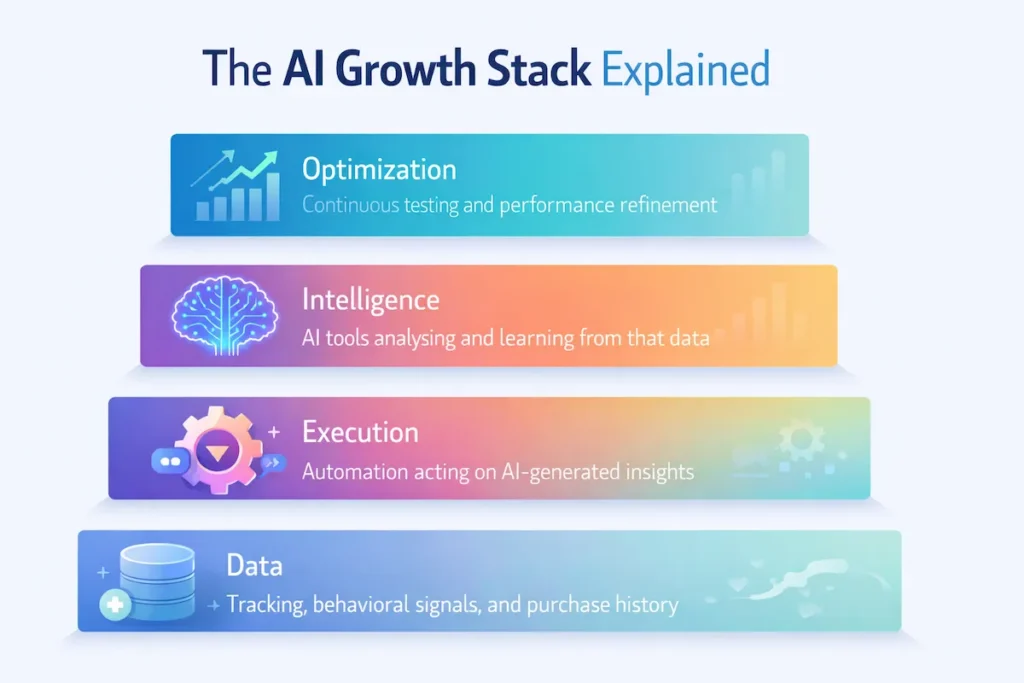
The AI Growth Stack for eCommerce
- Layer 1: Data — tracking, behavioral signals, purchase history
- Layer 2: Intelligence — AI tools analyzing and learning from that data
- Layer 3: Execution — automation acting on AI-generated insights
- Layer 4: Optimization — continuous testing and performance refinement
Key Technologies Powering AI for eCommerce Growth
The key technologies powering AI for eCommerce growth are what separate stores that scale from stores that stagnate.
AI Product Recommendation Systems
AI product recommendation systems are one of the most proven entry points into AI for eCommerce growth, delivering measurable ROI at any store size.
Product recommendation engines are one of the highest-ROI applications in AI for eCommerce growth. Instead of showing every visitor the same homepage, these systems analyze individual browsing history, past purchases, cart behavior, and patterns from similar shoppers — then surface the products most likely to convert for that exact person at that exact moment.
According to Built In’s comprehensive AI in retail report, Amazon’s recommendation engine accounts for approximately 35% of total sales — contributing to net sales of $143 billion in Q1 2024. For Shopify merchants, AI product recommendations are now built directly into the platform at no added cost, making this one of the most accessible starting points for any budget level.
💡 Practical Tip: The more behavioral data your store collects — browsing history, past orders, search queries — the better your recommendation engine performs. Start collecting and organizing that data now, even if you’re not ready to act on it yet.
AI Chatbots for 24/7 Customer Support
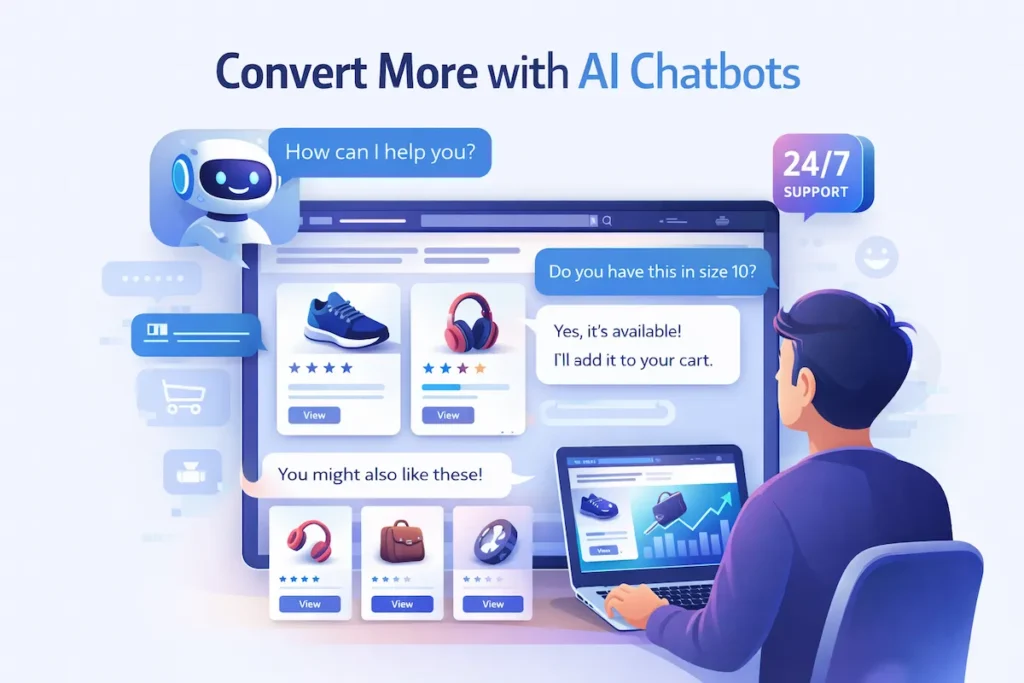
When it comes to AI for eCommerce growth, few tools convert more visitors into buyers than a well-deployed AI chatbot running around the clock.
AI chatbots allow stores to handle common inquiries — order status, returns, shipping timelines, product questions — instantly, 24/7, without adding headcount. According to Rep AI’s eCommerce AI statistics research, retailers using AI chatbots during Black Friday 2024 saw 15% higher conversion rates compared to stores using traditional support only. Modern AI chatbots understand conversational context, handle follow-up questions, recommend relevant products, and escalate to a human agent when needed.
AI Dynamic Pricing Systems
AI dynamic pricing systems give online stores one of the most underrated advantages in AI for eCommerce growth — the ability to compete on price automatically, without lifting a finger.
AI dynamic pricing tools monitor competitor pricing, live demand signals, inventory levels, and customer segments in real time — then automatically adjust your prices to optimize for margin, competitiveness, or sell-through rate depending on your goal. Platforms like Prisync and Wiser have made this capability accessible and affordable for smaller stores, not just enterprise brands.
AI Fraud Detection and Revenue Protection
Protecting your margins is just as critical to AI for eCommerce growth as increasing sales — which is exactly what AI fraud detection delivers.
AI fraud detection tools analyze transaction patterns, device fingerprints, location signals, and behavioral data in real time — flagging suspicious activity before an order is fulfilled. What makes AI-powered fraud detection genuinely better than older rule-based systems is its ability to adapt: rule systems catch known patterns, while AI identifies new ones by recognizing statistical anomalies across thousands of data signals simultaneously.
For the full security picture, see our guides on AI data security risks in marketing and AI security risks for small businesses.
How AI for eCommerce Growth Directly Increases Sales
The most direct path to higher revenue runs through AI for eCommerce growth — here’s how each tool moves the needle.
AI Personalization: Making Every Shopper Feel Understood
AI personalization is where AI for eCommerce growth becomes most visible to your customers — and most profitable for your store.
A 2024 BCG survey of 23,000 consumers found that 80% are comfortable with personalized shopping experiences and expect them by default, according to Shopify’s AI trends analysis for eCommerce. Mid-sized US apparel brands using Klaviyo’s AI-powered segmentation have reported significant lifts in email conversion rates after replacing broad campaigns with AI-triggered, behavior-based sequences. Instead of blasting the same newsletter to every subscriber, AI sends each customer a message triggered by their specific actions — a browse of a product page, an abandoned cart, or a 60-day gap since their last purchase.
Predictive Analytics: Knowing What Customers Will Do Before They Do It
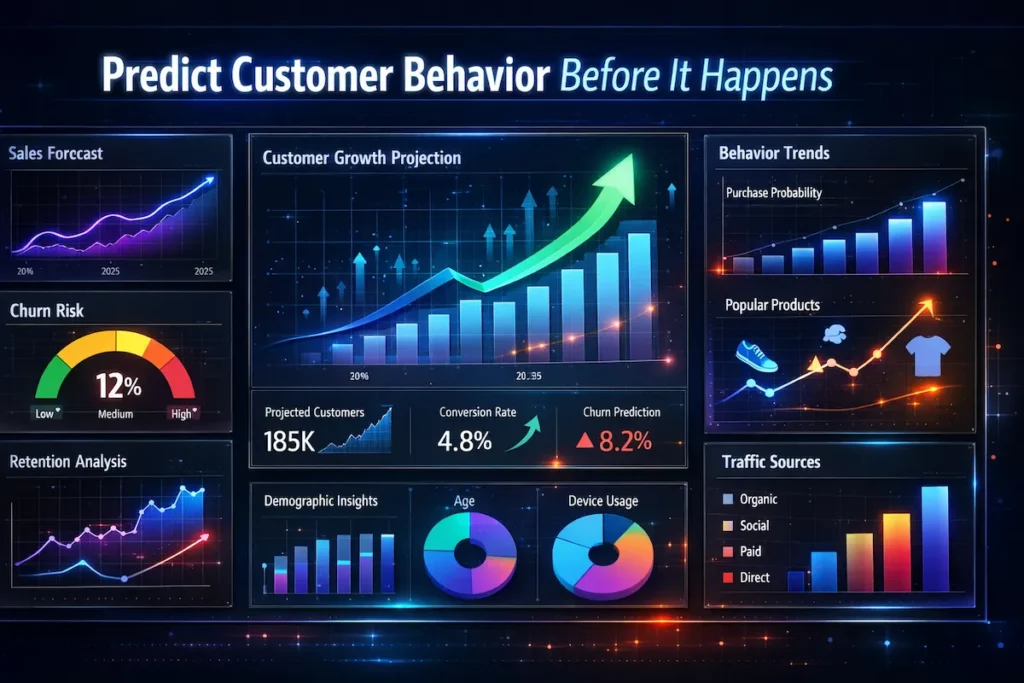
Predictive analytics takes AI for eCommerce growth beyond reaction and into anticipation — giving you the ability to act before a customer churns, converts, or walks away.
Predictive analytics eCommerce tools forecast what customers are about to do — whether they are about to churn, ready to purchase a higher-ticket item, or more price-sensitive than your baseline. Online subscription businesses using predictive churn models have been able to identify at-risk customers weeks before they cancel and intervene with targeted discounts or loyalty rewards before it’s too late. That’s a direct improvement to customer lifetime value — the single most important metric for long-term eCommerce profitability.
AI Inventory Management: Stop Losing Money to Stockouts and Overstocking
Smarter inventory decisions are one of the fastest ways AI for eCommerce growth pays for itself — eliminating the stockouts and overstock problems that quietly drain profit every month.
AI inventory management tools predict demand using historical sales data, seasonality patterns, promotional calendars, and external trend signals — then recommend optimal reorder points and quantities automatically. According to Shopify’s enterprise AI in retail analysis, 87% of retailers report that AI has had a measurably positive impact on revenue, with inventory optimization consistently ranked among the top contributing factors.
📊 Key Insight: 87% of retailers report AI has a positive impact on revenue — making it one of the highest-ROI investments in eCommerce today.
AI Marketing Automation: Better Results from Every Campaign Dollar
AI marketing automation is how serious brands stretch every dollar — and it’s one of the highest-leverage moves available in AI for eCommerce growth today.
AI marketing automation removes the manual guesswork from email campaigns, retargeting ads, and content scheduling by analyzing customer behavior to determine the optimal message, channel, and moment for each individual. For a comprehensive look at which platforms are delivering results, see our guide to the best AI tools for marketing agencies in 2026. Coca-Cola used machine learning and social media analytics to identify exactly when their target segments were most active on each platform — then served ads precisely at those moments, achieving higher engagement with lower overall ad spend.
AI Use Cases vs. Business Impact: Quick Reference
This quick reference table maps the core use cases of AI for eCommerce growth directly to the business outcomes they drive.
| AI Use Case | Primary Business Impact | Example Tools |
|---|---|---|
| Product recommendations | Higher average order value | Nosto, Shopify AI |
| AI chatbots | Faster conversions, lower support cost | Gorgias, Rep AI, Tidio |
| Predictive analytics | Better customer retention | Klaviyo, Barilliance |
| Dynamic pricing | Improved margins and competitiveness | Prisync, Wiser |
| Marketing automation | Higher email ROI, lower ad spend | Klaviyo, Jasper AI |
| Inventory management | Fewer stockouts, lower overstock costs | Inventory Planner |
| Fraud detection | Reduced chargebacks and revenue loss | Signifyd, NoFraud |
Best AI Tools for eCommerce Growth in 2026
The best AI tools for eCommerce growth in 2026 are more accessible than ever — with proven options available at every budget level.
You don’t need a custom AI system or an enterprise budget to start. Here are the most practical tools for US-based online businesses:
- Shopify Magic — Built into Shopify across all plans. Generates product descriptions, email subject lines, blog content, and image backgrounds instantly. The easiest entry point for most store owners.
- Klaviyo AI — Predictive segmentation and behavior-triggered email automation. Consistently one of the highest-ROI tools for email marketing.
- Nosto — Real-time personalization powering product recommendations, landing page customization, and behavioral popups. Excellent for stores with established traffic.
- Jasper AI — Content generation for product pages, ad copy, and blog articles. Significantly faster than traditional copywriting workflows.
- Gorgias — AI-powered customer support platform built specifically for eCommerce. Automates common ticket responses and routes complex issues to the right human agent.
- Tidio / Rep AI — AI chatbot platforms with native Shopify integration, delivering 24/7 support automation with proven conversion rate improvements.
- Prisync — Dynamic pricing tool that monitors competitor prices and adjusts your pricing automatically based on rules you define.
For a practical framework connecting these tools into a cohesive system, our guide on tools to automate your sales workflow end-to-end walks through exactly how to build an automated process that runs without constant manual oversight. Start with the tool that solves your biggest current bottleneck.
Real-World Examples: AI for eCommerce Growth in Action
Amazon — 35% of Revenue Driven by AI Recommendations
Amazon’s recommendation engine proves the concept at the most extreme scale. By continuously analyzing billions of behavioral data points, their AI surfaces products individual shoppers are statistically likely to buy — often before the shopper consciously knows they want them. That engine is directly attributed to approximately 35% of total sales. The same underlying logic scales down to any store with sufficient product and behavioral data.
Lowe’s — AI Assistant Improving the Customer Experience
In 2025, Lowe’s launched “Mylow Companion” — an AI-powered assistant helping both in-store associates and online shoppers get personalized product recommendations and project guidance through a conversational interface. The result: better customer experience at lower support cost. Any eCommerce store can replicate this model at their own scale using accessible tools like Rep AI or Gorgias.
Shopify Merchants — 15% Black Friday Conversion Lift
Data from Black Friday 2024 confirmed that Shopify stores using AI chatbots converted 15% more visitors than stores relying on traditional support. When shoppers get immediate, accurate answers to their questions, they complete their purchase. That single improvement translates into significant revenue gains during high-traffic periods.
US Apparel Brands — Email Revenue Lifted by AI Personalization
Mid-sized fashion brands using Klaviyo’s AI segmentation replaced batch-and-blast emails with behavior-triggered sequences and saw meaningful improvements in revenue per email sent. When the right message reaches the right person at the right moment, email becomes one of the highest-ROI channels in your marketing stack.
Subscription Retailers — Churn Reduced by Predictive AI
Subscription eCommerce brands using predictive churn models intervene with at-risk customers before they cancel — using targeted offers and loyalty rewards triggered automatically by AI risk signals. The result is higher retention rates and better lifetime value without adding manual workload to the team.
How to Implement AI for eCommerce Growth: A Step-by-Step Plan
Getting started doesn’t require a technical team, a custom system, or a large budget. Here’s a practical five-step framework:
- Step 1 — Identify your highest-impact automation opportunities. Look at where your team spends the most time on repetitive, low-skill tasks. Customer service responses, inventory tracking, ad bid management, and product description writing are typically the highest-frequency targets. The clearest ROI always comes from automating high-volume tasks first.
- Step 2 — Choose tools that match your platform and your specific problem. A Shopify store wanting to improve email performance should start with Klaviyo. A store needing better on-site personalization should explore Nosto. Match the tool to the specific bottleneck — not to what’s popular in your industry.
- Step 3 — Integrate before you build. Most modern AI tools offer native integrations with Shopify, WooCommerce, and BigCommerce. Start with plug-and-play tools before considering custom development. Validate the value at small scale first, then expand.
- Step 4 — Get your data foundation right. AI tools are only as good as the data you give them. Before adding any new AI system, audit your data collection. Are you capturing browsing behavior consistently? Purchase history across all channels? Poor data quality is the single most common reason AI tools underperform expectations.
- Step 5 — Review, test, and optimize continuously. Review performance monthly, run A/B tests on AI-generated recommendations and emails, and update configurations as your product catalog and customer base evolve. Treat AI as an ongoing system — not a one-time setup.
Quick Wins: Start Using AI in the Next 7 Days
You don’t need weeks of planning to get started. These five moves take less than a day each and deliver immediate impact:
- Install an AI chatbot. Tidio and Rep AI both integrate with Shopify in under an hour. Even a basic setup immediately reduces support volume and improves response time for every visitor.
- Enable Shopify Magic product descriptions. Start by rewriting your five lowest-converting product pages — you’ll see the difference quickly.
- Set up abandoned cart email automation. Configure Klaviyo or your existing email platform to send behavior-triggered sequences. This is one of the highest-ROI automations in eCommerce and takes less than a day to activate.
- Turn on AI product recommendations. Shopify’s built-in recommendation blocks can be added to your product and cart pages in minutes. No additional tool or cost required.
- Audit your top three data gaps. Identify what behavioral data you’re currently not capturing. Fixing your data collection foundation now pays dividends for every AI tool you add in the future.
If you’re serious about implementing AI for eCommerce growth, start by auditing your current workflows this week — identify one automation opportunity, choose one tool, and measure what happens. That single step puts you ahead of the majority of competitors still running everything manually.
Honest Challenges of AI for eCommerce Growth
AI delivers real results — but it comes with challenges worth planning for upfront.
- Cost vs. ROI alignment — quality AI tools carry real subscription costs, and enterprise-level platforms can run into tens of thousands annually. Start with tools that have a provable, measurable ROI before expanding your stack.
- Data quality and completeness — if your customer data is fragmented or incomplete, AI tools will consistently underperform. Invest in data hygiene before investing in AI tools.
- Integration friction — not every AI tool integrates cleanly with every tech stack. Expect some setup time, especially if your store runs custom-built components.
- Security and privacy — any AI system processing customer data introduces new security considerations. Before deploying AI tools, understand what data each one accesses and your obligations under US privacy regulations. See our guide on AI security risks for small businesses for a practical starting point.
The good news: every one of these challenges is manageable when you approach AI for eCommerce growth incrementally rather than trying to overhaul your entire stack at once.
The Future of AI for eCommerce Growth
According to Shopify’s enterprise AI in retail analysis, 97% of retailers plan to increase their AI spending in the next fiscal year. Here’s where AI for eCommerce growth is visibly headed:
- AI shopping assistants becoming the new storefront — OpenAI’s Agentic Commerce Protocol, built in partnership with Shopify and Stripe, now allows customers to find and buy products through a chatbot conversation without ever visiting a retailer’s website directly.
- Voice commerce opening a new purchasing channel — as smart speakers deepen their presence in US households, AI-powered voice shopping will require product data optimized for spoken, conversational queries.
- Hyper-personalized storefronts built in real time — the next generation will serve each visitor an entirely individualized version of your store — dynamic layouts, personalized pricing tiers, curated products, and tailored messaging all adapted in real time.
Businesses building their AI infrastructure now will have a compounding operational advantage that gets harder for late adopters to close over time. That’s what makes AI for eCommerce growth a long-term strategic investment, not just a short-term operational fix.

Frequently Asked Questions
What is AI for eCommerce growth?
AI for eCommerce growth refers to the use of artificial intelligence technologies — including machine learning, predictive analytics, and automation — to help online stores sell more effectively. This includes tools for product recommendations, customer support chatbots, email personalization, inventory management, fraud detection, and AI marketing automation.
How does AI actually increase online store sales?
AI increases sales primarily through personalization and speed. Recommendation engines surface the most relevant products to each individual shopper, increasing average order value. AI chatbots convert more visitors by answering questions instantly. Predictive analytics help marketers reach the right customers with the right offer at the right moment. These effects compound into measurable, consistent revenue growth over time.
What are the best AI tools for small eCommerce businesses?
For small eCommerce stores, the best starting points are Shopify Magic (free, built-in), Tidio or Rep AI for chatbot support automation, and Klaviyo for email personalization and segmentation. These tools offer meaningful AI capabilities without enterprise-level costs and integrate natively with most major eCommerce platforms including Shopify, WooCommerce, and BigCommerce.
Is AI affordable for small online stores?
Yes. Many of the most impactful AI tools for eCommerce start under $50 per month, and several — like Shopify Magic — are included with existing platform subscriptions at no added cost. The key is to start with one high-ROI use case rather than investing in multiple tools at the same time.
How do I start using AI in my eCommerce store?
Start by identifying the single biggest time drain or revenue leak in your current operation. Choose one AI tool that directly addresses that specific problem, integrate it with your existing platform, and measure the results over 30 days before expanding. The Quick Wins section above outlines five concrete actions you can take within the next seven days.
What data do I need before implementing AI tools?
The most important data is customer behavioral data — browsing history, purchase history, and on-site engagement patterns. Most AI tools pull this directly from your eCommerce platform once integrated, but the quality of your existing data tracking matters enormously. Stores with clean, consistent data get significantly better results from AI tools than stores with fragmented records.
What are the biggest risks of using AI in eCommerce?
The main risks are data privacy compliance, integration complexity, and over-relying on automation without ongoing human oversight. Choosing tools that are transparent about data handling, starting with plug-and-play integrations, and reviewing AI performance monthly reduces all three risks significantly. See our guide on AI security risks for small businesses as a practical starting point.
Conclusion: Your Next Move With AI for eCommerce Growth
AI for eCommerce growth is available, accessible, and delivering measurable results for online businesses of all sizes across the US right now. Product recommendations, dynamic pricing, marketing automation, predictive analytics, fraud detection — the tools exist at every price point to help you automate intelligently, personalize effectively, and grow more profitably.
You don’t need to implement everything at once. Pick the single area where AI can have the most immediate impact on your revenue or your team’s efficiency — and start there. Use the Quick Wins section above if you need a concrete first move.