
Key Takeaways
- AI agents for digital marketing go far beyond basic automation — they perceive, decide, and optimize autonomously
- These systems operate 24/7, improving campaigns in real time without constant human input
- Top platforms like HubSpot, Salesforce Einstein, and Jasper AI already offer accessible entry points
- Real use cases span SEO, email, paid ads, social media, and content marketing
- Risks include data privacy, AI bias, and over-automation — all manageable with the right guardrails
The Rise of AI Agents for Digital Marketing
Not long ago, running a digital marketing campaign meant spreadsheets, manual A/B tests, and a lot of guesswork. Then marketing automation arrived — and it helped. Marketers could schedule emails, trigger basic workflows, and segment audiences without doing everything by hand. It was a real upgrade, but it still had a ceiling.
That ceiling is now being broken by AI agents for digital marketing.
Today’s marketing landscape is driven by data moving faster than any human team can process. Audiences expect personalization at every touchpoint. Ad platforms update their algorithms constantly. Content demands have exploded. Rule-based automation was built for a simpler world — and the world isn’t simple anymore.
Here’s where it gets interesting: AI agents for digital marketing don’t just execute instructions — they think, adapt, and decide. This shift toward AI marketing automation is already reshaping how brands plan, launch, and optimize campaigns at every level. Brands that recognize this early are building meaningful competitive advantages. Those that wait are going to find themselves playing catch-up in a market that isn’t slowing down.
What Are AI Agents for Digital Marketing?
Before going further, it’s worth clearing up a common point of confusion — because “AI” gets thrown around loosely, and not all AI tools are created equal.
📌 Quick Definition
What are AI agents for digital marketing? AI agents for digital marketing are autonomous software systems that analyze data, make decisions, and execute marketing actions in real time — without constant human input.
An AI tool does one thing well. Grammar checkers, image resizers, sentiment analyzers — these are useful, but they’re narrow. You use them; they respond.
An AI assistant is more conversational. ChatGPT, for example, can answer questions, generate copy, and help brainstorm. But it still requires constant human prompting. You’re driving; it’s in the passenger seat.
An AI agent is something fundamentally different. AI agents for digital marketing are autonomous systems capable of perceiving their environment, making decisions, executing multi-step tasks, and adjusting their behavior based on results — all with minimal human intervention. They don’t wait to be asked. They pursue goals.
Think of the difference this way: an AI assistant will write an email if you ask it to. An AI agent will analyze your CRM, identify a high-intent customer segment, draft personalized email sequences, schedule the send for optimal open rates, monitor performance, and adjust subject lines — entirely on its own.
This is why AI agents for digital marketing represent the next generation of autonomous marketing systems — they bring genuine decision-making into the loop, not just execution. If you’re wondering whether AI can replace digital marketing jobs, the honest answer is that it’s less about replacement and more about this fundamental shift in how marketing work gets done.
How AI Agents for Digital Marketing Work in Modern Campaigns
Understanding the mechanics helps marketers deploy these systems with confidence rather than treating them like a black box.
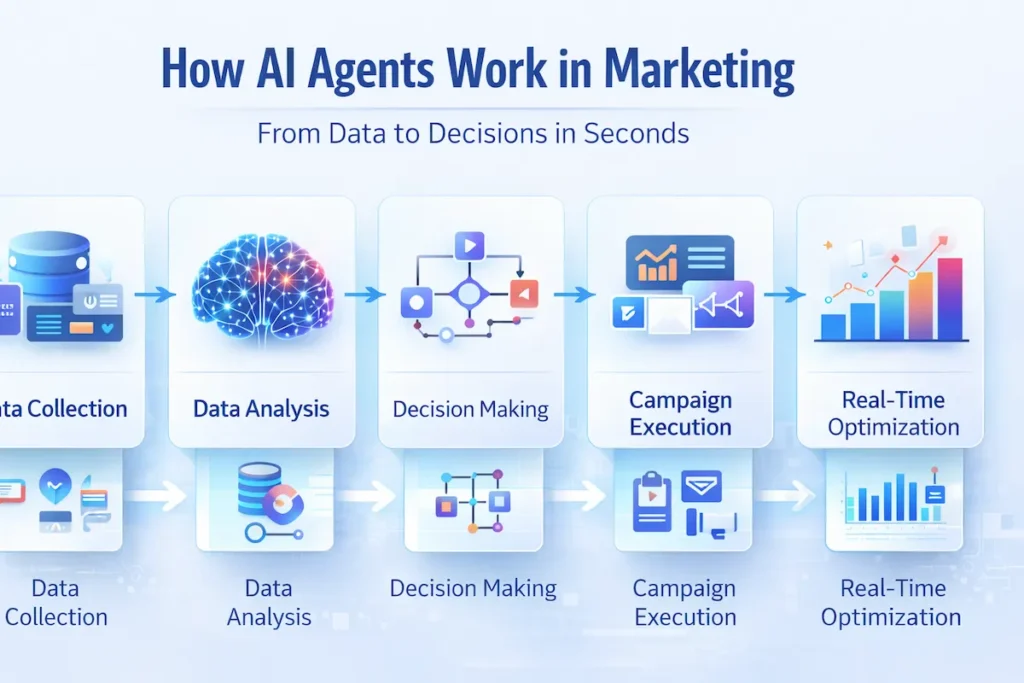
Data Collection and Analysis with AI Agents for Digital Marketing
Every AI-driven marketing agent starts with data. AI agents for digital marketing continuously pull from multiple sources — website analytics, CRM records, social media signals, ad performance dashboards, and even competitor data. Unlike traditional analytics tools that require human review, these systems process incoming information in real time and extract patterns automatically through machine learning marketing techniques.
In real campaigns, this shows up as something like: an AI agent monitoring a SaaS company’s funnel detects that users who visit the pricing page twice without converting tend to respond well to a specific type of case study email. It identifies that pattern, flags it, and acts on it — without waiting for a quarterly analytics review. That’s predictive marketing analytics working in practice, not just in theory.
Automated Decision-Making Using AI Agents for Digital Marketing
Once data is analyzed, AI agents for digital marketing move into decision mode. This is where they differ most sharply from traditional automation. Instead of following rigid if-then rules, these autonomous marketing platforms weigh multiple variables simultaneously and select the best course of action — a process that sits at the core of automated marketing decisions.
A campaign management agent might simultaneously evaluate budget allocation, audience overlap, creative fatigue, and historical conversion rates before deciding where to increase ad spend. That’s the kind of nuanced, multi-variable reasoning that previously required a senior paid media strategist.
Real-Time Campaign Optimization with AI Agents for Digital Marketing
Perhaps the most powerful capability is real-time optimization. AI agents for digital marketing don’t just set campaigns and report on them — they continuously refine them while they run. This is AI-powered campaign optimization at its most practical: testing creative variations, pausing underperforming ad sets, shifting budget toward high-converting audiences, and updating bidding strategies — all in real time, at a speed no human team can match.
This creates a compounding effect. Campaigns don’t just improve week over week; they improve hour over hour. According to Google’s research on AI-powered advertising, advertisers using AI-driven optimization consistently see stronger conversion performance than those relying on manual management.
⚡ Quick Reality Check
If your current campaigns still rely on manual reporting and weekly optimizations, you’re already competing at a disadvantage against AI-driven systems that improve performance every single hour. The gap between AI-managed and manually managed campaigns isn’t closing — it’s widening.
Key Benefits of AI Agents for Digital Marketing
Improving Marketing Efficiency with AI Agents for Digital Marketing
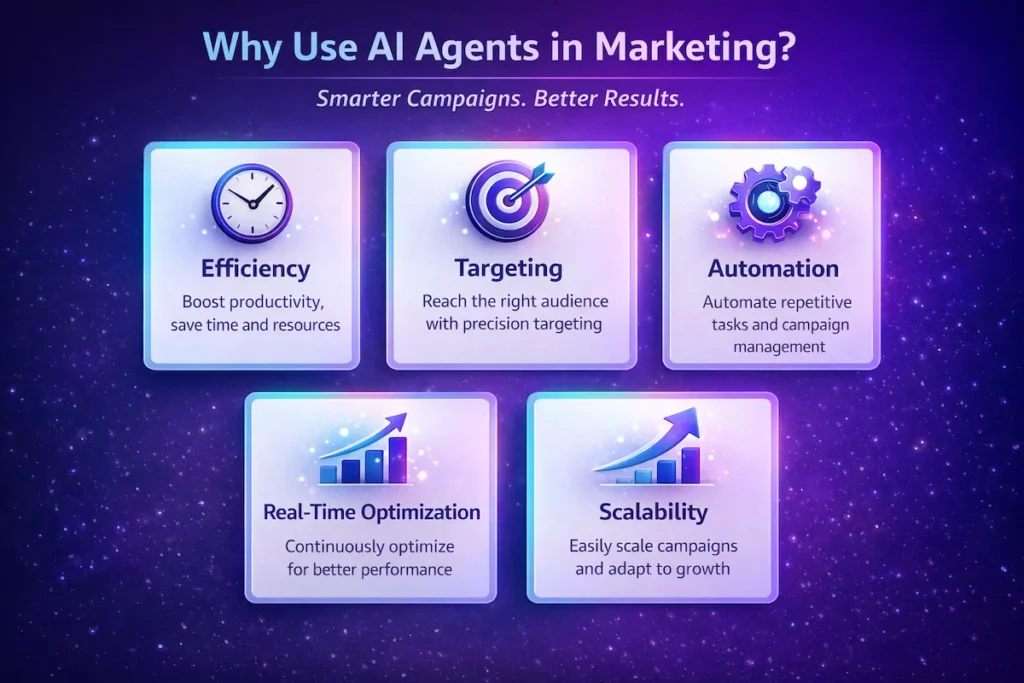
Time is the most limited resource in any marketing team. AI agents for digital marketing dramatically reduce time spent on repetitive, data-heavy tasks. Campaign reporting, audience segmentation, keyword research, content scheduling — tasks that once consumed hours each week now run automatically in the background.
This efficiency gain isn’t just about speed. It frees human marketers to focus on creative, strategic, and relationship-driven work that genuinely requires human intelligence. For a broader look at how AI automation is reshaping online business operations, the productivity gains extend well beyond marketing alone.
Better Customer Targeting Using AI Agents for Digital Marketing
Audience targeting has always been one of marketing’s biggest challenges. Here’s where AI agents for digital marketing solve this in a way that manual segmentation simply can’t match — through customer targeting with AI that analyzes behavioral signals, purchase history, content engagement, and demographic patterns simultaneously to build dynamic audience segments that update in real time.
A retail brand, for instance, might deploy an AI-driven marketing agent that identifies customers showing early signs of churn — and automatically triggers a re-engagement campaign with personalized product recommendations before the customer ever leaves. That’s AI-driven marketing strategy turning reactive marketing into proactive relationship management.
24/7 Marketing Automation with AI Agents for Digital Marketing
Human teams work in shifts. Campaigns don’t. AI agents for digital marketing operate continuously — monitoring performance, adjusting bids, responding to trends, and nurturing leads around the clock. For companies running campaigns across multiple time zones, or managing always-on content channels, this is a significant operational advantage.
A lead that fills out a form at 2 a.m. on a Sunday gets the same fast, personalized follow-up as one who comes in on a Tuesday afternoon. Consistency at scale is one of the clearest competitive advantages that marketing campaign automation powered by AI delivers.
Real-Time Campaign Improvements Through AI Agents for Digital Marketing
Static campaign strategies are a liability in today’s market. AI agents for digital marketing make continuous micro-improvements that add up to major performance gains. When a particular ad creative starts showing fatigue, the agent rotates in a fresh variant. When a keyword suddenly converts at a higher rate, the agent increases its bid immediately — this is where AI-powered campaign optimization becomes critical to maintaining performance without constant human oversight.
Top Platforms Offering AI Agents for Digital Marketing
If you’re evaluating AI agents for digital marketing, the good news is that you don’t need to build these systems from scratch. Several leading platforms now offer sophisticated AI-driven capabilities built into tools the industry already uses. For a comprehensive breakdown, our guide to the best AI tools for creative agencies covers a wide range of platforms worth evaluating.
HubSpot has integrated AI across its CRM and marketing suite, offering predictive lead scoring, AI-assisted content creation, and automated campaign workflows that adapt based on contact behavior. It’s one of the most accessible entry points for teams new to these AI-driven systems.
Salesforce Einstein brings AI-powered analytics and decision-making into one of the world’s most widely used CRM ecosystems. Einstein can predict which leads are most likely to convert, recommend next-best actions for sales reps, and automate personalized customer journeys at scale.
Jasper AI focuses on AI content marketing, enabling teams to produce high-volume, on-brand content with AI assistance — from blog posts to ad copy to social media captions.
Copy.ai offers similar content generation capabilities with workflow automation features, making it particularly useful for agencies managing content production across multiple clients.
ChatGPT (via OpenAI’s API) is increasingly being integrated into custom marketing stacks by agencies and SaaS companies building proprietary autonomous marketing agents for specialized tasks — from customer support automation to dynamic landing page copy generation.
These platforms are starting points, not ceilings. Many enterprise marketing teams now build custom autonomous marketing platforms that integrate multiple tools through APIs, creating unified systems tailored to their specific workflows.
Real-World Use Cases of AI Agents for Digital Marketing
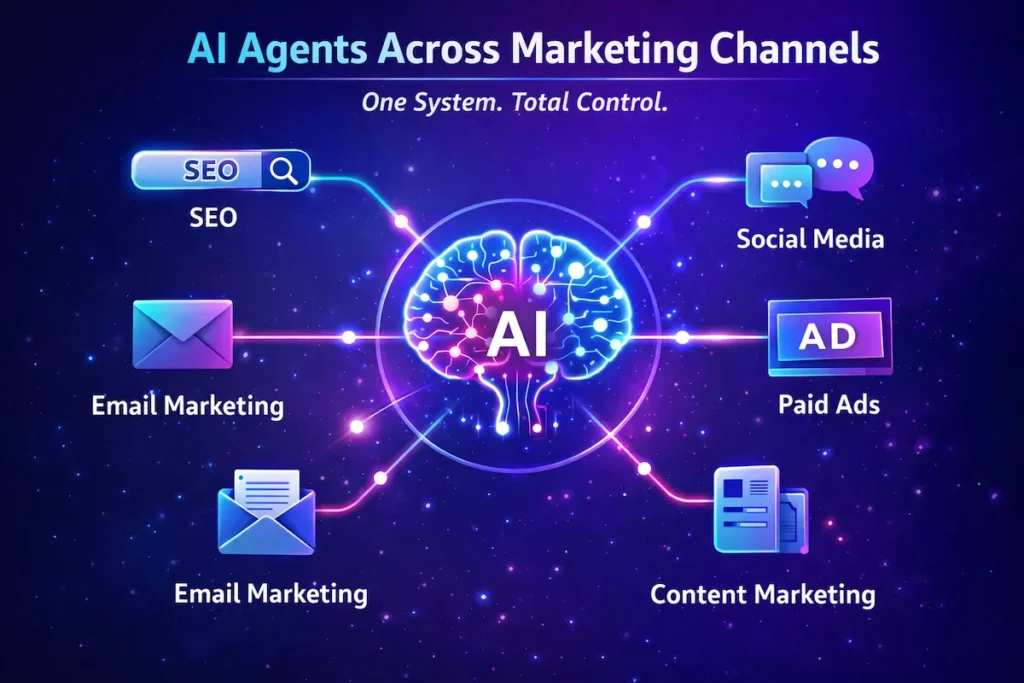
Using AI Agents for Digital Marketing in SEO
AI agents for digital marketing have become powerful SEO allies. These systems continuously audit sites for technical issues, identify keyword gaps through competitor analysis, and generate content briefs optimized for search intent — all on an ongoing basis. Some AI-driven marketing agents monitor SERP ranking changes and trigger content updates when a page begins to slip, making AI marketing automation a natural fit for long-term organic growth strategies.
Using AI Agents for Digital Marketing in Content Marketing
Content at scale has always been a genuine challenge for most teams. In real campaigns, this shows up as these AI systems building full content calendars, drafting initial long-form pieces, optimizing existing content for updated keywords, and distributing across channels automatically. The human role shifts from production to editorial oversight — a model that defines modern AI content marketing at its most effective.
Using AI Agents for Digital Marketing in Email Marketing
Email remains one of the highest-ROI channels — and AI agents for digital marketing are making it dramatically more effective. These autonomous marketing systems test dozens of subject lines simultaneously, personalize email content dynamically based on each recipient’s behavior, optimize send times at the individual level, and automatically suppress disengaging contacts before they unsubscribe. According to Mailchimp’s research on email personalization, segmented and personalized campaigns consistently outperform generic sends by a wide margin — and these AI systems make that level of personalization scalable for any team.
Using AI Agents for Digital Marketing in Social Media Marketing
Managing social media across multiple platforms is genuinely labor-intensive. AI agents for digital marketing can monitor brand mentions, schedule posts at peak engagement times, identify trending topics relevant to a brand’s niche, and draft response copy for community management review. Some AI-driven marketing agents analyze which content formats are performing best and adjust the content mix accordingly — turning AI-driven marketing strategies into a measurable competitive edge on social.
Using AI Agents for Digital Marketing in Paid Advertising
Paid media is one of the clearest areas where AI agents for digital marketing deliver measurable ROI. These autonomous marketing platforms manage bid optimization, audience targeting, creative rotation, and budget allocation across Google Ads, Meta, LinkedIn, and programmatic channels — simultaneously, in real time. For a deeper look at how AI is transforming advertising strategies across paid channels, the tactical applications go well beyond basic bid management. For performance marketing teams, this translates directly into lower cost-per-acquisition and higher return on ad spend.
AI Agents for Digital Marketing vs Traditional Marketing Automation
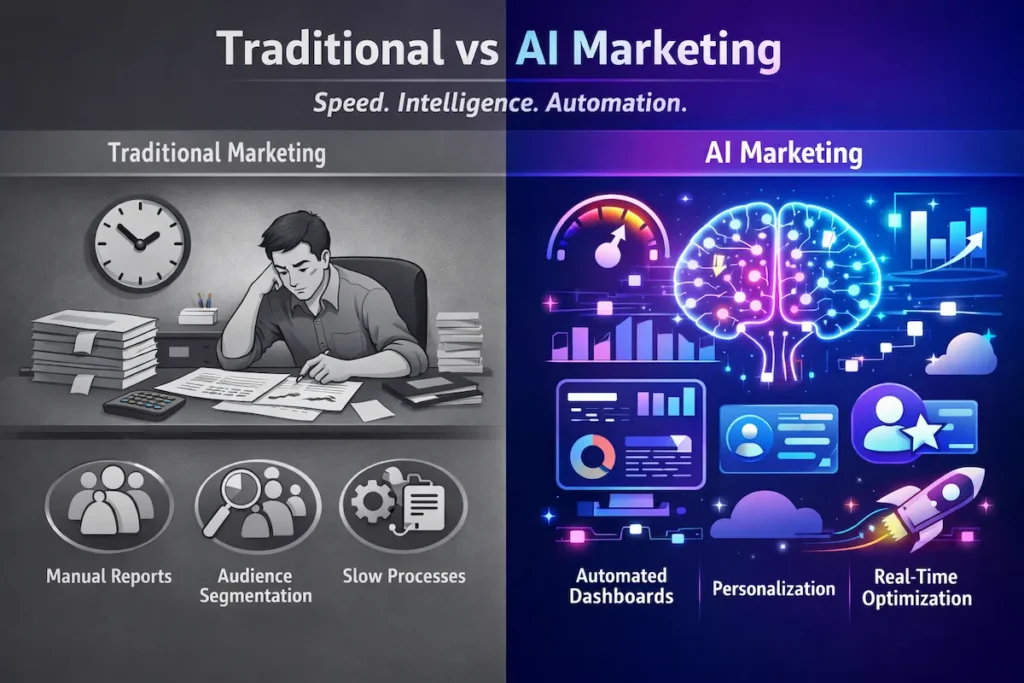
The distinction between these two approaches matters more than most marketing teams realize. Here’s a clear side-by-side comparison:
| Feature | Traditional Marketing Automation | AI Agents for Digital Marketing |
|---|---|---|
| Decision Logic | Rule-based (if-then) | Machine learning, adaptive |
| Personalization | Segment-level | Individual-level, real-time |
| Optimization | Manual, periodic | Continuous, autonomous |
| Data Processing | Structured data only | Structured + unstructured |
| Campaign Management | Human-directed | Largely autonomous |
| Learning Over Time | None | Continuous improvement |
| Speed of Response | Hours to days | Seconds to minutes |
| Human Involvement | High | Strategic oversight only |
The gap between these two approaches is widening rapidly. Traditional rule-based automation is becoming a baseline capability rather than a competitive differentiator. AI agents for digital marketing are fast becoming the new standard for any team serious about sustainable performance.
For teams getting started, the smartest move is to begin with one channel — like email or paid ads — and layer these AI systems into your existing workflow before scaling across your entire marketing stack. That incremental approach reduces risk while building the internal knowledge needed to get the most out of these tools.
Challenges and Risks of Using AI Agents for Digital Marketing
A complete picture of AI agents for digital marketing has to include an honest look at the limitations — ignoring these would be doing any marketing leader a disservice.
Data privacy and compliance is a genuine concern. These AI-driven systems require access to significant amounts of user data to function effectively. Marketers need to ensure their platforms comply with GDPR, CCPA, and applicable regulations. The FTC’s guidance on AI and data use makes clear that responsible data practices aren’t optional — they’re a legal and reputational necessity.
AI bias is a risk that’s often underestimated. If the training data reflects historical biases — in targeting, content, or decision-making — AI agents for digital marketing will replicate and potentially amplify those biases. Regular audits of AI outputs are essential.
Over-automation risk is real. Removing too much human judgment from marketing can produce tone-deaf campaigns, especially in situations requiring cultural sensitivity or crisis awareness. Even the most sophisticated autonomous marketing platforms don’t understand context the way humans do.
Implementation costs and complexity remain a barrier for many smaller businesses. Deploying AI agents for digital marketing requires investment in technology, data infrastructure, and often specialized expertise. The ROI is there — but the upfront commitment is significant.
Dependency risk is worth considering as well. Teams that rely too heavily on autonomous marketing platforms can lose internal skills and strategic muscle over time. Maintaining human expertise alongside these systems is a smart long-term practice.
The Future of AI Agents for Digital Marketing
The trajectory of AI agents for digital marketing points toward capabilities that will feel transformative even by today’s standards.
Autonomous marketing teams are already beginning to emerge — systems where multiple specialized AI agents collaborate, each handling a different function (SEO, paid media, email, content), coordinated by an orchestration layer. The human marketing team sets strategy and reviews outcomes; the AI-driven marketing agents handle execution end to end. This is the direction AI marketing automation is heading at the enterprise level.
AI growth marketing systems will increasingly identify not just optimization opportunities within existing channels, but entirely new growth levers — audiences, channels, and messaging angles that human teams wouldn’t have discovered through manual analysis. For e-commerce brands specifically, our guide on AI for e-commerce growth shows how these autonomous systems are already creating measurable revenue impact.
Hyper-personalized marketing campaigns will become the expectation rather than the exception. One-to-one personalization at scale — where every customer interaction is tailored to that individual’s unique history, preferences, and real-time context — is already moving from aspiration to operational reality. Tools like AI review generators illustrate how AI is personalizing customer touchpoints at stages of the journey that were previously manual and inconsistent.
According to McKinsey’s research on AI in marketing, companies that fully integrate AI into their marketing operations report significantly higher revenue growth compared to those using AI selectively. The brands building AI-native marketing infrastructure today are positioning themselves well for a market where these capabilities become table stakes.
Frequently Asked Questions About AI Agents for Digital Marketing
Q1: What exactly are AI agents for digital marketing, and how are they different from regular AI tools?
AI agents for digital marketing are autonomous software systems that go beyond responding to prompts — they actively analyze data, make decisions, and execute multi-step marketing tasks without constant human direction. A regular AI tool waits for input; an AI agent pursues defined marketing goals on its own, adapting based on real-time results.
Q2: Can small businesses benefit from AI agents for digital marketing, or is this only for large enterprises?
Small businesses can absolutely benefit from AI agents for digital marketing — and the barrier to entry is lower than most people assume. Platforms like HubSpot and Copy.ai offer AI-driven marketing features at accessible price points. The smartest starting point is to identify one high-volume, repetitive task — like email follow-up sequences or social media scheduling — and automate that first before expanding.
Q3: How do AI agents for digital marketing handle data privacy and compliance?
Responsible deployment of AI agents for digital marketing requires building privacy compliance into the system from the start. This means using platforms that are GDPR and CCPA compliant, limiting data collection to what’s genuinely needed, and auditing AI outputs regularly for potential bias or misuse. The FTC has made clear that AI systems operating on consumer data are subject to the same consumer protection standards as any other marketing practice.
Q4: What marketing channels benefit most from AI agents for digital marketing?
In practice, email marketing and paid advertising tend to show the fastest, most measurable ROI from AI agents for digital marketing — because both channels generate rich performance data that these systems can act on immediately. SEO and content marketing deliver strong long-term returns, while social media management benefits most from AI’s ability to monitor, schedule, and optimize at scale across multiple platforms simultaneously.
Q5: How long does it take to see results from AI agents for digital marketing?
Results vary depending on the channel and implementation, but most teams using AI agents for digital marketing start seeing measurable efficiency gains within the first 30 to 60 days. Performance improvements in paid advertising can appear even faster, often within the first few weeks of AI-managed optimization. Longer-term gains — like organic traffic growth from AI-driven SEO and content strategies — typically compound over three to six months.
Q6: Do AI agents for digital marketing replace human marketers?
No — and understanding why matters. AI agents for digital marketing are most effective when they handle execution, optimization, and data analysis, while human marketers focus on strategy, creativity, brand voice, and relationship-driven decisions. The most competitive marketing teams aren’t choosing between human and AI — they’re building workflows where both operate at their natural strengths.
Q7: What’s the biggest mistake companies make when adopting AI agents for digital marketing?
The most common mistake is trying to automate everything at once without proper data infrastructure in place. AI agents for digital marketing are only as effective as the data they’re working with. Companies that rush implementation without clean, well-organized data — and without clear goals for what the AI should optimize — tend to see poor results and conclude the technology doesn’t work. A phased, channel-by-channel approach consistently outperforms full-stack automation from day one.
Conclusion
AI agents for digital marketing aren’t a trend to monitor from a distance — they’re a structural shift in how effective marketing gets done. From real-time campaign optimization and hyper-personalized customer targeting to autonomous content workflows and 24/7 marketing campaign automation, these AI-driven systems are delivering results that traditional approaches simply can’t match at scale.
The path forward isn’t about replacing human marketers. It’s about equipping teams with AI agents for digital marketing that handle the high-volume, data-intensive, time-sensitive work — so the human side can focus on creativity, strategy, and the kind of judgment that machines still can’t replicate.
Start by identifying one area of your marketing operation where AI agents for digital marketing could create immediate value. Pilot it, learn from it, then scale. The competitive advantage in modern digital marketing increasingly belongs to teams that know how to work alongside intelligent autonomous marketing systems — not just use basic AI tools.
Written by a digital marketing strategist specializing in AI-driven growth systems, marketing automation, and content strategy for SaaS companies, startups, and digital agencies.